My Harley Softail stories seem to be hitting the spot (how’s that for alliteration?), and I mentioned in an earlier blog that I’d tell you about my gangster whitewalls. I keep my promises.
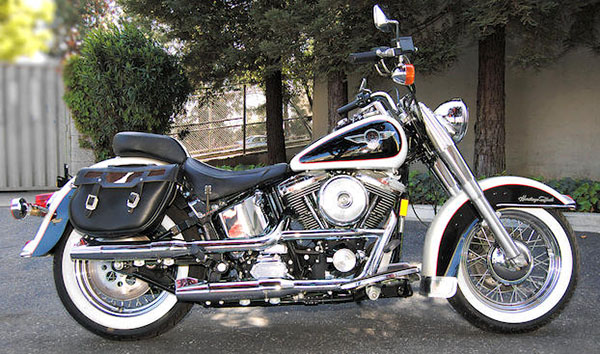
I need to provide some context here, and that entails telling you about two other vehicles. One is what might well be the most beautiful motorcycle Harley-Davidson ever made, and that’s the 1993 Heritage Nostalgia. Quickly dubbed the Moo Glide by whoever did the dubbing in those days, it was a stunning motorcycle. It was essentially a Heritage Softail, but what the Milwaukee maestros did was they painted the thing white with black panels, they dropped the windshield, they made the leather saddlebags smaller, and they left off the windshield.
Harley-Davidson didn’t stop there. The next steps were cowskin inserts on both the saddlebags and the seat, but it just wasn’t a brown leather insert. Nope, it was from whatever breed of cows have that black and white fur, and Harley left the fur on. It worked nicely with the bike’s black and white paint treatment. The motorcycle was stunning.
The 1993 Harley FLSTN, also known as the Moo Glide.
But wait. There’s more. The V-twin virtuosos had Dunlop add a new part number to their catalog, and that made the motorcycle a home run. The Dunlop dudes took the stock Harley blackwalls and added luxurious wide whitewalls. They (whoever “they” was) called them gangster whitewalls. You know, like Al Capone in a V-16 Cadillac or a Duesenberg. The effect was visually arresting. Literally. It stopped me in my tracks the first time I saw a Moo Glide. But I’ll get to that in a second.
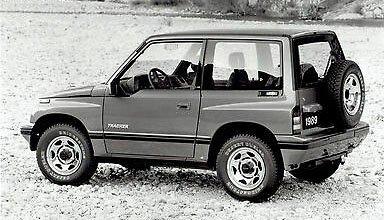
The second vehicle (remember, I said I needed to provide some context here) was my 1989 Geo Tracker. Well, actually, it was made by Suzuki, but GM did their badge engineering schtick and they sold it under the GEO Tracker label.
A 1989 Geo Tracker. Mine looked just like this. It was a great little truck.
I saw the very first one of these to arrive in So Cal at our local Chevy dealer, when I stopped to pick up a radiator hose for another Chevy I owned that needed, well, a radiator hose. I liked the Tracker immediately. It was small (a big plus), it was a 4×4 (that appealed to me), and it was a good-looking little truck. My stop for a radiator hose turned into a new car purchase.
As it turned out, I bought the very first Geo Tracker in southern California, and that got me on an early adopter marketing list. I’ve probably been paid to look at new concept cars from a half a dozen manufacturers maybe ten times over the years, but that’s a story for another time.
To get back to this story, I loved that Tracker and I really racked up the miles on it. That’s sort of the point where I’m going with this story. I got more miles out of a set of tires on that Tracker than any vehicle I’ve ever owned. I was at 78,000 miles on the Tracker’s original tires (Bridgestones, as I recall) and they were still going strong. My wife wanted me to get new tires just because of the miles. The Tracker was a small car, and in 1993, a set of tires just like the ones from the factory were $275. Nah, I told her, I can get another 10,000 miles out of these tires. I wasn’t going to spend $275 for tires if I didn’t need to. Money doesn’t grow on trees, I said, and $275 was a lot of money.
So, let’s get back to the point of this story, and that’s my Harley. I had my ’92 Softail in at Laidlaw’s for a scheduled service, and as I recall, I only had about 2,000 miles on its second set of tires. They were blackwalls, just like the bike came with from the factory. They had plenty of life left in them. But at Laidlaw’s I saw my first Moo Glide and my reaction was Wow!
Jerry Laidlaw saw me eyeing the Moo. He knew I wasn’t going to buy a new motorcycle so soon, but he also smelled blood in the water. “We have those gangster whitewalls in stock,” he said.
“How much?” I asked.
“$350 for the pair,” Jerry said.
I didn’t blink an eye. “Let’s do it!”
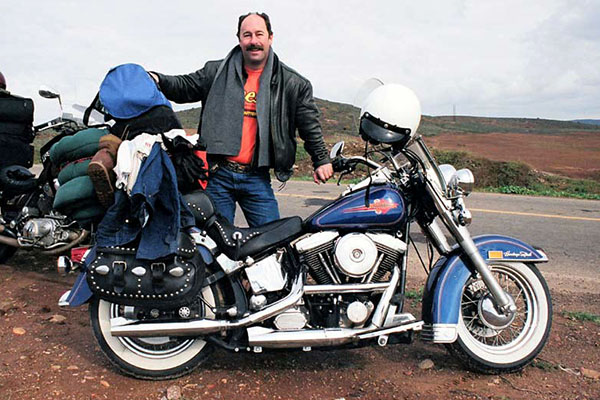
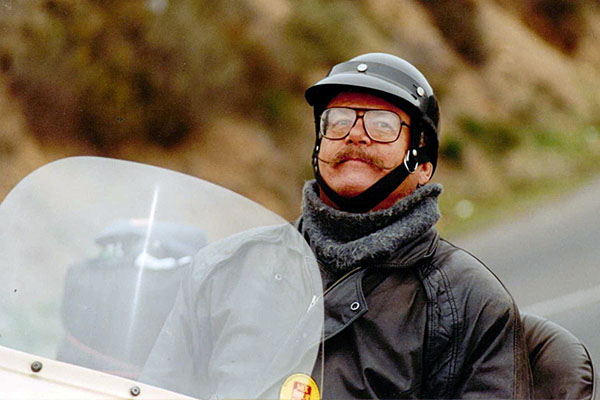
Yours truly, somewhere in Baja in the mid-’90s, proving that helmet hair is a real hazard if you have any hair at all. And yeah, with my gangster whitewalls.
So I had my new Harley, a gorgeous blue ’92 Heritage Softail, and it was a shockingly beautiful motorcycle. Yeah, some of the styling touches were a little hokey, but in a good way. I never even knew what a concho was before I bought the Softail, but I knew after I owned it. I became a Harley-riding cowboy. The conchos made the bike complete. How I ever made it to 40 without conchos I’ll never know. I had them now, though, and they just looked right. My Softail was a fashion statement. It made me look good and it made me feel good. I loved that bike.
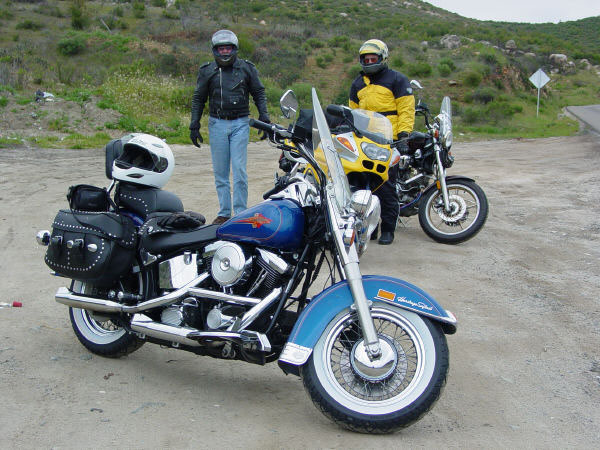
My ’92 Softail on a Baja ride to San Felipe. Good buddies Baja John and Marty rode with me on that one. Those gangster whitewalls? That’s a story for another blog.
There was only one problem, and it was a big one: The Softail was a dawg. It was a 700-lb lump that couldn’t get out of its own way. I’ve already spoken about how unreliable my ’79 Electra-Glide was, but that old clunker would get up and choogy, and it would have walked away from my new ’92 Softail in a drag race. I mean, the thing was slow. When I gave it more throttle going up a hill, it seemed like the only result was a deeper moan. It sure didn’t go any faster.
I worked in El Monte in those days and the nearby dealer was a famous one in southern California, Laidlaw’s, and I felt comfortable with them. I knew Bob Laidlaw, their founder, and I knew his son Jerry, and I knew both to be straight shooters. When it was time for the Softail’s first service at 500 miles, that’s where I went. Laidlaw’s has since moved to a larger, more modern facility in a better neighborhood, I’m guessing at Harley-Davidson’s insistence, and it’s still a great place. But I liked the old location better. Like I described for Dale’s in the last blog about buying my ’92, the old Laidlaw’s facility had that crusty old motorcycle shop schtick, and I liked that. You know, grease on the floor, a funky shop area, and guys who looked like their lives revolved around motorcycles and tattoos. Guys with calibrated arms who knew how much torque to apply to a 9/16 by feel alone.
I went to Laidlaw’s on an overcast Saturday morning for that first service, and Jerry wrote the service order. After completing it, he looked at me and asked: Anything else?
“Yeah,” I said. “The thing’s a dog.”
Jerry smiled. He knew. This wasn’t his first rodeo.
“They lean them out pretty good from the factory,” he said.
“So what do guys do?” I asked.
Another Jerry smile. “Well, most guys get a new cam, punch out the pipes, rejet the carb, and put the Screaming Eagle air filter in.”
“How much is that?” I asked. I could see this smoking past another $1500 without stopping to look back.
“It’s about $500,” Jerry answered. Hmmm, that wasn’t as bad as I thought it would be.
“So how much would everything be,” I said. “You know, the 500-mile service and the cam and carb and pipes and all the rest?”
“It’s $500 for everything,” Jerry answered, “including the 500-mile service.”
I could hardly believe what I was hearing.
“Let’s do it,” I said. I mean, I know a good deal when I see one. I hung around, as Jerry told me the whole thing would be a couple of hours. In the meantime, it had started raining, and I had no raingear. I walked across the street to some sort of an Army-Navy-99-cent store and bought a $3 rain suit.
In those days, it was no big deal to hang around in the service area and watch the techs work on your bike. The guy who was working on mine was a long-haired dude with lots of tattoos and a friendly smile. He held this giant steel toothpick-looking sort of tool that was essentially a ¾-inch-diameter rod sharpened to a point in one hand, and in his other hand he had a sledge hammer. He stuck the persuader into the end of one of my fishtail mufflers and whacked it with the sledge hammer. Then he repeated the process on the other fishtail. With a big grin, he said, “Adios, baffles!”
Then it was the carb work and the air cleaner replacement. And then it was the Screaming Eagle cam, which actually was pretty easy to install in the chrome cone on the right side of the engine. Then he buttoned it all up.
I finished my cup of coffee, donned my el cheapo raingear, paid my bill, and fired up the Harley.
Good Lord!
It was a completely different motorcycle. It sounded way better than it had before the Screaming Eagle cam work and exhaustectomy. It had been transformed from a smothered, anemic, pathetic, wheezing sort of thing into living, breathing, fire-snorting, spirited motorcycle. It reeked raw power and it had attitude. The idle was lopey and assertive, like a small block Chevy with an Isky cam and Hooker headers. My Harley rocked back and forth on its axles with each engine rotation. It was telling me: Let’s go! I think I’m pretty good at turning a phrase and I’m doing my best here, folks, but trust me on this: It’s hard to put into words how complete and total my Harley’s transformation was. It kind of reminded me of the first time I ever threw a leg over a Triumph Bonneville (I was 14 when that happened, and when Laidlaw’s tuned my Softail I was 14 all over again).
So I rolled out into the rain for my 30-mile ride home and I was afraid to whack the throttle open. I thought the rear wheel would break loose on the wet pavement; it felt that powerful. The rain and the clouds, I think, made the Harley’s Exhaust Notes (love that phrase) sound way mo better. I was there, man.
The year was 1991, and the last thing in the world I was thinking about was buying another motorcycle, and within the confines of that thought, the very, very last thought I would have ever had was buying a Harley-Davidson. I had previously owned a ’79 Electra-Glide I bought new in Texas, and that bike was a beautiful disaster. I called it my optical illusion (it looked like a motorcycle). I wrote about the bad taste it left in an earlier blog. Nope, I’d never own another Harley, or so I thought when I sold it in 1981.
My ’79 Electra-Glide Classic, as shown in the 1979 Harley catalog. It was the most unreliable and most beautiful motorcycle I ever owned. I wish I still had it.
But like the title of that James Bond movie, you should never say never again. I was a big wheel at an aerospace company in 1991 and I was interviewing engineers when good buddy Dick Scott waltzed in as one of the applicants. I had worked with Dick in another aerospace company (in those days in the So Cal aerospace industry, everybody worked everywhere at one time or another). Dick had the job as soon as he I saw he was applying, but I went through the motions interviewing him and I learned he had a Harley. DIck said they were a lot better than they used to be and he gave me the keys to his ’89 Electra-Glide. I rode it and he was right. It felt solid and handled way better than my old Shovelhead.
Dick Scott on his ’89 Electra-Glide. The day after I took this photo in Baja, Dick died when he crashed his motorcycle.
That set me on a quest. I started looking, and after considering the current slate of Harleys in 1991, I decided that what I needed was a Heritage Softail. I liked the look and I thought I wanted the two-tone turquoise-and-white version. The problem, though, was that none of the Harley dealers had motorcycles. They were all sold before they arrived at the dealers, and the dealers were doing their gouging in those days with a “market adjustment” uptick ranging from $2000 to sometimes $4000 (today, most non-Harley dealers sort of do the same thing with freight and setup). There was no way in hell I was going to pay over list price, but even had I wanted to, it would have been a long wait to get a new Harley.
One day while driving to work, a guy passed me on the freeway riding a sapphire blue Heritage softail, and I was smitten. Those colors worked even better for me than did the turquoise-and-white color combo. The turquoise-and-white had a nice ‘50s nostalgia buzz (it reminded me of a ’55 Chevy Bel Air), but that sapphire blue number was slick. Even early in the morning on Interstate 10, I could see the orange and gray factory pinstriping, and man, it just worked for me. It had kind of a blue jeans look to it (you know, denim with orange stitching). That was my new want and I wanted the thing bad. But it didn’t make any difference. Nobody had any new Harleys, and nobody had them at list price. I might as well have wanted a date with Michelle Pfeiffer. In those days, a new Harley at list price or less in the colors I wanted (or in any colors, actually) was pure unobtanium.
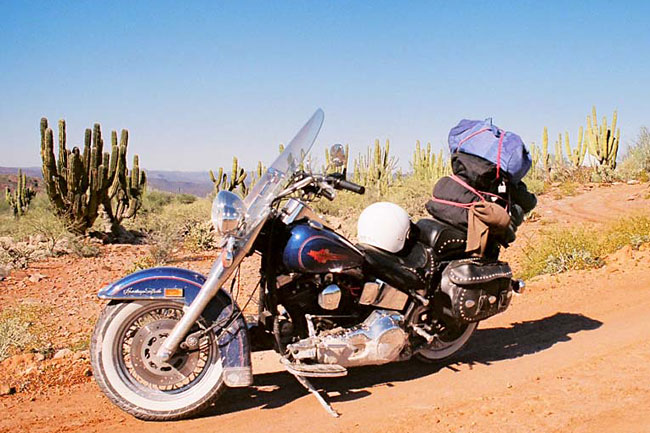
The Harley Softail I bought at Dale’s Modern Harley. I negotiated a hell of a deal. I kept that Harley for 12 years and rode the wheels off the thing. I’ve since learned how to pack a little better.
So one Saturday morning about a month later, I took a drive out to the Harley dealer in San Bernardino. In those days, that dealer was Dale’s Modern Harley (an oxymoronic name for a Harley dealer if ever there was one). Dale’s is no more, but when it was there, it was the last of the real motorcycle shops. You know the drill…it was in a bad part of town, it was small, everything had grease and oil stains, and the only thing “modern” was the name on the sign. That’s what motorcycle dealers were like when I was growing up. I liked it that way, and truth be told, I miss it. Dealerships are too clean today.
Anyway, a surprise awaited. I walked in the front door (which was at the rear of the building because the door facing the street was chained shut because, you know, it was a bad part of town). And wow, there it was: A brand new 1992 Heritage Softail in sapphire blue. Just like I wanted.
Dale’s had a sales guy who came out of Central Casting for old Harley guys. His name was Bob (I never met Dale and I have no idea who he was). Bob. You know the type and if you’re old enough you know the look. Old, a beer belly, a dirty white t-shirt, jeans, engineer boots, a blue denim vest, and one of those boat captain hats motorcycle riders wore in the ‘40s and ‘50s. An unlit cigarette dangled from one corner of his mouth. His belt was a chromed motorcycle chain. I’d been to Dale’s several times before, and I’d never seen Bob attired in anything but what I just described. And I’d never seen him without that unlit cigarette. Straight out of Central Casting, like I said.
“What’s this?” I asked Bob, pointing at the blue Softail.
“Deal fell through,” Bob answered. “Guy ordered it, we couldn’t get him financing, and he couldn’t get a loan anywhere else.”
“So it’s available?” I asked.
“Yep.”
Hmmm. This was interesting.
“How much?” I asked.
“$12,995, plus tax and doc fees,” Bob answered, walking back to his desk at the edge of Dale’s very small showroom floor.
$12,995 was MSRP for a new Heritage Softail back in 1992. That would be a hell of a deal. Nobody else in So Cal was selling Harleys at list price.
I followed Bob to his desk and sat down. I was facing Bob and the Harley was behind me. Bob was screwing around with some papers on his desk and not paying any particular attention to me.
“I’ll go $11,500 for it,” I said.
Bob looked up from his paperwork and smiled.
“Son,” he said (and yeah, he actually called me “son,” even though I was 40 years old at the time) “I’m going to sell that motorsickle this morning. Not this afternoon, not next week, but this morning. The only question is: Am I going to sell it to you or am I going to sell it to him?”
Bob actually said “motorsickle,” I thought, and then I wondered who “him” was. Bob sensed my befuddlement. He pointed behind me and I looked. Somebody was already sitting on what I had started regarding as my motorsickle. That guy was thinking the same thing I was.
“Bob,” I began, “you gotta help me out here. I never paid retail for anything in my life.”
“That’s because you never bought a new ’92 Harley, son, but I’ll tell you what. I’ll throw in a free Harley T-shirt.” I couldn’t tell if he was joking or if he was trying to insult me, but I didn’t care.
I looked at the Harley again and that other dude was still sitting on it. On my motorcycle. And that’s when I made up my mind. $12,995 later (plus another thousand dollars in taxes and doc fees) I rolled out of Dale’s with a brand-new sapphire blue Harley Heritage Softail. And one new Harley T-shirt.
Television in the mid-1960s was nothing if not predictable. As we watched the shadows on the wall, behind us society was undergoing dramatic change. The old ways were failing, cracks formed in the smooth, comforting facade. Bit by bit it was revealed that whoever was in charge was not being entirely truthful. One of the first television shows to reflect our growing national cynicism was The Monkees: Four longhaired kids who respected neither the camera nor the situation comedy process. The Monkees broke the fourth wall so many times you felt like you were on set with them.
My favorite Monkee episode (because of the motorcycles) opens with Micky Dolenz singing Going Down. Micky was the drummer and the best singer in the band and he nails Going Down’s proto-rap feel. From there, the show falls apart beautifully with motorcycles, a chalkboard Hog reference, dust and pretty girls beating up The Monkees.
Amid typical Monkee chaos in walks The Black Angels biker gang featuring a leader who just wants to destroy somebody. 50 years ago the cliché biker image was so embedded in our culture that all it took was a black jacket to signify a hoodlum. Harley Davidson has mined that image right up to today, creating an entire sub-set of true believers. The rest of us modern motorcyclists with our high-tech, high-vis monkey suits look more like school crossing guards.
The monkees form their own biker gang called The Chickens and during a race between the bad guys more cinema magic is revealed. There is a plot to all this but it’s mostly there to keep the boys from walking off the set. At the end of the show peace and love is restored, Triumphs and Harleys get along together and you’re filled with hope for the future.
This was situation comedy television unlike any that came before. It was random. It exposed the fakery. Jack Benny’s old TV show was The Monkees spirit guide. After 2 years the Monkees show was cancelled. The Monkees became a real band and had many hits written and preformed by themselves. Which just goes to show you that living a lie sometimes leads to success.
Ah, lots of good news and a few things to catch up on. For starters, I was alerted to another top notch motorcycle site, and that’s Terry Roorda’s ScooterScribes.news site. You’ll like it.
Terry is the former Thunder Press editor, and there’s lots of cool V-Twin stuff on ScooterScribes, and you don’t have to be a Big Twin dude or dudette to appreciate it. It’s good. Trust me.
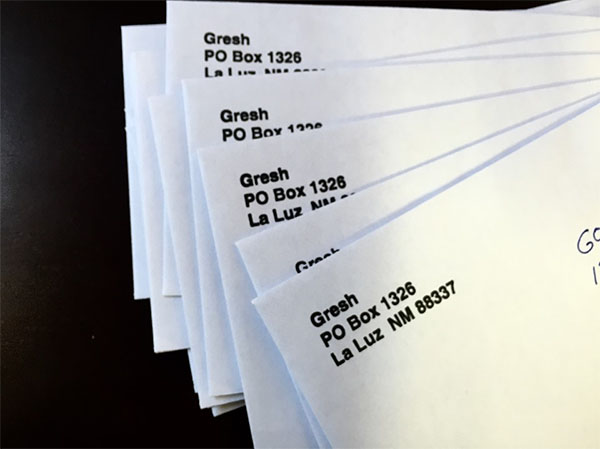
More good news…the ExNotes stickers are in, and the extensive Direct Mail arm of the ExNotes empire is busy sending them out.
We sent an email requesting your address if you signed up, so watch for it and shoot that info back to us. We promise that as soon as we get your snail mail address and confirmed that you’re on our email list, we’ll shoot them out to you as soon as we get around to it. Want to help us more? Hey, share our site and get more folks to sign up for our automatic emails, or just get them to visit www.ExhaustNotes.us. We think we’ve got a good thing going. Guns, motorcycles, scooters, opinions, dream bikes, resurrected bikes, books, articles, Baja, and lots, lots more. Let us know what you think by posting your comments here on the blog. We get all kinds of inputs. Folks want more on Harleys, they want less on Harleys, they want more political commentary (seriously?), they want less political commentary…hey, let us know. There’s no guarantee we’ll take any of it seriously, but you never know.
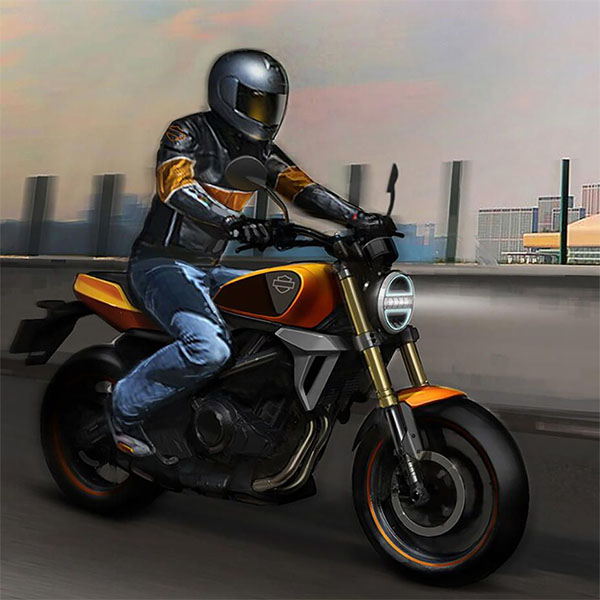
Yet more news…several online pubs are breaking the news that Harley is working with a Chinese company to offer a small HD.
Hey, we saw a Chinese manufacturer making parts for Harley a decade ago. But the recent news is this is going to be a complete small bike, just over 300cc. I’m surprised Harley didn’t do this several years ago, but then, Gresh and I were in the catbird’s seat on the small bike thing from the gitgo. CSC and Zongshen were way ahead of the curve on this one. Dollars to donuts says that the small Harley will find its way to the US, and that’s a good thing. I’ve seen the photos and I think it looks good. I’m waiting for the inevitable jokes and the anti-China rants to start, but Harley, if you’re reading this, ignore those folks. The only thing worse than a smartass is a dumbass, and anyone who criticizes a motorcycle based solely on its Chinese origin is most definitely in that latter category.
One last bit of news…make sure you pick up the latest issue of Motorcycle Classics magazine. It’s got my feature story on our Enfield Baja trip, and my Destinations piece on Tecate. Good stuff, Motorcycle Classics is.
Glenn sent me a few photos from the old days and one that got my attention was a shot of us building a Sportster in the living room of the shack we used to live in. Having a living room to work in was a luxury because prior to renting the shack I was homeless. I had an old Chevy truck with a bench seat that I could stretch out enough to get some sleep and I had a job that let me take a dry bath in the restroom after work. But when Admiralty Marine closed its doors for the evening I was on my own until the next morning. The boss let me know that the situation couldn’t go on forever and that I really needed to find a place to live.
It wasn’t so much lack of money. I was working a lot of hours, but I was only 19 and landlords didn’t want to rent to a greasy, punk kid. I can’t blame them. I would do the same thing myself. Finally a co-worker who was a full-fledged adult vouched for me when his landlord had a vacancy next door. I shaved, dry-bathed, put on clean clothes and did everything I could do to look like a respectable young man with a future. I’ll be dammed if it didn’t work. I was in after paying first, last and a deposit. Cash.
After waiting for the dust to settle the first thing I did was to rebuild my Sportster in the living room. When I bought the 1968 Sportster I was kind of shocked at how archaic the motorcycle felt. It was cool and all but the front end was so wobbly it felt like silly string and the front brake might as well have been deleted and an AM/FM radio installed in its place for all the stopping it would do.
The engine seemed to run well but I was going to ride across country on the thing, so a freshen-up was in order. I don’t know if it was a good idea because the 900cc V-Twin had some strange things going on inside and I was destined to do even more stupid stuff to the poor bike.
Someone had replaced the stock Harley intake valves with huge, unknown-origin valves. The valves were so big they had to cut the seat into the dome of the combustion chamber. Once the giant valves were removed the old seats were revealed along with the stock porting. The only advantage I could see to the big valves was a bump in compression ratio due to the valves occupying more space in the combustion chamber and the circumference increase giving slightly more flow when the valve first popped open. Once into the lift though the stock ports would probably be the limiting factor.
I wasn’t having any of it. I bought standard Harley valves and guides and set about putting things right. Admiralty Marine had a Sioux valve grinding kit so I could do all the work myself. After the seats were re-cut to fit the new valves the installed height was wrong so I had to trim the ends of the valves and shim the springs. The heads were a mess.
The Sportster’s high dome pistons were ok so a quick hone job and a set of rings finished off the top end. After that you’d think I’d leave the engine alone but I had to have a tin primary cover like the XR750 flat trackers ran.
Opening and consuming a whole ‘nother can of worms, I had to get rid of the crankshaft’s spring and ramp style compensating sprocket. The compensating sprocket absorbs the 45-degree V-Twin’s power pulses before sending smooth, less spikey power on to the clutch basket, gearbox and rear sprocket. This vital part stuck out way toofar for my tin primary so into the trash it went.
A solid front sprocket was fitted to the crankshaft and the tin primary would still not fit so I had to make a 3/8’ aluminum spacer the same size and shape as the primary cover gasket. The ’68 XLH was electric start but I wanted to eliminate as much weight as possible. At an independent Harley shop I swapped the starter motor, big battery box and oil tank for a kick-start shaft, gears and kick lever. You can anticipate the next problem: the electric-start primary case had a square-ish hump on the back to accommodate the starter Bendix. I had to weld a flat metal part onto the tin primary to cover the hole.
Without an XLH-style starter motor there was another gaping hole on the other side of crankcase. I blanked off the hole where the electric starter fit with a large chunk of angle aluminum that doubled as a battery box for the much smaller kick-only battery. Now the engine was ready to slot back into the frame. And that’s yet another can of worms I’ll write about later.
Want to get a free ExhaustNotes decal? Just sign up for our free email notifications!
In San Diego I lived across the street from a Safeway food market. Man, I never ran out of anything. That Safeway is now a West Marine boat supply store. They got nothing to eat in the whole damn place. But back then, around 1980, it was a great food source.
In my pad I had a tiny refrigerator with one of those wine-in-a-carton things inside. My buddy Mark found it in the road, not far from the house. Nobody I knew drank wine, or at least that wine. There was a perforated cardboard section that you knocked out and inside was a hose that connected to the plastic sack of wine. It was practical as hell, like a battery acid container. The hose had a shut off thingy, you kind of rolled the shut off onto a ramp until it pinched the hose closed. The wine tasted bad. Maybe it got hot in the sun out in the street. No telling how long it was there before Mark found it. Whenever anyone would drop by I’d ask if they wanted some wine, that’s what adults do. It was still in the fridge a few years later when I moved away.
I’d leave my one bedroom, one bath rental house on Point Loma’s Locust Street around 5pm. My bike was a 1968 electric-start XLH Sportster converted to kick start. Because electric kickers are for Honda riders, man. From Point Loma I’d reel onto Interstate 5 and roll the throttle on, lane splitting for 15 miles to Gene’s house in Mira Mesa. Back then every subdivision in San Diego sounded like one of the wooden sailing ships that discovered America: The Nina, The Rancho Bernardo and The Santa Antiqua. I guess they still name California things that way. Streets are Calles or Avenidas. Townhouses are called Don Coryells, after a football coach.
Gene had a 1973 Sportster, the one with the crude looking steel bar bent into a U-shape to secure the top shock absorber mounts. The result of AMF cost cutting. My older Sporty had a beautiful cast part welded into the frame tubes performing the same function. You couldn’t see either one once the seat was installed but I knew it was there. Gene knew it too. Gene was my wing man, my BFF. We used to drink in bars and shoot pool after work. It was nothing to stay up late at night, I only needed a few hours sleep. In those years Harley-Davidson motorcycles had a terrible reputation. Their riders were no prize either. We liked the way the bikes sounded and the way they looked.
California traffic was just as bad in 1980 as is today. We lane split all the way to Oceanside where the northbound traffic would thin out for 30 miles or so then lane split to the 405 and past the “Go See Cal” auto dealership. Cal’s dog Spot was a lion. He was featured in Worthington Ford television ads. It was nerve wracking bumper to bumper riding all the way til dusk and the exit for Ascot park Raceway.
I saw my first Ducati Darmah in the parking lot at Ascot. It was the most beautiful bike I’d ever seen. The squared off crankcases were works of art. Our iron-head Harleys looked like civil war relics next to the Darmah. Like Genus Rattus, man. I didn’t envy the Ducati. I was still a hard core Harley guy. Pretty don’t mean nuttin’ to us. Fast, reliable motorcycles are for the weak. I still feel that way.
I may have this wrong but Ascot held two AMA Grand National races each year. Every race I went to was advertised as the final race because the track was closing to be sold. This went on for 12 years until the track really did sell. One National was a standard flat track race and one National was a TT, which is a standard FT track with a bump and a right hand turn. Usually by the time Gene and I got up there the heat races had already started.
Ascot wore its years well. The stands were uncomfortable and crowded. AMA Nationals are big deals. The restrooms were dungeons. We would eat bad food and drink beer and watch the best racing anywhere until 11pm at night. Being part of the hundreds of motorcycles leaving Ascot was a real thrill. The riders were fired up from the racing and we rolled it on to 405 and then 5 to the El Toro Road exit and the Bob’s Big Boy restaurant. Bob’s was a tradition for AMA Nationals. The burgers were small and nearly tasteless, the little triangle salads were frozen and the fries were thin as shim stock. Bob’s was a good place to feed your Genus Rattus.
Because we were riding so late, no matter what the time of year it was always cold on the way home from Ascot. Long, empty stretches of interstate 5 stuffed each gap in your leather jacket with a chilling, low hanging fog. The cold would quiet your mind. Focus on your breathing now, keep still, those iron engines loved the cold. I could see Gene’s Sportster chuffing away in the dark, tiny glints of chrome primary case flashed in sync with my wobbling headlight. Both our Sportsters ran straight pipes and Interstate 5 sounded like the back straight of Ascot. Except we never chopped the throttle.
South of La Jolla the air temperature would rise and dropping off 5 onto Rosecrans Street wrapped sea-warmth around my body. I loved that part of the ride. The shivering was over, I could smell ocean smells. My muscles relaxed. This early in the morning Rosecrans is deserted, I have to run the red lights because the sensors in the pavement cannot pick up motorcycles. The only sound is my 900cc Sportster slowly rowing through the gearbox, rumbling home.
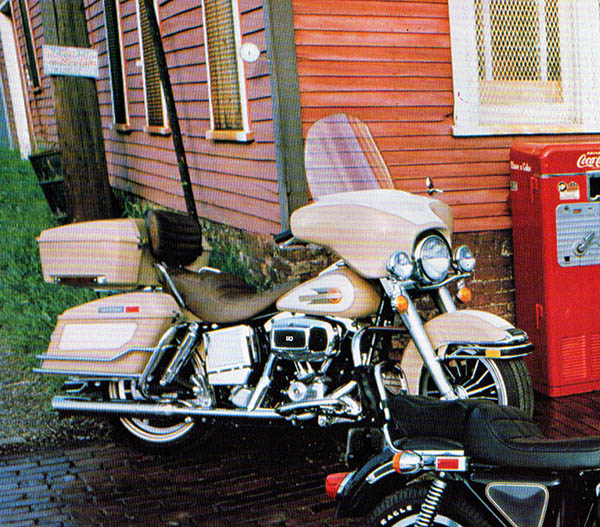
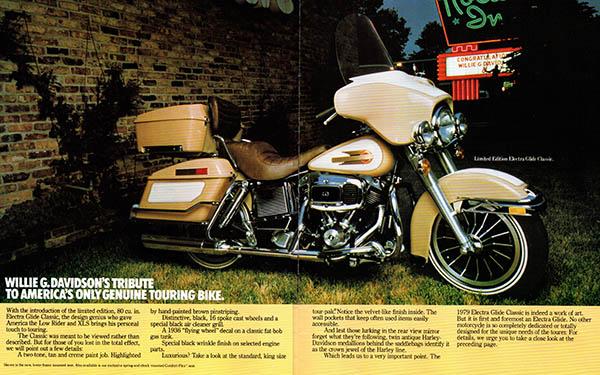
The Harley Electra-Glide Classic, as seen in Harley’s 1979 sales brochure.
It was beautiful, it was something I always dreamed about owning, and I couldn’t ride a hundred miles on it without something breaking. I paid more for it than anything I had ever purchased, I sold it in disgust two years later for half that amount, and today it’s worth maybe five times the original purchase price. I wish I still had it. I’m talking about my 1979 Harley-Davidson Electra-Glide, of course. That’s the tan-and-cream motorcycle you see in the photo above, scanned from my original 1979 Harley brochure. The motorcycle is long gone. I had the foresight to hang on to the brochure.
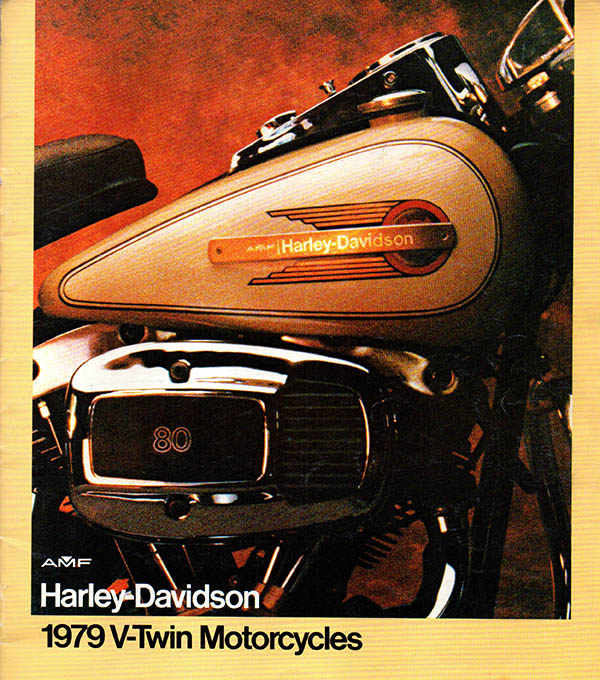
All of the photos in this blog are from that brochure. I wasn’t into photography in those days, but I wish now that I had been. The Harley’s inability to go a hundred miles without a breakdown notwithstanding, I hit a lot of scenic spots in the Great State of Texas back in 1979. The Harley’s colors would have photographed well. The only photo I can remember now is one of me working on the Harley with the cylinder heads off. It seems that’s how the Harley liked to be seen. But I’m getting ahead of myself.
The 1979 Harley brochure cover.
So the year was 1979, I was young and single, and I was an engineer on the F-16 at General Dynamics in Fort Worth doing the things that well-compensated, single young guys did in those days: Drinking, riding (not at the same time), chasing young women, and dreaming about motorcycles. If you had mentioned gender-neutral bathrooms, man bun hairstyles, a universal basic income, democratic socialism, sanctuary cities, the Internet, or something called email in those days (especially in Texas), no one would have had any idea what you were talking about, and if you took the time to explain such things, you would have been run out of town after being shot a few times. Texas in 1979 was a good time and a good place.
I stopped often at the Fort Worth Harley dealer, and Harley was just starting to get into the nostalgia thing. I had sold my ’78 Bonneville and I had the urge to ride again. Harley had a bike called the Café Racer and I liked it a lot, but I took a pass on that one. Then they introduced the Low Rider and I loved it, but when sitting on the showroom Low Rider I turned the handlebars and one of the handlebar risers fractured (Harleys had a few quality issues in those days). Nope, it wouldn’t be a Low Rider. Then they introduced the Electra-Glide Classic, that stunning bike you see in the photos here. It was a dagger that went straight to my heart. I was stricken.
The Electra-Glide Classic was Harley’s first big push into the nostalgia shtick and it stuck. At least for me it did. My first memory of ever being stopped dead in my tracks by a visually-arresting motorcycle was with a Harley Duo-Glide full dresser when I was a kid (it was blue and white), and the Classic brought that memory home for me. The Classic’s two-tone tan-and-cream pastels were evocative of the ‘50s, maybe a Chevy Bel Air (even though those were turquoise and white, a color Harley later adopted in the early ‘90s with its Heritage Softails). The whole thing just worked for me. I had to have it.
I sat on the Classic and it was all over for me. I fell in love. I knew at that instant that I was meant to be a Harley man. I turned the handlebars and nothing broke. There was a cool old sales guy there named Marvin, and I asked what the bike would cost out the door. He already knew the answer: $5,998.30.
A two-page spread featuring the bike I bought.
Hmmm. $5,998.30. That was a lot of money. I was riding around in a new CB-equipped Ford F-150 that had cost less than that amount (hey, it was Texas; Breaker One Nine and all that). My internal struggle (extreme want versus $5,998.30) was apparent to old Marvin.
“You know you want it,” Marvin said, smiling an oily, used-car-salesman, Brylcreem smile (these guys all went to the same clothing stores and barbers, I think). “What’s holding you back?”
“I’m trying to get my head wrapped around spending $6,000 for a motorcycle,” I said.
Marvin knew the drill. He was good at what he did. He probably made a lot more money than I did.
“Are you single?” he asked.
“Yep.”
“Working?”
“Yep.”
“Got any debt?”
“Nope.”
“So what’s your problem?”
“It’s like I said, Marvin,” I answered. “I’m trying to justify spending six grand on a motorcycle.”
“You’re single, right?”
“Yep.”
“Well, who do you need to justify it to?”
And, as Tom Hanks would say 30 years later in Forrest Gump, just like that I became a Harley rider.
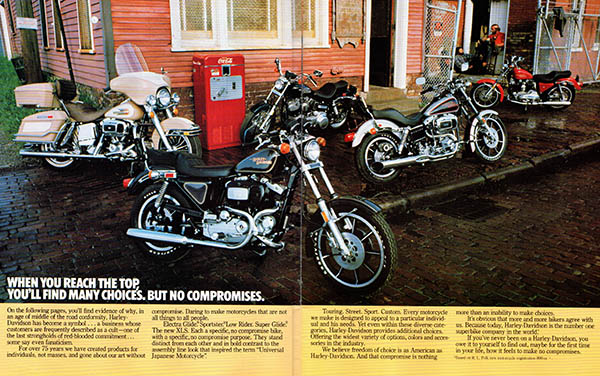
Another two-page spread in the ’79 brochure, showing the entire Harley line. They were beautiful motorcycles.
Yeah, the bike had a lot of quality issues, the most bothersome being a well-known (after you bought one, that is) tendency for the new 80-cubic-inch Shovelhead valves to stick. I first stuck a valve at around 4,000 miles (all of a sudden my Classic was a 40-cubic-inch single, and Harley fixed it on the warranty). I asked Marvin about that, and the answer was, “Yeah, this unleaded gas thing don’t work too good with the new motors. Put a little Marvel Mystery Oil in each of the tanks, or maybe a dime’s worth of diesel, and you’ll be okay…”
Seriously? Marvel Mystery Oil? Diesel fuel?
But I wanted to be good guy, and I did as directed. It wasn’t enough. A valve stuck again at 8,000 miles, Marvel Mystery Oil and that dime’s worth of diesel notwithstanding. Another trip to the dealer, and another valve job. I could see where this was going. The bike had a 12,000 mile warranty.
“So, Marvin,” I began, “what happens the next time a valve hangs up?”
Marvin smiled a knowing smile. “It all depends which side of that 12,000 miles you’re on.” Somehow, Marvin’s Texas accent made it not hurt as much.
Sure enough, at 12,473 miles, a valve stuck for a third time. This one was on me. I pulled the heads, brought them to the dealer, and paid for that valve job. You know, you can just about fix anything on a Harley with a 9/16 wrench and a screwdriver. It was easy to work on. But it wasn’t just the valves sticking. The rear disk brake had problems. The primary cover leaked incessantly. And a bunch of other little things. I’m not kidding. The mean time between failures on that bike was about a hundred miles, and I’d had enough. I called the bike my Optical Illusion. It looked like a motorcycle.
One other thing about the Harley sticks out. I took it with me when I moved to California, and at one of the dealers one of the many times when it was in for service, the dealer’s mascot did what I suddenly realized I had wanted to do. That mascot was a huge, slobbering St. Bernard. It sauntered over to my bike and took a leak on the rear wheel. “Oooh, better hose that down,” the service manager said. “That will eat up the aluminum wheel.” I had to laugh (hell, everyone else was) as the guy sprayed water from a garden hose all over the bike. That dog had beat me to it. He did what I had felt like doing the entire time I owned the bike. The kicker is that even though the service manager sprayed the bejesus out of the bike in a vain attempt to remove all traces of the St. Bernard’s territorial claims, it was all for naught. From that day on wherever I went if there was a dog within a hundred yards, it did the same thing. My Harley was a two-tone tan-and-cream traveling fire hydrant.
Good Lord, though, that Harley was beautiful. Park it anywhere and it would draw a crowd. Half the people who saw it wanted a ride, and if they were female I was happy to oblige. It was big and heavy and it didn’t handle worth a damn, but it sure was pretty. The only time I almost crashed I was riding through a strip mall parking lot admiring my reflection in the store windows. That’s how good-looking it was. I wish I kept it.
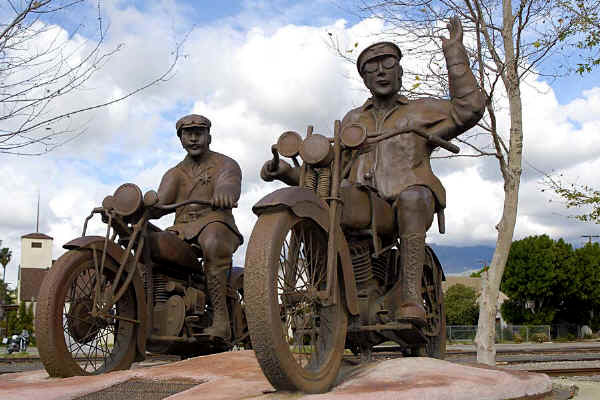
Check out these two men and what they did almost a century ago…folks, you couldn’t make a movie this exciting!
The monument above (The Warning, sculpted by Eric Richards) was erected in 2003 in Santa Paula, California, to mark a heroic evening in 1928. Motor Officers Thornton Edwards (on the Indian) and Stanley Baker (on the Harley) were on duty the evening of March 12, 1928, when California experienced the second worst disaster in the state’s history. The recently completed St. Francis Dam, 36 miles upstream in Santa Clarita, collapsed shortly after midnight.
The collapse released 52 billion gallons of water, and that water was headed directly toward Santa Paula. The Santa Paula Police Department learned of the impending danger shortly after the dam broke. Thornton and Baker spent the next 3 hours riding their motorcycles throughout Santa Paula, notifying residents and evacuating the town. Thornton worked for the State Highway Department, which later became the California Highway Patrol. Baker was a Santa Paula Police Department Officer. Although the records from this era are sketchy, legend holds that Thornton’s bike had to be repaired during his midnight ride when it ingested water. As a result of these two officers’ actions, the residents of Santa Paula were successfully evacuated, and few Santa Paula residents died that night.
The water released by the dam (the reservoir had just filled, and the poorly-designed dam was not strong enough to contain it) mixed with mud and debris to form a wall of slurry that advanced 54 miles to the ocean at about 12 miles per hour. The disaster killed an estimated 470 people, and to this day, it is the second worst disaster in California history. Only the San Francisco earthquake resulted in more death.
The Warning contains no mention of either motor officer’s name; rather, it is intended to honor all acts of heroism, and to honor those killed during the St. Francis Dam collapse. If you head through downtown Santa Paula, The Warning is hard to miss. It’s worth a trip to Santa Paula just to see it.
Special thanks for the above research to Peggy Kelly, a reporter for the Santa Paula Times, whom I interviewed for the above information.
I guess more financial mags are zeroing in on Harley-Davidson’s plans to introduce an electric motorcycle. You saw our post a week or so ago about The Motley Fool and their thoughts on the Livewire. Barron’s, another financial newspaper/advisory service, similarly reported on Harley’s woes but with a twist. This most recent Barron’s article strongly recommended that either Harley move into manufacturing pickup trucks, or allow itself to be acquired by Ford. Yeah, that’s right. Ford. The car company.
Ford has already produced F-150 pickups with Harley trim packages (seriously, I can’t make up stuff this good) and they are reintroducing a $100K Harley-themed truck for 2019…
Barron’s reasons that Harley’s brand recognition could help Ford (a company who’s stock price has been tanking for years). The Barron’s article actually recommends Harley as a buy (the stock, not the motorcycle), with a target price of $50 per share if such an acquisition occur (i.e., Ford buying Harley). Seeing as Harley stock (symbol HOG) is currently about $35 per share, Barron’s reasons that could be a wise investment if Ford acquires Harley (which I don’t think will ever happen).
I’m watching all of this in stunned silence. Well, nearly stunned silence, except for the tapping of my laptop’s keyboard as I whip out this blog. $35,000 electric motorcycles. Harley-badged $100,000+ Ford pickup trucks, which presumably will sell to folks whose judgement, common sense, and sobriety has to be questioned. Financial advisors recommending buying Harley stock because if Ford (a company with terrible stock performance) buys Harley (another company with terrible stock performance), the Harley stock price will go up (while Harley’s business has been tanking in a dive so steep they may not be able to pull out of it). Got it. Right.
My take on all of this? It’s hard to take it all in, let alone understand most of it. Your thoughts? Let’s hear them!
Never miss an ExNotes blog…just sign up for our automatic email notifications. We’ll never give your email to anyone else, and you’ll automatically be entered in our quarterly adventure moto book giveaway drawing!
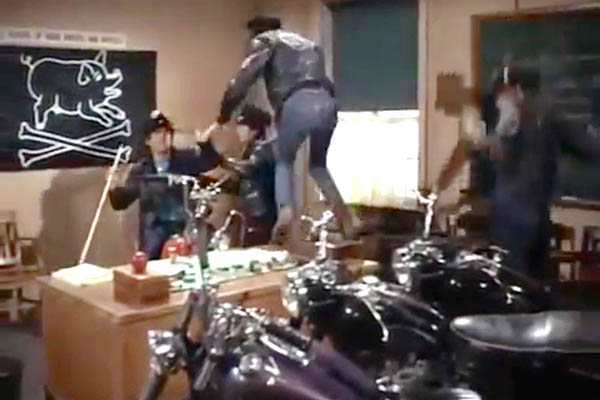 My favorite Monkee episode (because of the motorcycles) opens with Micky Dolenz singing Going Down. Micky was the drummer and the best singer in the band and he nails Going Down’s proto-rap feel. From there, the show falls apart beautifully with motorcycles, a chalkboard Hog reference, dust and pretty girls beating up The Monkees.
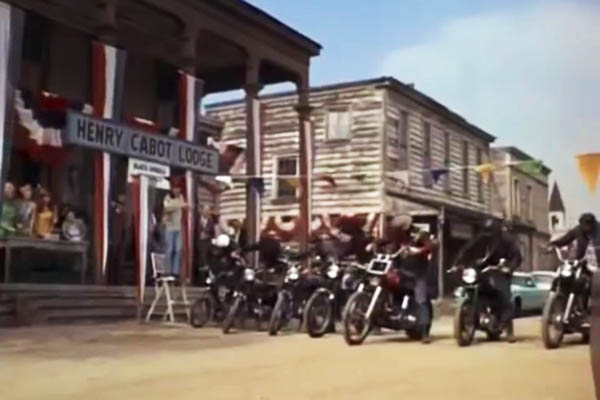 The monkees form their own biker gang called The Chickens and during a race between the bad guys more cinema magic is revealed. There is a plot to all this but it’s mostly there to keep the boys from walking off the set. At the end of the show peace and love is restored, Triumphs and Harleys get along together and you’re filled with hope for the future.
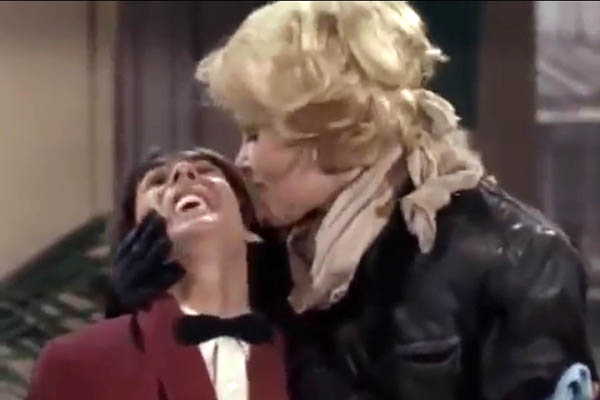 This was situation comedy television unlike any that came before. It was random. It exposed the fakery. Jack Benny’s old TV show was The Monkees spirit guide. After 2 years the Monkees show was cancelled. The Monkees became a real band and had many hits written and preformed by themselves. Which just goes to show you that living a lie sometimes leads to success.
 Terry is the former Thunder Press editor, and there’s lots of cool V-Twin stuff on
 We sent an email requesting your address if you signed up, so watch for it and shoot that info back to us. We promise that as soon as we get your snail mail address and confirmed that you’re on our email list, we’ll shoot them out to you as soon as we get around to it. Want to help us more? Hey, share our site and get more folks to sign up for our automatic emails, or just get them to visit
  Hey, we saw a Chinese manufacturer making parts for Harley a decade ago. But the recent news is this is going to be a complete small bike, just over 300cc. I’m surprised Harley didn’t do this several years ago, but then, Gresh and I were in the catbird’s seat on the small bike thing from the gitgo.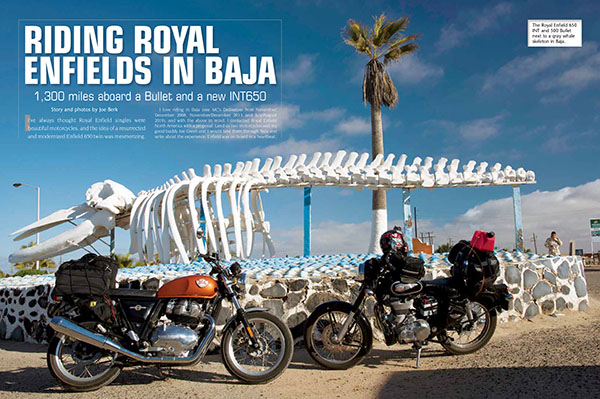
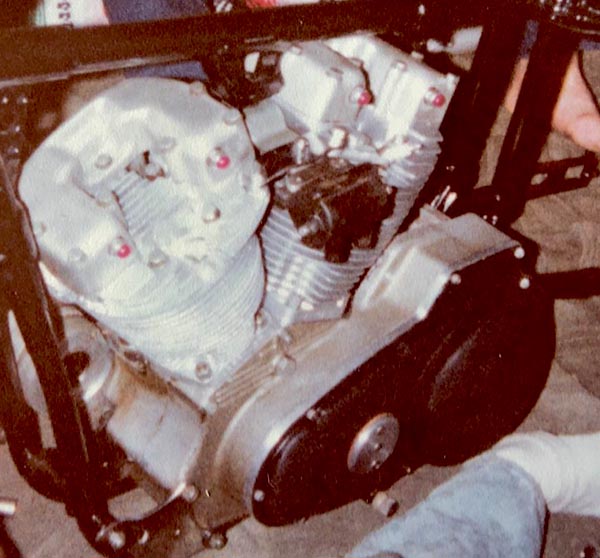 Glenn sent me a few photos from the old days and one that got my attention was a shot of us building a Sportster in the living room of the shack we used to live in. Having a living room to work in was a luxury because prior to renting the shack I was homeless. I had an old Chevy truck with a bench seat that I could stretch out enough to get some sleep and I had a job that let me take a dry bath in the restroom after work. But when Admiralty Marine closed its doors for the evening I was on my own until the next morning. The boss let me know that the situation couldn’t go on forever and that I really needed to find a place to live.
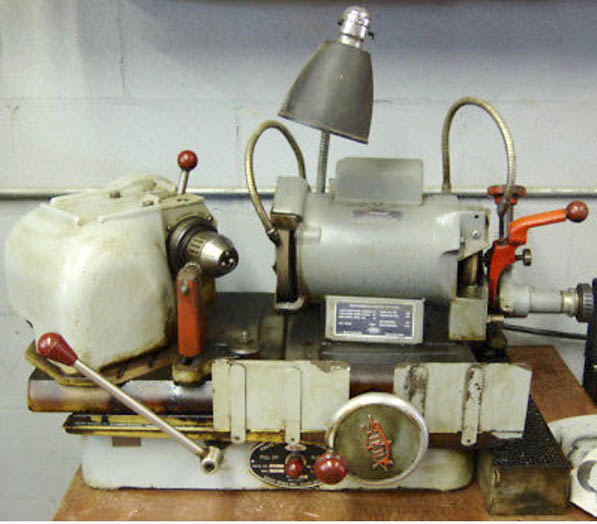 The Sportster’s high dome pistons were ok so a quick hone job and a set of rings finished off the top end. After that you’d think I’d leave the engine alone but I had to have a tin primary cover like the XR750 flat trackers ran.
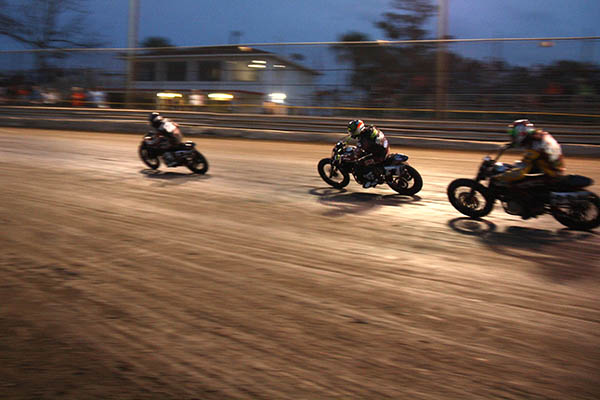 In San Diego I lived across the street from a Safeway food market. Man, I never ran out of anything. That Safeway is now a West Marine boat supply store. They got nothing to eat in the whole damn place. But back then, around 1980, it was a great food source.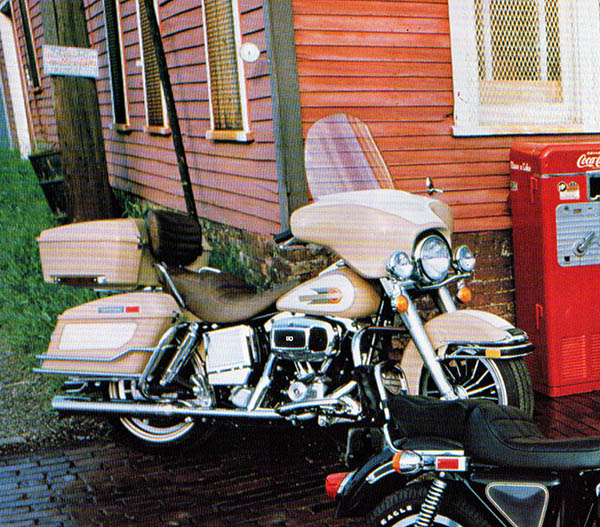
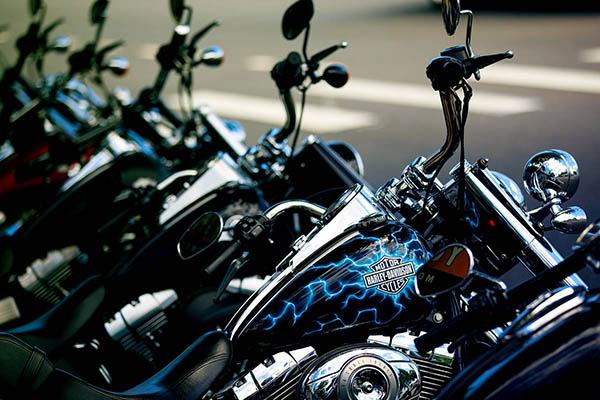 I guess more financial mags are zeroing in on Harley-Davidson’s plans to introduce an electric motorcycle. You saw our post a week or so ago about The Motley Fool and their thoughts on the Livewire. Barron’s, another financial newspaper/advisory service, similarly reported on Harley’s woes but with a twist.