Good buddy Juan, who showed me a grand time riding in Colombia, recently posted this video. I don’t speak Spanish, but I didn’t need to. The riding scenes brought back fond memories of the Colombia adventure…
The video features a new AKT Motos bike. AKT is a fine company; one of the four big ones manufacturing motorcycles in Colombia. I know Enrique, the General Manager, and he was a most gracious host during our visit. Good times. I sure miss Colombia.
The ExhaustNotes post today has two videos, and both are from Janus Motorcycles.
Janus checks all of the boxes for us: Small displacement, custom crafted, ultra-high quality, hand-built-in-America motorcycles. What I found especially intriguing is that one of the Janus founders, Richard Worsham, rode his 250cc motorcycle across the United States. That, my friends, is extremely cool (it’s downright inspirational, in my opinion). It grabbed my attention because long trips on small-displacement motorcycles to demonstrate reliability is one of the things we did when I was at CSC Motorcycles. It’s a brilliant strategy.
We’ll be telling you more about the Janus line in the future, but one of the things I’ll mention up front is that Janus uses an overhead valve CG-clone engine, which is probably the most-frequently-used engine on the planet. My experience with these engines has been that they are bulletproof, and I say that because I’ve put tons of miles on them. They’re easy to maintain, as they should be. That’s what Honda had in mind when they designed the CG engine.
So, enough yakking. Let’s get to the videos. First, the ride across the United States…
And here’s another one about the Janus culture, and the inspiration for their motorcycles…
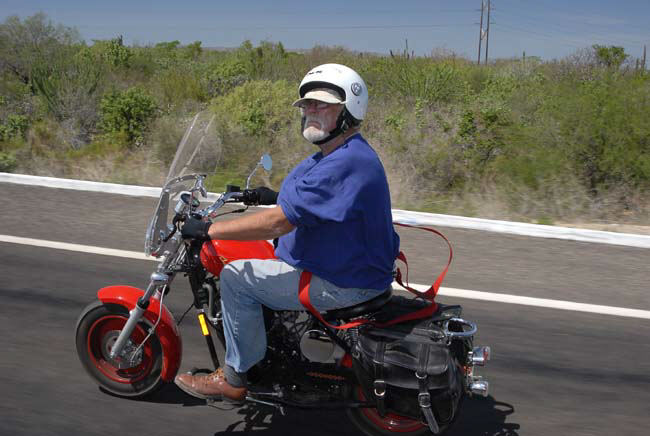
That’s my good buddy Bill in the photo above, at speed, riding the Lake Erie Loop, a 600-mile scooter endurance rally. I first met Bill shortly after starting the CSC blog. Bill is a retired firefighter who is a serious Iron Butt rider, and he wanted a CSC scooter to ride in the Lake Erie endurance event back in those days. We were only too happy to oblige.
Yesterday, I received a nice note from Bill, and I want to share it with you…
Joe:
I’ve just registered for the Distinguished Gentleman’s Ride, a fundraising motorcycle ride to help beat prostate cancer. You’re receiving this because you happen to be in my phone directory and because you know what a fanatic I am about riding. This year’s ride is on September 30th and, ironically, my birthday is on September 29th. Now, I know you were going to send me some kind of gift (nudge nudge, hint hint), but in lieu of that, I’d prefer that you make a nominal donation in my name for this great cause. Or, better yet, join me on the ride. To do either (or both) go to www.gentlemansride.com/fundraiser/WilliamMurar227980
Thanks, Ride Aware, Bill
Bill, that’s awesome! Thanks for writing and we’re only too happy to post your request here on the ExNotes blog. How about it, folks…let’s help Bill in this most noble cause!
Highway 41. Falling safes and ACME dynamite country. Beep beep!
Highway 41 runs from the Gran Quivira ruins to Highway 380. Forty miles of easy dirt, (unless it rains), the road really doesn’t go anywhere I need it to go but I still take the route if I’m going north/south to Santa Fe and have time to kill. I have lots of time to kill.
The consequences of not keeping your rig in shape?
There are old ranches in New Mexico. This dry land requires thousands of acres to support cattle or whatever hybrid, cactus-eating animals they raise out here. Access to these ranches is via roads like 41. The road cuts through warning signs and fence lines working its way past lonely muster stations that no longer thunder with the sounds of hooves and bellowing cattle. Time continues to function out here, hour by hour degrading nails and planks, erasing the best efforts of past generations. It’s a bygone landscape that appeals to a kid raised on a steady diet of Road Runner and Wiley Coyote cartoons.
Highway 41. The red pin is Gran Quivira.
I’d like to think I could have made a stand out here, been a solitary man roping and fence-mending in the bitter wind of a New Mexico winter, surviving by my wits and taming this vast, high desert. I would have mail ordered rockets and catapults from ACME, the cartoon version of Amazon. I’d build windmills and log cabins. I’d eat snakes and shoot quarters out of mid-air with a six-gun that I took out of a dead man’s holster. Then I’d write a Rustic’s poem about the dead man titled, “His Noted Life Was Not In Vain.” I’d have all the trappings of America’s western lore and I would have shouldered it in stride. A life without comfort or ease would be met with a steely-eyed stoicism that concealed deep emotions surging through my fully realized cowboy-self.
A time gone by.Bring it on, and I’ll still be standing!
Highway 41 is remote, the kind of road that makes you worry about tires or if you have enough water. There’s no cell phone reception and you’ll want your rig in top shape to travel out here. I keep my rig in just-above-collapse shape. Clapped out with three broken engine mounts appeals to my cowboy-self. After climbing a small ridge, 41 becomes increasingly populated by ghosts. Bent and weathered power poles spread their arms, holding nothing. I should have brought more water and a jar of peanut butter.
If you have the time, and the back road leads somewhere you don’t really need to go, I recommend taking Highway 41. There’s adventure in every movement. Joy in discovering a structure that still stands despite it all. America’s private history is waiting to be discovered, starting with the insignificant bits first. It’s on us to record the passing of the Old West. We can be witnesses for unheralded battlefields where stoic cowboys fell to Time and Nature.
I posted this photo a year or so ago when I was writing the CSC blog, and it’s worth posting again.
Photo by good buddy Burt!
The Reader’s Digest version of the story goes like this: When we did the Western America Adventure Ride (you can read all about that in 5000 Miles at 8000 RPM), one of the places my good buddy Baja John found to spend the night was Panguitch, Utah, just outside of Bryce Canyon National Park. The area and the little town of Panguitch were a lot of fun, we were having a grand time, and then I got to feeling guilty. That happens a lot on the group tours, and it’s because I’m not sharing the adventure with my girlfriend, Sue. But I have an app for that…I do the trip again and bring Sue along.
Fast forward a couple of years, and Sue and I found ourselves waiting to be seated at the Cowboy BBQ, the best restaurant in Panguitch (there’s always a line to get in). When we were seated, another couple came in behind us. Burt saw my Nikon and asked if I was a photographer. One thing led to another, and Sue and I and Burt and Roz had a great dinner that night. We became good friends.
Fast forward a little more and Burt sent the above photo to me, but it was not just any photo. Burt had just won a DPReview.com contest with it (the subject was newlyweds).
Nice work, Burt, and thanks for sharing your fabulous photo with us!
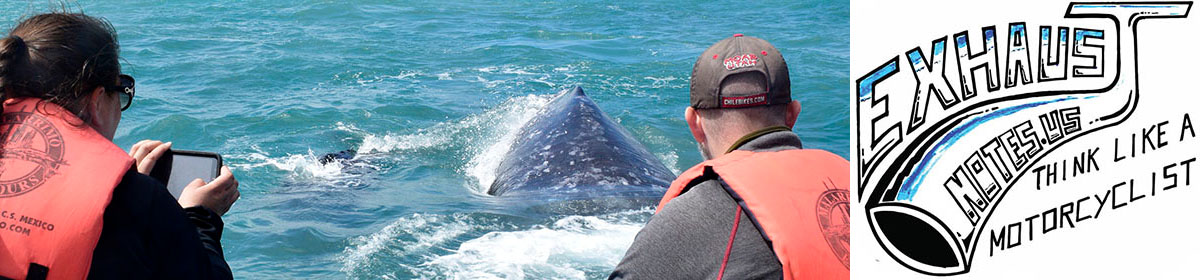
It’s as good as it gets, folks. Whale watching, Baja style. It’s the only place in the world were you can get up close and personal, and actually touch the whales. Combined with a motorcycle ride, it makes Baja even more special…
Figure on two days from the Los Angeles area to get down to Guerrero Negro. I’ve done it in one day, but that involves getting up at 4:00 a.m. to leave LA and riding hard for 700 miles…it’s not the best way to do it.
The ride south is awesome, especially once you get south of Ensenada. You could make this an easy 5-day run if seeing the whales was your main objective, and hey, I’m here to suggest it should be. We’ll talk more about that in just a bit.
The deal is this…the California gray whale herd spends its time migrating north in the summer (all the way to Alaska) and south in the winter (down to two major lagoons on Baja’s Pacific side). It’s the longest mammal migration in the world. The two lagoons where you can see the whales are Scammon’s Lagoon near Guerrero Negro, and San Ignacio Lagoon about an hour west of San Ignacio via a gnarly dirt road.
Let’s go see the whales.
My preference (and my recommendation) is to do Scammon’s Lagoon from Guerrero Negro, as getting to the little boats only takes about 10 minutes. If you want to do San Ignacio Lagoon, you have to go with a service that picks you up in San Ignacio and takes you for a one-hour van ride to the lagoon. There are several whale watching services in Guerrero Negro; my favorite is Malarimmo’s or my good buddy Martin’s whale watching tour. It’s $50 per person, it includes a box lunch, and it’s literally a life-altering experience. Nobody does this who doesn’t come away moved by the experience. I know it’s hard to accept that reading a blog, but trust me, it’s what will happen.
The whales are cool. They’re longer than the boats we’re in. And like I said earlier, you actually get to touch them. Ever been kissed by a 45-foot California gray whale?
Up close and personal, good buddy Rob makes two new friends…Scammon’s Lagoon, a ponga, and a motorcycle ride….it all makes for a whale of an adventure!
The whales are only in town (i.e., in Baja) from January through April, and then they’re back on the road headed north to Alaska. I like to visit with them in March; it’s when I think the whales are most friendly. This is a really cool thing to do.
I used to do these tours for CSC, and we’re thinking of opening it up for anybody in the ExhaustNotes crowd who wants to ride with us. You can be on any kind of bike, with a maximum number of people we’ll define at some point in the future. There won’t be any charge for this, folks, but you will have to sign up for our automatic ExhaustNotes email blog notifications to ride with us, and basically you’ll have to pass the personality test (that means you can’t be a jerk if you want to ride with us).
If you’re interested, let us know at info@ExhaustNotes.us (but only let us know if you’re serious; we not interested in a lot of “if” pre-qualifiers…you know, if I can get the time off, it my wife says it’s okay, if I can get my bike running, etc.).
Follow the ExhaustNotes blog if you want to know more about our planned Baja whale watching adventure ride. You should be reading the blog at least once every day, anyway (it will make you taller, thinner, better looking, and a better rider). Get your bike insured with BajaBound. We’ve got a lot of good info on Baja on our Baja page, and there’s more coming.
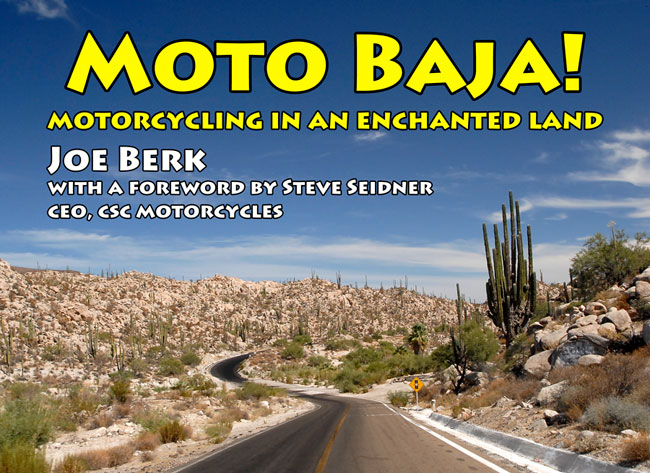
Stay tuned…there’s lots more to follow, but in the meantime, if you want to get a feel for what it’s like riding in Baja and seeing the whales, check out Moto Baja!
Another blog a few entries down (it was on my magical journey to Mompox, Colombia) told about the isolated and surreal nature of that beautiful town. We had to take a ferry ride down the Magdalena River to get there, and I mentioned in the blog that my ride leader, Juan Carlos, had told me they would soon be building a bridge to Mompox. Well, they are, and here’s a video Juan sent to me about it…
There’s an old saying that goes something along the lines of “bad roads bring good people, and good roads bring bad people…” I think Mompox is going to change with improved access. I’m glad I saw it when I did. It was a special place on a special ride.
When I was 13 years old in Florida you could get a restricted permit at age 14. The restricted permit was a driver’s license that allowed you to drive as long as an adult was in the car with you. Assuming he/she wasn’t suicidal, the adult was supposed to keep an eye on your driving and coach you. An adult would help you pick up the nuances of parallel parking, rude hand gestures, and, in Dade County, gun fighting after minor traffic accidents. Needless to say, having an aged, creaking burnout sitting in the car fouling the air with the smell of stale urine cut down on motoring fun quite a bit.
There was a motorcycle loophole in the restricted permit system. If a motorcycle was less than 5 horsepower, and if you stayed off the major highways and didn’t ride at night, you could ride solo without adults helicoptering over your ride. It was wonderful. Obey these few rules and a kid could ride his motorcycle anywhere he pleased.
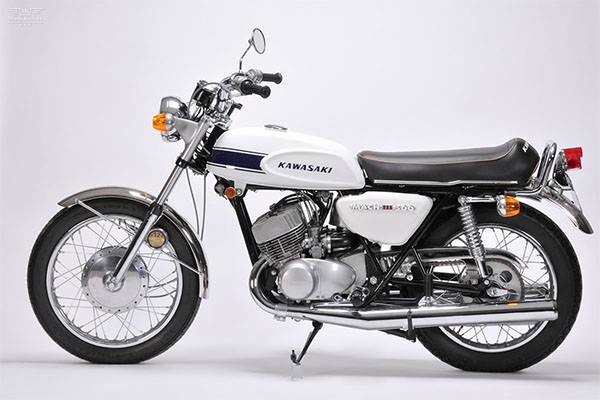
Motorcycles between 50cc and 90cc were right in the 5-horsepower wheelhouse but your average traffic cop couldn’t tell a 175 from a 50. Many bikes were rebadged to appear smaller displacement than they were. I never knew anyone in my circle of friends that got busted for riding a bike too big. Of course, you had to be reasonable about the subterfuge. A 50cc badge on a Kawasaki 750 wouldn’t fly.
Two months before I turned 14 the state upped the age for a restricted permit to 15 years old. The world ended that day. Massive volcanic eruptions, cataclysmic earthquakes, a steady rain of nuclear weapons bombarding the United States, nothing was as devastating to me as Florida’s stupid statute change.
I would have to wait an additional 365 days and I’d only lived 5000 days in total. The year dragged by. Endless days were followed by endless nights only to be repeated one after another. I had to attend yet another grade in school. I couldn’t wait to be done with public conformitouriums anyway and this stolen year of motorcycle riding made it all the more aggravating. The drip, drip, drip of time counted my heartbeats, counted my life ebbing away. I was inconsolable, miserable and the experience placed a chip on my shoulder for government that I have not shaken off.
There are 9 years hidden in there somewhere!
Begrudging the failed clutch on my Husqvarna the other day I came to the jarring realization that I have owned the bike 9 years. I swear, I bought this thing not more than a couple days ago. I degreased the countershaft sprocket area to gain access and removed the clutch slave cylinder. From the inside of the slave I pulled out an aged, creaking o-ring that smelled of stale urine. The leak had allowed the clutch fluid to escape into the crankcase. Except for the missing 9 years the clutch repair went well.
Einstein was right; time is relative. From my 14-year-old perspective a year was an eternity. Now, as an adult I’m scared to close my eyes for fear that another decade will have passed by at light speed. Or worse yet, I won’t be able to re-open them at all.
So, about that photo at the top of our ExhaustNotes blog. We had a contest to see if anyone could identify the location (with a copy of Moto Colombia! as the prize), and after several weeks, our good buddy Patrick grabbed the brass ring. It’s Mompox in Colombia. It was a magic place we rode (and sailed) to on our second day in this wonderful country.
Colombia was easily one of the two best motorcycle rides I’d ever done (the other was China). I rode with great guys while I was there…my good buddies Juan and Carlos. To get the full impact of that photo at the top of the blog, allow me to share with you an excerpt from Moto Colombia! telling a bit more about Mompox…
********************************
Boarding the ferry to Mompox for the trip down the Magdalena River.
Finally, it was time to start loading the ferry. The guys directing this operation had the trucks turn around so they could back onto the ferry. These were big trucks, the angle down to the boat was steep, and there wasn’t all that much room on the boat. Juan told me they load the trucks first, then the cars, and then the bikes (we would be the last ones to get on the ferry).
When the first truck’s rear wheels rolled onto the port side of the ferry, the entire boat tilted. Guys with the shovels materialized and piled dirt on the now tilted-to-the-left ramp. The second truck fired up its diesel engine and slowly backed down the bank to load on the starboard side. The ferry leveled out. This was repeated until the loadmasters had two lanes of trucks on either side of the ferry, then the cars backed onto the ferry, and then it was time for us to ride our motorcycles onto the boat. I’m smiling as I type this, because I remember how exciting this all was. It was incredible fun.
Loading a ferry from the Magdalena’s muddy banks.
After the boat was loaded, I wanted to hop off and grab a photo, but there was a woman who was directing traffic who motioned for me to stay on the boat. She was perhaps 50 years old and she was stunning. Many of the Colombian women I met on this trip were stunning. I’ve heard people say Colombia has the most beautiful women in the world. They might be right.
The ride down the Magdalena River was magical. When I say “down” the Magdalena, it felt unnatural. We were heading downstream, but we were sailing north. I’ve never been on a river in the United States where you can do that. The Magdalena flows north to the Caribbean from deep within the upper reaches of Colombia’s Andes Mountains.
This entire region is an area laden with waterways. Mompox used to be on the Magdalena. The town is still in its original location, but at some point in the distant past the Magdalena changed its course. The main branch of the Magdalena took a turn on its way to the Caribbean to meet the sea at Barranquilla, and Mompox was left behind.
I shot a video on our ride to Mompox and I posted it on YouTube that evening. It was fun…
The ride was comfortable because it was cooler on the river and the ferry created its own breeze. When I panned around with the camera, to my great surprise Juan was on top of the pilot’s cabin. The whole thing added another dimension to this adventure that I really enjoyed, and we were only into our second day of an 8-day ride.
We arrived at the debarkation point, and as I knew from other ferry debarkations, getting off the boat can only be described as controlled chaos. The ride up the dirt bank at this end of our trip was even steeper, and traffic converged to a single lane on a steep uphill dirt slope. Juan was in front of me and we were all stopped.
There was a huge truck on my left (the top of its wheels were at eye level when I was on the bike), I was on dirt, there was a taxi crowding me on my right, and I was pointed uphill at a severe angle. Juan was able to get between the truck and the taxi and pull away. I slipped the clutch and eased up the hill, leaning the bike sharply to the right to keep my left pannier from touching the truck tires. As I did so, I felt my right pannier scraping along the taxi’s fender. Not good, I thought. I scraped along the taxi (it was motionless), I got past it, and we were gone. Surprisingly, the aluminum case was unmarked when I checked it later (it didn’t have a scratch). I don’t know how the taxi fared (no pun intended).
Juan’s rearward-facing photo, shot from the saddle of his motorcycle, as we maneuvered along a dirt road on the way to Mompox. Photo by Juan Carlos Posada Roa.
The next 10 miles or so were rough. The road was dirt, it was a bit gnarly in spots, and there was a lot of traffic. The sun was setting and I was a little uncomfortable. I don’t consider myself much of a dirt rider, and I especially don’t like riding on dirt in the dark. Juan and Carlos were unfazed by all of this; they are used to the roads. Juan even turned around on his bike to take pictures of Carlos and me while we were all moving.
When we entered Mompox it was already dark. Juan found the hotel quickly, we checked in, and Juan asked for a restaurant recommendation. I was picking up enough Spanish to know that he asked for a good pizza spot (¿Dónde hay un buen lugar para una pizza?). The nice young lady who checked us in recommended a place owned by an Austrian a block away.
Quite possibly the best pizza I have ever had.
We each ordered an Aguila (that’s a Colombian beer), and those first cold brews went down easy. So did the second one. This was our second night on the road and we were already comfortable with each other. We ordered a couple of pizzas; the recommendation had been a good one. The dinner was great. It was quite possibly the best pizza I’ve ever had.
The conversation that evening was relaxing and intellectually stimulating. Juan told me about Mompox and its historical significance to Colombia. He mentioned the Pulitzer-Prize-winning novel 100 Years of Solitude, written by the great Colombian writer Gabriel Garcia Marquez. I was embarrassed to admit to Juan and Carlos that I had not read it (a character flaw I corrected as soon as I returned to the United States). The novel was set in the mythical town of Macondo. Some people think that Marquez based his fictional town of Macondo on his own Colombian home town of Aracataca, the town where he was born. Others believe Macondo used Mompox as the novel’s inspiration. I am firmly in the second camp. While reading the novel after I returned to the US, I felt as if Marquez was describing the areas we rode through, and his descriptions of Macondo kept my mind drifting back to Mompox.
Carlos, me, and Juan having pizza, beer, and a literary discussion in Mompox.
When we finished dinner, I thought we would go back to the hotel and call it a night. I was tired. I told Juan and Carlos I wanted to post an entry on the blog I wrote for CSC Motorcycles.
“Joe,” Juan said, “your readers will wait.”
The way he said it made me realize he was right. The blog took a back seat to walking along the Mompox riverfront with Juan and Carlos that evening. I was glad I listened to Juan. I captured some of the best photos of my entire stay in Colombia while we were in Mompox.
The Santa Barbara Church in Mompox. It is a brilliantly-colored yellow and white structure. I had to put the D3300 on manual focus for these shots; there was not enough light for the camera to autofocus.The Church of San Francisco in Mompox. This church was a deep burgundy with white trim. It was striking in the evening.
Mompox, a place I had never heard of, is an absolute treasure. I’ve read a bit about it since my return, and it’s intriguing. Mompox looks pretty much like it did in Colombia’s colonial times. The place was founded in 1540, and in 1998 it was designated a World Heritage site. Mompox used to be a key trading center when the Magdalena River flowed by it, but when the river decided to take another route to the sea, time more or less forgot Mompox (exactly as described in 100 Years of Solitude, by the way, for the fictional town of Macondo).
Mompox was a big port for the Spanish while they were systematically looting Colombia’s gold and emeralds. Mompox’s inland location helped protect the soon-to-be-seaborne loot from Sir Francis Drake and his pirates, who were as busy stealing from the Spanish as the Spanish were stealing from the indigenous Colombians. I remember seeing the river front and imagining galleons so laden with treasure the tops of the boats were barely above the water line. I may be exaggerating, but not by much. Many of those Spanish galleons sunk in rough seas because they were so overloaded.
Homes along the river in Mompox. It would be awesome to live here.
That late night walk along the river was one I’ll remember forever. The place was an explosion of color and I was having a blast photographing it. There was a wall I used to stabilize the camera, and I shot at a low ISO to get great colors. I was lucky to be able to shoot this city at night; the colors were far more saturated than they would be if I shot in sunlight. It was 10:00 in the evening and the place was alive. People were walking along the river, small motorcycles with young couples were burbling along on the narrow streets, cafes were serving coffee, and salsa music drifted through the humid evening air. I remember thinking it was amazing I had never heard of this place before.
The money shot, taken along the riverfront in Mompox.
Juan told me that there are plans to build a bridge to Mompox. That would do away with the need for the ferry and the ride down the Magdalena River to get to this magical place. I’m not so sure that’s a good thing. Mompox and the journey to reach it are special. I am glad Juan included it in our itinerary.
Day 2 had been a good day. A great day, actually. Juan knew what he was doing when he planned this trip. I thought about our first two days. I wasn’t playing at being Indiana Jones on this ride; I was Indiana Jones. On a motorcycle, no less. I couldn’t wait to experience the coming days. I wondered: Had the trip’s high points peaked too soon? How could Juan have possibly planned this adventure with even better things awaiting our exploration?
Did you enjoy reading the above? Hey, I wrote a book about that ride, and you can order it here. I think you’ll like reading it, and I know I sure had fun writing it!
During the summer of 2016, your blogmeisters (Arjiu and Dajiu) rode RX3 motorcycles 6000 miles across China. Tracy was our translator and he was funny as hell.
Our good friend Tracy is an up and comer in the Zongshen organization. He sent an email to us recently, along with the above photo. Tracy is being reassigned to the Zongshen team in Mexico, and Gresh and I may take a ride down there once Tracy is in country. You can bet the beer will flow freely when that happens!
Hey, buy two or three…they make great gifts!
If you’d like to read the story of our ride across China, you can do so here. It was a great ride and an amazing adventure.