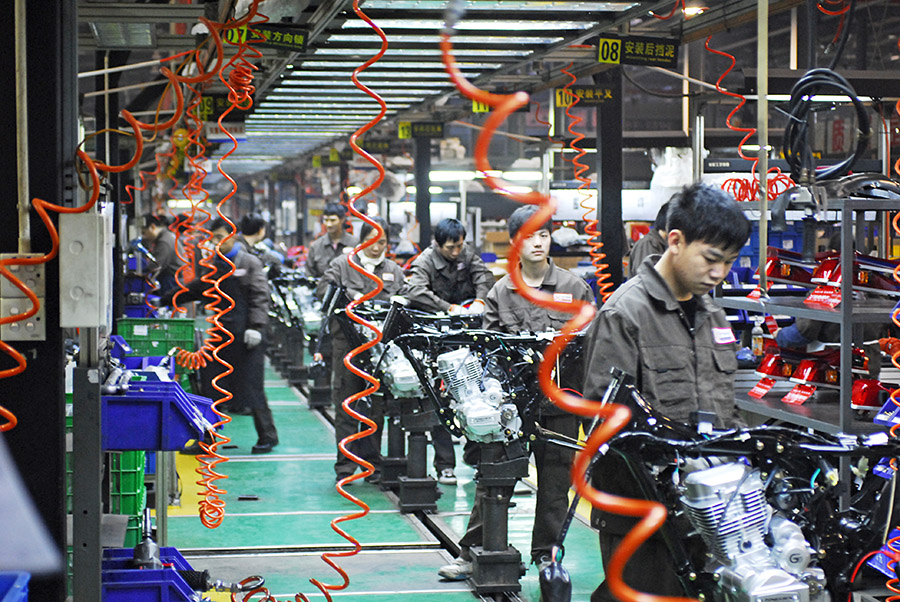
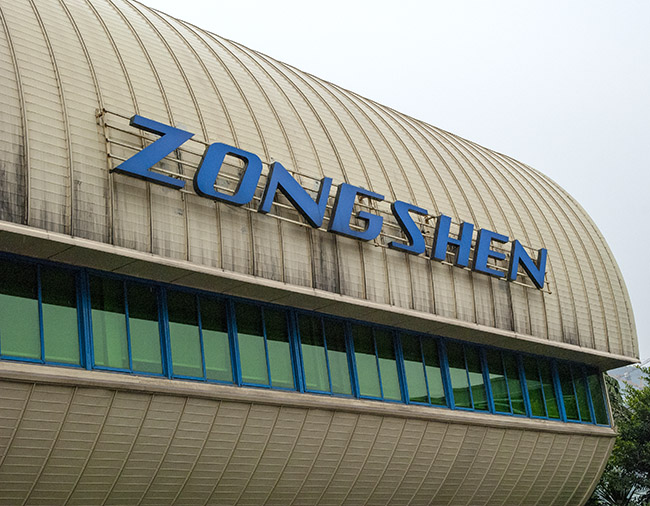
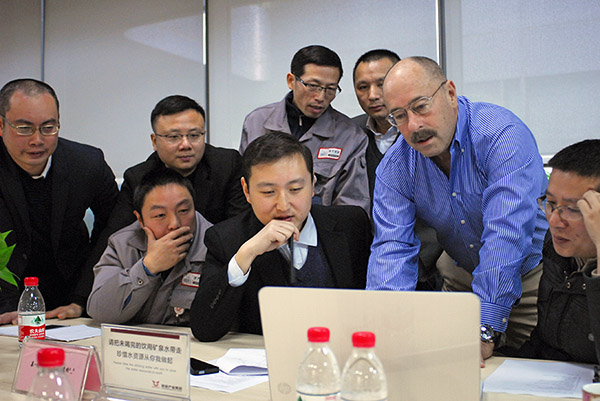
Two of the largest motorcycle companies in China are Zongshen and Loncin. I recently learned that Zongshen became the major shareholder of Loncin, turning Zongshen into the largest of the motorcycle companies in China. I asked my contact at Zongshen if he could tell me more about this, and he did.
Hi Joe:
On July 3rd, Zonsen Power, a listed company under Zongshen Group, announced official news. Here are the details:
Zonsen Power announced that its associate company intends to invest 3.35 billion yuan (CNY) to acquire a 24.55% stake in Loncin. Upon the completion of the transaction, Zonsen will become the largest shareholder and the actual controller of Loncin.
In fact, before this acquisition, Loncin Group had been trapped deeply a debt crisis due to heavy losses in its real estate business, leading to significant debts in 13 of its subsidiaries.
In previous years, Loncin had been trying hardly to resolve this issue, and some companies proposed acquiring shares in Loncin, but ultimately, none succeeded.
The Chongqing court ruled that Loncin Group must resolve this debt issue before August 2024, or the company will be auctioned. This acquisition of Loncin by Zonsen is likely the result of coordination by the Chongqing government.
As the previous acquisition of Lifan by Geely Automobile was not successful. Geely, a powerful automotive enterprise in China that is the largest shareholder of Daimler and once acquired 100% shares of Volvo, but had no intention of developing the motorcycle industry by acquiring Lifan. Instead, it aimed to obtain Lifan’s electric vehicle production license. However, after the acquisition, Geely did not invest much in the motorcycle sector, causing Lifan to decline significantly, which greatly displeased the local government.
Although Loncin’s real estate business has suffered heavy losses, its motorcycle business is still operating well. Therefore, the local government is unwilling to let Loncin suffer the same fate as Lifan, so it coordinated with Zonsen to acquire a majority stake in Loncin, and state-owned assets also invested in Loncin.
Whether Zongshen and Loncin’s businesses will be merged is yet to be announced officially, but most people believe that Loncin will maintain its current structure and business, and there will still be competition between the two companies in the same industry.
Thanks!
These are interesting developments. In case you were wondering, Zonsen is the name by which what we knew as Zongshen now wishes to be called. Another bit of information: 3.35 billion Chinese Yuan is the equivalent of approximately 461 million US dollars. I first visited Zongshen more than a decade ago, and the company impressed me greatly.
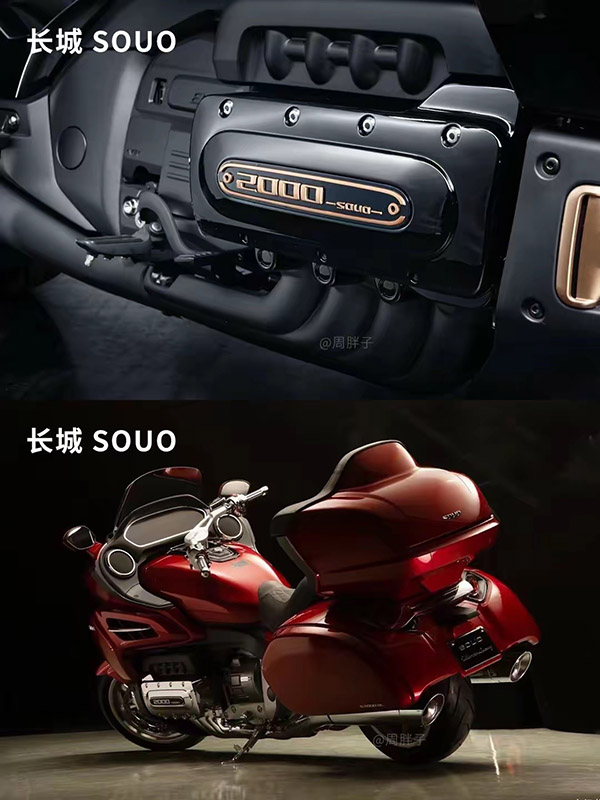
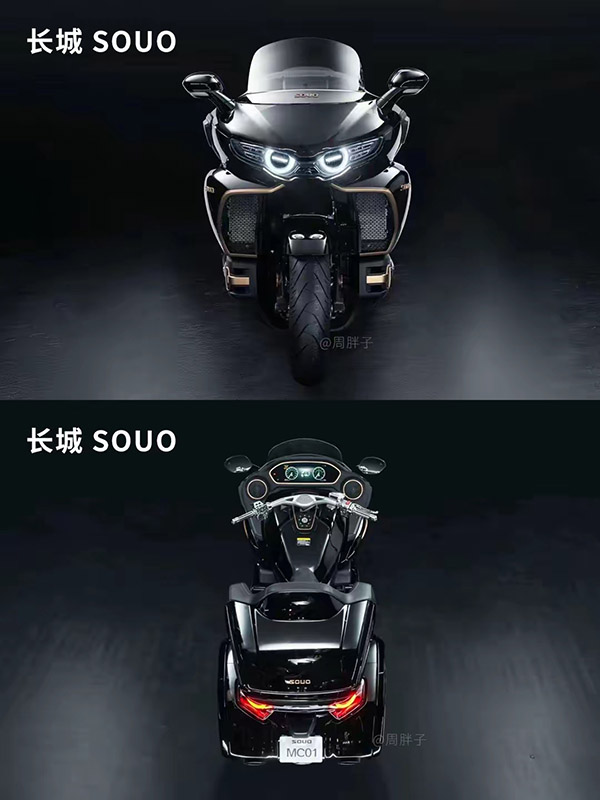
I’ll bet you thought you were looking at a Gold Wing when you opened this blog.
Wow, the world is full of surprises. On my first foray into the Chinese motorcycle industry (a trip to Zongshen’s giant manufacturing campus in Chongqing), I was blown away by the size and sophistication of that company. Since then, I’ve been to China many times (including a visit to the Canton Fair, China’s significant motorcycle industry trade show). I thought I’d seen it all, and then I found this email from good buddy Fan in my inbox:
Hi Joe:
How are you, friend?
I’d like to share a news to you, of course it’s still about motorcycles/
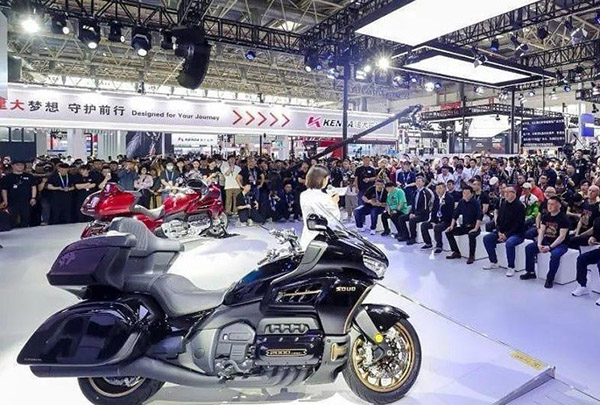
A motorcycle exhibition was held in Beijing from May 17th to 20th.
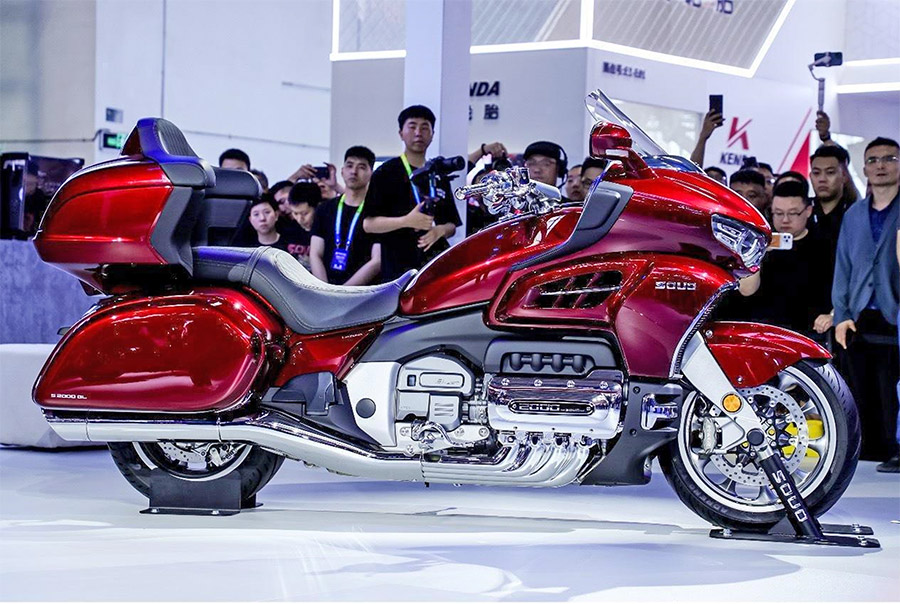
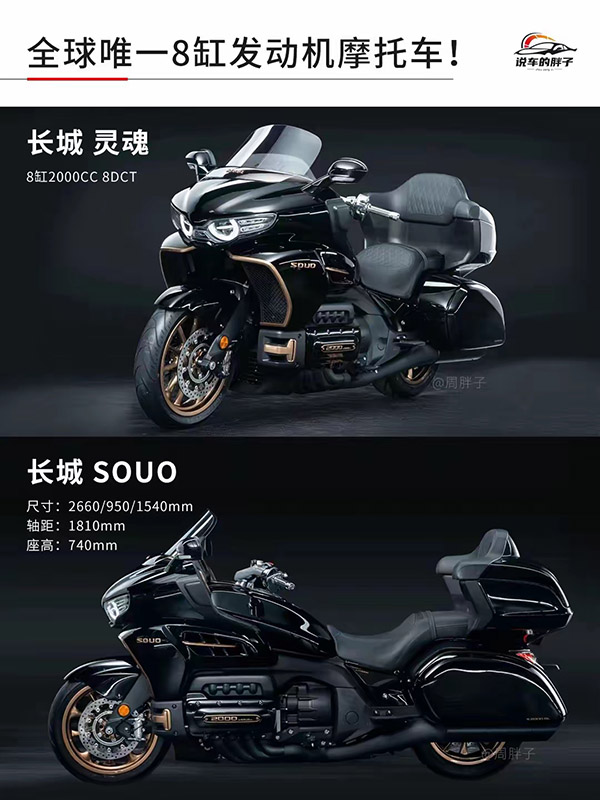
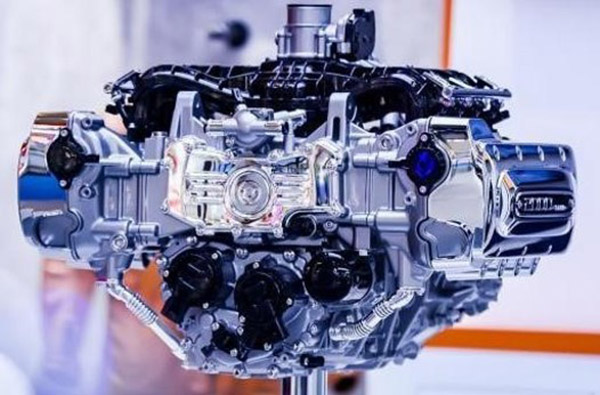
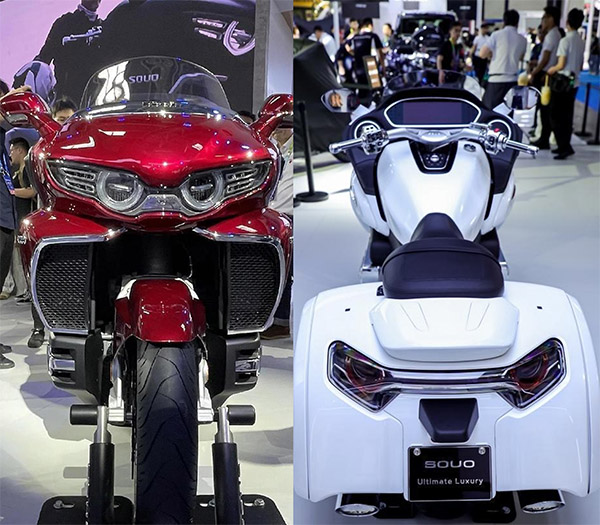
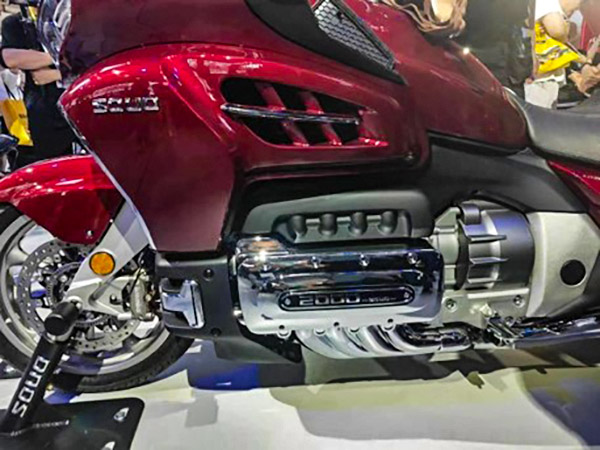
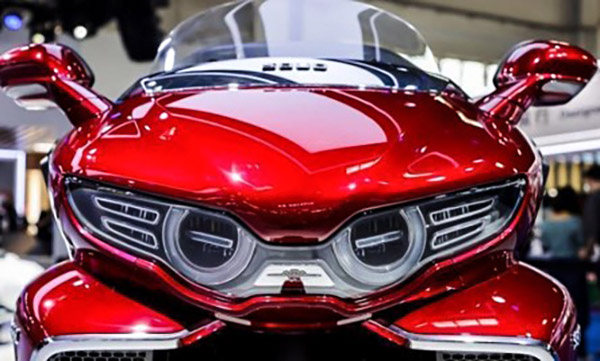
Most of the products were still unremarkable to me, but one motorcycle sparked interest. This is a cruiser developed by Great Wall Motors, a Chinese automobile company. Its appearance may remind you of the Honda Gold Wing. At first, I thought this was another simple imitation of another motorcycle, but when I understood its structure and parameters, I found that it was not that simple. This cruiser is named SOUO and is equipped with a 2000cc engine with 8 cylinders, while the Honda Gold Wing is 1600cc with 6 cylinders only.
The price of this motorcycle has not yet been announced, but it is said that it will start accepting reservations in August. I guess the retail price should be 250,000 yuan, about 35,000 US dollars.
For your reference.
Best regards!
Fan
Whoa! 2000cc! Eight cylinders! An 8-speed dual clutch transmission! Talk about overkill!
I wonder what it weighs.
I tried to find what SOUO translates to in English, but it doesn’t translate to anything. What I found online is that SOUO is an acronym (you know, an abbreviation that forms a word). SOUO means “Search Own, Unlimited Outlook.”
This is a huge step in the Chinese motorcycle world. How Great Wall Motors markets the bike will be interesting to watch. I would think one of their principal markets has to be the United States (where else could it be?), but I have to wonder how many they think they are going to sell. Assuming the motorcycle could meet U.S. Department of Transportation and EPA emissions requirements (it most likely would, as the bikes I assisted in guiding through U.S. certification requirements all did), and assuming someone steps up to pay the roughly $50K associated with going through the certification process, how many people are willing to drop $35K on a new Chinese motorcycle? That’s more than what a new Gold Wing, a new BMW, or a new Harley costs. It’s a steep sales hill and it will require a significant marketing effort. I think the issues are the small size of the target market, the target market’s willingness to go with a new and unproven Chinese product (instead of a Gold Wing, a BMW, or a Harley), the price, and questions about Chinese motorcycle reliability and parts availability.
No one has asked for my advice on this, but that’s never slowed me down before. Here’s what I’d do:
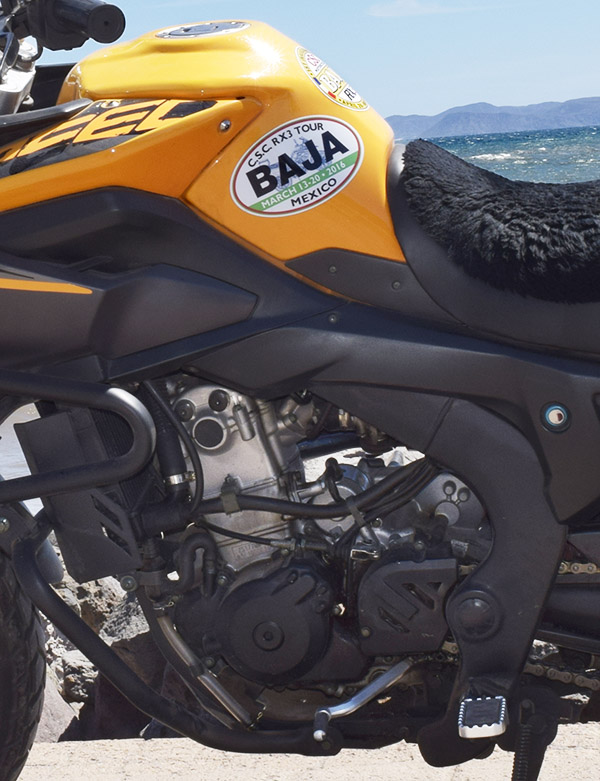
Lower the price dramatically to bring new folks to the table. The RX3’s initial price was a scant $2895 and none of the other manufacturers could touch that price. CSC didn’t make money on those bikes, but we more than made up for that with future sales, accessory sales, and building a loyal customer base.
Do something similar to what we did at CSC to convince people the RX3 was a superbly reliable motorcycle. CSC sponsored a series of adventure tours to demonstrate the RX3’s reliability. Zongshen sponsored the 5000-mile Western America Adventure ride, and CSC sponsored a series of Baja rides. These events served us well. With the SOUO motorcycle, I’d think they might consider working a deal with the Southern California Motorcycle Club and the Iron Butt Association and run several of their bikes in their events, to include a Four Corners Ride (a ride that hits all four geographic corners of the U.S.), the Three Flags Ride (a rally from Mexico through the U.S. to Canada), and an Iron Butt ride (a run that covers 11,000 miles in 11 days). On top of that, I’d offer a 10-year warranty, kind of like Hyundai did with its cars.
Bring in a huge spare parts inventory and brag about it. Folks will naturally worry about spares. Bring in enough to build complete bikes and let everyone know it. It’s what CSC did and it blew away any concerns about parts availability.
Build a U.S. manufacturing facility. Boy, this could get complicated fast. But Great Wall Motors needs to address the U.S. disdain for Chinese products and the ongoing U.S./China trade war. Doing so is above my pay grade, but I would think making this bike in America would get around a lot of issues.
Go balls out on a product placement campaign. The U.S. motorcycle market for big touring machines is primarily old guys, and we are dying off. One way to attract new blood is to get the bike featured in movies and streaming TV shows. You know, like BMW and Triumph have done in the Bond and Mission Impossible franchises. (“Balls out” is not an obscene anatomical reference to moving at great speed; the phrase actually comes from the old mechanical centrifugal governors used on steam and internal combustion engines.)
This motorcycle is an interesting development. I don’t think we’ll see SOUO motorcycles here in the U.S. any time soon, but I’d sure like to. In the meantime, here are a few more photos.
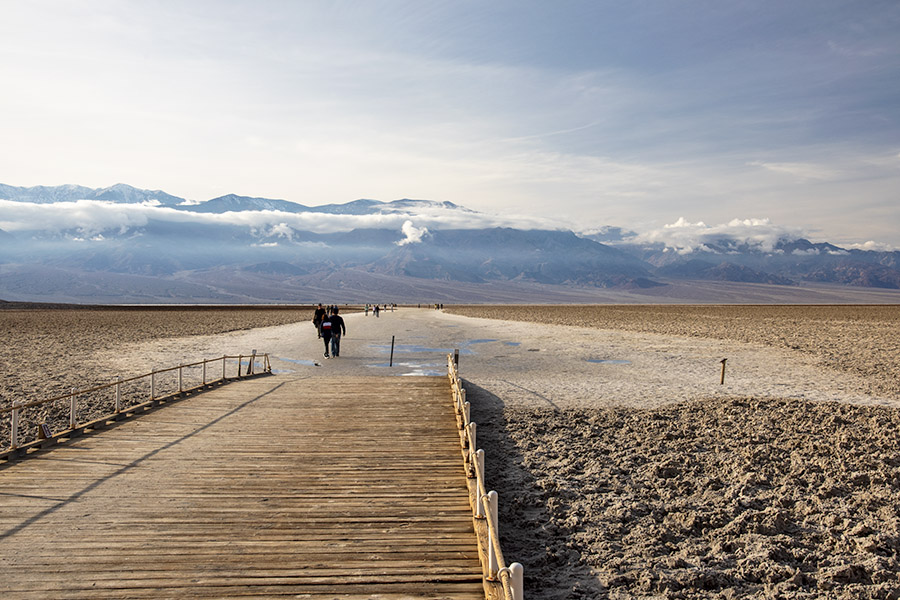
As I mentioned in a recent blog, Sue and I recently spent a couple of days in Death Valley. I love the place. I lived in California for 30+ years before I ever made the trip out there on my KLR 650, and since then, I’ve been back several times. Here’s a short recap of those previous visits.
The Teutonic Twins Run
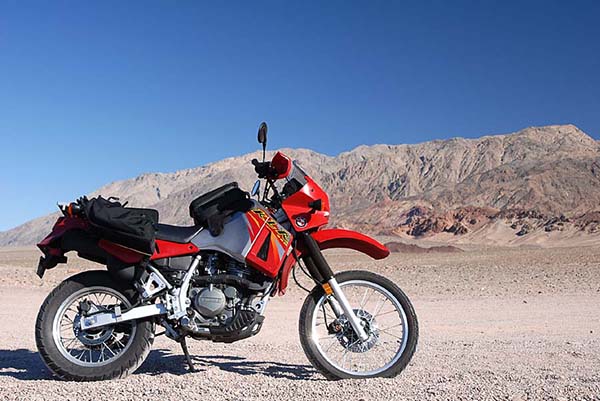
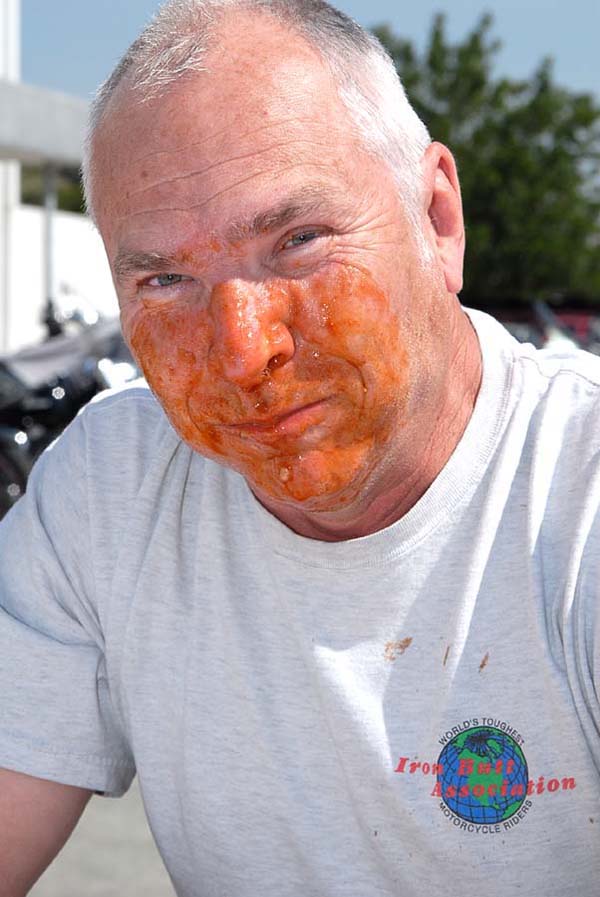
My KLR in Death Valley on that first visit. I loved my KLR; it was a great motorcycle.Good buddy Dennis, who won the chili-eating contest at Brown’s BMW.
That first ride on the KLR 650 didn’t just happen because I decided to finally get out there to see the hottest place on the planet. It came about because the guys at Brown BMW had a chili cookoff and eating contest followed by a two-day ride to Death Valley. If it hadn’t been for that, I wouldn’t have made it out there. I was the lone KLR rider; all the other guys were on big BMW twins. I’d ridden with those guys before and they were too fast for me. Nope, I was happy as a clam poking along on my 650cc single. I left right after the chili cookoff because I planned to meander along through other parts of the Mojave before spending the night in Baker, which was to be our jumping off point the next morning. It was fun, that ride out to Baker was. Just me and the KLR. I explored the desert around Kelbaker (southeast of Baker) and the old train depot there.
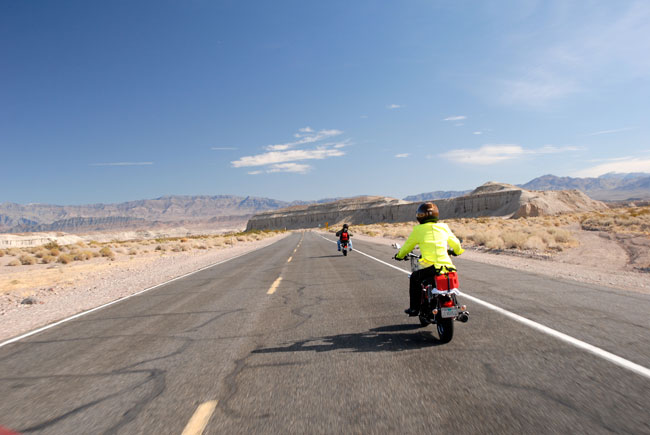
The next morning, we all had breakfast at the Mad Greek (a Baker and southern California icon), and then rolled out on California State Route 127 to the lower end of Death Valley. That’s a good highway that cuts through the desert. There’s nothing else out there, and the Teutonic twin crowd quickly left me in the dust. They were running well over 100 mph; the KLR might touch 100 on a good day. But I didn’t need to run at those speeds that day. I was enjoying the ride.
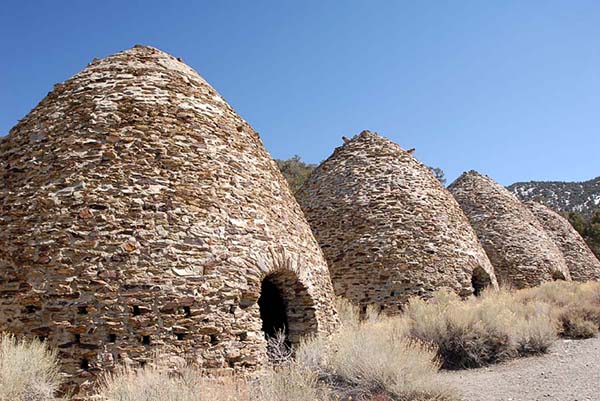
The charcoal kilns in Death Valley, I’m sure glad I didn’t skip seeing them on that first Death Valley foray.
When I left Death Valley on that first trip, I left through the northwestern part to pick up the 395 back down to southern California. That was a good thing. I saw a sign for Wildrose Canyon Road and another sign for the charcoal kilns pointing down a dirt road. I was by myself and I was in no hurry. I didn’t have any idea what the charcoal kilns were all about, but I was interested in learning more. I took that road, and I’m glad I did. Every time I’ve been in Death Valley since that first trip, the road to the charcoal kilns was closed, including on this my recent trip. If you are ever out there and the road is open, you might consider seeing them. The kilns are interesting, and Wildrose Canyon Road (as the name suggests) is a beautiful ride.
The Hell’s Loop Endurance Run
Following Arlene and TK on 150cc California Scooters into Death Valley.
Another ride in was when good buddy TK, good buddy Arlene, and I rode in the Hell’s Loop endurance rally on the 150cc California Scooters. That was a challenging day. We rode 400 miles into and through Death Valley and then returned to Barstow. It was cold and the hardtail CSC 150 beat me up, but it was fun. That little 150 never missed a beat.
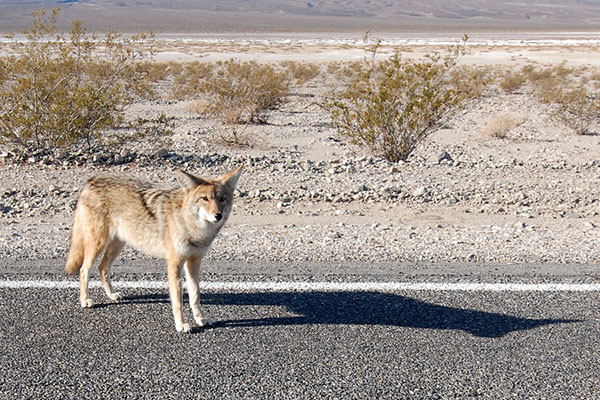
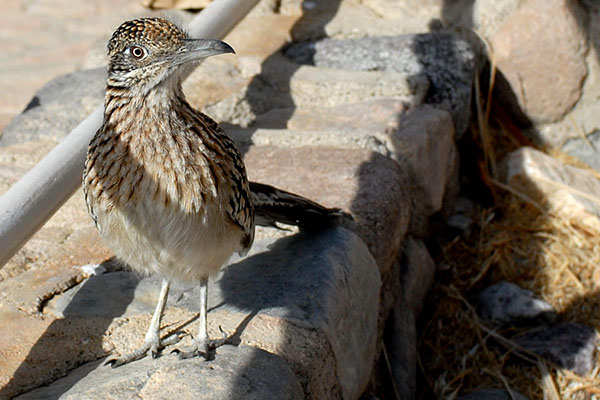
We had lunch at the Furnace Creek Inn, and shortly before turning off the road, we saw this guy. He is obviously well fed.As soon as we sat down for lunch at the Furnace Creek Inn, this guy landed a couple feet away. We had just seen the coyote. I asked the roadrunner if he owned anything made by Acme, or if he was being chased by old Wiley. He responded with but two words: Beep Beep.
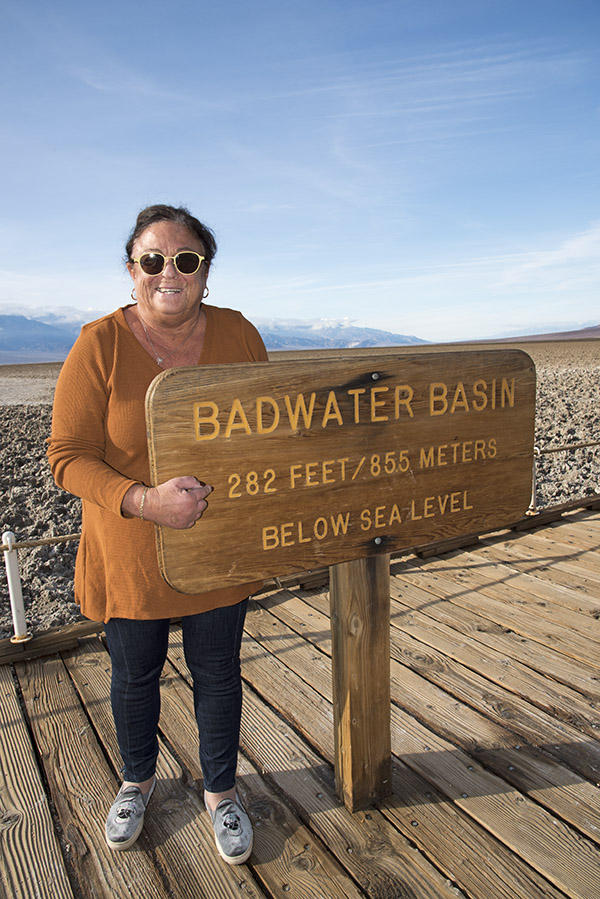
My next Death Valley adventure was a photo safari with Sue. We did that one in my Subie CrossTrek in a single day. It was a long day, but the photo ops did not disappoint. What was kind of cool about that trip is that when we rode through Badwater Basin, we saw a coyote loping along the road headed north, and a short while later when we stopped at the Furnace Creek Inn, a roadrunner landed right next to us as we enjoyed lunch on the patio. Was the roadrunner running from the coyote? Cue in the Warner Brothers: Beep beep!
The Destinations Deal Tour
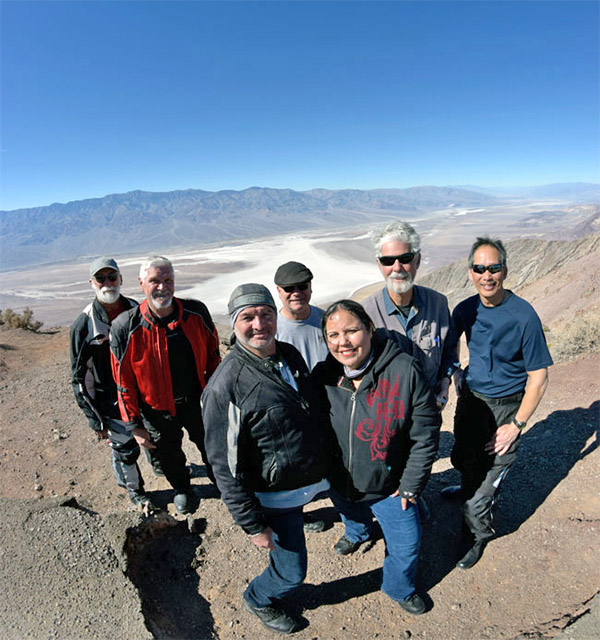
The Destinations Deal crew overlooking Death Valley from Dante’s View. We covered a lot of territory on that trip.
A few years ago we rode through Death Valley on RX3 motorcycles. That was part of a promotion we ran when I was working with CSC. We took a half dozen riders through a handful of southwestern states, and Death Valley was the last of several national park visits. It’s where I first met Orlando and his wife Velma. Joe Gresh was on that ride, too. It was fun.
The “My Sister Eileen” Trip
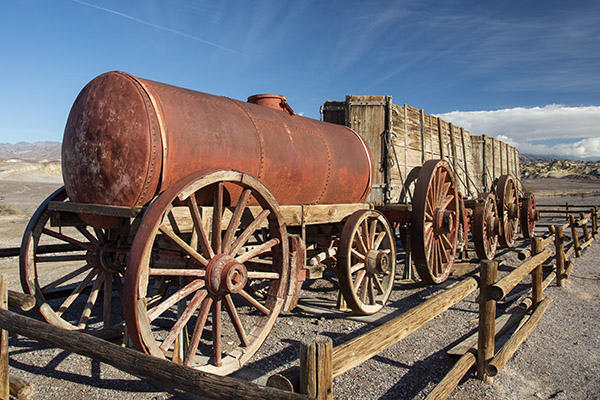
A 20-mule-team borax train.Just like the theatrical title: My sister Eileen. We had a great time on that trip.
After the Destinations Deal run, Sue and I and my sister Eileen had a road trip through California and Nevada, with a run down the 395 through a major league snowstorm. We went through Death Valley the next day (the snowstorm had ended) and it was awesome. I didn’t do a blog on that Death Valley visit (I have no idea why), but trust me on this: Like all trips to and through Death Valley, it was awesome.
That gets me caught up on my prior Death Valley visits. If you want to see more photos and read more about those earlier visits, here are the links:
Watch for a series of Death Valley blogs. The first will be about our most recent visit, and then I’ll post blogs about Death Valley history, Death Valley geology, things to do around Death Valley, Shoshone, nearby Red Rock Canyon National Park, and maybe more. Stay tuned.
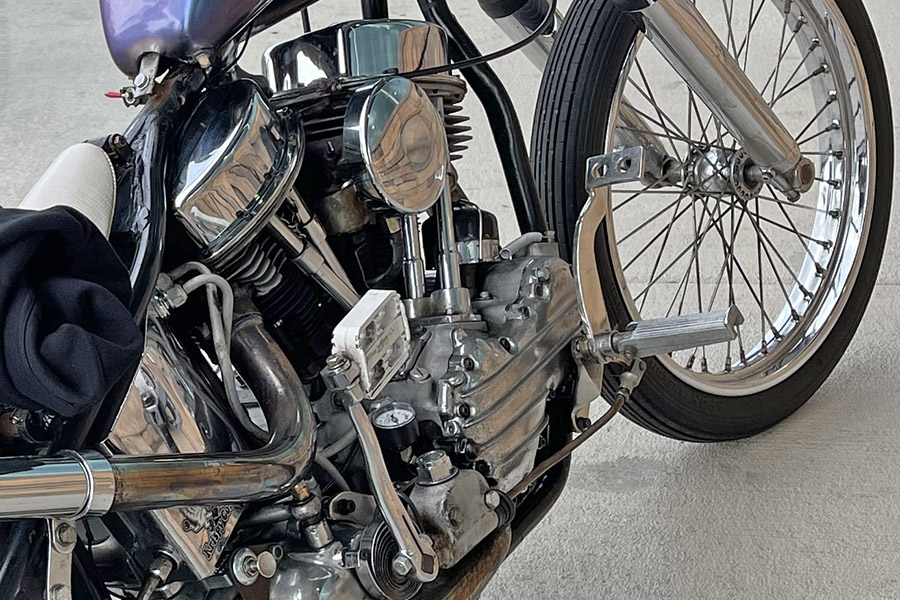
For me a motorcycle’s appearance, appeal, and personality are defined by its motor. I’m not a chopper guy, but I like the look of a chopper because the engine absolutely dominates the bike. I suppose to some people fully faired motorcycles are beautiful, but I’m not in that camp. The only somewhat fully faired bike I ever had was my 1995 Triumph Daytona 1200, but you could still see a lot of the engine on that machine. I once wrote a Destinations piece for Motorcycle Classics on the Solvang Vintage Motorcycle Museum and while doing so I called Virgil Elings, the wealthy entrepreneur who owned it. I asked Elings what drove his interest in collecting motorcycles. His answer? The motors. He spoke about the mechanical beauty of a motorcycle’s engine, and that prompted me to ask for his thoughts on fully faired bikes. “I suppose they’re beautiful to some,” he said, “but when you take the fairings off, they look like washing machines.” I had a good laugh. His observation was spot on.
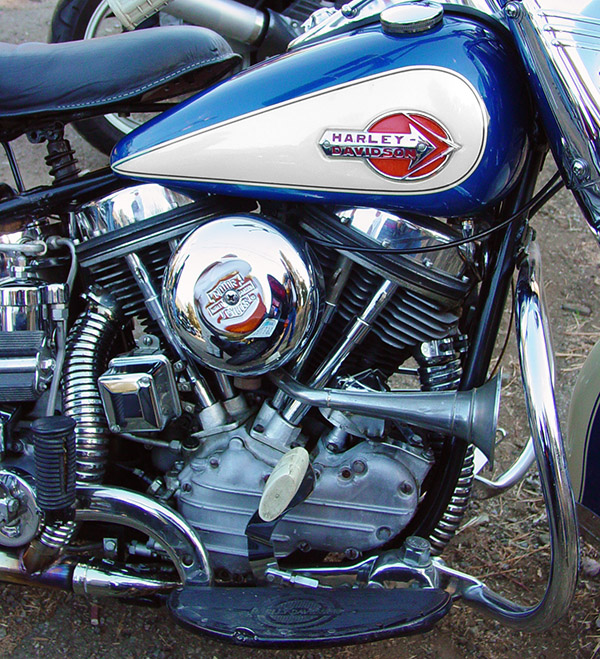
A 1200cc Harley Panhead motor I photographed at the Rock Store in Malibu.
My earliest memory of drooling over a motorcycle occurred sometime in the 1950s when I was a little kid. My Mom was shopping with me somewhere in one of those unenclosed malls on Route 18 in New Jersey, and in those days, it was no big deal to let your kid wander off and explore while you shopped. I think it was some kind of a general store (I have no idea what Mom was looking for), and I wandered outside on the store’s sidewalk. There was a blue Harley Panhead parked out front, and it was the first time I ever had a close look at a motorcycle. It was beautiful, and the motor was especially beautiful. It had those early panhead corrugated exhaust headers, fins, cables, chrome, and more. I’ve always been fascinated by all things mechanical, and you just couldn’t find anything more mechanical than a Big Twin engine.
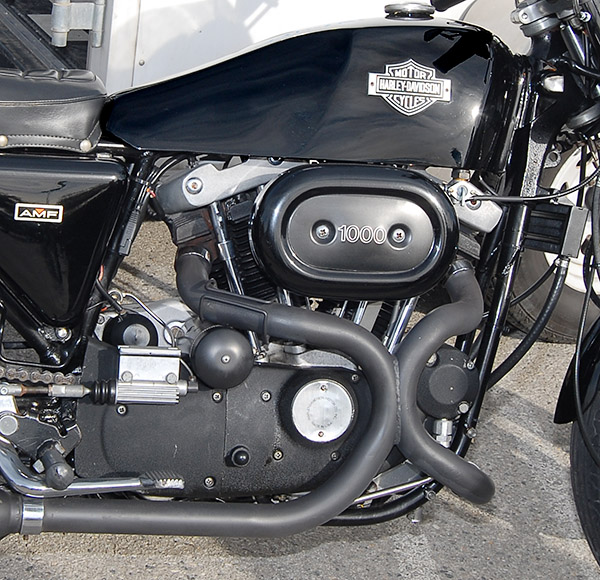
There have been a few Sportsters that do it for me, too, like Harley’s Cafe Racer from the late 1970s. That was a fine-looking machine dominated by its engine. I liked the Harley XR1000, too.
A 1000cc Harley Cafe Racer photographed at one of the Hansen Dam meets. When these were new, they sold for about $3,000.
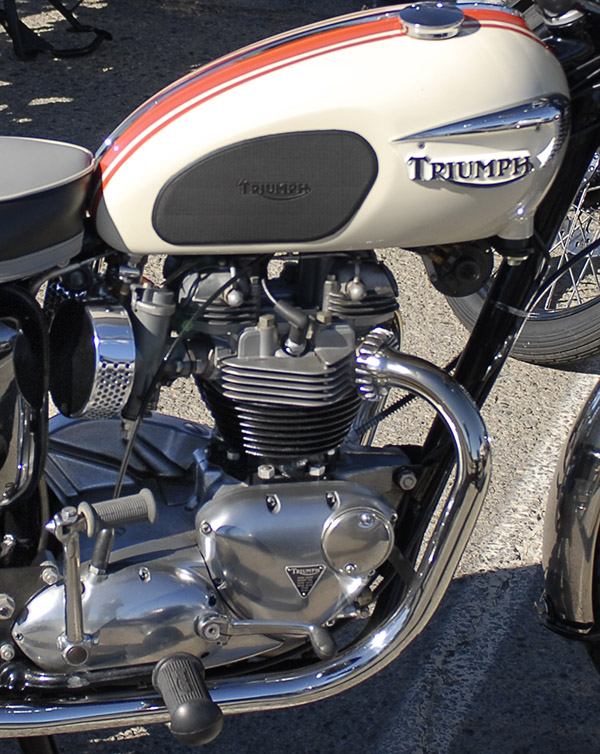
I’ve previously mentioned my 7th grade fascination with Walt Skok’s Triumph Tiger. It had the same mesmerizing motorrific effect as the big twin Panhead described above. I could stare at that 500cc Triumph engine for hours (and I did). The 650 Triumphs were somehow even more appealing. The mid-’60s Triumphs are the most beautiful motorcycles in the world (you might think otherwise and that’s okay…you have my permission to be wrong).
A 1966 Triumph Bonneville and it’s 650cc twin-carb engine. My Dad rode a Bonneville just like this one.
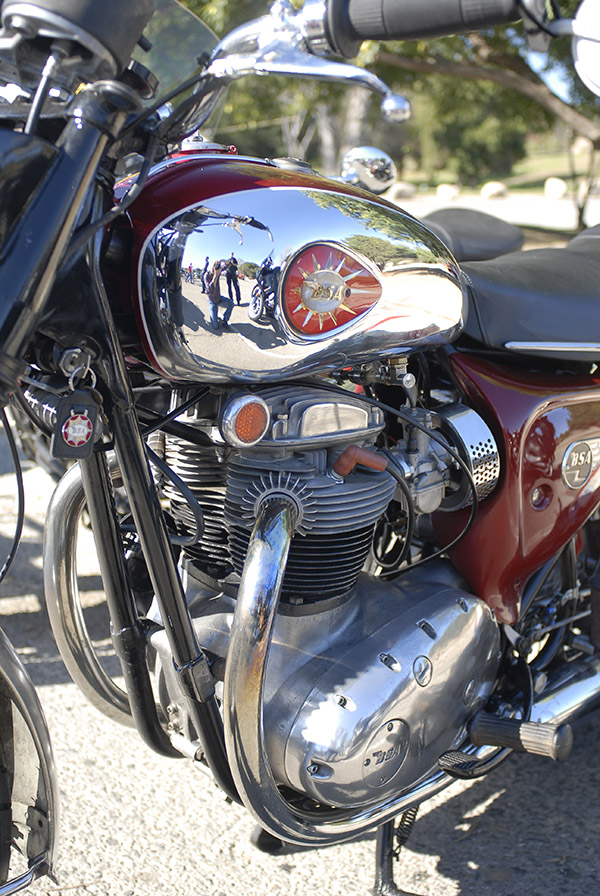
BSA did a nice job with their engine design, too. Their 650 twins in the ’60s looked a lot like Triumph’s, and that’s a good thing. I see these bikes at the Hansen Dam Norton Owners Club meets. They photograph incredibly well, as do nearly all vintage British twins.
A late1960s BSA at Hansen Dam. These are beautiful motorcycles, too.
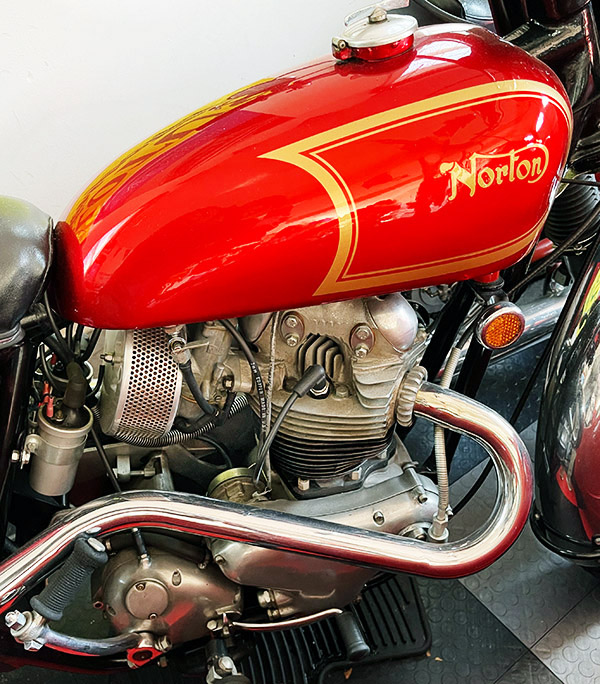
When we visited good buddy Andrew in New Jersey recently, he had several interesting machines, but the one that riveted my attention was his Norton P11. It’s 750cc air cooled engine is, well, just wonderful. If I owned that bike I’d probably stare at it for a few minutes every day. You know, just to keep my batteries charged.
Andrew Capone’s P-11 Norton. You can read about our visit with Andrew here.
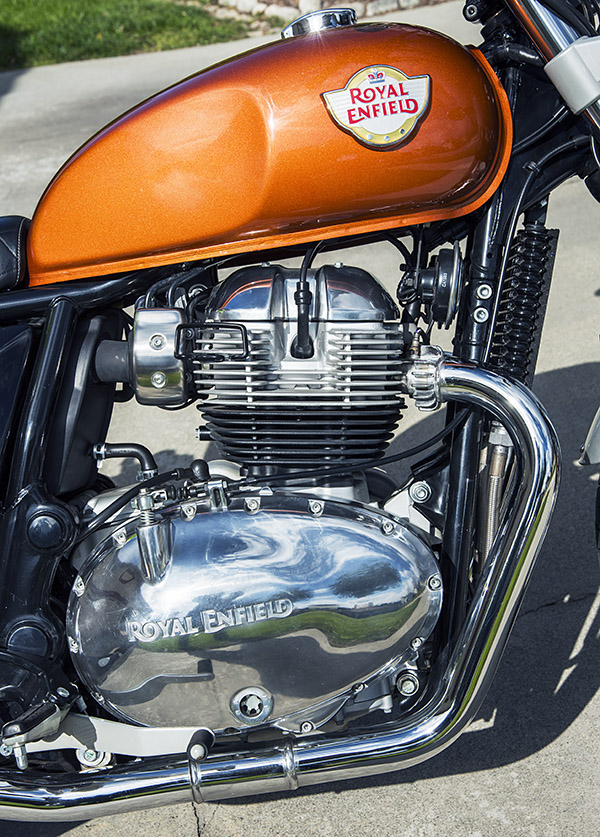
You know, it’s kind of funny…back in the 1960s I thought Royal Enfield’s 750cc big twins were clunky looking. Then the new Royal Enfield 650 INT (aka the Interceptor to those of us unintimidated by liability issues) emerged. Its appearance was loosely based on those clunky old English Enfields, but the new twin’s Indian designers somehow made the engine look way better. It’s not clunky at all, and the boys from Mumbai made their interpretive copy of an old English twin look more British than the original. The new Enfield Interceptor is a unit construction engine, but the way the polished aluminum covers are designed it looks like a pre-unit construction engine. The guys from the subcontinent hit a home run with that one. I ought to know; after Gresh and I road tested one of these for Enfield North America on a Baja ride, I bought one.
The current iteration of Royal Enfield’s 650cc twin. I rode this bike through Baja and liked it so much I bought one when I returned from Mexico. Here’s more (a lot more) about that adventure.
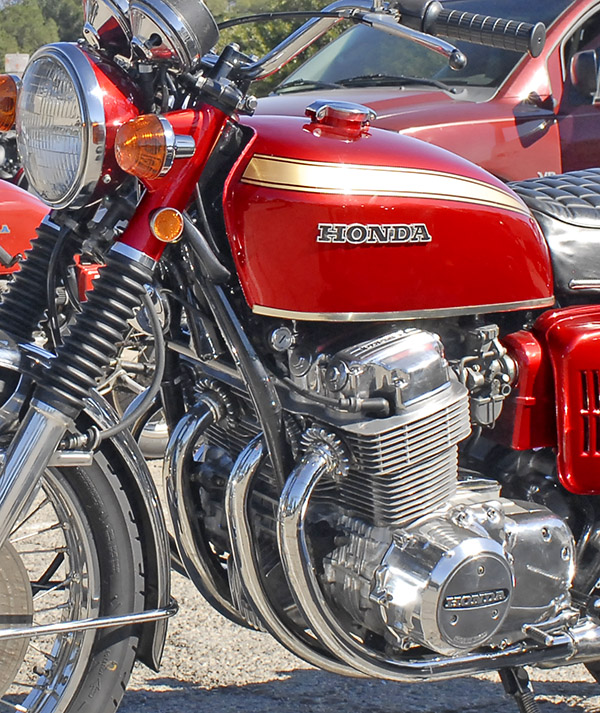
Another motorcycle that let you see its glorious air-cooled magnificence was the CB750 Honda. It was awesome in every regard and presented well from any angle, including the rear (which is how most other riders saw it on the road). The engine was beyond impressive, and when it was introduced, I knew I would have one someday (I made that dream come true in 1971). I still can’t see one without taking my iPhone out to grab a photo.
A 1969 or 1970 Honda CB 750. This is the motorcycle that put the nail in the British motorcycle industry coffin. I had one just like it.
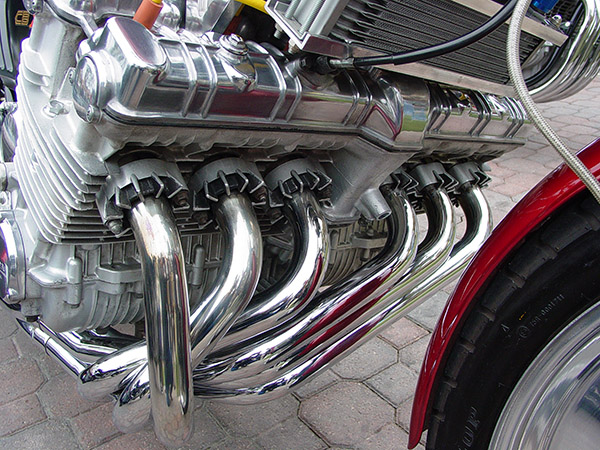
After Honda stunned the world with their 750 Four, the copycats piled on. Not to be outdone, Honda stunned the world again when they introduced their six-cylinder CBX. I had an ’82. It was awesome. It wasn’t the fastest motorcycle I ever owned, but it was one of the coolest (and what drove that coolness was its air-cooled straight six engine).
A Honda CBX engine photographed at the Del Mar fairgrounds near San Diego. The CBX was a motorcycle that added complexity where none was required. It was an impressive machine.
Like they did with the 750 Four, Kawasaki copied the Honda six cylinder, but the Kawasaki engine was water-cooled and from an aesthetics perspective, it was just a big lump. The Honda was a finely-finned work of art. I never wanted a Kawasaki Six; I still regret selling my Honda CBX. The CBX was an extremely good-looking motorcycle. It was all engine. What completed the look for me were the six chrome exhaust headers emerging from in front. I put 20,000 miles on mine and sold it for what it cost me, and now someone else is enjoying it. The CBX was stunning motorcycle, but you don’t need six cylinders to make a motorcycle beautiful. Some companies managed to do it with just two, and some with only one. Consider the engines mentioned at the start of this piece (Harley, Triumph, BSA, and Norton).
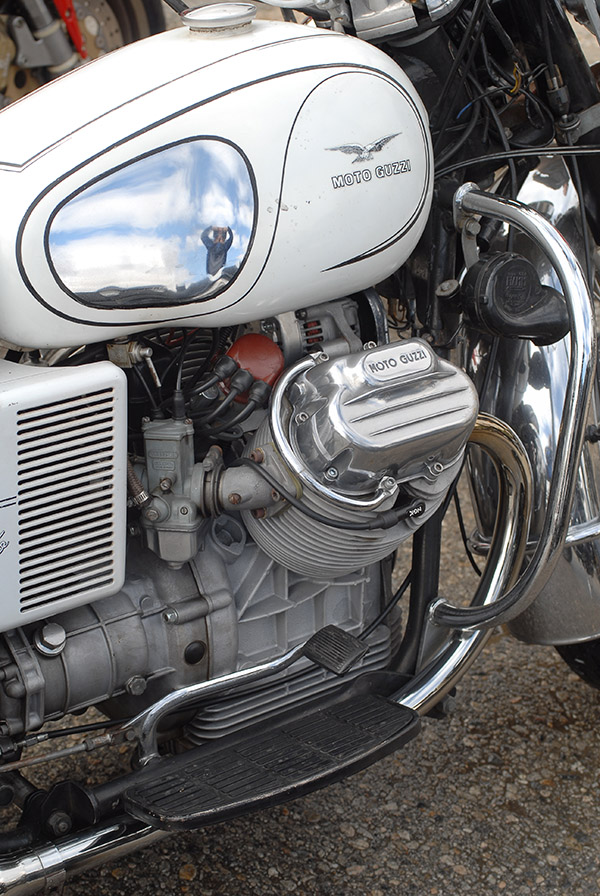
I shot this photo at Hansen Dam, too. I always wanted a mid-’60s Moto Guzzi. Never scratched that itch, though. They sound amazing. Imagine a refined Harley, and you’d have this.
Moto Guzzi’s air-cooled V-twins are in a class by themselves. I love the look and the sound of an air-cooled Guzzi V-twin. It’s classy. I like it.
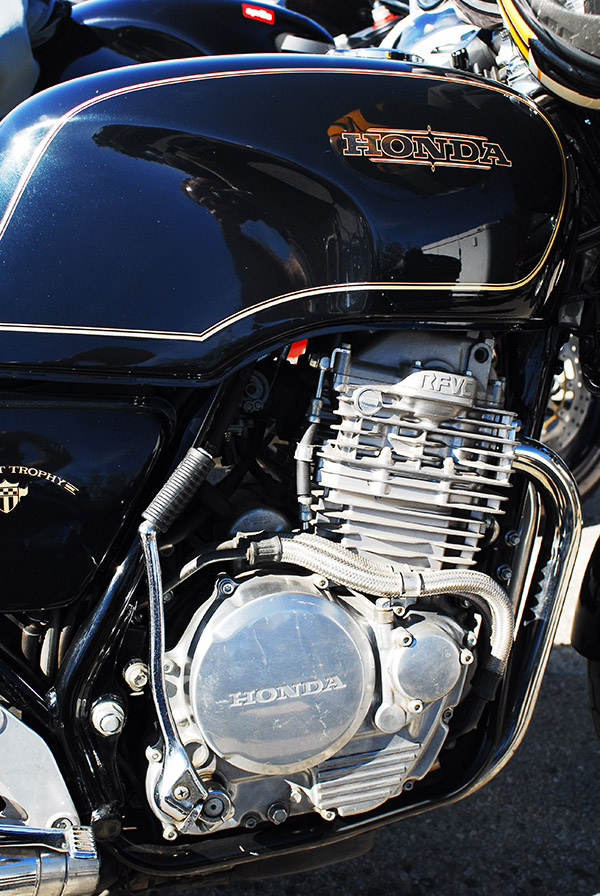
Some motorcycle manufacturers made machines that were mesmerizing with but a single cylinder, so much so that they inspired modern reproductions, and then copies of those reproductions. Consider Honda’s GB500, and more than a few motorcycles from China and even here in the US that use variants of the GB500 engine.
The Honda GB500, Honda’s nod to earlier British singles. It’s another one I always wanted.
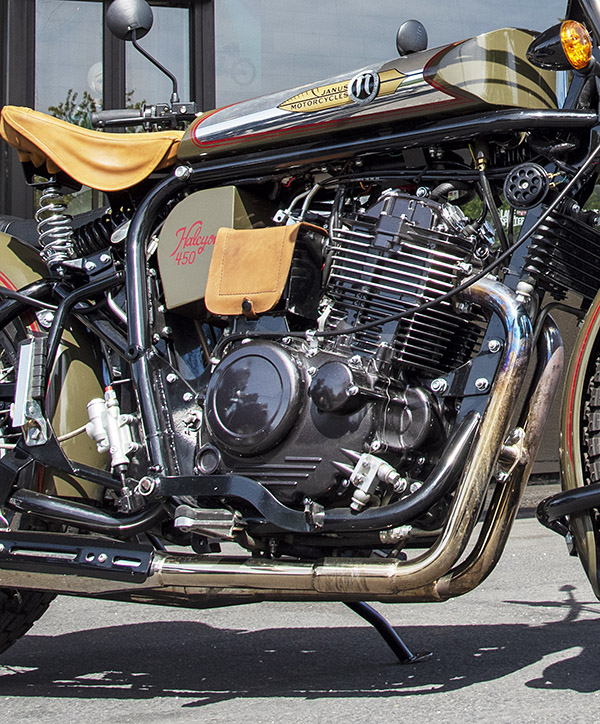
The GB500 is a water cooled bike, but Sochoiro’s boys did it right. The engine is perfect. Like I said above, variants of that engine are still made in China and Italy; one of those engines powers the new Janus 450 Halcyon.
The Janus 450 Halcyon I rode in Goshen. That resulted in a feature story in Motorcycle Classics. It’s engine is by SWM in Italy, which is a variant of the Chinese copy of the GB500 engine. I liked the Janus.
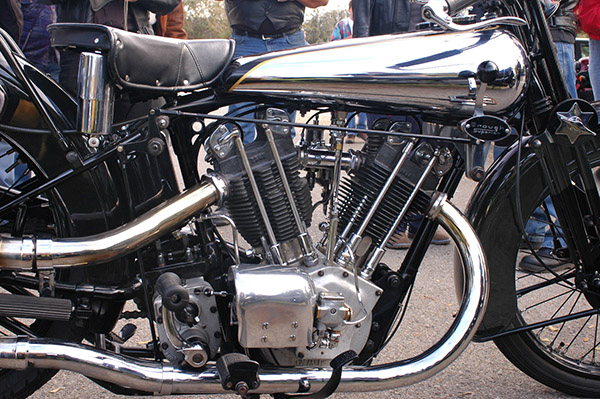
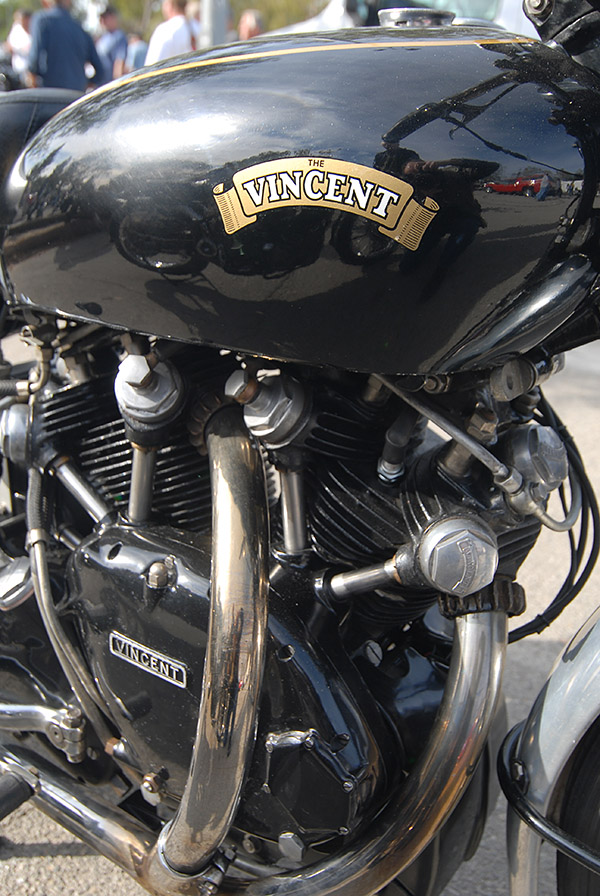
No discussion of mechanical magnificence would be complete without mentioning two of the most beautiful motorcycles ever made: The Brough Superior SS100 and the mighty Vincent. The Brits’ ability to design a visually arresting, aesthetically pleasing motorcycle engine must be a genetic trait. Take a look at these machines.
The Brough Superior SS100. Its engine had a constant loss lubrication system. This is the same motorcycle Lawrence of Arabia rode. One of my grandsons is named T.E. Lawrence.The mighty Vincent. This and the Brough Superior above were both photographed at Hansen Dam.
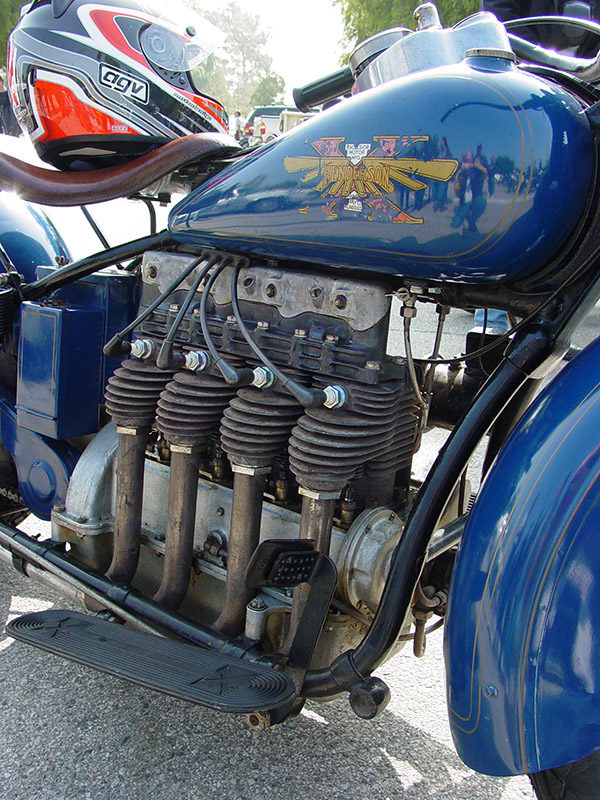
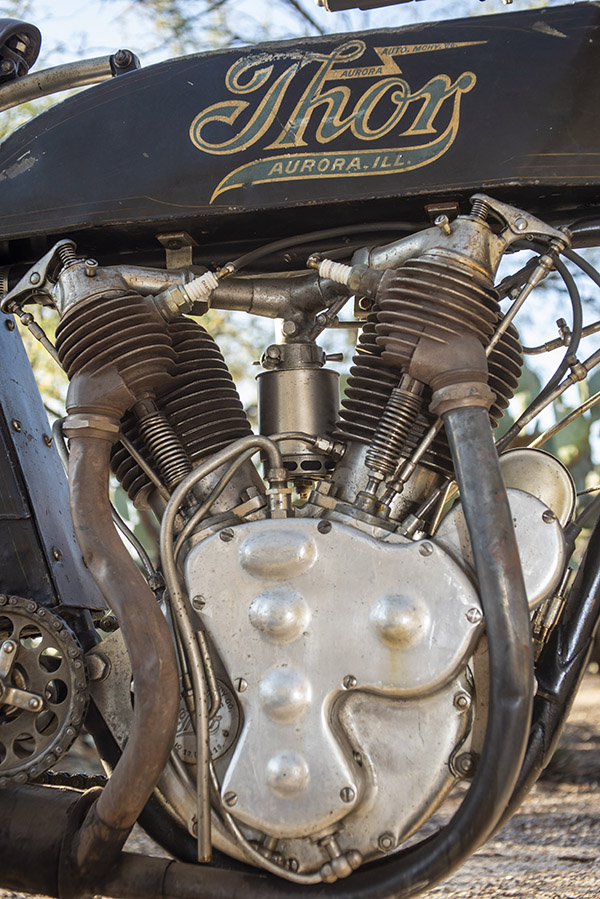
Two additional bits of moto exotica are the early inline and air-cooled four-cylinder Henderson, and the Thor, one of the very first V-twin engine designs. Both of these boast American ancestry.
Jay Leno’s 1931 Henderson. He told me he bought it off a 92-year-old guy in Vegas who was getting a divorce and needed to raise cash, and I fell for it.
The Henderson you see above belongs to Jay Leno, who let me photograph it at one of the Hansen Dam Norton gatherings. Incidentally, if there’s a nicer guy than Jay Leno out there, I haven’t met him. The man is a prince. He’s always gracious, and he’s never too busy to talk motorcycles, sign autographs, or pose for photos. You can read about some of the times I’ve bumped into Jay Leno at the Rock Store or the Hansen Dam event right here on ExNotes.
A Thor V-twin photographed at the Franklin Auto Museum in Tucson, Arizona. You almost need a four-year mechanical engineering degree to start one of these. Thor made the first engines for Indian.
Very early vintage motorcycles’ mechanical complexity is almost puzzle-like…they are the Gordian knots of motorcycle mechanical engineering design. I photographed a 1913 Thor for Motorcycle Classics (that story is here), and as I was optimizing the photos I found myself wondering how guys back in the 1910s started the things. I was able to crack the code, but I had to concentrate so hard it reminded me of dear departed mentor Bob Haskell talking about the Ph.Ds and other wizards in the advanced design group when I worked in the bomb business: “Sometimes those guys think so hard they can’t think for months afterward,” Bob told me (both Bob and I thought the wizards had confused their compensation with their capability).
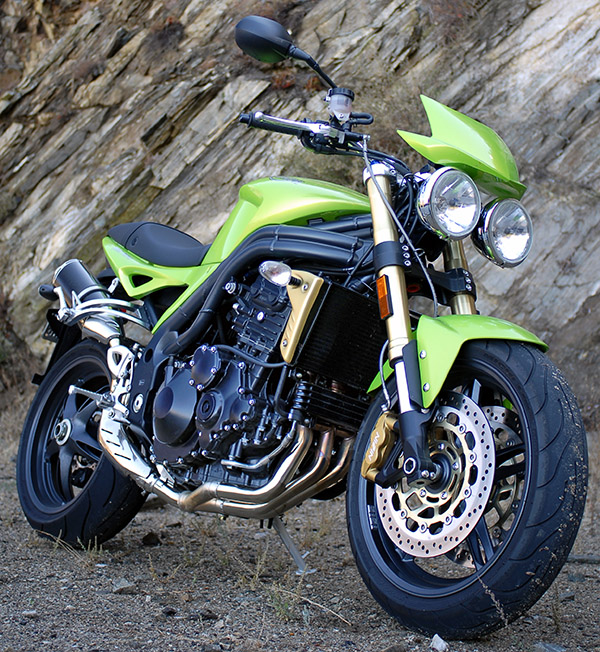
There’s no question in my mind that water cooling a motorcycle engine is a better way to go from an engineering perspective. Water cooling adds weight, cost, and complexity, but the fuel efficiency and power advantages of water cooling just can’t be ignored. I don’t like when manufacturers attempt to make a water-cooled engine look like an air-cooled engine with the addition of fake fins (it somehow conveys design dishonesty). But some marques make water cooled engines look good (Virgil Elings’ comments notwithstanding). My Triumph Speed Triple had a water-cooled engine. I think the Brits got it right on that one.
My 2007 Triumph Speed Triple. Good buddy Marty told me some folks called these the Speed Cripple. In my case, that turned out to be true, but that’s another story for another blog.My 2015 CSC RX3. Before you go all nuts on me and start whining about Chinese motorcycle quality, I need to tell you I rode these across China, through the Andes Mountains in Colombia, up and down Baja a bunch of times, and all over the American west (you can read about those adventures here). It was one of the best and most comfortable bikes I ever owned.
Zongshen is another company that makes water-cooled engines look right. I thought my RX3 had a beautiful engine and I really loved that motorcycle. I sold it because I wasn’t riding it too much, but the tiny bump in my bank account that resulted from the sale, in retrospect, wasn’t worth it. I should have kept the RX3. When The Big Book Of Best Motorcycles In The History Of The World is written, I’m convinced there will be a chapter on the RX3.
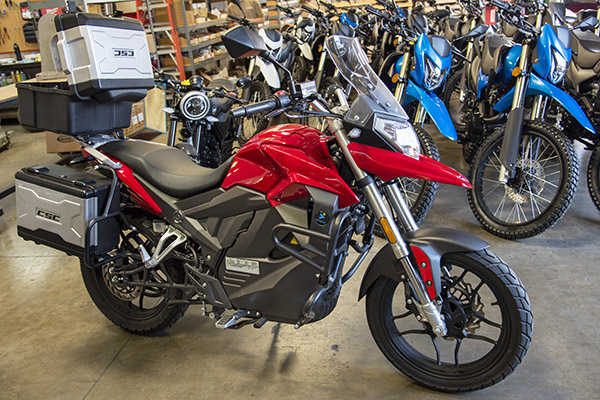
The future of “motor” cycling? This is the CSC RX1E. I rode it and liked it. The silence takes some getting used to.
With the advent of electric motorcycles, I’ve ridden a few and they are okay, but I can’t see myself ever buying one. That’s because as I said at the beginning of this blog, for me a motorcycle is all about the motor. I realize that’s kind of weird, because on an electric motorcycle the power plant actually is a motor, not an internal combustion engine (like all the machines described above). What you mostly see on an electric motorcycle is the battery, which is the large featureless chingadera beneath the gas tank (which, now that I’m writing about it, isn’t a gas tank at all). I don’t like the silence of an electric motorcycle. They can be fast (the Zero I rode a few years ago accelerated so aggressively it scared the hell out of me), but I need some noise, I need to feel the power pulses and engine vibration, and I want other people to hear me. The other thing I don’t care for is that on an electric motorcycle, the power curve is upside down. They accelerate hardest off a dead stop and fade as the motor’s rpm increases; a motorcycle with an internal combustion engine accelerates harder as the revs come up.
Wow, this blog went on for longer than I thought it would. I had fun writing it and I had fun going through my photo library for the pics you see here. I hope you had fun reading it.
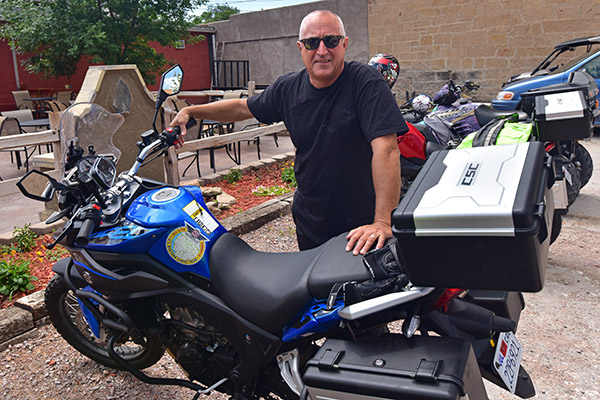
We were a swarm of 250cc bees bound for Medicine Bow, Wyoming. I didn’t know why that excited me and I didn’t know what to expect, but the place sounded romantic. Not romantic in the sense of female companionship; it was instead the romance of the Old West. Medicine Bow, Wyoming, and we were headed there on our single-cylinder Zongshen motorcycles. We had been on the road for a week, showing the American West to our Chinese and Colombian visitors. It all started on the other side of the world in Chongqing when Zongshen asked if I could take them on a ride though America.
Wow, could I ever.
Susie took this photo as I was showing the Zongshen execs where we might ride in America. The guy on my immediate right is good buddy Fan, who follows the ExNotes blog.
Medicine Bow. It had a nice ring to it. I was thinking maybe they had a McDonald’s and we could have lunch there. I think the reason Medicine Bow sounded so intriguing is I had heard it maybe dozens of times in western movies and television shows. Medicine Bow was one of the major destinations for cattle drives in the 1800s, where cows boarded trains for their one-way trip east, where they would stop being cows and become steaks. An average of 2,000 cows shipped out of Medicine Bow every day back then. That would keep McDonald’s going for a day or two (except there were no McDonald’s in the 1800s).
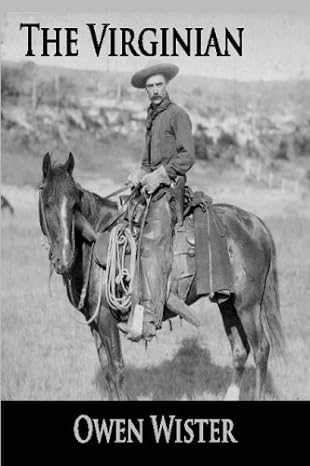
The very first western novel.
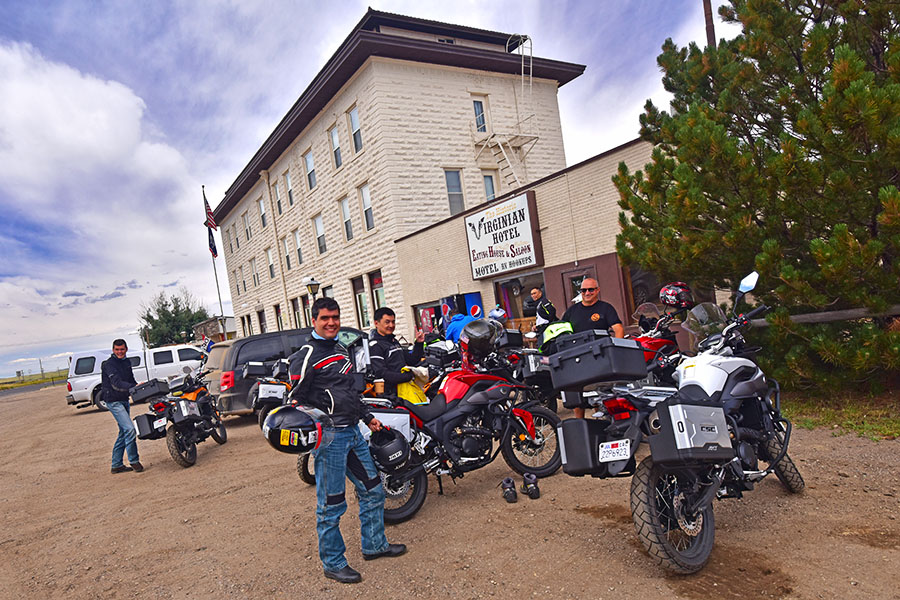
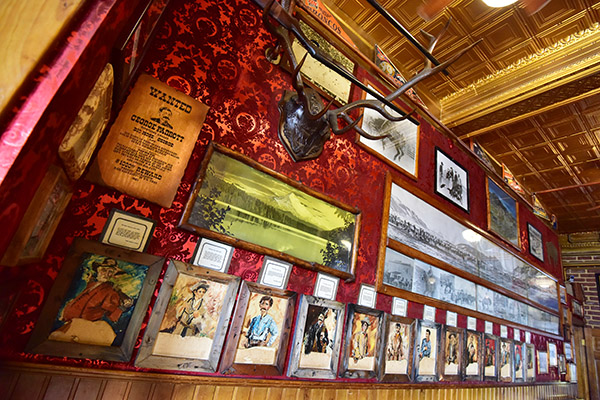
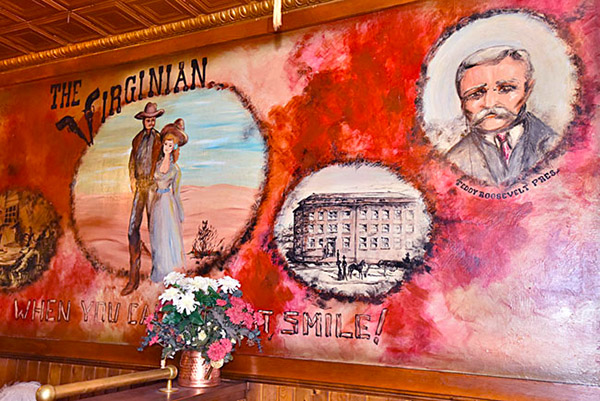
I was surprised when we buzzed in. Medicine Bow is about five buildings, total, none of them was a McDonald’s, but one was the Virginian Hotel. It’s the hotel you see in the photo at the top of this blog and as you might imagine there’s a story to it. You see, back in the day, the first western novel ever was written by a dude named Owen Wister, and the title of his book was The Virginian. It was later made into a movie. The story is about a young female schoolteacher who settled in Medicine Bow and two cowboys who vied for her attention. When the historic hotel was later built in Medicine Bow, what other name could be more appropriate than The Virginian? And about the name of the town, Medicine Bow? Legend has it that Native Americans found the best mahogany for making bows (as in bows and arrows) in a bend (a bow) along the Medicine River, which runs through the area. I can’t make up stuff this good.
I was the designated leader of the Zongshen swarm on this ride. My job was easy. All the mental heavy lifting and deep thinking fell to good buddy and long-time riding compañero Baja John, who planned our entire 5,000-mile journey through the American West. John did a hell of a job. The roads he selected were magnificent and the destinations superb. It’s also when I first met Joe Gresh, who was on assignment from Motorcyclist magazine to cover our story (more on that in a bit).
Big Joe Gresh, or “Arjiu” as the Chinese called him, on our 5000-mile ride through the American West.
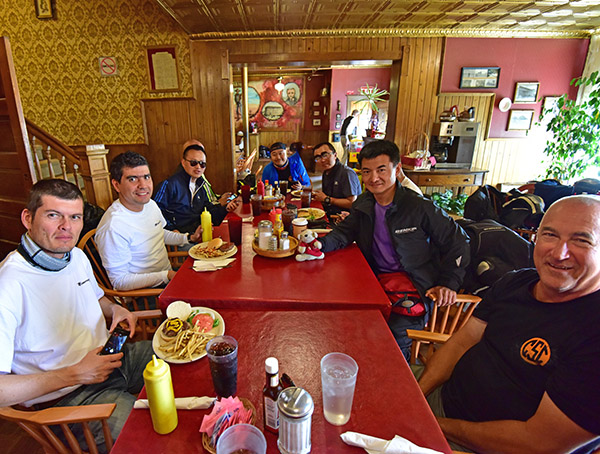
Back to Medicine Bow, the Virginian Hotel, and a few of the photos I grabbed on that ride. The place is awesome, and the Virginian is where we had lunch.
Lunch at the Virginian. That’s Gresh on the right, and Juan and Gabe (two dudes from AKT Motos in Colombia) on the left. A few months later I rode with Juan in Colombia, another grand adventure.
After lunch, we wandered around the hotel for a bit. It would be fun to spend the night in Medicine Bow, I thought. Dinner at the hotel and drinks in the bar (as I type this, I can almost hear someone on the piano belting out Buffalo Gal). I will return some day to check that box.
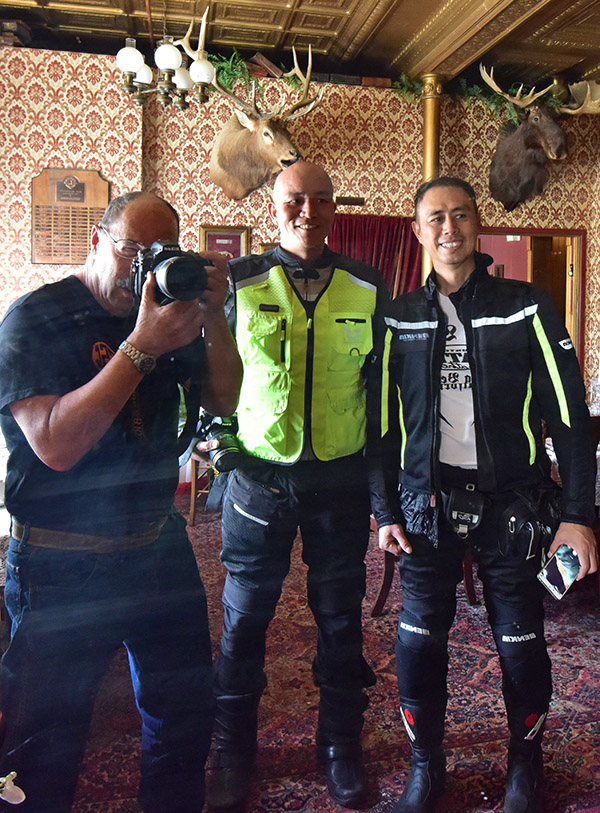
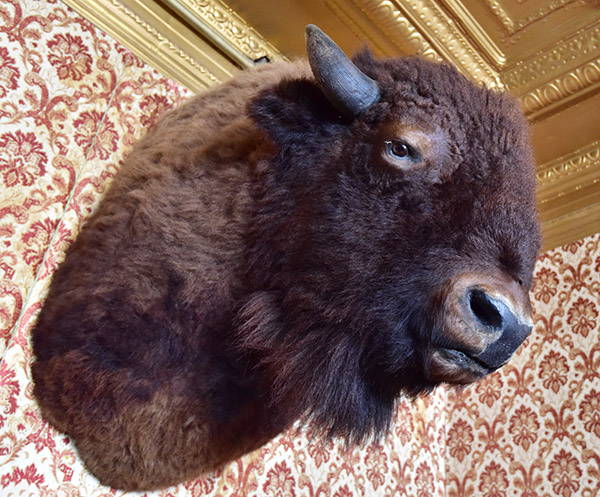
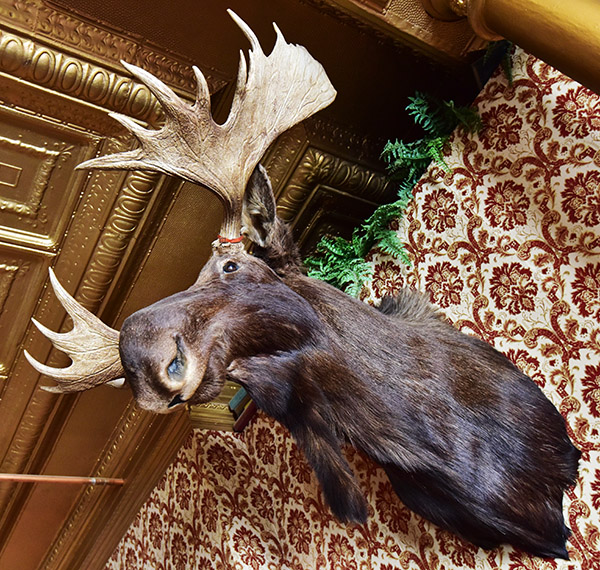
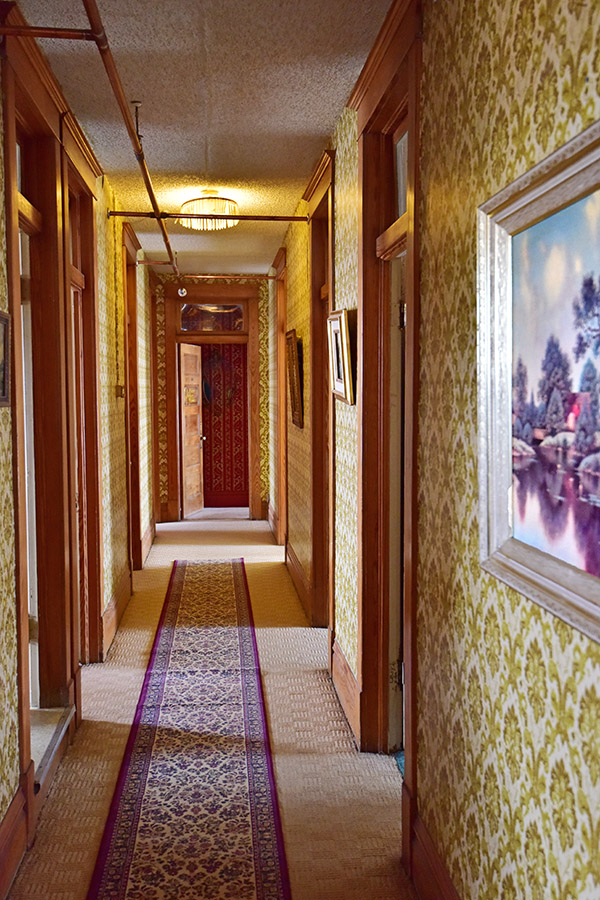
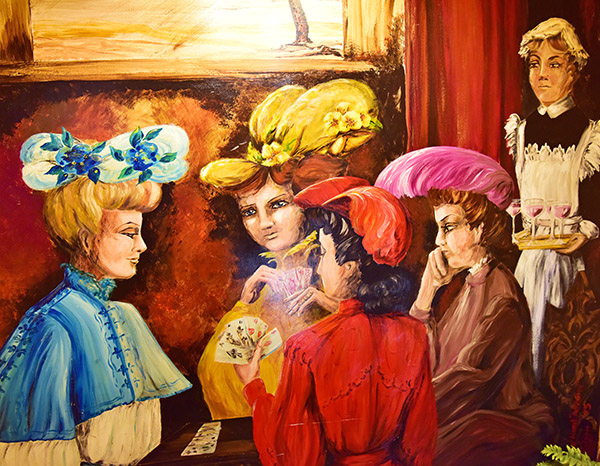
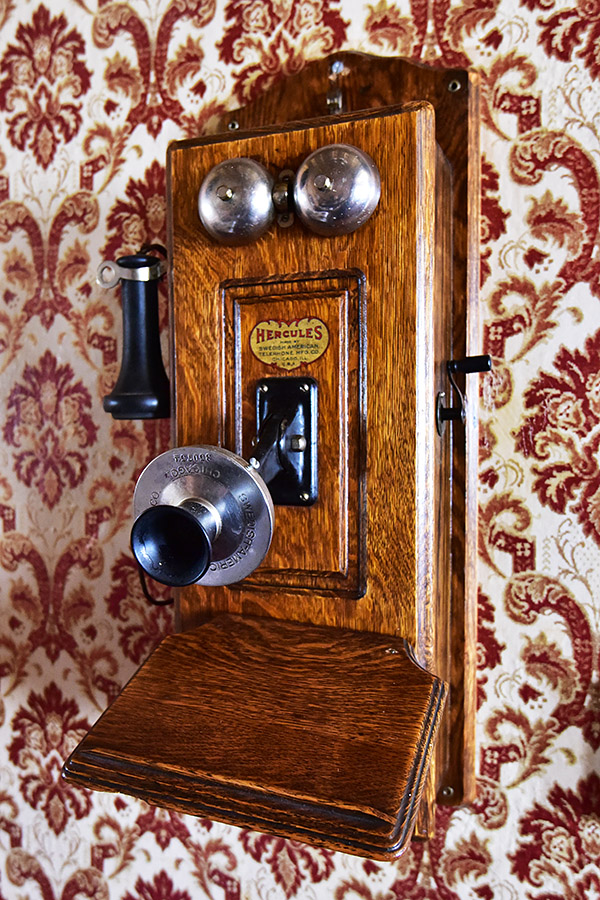
The lighting isn’t great in this selfie (of sorts). Yours truly on the old D200, Lester, and Mr. Zuo. Lester is a teacher in China. Mr. Zuo owns a motorcycle jacket company in China.Bison. We saw a few live ones in the next couple of days.Who’s a good boy? That’s Baja John and Lester, taking a break after a great lunch at the Virginian Hotel. Lester came to America as a vegetarian. That lasted about two days. He sure enjoyed his hamburger at the Virginian. He told us he wants to be like Baja John when he grows up.Yes, there are moose in Medicine Bow, along with mountain lion, bear, elk, deer, and a host of other animals. Theodore Roosevelt hunted this part of the world.A Virginian Hotel hallway. I think you can still stay here overnight.Hotel hallway art.Even a public telephone.
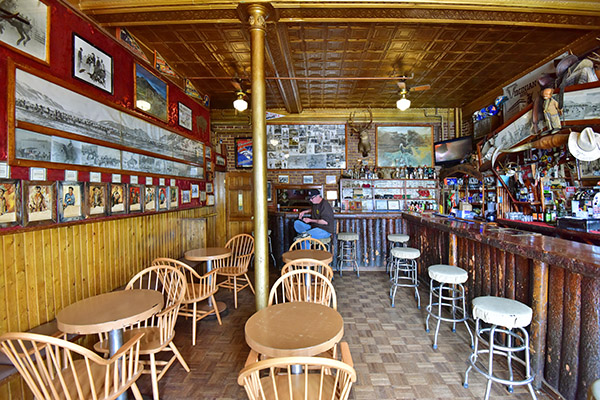
The Virginian Hotel bar was indeed inviting and I could have spent more time there, but we were on the bikes and my rule is always no booze on the bikes. I grabbed a few photos. We had more miles to make that afternoon and more of Wyoming awaited.
The Virginian Hotel bar. It looks like it would be a fun spot to have a beer or three at the end of the day.Photos and artifacts on one of the Virginian Bar walls.A mural in the Virginian Hotel bar
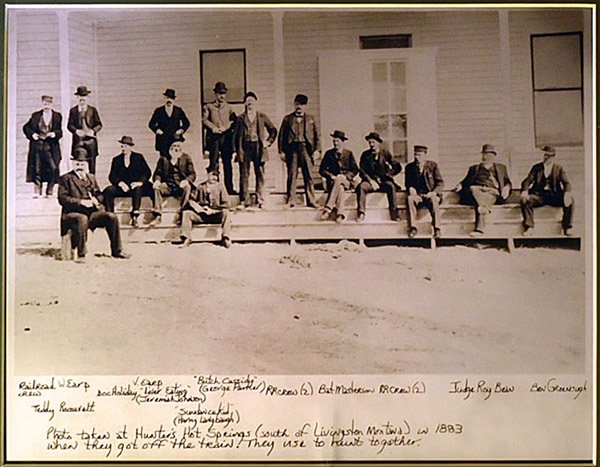
The Virginian Hotel owner (who looked like he could have been someone right out of Central Casting) saw our interest in photography and showed us this photograph. He told me only six or seven copies of it exist. Spend a minute reading the writing…it is amazing.
There are more than a few interesting characters depicted in this photo.
Medicine Bow was a fun visit, it is a place I would like to see again, and it has a palpable feel of the Old West. It was a place where we could have stayed longer, but after lunch it was time for Happy Trails and we were on the road again. I felt like a cowboy, I suppose, swinging my leg over my motorcycle. Instead of “giddy up” it was a twist of the key and a touch on the starter button; the result was the same as we continued our trek west with Frankie Lane’s Rawhide on repeat in my mind: Keep rollin’, rollin’ rollin’, keep those motos rollin’…
In a few hours, we’d be riding into the sunset. Lord, this was a fantastic ride.
Here are a couple of videos you might like. The first is about Medicine Bow, the second is Joe Gresh’s video covering the ride. And one more thing…don’t miss Joe Gresh’s magnificent story about our ride in Motorcyclist magazine.
That’s me that I’m talking about in the title of this blog and the story is a Riding China excerpt. Joe Gresh and I rode with a group of Chinese riders on a 38-day motorcycle ride around China. This is a small part of it describing the ride into Beijing.
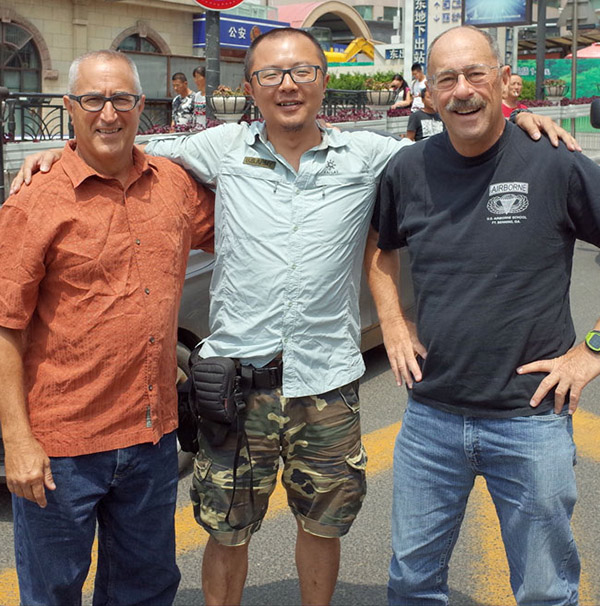
Gresh, King Kong, and yours truly in China. I’m the bugeyed old bastard on the right (after the swelling subsided).
Traffic was moving but it was heavy, and Chinese drivers in cars do not respect motorcycles. If they want to occupy your spot on the road, they just move over. It’s not that they don’t see you; they just don’t care. You’re a motorcycle. They’re a car. They know who’s going to win. At very low speeds in city traffic, you can scream at them or maneuver away or stop. At freeway speeds if you don’t get out of the way, you’re a hood ornament or a big wet spot on the asphalt. Our Chinese riders’ propensity to ride on the shoulder all the time suddenly made sense to me.
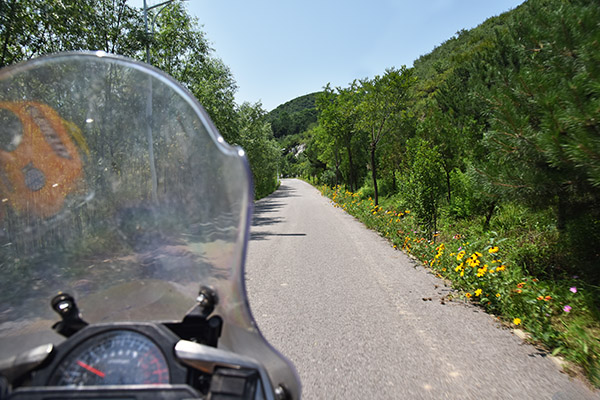
On a quiet road in China. China has delightful country roads and modern freeways. We weren’t supposed to take our motorcycles on the freeways, but we didn’t do too well with rules. We literally rode thousands of miles, all of it illegal, on Chinese freeways.
It was dark well before we reached our hotel that night and we had to ride about 45 minutes or so after the sun set. The Asian-configuration RX3 headlight is not very bright (our US bikes are much better), and to make a bad situation worse, as I have mentioned before I don’t see too well in the dark. To see a little better that night, I lifted my visor. Even though it was a clear visor it still has a slight tint to it and when I lift it at night I can see better.
In the motorcycle world, there’s another term that’s similar to ATGATT (you know, all the gear, all the time). It’s “visor down.” What it means is that you should keep your helmet visor down all the time. The reason is obvious: You don’t want to get whacked in the eye with whatever is floating in the air. That night, I proved that “visor down” makes sense. I caught a bug smack in my right eyeball. It hurt immediately, but I could still see. At that point, I put the visor down, but it was a classic case of closing the barn door after the horse got away.
We arrived at the hotel about 20 minutes later. I was tired and cranky. I went to my hotel room in a blue funk. Gresh tried to calm me down, but he was fighting a losing battle. “We have a couple of good rolls of toilet paper in this room,” he said. That was a good point and it was definitely something to be happy about, but it didn’t help me feel any better.
I really didn’t want to eat dinner that night, but I decided that bagging dinner would be too rude. So I went and I sat next to Sean. After some small talk, he noticed my eye. He was shocked. I had not seen myself in the mirror and I guess it looked pretty bad. My eye wasn’t white anymore; it was mostly red and swollen. Okay, I’ve been whacked in the eye by bugs before. I knew it would be red and it would bug me (pardon the pun) for a couple of days, and then it would be okay.
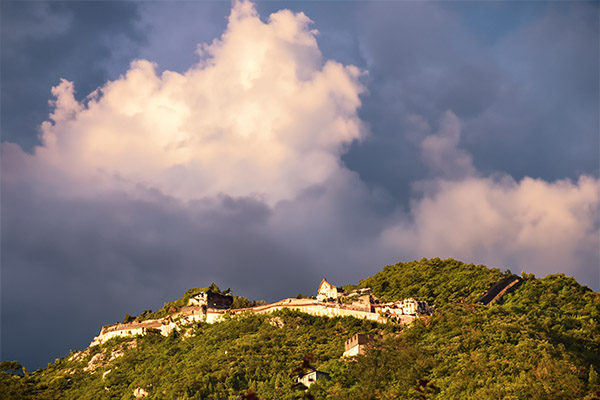
Yep, that Great Wall.
We rode through the countryside the next day to see the Great Wall at another location, but I still wasn’t over being upset and cranky from the night before. When I lead rides in the US or in Mexico that last for more than a weekend, there’s usually one guy in the group that will get cranky at some point. I had thought about that before this ride and I realized that on a ride lasting over five weeks someone would get to that point. I just didn’t think that guy would be me. But it was. I was tired, my eye was jacked up, and the stress of watching out for Chinese drivers was getting to me.
Dong drifting toward Beijing.
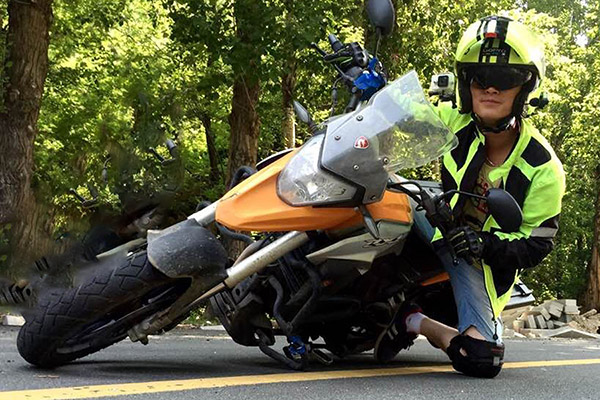
The next morning, I missed grabbing a good photo because of that. We were riding to see the Great Wall at a different location. On a lightly-traveled mountain road on a curve, we all stopped and Dong intentionally laid his RX1 on its side in the middle of the lane. He got on the bike with his knee out and had one of the other guys photograph him from the front (to make it look like the bike was leaned way over in the corner and he was dragging his knee). I think nearly everyone got their photo on the bike, but I declined. I just wasn’t in the mood. I think Dong knew I wanted that photo, though, and after I had returned to the US, he emailed a copy to me. (It’s the photo you see above.)
When we got to the Great Wall that morning it involved a considerable hike up a steep hill to get close enough to touch it. I’ve done that on prior visits, so I didn’t want to do it that day. Four of us opted to wait while the rest of the guys made the hike. It was relaxing. Wong, Zuo, Furem, and I shared a bag of peanuts Sean had left in his car while we waited for the others to return.
As we were riding back to the hotel from that location, heading downhill through the mountains the same way we had ridden in, I started slowing down. I didn’t realize it at first, but eventually I was the last guy in our formation. Then I started riding even more slowly, until the rest of the guys were so far ahead of me I couldn’t see them. My eye was still bothering me and by now I was having some problems seeing well. To add fuel to that fire, my left shoulder was hurting (I have a pinched nerve somewhere in there and it bothers me on long motorcycle rides).
But there was more to what I was feeling than just what I described above. Something was going on. I suppose a shrink would call it an anxiety attack. I was driving around every twist in the road expecting to see a truck stopped in my lane, an oncoming truck passing another vehicle in my lane, a person sweeping the street in the middle of the turn in my lane, a guy pulling out right in front of me, a bus making a U-turn in front of me, a car cornering too hard drifting into my lane, someone going the wrong way in my lane, someone pulling into my lane without looking, an old woman walking directly in front of me, people stopping to have a conversation in the middle of the street, or someone squatting down to take a dump (in my lane, of course). On this trip, I had seen all of what I just described and more. What was happening that morning was the enormity of the insanity that is riding a motorcycle in China caught up with me. Yeah, it was an anxiety attack. The nuttiness of it all, my vulnerability being on a motorcycle, and my inability to do anything about it was suddenly overwhelming.
The guys were waiting for me at the next intersection, and from there we went to a Sinopec gas station to refuel the bikes. It was hotter than hell. I guess it was fair to say I was miserable. I was still feeling all of this accumulated anxiety when a guy in a black Mercedes starting blasting his horn at me in that gas station parking lot. He didn’t want to drive around me; he wanted me to move even though there was plenty of room for him to go around. It was more of the “I’m a car, you’re a motorcycle” bullshit that is pervasive in China.
I don’t know what came over me, but I think I just got supremely tired of being the vulnerable victim. I looked directly at that Mercedes driver. I made eye contact. He looked at me, not realizing I was here with eight other guys on motorcycles. I eased the clutch out until my bike was directly alongside his window (which was open). I then leaned on my horn and let it rip for a good solid 20 seconds. Then one of the other Chinese riders watching me did the same, and yet another yelled a really bad word at the Mercedes (which he probably learned from either Gresh or me). It was pretty funny, especially hearing that kind of profanity with a Chinese accent. The guy in the Mercedes had screwed with the wrong Marine on the wrong day. Without realizing it, he took on the Wild Angels that hot afternoon just outside of Beijing. He suddenly and fully realized what might happen as a result of his boorishness. He rolled up his window, he averted his eyes, and he backed his big black Mercedes respectfully away from us. That broke the spell. I wasn’t helpless any more. I felt amazingly better.
Okay, enough about me being a butthead: On to Beijing proper. We stopped at the Beijing Zongshen dealer that afternoon (where they were expecting us) and it was the Dajiu and Arjiu show all over again.
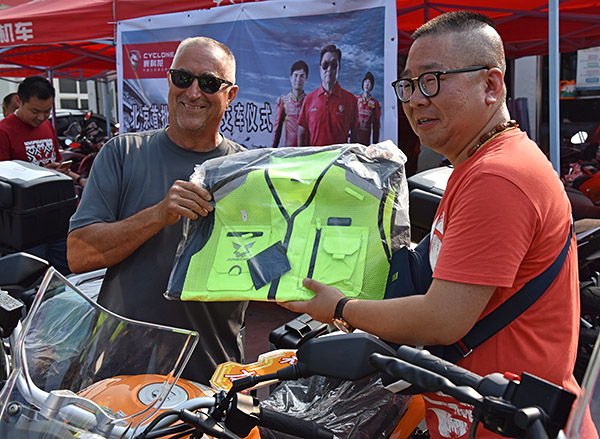
Gresh presenting a vest to a Zongshen rider. They thought we were celebrities.
There were the usual tons of photos with Gresh and me. Hey, how often do Dajiu and Arjiu show up in your neighborhood? Tracy told us the dealer had just sold five new RX1s. He wanted to have a ceremony in which we gave the keys and Zongshen fluorescent vests to the five lucky guys who had purchased the bikes. I was feeling my old self again. I saw an opportunity and I took it.
“We’ll do it this time, Tracy,” I said, “but if you don’t start doing a better job getting these dealers prepped it will be the last time.” Tracy doesn’t always know when I’m teasing him. I could tell that this was going to be one of those times. Gresh picked up on it, too.
“Yeah!” Gresh said. Joe sometimes has a way with words.
“What is wrong, Dajiu?” Tracy asked, concern and maybe a little fear showing in his eyes.
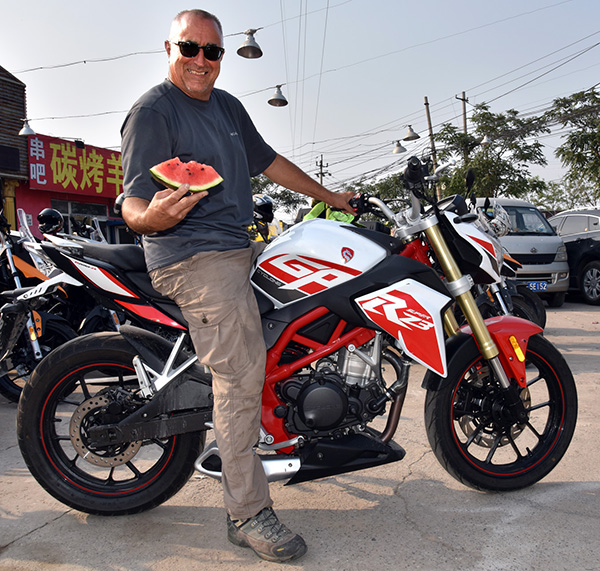
“Where’s the watermelon?” I said. “We’re supposed to have watermelon waiting for us at each dealer visit,” I said.
Joe Gresh on a Zongshen motorcycle and his contractually-mandated chilled watermelon.
“Yeah,” Gresh added, “and it’s supposed to be chilled, too.”
“It’s right there in Section 6, Paragraph 3.2 of the Dajiu and Arjiu contract,” I said, “and there’s no cold watermelon here, Tracy!” (I don’t think I need to mention this for my readers, but I will just in case you were wondering, there is no such thing as a Dajiu and Arjiu contract, let alone any paragraphs about cold watermelon.)
“Ah, I am so sorry,” Tracy said. “It is my bad, Dajiu. I am so sorry.” Then he turned to Gresh, and addressing him as Arjiu, he said the same thing.
“Tracy, relax,” I said. “I’m just screwing with you.” But it was too late. Tracy heard me tell him I was joking, but it didn’t register.
We had a great ceremony and we had fun taking photos and giving those five proud new RX1 owners oversized Styrofoam keys and then their real keys. It was one of the most fun things I did on this entire trip. As we were doing so, I could see Tracy (who had left and returned) slicing several large (and delightfully cold) watermelons on a table in front of the showroom. Hey, a contract’s a contract.
The Beijing dealer had an RZ3, Zongshen’s naked sportbike, parked in front. Gresh was really impressed. I took photos of it and put them on the CSC blog that night, but I couldn’t tell you then what you now know to be the case: CSC is going to bring the RZ3 to North America. I like the RZ3 a lot. It’s essentially the RC3 with a normal seating position and upright bars without the RC3’s bodywork. We’re going to sell a lot of RZ3s. The RZ3 has the RX3 powertrain, and that’s both bulletproof and fast. I already have ideas on how I’m going to customize mine.
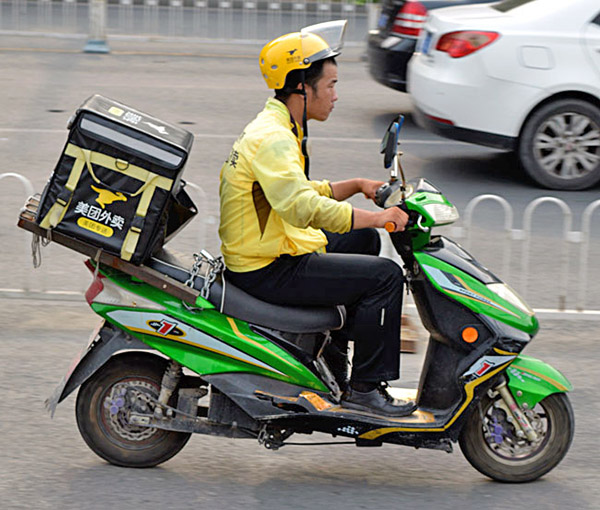
When we got off the subway after visiting The Forbidden City, we waited on a street corner for our Uber ride back to the hotel. I watched the scooters and small utility vehicles rolling by, and I realized that nearly every one of them was electric. I must have seen 200 scooters during the 20 minutes we waited, and perhaps 2 had gasoline engines. This wholesale adaption of electric scooters and small utility vehicles in China is nothing short of amazing.
An electric scooter in China.
Sean explained to me that the transition to electric vehicles started about 15 years ago, and the government has done a number of things to encourage people to convert to electricity. For starters (once again, pardon my pun), many of the larger cities in China now prohibit motorcycles and scooters unless the vehicle is electric. Electric scooters are allowed where gasoline-powered bikes are not. That alone is an enormous incentive. The next incentive is that you don’t need a driver’s license to take an electric vehicle on the street. You just buy one and go. And finally, as I’ve mentioned before, electricity is cheap in China. There are windfarms, solar panel farms, coal plants, nuclear power plants, and hydroelectric power plants all over the country. We saw scooters parked on the sidewalk and plugged into extension cords running into small stores everywhere. People charge them like iPhones; they didn’t miss any opportunity to top off the batteries on these things.
That night was a great night. The Zongshen dealer took us to a restaurant that specialized in Peking duck. The guys were excited about this development, but I was initially leery. I thought I didn’t like Peking duck. Boy, was I ever wrong!
I tried Peking duck 25 years ago when I visited Beijing with Sue. We both thought the duck was awful. That’s because we went to a restaurant that served tourists. The food at that place didn’t have to be good. They knew they would never see us again, and Yelp hadn’t been invented yet.
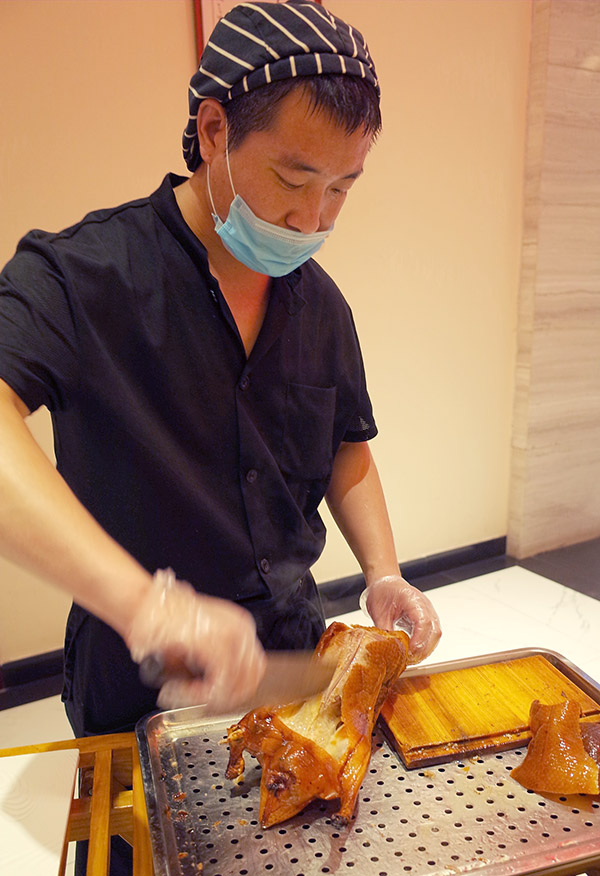
This night in Beijing with the Zongshen dealer and the RX3 owners club was different. The Peking duck was incredible. The chef sliced it paper thin right at our table. They had thin tofu (almost like a crepe), and the guys taught me how to eat duck properly. The deal is you put a few fresh vegetables on the tofu, you add a slice or two of duck, you add this amazing brown gravy, and then you roll the affair up like a burrito. Wow, it was delicious!
Peking Duck, done the way it is supposed to be done, in a Beijing restaurant. It was exquisite. Photo by King Kong.
We had several rounds of toasts at dinner that night and the liquor flowed freely. I got lucky. Kong sat next to me and he schooled me in the proper way to make a Chinese toast. To show respect, you clink your glass against the other guy’s glass, but you hold your glass at a lower level so that when the two glasses meet, the rim of yours is lower than the other person’s. When the Zongshen dealer toasted me, I followed Kong’s advice, and the Chinese riders all nodded approvingly. Ah, Dajiu knows.
It was funny. Sergeant Zuo and I had made several toasts to each other, and when we touched glasses, we both tried frantically to get our glasses lower than the other, so much so that we usually crashed the bottoms of both on the table (to a hearty laugh and round of applause from everyone). Zuo was being polite; I was being completely serious (I have enormous respect for him).
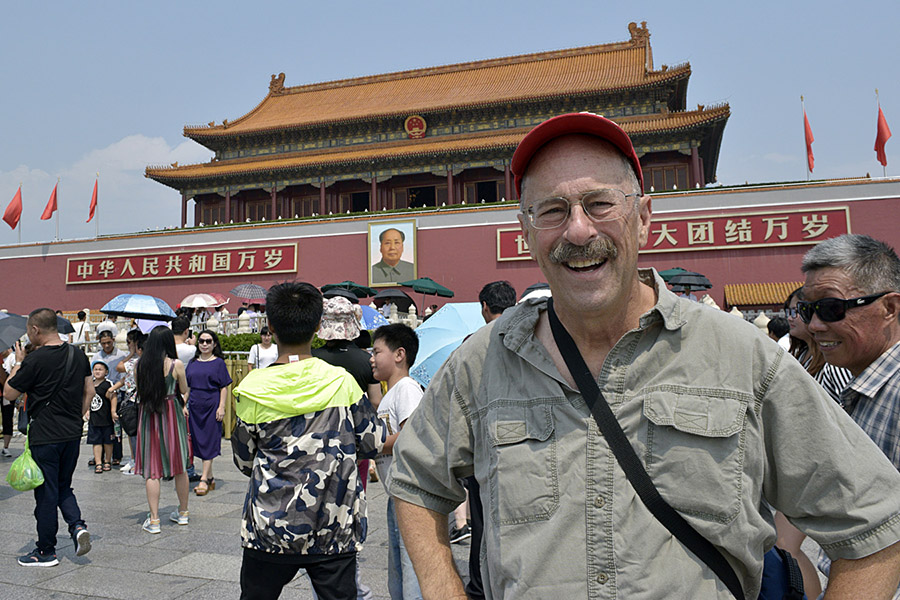
The next day we took the subway into Beijing. We already were in Beijing when we got on the subway, but Beijing is a megacity and you can’t simply drive into the center of it. We rode the subway for a good 45 minutes, and when we emerged, we visited the Forbidden City and Tien An Men Square. It was all grand. It was touristy, but it’s something that should be on any China visitor’s bucket list.
After seeing the Forbidden City, we walked around downtown Beijing for a while. I told Tracy my eye was getting worse and I wanted to get antibiotic eye drops for it. It was Sunday afternoon, but there was a large pharmacy right in front of us and it was open. Tracy went in with me and he told one of the young pharmacists what I wanted. She responded and it didn’t sound good.
“She cannot sell it to you without a prescription,” he told me.
“Well, shoot, Tracy, it’s Sunday afternoon,” I said. “We’re not going to find a doctor. I’ll be okay. Let’s just go.”
“No, it is okay, Dajiu,” he said. “We are China and we have a bureaucracy. It is my bad.”
Good old Tracy, I thought. The guy felt responsible for everything. I was resigned to the fact that my eye was going to take a while to get better. Tracy, in the meantime, had walked not more than 8 feet away to an elderly woman sitting at a wooden table. He spoke to her in Chinese and pointed to me. She never looked at me, nor did she look up. She simply pulled out a white pad with a big “R” at the top. Nah, this can’t be, I thought. She wrote something in Chinese characters and handed the slip to Tracy.
“Our prescription,” Tracy said. “Such a bureaucracy.” He walked the three steps back to the pharmacist, Tracy handed her the prescription, and 30 seconds (and 24 yuan, or about $4) later, I had my antibiotic eye drops. I put two drops in my eye. When we rode out of Beijing the next morning, my eye was good as new.
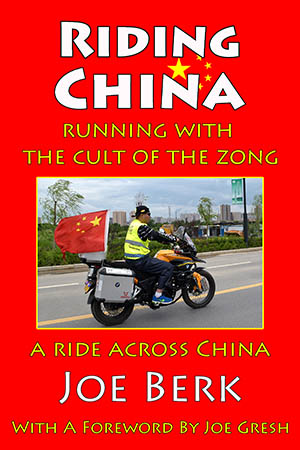
Like the above story? Want more? Pick up your copy of Riding China!
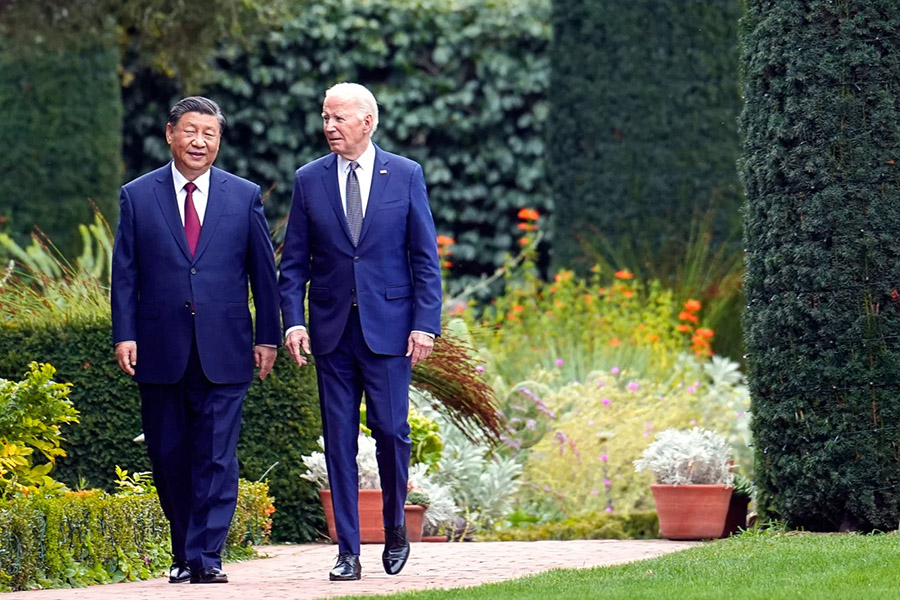
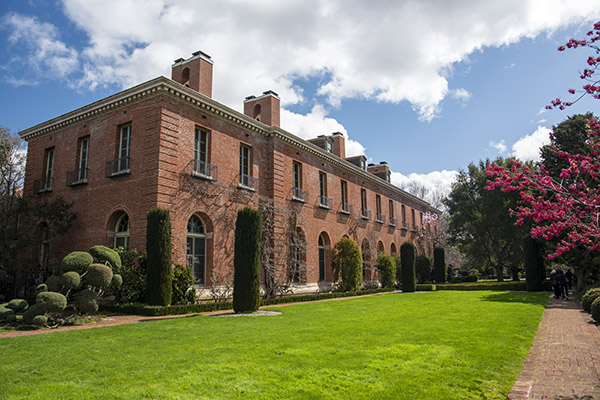
You probably know about the meeting between Joe Biden and Xi Jinping last week. What you might not know about is Woodside, California, and the Filoli estate where they met. As always, we want our ExNotes readers to be knowledgeable and up to date, and that’s the focus of this article. I’ve actually been to and photographed the Filoli estate and mansion, and I’ve written a bit about Woodside before.
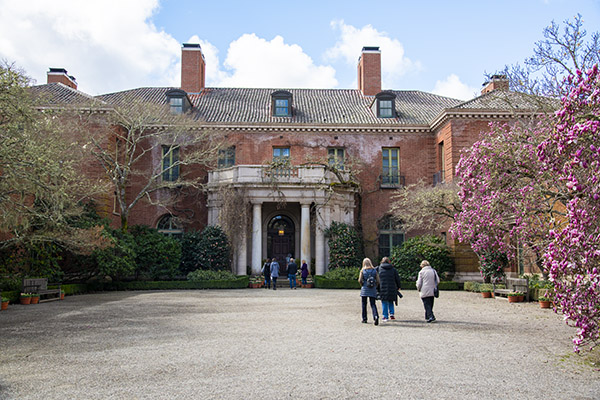
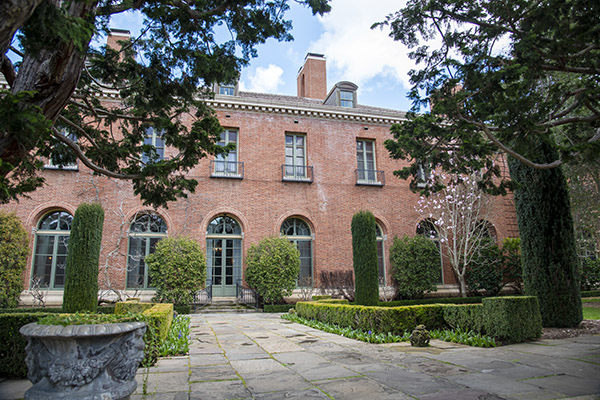
The Filoli mansion was built in 1917 for William Bourn II, who by any measure was a wealthy guy. He owned one of California’s richest gold mines and was president of the Spring Valley Water Company that served San Francisco and its surrounding areas. If you are wondering about the name, it’s formed by the first two letters of each word from of Bourn’s motto: Fight for a just cause; Love your fellow man; Live a good life.
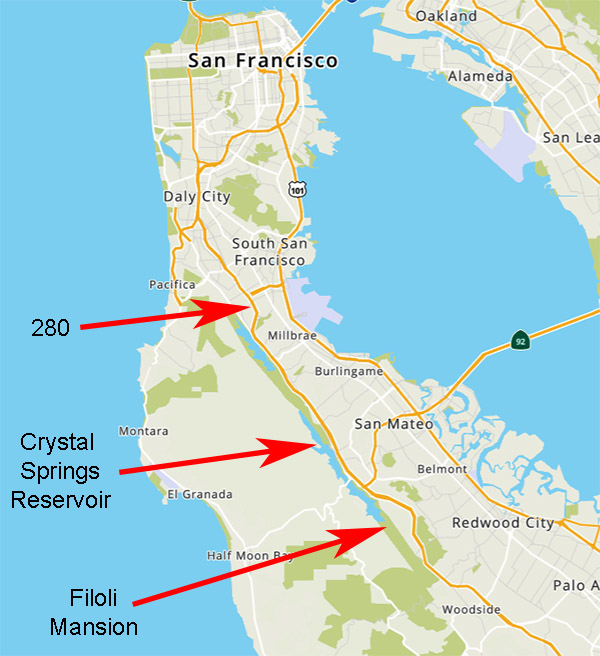
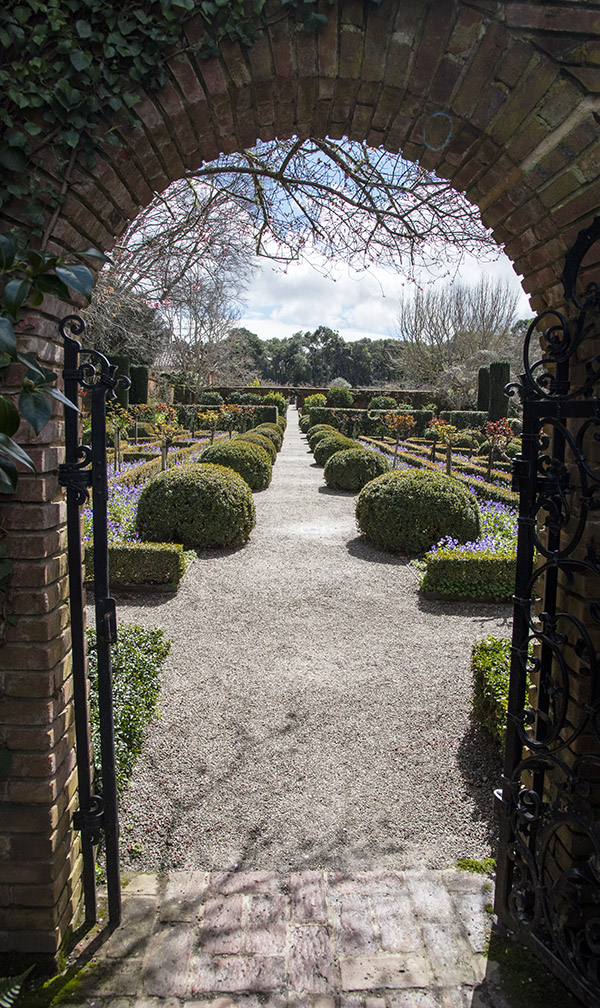
The Filoli mansion and its gardens occupy 16 acres; the entire estate covers 654 acres and extends to the Crystal Springs Reservoir (which still provides water to San Francisco). If you drive south on the 280 freeway from San Francisco (it follows the San Cruz Mountain range), you can see the reservoir on the right.
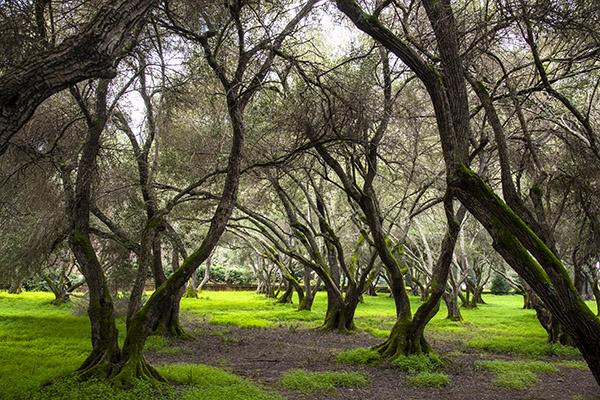
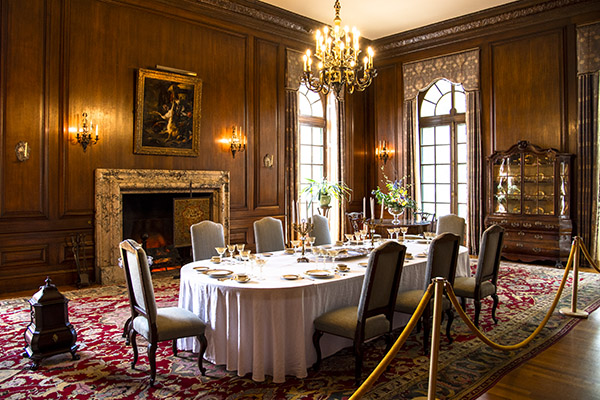
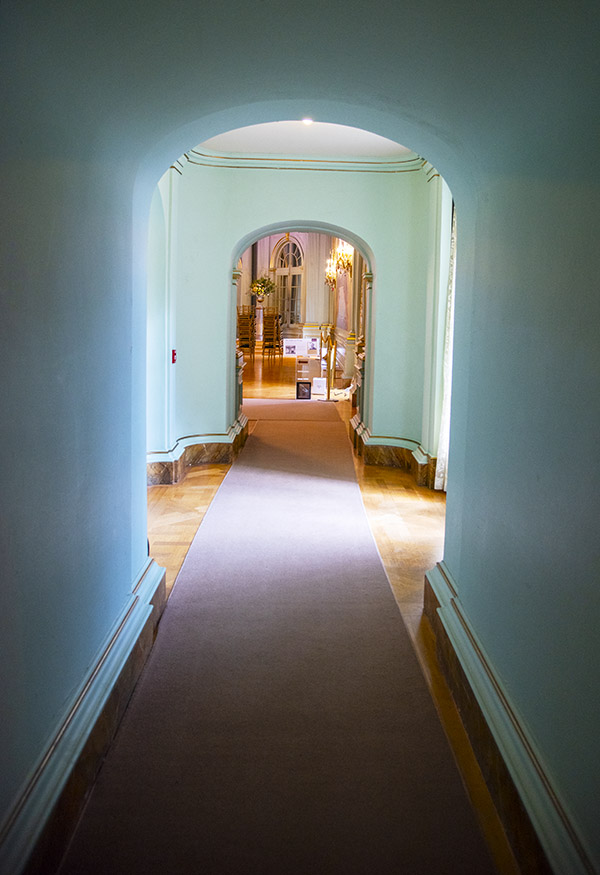
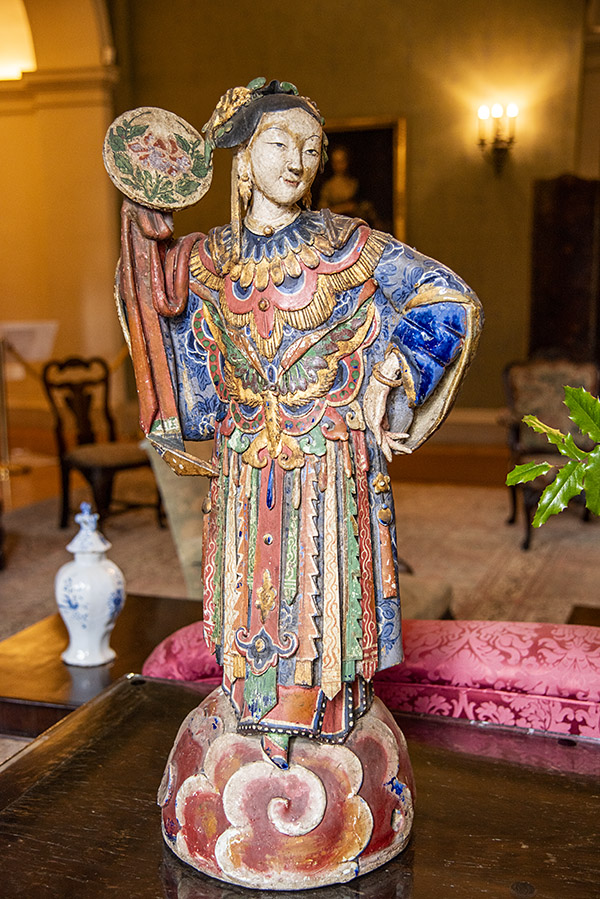
Big mansions are expensive to maintain and hard to keep up. That’s why a lot of the big ones have been donated by the families that owned them to the state or other organizations and opened to the public for tours. It’s what the Hearst family did with Hearst Castle further south, and it is what happened to the Filoli mansion. The Filoli mansion and surrounding grounds are now owned by the National Trust for Historic Preservation. For a modest fee you can visit and walk through the same rooms and gardens as Xi and Biden. It’s cool. I did it in 2019 and here are a few Filoli photos from that visit.
A bit more about the town of Woodside: Woodside is one of the wealthiest places in America. A partial list of the big names who live or have lived in Woodside include Charles Schwab (yes, that Charles Schwab), Steve Jobs, Michelle Pfeiffer (the classiest actress ever), Joan Baez, Nolan Bushnell (the founder of Atari and the Chuck E. Cheese restaurant chain), Scott Cook (the founder of Intuit), Carl Djerassi (a novelist and the guy who developed the birth control pill), Larry Ellison (the CEO of Oracle Corporation), James Folger (as in need a cup of coffee?), Kazuo Hirai (the CEO of Sony), Mike Markkula (the second Apple CEO), Gordon E. Moore (Intel’s co-founder and originator of Moore’s Law), Prince Vasili Alexandrovich (the nephew of Tsar Nicholas II of Russia), Shirley Temple, John Thompson (Symantec’s CEO), and Nick Woodman (founder and CEO of GoPro). Woodside is within commuting distance of Silicon Valley, so it’s understandable, I guess, why so many high-rolling Silicon Valley types call it home.
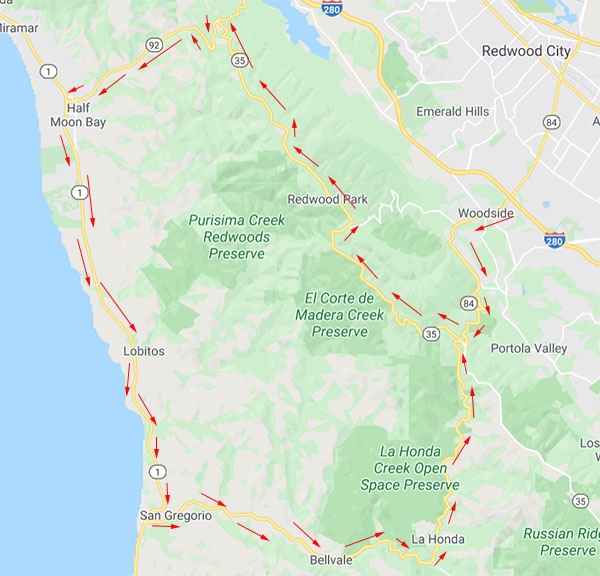
This is an interesting and beautiful area. The Pacific Ocean is just on the other side of the San Cruz range, and a circumnavigation of these mountains makes for a hell of a motorcycle ride (see our earlier blog and the article I wrote for Motorcycle Classics magazine).
I don’t know if Xi and Biden accomplished much during their meeting. If I had organized their visit, I would have left all the entourage folks behind and given Uncles Joe and Xi a map and a couple of RX3 motorcycles. They would have had a better time and probably emerged with a better agreement. A good motorcycle ride will do that for you.
You know, we don’t do politics on ExNotes, but I have to get in a comment here. There ought to be a win-win solution to our current disagreements with China. I think if I could be king of the U.S. for about six months (not President, but King) and good buddy Sergeant Zuo from our ride across China could be King of China for the same time period, we could go for another ride and figure it all out. I’d bring Gresh along to keep it interesting and I’d get another book out of it, too. That’s my idea, anyway.
If you’d like to read more about Joe Gresh’s and my ride across China with Sergeant Zuo, you should pick up a copy of Riding China.
And if you’d like to read about Gresh and me riding across America with the Chinese, you need a copy of 5000 Miles at 8000 RPM.
I have been following this column ever since it hit the blogosphere, and I noticed that nearly all of our ExNotes writers have written about motorcycles they previously owned. This story is about some of the motorcycles and scooters I’ve had. It’s good to look back and cherish the things that have made life fun, and for me, motorcycles and motor scooters have certainly been a big part of that. Since I was a wee lad out on the farm, motorcycles have been my comfort, sanity and spare time hobby. They kept me out of the drinking and drugs my friends were getting into during high school. I opted instead for racing motocross in the mid 1970s when I was in high school. I was a Suzuki mechanic during high school and I loved it (despite all the teenage hormones interfering with my mind).
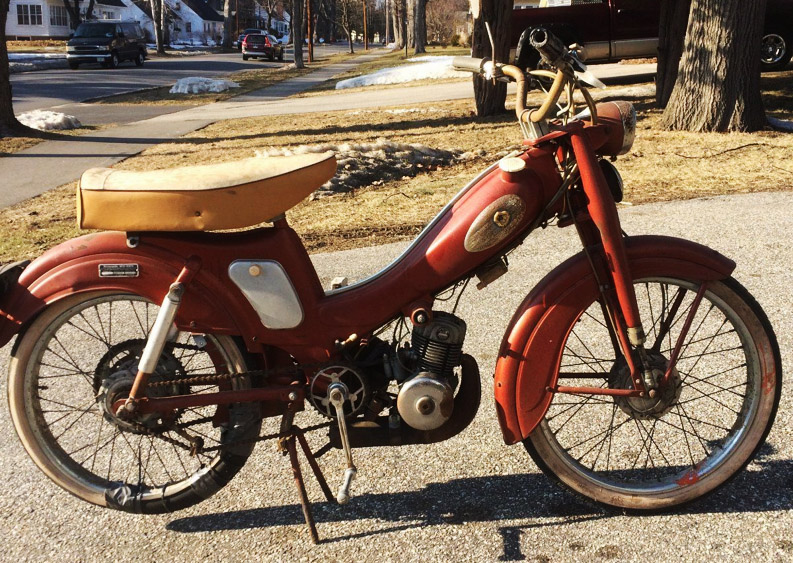
My very first bike was a Motobecane moped, which was also known as our barnyard speedway bike. With a little rain on the manure we could slide that baby around like Mert and the boys at the San Jose mile.
My next bike was a 1969 Hodaka Ace 100, and it was my first love. I spent many hours riding this motorcycle around the farm. I learned how to work on bikes on this motorcycle. They were great bikes.
This next one is a 1969 Maico MC125 motocrosser. I never got to ride or race it. A personal shortcoming is that I like to take things apart to see how they work. I took the rotary carb the off the engine to see how it worked. I then put it back together not realizing the rotary valve needed to go on in a certain way to time it with the piston going up and down. It never ran after that and burned up in the chicken house fire. Now, 50 years later, I know how to fix it. They say we get smart too late. This bike, for me, is one of many things that proves it.
This 1974 Suzuki TM125 was my elixir through high school. I raced it at Puyallup International Raceway’s high school challenge.
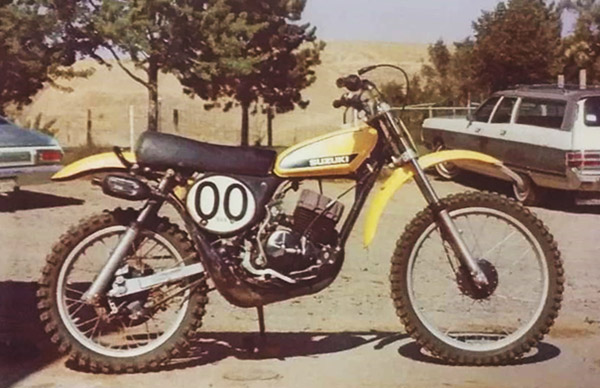
The 1974 Suzuki TM250 was my other elixir through puberty. In my first race I looped it over backwards and they wouldn’t let me race again at the Starbuck track in Washington.
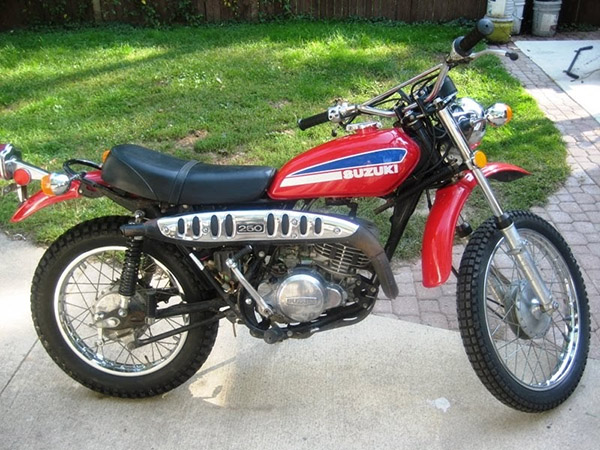
Here’s my 1976 Suzuki TS250. It was my first adventure travel bike and I loved it. I remember its two-stroke motor smoking down Interstate 5. Yeah, baby!
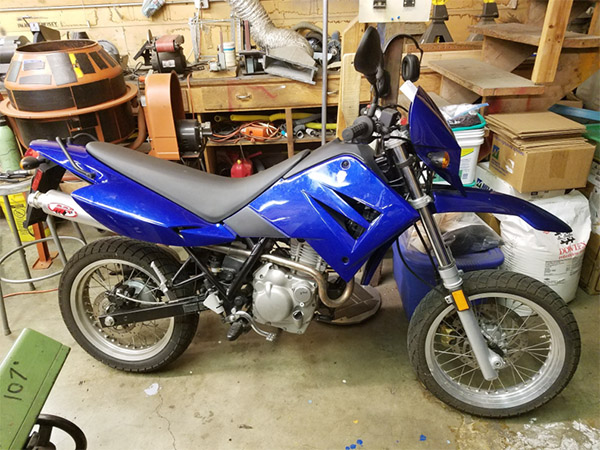
Then it was a series of bikes for which I have the memories but no photos. I had a Honda MT250 enduro that I traded for a Skidoo snowmobile. I should have kept the bike. Then it was a Suzuki GN400 thumper road bike. It was old school cool. Next up was a 1978 Husqvarna OR250 enduro. I broke a rib on crashing that bike going less than 10 miles an hour and I suppose that makes me lucky (that rib was the only bone I ever broke, and I’ve been riding a lot of years). I next had a GY200 Chinese enduro with a Honda-based engine. That was followed by a 1998 DR650 Suzuki, a nice big thumper. I had a Kinlon 150 road bike prototype that I later donated to the Barbour Museum. They resold it at a Mecum auction a few years ago.
Here’s my 1974 Honda MT125 Elsinore project bike. I rode to the Badrock Reunion at Hodaka Days with it a few years back.
My 1986 Husqvarna WR400 was a wonderful bike, but it was too tall and too hard for me to kick start with a bad hip. I think I was over-compensating for something. But the price was good so I bought it.
I had a 1988 Honda NX250, another one that left me fond memories but no photos. It was a nice little enduro with a water-cooled engine and a 6-speed transmission. It was kind of like a CSC RX3.
This was my 2006 Suzuki DR650. If it’s a yellow motorcycle, I’m a goner.
I had a 2008 Kawasaki Versys 650 (another one with no photos). That was my first long distance traveling big boy bike and I rode it to the Grand Canyon, Bryce, Zion, and Yellowstone. It’s the only bike I’ve ever crashed on the road. I spun out going about 35 mph in Yellowstone on the geyser snot on the road. Who would have thought that was even possible? I smelled like rotten eggs the rest of that day after landing in a ditch filled with geyser water. (Editor’s Note: Better that than crashing the manure-drifting moped you mentioned at the start of this blog!)
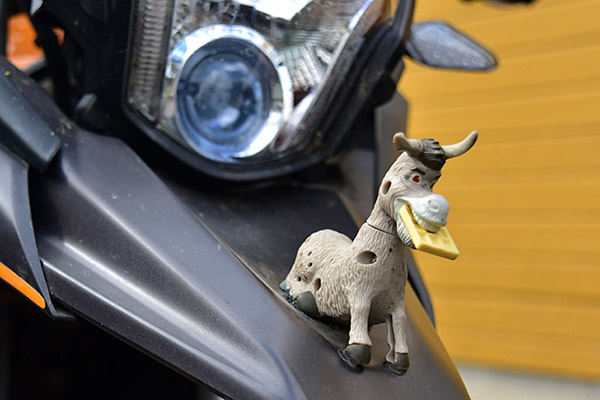
I was one of the first to buy the new 2015 CSC RX3 250 and it was a fabulous motorcycle. It’s the motorcycle you I covered 17,500 miles with it and had tons of camping fun on rides to Baja, Hells Canyon, the Grand Canyon, Canada, Death Valley, the ExtraTerrestrial Highway, the Columbia River Gorge, and Moab. I rode an Iron Butt (baby butt) ride on the RX3, and I rode on the original CSC Western America Adventure Ride and the Destinations Deal ride. I called it Donkey Hotey, and mounted a hood ornament on it.
Those RX3s were fabulous motorcycles. It’s hard to believe that they came out 8 years ago.
Other bikes I’ve owned that I don’t have photos of that I owned around this time included a 2008 Yamaha XT250, a 2009 Yamaha XT250, a 2006 GY200 Chinese enduro project R&R motor that I worked on with my son.
Here’s a photo of my 2002 MZ 125SM. It was a cool little water-cooled motard bike. I had a lot of fun on it.
I bought a 1982 Kawasaki KZ440 basket case bike and put a Harbor Freight 312cc motor in it. It had a constant velocity belt drive. I really wanted a Rokon RT340. I got one of those later, and I’ll cover it below. I then had a 1999 Suzuki DS80. That was one I fixed to resell for a neighbor’s kid. I had a 1982 Suzuki PE175Z. I got it running and sold it. It was a very nice enduro motorcycle.
I owned a 2009 BMW F650GS twin. The BMW was a very nice bike for traveling across America. I rode it from Oregon to Alabama and back.
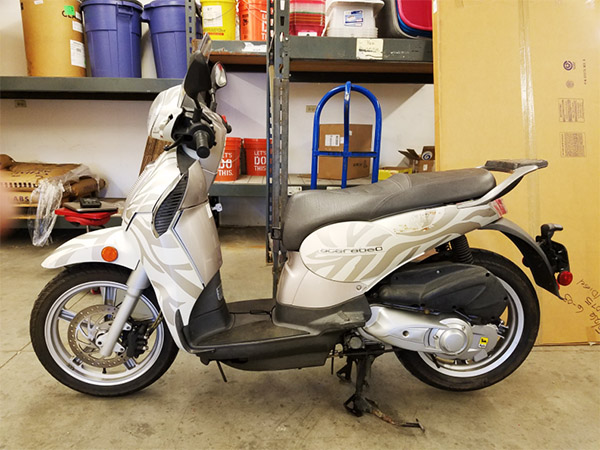
This was my 2009 Aprilia Scarabeo 200 scooter. I bought it to run in the 2020 Scooter Cannonball ride, but Covid canceled that run and I sold it.
Here’s a 1975 Rokon RT340. I had one just like the one in the photo below. It had a Sachs 340 snowmobile motor with a CVT belt drive. I was a twist and go setup that could reach 90 mph. Well, not with me on it, but it could.
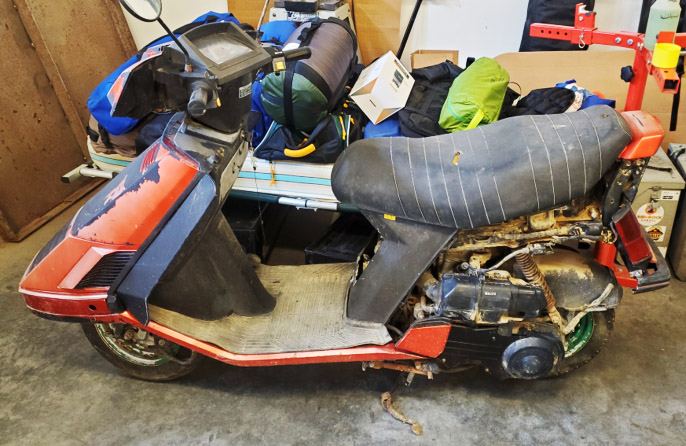
I had a 1985 Honda Elite CH150 scooter that had been stolen, recovered, and then sat for years out in the weather. I got it running and it became my daily driver. I affectionately called it “Tetanus Shot,” because I felt like I needed a tetanus shot just by looking at it.
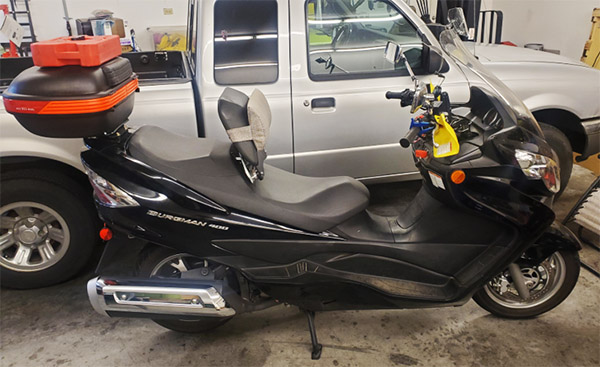
This is my 2008 Suzuki Burgman 400 Maxi scooter that has become my traveling bike now. I guess that makes me a Burg Man, too.
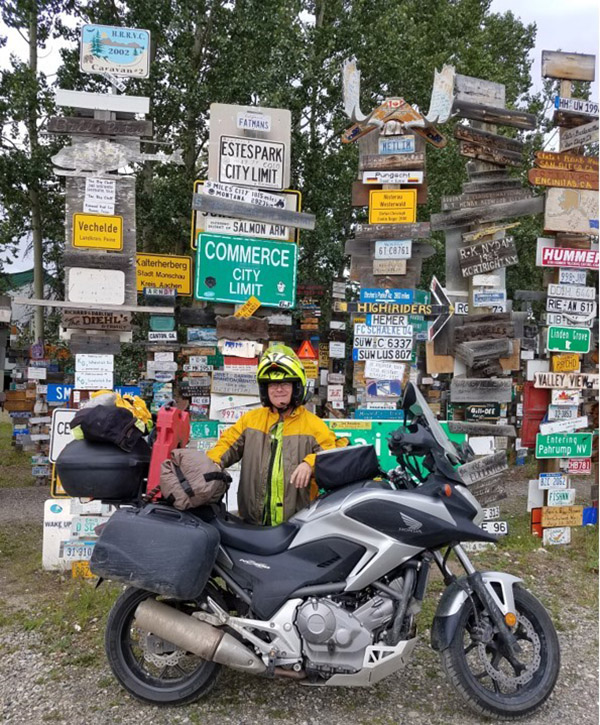
Here’s my 2012 Honda NC700X. I did a 7000-mile Alaska trip on it. It ran like a sewing machine all the way up and all the way back.
Here’s a 2019 Genuine G400c Chinese thumper road bike. I bought it used for a good price. It’s a fun little nostalgic bike that has a 1970s look. The same company that imports Genuine scooters imports this bike from China. It’s made by Shineray (they pronounce it Shin You Way in China). The engine is based on an old Honda design that Shineray picked up, and that engine is used as the basis for the Janus 450cc. Joe Berk rode one of the Genuine motorcycles out of Barry Gwin’s San Francisco Scooter Company about three years ago and he liked it, too.
This blog may be getting too long with all my old bikes and photos, so I will stop for now. Thinking about my former bikes has been fun, though, and if you have a bike you have fond memories of, please leave a comment below and tell us about it. And watch for a future blog about me going over to the dark side and becoming primarily a scooter rider.
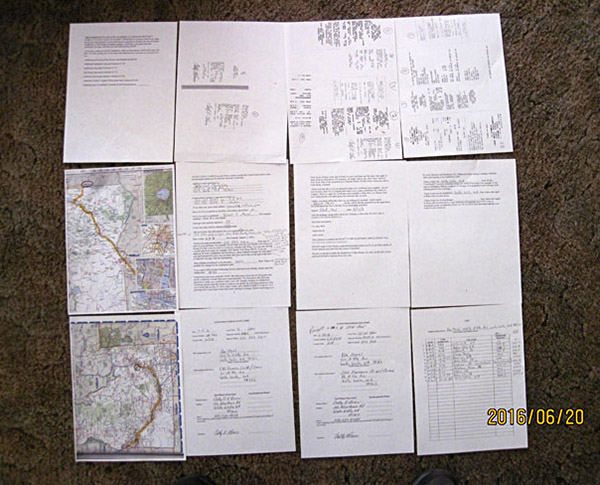
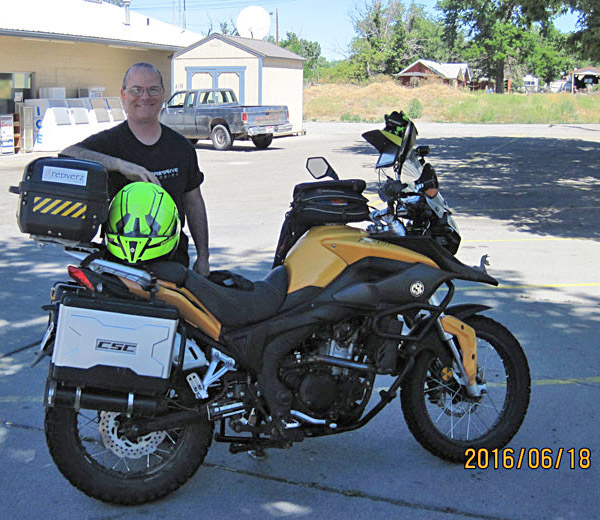
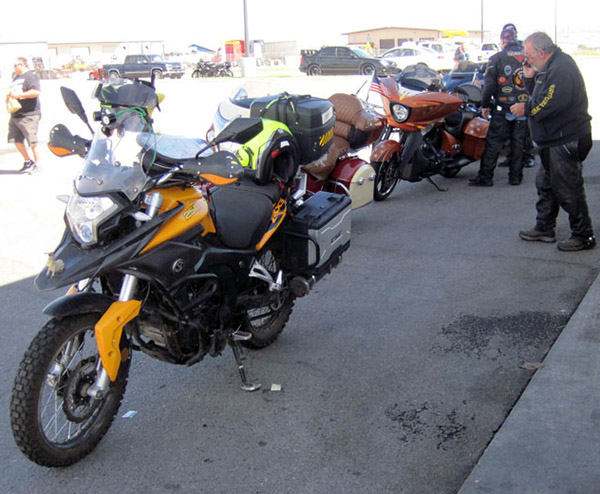
Joe Gresh’s recent story of high-mile motorcycle rides reminded me of my 1,000-mile ride several years ago. I rode my Zongshen RX3 250cc motorcycle on an Iron Butt 1000 back in 2016. That ride was 1,000 miles in under 24 hours. It required documenting start and stop times, and providing all my fuel receipts to prove I actually did it.
The 1000 miles took just under 20 hours to complete. I made 11 gas stops, burned through 23.1 gallons of gas in 1,055 miles, and achieved an average of 45.65 mpg. My total fuel expenditures were $57.90. I ran the lowest grade of gasoline for the first 500 miles, and then I switched to mid-grade fuel. That resulted in an extra 2 to 3 mph on the top end, and more power to get over the hills. I didn’t need to downshift as much. I used 20W-50 premium synthetic oil.
What amazed me was the flogging the little 250cc motor took. I literally rode it at full throttle (at 65-70 mph on the GPS for 70-80% of the trip) going up and down interstate hills where the speed limit was 70 and 80 mph in Oregon and Idaho. The motor seemed to take it all in a stride.
I made judicious use of the gearbox to keep the engine above 6,500 rpm, which I had to do to get over mountain passes and curvy hills (usually in 4th or 5th gear). I never had to run the engine above 8000 rpm. On one long downhill stretch I held the throttle wide open to gain speed to get up the next hill; that sprint showed 75 mph on the GPS. Usually, though, I ran at 65 to 70 mph on the GPS with 80 mph cars passing me like flies on the way to the milk barn.
I really didn’t make any changes to the bike. The gearing on my motorcycle was up two teeth from standard on the rear sprocket. Stock gearing would have been fine. I had a nice gel seat. I was okay until higher temperatures arrived. Then it became an uncomfortable ride.
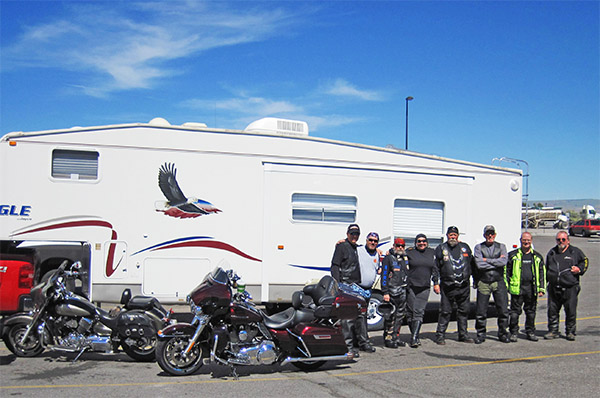
The bike never once gave me trouble or left me wondering if I would make it home. In fact, it impressed the Harley, Indian, and Victory guys I rode with. They soon left me with their higher top speeds, so I was riding solo for most of the 20 hours it took to complete the 1,000 miles. I made it to the last refueling stop maybe 15 minutes after they finished.
While not the best choice for Iron Butt riding, that little 250cc Zongshen motorcycle showed that it can run with the big dogs and finish what it started.
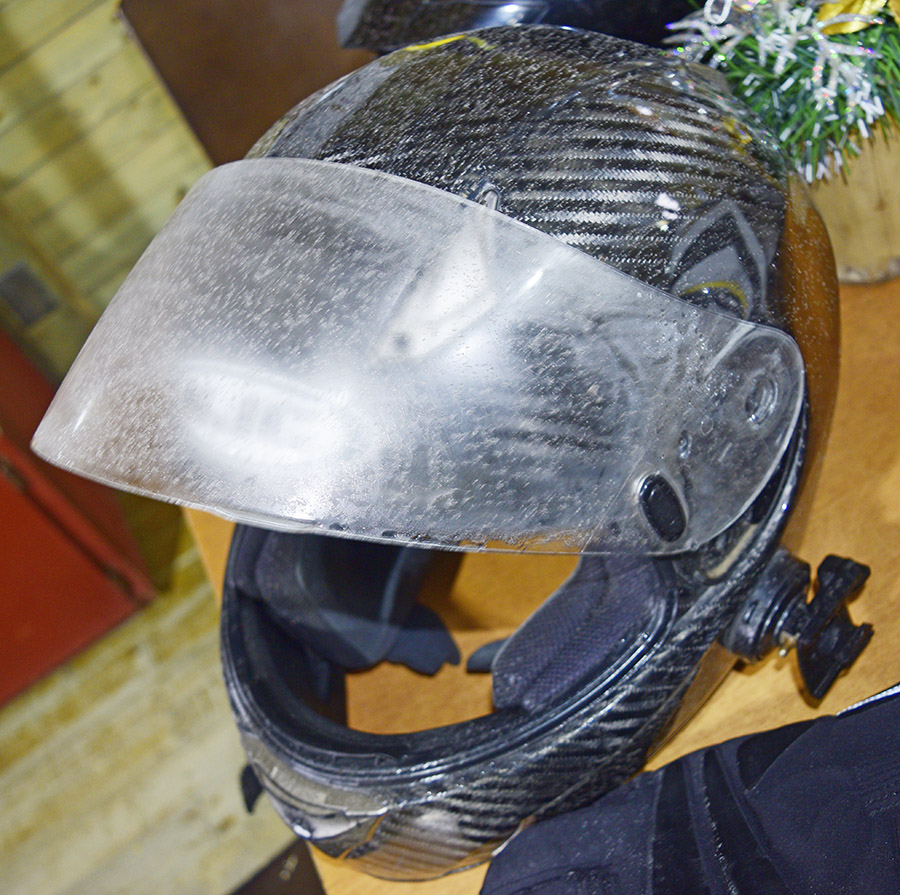
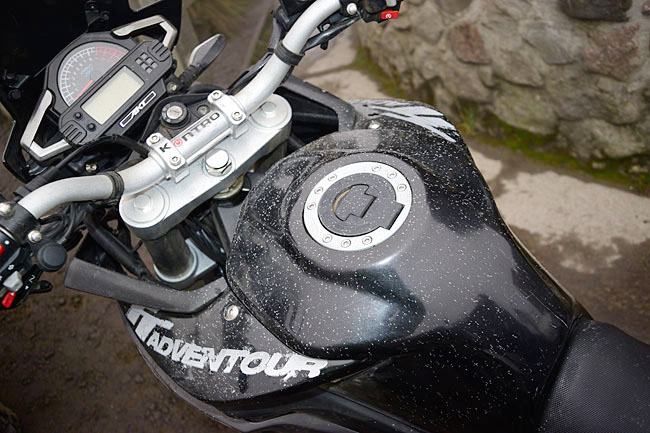
That big photo above? That’s my old HJC carbon fiber helmet at an elevation of 13,576 feet, and the gunk you see on it is ash. As in volcanic ash. We’ve written about Colombia’s Volcan Nevado del Ruiz before here on ExNotes. I’m writing about my ride there again because it seems the old girl has awakened again.
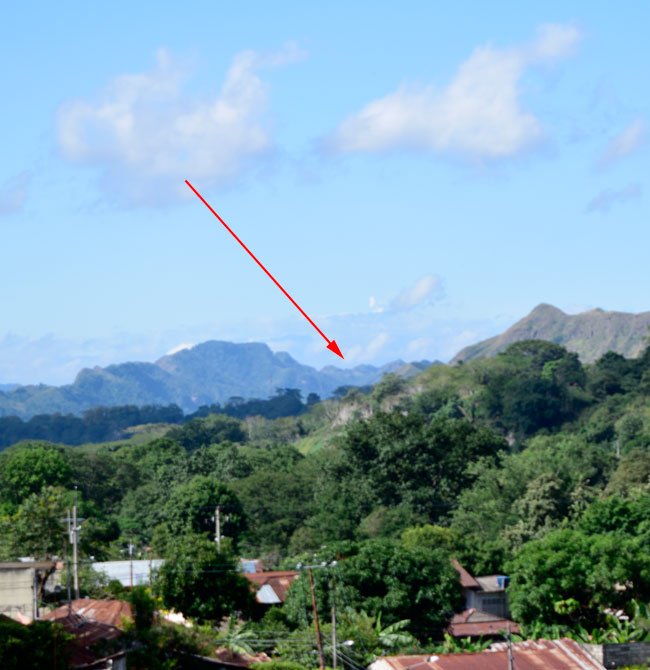
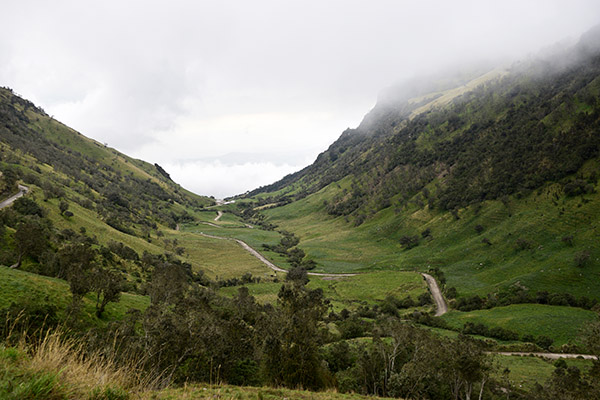
The view from afar. I would be a several hour ride and a monstrous elevation climb (but on amazing roads) to get to the Volcan Nevado del Ruiz.
Volcan Nevado del Ruiz is an active Colombian volcano 80 miles west of Bogotá. Starting in April of this year, it started acting up again. I say “again” because in 1985, Nevado del Ruiz erupted and killed 25,000 Colombians. That event was not only Colombia’s deadliest eruption…it was all of South America’s.
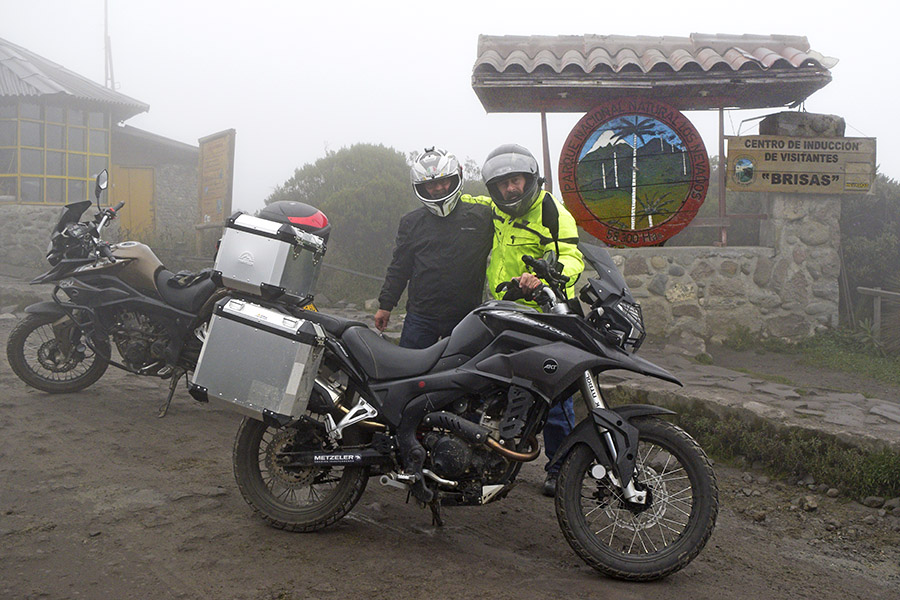
The National Park entrance. They turned us around a half hour after we arrived when the volcano started spewing ash.
I’ve been to the Volcan Nevado del Ruiz. I rode to the top on a motorcycle with good buddies Juan and Carlos. We were there in 2015, and a short while after we entered the Colombia’s Brisas National Park at the 4,138-meter summit, the park rangers told us we had to leave because the volcano was active. It had started spewing ash. It was snowing at that elevation, too. It made for a fine mess and exciting riding.
The ride up to the top of the Volcan Nevado del Ruiz was awesome. The roads were typical Andes Mountains Colombian switchbacks and we were in rare form. The day was beautiful at the lower elevations, but that was about to change as we continued our Andean ascent.
Ah, the Andes. The riding in Colombia is amazing.
On that ride, we were mounted on AKT Motos RS3 motorcycles. That’s the Colombian equivalent of CSC’s RX3, but with carburetors instead of fuel injectors. The fuel is a bit more flaky in Colombia, so AKT opted for carbs instead of injectors. People have asked if the carbs were problematic or if the bikes were slower than the US RX3. I couldn’t tell the difference.
Volcanic ash on my beautiful black AKT motorcycle.
Colombia has a pretty good deal for AKT making Zongshen motorcycles over there. If AKT brings in assembled bikes, they would have to pay a 30% import duty on them. If they components from Zongshen and then buy 15% of the bikes’ content in Colombia (thus encouraging Colombian manufacturing), AKT pays only a 2% import duty. Ah, if only our politicians were that smart.
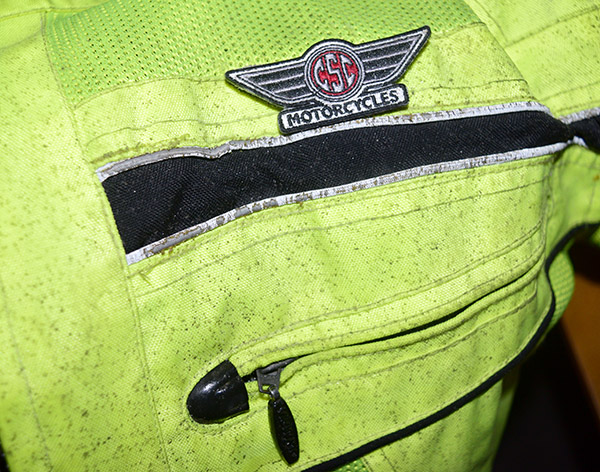
Carlos and I at the park entrance. It was cold, wet, and gritty with the airborne volcanic ash mixing with the snow. This wasn’t a beer and burger run to Cook’s Corner!My Olympia motorcycle jacket, spotted with ash and my CSC pilot wings.
After running to the top of Volcan Nevado del Ruiz, we descended along dirt roads to a magnificent Colombian hotel just a few miles down the road, the Termales Del Ruiz. My buddy Juan knows how to organize a great ride, and I sure had an awesome time. The Termales Del Ruiz is at the end of that dirt road somewhere in the fog, and it’s at 3,500 meters above sea level (still pretty high). It has a thermal pool fed by water (heated by the volcano, I guess) and that water was hot! The air was bitter cold, but the water was nice. It was one of the best nights in Colombia, and that’s saying something. Every night was awesome.
So, back to the Volcan Nevado del Ruiz going live again: It’s really happening, and it wasn’t that many years ago that this same volcano killed 25,000 people in Colombia. Here’s a recent news story on what’s happening now:
Subscribed but not getting your ExNotes new post notifications? Check your email spam folder and tell your email provider we’re the real deal!