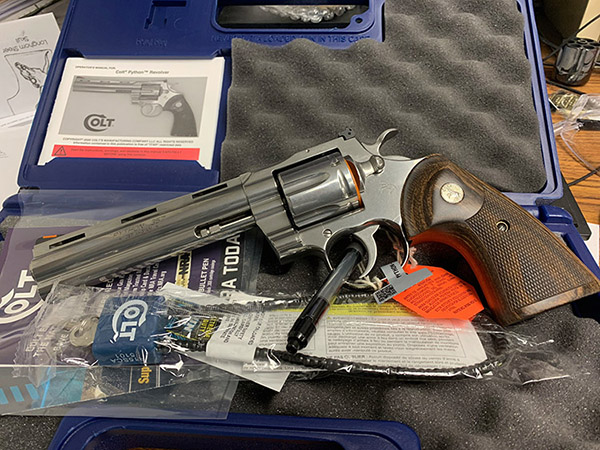
As I mentioned in a recent blog, good buddy TJ (of TJ’s Custom Gunworks) reworked the trigger on my Colt Python. The original single action trigger had a lot of creep, it was heavy, and what surprised me most of all was that it actually cocked the hammer another few degrees before it released. I was getting a little double action when firing single action.
That bothered me enough to call my contact at Colt Manufacturing, and I think he was surprised when heard about it, too. He checked with his engineering department, and the word came back: They had to do that to meet the California and Massachusetts drop test requirements. I checked the California regulation and it requires dropping a loaded, cocked revolver from a height of 1 meter six times on a concrete surface without the gun firing inadvertently. Think about that. Dropping a loaded and cocked revolver, a .357 Magnum, onto a concrete floor. Six times.
Me? I’m going with an alternative approach. I’m not going to drop my loaded, cocked, .357 Magnum revolver on a concrete surface even once. It’s kind of a common sense approach, one that the politicians in California and Massachusetts apparently think we can’t be trusted to take.
A loaded revolver. Cocked. Dropped. Six times. Onto a concrete floor. What were they thinking?
I’m not one to to argue Darwinism versus Divine Creation (we don’t do politics or religion here on ExNotes), but here’s a thought. Maybe someone who drops a cocked, loaded, .357 Magnum revolver on a concrete surface six times, well, maybe Darwin was on to something. Maybe that person needs to be culled from the gene pool. Before you get your shorts in a knot, though, remember my preface: It’s just a thought.
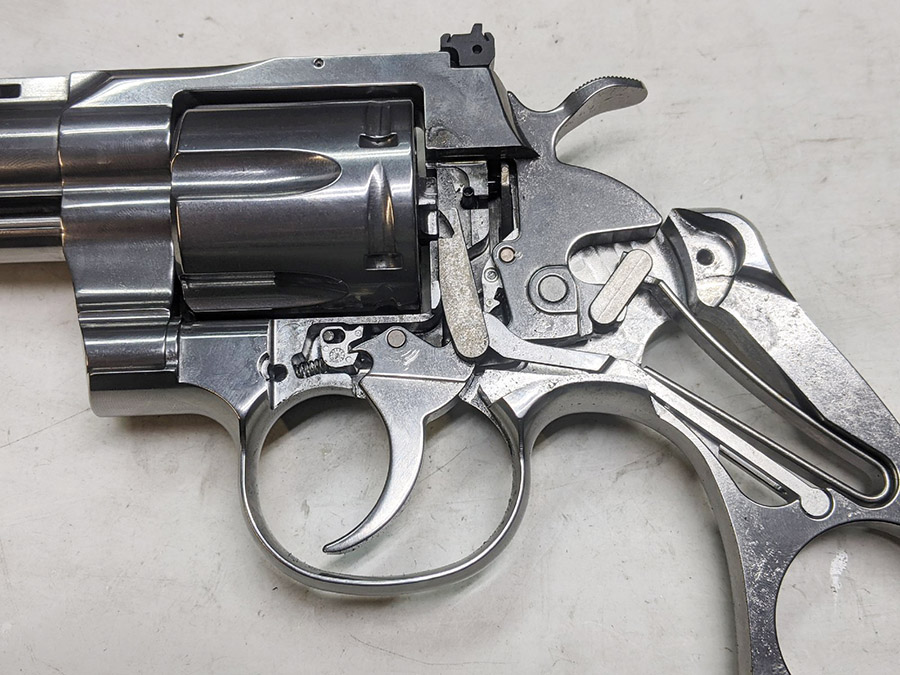
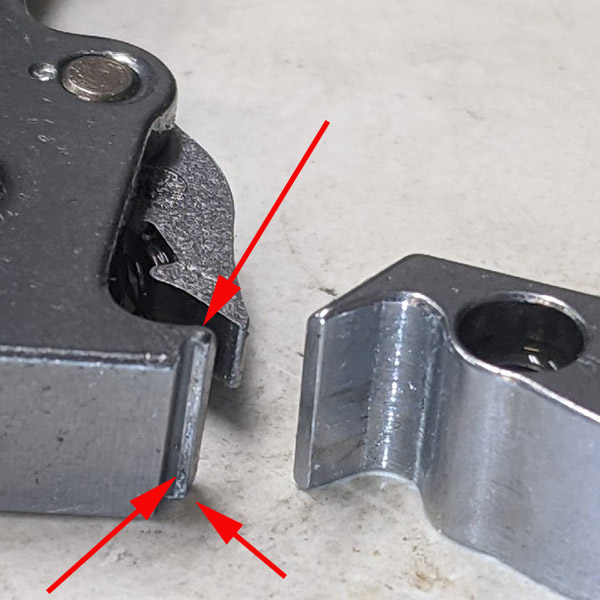
Anyway, back to the main attraction, and that’s the trigger job TJ did on the new Python. TJ took photos of the Python’s internals (the complete parts interface is shown above in the large photo). The photo below shows what was causing the trigger creep and the hammer movement during a single action trigger pull:
That’s the hammer on the left, and the trigger on the right. You’ll notice that the hammer’s sear area (denoted by the red arrows) is kind of rough and it contains a hooked ledge of sorts. That’s what was rotating the hammer back a few more degrees when the trigger was actuated in the single action mode.
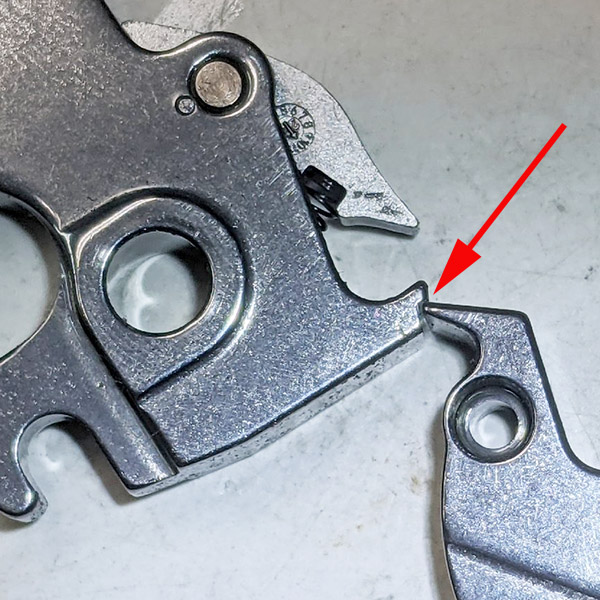
TJ modified the sear to eliminate the hooked ledge and create the angles and surface finish the Python trigger-to-hammer interface deserves. That’s what you see below.
Before he improved the sear interface, the Python’s double action trigger pull was 9 1/2 lbs; it is now 9 lbs. The single action trigger pull was a very creepy 5 1/2 lbs; now there is no perceptible trigger or hammer movement before the hammer is released and the trigger breaks at a very clean 2 1/4 lbs. The upgrade completely changes the character of the new Python. I can’t imaging anyone buying a Python and not wanting to have the trigger cleaned up in this manner. TJ is the guy to do it.
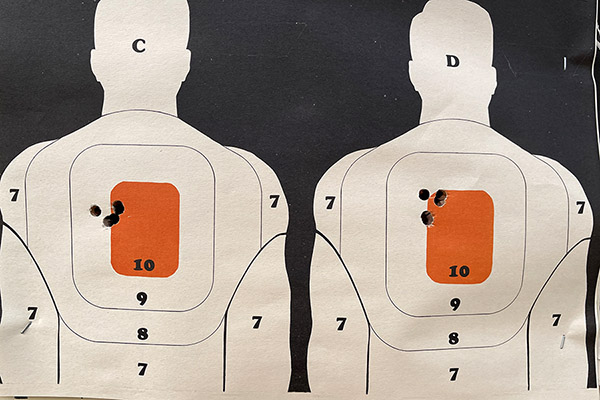
The next big question is: Did the new trigger a make a difference in how the Python performed? Hey, you tell me. Here are two 5-shot groups shot at 50 feet with the improved trigger:
Those two groups were shot with my go-to .38 Special target load (a 148-grain wadcutter and 2.7 grains of Bullseye prepared on my Star reloader). The group on the left measures 0.680 inches; the one on the right measures 0.830 inches. Some of the .357 Magnum loads performed just as well. I’ll share all my Python load testing results in a near-term future blog. I didn’t adjust the sights during my load testing because I’d be moving them with each new load; I’ll zero the gun when I’ve selected the load I want for the Python. I am a happy camper; these are phenomenally good results.
You might be wondering about now why you’d need a trigger job on a $1500 handgun. Folks, this isn’t Colt’s fault. They’re doing what they have to in order to meet a requirement imposed by people who don’t understand what they are doing. Don’t get upset with Colt. Do the right thing and vote.
If you have a Python and you’re not happy with the trigger, take a look at TJ’s Custom Gunworks and drop TJ a note. Trust me on this: You’ll be glad you did.
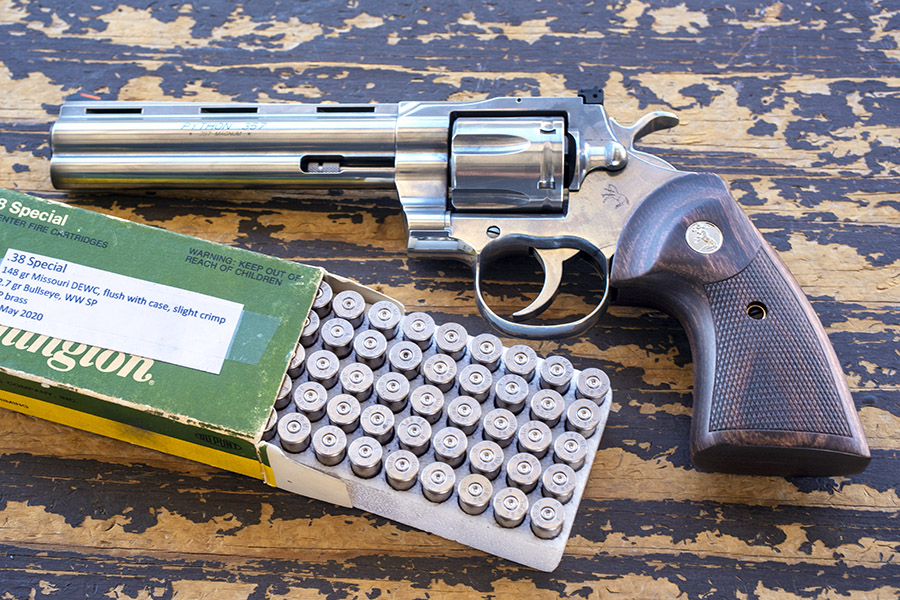
The Colt Python is an iconic handgun that stands out as the pinnacle of the gunmaker’s art. They were originally offered by Colt as their premier .357 Magnum revolver in a run that spanned decades and offered several variants: Blue steel, nickel-plated steel, brushed stainless steel, bright stainless steel, and barrel lengths of 2 1/2, 4, 6, and 8 inches. For a brief period, they even offered one chambered in .38 Special only. That all ended a few years ago when the revolver market subsided and black plastic, semi-auto 9mm gangbanger guns held sideways took over the silver screen (there’s absolutely no accounting for some folks’ taste, I guess). Then, in a surprise move, Colt introduced a re-engineered Python last year, in stainless steel only, with either a 4 1/4-inch or 6-inch barrel. I had to have one, and about a month ago, I scratched that itch.
The new Python carries a hefty $1499 price tag and they are just about impossible to find. And when you do see one, it is always substantially above MSRP. I don’t see the prices coming down on these guns, either. The original Pythons sell for $3K or more (mostly more), and with guns in high demand now and for the forseeable future, I think you’ll always always be able to get your money out of a Python if you ever wanted to sell it. I don’t see the prices going anywhere but up, and like I said, it is near-impossible to find a new Colt Python. But I know people in high places, I got a hell of a deal on my Python, and I am enjoying it enormously. Just looking at it is fun.
I went to my gun club a few days ago to shoot the new Python for the first time, and in a word, it was spectacular. I’ll get to that in a second.
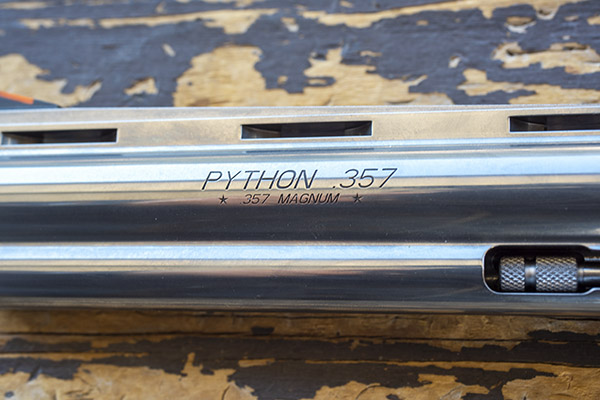
My Python has a 6-inch ventilated rib barrel. The revolver is polished stainless steel and it looks great. The roll marks on the new Python are very similar to the original Pythons. Very classy, in my opinion.
One of the reasons Colt stopped making the original Pythons a few years ago is they were too expensive to manufacture, as they required too much hand fitting of the revolver’s internal components. Colt’s re-engineering effort made all but one internal part capable of being CNC-machined to final dimensions, and in the modern Python hand-fitting is required for only one component. What that did was dramatically improve the double action trigger pull, and somewhat degrade the single action trigger pull. The double action trigger is short and sweet, and the hammer travel is only about half what it used to be. The single action trigger pull is, well, different. Read on, my friends.
Help us keep the content coming: Please click on the popup ads!
Single action, by design on the new Python, has a some take-up and you can actually see the hammer move a little further to the rear when you squeeze the trigger shooting single action. Think of it as a single action trigger that adds a little bit of double action to the dance before it releases the hammer.
I thought there was something wrong with the revolver, but my contact at Colt told me the new Pythons were designed that way to meet the California and Massachusetts drop test requirements. It is definitely not a “breaking glass” single action trigger; it’s closer to pulling the trigger on a Glock (that’s not intended to be a compliment). Double action, though, is absolutely outstanding. It’s a shorter pull than any other double action revolver I’ve ever fired and I like it. I suppose some people might think it’s a good thing that the gun meets the drop test requirements of left-leaning governments. Me? I’d go with Door No. 1 and refrain from dropping my loaded $1499 revolver.
Anyway, the single-action trigger threw me for a loop, but I adjusted to it quickly during a dry firing session. I don’t notice it anymore, and as you’ll see below, it sure hasn’t hurt accuracy.
Fit and finish on the new Python are top notch. You can see that in the photos on this blog, which I shot during and after an extended range session. I probably should have taken pictures before I fired the new Python (when the gun was factory immaculate), but hey, it is what it is.
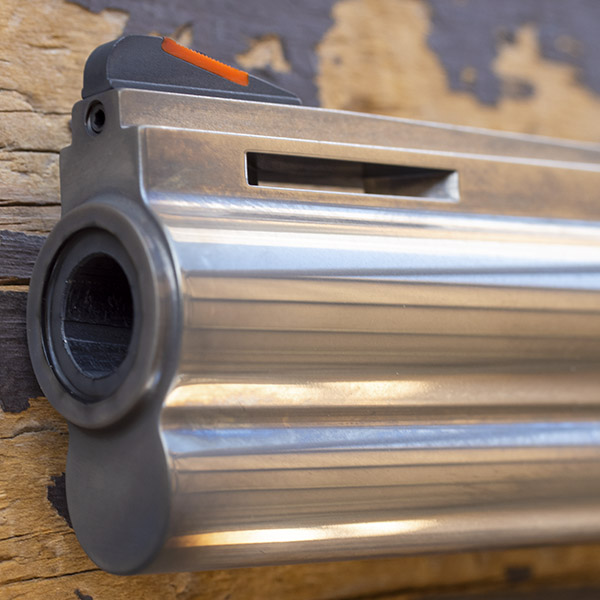
The new Python has a red ramp front sight, which I like. There is no white outline rear sight (it’s plain black). The combination works well, as the targets you see here show. The Python also has a recessed crown, unlike the original one, which was flush. The recessed crown better protects the bore.
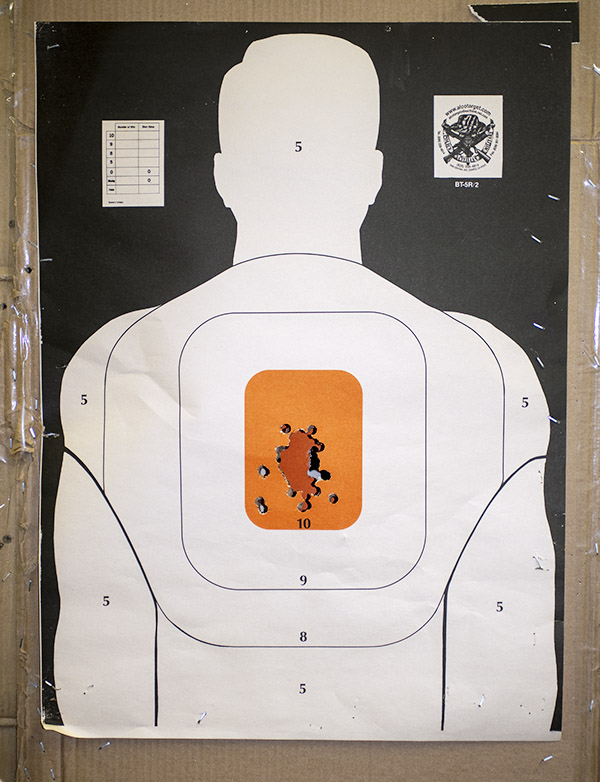
My first shots were 50 rounds I put through the gun using my standard .38 Special target load (2.7 grains of Bullseye and a 148 gr wadcutter, loaded on my Star reloader), all fired single action. I shot from the 50-foot line and it was windy as hell. I had to stop a few times to walk downrange and add more staples to the target because it was starting to come loose, and the target stand was swaying toward and away from me as the wind rocked it. I was shooting, literally, at a moving target.
A complete box of .38 Special wadcutter ammo…50 rounds fired at 50 feet firing single action. All those extra staples were needed to keep the wind from tearing the target off the stand.
I was surprised (and pleased) at how stunningly accurate the new Python is. I hadn’t touched the sights, and it was punching holes right where I wanted right out of the box. It put an entire box of ammo into the bullseye with a standard 6:00 hold and the sights left as they came from the factory. That’s a first for me, and I’ve been doing this a long time. The bottom line: The new Python is accurate.
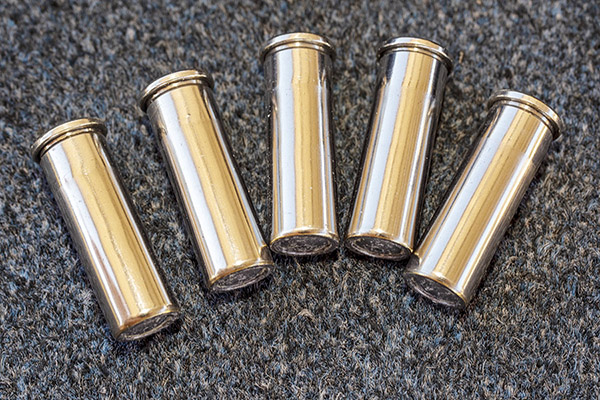
.38 Special ammo loaded with 148-grain wadcutter bullets. The bullet’s “wadcutter” nose profile cuts a clean hole in the target. I used mixed brass shooting the new Python for the first time.
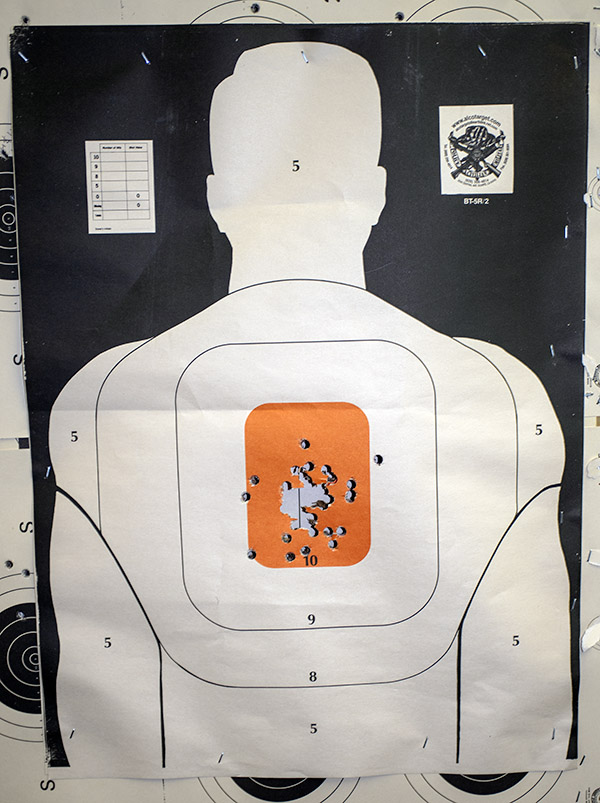
Then I shot another box of 50 cartridges (using the same .38 Special target load I used for the target above), but this time shooting double action. Let me make the point again: These two boxes were the first time I ever fired the new Python. Here’s my second 50 rounds on the target, fired double action.
Another 50 rounds at 50 feet, this time shooting double action. Not too shabby, if I do say so myself. The new Python’s double action trigger is superb.
Eh, one shot went out of the bullseye (it’s that one in the 9-ring, just outside the 10-ring, on the right). Like I said, it was windy out there. But still, for me, this was phenomenal double action shooting. It’s the best I’ve ever done shooting double action, actually.
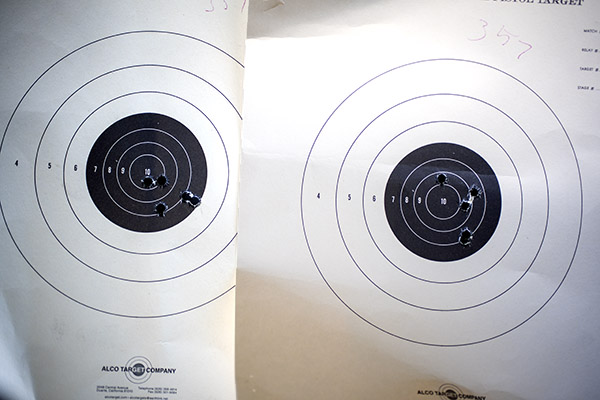
Then I thought I’d try two 5-shot groups on the 50 foot standard pistol target with .357 ammo (all targets shown here were shot at 50 feet). As you know, a .357 Magnum handgun can shoot either .357 Mag ammo or .38 Special ammo. I brought along some of my standard 357 Magnum reloads (15.7 grains of Winchester 296 powder and a 158 grain Hornady jacketed hollow point bullet). This is a load I’ve been using since my Army days and it does well in any .357 Magnum revolver I’ve ever owned. It came from the pamphlet Winchester published in the 1970s for their powders. It performed superbly well in the new Python.
.357 Magnum shots at 50-foot targets. Point of aim was 6:00 for all shots. Bring it on…fire and brimstone…the new Python handles full power .357 Magnum loads well.
It’s easy to forget how powerful the .357 Magnum cartridge is unless you fire it back-to-back with the .38 Special. The .38 Special is a very manageable cartridge with moderate recoil, especially in a big, heavy, 6-inch handgun like the new Python. When I shot the .357 Magnum loads, I was instantly reminded that the .357 is a real barn burner. Think big recoil and lots of muzzle flash and blast. It was cool, and the big Python handled full power magnum loads well.
As I already mentioned, it was very windy and gusty on the range (two tractor trailers were on their side on I-15 when I drove out to the club). I was the only guy out there (I’m probably the first guy to visit our range with the new Python, too). On a calm day, I’m sure I could do better than the targets you see above.
I finished up another box of .38 Specials shooting 158 gr cast flatpoint Hursman bullets (also loaded with 2.7 gr of Bullseye), shooting at one of those green star target things you throw on the ground (my daughter bought it for me a few years ago and I think the thing is going to last forever). I walked it out to 50 yards with repeated hits, and I’ll bet I didn’t miss but two or three times out of 40 or so rounds.
There were no malfunctions of any kind in the approximately 150 rounds I fired through the new Python. No light strikes, no misfires, and no jams. And like I’ve been saying, accuracy was stellar. It’s almost like the new Python is laser guided.
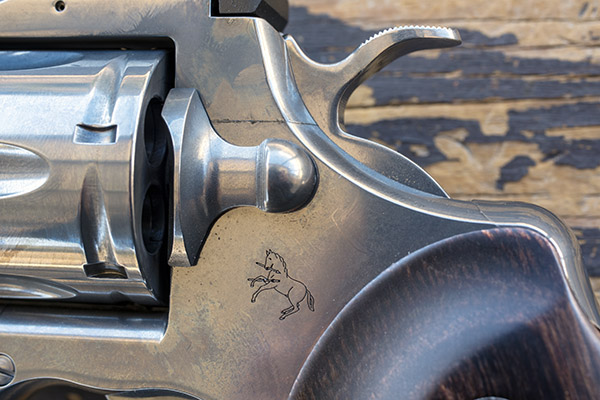
A prancing pony…the rampant Colt logo that has adorned Colt firearms for more than a century and a half. Long may it live!
You know, there’s an old saying: You get what you pay for. To that, I would add the qualifier: Sometimes. In the case of the new Colt Python, this is one of those times. I love the new Python. It’s an iconic firearm and if you are thinking about getting one, my advice is this: Do so. You won’t be disappointed.
Colt’s ad for the new Python. I have high hopes for this gun.
The Colt Python was the king of the handgun world back in the ’60s and ’70s. It was the Rolls Royce of revolvers. I owned two of them at different times in the mid-’70s. I bought one while I was deployed overseas in Korea (we could actually order guns through the base exchange) and it was delivered to me in Korea. I paid something like $150 for it back then, and it was sleek…deep bluing (Colt called it Royal Blue), a 6-inch barrel, and then I had to worry about bringing it back to the US. I was told I would need a certificate signed by the Director of the Alcohol, Tobacco, and Firearms Bureau and I could only imagine how long that would take, but it didn’t take long at all. I submitted the request and three weeks later I had a hard copy (this was the 1970s) signed in ink by the actual top guy at the ATF. That gun came back to America with me in a duffel bag. I remember that 10 grains of Unique behind a 110-grain jacketed hollowpoint Hornady tore one ragged hole at 25 yards. It was phenomenally accurate.
I traded that Python for a new Ruger No. 1 in .30 06 and a couple of boxes of .30 06 ammo, and I still have that rifle. But back at Fort Bliss I missed the Python. Good buddy Roy told me I could order one through the Fort Bliss Rifle and Pistol Club, so I did (this time in nickel, but still a 6-incher). It was stunning, with flawless nickel plating and a absolutely jewel-like, luxurious look. The I sold that one when I moved to Fort Worth. It was not my brightest move ever. I’ve done a lot of dumb things in my life. This was definitely one of them.
Colt quit making the Python several years ago, and prices went through the roof. An original Python goes for something around $3k, give or take a K or two (almost always to the north). Big bucks, and way more than I want to spend.
Pete’s Python. It’s one of the originals, and it is phenomenally accurate.
I sort of got the Python fever again a few months ago when good buddy Python Pete let me take a few shots with his vintage 8-inch barreled Python. It was the accuracy that got me excited. These were great revolvers. I wrote about that day here.
And then suddenly, just a few weeks ago, Colt announced that they were reintroducing the Python, and it would retail at $1500. That was a good thing, I thought. It’s still pricey, but a new Python would be great. Maybe when the supply exceeds the demand prices might drop, I thought.
I want the new Python to succeed. A frontline company like Colt (an iconic name if ever there was one) deserves nothing less.
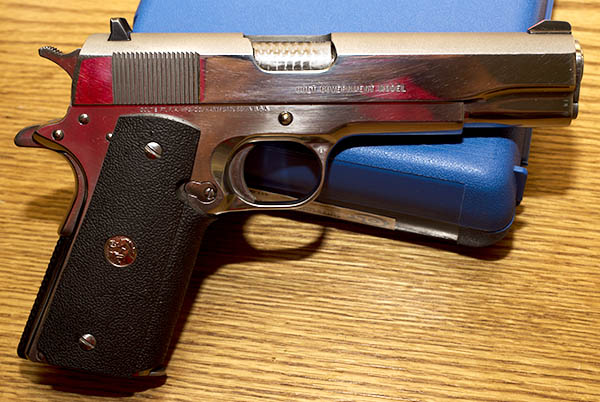
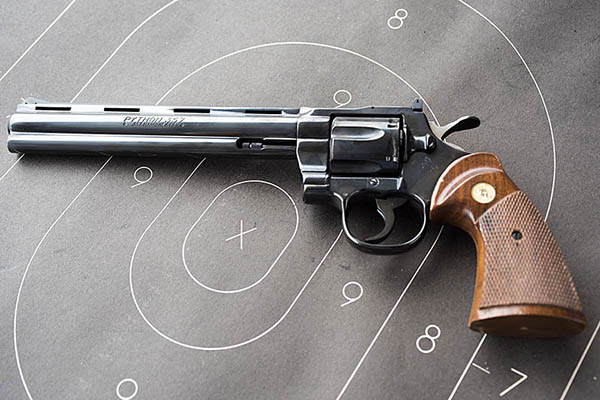
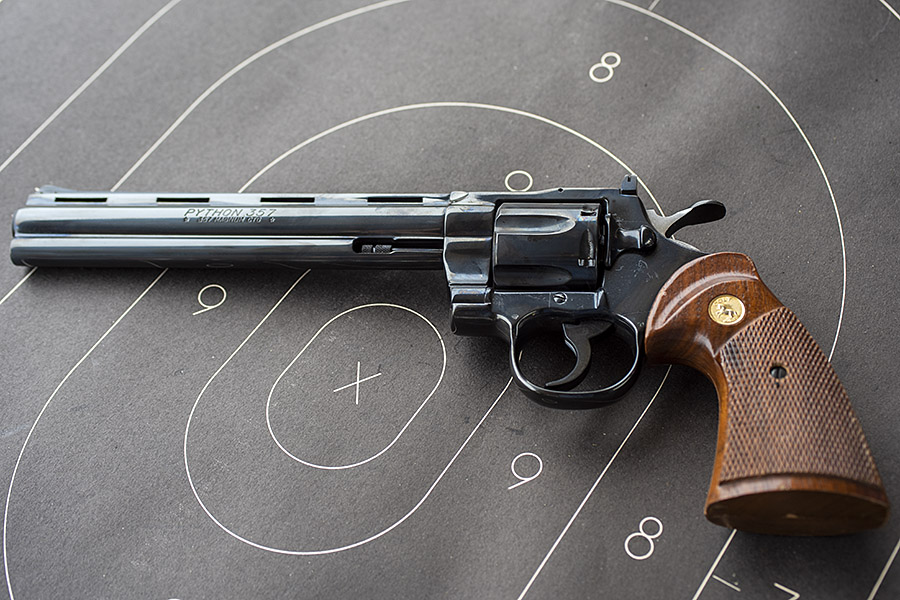
Good buddy Python Pete and I went to the range a few days ago to let loose with a pair of prancing ponies (that is to say, Colts), in both revolver and automatic flavors. The auto was my tried-and-true bright stainless Colt Government Model 1911; the wheelgun was Pete’s stunning 8-inch Colt Python. Both are stunningly beautiful and both are good shooting guns.
A custom bright stainless Colt, with Baer barrel, Millet sights, and a few other nice touches.
I bought the 1911 you see above at a pawn shop brand new back in the mid-1980s for just over $500. Colt no longer offers bright stainless steel guns, so I guess you could say mine is collectible, and when you see bright stainless Colt 1911s come up for sale (which doesn’t happen very often), prices start at $2,000 and go north from there. I guess you could say I made a good investment (except I won’t ever sell it).
A few years ago the front sight popped off my 1911, so I took it to a local gunsmith to have it restaked. That repair lasted all of 50 rounds, and I realized I needed to see an expert. That’s when I hooked up with TJ’s Custom Guns, and I had TJ revamp the Colt. It’s got a Les Baer match barrel, an extended one-piece guide rail, an engine turned chamber (I love that look), high profile/high visibility Millet fixed sights, and TJ’s exclusive high reliability tune. That last little bit means that my Colt 1911 will reliably feed any bullet configuration (semi-wadcutters, hollow points, etc.) and it will work no matter what. Folks, I’ve put tens of thousands of rounds through my 1911 since TJ massaged it, and it’s never had a failure of any kind (no failures to fire, no failures to feed, and no failures to eject…it just goes and goes and goes).
On to the Python. I’ve known good buddy Pete for more than 30 years (we sort of grew up together in the aerospace industry). Pete owns a Colt Python, a gun that is arguably the finest revolver ever made. His is the super-rare 8-inch model, too.
Revolver royalty…the stunning Colt Python. The Colt Python is perhaps the finest revolver ever made.
Colt no longer makes the Python, probably because they were too expensive to produce. The fit and finish are superior, and the feel of the thing is just sublime. It’s a .357 Magnum, one of the world’s all time greats, and a cartridge that dominated the police market before 9mm became all the rage. Colt revolvers were hand-fitted and involved lots of custom assembly, and I suppose it just didn’t in with the need for low cost manufacture in a market dominated by black plastic 9mm handguns. No, the Python is from another era characterized by highly polished blue steel and finely figured walnut, an age in which I felt more comfortable. Seeing a Python on the firing line again was a treat, and when Pete asked if I wanted to try the big Colt, he didn’t have to ask twice.
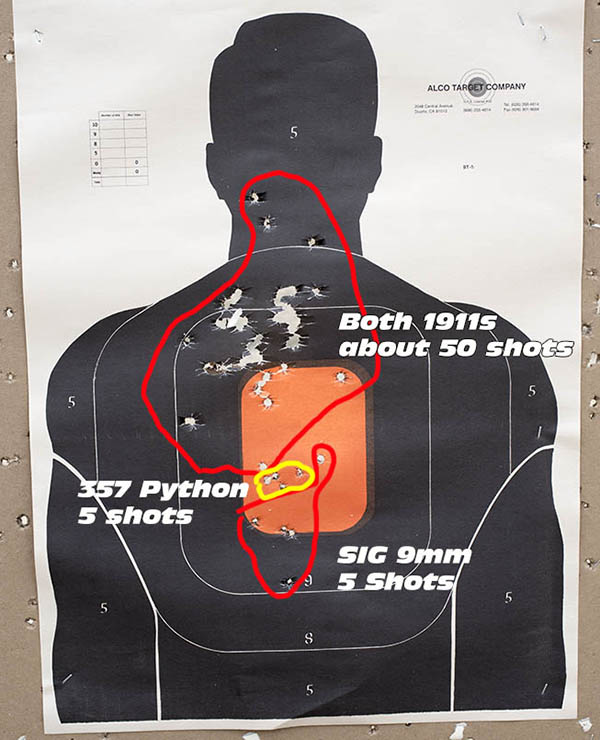
Pete and I had four handguns with us (the two mentioned above, plus a SIG 9mm and my Rock Island Compact 1911). I shot my two 1911s offhand for a while, and then I tried my luck with Pete’s SIG and the Python. It was fun.
You can argue about a good automatic being as accurate as a high-end revolver, but you won’t convince me. The Python is a tack driver.
I fired 5 shots of “nothing fancy” factory ammo with the Python, and the accuracy was superb. The targets don’t lie, folks.
I’ve owned two Pythons in my life, and both were back in the 1970s. When I was in Korea, I found out I could order one though the Base Exchange at a substantial discount. I couldn’t believe what the nice lady was telling me at the Kunsan AFB Exchange, so I ordered a 6-inch blue steel Python for something like $150 (it sounded too good to be true). Incredibly, it came in the mail to me in Korea. Before I rotated home, I had to submit a form through the Army to get permission to import the revolver back to the US. I did that, and a few weeks later I had a letter signed by the Director of the Alcohol, Tobacco, and Firearms Bureau allowing me to bring my Python home. It went into my duffel bag, I produced the letter when I went through Customs in San Francisco, and that was that. Better times.
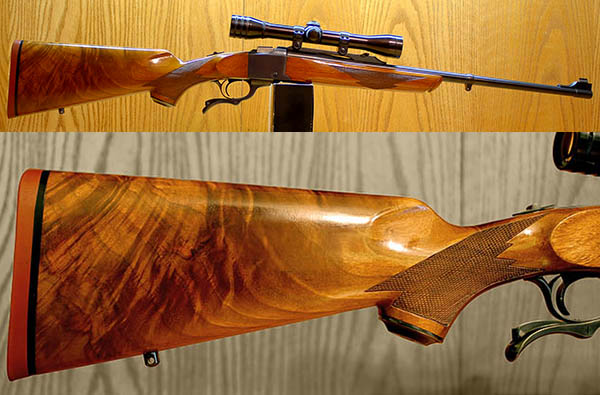
You know how it goes with these things. When I was back in Texas shortly after my stint in Korea, I saw a Ruger No. 1 single shot rifle in .30 06 I couldn’t live without, and I traded the Python for it (the guy at the store through in a couple of boxes of .30 06 ammo, too). Then I felt a void in my life because I no longer owned a Python, so I ordered another one (this time a 6-inch nickel-plated model) through the Fort Bliss Gun Club. It was under $200. Then I traded that for something else (I can’t remember what). Ah, the mistakes we make. But maybe they weren’t all mistakes. I’ve sent a lot of lead downrange with the Ruger No. 1 over the last 45 years, it’s one of the most accurate rifles I own, and it has stunning walnut.
The Ruger No. 1 in 30 06 I traded the Kunsan Python to get. It’s a 200th Year Ruger. I miss the Python, but I love my ’06 No. 1. Some day I’ll do a blog on this rifle.
Today, Colt Pythons typically sell for something in the $3,000 to $4,000 range. Pete’s would command even more, because it’s the 8-incher, which is a rare item. I’ve asked Pete if he wanted to sell his, but all I got in return was a smile. That’s probably just as well; I couldn’t afford it at today’s prices.

 and have them delivered to your door!


 Good buddy Python Pete and I went to the range a few days ago to let loose with a pair of prancing ponies (that is to say, Colts), in both revolver and automatic flavors. The auto was my tried-and-true bright stainless Colt Government Model 1911; the wheelgun was Pete’s stunning 8-inch Colt Python. Both are stunningly beautiful and both are good shooting guns.