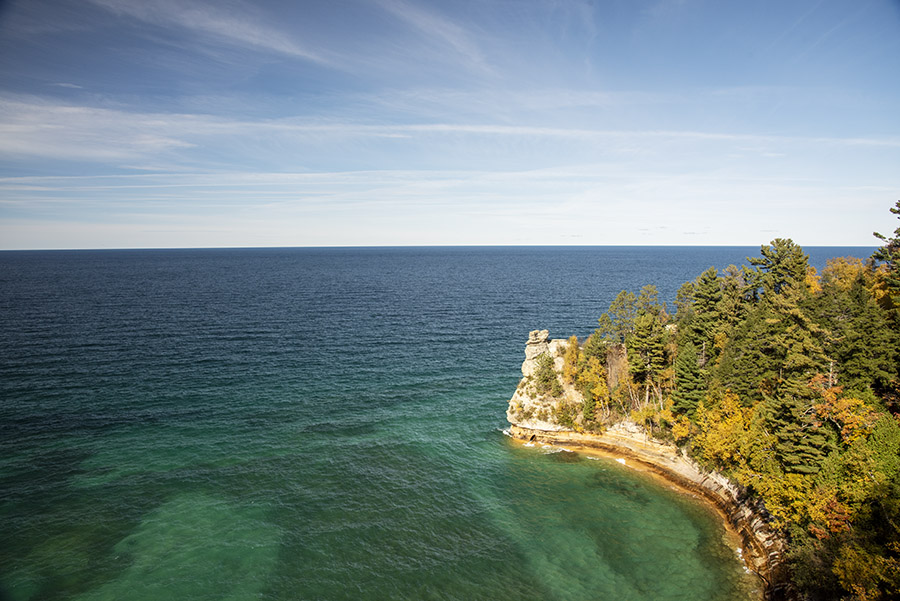
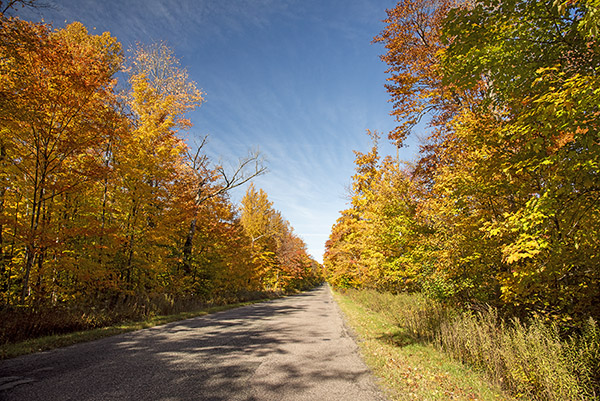
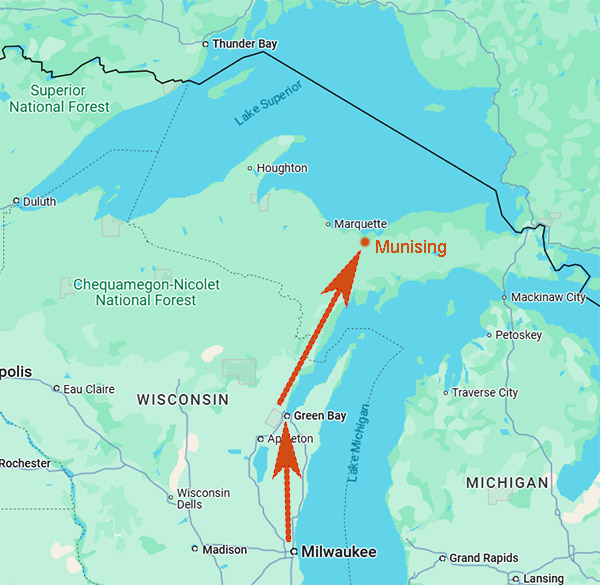
The destination on this fine day was Pictured Rocks National Lakeshore, part of the National Park Service network. It’s situated in the Hiawatha National Forest along the shores of Lake Superior, which is the large body of water you see in the above photograph. Pictured Rocks lived up to its name; the drive to get there was even better. It’s part of Michigan’s Upper Peninsula, and once we left the freeway on our ride out of Green Bay, Wisconsin, the roads were majestic. We hit it at just the right time, too, which was in mid-October when the leaves were turning colors. You might think I turned up the saturation in the photo below. I did not. You’re seeing it the way it came out of the camera (my Nikon D810, a 24-120 lens, and a Hoya polarizer).
The Pictured Rocks National Lakeshore area includes sandstone cliffs, beaches, waterfalls, and sand dunes. There are many lakes in this area as well. The roads are lined with forests. It’s a nice area, and my thoughts were that it would be well suited for exploring on nearly any kind of motorcycle in the summer months (it’s cold in the fall, and from what I understand, really cold in the winter). Speed limits were low (I think the highest we saw was 55mph, many areas were 40 or 45mph, so a small bike would do well here). All the roads were fairly straight with few curves; a big touring bike like a Harley or a Gold Wing would be fine, too.
The temperatures are brisk this time of year. We had frost on the windshield in the morning. This is a good time of year to take in the changing colors, though. The leaves and the ride were incredibly scenic.
Once we entered Pictured Rocks National Lakeshore, we found that it’s not like the Jersey shore or the Grand Canyon’s South Rim; we couldn’t just ride along the edge of Lake Superior and take in the entire shoreline. Nope, the way to see this National Park is by riding to a series of points along the lakefront from the interior. Getting to each involves taking different roads to their ends where they meet Lake Superior. That’s okay, because doing this in the fall with the leaves turning colors makes for a beautiful ride.
The town where we stayed the night is Munising (pronounced just like it’s spelled: Muni Sing). There is at least one glass bottom boat tour in the area, although we didn’t do that.
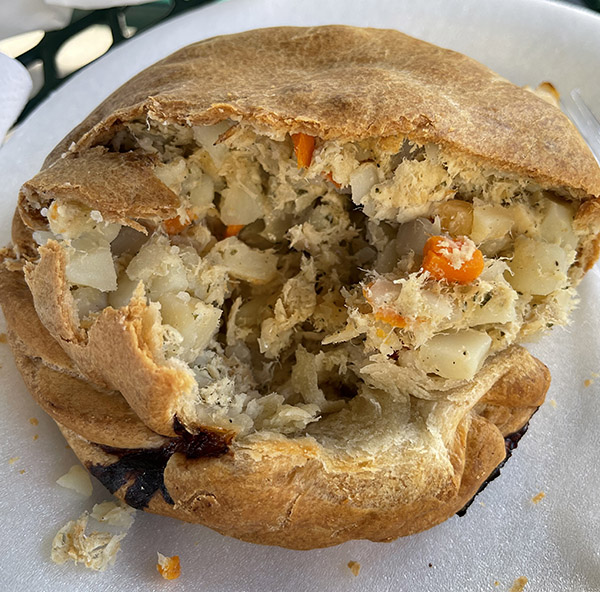
We couldn’t get anyone to recommend a restaurant in Munising, and after trying one, we understood why. But that’s all right. There are several shops in town that sell pasties, and the pasties are great. Muldoon’s Pasties is the one we tried. (Pasties are not what you might be thinking. They are actually pastries.) We had the chicken pasty and then a cherry one for dessert, and they were awesome. That one chicken pasty you see below was more than a meal for both of us.
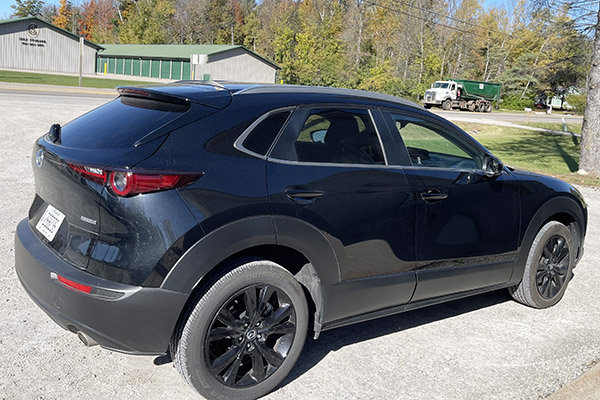
For this trip, we flew from Atlanta (where we stopped to visit with an Army friend and mentor) to Milwaukee, where we rented a Mazda CX30. It’s an all-wheel-drive automobile that was okay, but not okay enough for me to ever consider buying one.
The CX30’s fuel economy was good, ride comfort (while better than a motorcycle) and road noise were not. It would probably be an okay car for the area (they get a lot of snow up here in the winter). We put about a thousand miles on the Mazda and had no issues, other than the tire pressure indicator nearly constantly flashing. That seems to be a common occurrence with Enterprise Rental; the car we rented in Atlanta had the same problem.
We’ve got more good stuff coming your way: The Harley-Davidson Museum, World War II military motorcycles, the Green Bay Auto Gallery, the National Rail Museum, the Miller Beer tour, the Pabst Mansion, and a few other stops. Hang in there, click on the pop-up ads to keep the lights on and the content flowing, and as always, stay tuned.
There must be a lot of potheads in Michigan. I believe I saw more marijuana stores in Michigan than any place else I’ve ever been (and coming from the Peoples Republik of Kalifornia, that’s saying something). There was one cannabis store after another, especially in the Upper Peninsula.
With an open schedule and in need of some routine I took it upon myself to enroll in a Rescue Diver Certification Course. With still being in Thailand and continuing to dive while learning every mistake not to make it only made sense to become more proficient if not for myself, then for the fellow divers around me.
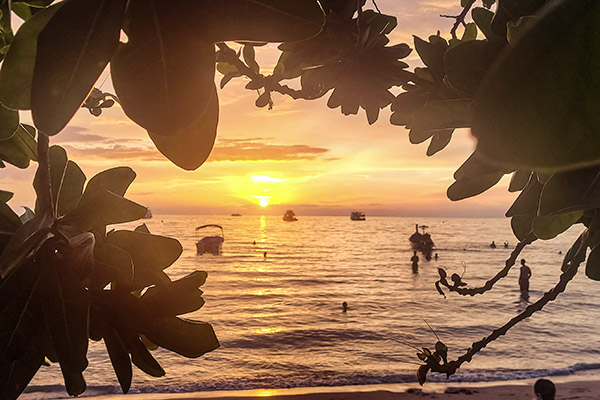
Returning to Koh Tao Thailand seemed the perfect place to take this course. With so many dive shops on the island and being unsure who to use for this next level class I did what I always do. I went to a bar and chatted other divers up. One shop that seemed to always be spoken highly of was Scuba Shack. It was not only a great decision to choose them for their professionalism, but it was right next door to where I was staying on Sairee Beach.
There are several requirements prior to beginning the rescue diver course. One is having an advanced scuba certification which allows you to dive to a depth of 30 meters and further educates you on proper buoyancy while underwater. Having just taken this a month prior helped me as the fundamentals were still fresh in my head. The second was to obtain an updated First Responder course. This part of the class was half a day and entailed covering CPR, proper bandage application, and procedures on how to help others in numerous types of emergency situations from car accidents to everyday incidents you may come across anywhere on land. Once that was completed and I passed the online course, the real challenge began. Scuba rescue operations while at sea include incidents well below the water’s surface.
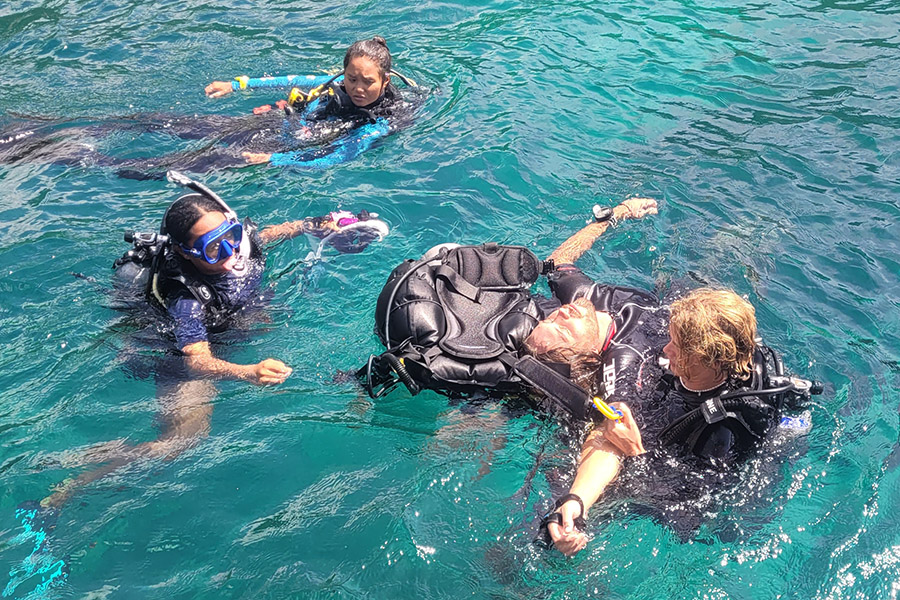
The water rescue portion was what I was really itching to learn. It was a challenging experience both mentally and physically. Many of the scenarios involved how to identify and treat divers who are exhausted, panicked, or unconscious. Another major prop I will give Scuba Shack is the actors in these scenarios did a fabulous job (I think I may still have a lump on my head from rescuing the panicked diver). The most work was in having to rescue an unconscious diver underwater. This included how to bring them safely to the surface, how to bring them to the boat while they are yelling for help, and providing rescue breaths every 5 seconds (including doing wo while taking both your gear and their gear off). It was humbling how much work and focus it took to perform these tasks with precision. My partner, Naz and I managed to successfully perform these tasks both solo and as a team.
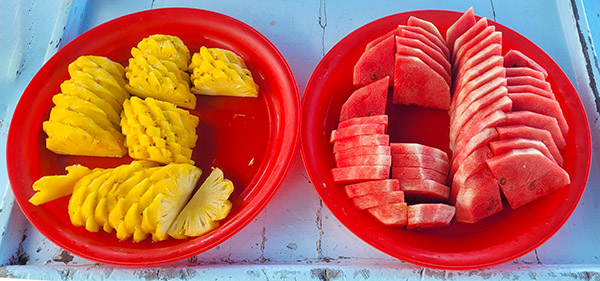
Upon completing our final skills test (which was an underwater navigation search and rescue), we both relaxed on the boat celebrating with some coffee and fresh fruit when we heard several people screaming for help in the water. It was the final exam. Naz and I had to rescue three divers needing help. We had to prioritize each one and work as a team to safely rescue them all in order of priority. We performed this successfully.
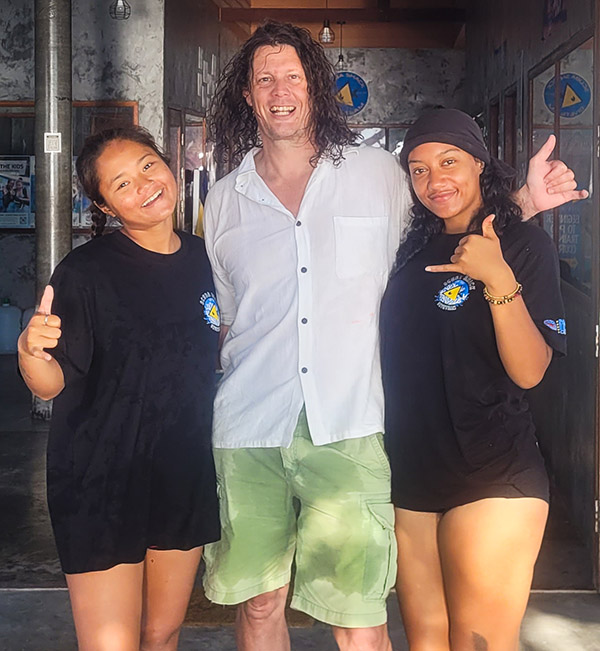
We both passed our course, and our confidence and diving abilities greatly increased from attending this class. Naz is currently in the Dive Master Program with Scuba Shack on Koh Tao. She will be an excellent dive master. My travels are continuing; I’m currently examining a map and selecting the next country I’ll visit.
I want to thank all the wonderful people at Scuba Shack and our instructor Sita on the great experiences during this class and on our fun dives we performed several times each week.
Unless you have visited Oklahoma or you live there, you probably wouldn’t think of Oklahoma as a motorcycling paradise. But trust me, it is. And finding the best rides in Oklahoma is easy, thanks to Oklahoma’s Tourism and Recreation Department. Sue and I are always looking for interesting travel destinations, and as a guy who writes travel pieces for Motorcycle Classics magazine, my antenna goes up when I hear about great roads and great destinations. Several years ago when I was working for CSC Motorcycles, we attended the Long Beach International Motorcycle Show. In the vendor display area, Sue found a booth manned by the Oklahoma tourism folks.
One thing led to another, we received a package of travel information that would choke a brontosaurus, and shortly after that we were in Oklahoma. I have a friend who retired in Tulsa, we visited a bit, and we hit a bunch of great destinations in Tulsa, Oklahoma City, and the surrounding areas. I wrote several blogs about our visit, and several Motorcycle Classics Destinations articles. These are the blogs:
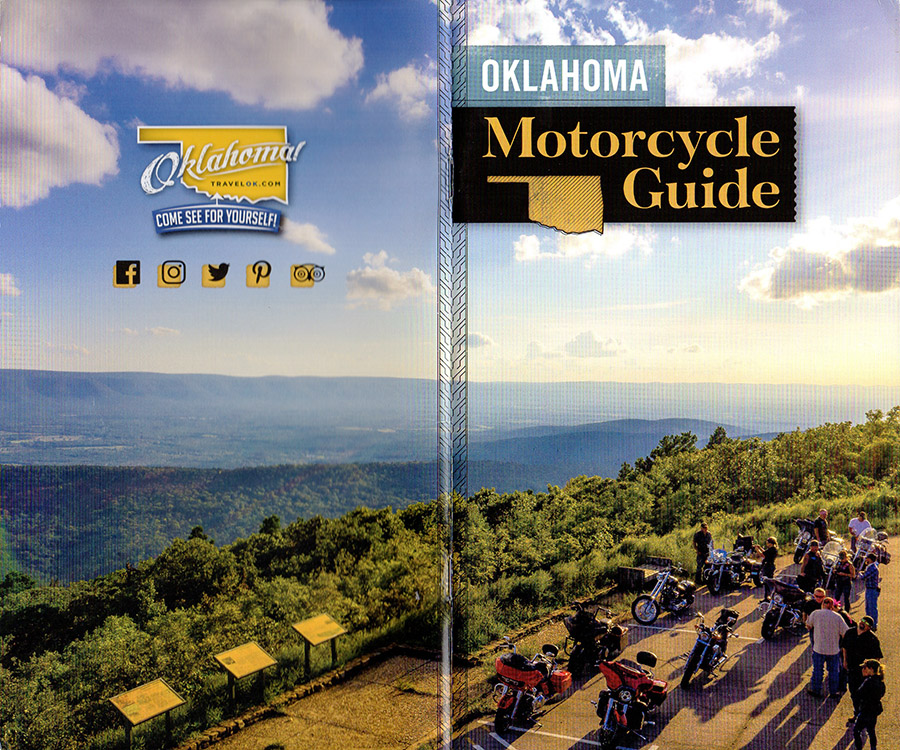
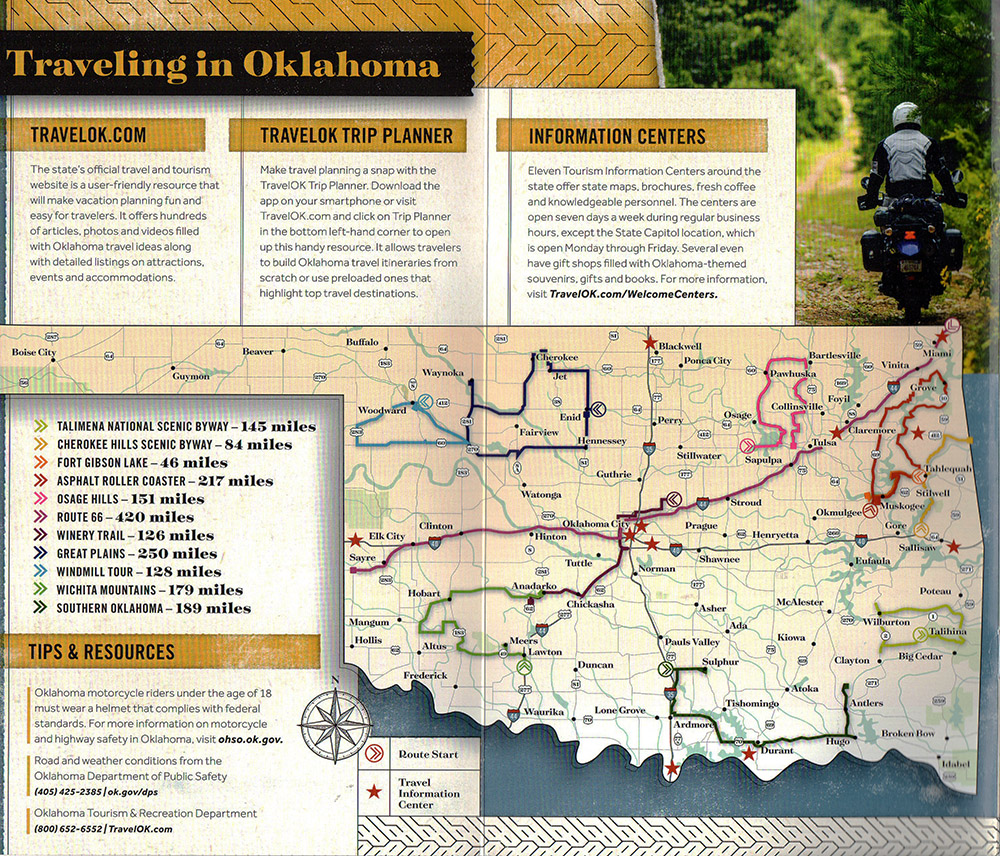
But even with the above, we barely scratched the surface of what Oklahoma offers. The materials the good folks in Oklahoma mailed to us included the Oklahoma Motorcycle Guide. It suggests several rides, complete with maps and two or three pages on each ride. The Oklahoma Motorcycle Guide is impressive.
A few suggested Oklahoma rides. Click on this image a couple times to enlarge it.
Imagine that: One of our states issuing a motorcycle travel guide! More good news? It’s free, the latest version includes even more rides than does the version I received several years ago, and you can download it immediately at this link: Oklahoma Motorcycle Guide Free Download
Trust me on this: If you’ve been looking for your good next place to ride, Oklahoma needs to be on your list.
With the temps hitting over 100 degrees out here, I thought it might be a good idea to rerun a blog we ran a few years ago. Let’s stay cool out here, folks!
I visited Chiriaco Summit and the Patton Museum last week (we’ll have a blog on it soon) and it was awesome. But wow, was it ever hot. As in 111 degrees when we left, and that’s not an unusually warm day out there in the Sonoran Desert. The next town over is called Thermal, and a little further north there’s this place called Death Valley. Death Valley recorded a whopping 131 degrees three weeks ago. Sensing a pattern?
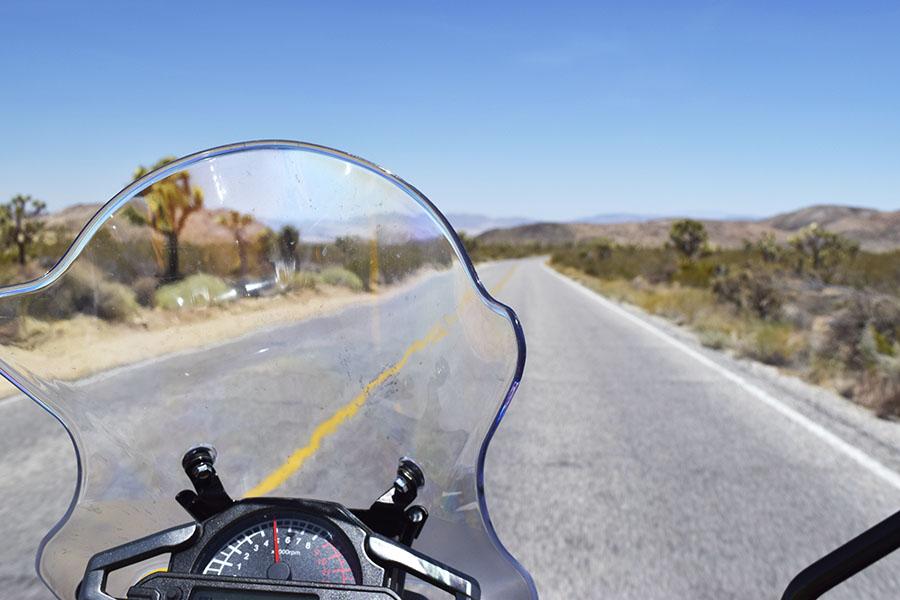
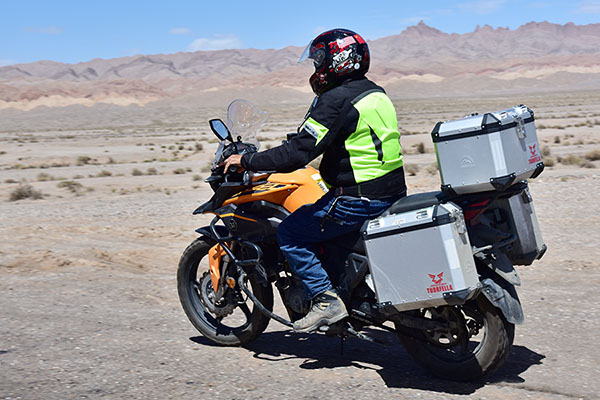
Looks like the Mojave, doesn’t it? Nope. That’s Joe Gresh in the Gobi Desert. Gresh and I rode across it after coming down off the Tibetan Plateau. It was a bit warm out there.
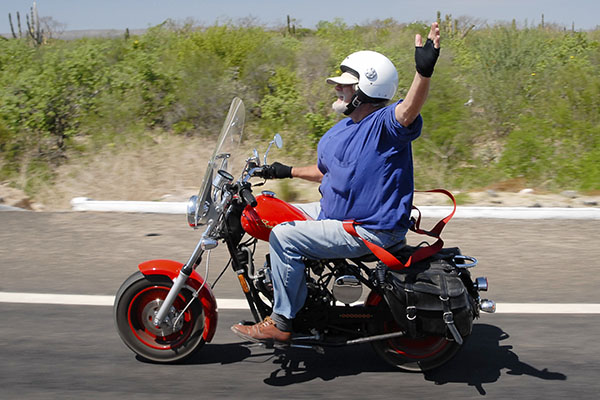
Yeah, it gets warm in these parts, and in other parts of the world as well. Hot weather is not ideal riding weather, to say the least, but sometimes we find ourselves riding in shake and bake conditions. I’ve done it. I rode a 150cc scooter all the way down to Cabo and back in Baja’s hottest month of the year (September, when it was well over a hundred degrees every day). It was humid down there, too, once we crossed over to the Sea of Cortez side of the peninsula. We were literally entering the tropics as we crossed the Tropic of Cancer. Whoa, that was rough riding!
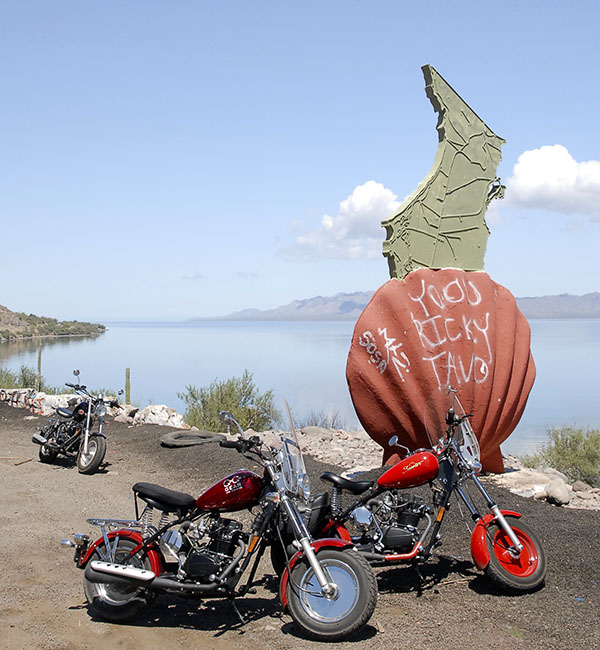
Simon Gandolfi, suspenders flying in the breeze, riding my Mustang replica bike south of the Tropic of Cancer in Baja California Sur. It was one of the hottest rides I ever experienced.
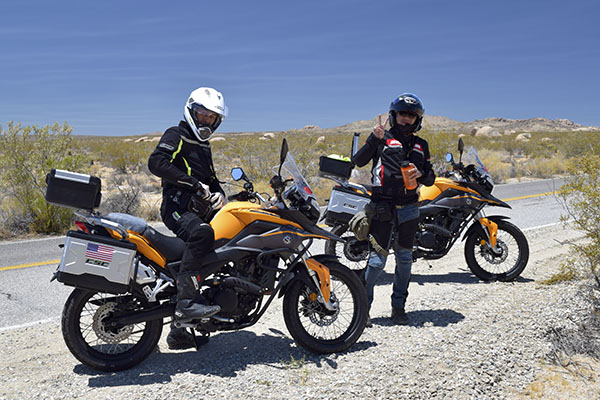
When we did the Western America Adventure Ride with CSC and the guys from Zongshen, we rode through the same corridors described earlier above, riding across California and the Mojave Desert, through Joshua Tree, and on into Arizona with temps approaching 110 degrees. That was brutal riding.
King Kong and Mr. Zuo in Joshua Tree National Park. That was another brutally hot day. Higher higher temps were still in front of us when we later rolled through Amboy, California. This picture became the cover photo for 5000 Miles At 8000 RPM. You should buy a copy or three (they make great gifts).
The ride across China that Joe Gresh and I did had similar challenges. It started out hot, then it got cold as we rode into the Tibetan Plateau, and then it became brutally hot and humid as we descended into central China and rode east to Qingdao. That was a 38-day ride, and I’d guess it was well over 100 degrees for at least 30 of those 38 days.
The risk, of course, is heat stroke, and it’s often not the kind of thing you can feel coming on. You’ll think you’re okay one minute, and the next you’re waking up in an emergency room wondering what happened. If you start to feel a headache while riding in hot weather, you are already perilously close to heat stroke. You need to stop, drink copious amounts of water, and get some shade. The better approach, though, is to not let yourself get anywhere near that condition, and that’s what this article is all about.
It almost seems like heresy to say it, but my first bit of advice about riding in hot weather is: Don’t. Given the choice, postpone the ride. But let’s assume that this is not an option, as was the case for each of the rides mentioned above. Okay, then…here’s my guidance on the topic.
12 Hot Weather Riding Tips
One: Don’t ride naked. I’m not trying to be funny here, and I’m not implying you might be the kind of person who would go down the road wearing nothing at all (although there is that story about Gresh riding around with only a bathrobe). Nope, what I’m talking about is not shucking your safety gear. You have to wear it. All of it. ATGATT. All the gear, all the time. You can’t peel it off just because it’s hot. It’s saved my life.
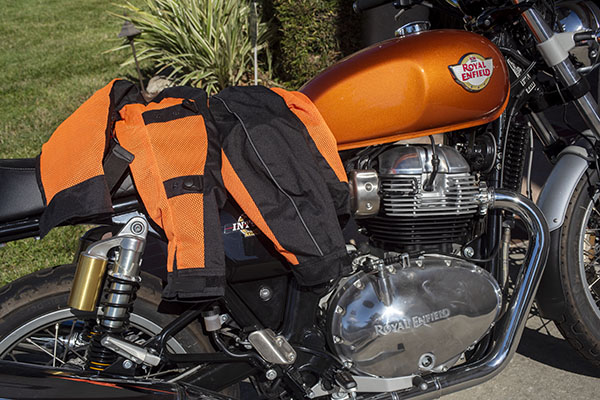
My Viking Cycles mesh jacket and the mighty Enfield.
Two: Wear a good mesh jacket. These are available from several sources. I have a Viking Cycles jacket I’m wearing these days and it works well. I wore a Joe Rocket mesh jacket on the ride across China and it made a big difference. You can get them from Viking Cycles, CSC Motorcycles, British Motorcycle Gear, and other sources. Trust me on this…you need a ventilated jacket for riding in hot weather. EDIT: We’re getting interesting comments advising not wearing a mesh jacket in hot weather. Make sure you read the comments below, and for those of you who responded, thanks very much!
Three: Use a cooling vest. These things actually work, but they’re not as easy to use as it sounds. They don’t work for long, but they work. The idea is you soak them, and then wear them under a jacket. The airflow causes the water in the vest to evaporate and that cools the vest and you. I’ve found that on really hot days these vests need to be remoistened about every thirty minutes, but you should be stopping that often anyway (more on that later). It’s the remoistening part that I don’t like. It seems like they take forever to soak up water when you remoisten them. I’ve found it easer to just get my clothes wet (see the next point below).
Four: Go soak your head (and everything else). Don’t laugh; I’ve done this. On the Baja ride I mentioned above, it was so unbearably hot that we took to pouring water down the inside of our riding jackets and inside our helmets at every stop. We became rolling evaporative coolers. It helped.
Five: Change your riding hours. On the really hot days, I like to hit the road at 0:Dark:30. Get out and get a hundred or so miles in before it gets unbearably hot. You’d need good lighting on your bike to do this (I generally don’t like to ride at night, but I’ll make an exception when I know it’s going to be hot). This is difficult to do when riding in a group because it’s hard to get everybody moving that early. If it was just me and Gresh or Welker, we’d leave way early and get in a couple of hours of riding (or more) before the sun comes up.
We knew it was going to be brutally hot riding through Joshua Tree and the Mojave Desert, so we left just before sunup on the first day of the Western America Adventure Ride.
Six: Drink a lot of water. The problem with riding in high temperatures is you don’t realize how much water you lose through perspiration. My advice is to stop every 30 minutes and drink a bottled water. Like I said above, most of us ain’t spring chickens, and you might be wondering if this means you’re going to be stopping a lot to pee. Hey, it’s a common old guy problem, but it won’t be in hot weather. Drink a lot of water; you’ll lose it through perspiration as you ride.
Seven: Avoid alcoholic beverages. Alcohol will cause you to dehydrate more rapidly, and that’s the opposite of what we’re trying to do here. You shouldn’t be consuming alcohol on a motorcycle ride anyway. Drinking any kind of alcohol while riding in hot weather is just stupid. Where I found you really have to watch this is when riding in a large group (there will be one or two riders who have to have that beer or two at lunch).
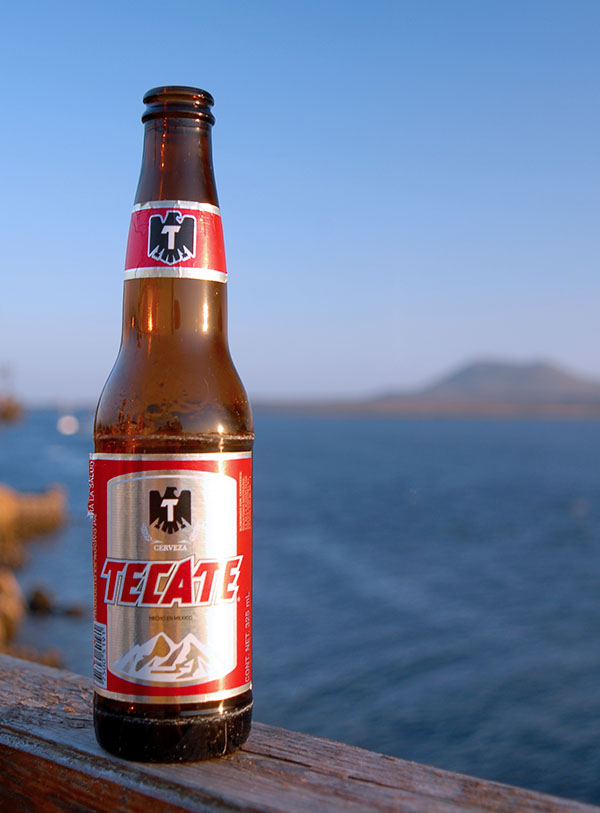
Beer is good, especially when it’s a Tecate at the Old Mill in Baja overlooking Bahia San Quintin. But save it for the end of the day, when the bikes are parked for the night.
Eight: Stop regularly to cool off. Find a bit of shade or someplace air conditioned, and get off the bike to cool down. When I ride in hot weather, I usually stop to cool off and rehydrate every 30 minutes or so.
Stopping to cool off at the Tropic of Cancer. Wow, it was hot and humid down there! We were off standing in the shade, drinking bottled water.
Nine: Keep your tires at recommended pressures. Another thing you definitely don’t want on a hot day is underinflated tires. Tires flex with every rotation, and flexing causes the tires to heat. Throw in high road surface temperatures with underinflated tires, and you’re flirting with a blowout. This is especially important to remember if you’re one of those guys or gals who deflate their tires for dirt riding. Don’t forget to pump them back up when you get back on the asphalt.
Ten: Don’t speed. Tar melts on hot days, and melted tar is slick. Factor that into your riding when it gets toasty.
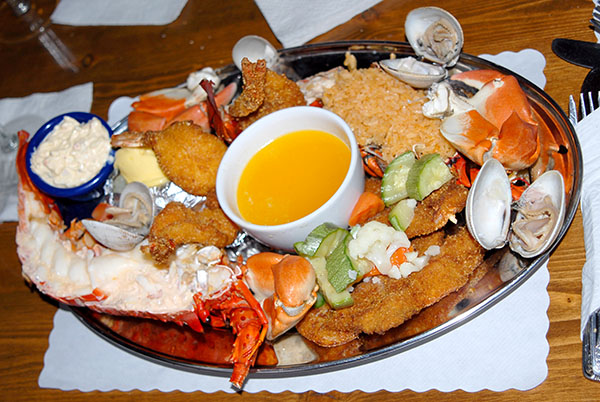
A meal fit for a king, but not for lunch. You wouldn’t want to ride in hot weather immediately after this Baja seafood extravaganza.
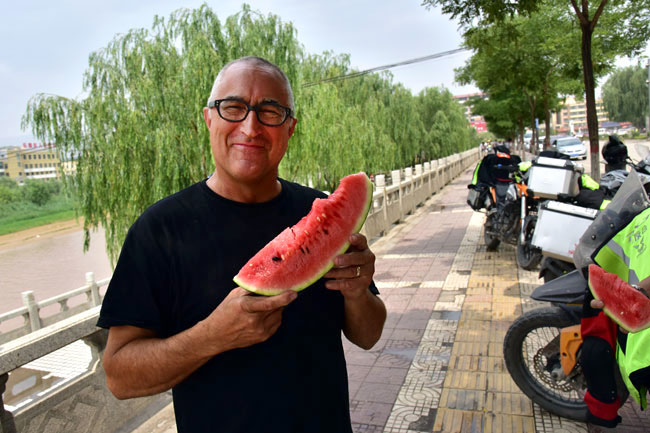
Eleven: Eat light. Don’t over indulge. Heavy meals put a strain on your digestive system and your heart, and that can elevate your body temperature. When I was involved in testing munitions out in the Mojave on hot days (where it was sometimes over 120 degrees), we always brought along melons for lunch and nothing else. We didn’t need to keep them cool. They were a great treat, they seemed to make it a little cooler on those horrifically hot days, and they help to keep you hydrated. Good buddy Sergeant Zuo seemed to know all about that in China, too. We were riding through Ledu in central China one ferociously hot day when our favorite Chinese NCO stopped the group, disappeared, and returned with a couple of watermelons. That was a welcome respite and a marvelous treat. We ate a lot of watermelon in China.
Gresh taking a break in Ledu, China. That’s the Yellow River (China’s Mother River) behind Uncle Joe.
Twelve: Lighten up on the low sodium schtick. A lot of us older guys try to watch our sodium intake. When I was in the Army, they actually gave us salt tabs on really hot days when we were in the field, the theory being that we needed the sodium because we were losing so much through perspiration. I later heard the Army reversed that practice, but the fact is you lose a lot of minerals through perspiration. I don’t worry about my sodium intake when riding on hot days.
So there you have it. You know, most folks who ride motorcycles these days…well, how can I say this delicately? We aren’t spring chickens anymore. Motorcycling tends to be a thing mostly enjoyed by full-figured senior citizens, and we have to take care of ourselves, especially when we venture out on hot days.
If you other ideas about hot weather riding, let us know in the Comments section. We love hearing from you.
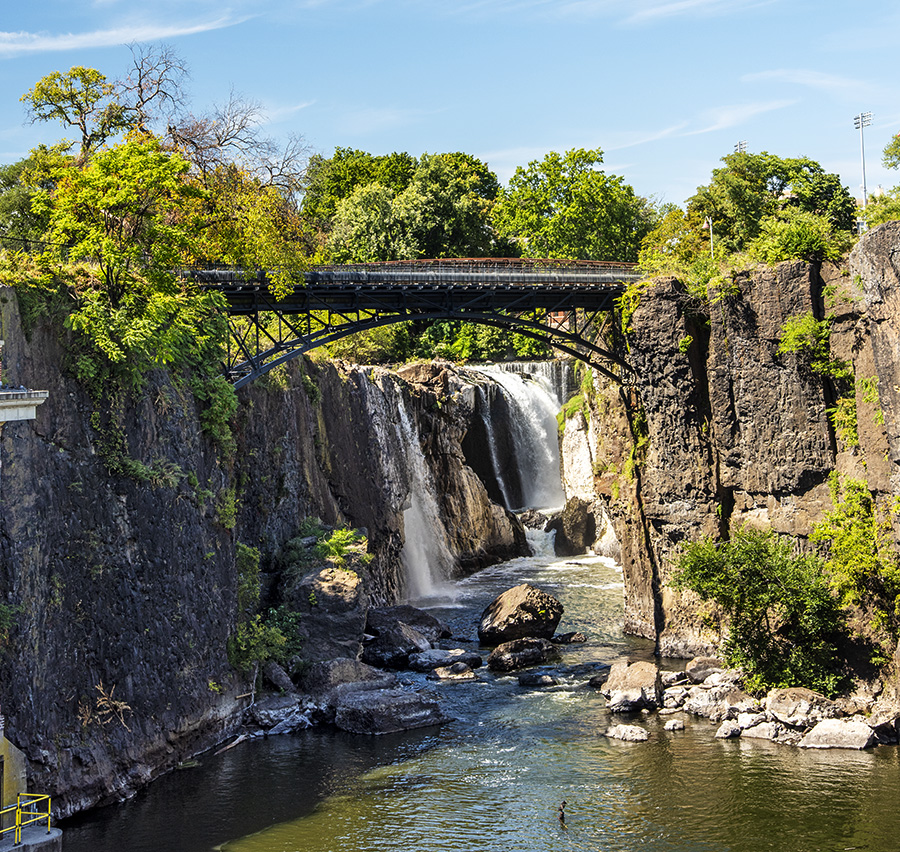
Another one of the stops on my New Jersey Sopranos tour was Paterson Falls. Although only about 40 miles or so from where I grew up, I’d never been there.
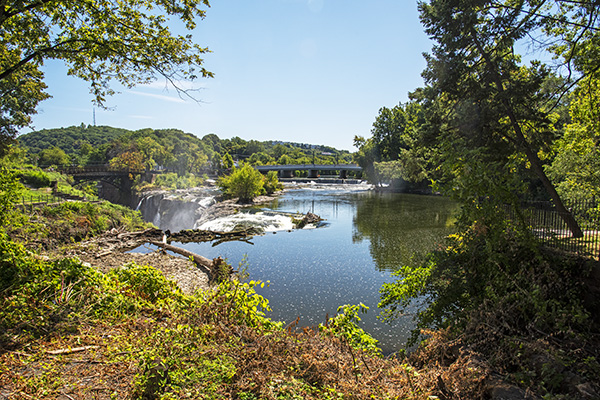
I knew of the town, though. It’s an old industrial village with waterfalls, which meant that in the early days of our country it was perfect for industrial development. The falls provided hydraulic power, and that could be used to drive machinery. Indeed, it’s where Samuel Colt built his first run of revolvers, which are known (not surprisingly) as Paterson Colts. Paterson was established as the nation’s first planned industrial city in 1792, with its readily-available hydraulic power and close proximity to New York City and the Atlantic Ocean. Paterson manufactured silk cloth, steam locomotives, textiles, paper, firearms, and aircraft engines. It is centered on the Passaic River, which flows into Newark Bay and from there to the Atlantic Ocean.
The Passaic Falls are contained within the Paterson Great Falls National Historic Park, which is (as the name implies) part of the U.S. National Park system. All this was news to me, which is kind of amazing when you consider that I grew up a short 40 miles to the south. I’d never known any of this, and to learn about it at my age was surprising. I’ll give the credit for that to David Chase (the guy who created The Sopranos). Had that show not sparked my interest, I’d still be ignorant.
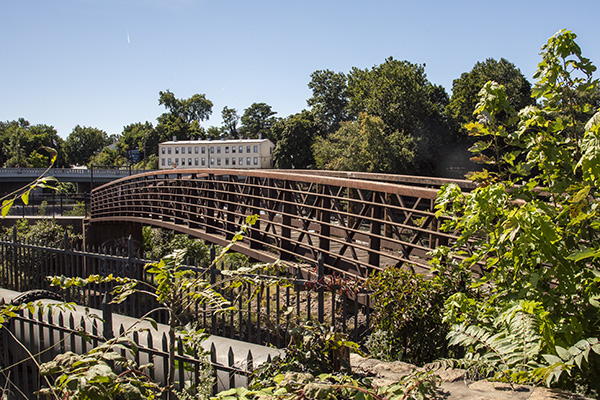
So, let’s move on to the scene in The Sopranos that caught my attention. It’s the episode in which Mikey Palmici (Uncle Junior’s driver and bodyguard) throws a drug dealer off the bridge over the Passaic Falls:
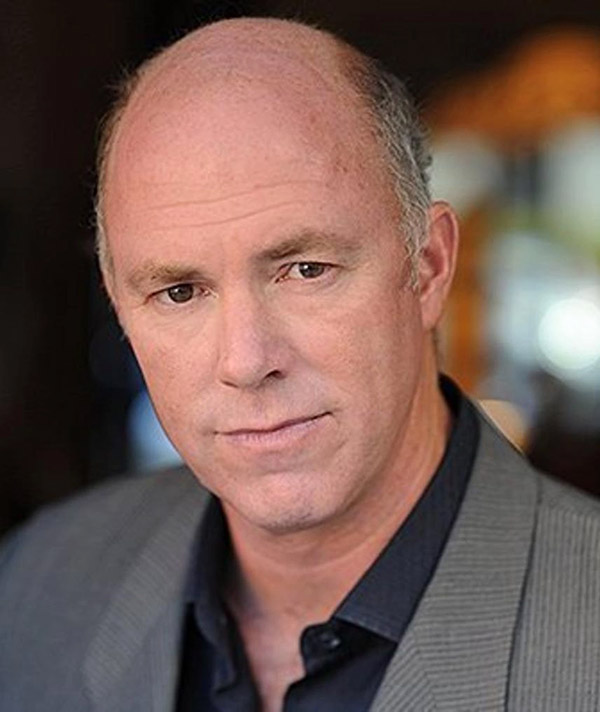
That episode you see above occurred later in The Sopranos. There was another scene in the very first Sopranos episode on the same bridge shown above in which Hesh Rabkin and Big Pussy Bompensiero (two of The Sopranos characters) threaten to throw a health insurance company executive (a guy named Alex Mahaffey, played by Michael Gaston) off the same bridge if he didn’t cooperate with a Sopranos scam to defraud the insurance company.
When threatened with a swan dive off the bridge, Mahaffey gave in to the Soprano family’s demands, but alas, his Sopranos career was over; Michael Gaston never appeared in another episode. But that didn’t mean Sue and I wouldn’t see him again. In one of our trips to New Jersey, we rode the Air Trans shuttle between the airport and the rental car facility. Just before we boarded the shuttle, Michael Gaston was leaving the car we entered. We didn’t bug him, but we made eye contact and he knew we knew who he was.
Michael Gaston, an actor we bumped into on the Newark Airport Air Trans.
There’s a lot more to Paterson, though, then simply having been a location for a couple of The Sopranos scenes. Here’s another video that describes Paterson’s history:
Today, Paterson is undergoing a renaissance, as the old factory buildings are being converted to loft apartments. Yup, Paterson is being yuppified. It looks like an interesting place to spend more time, but my schedule didn’t permit doing so on this visit. For us it was roll into town, grab a few photos, and bail.
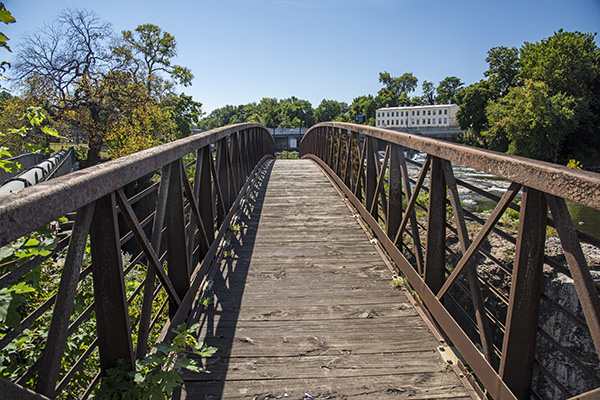
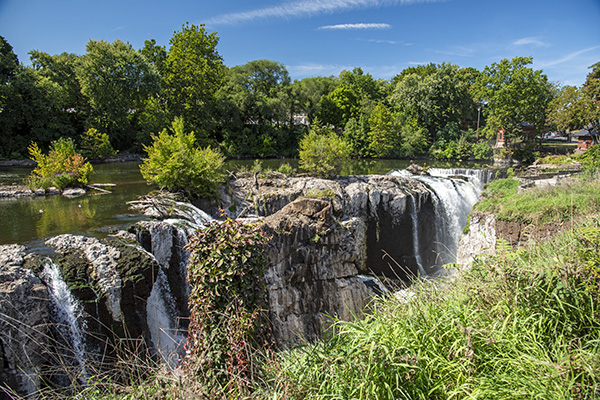
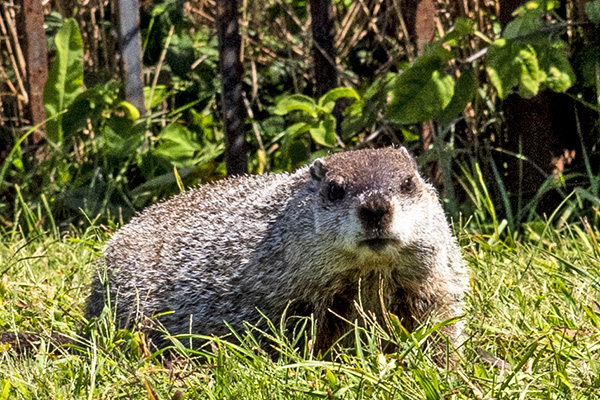
A view of Passaic Falls. This is a beautiful area.The wood-surfaced foot bridge featured in two different Sopranos episodes.Another view of the bridge. It’s closed to the public. On the Internet, it says it’s for safety reasons. One of my police buddies told me it’s because there were too many suicides from this bridge.Another view of the Passaic River and its Falls in Paterson.While we were visiting the Paterson Great Falls National Historic Park, this rather plump groundhog was doing the same. My Dad used to hunt these in New Jersey with his .243 Model 70 Winchester and the farmers loved having him do so. These woodchucks may look cute, but they destroy a lot of crops.
One thing I know for sure: I’ll return to Paterson. I’d like to explore the city, its museums, and more in greater detail.
Want to see our other visits to The Sopranos locations? Here they are:
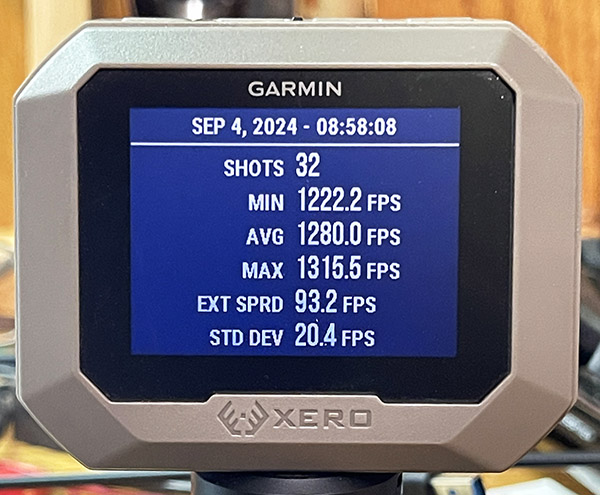
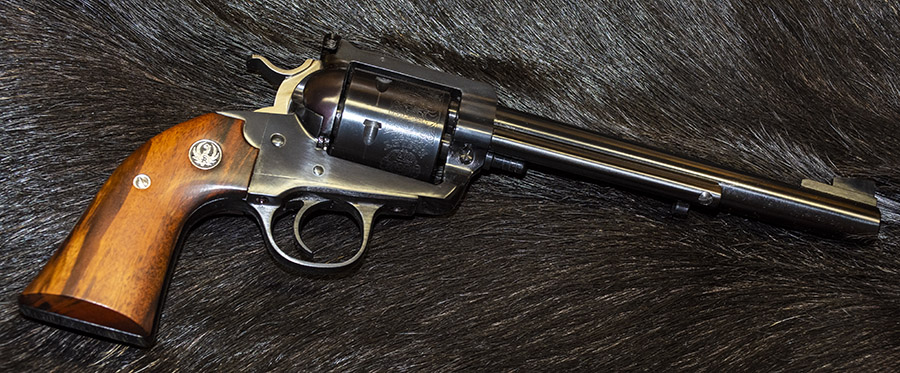
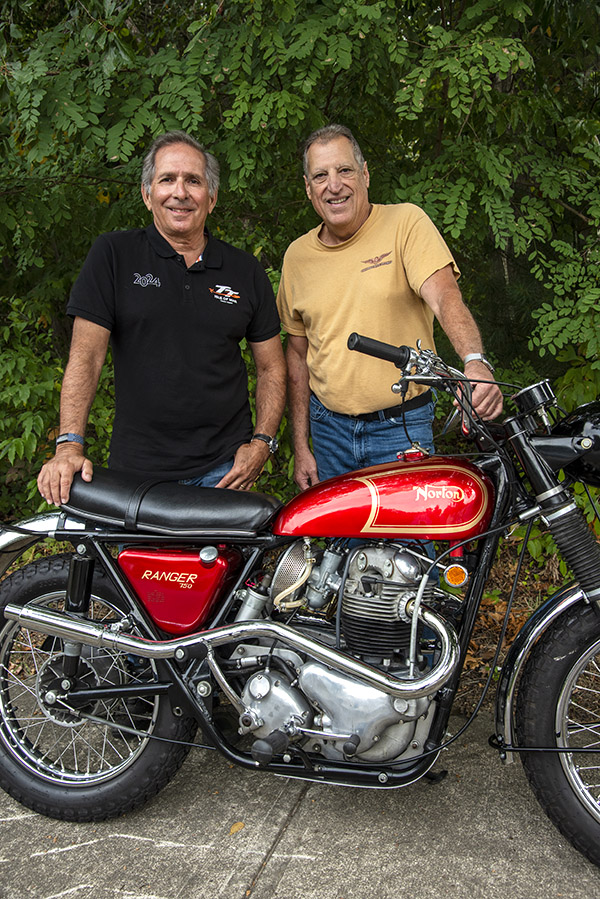
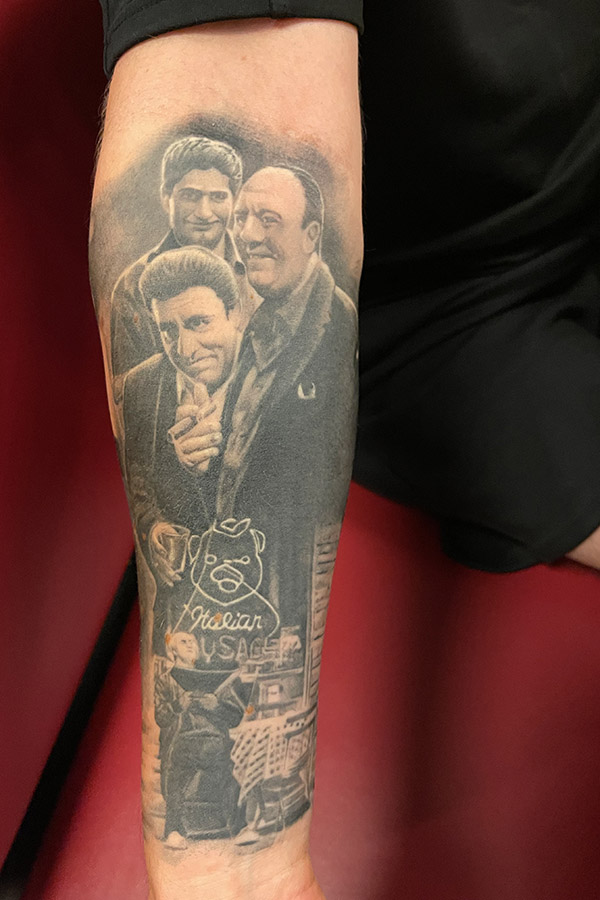
We’ve got a bunch of good stuff coming your way, my friends. I just finished a whirlwind week in New Jersey, we hit some of the Sopranos film locations, I grabbed a bunch of very cool Norton P11 photos, we saw where Bruce Springsteen was setting up for a concert in Asbury Park, I have a review on the new Garmin chronograph about to go live, Mike Huber (aka Mike Nelson) is down there in Indonesia and Thailand becoming one with the sea turtles, I’ve got a review on Ruger Customer Service and my revamped .357 Bisley, Joe Gresh has his Z1 Kawi all dressed up with lots of new places to go, and lots, lots more.
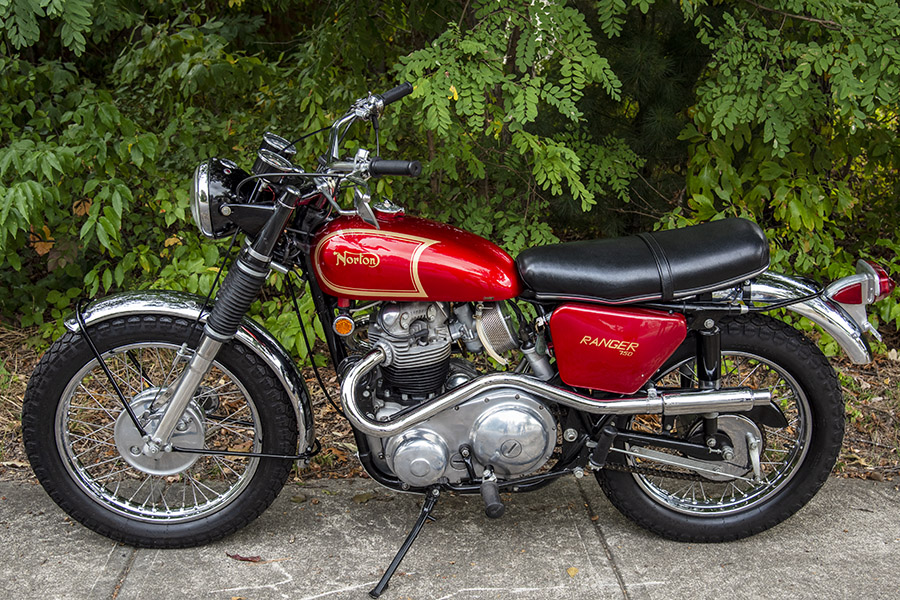
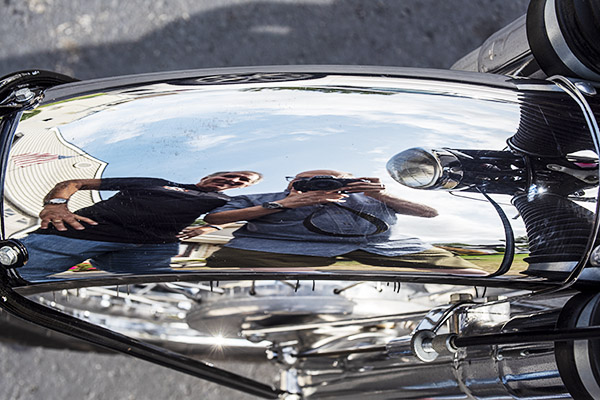
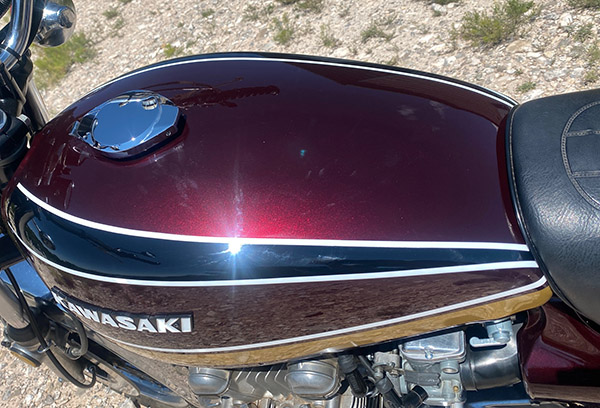
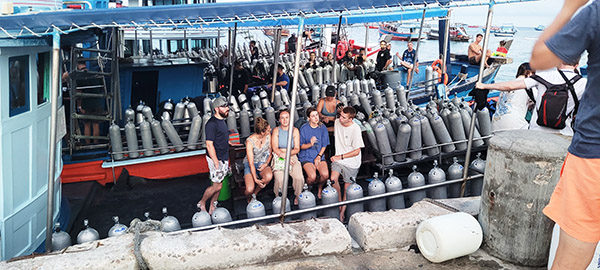
Andrew Capone, Isle of Man impresario and British Motocycle Gear CEO, with an unknown paparazzi reflected in a Norton Scrambler fender at an undisclosed location in New Jersey.All dressed up with lots of places to go…Joe Gresh and the Z1…the gift that keeps on giving!How fast is fast? Stay tuned, and we’ll tell you!Scuba Southeast Asia with Mike Huber!Bisley mania! Plinking at 100 yards with a handgun? You bet!Andrew, Harry (aka “the Norton Whisperer”), and what is unquestionably one of the most beautiful motorcycles ever made!There’s ink, and then there’s Sopranos ink. Oh, do we have a story for you!
You know, we blew right by 1500 blogs some time ago, and I started to wonder if we were going to run out of things to write about. Nope. Not gonna happen. It’s like when one of my geezer buddies told me he didn’t know what to say at a lunch gathering, and another of my geezer friends told him, “Don’t worry…you’ll keep talking until you think of something.”
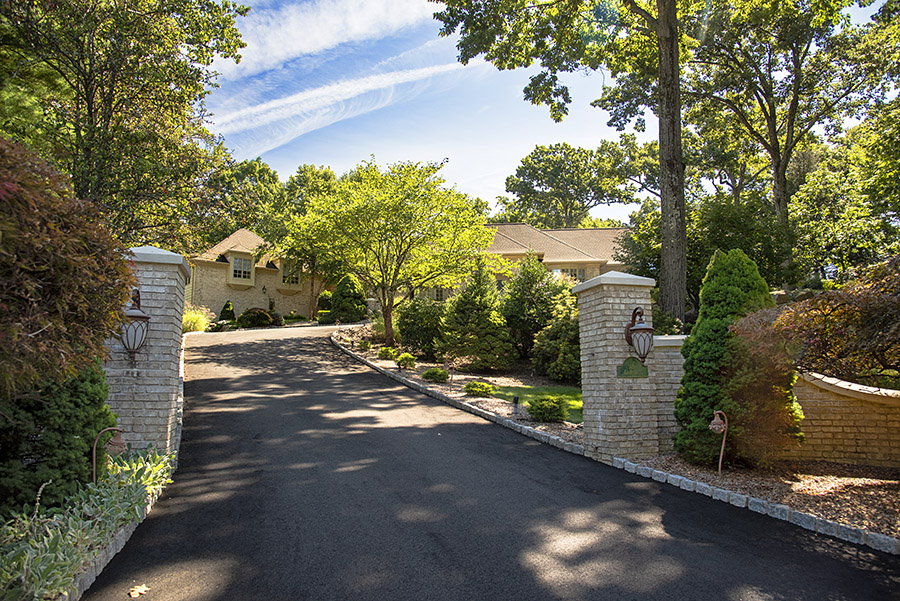
The scenes and the locations are iconic, and I take pride in recognizing every one of them in The Sopranos opening credits. The music, the New Jersey Turnpike toll booth, the aged industrial locations, Pizzaland, and motoring up that long driveway at 14 Aspen Drive in North Caldwell, New Jersey. Today’s topic is the home you see at the beginning of every episode in what is unquestionably the best television series that ever aired.
I had originally seen the series sometime after it first ran on HBO. I didn’t at first recognize how wonderful the show was and how it would come to be known throughout the world. It was so good that many people think Tony Soprano is real. I was in Scotland for a consulting gig when my driver, an elderly gentleman, recognized my American accent but told me I didn’t sound “like California.”
“I’m originally from New Jersey,” I explained.
My driver grew silent. He was thinking. Finally, the Question: “Do you know Tony Soprano?” He was dead serious. We were in Glasgow on a motorway taking me to my destination, and here was this Scot asking me about a fictional character. One who obviously seemed all too real to anyone who watched the show.
“I never actually met the man,” I truthfully answered, “But I know people who knew him.”
What I told the driver was true, sort of. James Gandolfini, one of Tony’s many aliases, was a Jersey boy like me. He graduated from my alma mater, Rutgers University. I could identify with The Sopranos and its New Jersey setting. I knew people who spoke with the same accent and who most likely knew the DeCavalcante crime family (the real-world gangsters The Sopranos modeled). Hell, I speak with the same accent, and that old Scot picked up on it in Glasgow. Did I know Tony? Hey, I could name names, but I don’t want to sleep with the fish. I’m no rat.
On a recent trip, I thought it might be fun to Waze my way to a few of The Sopranos locations. The list was long, as the show was mostly shot in New Jersey (as were most of the guys and a couple of gals who fell from Tony’s favor). The first location I would visit, of course, had to be Tony and Carmela’s mansion. Waze knew the way. The Garden State Parkway took me there, and that seemed fitting.
When we arrived, the cul-de-sac was way smaller than it had appeared each morning when a bathrobe-clad Tony waddled down the driveway to pick up his Newark Star Ledger (a paper I used to read, by the way). I couldn’t see too much of the mansion, the result of 25 years of landscaping doing what landscaping does. The trees and bushes had grown to obscure the view from the street. It’s what Tony (or any organized crime figure) would have wanted. Best to keep a low profile, free from Agent Harris’s probing eyes.
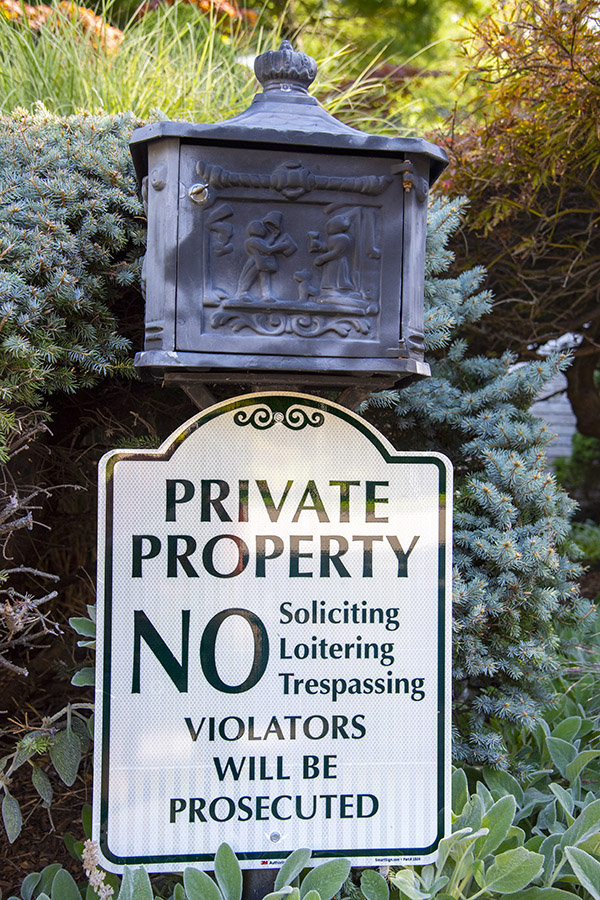
When a guy like Tony Soprano posts a sign like this, I pay attention. Nah, not really. What’s he gonna do? Coincidentally, we had that same mailbox in front of our house for years. It leaked and we grew tired of wet mail.
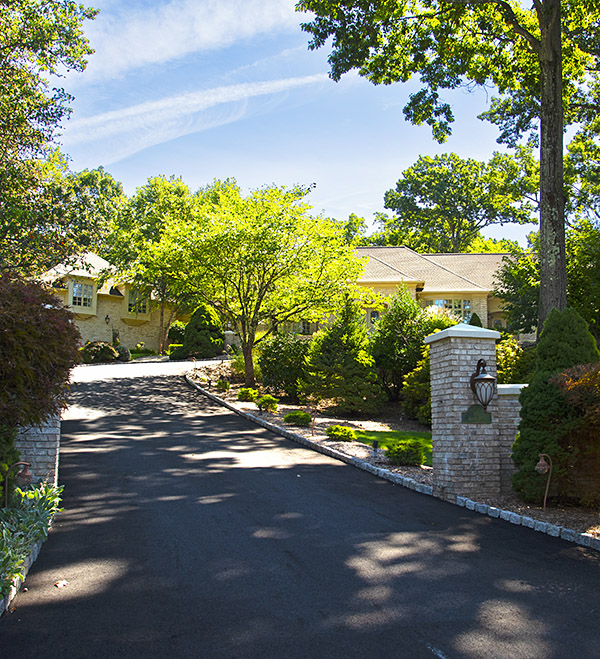
There it was, tucked away behind the vegetation, most definitely the mansion featured in so many episodes and, as mentioned above, in the opening at the start of every episode. Even though the current occupants obviously discouraged visitors, we still took our chances. As I was snapping photos midmorning on this New Jersey weekday, others appeared and did the same. Some of them might have been FBI agents. The fans of fame kept the flame burning bright, almost three decades after the music and the scenes first appeared. Note to self: Make the next visit in the dead of winter when the trees are bare, and do so late in the afternoon when the sun is in a better position. The lighting was not good when I gathered this evidence; a good lawyer could get the photos thrown out in court (a junior G-Man I’m not).
14 Aspen Drive. If you listen carefully, you can hear Carmela bitching.
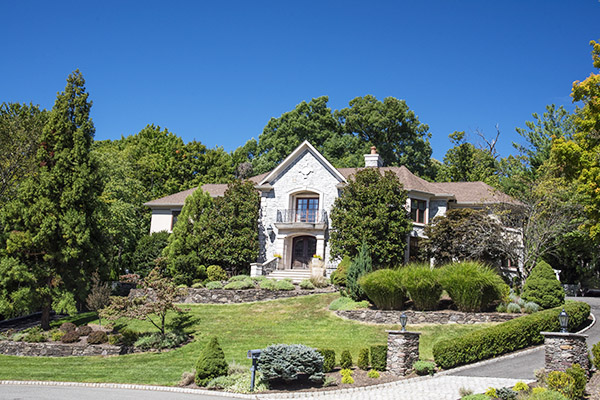
The sign’s admonitions notwithstanding, I looked around and started working the Nikon’s shutter (I’m not gonna lay down for some mailbox sign). The neighborhood was befitting a kingpin like Tony Soprano. The home on the other side of the cul-de-sac was better lit by the sun’s mid-morning rays, so I had to shoot it, too. Collateral damage; couldn’t be helped. An impressive zip code, to be sure.
A home across the street from Tony’s place. This is an exclusive neighborhood.
I liked The Sopranos television series then and I like it now. I watch The Sopranos episodes on my cellphone (it’s running on Max) when I’m working out. I get through an episode or so each time I visit the gym. I’ve been through the entire series four times (and I’m into Season 5 for the fifth time now). I started binge watching The Sopranos 18 pounds ago. The Sopranos have been very good to me, my waistline, my cholesterol, and my A1C. I need to buy a new belt, and Tony is the guy who made that happen.
So what’s next? Paterson Falls, my friend. It’s where Mikey Palmici threw a drug dealer off the bridge. Stay tuned if you know what’s good for you.
As I had begun to enter my 5th month of travel, not knowing where I would be sleeping the next night became routine. My mentality was “Future Mike will figure this one out, he always does.” And I always did. That mindset isn’t wrong, as crazy as it felt. However, as time pushed on and the countries began to be more in my rearview mirror something was missing. A way to deeply experience a country, more than most experience it. Similar to my past life with living off the BMW GS1200. The bike added a much-needed color to my adventures whereas most were just doing these adventures in a van or car. The BMW gave me that extra level of depth that awakened my senses and really allowed me to meet some wonderful people I wouldn’t have otherwise.
Realizing I needed to experience something new (besides circling the globe solo). I needed something thrilling but something I had never done. I was two months into driving through Australia and about to board a flight from Sydney to Cairns. When I asked others in my hostel what was worth doing up there, one reply was always consistent: Scuba dive the Great Barrier Reef. That was it! I would become a certified scuba diver and head for the Great Barrier Reef.
I registered for the dates I would be in Northern Australia for a 5-day Open Water PADI Scuba Certification Class. This class would include two days of classroom/pool training and three days and two nights on a live-aboard boat in the Great Barrier Reef. Upon filling out the school course paperwork it seems that due to my ripe old age of 51 I would require a physical. Not a big deal; there was a clinic across the street from my hostel. I am sure they would rubber stamp me through this, so I booked an appointment. Upon being called into see the doctor I noticed his clothing apparel seemed a bit…off. It wasn’t until I went into his exam room I noticed posters of Elvis all over the walls. Now his butterfly collar, gold glasses, slicked back hair made sense. He was an Elvis impersonator, or a big fan at the least. Once reviewing the physical requirements with him he explained the physical entailed much more than I expected, including chest x-rays, hearing tests, vision test, drug test, etc.
So I am not saying I cheated on this physical, nor am I disclosing if I did cheat how I would complete such an act. What I am saying is I passed the physical with flying colors. Sweet. I sent the paperwork off to the diving school and was formally accepted into the program. I was still smiling as I boarded my flight from Sydney to Cairns in Australia (which was one of the northern-most points of this mind-blowing continent).
Arriving on time to class (15 minutes prior to its scheduled start) I learned the class would be small. Myself, a young man from France and an American female from San Diego. Our instructor was from Pittsburgh. Normally I would hold that against her, but she was beyond stunning so it was easy to let that go as we began our class instruction on the equipment and different emergency protocols, hand signals, and a tutorial of almost any underwater emergency we could possibly encounter. This was the first half of the day and post lunch it was time to put these lessons to use, using our scuba gear in an enclosed 12-foot deep pool.
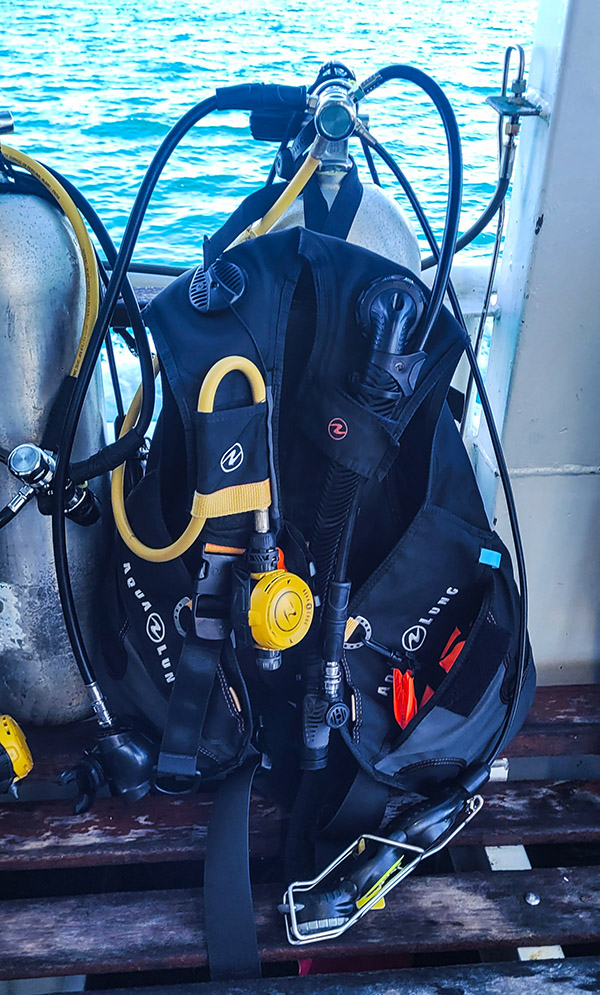
The first thing in the pool we performed even before learning about our gear was a swim test. This consisted of treading water for 10 minutes in place and a 300-meter swim. Upon successfully passing this, it was time to learn about all our gear. This included the air tank, BCD, respirator, fins, mask and snorkel, and how to successfully connect it all together.
It was now time to put on the scuba gear and go underwater in the pool for the first time. I will admit this caused a bit of anxiety for the first few minutes, even though we were just a few feet under. It was a new experience for me and the others, so that was normal. In no time we were nailing the different drills, such as mask removal and replacement while underwater, and buoyancy control. We also performed drills in the event we ran out of air and how to signal and use your buddy’s secondary air supply (I of course made sure I was paired with the instructor). Little did I know at the time, but paying attention to this lesson would prove to be lifesaving in just a few weeks in Indonesia.
Upon successfully completing the classroom, pool sessions, and passing a written exam, we were ready to take our skills into the ocean. The next day we were scheduled to meet at 0700 at the boat launch where we would be on a live-aboard boat for the next three days. The remainder of our training and honing our skills would be performed in the open waters of The Great Barrier Reef in Australia. This is where we hopefully would pass and become Open Water Certified Divers. Bad ass!
Guys, I apologize (again) for the long gap without writing. I have a massive backlog that I am attempting to catch up on and really have just been constantly doing too much to complete even a short blog. It has been a busy but productive time for me. I’m currently in my 6th country and I’m 8 months into a 1-year journey. I’m in Cambodia.
Cambodia is yet another country that wasn’t on my radar but having been semi-obsessed with experiencing all 7 Wonders of The World I really wanted to see Angkor Wat. I know, I know. It isn’t on the list of 7 Wonders now but that list seems to be ever changing and I didn’t want to miss out in the event it was added again. That, and the other reason is I was about to overstay my visa limit in Thailand (running my visas out seems to be a new talent of mine).
Originally, I booked a flight to Phnom Penh as a forward journey requirement for Thailand entry. As the time got closer to my travel I linked up with a driver in Cambodia who would take me around to see the many Temples. However, upon sending him my flight itinerary he quickly replied “Dude, you are flying into the other side of the Cambodia, Angkor Wat is 360 kilometers from that city.” After 8 months this was really my first error of any consequence. There were two options, a 6-hour bus ride, or just eat the $80 and book a new flight. I chose the latter to save time.
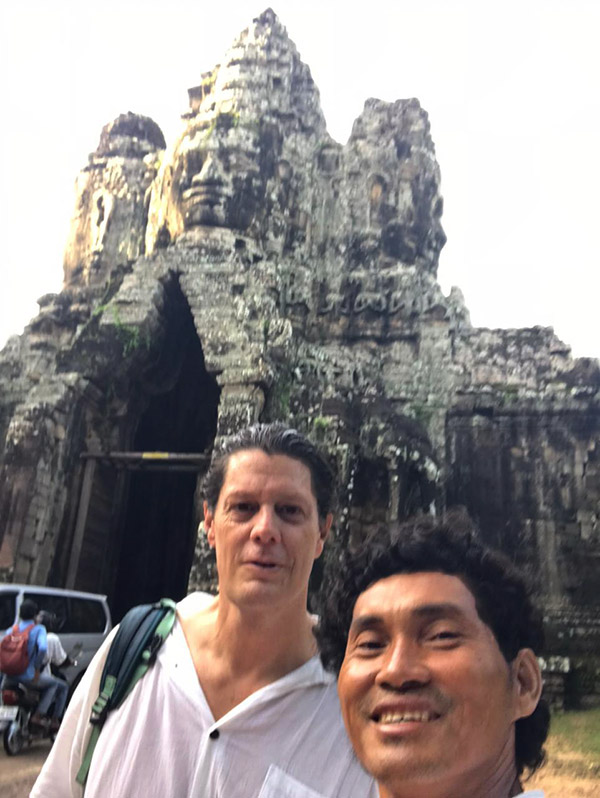
Upon arrival and a minor hiccup going through immigration (I didn’t bring $30 for a visa so I had to “borrow” it from an immigration officer who included a hefty “tip”). It was part of the game and another lesson learned from my poor planning. I can’t complain. Once through customs I met my driver, Kong, outside the airport. And we were off to my hotel in Seim Reap.
The first thing I noticed in Cambodia (beside the fact that they drive on the right side of the road…it has been 8 months since I have been in a country that drives on the right) was the heavy humidity. It was brutal, even though I was in high humidity places over the past three months. This was next level and there just was no reprieve, even in the early morning and evening. Along the drive we discussed my objectives while in Cambodia and the main one was to see Angkor Wat. With the heat and humidity being so oppressive, Kong recommended we start at 0430 the next morning in order to see sunrise at the Temple. This would provide for a magnificent way to begin the day and allow us to get a head start on the heat.
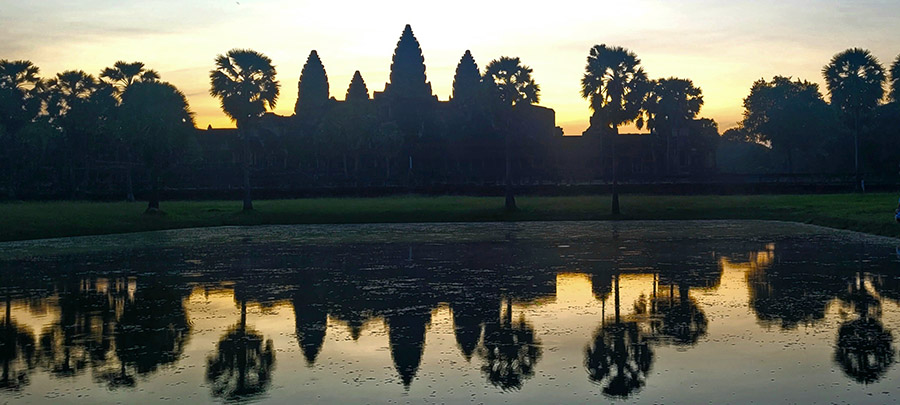
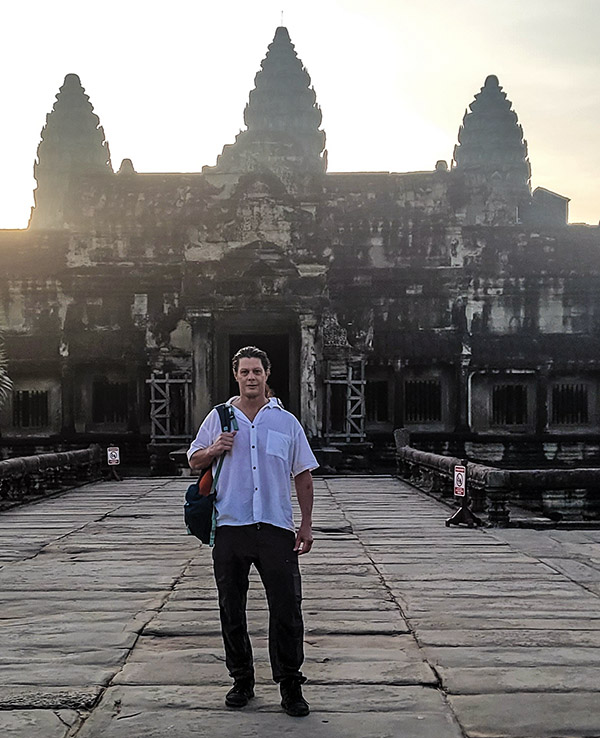
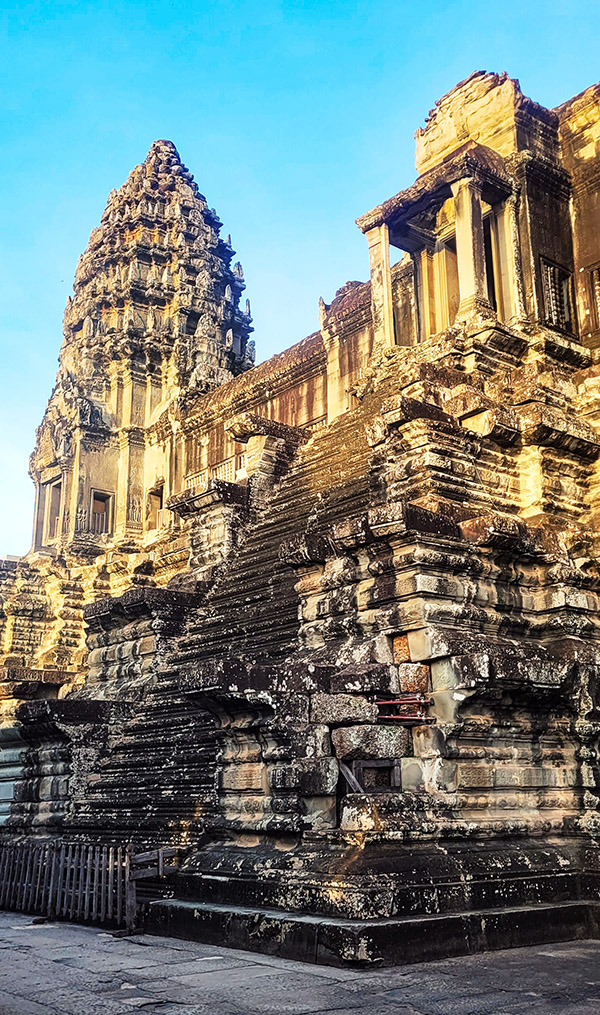
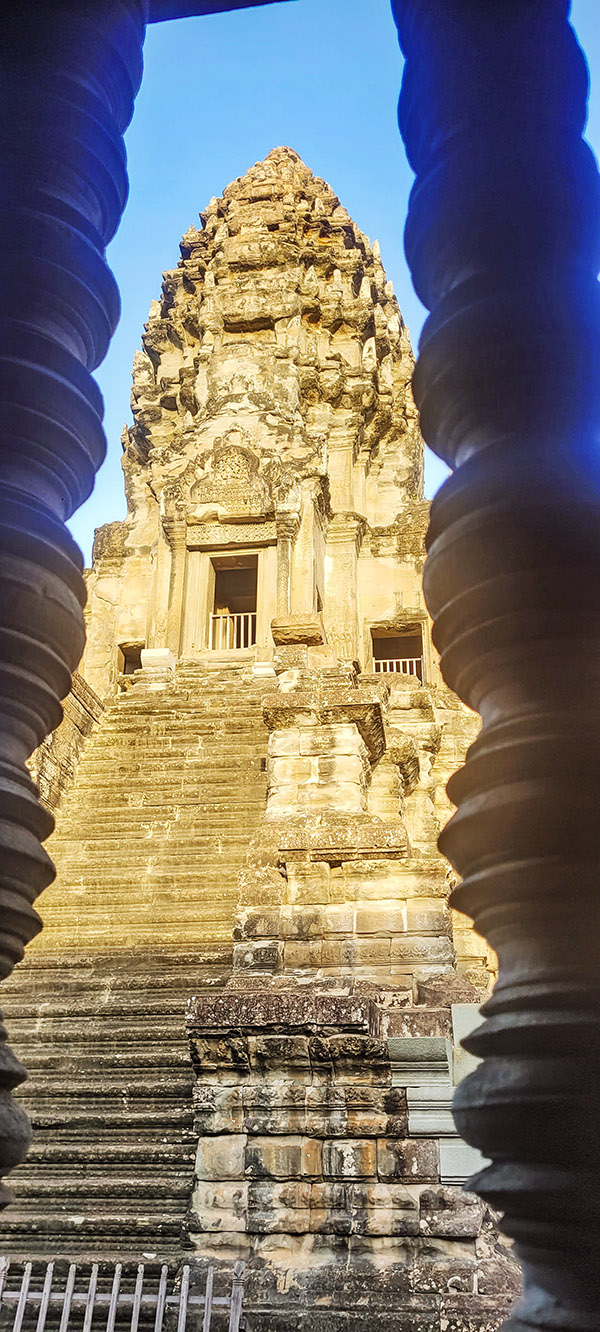
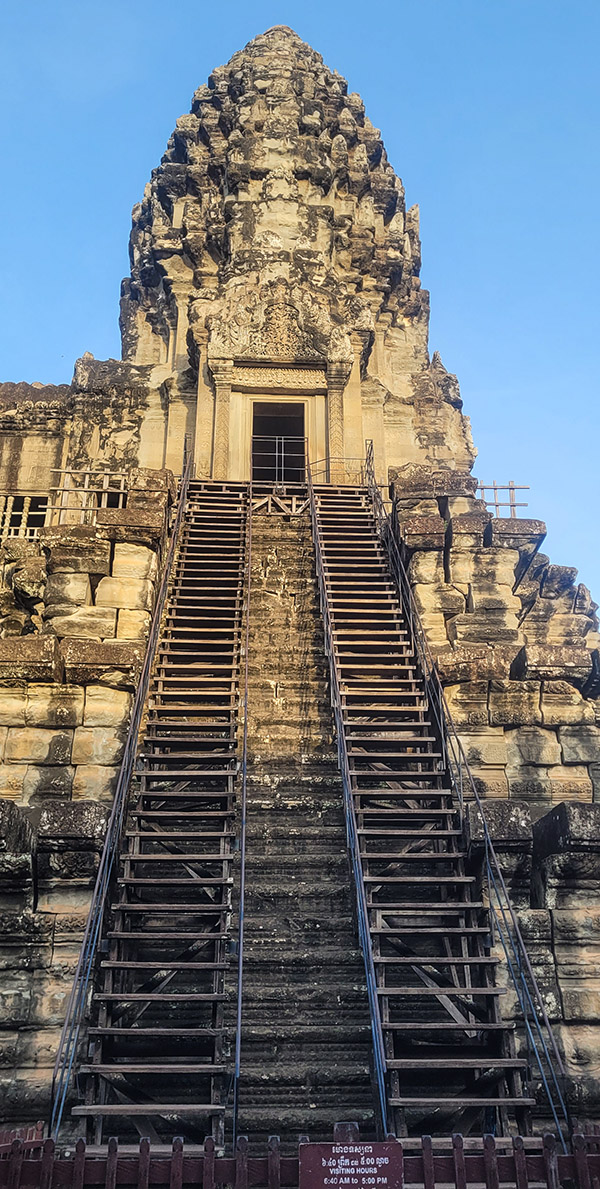
We arrived at Angkor Wat at around 0530 and walked through the darkness and over the moat that guards this UNESCO treasure. All the while the mountainous sandstone silhouette was gaining in color and depth as our path led toward a meeting point between us and the rising sun. Even during off season there was quite the crowd at the reflection pool, at sunrise, to try to get that perfect photo of this stunning homage to Hinduism. It didn’t take long for the heat to follow. This was our queue to seek out shade deep within the Temple to avoid more heat and more crowds, and begin exploring the hidden Temple chambers.
The depth and detail on the Temple was more than impressive. Even with the destruction from past wars and an occasional bullet hole in the sandstone, the overall structure hadn’t lost its mystical feeling. The mysticism was unavoidable as we walked through the Temple’s many chambers.
Of the many experiences along my journey, I think Angkor Wat is one of the best things worth seeing, touching, and experiencing. Whether included in the 7 Wonders of the World or not, it makes little difference in my appreciation of this stunning structure. Even as a massive tourist attraction, this Temple sets the criteria for what an ancient wonder should be. Experiencing it was well worth the trip to Cambodia.
I grew up up in the Evel Knievel era. It was a glorious time, the 1960s, and if you were a motorcycle freak (as I was and still am), there was no way you could not have heard of Evel Knievel, a man who jumped cars and buses (and ultimately, the Snake River Canyon) on a motorcycle. He was one hell of a showman.
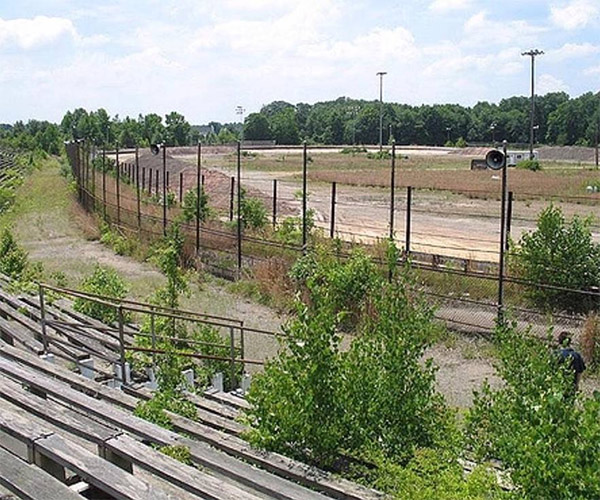
In the summer of 1966 I was a skinny little 15-year-old kid, my Dad owned a new Triumph Bonneville, and I was in hog heaven for that reason. Then and now, there was and is nothing cooler than a Triumph Bonneville. We were going to the motorcycle races. A big night out in those days was the East Windsor Speedway, a half-mile dirt track oval where they raced everything. Stock cars, two-strokes, and the big bikes. Not just locals, either. Harley’s Bart Markel (National No. 1), Triumph’s Gary Nixon (National No. 9), and more. It was the 4th of July weekend and it was 58 years ago. I remember it like it was last week.
East Windsor Speedway is no more. It’s now tract homes. My loss; New Jersey’s property tax gain.
East Windsor Speedway put on quite a show. Dad and I rode there on the Bonneville. I fancied myself a motorcycle guy and it just didn’t get any better than the half-mile dirt oval at East Windsor. The fun started right in the parking lot with hundreds of fans’ motorcycles. Fins and twins (everything was an air-cooled twin in those days), carbs, chrome, custom paint, custom seats, and more. It was all England and America and a little bit of Japan: Triumph, BSA, Honda, Harley, Suzuki, Yamaha…you get the idea. Italy and Ducati were yet to be discovered, only weirdos rode BMWs (remember those strange sideways kick starters?), and weirdos definitely didn’t go to the races. A new Bonneville was $1320 and a Honda Super Hawk (electric start, no less) was only about $600. It all seemed so attainable.
The East Windsor Speedway is long gone now, shut down by noise complaints from the encroaching ‘burbs and then plowed over for more cookie cutter homes. It’s a pity, really.
East Windsor always put on quite a show, but that 4th of July evening was a six sigma outlier on the right side of the bell curve. Stock car racing was first, then the 250cc class (love that smell!), then the big boys (including Nixon and Markel), then the main event (Evel Knievel!)…and it was all washed down with a 4th of July fireworks display that was as good as I had ever seen. That warm New Jersey night out started before the sun went down and finished around midnight. I think the cost to get in was something like $2.50.
Evel Knievel was the highlight for me and I think for everyone else, too. Evel was just starting to get famous, and here he was in person. White leathers and a cape trimmed in red and blue on the 4th of July. (Gresh and I always wanted capes, but we had to wait 50 years and go to China to get ours.) A Harley V-twin, with monstrous ramps set up on the infield (one for liftoff and one for landing), with a couple of Greyhounds in between (buses, that is…not the dogs).
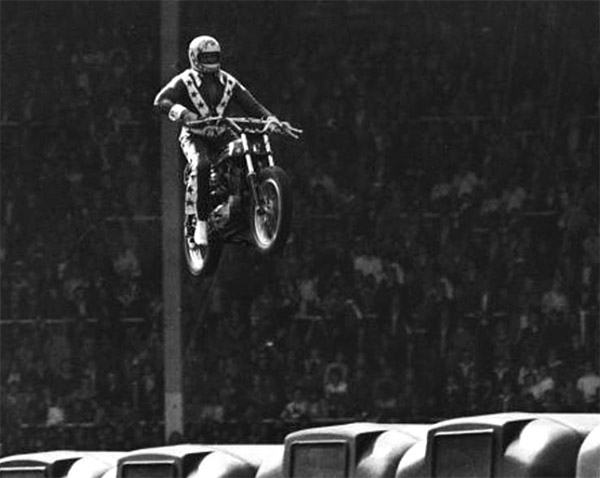
Airborne Evel back in the day.
The crowd fell silent as Evel revved the 750 Harley and then accelerated. But it wasn’t up the ramp. Nope, Evel (ever the showman) accelerated alongside the ramps and the buses when we all expected him to jump. Faked us out, he did. Then he looped around to start again. Ah, I get it, we all thought. That was just to gage his acceleration before hitting the ramps for real. The anticipation built. Thousands held their breath as Evel accelerated again, but he faked us out with another run alongside the ramps. Okay, all part of the show. A third time….maybe this would be it…but no, it was yet another tease. Back to the start point, more revving, and by now we were wise to the ways of Evel. We all thought it would be another feint. But nope, this was the real deal…up the ramp rapidly and suddenly there he was: Airborne Evel, sailing up and over the buses, suspended high in the evening air, and then back down on the landing ramp. He hit the brakes hard, struggling to stop before running out of room, the Harley’s rear end sashaying around like an exotic dancer in a room full of big tippers. The crowd went nuts. A seismic cheer drowned out the mighty Milwaukee sound machine. We had seen Evel, the man and the motorcycle, airborne and in person, flying over the buses that would have you leave the driving to them. It was awesome.
It all happened 58 years ago. Evel, my Dad, and the East Windsor Speedway have gone on to their reward and I’m officially a geezer drawing Social Security. But that evening will live in my memory forever, which sort of brings us to the present. Sue and I were on a content safari in Idaho (you’ve seen several blogs from that trip, and I still have a few to go). When we visited Twin Falls, we were on the edge of the Snake River Canyon. That name stuck in my mind because it was where Evel went when the US Government said “no dice” when he asked for permission to jump the Grand Canyon.
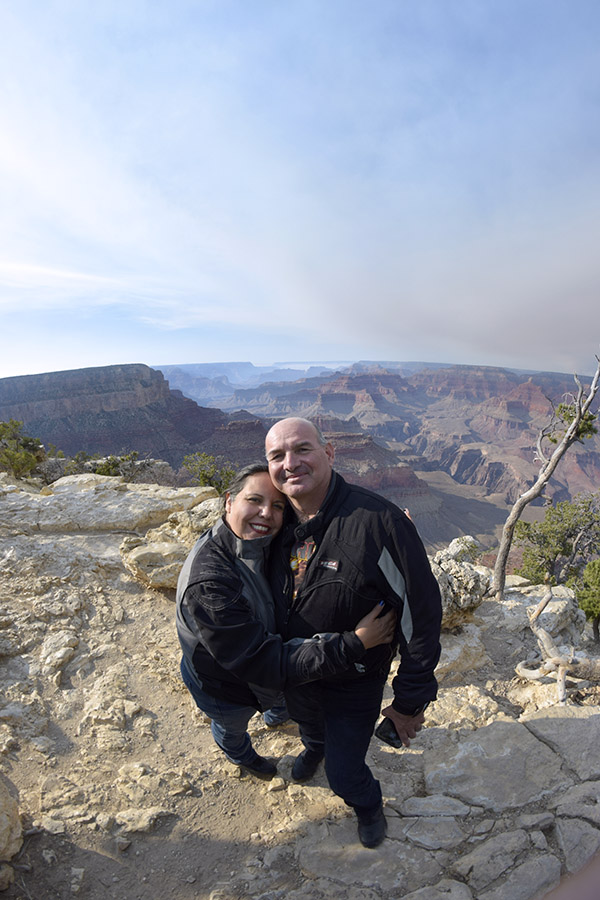
Good buddies Velma and Orlando on the south Rim of the Grand Canyon. Evel asked, and the Feds said no.
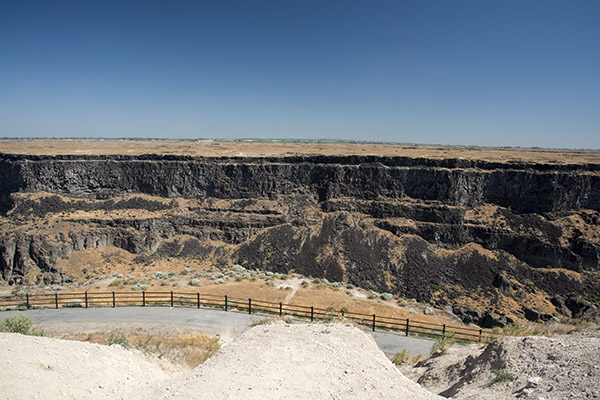
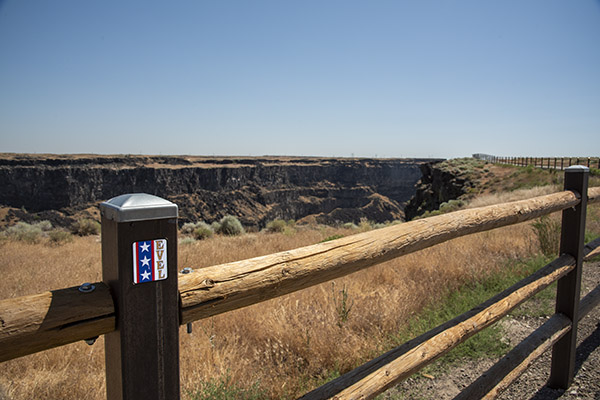
The entire concept was preposterous on so many levels I can’t list them. But that was Evel Knievel. Before he did it, the idea of jumping over a car was preposterous, as was the idea of jumping over several cars, as was the idea of jumping over a bus, as was the idea of jumping over several buses, and…well, you get the idea. Evel had bumped up against the limits of preposterousness, and that’s when he floated the Grand Canyon idea. The Feds nixed that, but Evel wasn’t a man stopped by obstacles. He went for the next best thing, and that was the Snake River Canyon. It’s over a mile wide, and it’s a big drop to the bottom.
To get back to Idaho connection and this story, I looked on the map to see if it denoted where Evel did his thing and to my surprise, it did. And it wasn’t very far from Shoshone Falls. Sue and I did our thing at Shoshone Falls and as soon as we were back in the car, I plugged in “Evel Knievel Snake River Canyon Jump.” Waze didn’t know from Evel Knievel, but the regular iPhone mapping app did. We were only a few miles away, we were off to the races (so to speak).
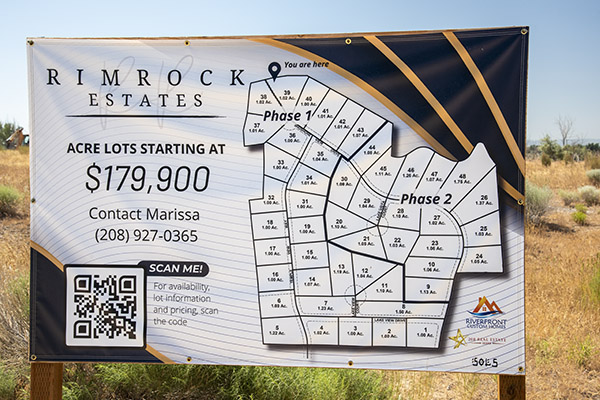
On the way in, as we approached the road’s end (it ended at the Snake River Canyon), we saw no signs initially marking the spot where Evel made history. We did see a lot of tract homes, and a sign selling more.
Not bad for an entire acre by California standards, but that’s Idaho. Someday every square inch of America will be covered by tract homes or high-density housing, and our politicians will wonder why there’s so little water and so much traffic.
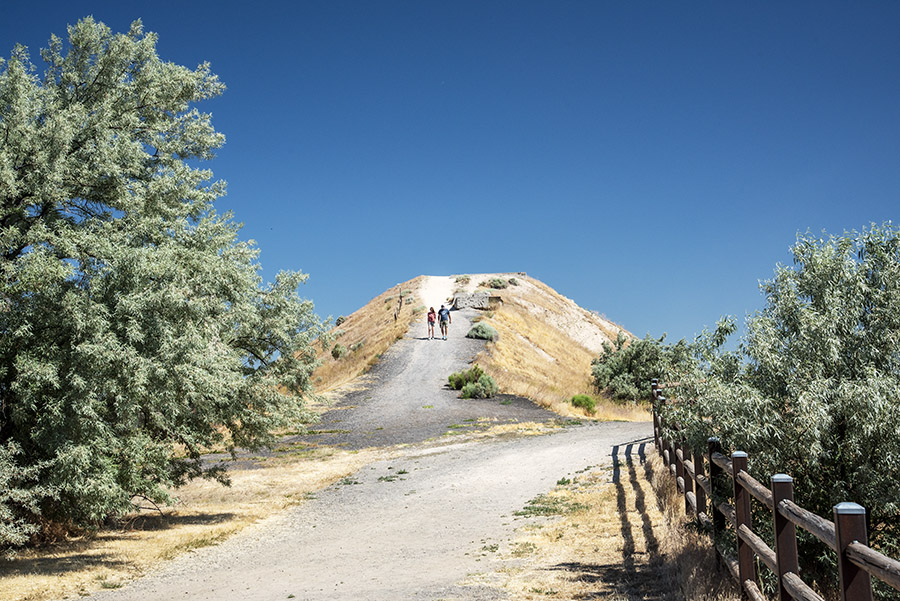
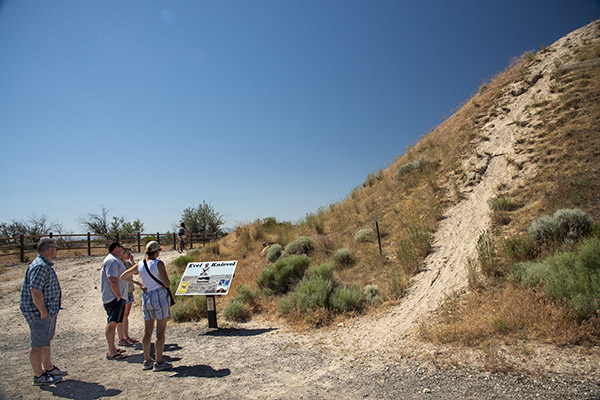
As we reached the end of the road, the Canyon came into view, as did the ramp you see in the photo at the top of this blog. Whoa! Can it be?
The Snake River Canyon, where Evel attempted his jump. It’s wider and deeper than it looks.
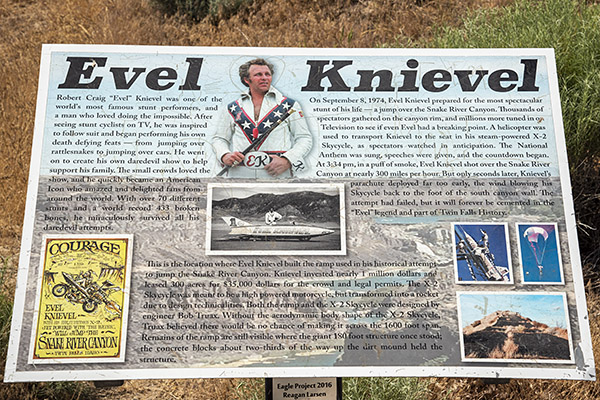
It was. On the other side of that dirt ramp, we saw our first indication that we were where we wanted to be. It was a good summary of Evel and the attempted jump that occurred decades ago.
Evel: The Man, the myth, and the motorcycle.
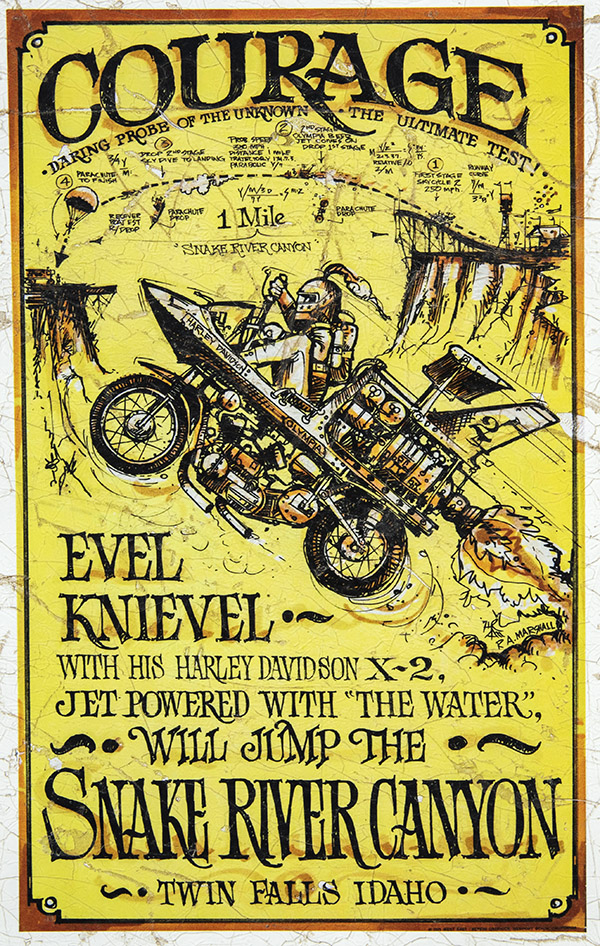
The deal on the Evel Knievel Snake River Canyon jump is this: Evel didn’t attempt it on a regular or even a modified motorcycle. He instead used a steam rocket-propelled aircraft of sorts that was mounted on a launch ramp. The dirt ramp you see in the photo at the top of this blog was not one that you would attempt to roll up and hit at high speed with a motorcycle to become airborne. The idea instead was that the rocket ship would launch off a launch rail, carry Evel across the Snake River canyon, and then Evel would deploy a parachute and he (and the rocket ship) would float back to Earth on the other side. That was the theory.
An excerpt from the above sign. Evel Knievel, motorcycle astronaut.
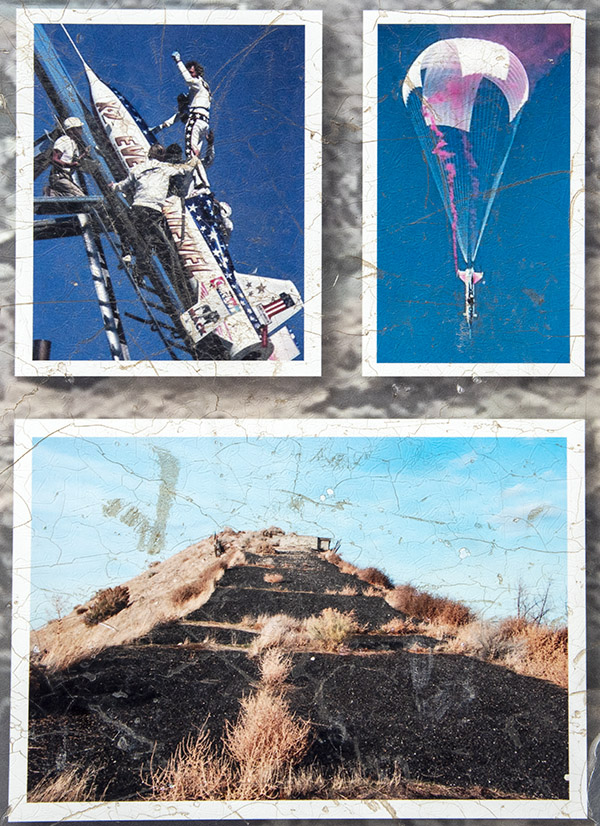
It didn’t work out that way, though. Evel and his rocket ship made it about halfway across the Snake River, the parachute deployed inadvertently and prematurely, and man and machine descended into the canyon and onto the Snake River’s banks. Miraculously, Evel walked away, never to attempt a canyon (any canyon) jump again.
Another excerpt from the photo above. There was no V-Twin hidden in the bowels of Evel’s rocket ship.
We climbed to the top of the ramp and gazed across the Snake River Canyon. I wondered: Will we ever see another man like Evel Knievel? I think it’s less likely, given our predilection with biological males competing in women’s sports, our insistence on listing our pronouns (you can just refer to me as “hey, you”), and everything else our society has degenerated into. But that borders on being political, and as you know, we don’t do that. That said, though, I think it’s a safe bet that Evel never worried about anyone using his preferred pronouns.
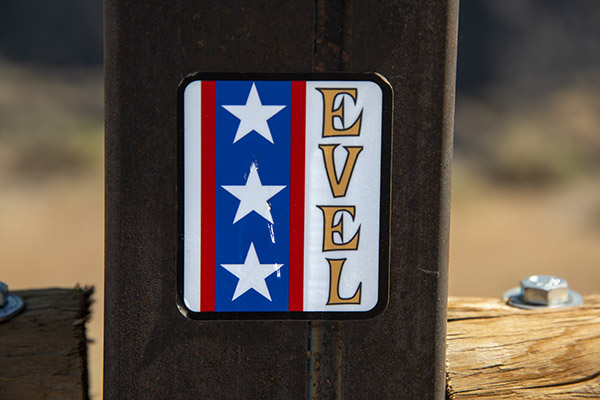
After our climb down, we wandered around the area a bit. Other than that sign above (which isn’t visible until you walked to the other side of the ramp) and a marker on the trail fence, you’d never know this was an historic spot.
Peering at the Evel Knievel sign on the canyon side of the historic launch site.A tiny fencepost marker on the trail that runs along the Snake River Canyon.A macro shot of the Evel fencepost marker. History happened here.
We had a marvelous trip through Idaho, and like I said above, I still have another two or three blogs to wrap up our Idaho expedition. I’ll tell you before I get there, though, that visiting this obscure (and rapidly fading into further obscurity) spot was the highlight of the trip for me.
 Returning to Koh Tao Thailand seemed the perfect place to take this course. With so many dive shops on the island and being unsure who to use for this next level class I did what I always do. I went to a bar and chatted other divers up. One shop that seemed to always be spoken highly of was Scuba Shack. It was not only a great decision to choose them for their professionalism, but it was right next door to where I was staying on Sairee Beach.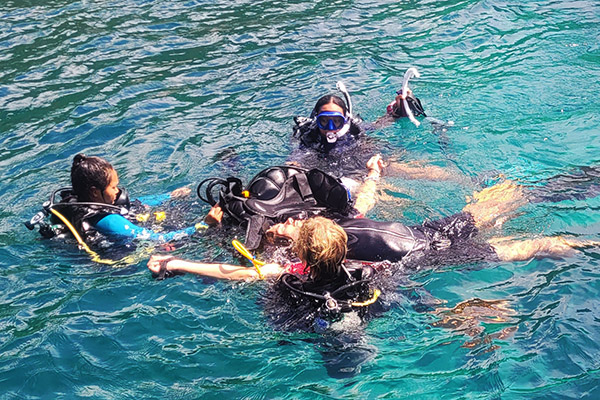
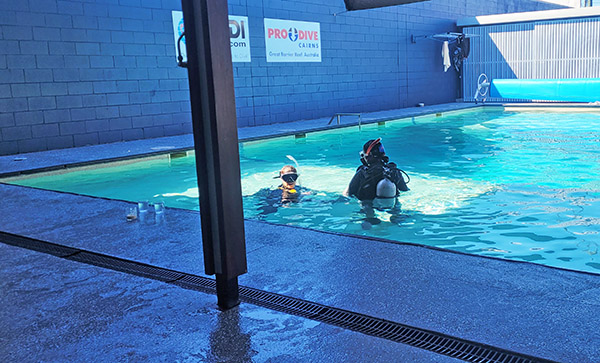 I registered for the dates I would be in Northern Australia for a 5-day Open Water PADI Scuba Certification Class. This class would include two days of classroom/pool training and three days and two nights on a live-aboard boat in the Great Barrier Reef. Upon filling out the school course paperwork it seems that due to my ripe old age of 51 I would require a physical. Not a big deal; there was a clinic across the street from my hostel. I am sure they would rubber stamp me through this, so I booked an appointment. Upon being called into see the doctor I noticed his clothing apparel seemed a bit…off. It wasn’t until I went into his exam room I noticed posters of Elvis all over the walls. Now his butterfly collar, gold glasses, slicked back hair made sense. He was an Elvis impersonator, or a big fan at the least. Once reviewing the physical requirements with him he explained the physical entailed much more than I expected, including chest x-rays, hearing tests, vision test, drug test, etc.