Last year, Susie and I took a trip to Georgia, Wisconsin, and Michigan. It was fun. We met with my former battery commander (with whom I served in Korea), we went to the Harley Museum in Milwaukee, we visited Green Bay and their fabulous Auto Museum, we stopped in at the Green Bay Rail Museum, we rode up to the Pictured Rocks National Lakeshore, we toured the Miller Brewery, and we hit a few other places (I’ll provide links for all these at the end of this blog). We do trips like this to have fun and as ExNotes and Motorcycle Classics content safaris. It’s fun. I like to travel, I like to write, and I like taking pictures. Yep, life is good, and what we do sure beats working for a living.
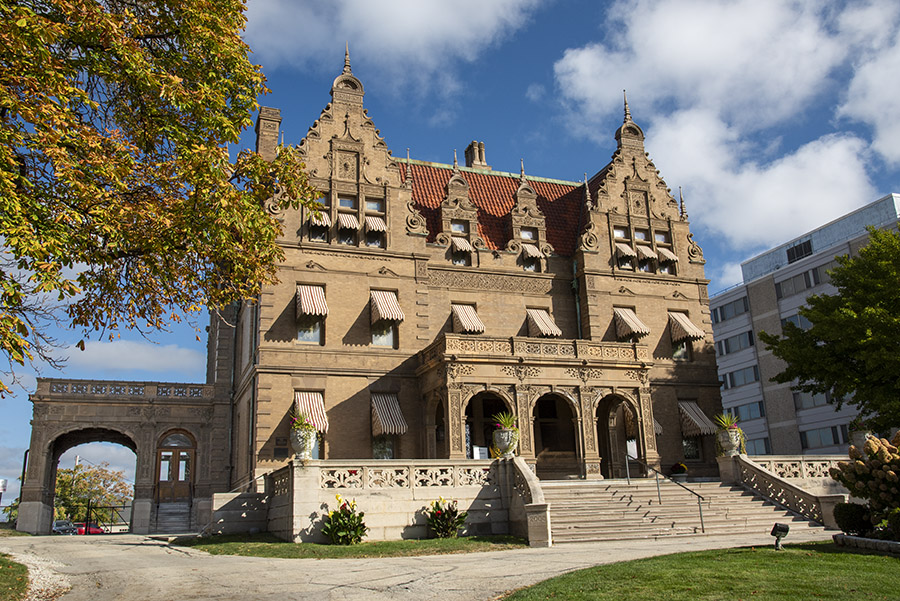
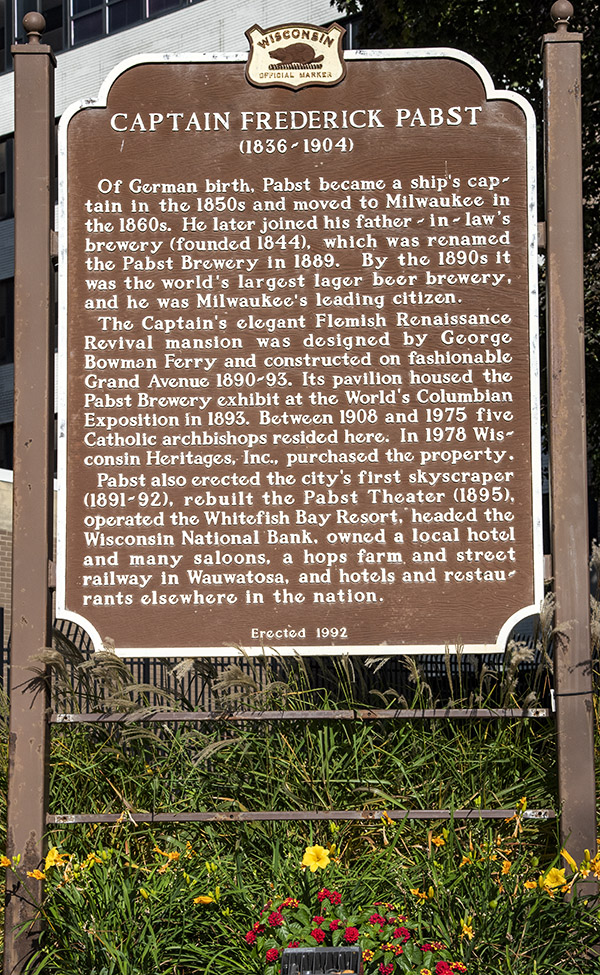
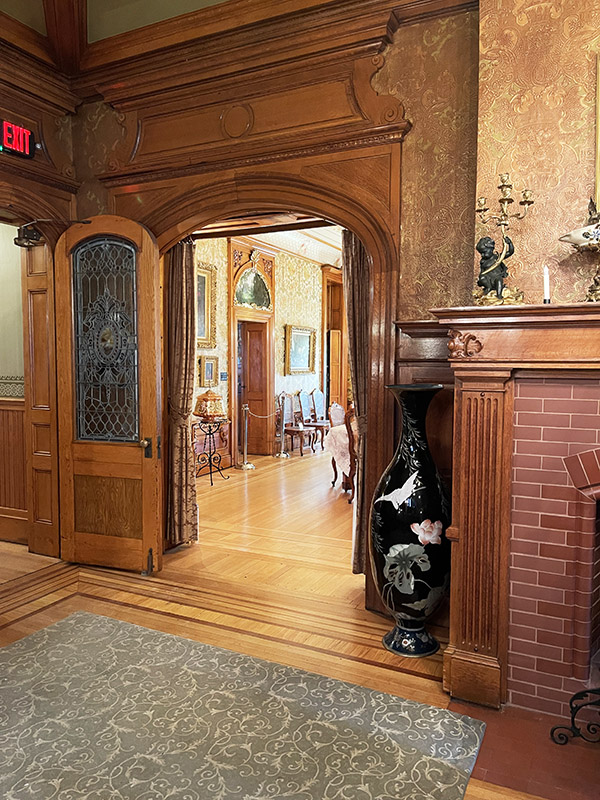
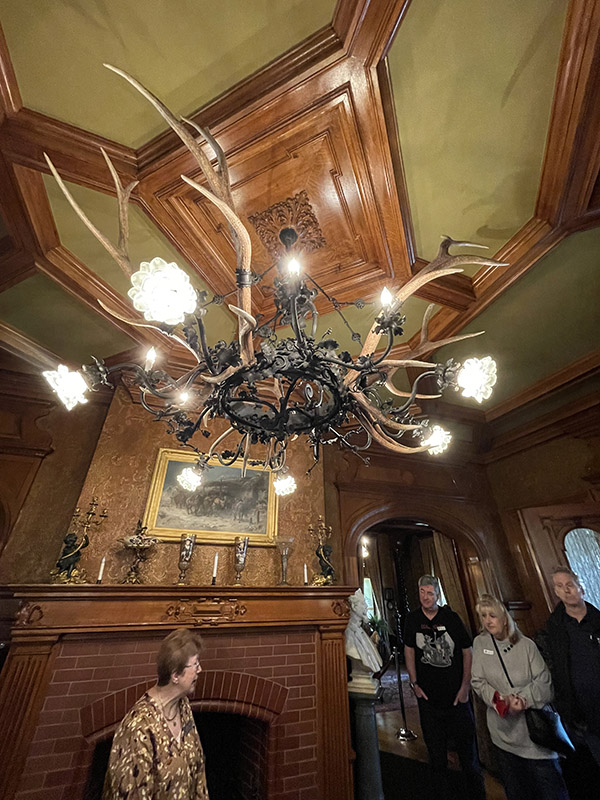
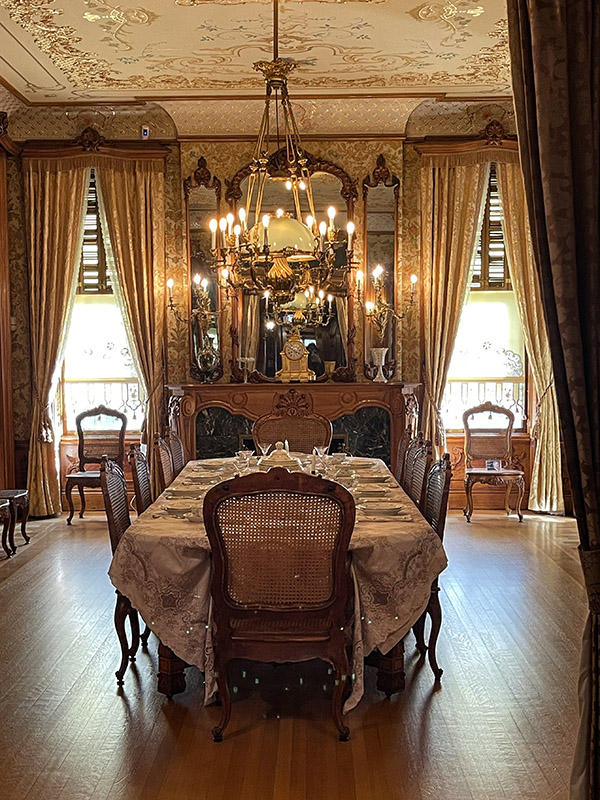
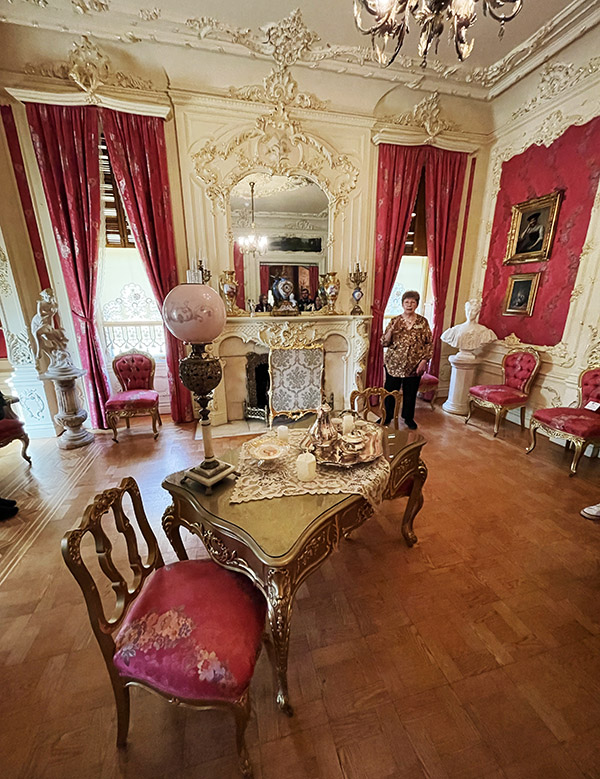
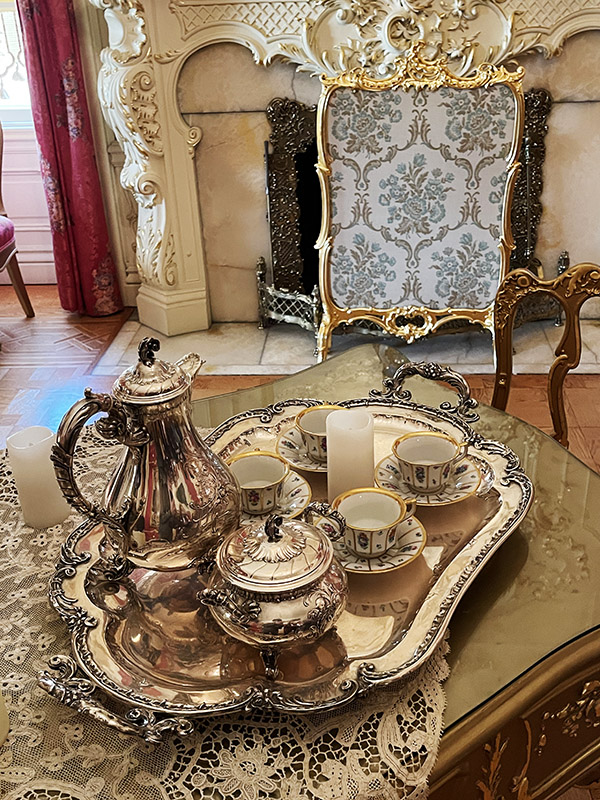
Susie is super good at finding places (usually ones I’d never heard of) wherever we wander, and one of them was the Pabst Mansion in Milwaukee. This is an interesting story. You probably know from the Miller Brewery blog we wrote last year that Milwaukee is America’s beer capital. One of the early beer companies in America was Pabst. The story goes like this: Frederick Pabst came to this country from Germany as a 12-year-old boy (with his family) in 1848. He started his working life as a cabin boy on the ships plying Lake Michigan and eventually worked his way up to captain. He married Maria Best in 1857, which brought him into the beer business. Maria’s father owned Best and Company, which at the time was the largest beer company in the country. The Captain (as Frederick Pabst was known by that time) joined the beer biz in 1864, and through hard work (and an obviously smart choice in the matrimonial department) he soon became the top dog. The Captain changed the company’s name to the Pabst Brewing Company in 1874.
The Captain commissioned construction of the Pabst Mansion in 1890. It took a couple of years to build, but I think the wait was worth it. This place is as grand as anything I’ve seen anywhere in the world. Apparently, I’m not the only who felt that way; in 1908 the Catholic church’s Archdiocese of Milwaukee purchased the place. Over the next seven decades, five Archbishops and more than a few priests and nuns lived there, too. By 1975, the Archdiocese wanted out, and sold the property to Wisconsin Heritage, and outfit that offers tours and sells tickets. That’s a good thing; the Pabst Mansion (prior to the sale) was going to be demolished and turned into a parking lot. Just prior to the sale to Wisconsin Heritage, the Pabst Mansion was added to the National Register of Historic Places.
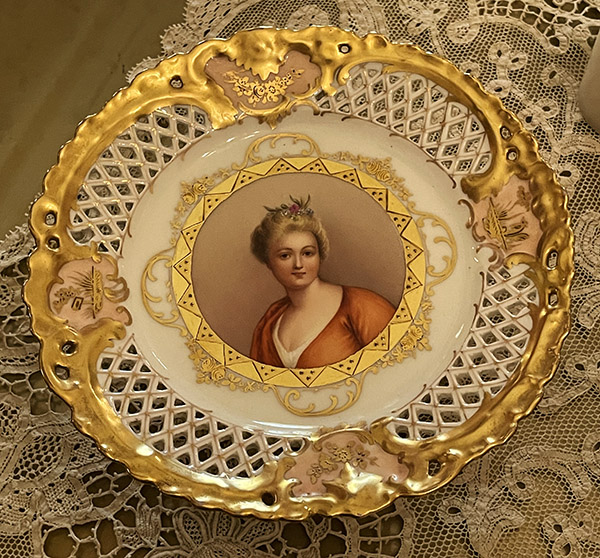
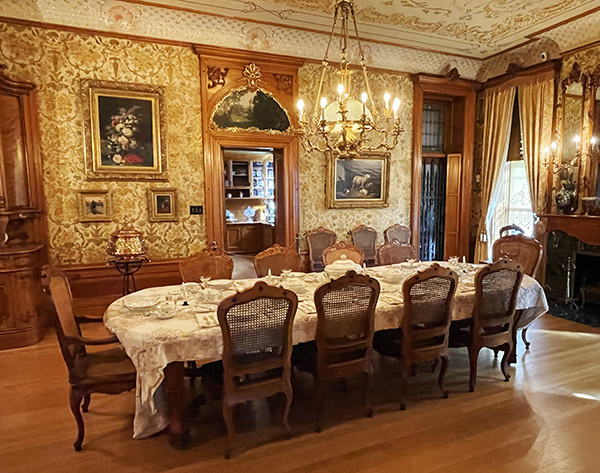
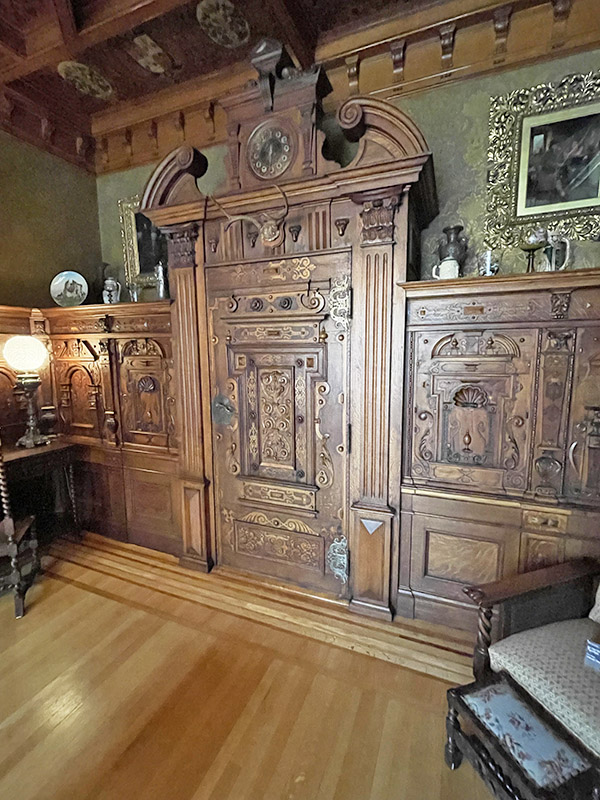
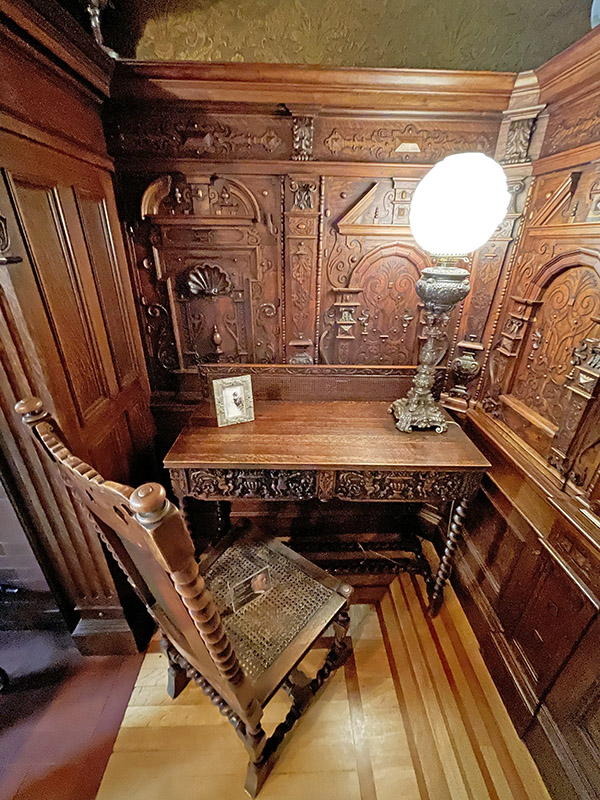
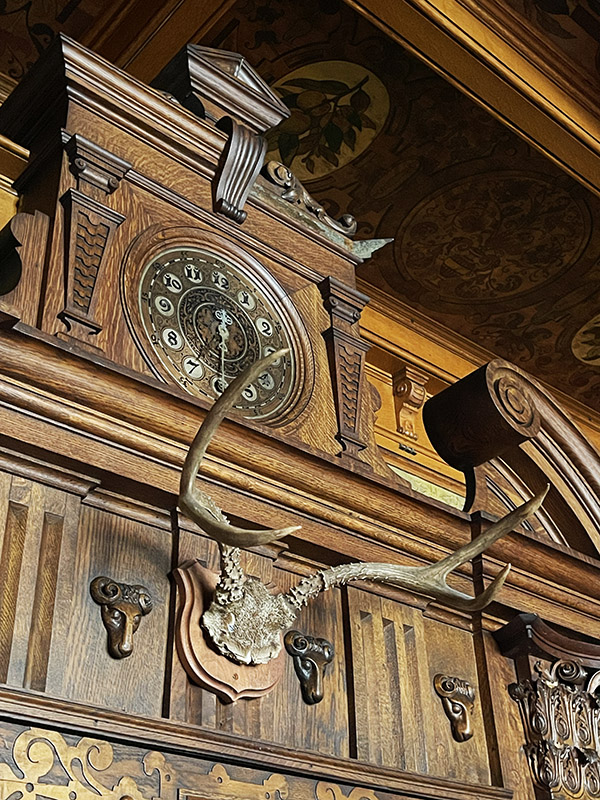
Once inside the mansion, we were blown away by its ornateness, the beautiful wood paneling, and the sheer luxuriousness of it. As we went through the different rooms, I wondered what it must have been like for the Captain, and then all those archbishops, priests, and nuns to live here. It must have been grand.
Living there must have been grand. We had a fun time at the Pabst Mansion. If you ever find yourself in Milwaukee, the Pabst Mansion is worth a stop.
The other blogs and magazine articles I mentioned that resulted from our visits to Georgia, Wisconsin, and Michigan? Here they are:
This was an interesting blog to write (and it was interesting on many levels). As you know, I’m writing a series of blogs on motorcycles I’ve owned with the machines organized by cylinder count. The idea is to consider all of them from my ownership perspective, rack up a bunch of (hopefully) fun-to-read blogs, and then wrap up with my opinion on which engine configuration is the best. I’ve already done the first one on the singles I’ve owned.
A word on the photos: I was surprised I had photographs of every bike I’ve ever owned. In recent decades, after I had become a half-assed amateur photographer, the photo quality is generally good. In earlier years, I was not a very good photographer, nor was my equipment very good. Some of the photos are in black and white, and most of the earlier ones were taken with a dinky little Minolta C-110 camera. Hey, you go to war with the army you have.
Between that first ¿Quantos Pistones? post and this one, something self-updated on my computer and my laptop went from simply taking my orders to predicting what words I’m going to type next and then filling them in, which I found to be wildly annoying. I thought it was in the WordPress software, but it wasn’t. It was in my Edge browser. Google helped me; I found the offending “feature” in the Edge settings and switched it off. I think these software weenies are changing things just to give themselves something to do. I wish they would stop. The folks who keep doing this sort of thing are going to have a hard time explaining themselves when they’re standing in front of the pearly gates. I’ll be there, too, as a witness for the prosecution.
Rant over; let’s get back to the main attraction.
As was the case in the blog on singles, I am again discovering this: Just when I think I’ve listed all of the twins I’ve owned, I remember another one. That sure has been the case here. I suppose I had better hit the Publish button before I remember another one.
Alrighty then: With the above as a backdrop, here we go.
1965 Honda CB 160
Okay, I’m cheating a little. This wasn’t my bike at all. It was my Dad’s. But I rode it in the fields behind our house quite a bit and I sort of considered it to be mine, and that’s why it’s on this list.
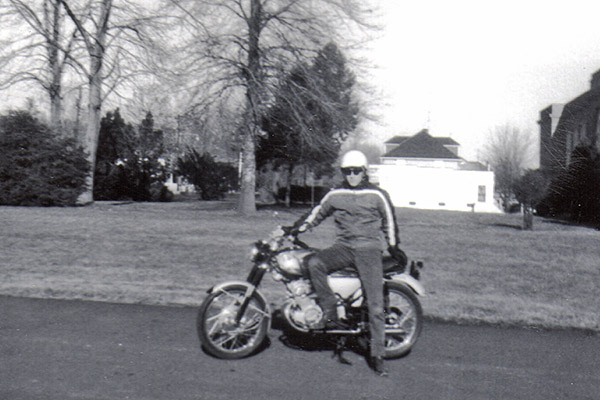
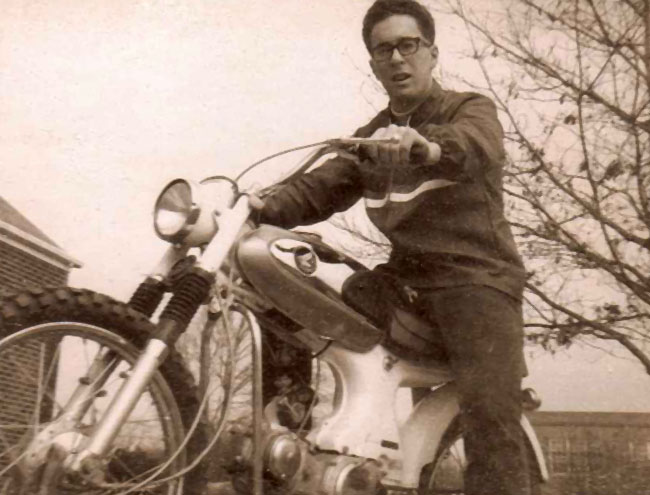
The 1964 Honda CB 160, That’s me on the bike in New Jersey, during the winter months, when I was 14 years old.
The little 160 was nice. It was the first motorcycle I ever rode and I had a lot of fun on it. Honda was making big inroads in the United States in the mid-1960s and they changed nearly everything in the motorcycle world. It was a fun time for a 14-year-old kid.
The CB 160 only stayed with us for a couple of months. Dad had been bitten by the bug. He wanted something bigger.
1965 Honda Super Hawk
As was the case with the CB 160, the Super Hawk was Dad’s motorcycle. But the same modifier applied: I used to ride it in the fields behind our house in New Jersey, so I’m including it here.
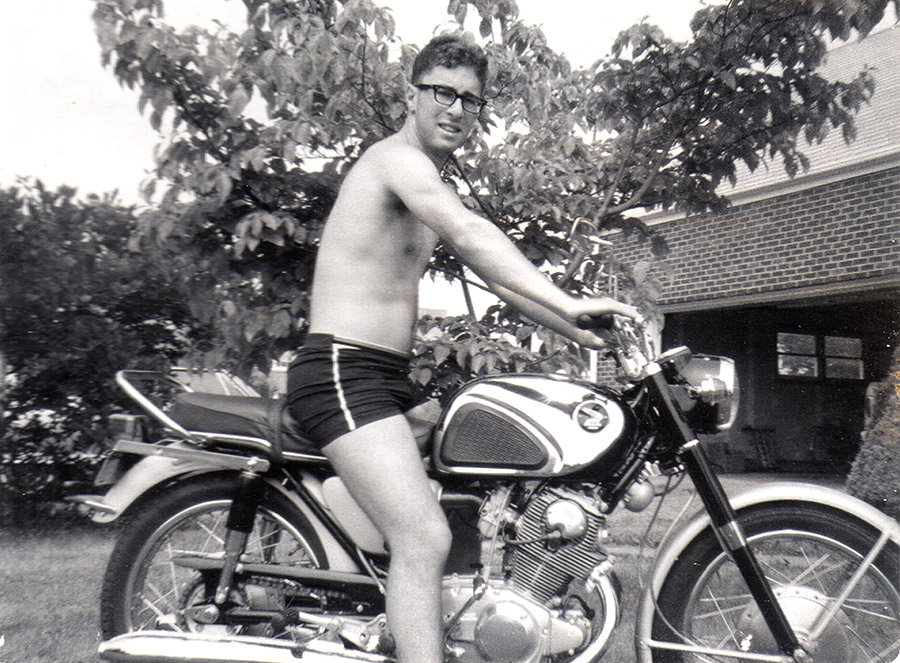
Fast forward a bit, and it’s me again during the summer months on a 1965 Honda Super Hawk. We had a swimming pool, so I spent my summers in a bathing suit.
The Super Hawk, with its 305 cubic centimeters, seemed infinitely more powerful than the CB 160 (especially riding it in the fields behind our house). Dad had the bug, though. The Super Hawk would only last for a couple of months, too.
1966 Triumph Bonneville
Ah, this was a motorcycle. A Triumph Bonneville. I couldn’t believe it. It had been my dream machine for at least a couple of years, and now there was one in the garage. And you know what? Dad let me ride it in those same fields behind our house. I can’t imagine what he was thinking or why he let me do that. I never dropped it, though. God Almighty, it was powerful. And the sound….it was awesome.
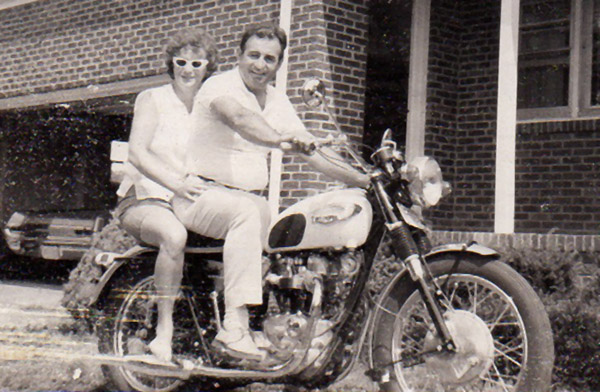
Mom and Dad on the 1966 Triumph Bonneville. You can see their other Bonneville (a 1965 Pontiac) in the garage. You could say we liked Bonnevilles. No one in my family has ever been to the Bonneville Salt Flats. I probably should go there one of these days.
The Bonneville was an amazing motorcycle. Dad and I had a lot of good rides on it. I wish we had kept it. On that sound comment above: Nothing, and I mean nothing, has a a more soul-satisfying exhaust note than a Triumph.
1978 Triumph Bonneville
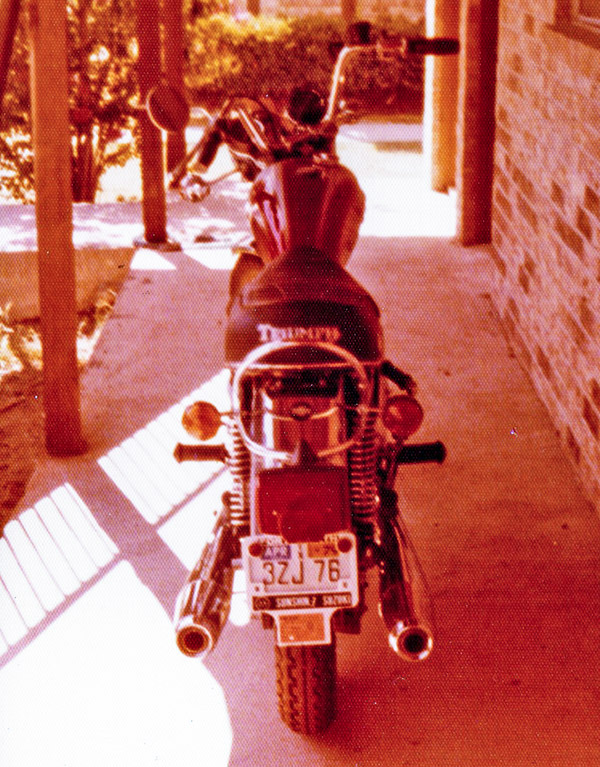
I was living in Fort Worth, Texas, I was single, and I was an engineer at General Dynamics on the F-16 program. When I passed by the Triumph dealer I realized I hadn’t ridden a Triumph Bonneville since I was 16 years old, so I thought I’d stop by. An hour later I signed on the dotted line, and I owned a Bonneville again.
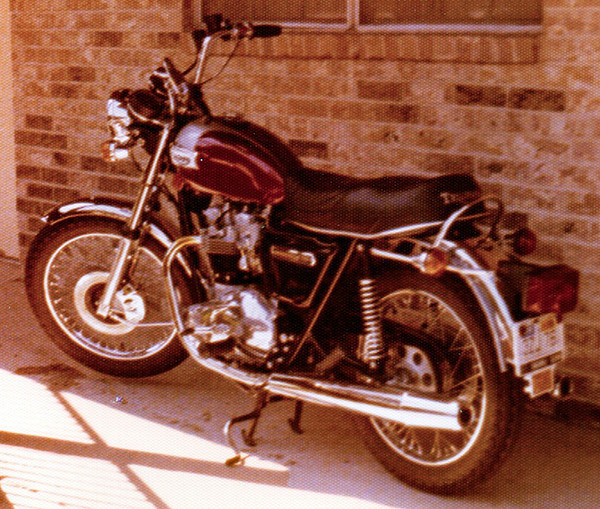
My 1978 Triumph Bonneville, parked outside my apartment in Fort Worth, Texas. The colors have mostly drained from these two photos. The bike was a deep candy apple red.Another shot of my 1978 Triumph Bonneville.
It was a great motorcycle. There was an older guy who owned a Yamaha TT 500 at General Dynamics (his name was Sam), and we road all the farm roads in the areas around Fort Worth. We both had hay fever and Texas had terrible pollen, but the riding was great. My Bonneville would top out at exactly 109mph (the earlier T120 and then T140 designations notwithstanding), and that was enough. The bike was kick start only (which made it an anachronism in 1978), but I was okay with that, too. For awhile, anyway.
I sold the Bonneville. I’m can’t remember why; I did a lot of dumb things when I was young. Shortly after I sold the Bonneville, I realized I needed a motorcycle again. You know, to be a complete person. That led to my next acquisition. But to this day, I wish I had kept the Bonneville.
1979 Harley Electra-Glide Classic
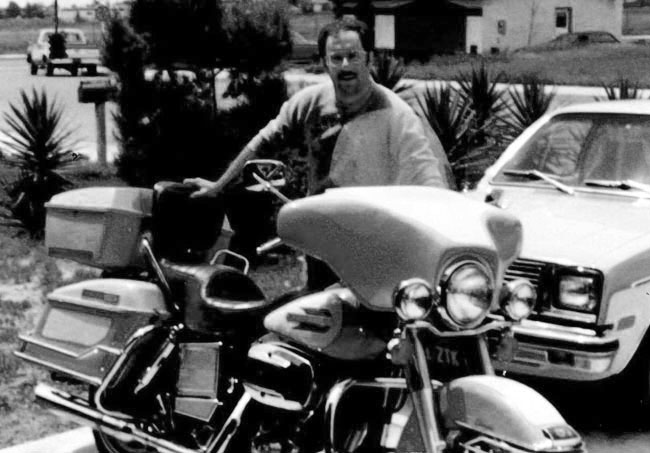
I used to spend a lot of time at the Fort Worth Harley dealer drooling over their new bikes. The late ’70s were, in my opinion, the height of the Willie G styling years at Harley. It was also the absolute bottom for them from a quality perspectives, as I would soon find out when I finally bit the bullet and bought the bike I thought was the most beautiful motorcycle I’d ever seen: The 1979 Electra-Glide Classic.
Yours truly, with a full head of hair and a 1979 Electra-Glide Classic. I called it my optical illusion. It looked like a motorcycle.
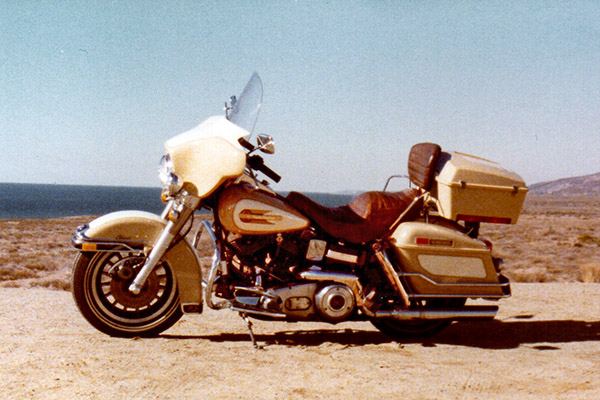
The Electra-Glide was beautiful, but to call it a piece of crap would be insult to turds the world over. The bike couldn’t go a hundred miles without something breaking on it. It needed three top end jobs in the 12,000 miles I owned it (the first two were on the warranty, the last one was on me). I’d finally had it with that bike and what some folks like to call “The Motor Company.” Hell, the motor was the worst thing on that bike. And the brakes. And the clutch. And the starter. And the handling. And the….well, you get the idea. It was one of the last years Harley was owned by AMF, and when a Harley mechanic told me what that stood for, I finally got it. I smiled inwardly when I sold the bike, thinking to myself, “Adios, MF.”
On the way down to San Diego, with the Pacific Ocean in the background. I explored a lot of southern California on the Harley. It was the most unreliable motor vehicle of any type I ever owned.
After that awkward ownership experience, I swore I’d never buy another Harley. I didn’t keep that promise, though.
Even considering all the above, I wish I still had that ’79 Electra-Glide. It would be worth a small fortune today. It sure was a pretty motorcycle.
1976 Triumph TR6
Somewhere in the succession of events described above, I moved from Fort Worth to southern California. General Dynamics transferred me to the Pomona facility. I loved southern California and I hated GD/Pomona. Actually, that’s not entirely accurate. The company was okay, but my boss was a dickhead. So I did what I normally do in that situation: I quit and went to work for another defense contractor. While there, I worked with yet another defense company, and one of the guys there had a 1976 Triumph TR6 he offered to sell to me for $500. It was running, it was registered, and minutes later it was mine.
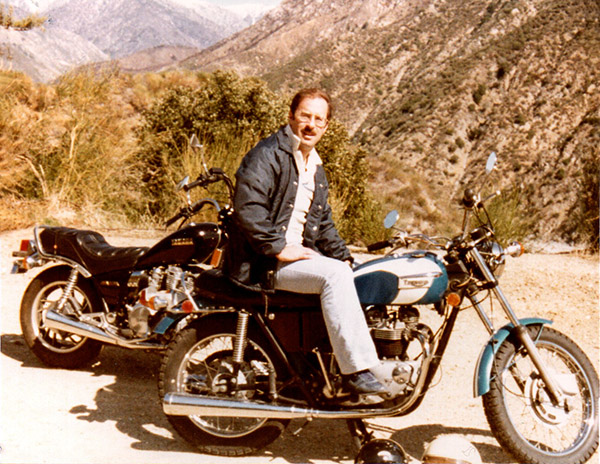
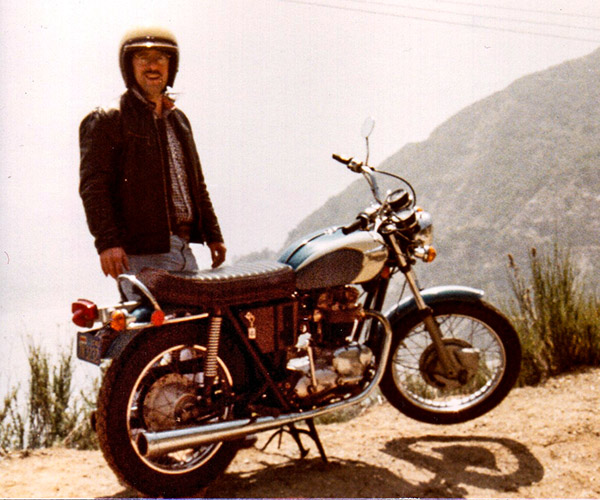
On Glendora Ridge Road on the 1972 Triumph Tiger. It was a great motorcycle.
The TR6 was a wonderful motorcycle. If there was a performance difference between it and a Bonneville, I didn’t have the asspitude to feel it. The single-carb TR6 actually felt stronger at low rpm than the Bonneville did. I loved that bike, too.
Another Glendora Ridge Road portrait. The Tiger had character, and I mean that in a good way.
The paint on the TR6 had oxidized pretty badly (the former owner kept it outside). I had this idea I would restore it (see above regarding my propensity to do dumb things when I was younger). I did a pretty good job turning the great-running TR6 into a basket case (again, see the preceding comments regarding my youthful decisions). The paint job I paid for on the fuel tank was a disaster, and then I lost interest in resurrecting the bike. I sold the basket of bits and pieces for what I had paid for the bike. I wish I still had that one.
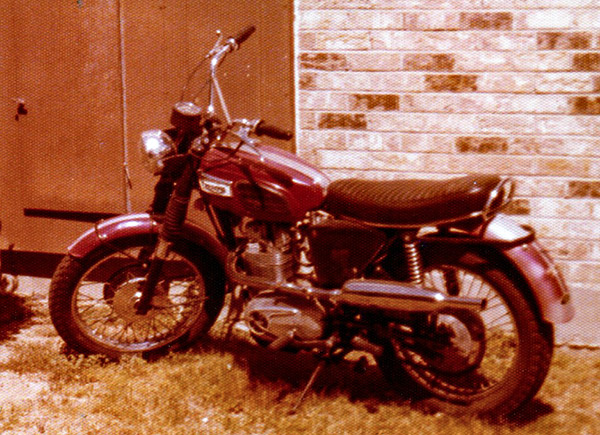
1972 Triumph Daytona
The first motorcycle I ever went gaga over was a 1964 Triumph Tiger that a kid named Walt Skok rode to high school. In those days, the Tiger was a 500cc twin that looked a lot like a Bonneville. God, that thing was beautiful.
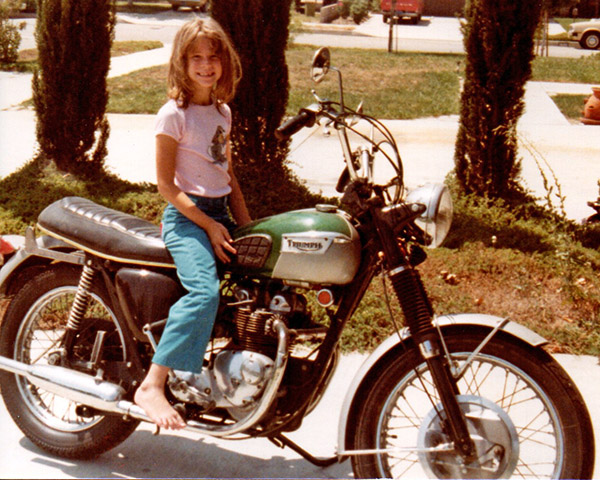
One of the neighbor kids on my 1972 Triumph Daytona, also known as the Baby Bonneville. This was another great motorcycle.
Triumph kept that 500cc twin in their line for years, ultimately adding a second carb and rechristening the bike as the Daytona. When the 650 line went to the oil-frame-configuration in the early 1970s, the Daytona (also known as the Baby Bonneville) did not; it kept the classic Triumph separate oil tank and peashooter mufflers.
I can’t remember who I bought the Daytona from (I bought it used), but I sure remember its looks. It was a deep candy metallic green with silver accents. It was bone stock and it was a wonderful ride. The handing was almost thought-directed…I could just think what I wanted the motorcycle to do and it would do it. One day, for no particular reason, I took it to the top of one of our streets that ran up into the mountains, turned it around, turned off the ignition, and started coasting downhill. I wanted to see how fast it would go with zero power (see my previous decision-making comments); the answer was exactly 70mph.
I never registered the Daytona over the three years I owned it; I just rode the snot out of it. I never got stopped or and I never had a citation for the expired plates. I can’t remember why I sold it, or who I sold it to. The Daytona was a wonderful motorcycle. I wish I still had it.
1992 Harley Heritage Softail
I didn’t keep my promise to never buy another Harley. A fried let me ride his ’89 Electra-Glide. It was a big, fat porker (the bike, not my friend), but Harley was getting a lot of press about their improved quality. I saw a blue Heritage Softail on the road one day, and I decided I need one. It was that simple.
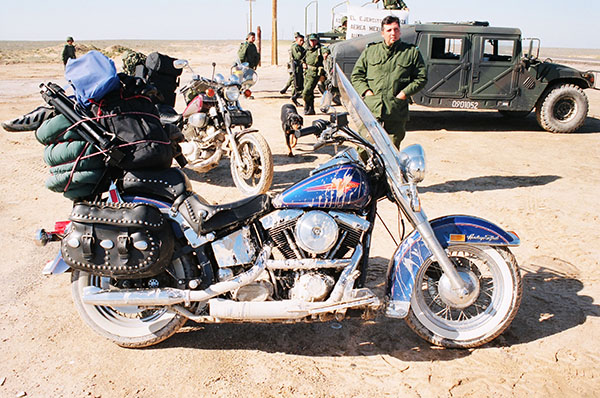
I covered a lot of territory on my 1992 Harley Softail. This shot was in the mud flats near Guerrero Negro in Baja, a trip I made with good buddy Baja John.
I put a lot of miles on my ’92 Softail, and while it lasted, it was a great motorcycle. Good buddy Baja John and I rode our bikes to Cabo, we took the ferry across the Sea of Cortez, and we rode down to Guadalajara and then back up through mainland Mexico to Nogales (you can read about that adventure here).
The Harley died on me down in Mexico on another trip, and although I had regained a tiny bit of trust in Milwaukee, the dealers were still (in my opinion) basically incompetent. When my ’92 went belly up, the dealer wouldn’t touch it because it was more than 10 years old (I can’t make this stuff up, folks), so I took it to an unencumbered independent repair shop and had it rebuilt as a real motorcycle (you can read that story here).
What kind of killed the Harley dream was me forgetting to pick up milk one day when coming home from a ride on the Harley. My wife asked about the milk. I realized I had forgot it, so I went back out to run to the store. For whatever reason, I took my KLR, and it was as if I had been set free. The KLR was just so much better, I put an ad in the local Cycle Trader the next day and sold the Harley the day after that.
While I am on this subject of Harley twins, I will tell you that I always wanted a Sportster. One day the Harley dealer had to keep my bike overnight and he lent a Sportster to me. That changed my mind in a hurry. It was gutless. I know some of my readers ride Sportsters and others ride Big Twins. Mea culpa in advance. If you’d like to tell me how great your bikes are and how I have my head up my fourth point of contact, please leave a comment, or send in a draft blog (info@exhaustnotes.us) with pics and I’ll publish your rebuttal.
1982 Yamaha XS 650
This was a lucky find, or rather, it sort of found me. I was teaching a failure analysis class at McDonnell Douglas about thirty years ago, and the first evening when I connected my laptop to the projector, a photo of the Triumph Daytona (the one described above) briefly appeared in front of the class.
“Hey, I have one of those,” one of the older engineers in the class said. I asked if he was a Triumph fanboy (as I was). He told me that he didn’t have a Triumph; he had the Yamaha that was based on it. He offered to sell it to me in front of the entire class. I hadn’t even introduced myself yet.
“Let’s talk after class,” I said.
I turns out this guy had purchased the XS 650 new, rode it very little, and it had sat in his garage for several years. I bought it for $900. I think it was a 1982 model, but I can’t say that for sure. Being a Triumph rider, I always thought it would be cool to own one of the Japanese 650 twins. You know…better reliability, no oil leaks, smoother running engines, better fit and finish, and all that.
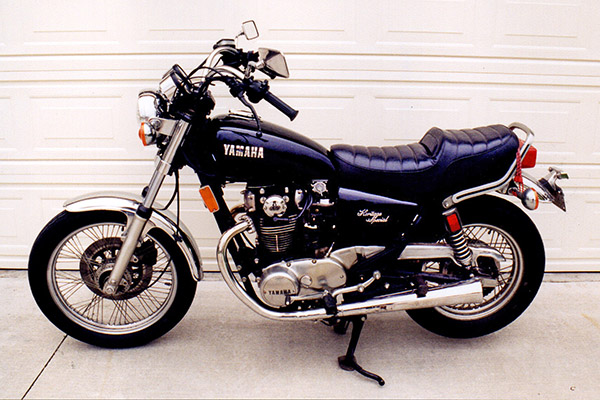
I found had a good shot (at least I think it is good) of my 1982 Yamaha XS 650 Heritage Special. To this day, I don’t know how Yamaha managed to make the bars so uncomfortable.
I didn’t keep the XS 650 long enough to assess its reliability. I did keep it and ride it long enough to find out that it had absolutely no personality, it didn’t have the bottom end torque that a Triumph did, it sounded more like George Jetson’s car than a real motorcycle (let’s see how many of you know who he was), its Phillips head screws reacted to a screw driver the same way butter reacted to a hot butterknife, and the “cruiser style” handlebars were the most uncomfortable I’d ever experienced. As you can guess, the XS 650 didn’t hang around long. I traded it in to lower the cash outlay on my TL1000S Suzuki.
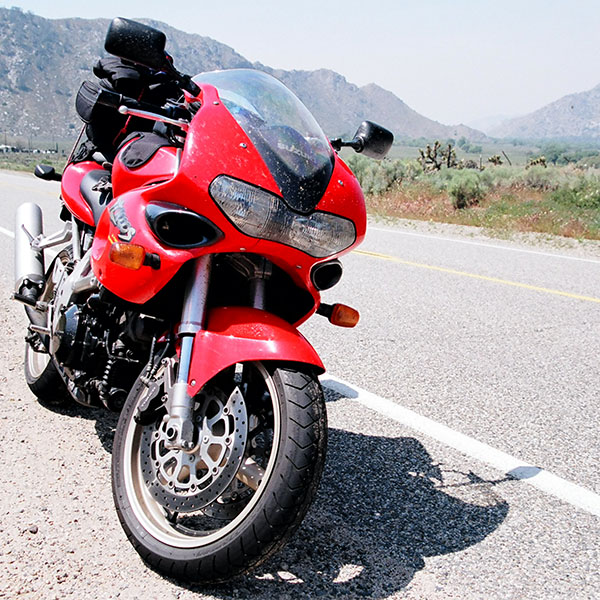
1997 Suzuki TL1000S
Ducati was setting the world on fire with its L-twin performance bikes, and predictably, it was only a matter of time before the Japanese attempted to do the same. Two L-Twin Japanese motorcycles emerged in 1997: Suzuki’s TL1000S and Honda’s Super Hawk (not to be confused with their Super Hawk of the mid-1960s, as shown above in this Twins story). I opted for the Suzuki variant in red. I just liked the looks of it; I felt it was a prettier motorcycle than the Honda.
The Roadmaster. This thing ate miles and speed limits voraciously. I toured a lot of Baja on it. This photo was taken somewhere in northern Baja.
The Suzuki was the fastest and hardest accelerating motorcycle I ever owned. It would lift the front wheel when shifting from second to third at over 100 mph. I dropped it twice getting in over my head, but I never really damaged the bike or myself. I used the TL as a touring bike, and I covered large parts of Baja with it. It was a fabulous machine and I wish I still had it.
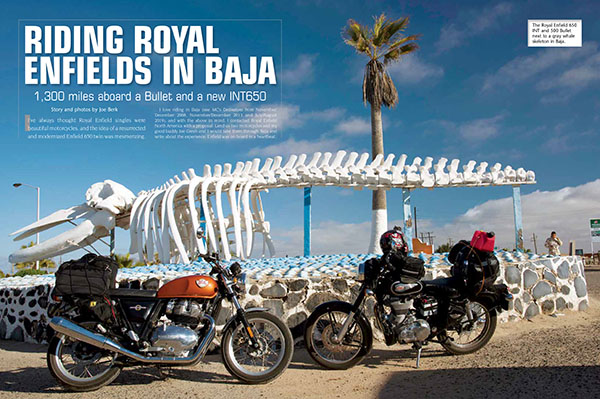
2020 Royal Enfield INT
My most recent twin is the Royal Enfield 650 INT. Enfield called it the Interceptor initially (which is a much better name), but they quickly changed it to the INT (my guess is because Honda threatened to sue them, as they already had a model called the Interceptor).
The Motorcycle Classics magazine centerfield showing the two Enfields Gresh and I used for touring Baja. It was a fun trip.
Gresh and I conned Enfield North America into loaning us two bikes (a 500cc Bullet and the new twin INT) for a comparo ride in Baja. We had a great trip, trading bikes off each day and blogging extensively about our impressions. I liked the INT so much I bought one shortly after we returned. It’s a great bike at a great price and it has all the performance I’ll ever need, both as a street bike and as a touring bike.
So there you go. I’ve owned a lot of twins. To me, a well-engineered twin makes a great street bike.
You know what? In searching for photos of my old twins, I found another single I’d forgotten all about. It was my Triumph Cub.
I never put the Cub on the street. I just rode it a bit in the fields behind my apartment building and then sold it. It was crude compared to other bikes of the era, but it was nice. It would be worth way more today than what I paid for it or what I got when I sold it.
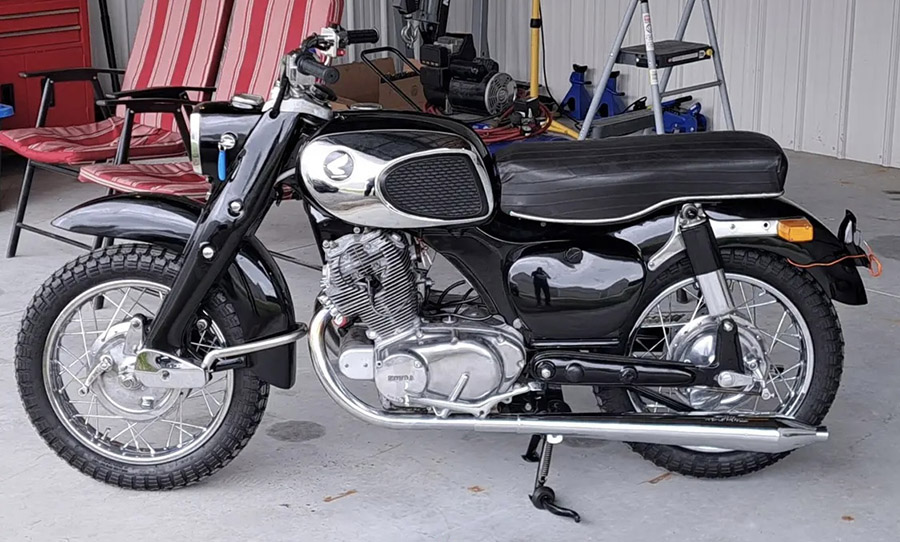
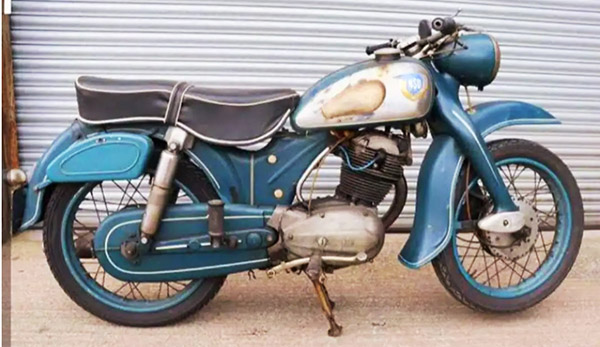
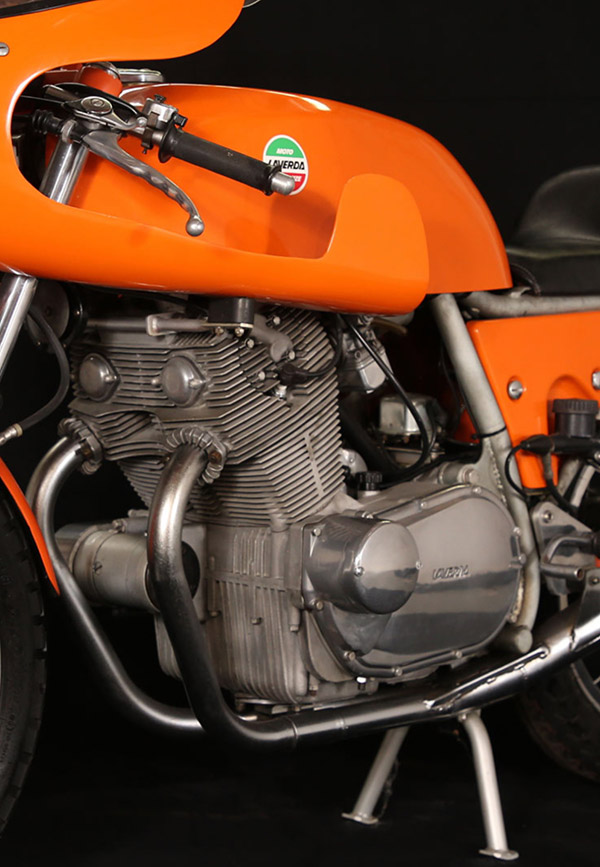
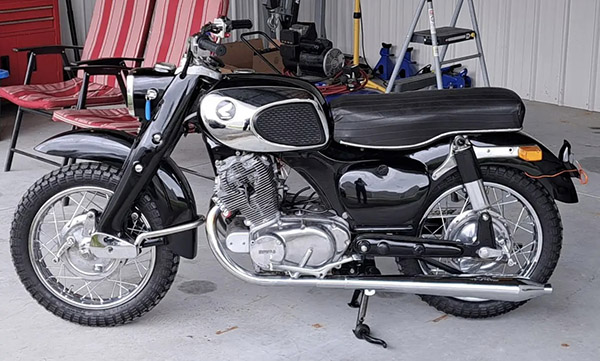
Originality is rare in the mechanical world. Designers build on other’s work. The clean sheet stays clean and so the Honda Dream was heavily influenced by German motorcycles of the 50’s. Just like Honda’s 305 inspired Laverda’s 750 of the mid-1960’s.
The Dream borrowed a lot of ideas from the German NSU.And then Laverda borrowed a lot of ideas from Honda’s 305 engine.
Of course, none of that has to do with the job at hand: getting the 1962 Dream running as cheaply as possible.
The running part was easy: you can’t kill these old Hondas. I cleaned the carb, squirted some oil in the cylinders and onto the valve train, rigged a battery and a hot wire to the ignition, stabbed the starter wire onto the positive-battery and the Honda fired right up.
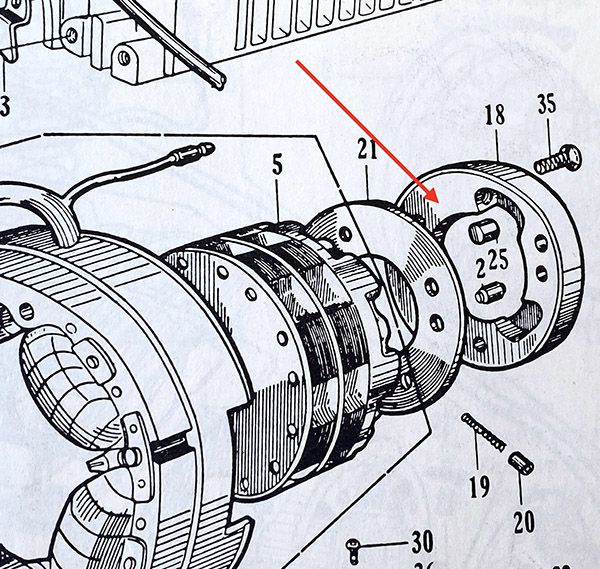
The sprag clutch (red arrow) will need some work. It skips and grabs intermittently.
Not right-right up as the electric starter’s sprag clutch is a hit and miss affair. (I’ll work on that later) once the engine turned over it ran.
Of course, clouds of smoke poured out of the tail pipes, as all that oil I squirted in the cylinder was burning off. Then the left cylinder stopped firing. I discovered the Tytronic ignition puts out a strong spark when I electrocuted myself pulling the left-side spark plug lead to confirm it wasn’t hitting.
Next I swapped leads to check the secondary of the ignition coil and the problem stayed on the left side. Since there’s only one carb, that left the spark plug. I swapped plugs and the problem moved to the right side.
The Dream came with three boxes of parts, and inside those boxes were at least eight new spark plugs. All were the wrong ones (the reach was too long). I kept digging and found a used plug with the correct reach but a different part number. Regardless, I screwed the thing in and the Honda ran on both cylinders.
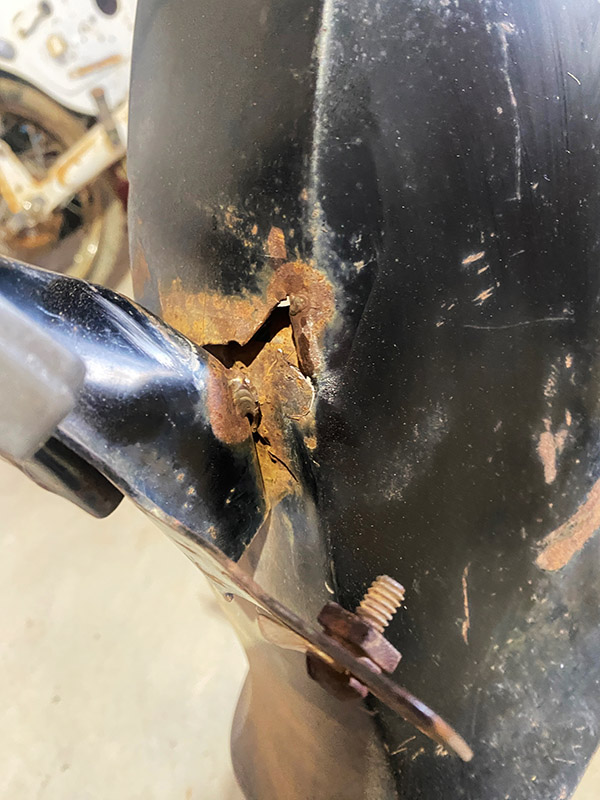
The rear fender is kind of a mess.
I shifted the gearbox through its four speeds. The countershaft rotation speed increased with each up shift. I didn’t hear any untoward noises except for the taillight. At some point the taillight cracked the rear fender. Someone, probably an engineer, welded the light to a back plate and then to the fender. Which should have been fine. It wasn’t. The welds broke and the taillight rattled like a loose roofing panel.
I like the way the Dream looks with the fenders shaved. (Photo from internet, I don’t know who took it.)
A hacksaw remedied the taillight situation. I ran the Honda until it quit smoking. The bike kept running better the longer it ran. I have something to work with, baby. Now I can move on to the running gear.
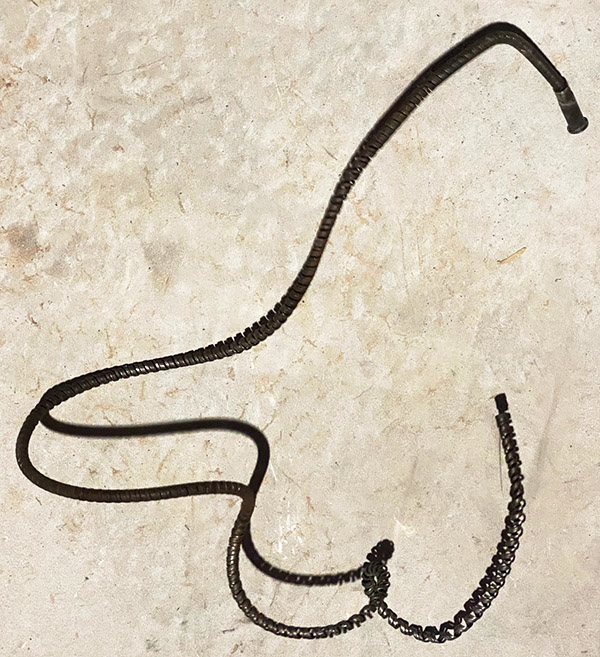
The old speedo cable took a beating.
Unfortunately, my budget-build took a setback with the speedometer cable. The cable stuck in the housing and twisted the end off near the wheel side. Fiscally, I was going to fix it. The dried grey plastic around the housing flaked off easily. I managed to get the cable out and since the speedo cable was a bit long I figured to shorten it by a 1/2-inch and re-crimp the drive tang and end piece. For the plastic cover I was going to use black, heat shrink tubing.
All was going well. I decided to wire wheel the rust on the cable housing. Long-time wire-wheelers will be able to predict what came next. I must have momentarily relaxed my grip on the housing. The wheel grabbed the housing and wound it around the grinder shaft. The loose end flailed like a weed whacker string. I was lucky to escape un-whacked. The worst part is I kind of knew it was going to happen but I kept going anyway.
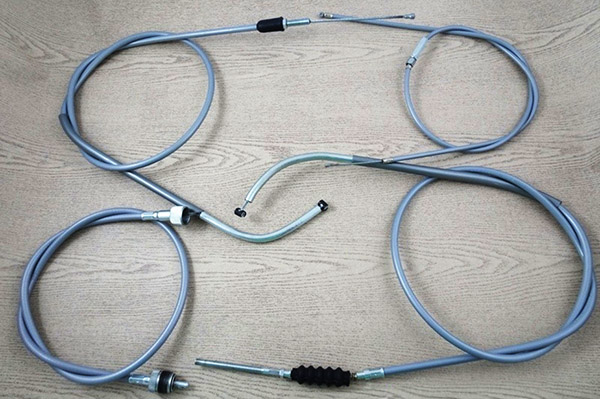
Four cables for $100! Such a deal!
A new speedometer cable was around $50 on eBay. Or, I can get a complete set of speedometer, clutch, throttle and front brake cables for $100. My budget swelled with excitement. At least I won’t have to watch those other three cables wind around the wire wheel.
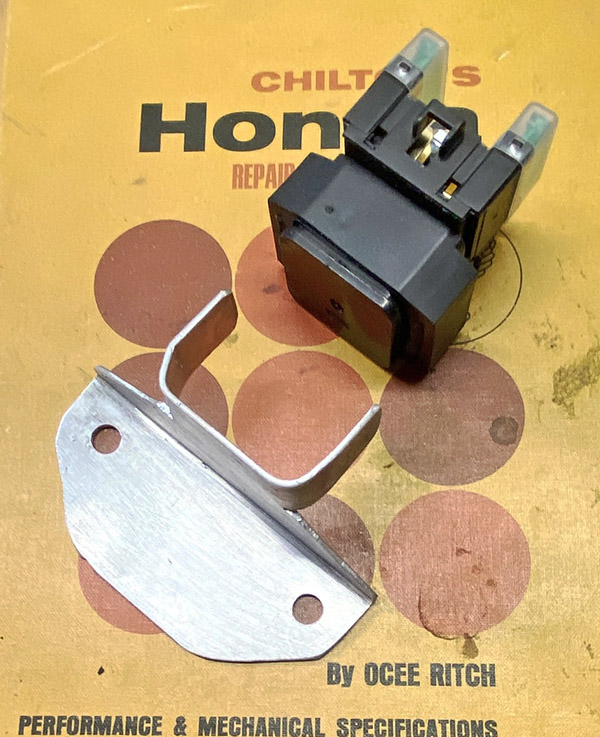
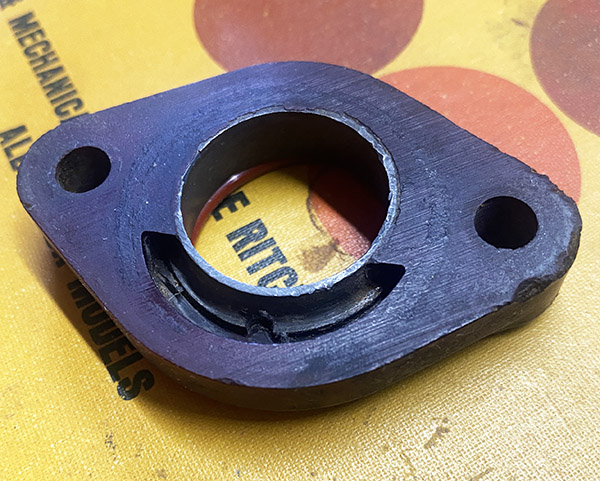
I’m using a generic starter relay. These are cheap and available. I’ll need to make a bracket to mount the thing to my bike.Interesting duct work on the 305’s phenolic carb spacer
Then came a bridge rectifier, a starter solenoid, a chain, some o-rings, and new spark plugs. When the stuff shows up I’ll have more work to do.
Still on the list is tires and tubes, a seat cover, cleaning out the gas tank liner crap, and all the wiring. The plan now is to get the bike operational and ride it around a bit to see if it’s worth messing with further.
For Where You in ’62 Parts 1 and 2, as well as earlier Joe Gresh Resurrections, click here.
It’s monsoon season here in New Mexico and the hard rain mixed with hail has me wasting time indoors…I mean tinkering with the Dream 305.
The most annoying problem on the black Dream was the clutch lever wouldn’t move. The cable was like a banjo string, the lever wouldn’t move and the kickstart spun freely. I guess the Dream doesn’t have primary gear start.
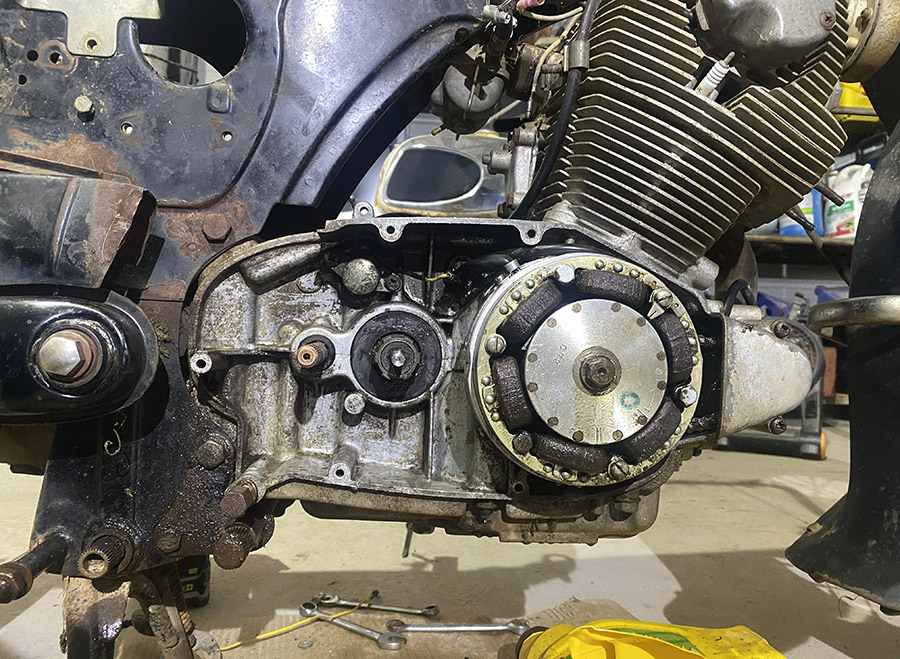
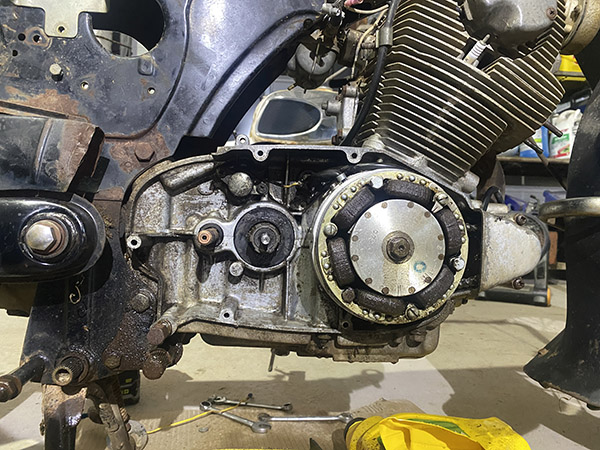
The clutch released after I removed the right cover. Several sessions of Gunk got it looking a bit cleaner.
I took off the right-side engine cover and that released the clutch. Once the cable was loose I slipped the cover back on and the kicker turned over the engine with a slipping gear sound.
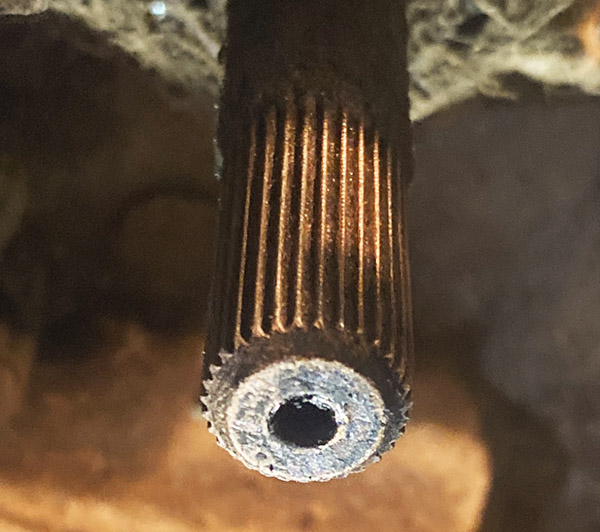
The kickstart splines look ok but the start lever slips. I’m thinking a keyway might solve the problem.
Turns out the kick lever slides onto the kickstart shaft and is kept from turning by shallow splines in the shaft and kick lever. My Dream must have been kicked a lot. I’m not sure how to fix the problem, maybe grind a keyway?
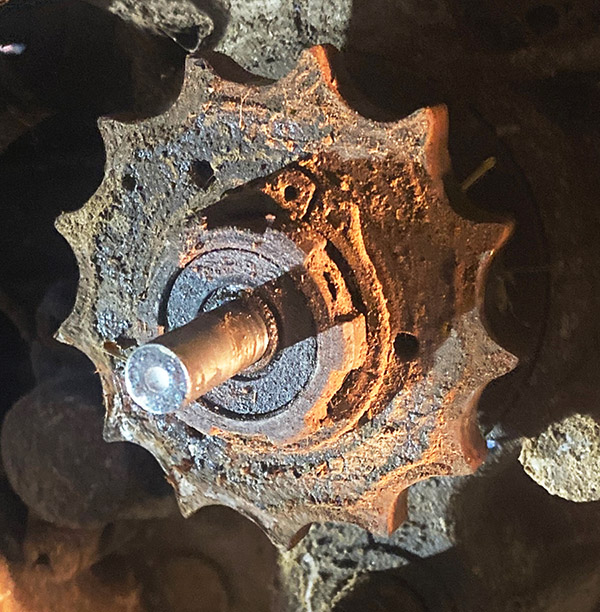
Sprockets don’t wear out this much in 4000 miles. I suspect the white Dream is the low mileage bike. This black Dream has been around the block.
The sprocket area was a greasy mess so I cleaned it up and removed the worn out countershaft sprocket. The kickstarter and the sprockets have me thinking the 4000 miles on the odometer isn’t accurate. The white Dream looks more like the low-mileage bike.
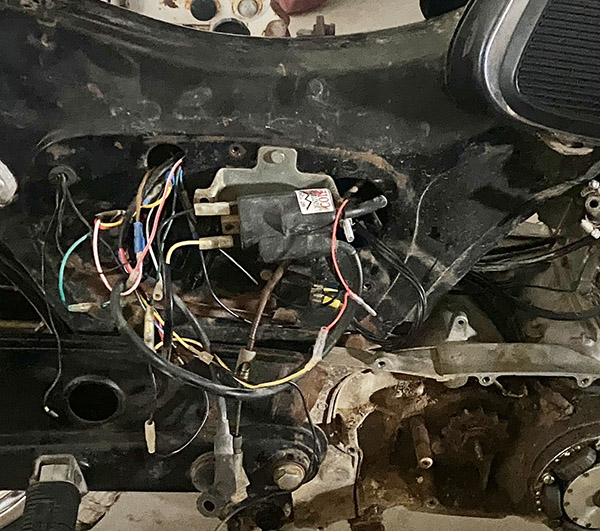
The wiring was a snarl of mismatched colors. When things get this bad it’s time to start over.
Moving on, the wiring was a mess. The main harness looks like it was new in the past 10 years. Everything else was a tangle so I removed all the wiring to get a clear view of the situation. I’ll start fresh if the engine proves usable.
I’m going to check the valve clearances but the round rocker covers are 23mm. I started easing into the cover with a large adjustable wrench but it felt like the aluminum might round off. 23mm is a socket I don’t have. I’ve ordered a socket from Amazon and when it shows up I’ll tackle the valves.
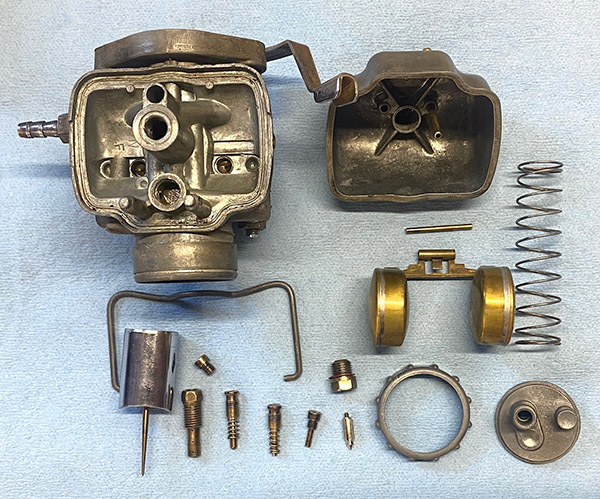
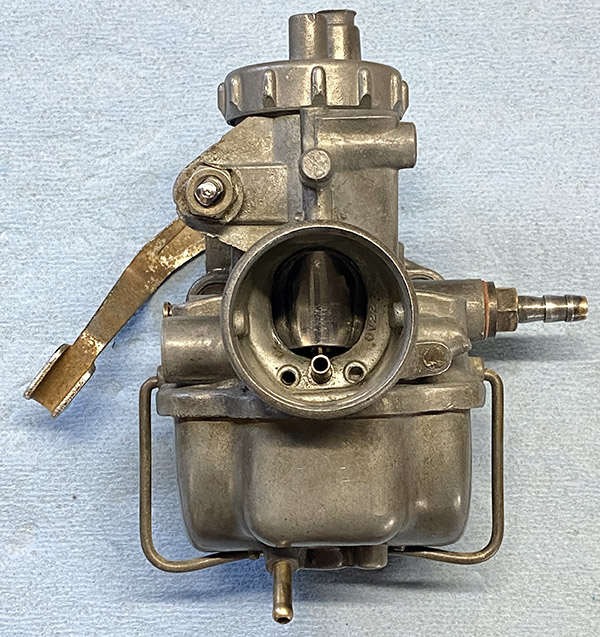
The carb bits looked good. The Dream is a simple machine to work on and tune.63 years old and doesn’t look a day over 40. The single small venturi and two, 150cc pistons promise many miles per gallon.
I also removed the carb for cleaning. At first glance it seemed not too bad and the second glance confirms it. Everything was in good shape inside so I reused all the bits.
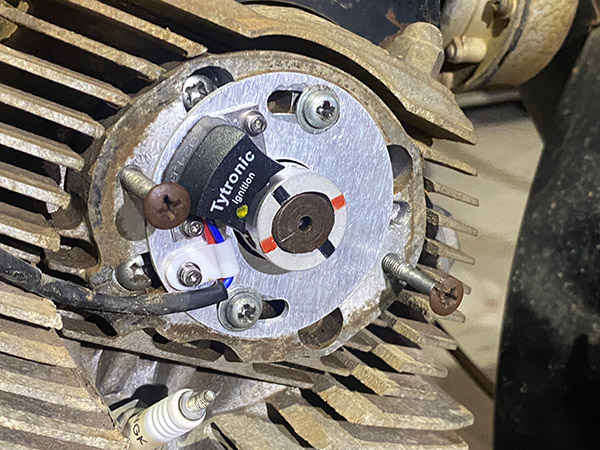
The Tytronic system is easy to connect once you have a diagram. I don’t like the single Allen head set-screw holding on the magnetic trigger.
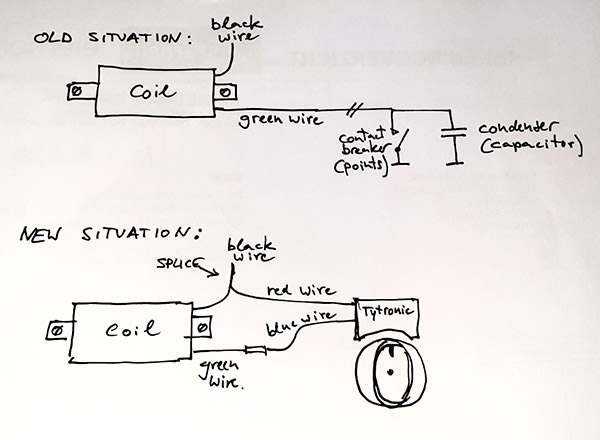
The Dream came with a Tytronic electronic ignition system. Whoever wired it connected the ground side of the coil in series with the condenser then to the ignition module. I don’t see how that can work. Condensers are used with points to help with arcing when the points break so why would an electronic ignition use one?
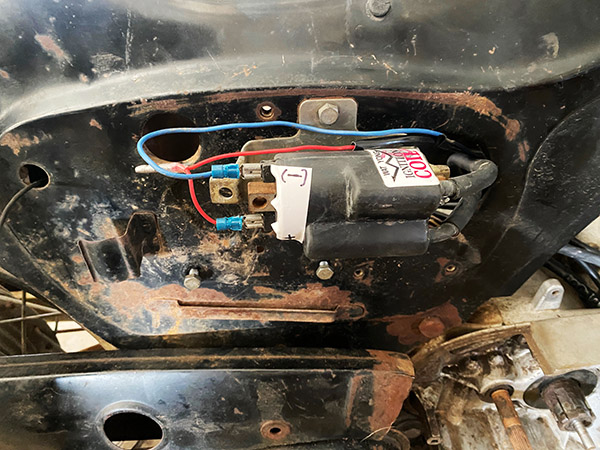
Thank you to the internet hero who took the time to draw a diagram. Something Tytronic should have done instead of their lame, verbal-to-text description.The simplified coil/ ignition wiring. Blue and red go to Tytronic module. Battery positive to red, battery negative to frame.
Clear information on the Tytronic set up wiring was hard to find. The factory instructions online used wire colors, most of the colors didn’t match what I have. I like a wiring diagram but all I found was “connect the yellow to the blue” type of stuff. Luckily some brave soul posted a diagram of his set up. I rigged the Tytronic as the line drawing showed. Next I used a test light across the coil connections to set the timing. It’s really simple. I hope the Tytronic actually works.
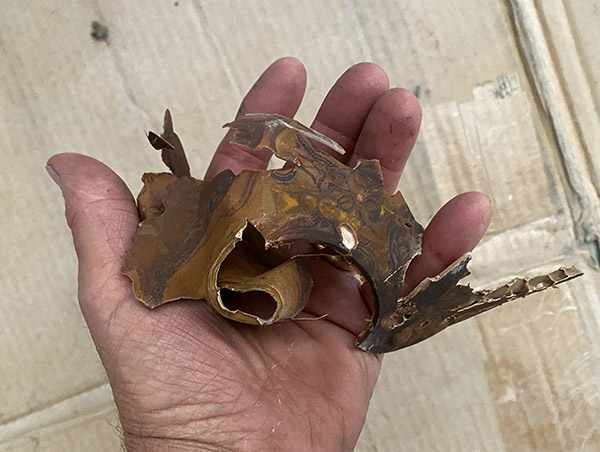
Oh, how I hate tank liner. Anyone using this crap is not professional.
I’m kind of all over the map on the Dream but as issues are resolved you’ll see a more organized approach. The gas tank has that horrible tank-liner crap inside. It’s delaminating so I pulled some big pieces out. Now only 90% of the liner needs to be removed. There are very few occasions when tank liner is required. Don’t do it.
The near-term goal is to see if the engine is good. After that I don’t know where this project is going. I’m not spending any money on the bike or making a decision until I hear the engine run.
The question du jour (and for several upcoming blogs) is as stated above: How many pistons?
A thought occurred to me the other day: I’ve owed singles, twins, triples, fours, and even a six (a Honda CBX, which was a wonderful motorcycle). There have even been (and are) companies that offer 8-cylinder bikes. 1, 2, 3, 4, 6, 8: What’s should be the right number of pistons for the perfect motorcycle?
Man, I don’t know. I’ve owned a lot of motorcycles of varying engine configurations. This blog focuses on the singles. There will be future blogs on other engine configurations. What I’ll describe are my experiences with singles, and (spoiler alert) they’ve all been good. Your mileage may vary.
Honda Super 90
My first motorcycle ever was a Honda Super 90 previously owned by Sherm Cooper of Cooper’s Cycle Ranch in New Jersey. Sherm was a famous flat track and ISDT racer in the 1950s and 1960s. Mr. Cooper had customized the Super 90 I bought from him with an upswept pipe, a skid plate, and knobby tires.
On my Super 90 in the 1960s. It was a fun bike. I wasn’t old enough to have a driver’s license yet, but that didn’t slow me down at all.
I owned the Super 90 before I had a driver’s license, and I rode my Honda all over. It would hit 65mph given enough time and road. I had a lot of fun on that bike.
BSA Bantam
Somewhere in my misspent youth as a goofy teenager, I owned a 125cc two-stroke BSA that actually ran, but not well enough that I was willing to venture very far from the house on it. I rode it in the fields behind our place for a couple of weeks and then parked it on the front lawn with a for sale sign. My first and only Beezer sold quicky.
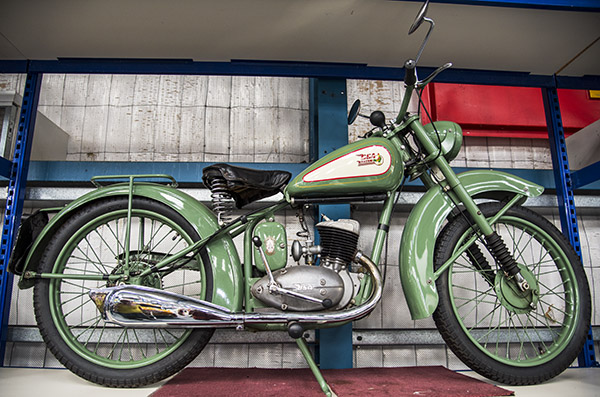
A BSA Bantam on display in Australia. This one was way nicer than mine.
My Bantam was all black (I don’t know if that was its original colors), it had a lot of power for a small bike, and then it was gone. I didn’t own it long enough to get a photo, but decades later when visiting a motorcycle museum in Australia, I did manage to get a photo of a concours condition Bantam.
Honda SL90
I sold the Super 90 and the BSA Bantam you read about above, and I was a working kid, so I was pretty flush with cash but I didn’t have a motorcycle. I didn’t have a driver’s license, either, but that didn’t slow me down. I bought a new Honda SL90, a model Honda had just released, and I loved it.
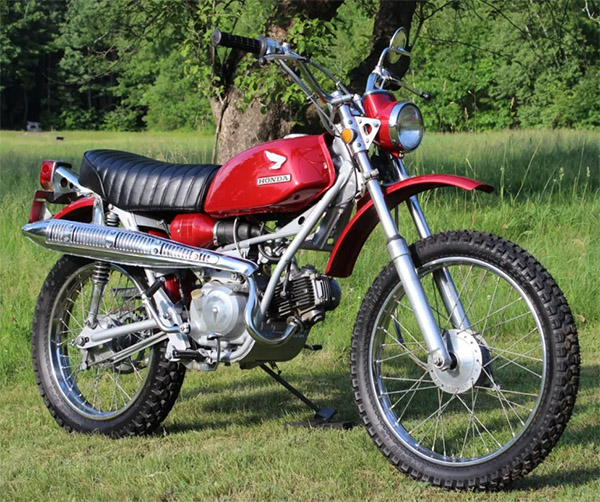
A Honda SL90 just like mine (I never took a photo of my SL90). This one sold for about $3500 five years ago.
The SL90 wasn’t any faster than the Super 90, but it had that SL look. Honda had a series of SL bikes back in those days, including an SL175 and an SL350. I’d really like to own an SL350 today, but the prices on those bikes are in the stratosphere. I rode the wheels off my SL90, and I kept it immaculate the entire time I owned it. You know, it’s funny: I can’t remember selling it. But I guess I did. I just checked my garage and it’s not out there.
Honda Cub
One of the families in our neighborhood had a welding business (I guess their welding business was good; they bought new Cadillacs every year). The guy who owned that business somehow acquired a 50cc Honda Cub. You know, the little ones with a step-through frame. I offered him $50 for the Cub. Suddenly, I owned a 50cc Honda Cub.
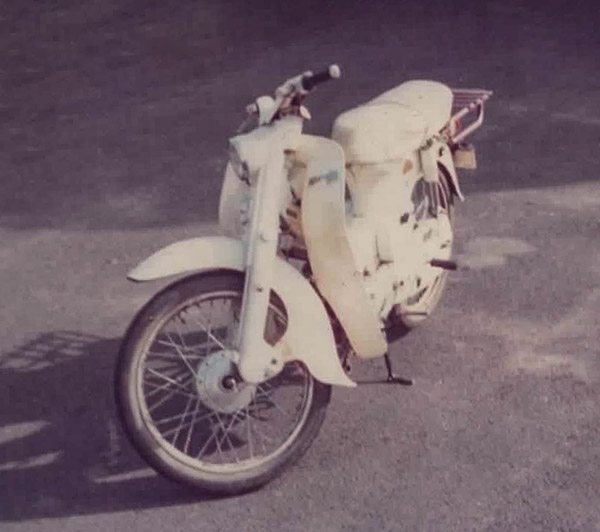
My 50cc Honda Cub. I only owned it for a short period.
The Cub had three speeds and a centrifugal clutch. I sold it a month or two later for $75 and considered myself a wheeler dealer. Seiko recently came out with series of watches commemorating the Honda Cub. I’m wearing that watch as I type this blog.
Honda Cubs are still in production (new ones MSRP for $3,899.00, not including transportation to the dealer, California emission equipment, government fees, taxes, finance charges, dealer document preparation, electronic filing fees, tire tax, and, well, you get the idea). As I understand it, more Honda Cubs have been built than any other motor vehicle of any type. I’ve traveled a bit in my life, and I can tell you that Honda Cubs are everywhere. The people who keep track of such things stopped counting when the total number of Cubs went over a hundred million. Soichiro outsold Henry Ford. Imagine that.
KLR 650
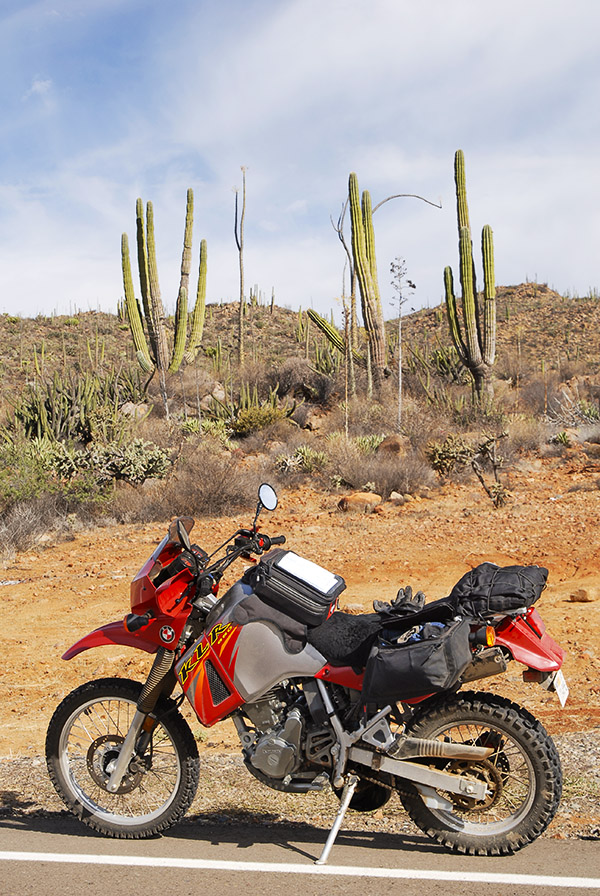
I had always wanted a Kawasaki KLR 650, and in 2006, I scratched that itch. It was one of my all time favorite motorcycles. I used mine as a touring bike, and that touring sometimes included offroad excursions here and in Mexico. I had fabulous rides in Baja with the KLR.
I covered a lot of miles in Mexico on my KLR. It never let me down. It was the perfect motorcycle for Baja.
I sold the KLR just because I was busy riding other machines. Looking back on that, I wish I’d kept it. The KLR was a fabulous motorcycle. I think it made less than 40 horsepower, and that was all I needed. I could touch 100mph on mine. The ergonomics on it were perfect for me. I loved that bike.
CSC 150
My CSC 150 Mustang replica was kind of my comeback bike after I crashed big time on a Triumph Speed Triple (that’s a story I’ll tell in a subsequent blog).
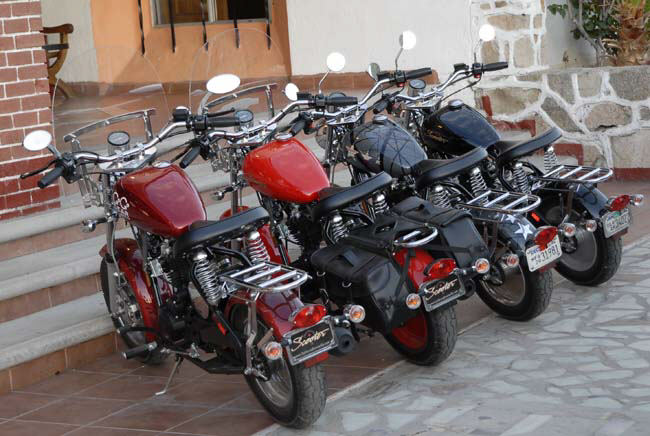
My new buddy Umberto upgrading a preproduction muffler tab to the production configuration, while simultaneously demonstrating proper personal protective equipment use. Welker is pulling fire guard duty.Our CSC 150s parked in front of the Desert Inn in Catavina, Baja California Sur, about 330 miles south of the border. My bike is the fire engine red one, second from the left.
I caught a lucky break after the above-mentioned motorcycle crash: My buddy Joseph Lee told me about a new venture, the California Scooter Company, that was resurrecting the Mustang motorcycle. I consulted for CSC for the next 6 or 7 years, and one of my brilliant ideas was to ride the little 150cc Mustang to Cabo San Lucas and back. I and three of my friends did so. You can read about it here.
Janus Gryffin
I never owned a Janus, but I spent a four day weekend riding one through southern California and northern Baja with the Janus CEO and his videographer (you can read about that ride here). It was a Janus promotional ride that I talked them into doing, it was a lot of fun, it resulted in a couple of magazine articles for me, and I had a hoot doing it.
The Janus CEO taking the Gryffin offroad in northern Baja.
The Janus Gryffin uses a CG-250 Honda clone engine (the same one used in the CSC TT 250: see below). I had a good time on that ride. Hell, I’ve had a good time on all of my rides through Baja.
CSC TT 250
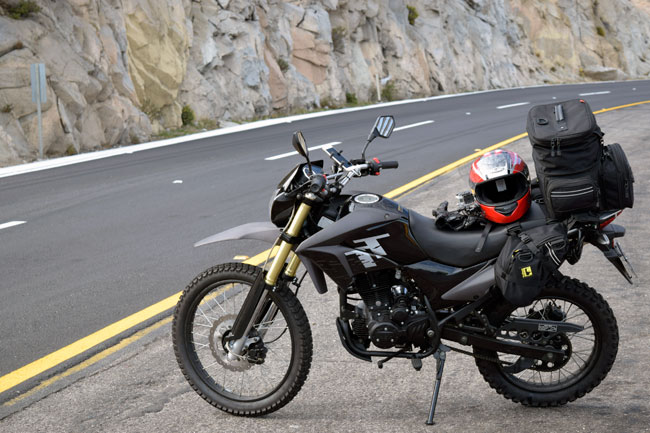
I talked CSC into bringing the TT 250 to America. On one of my many visits to Zongshen (in Chongqing, China), I noticed a 150cc motorcycle on a platform in their marketing department. It was a sharp bike, I knew that the CG 150 engine has the same exterior dimensions as the 250cc engine, and I asked the Zong wizards if they would make that bike for us (us being CSC) with the larger engine. The answer was yes, and the CSC TT 250 was born.
My TT250 On Mexico Highway 2 at the Rumarosa Grade. it was a fun trip.Dangerous Dan with his TT250 in Baja.
The bike was wonderful, and they initially retailed for $1895. They sold like hotcakes, and to this day, they still comprise the bulk of CSC’s motorcycle sales. I had a blast on mine. Many of the folks who owned CSC RX3 motorcycles also purchased the TT 250, and we ended up doing a ride through Baja on those bikes. They were awesome.
CSC RX3
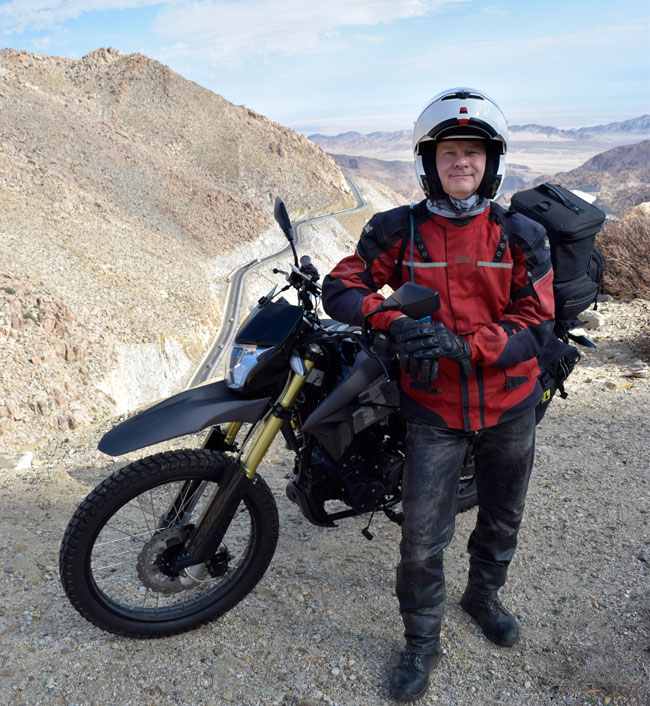
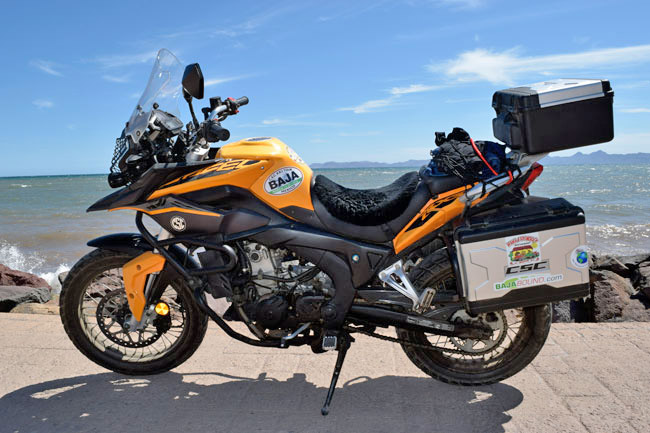
My last single-cylinder motorcycle was a 250cc RX3, imported to the US by CSC Motorcycles in Azusa, California. The RX3 is a Chinese motorcycle that looks a lot like a slightly scaled down GS1200 BMW.
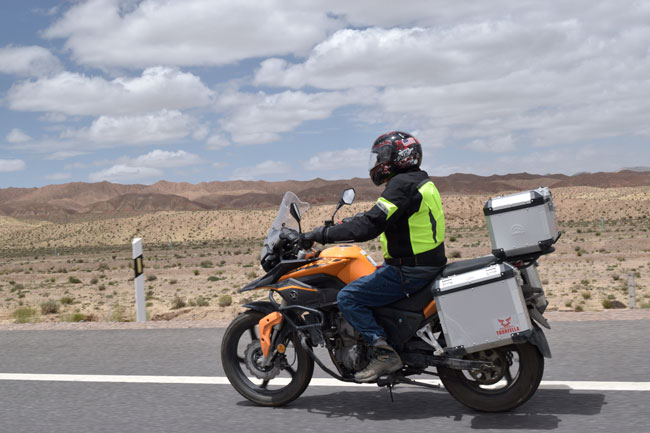
My RX3 along the malecon in Loreto, Baja California. That’s the Sea of Cortez in the background. I covered a lot of miles on this motorcycle. It was one of the two best bikes I ever owned (the other was my KLR 650).Joe Gresh (shown here in the Gobi Desert) and I rode RX3 motorcycles across China. It was the ride of a lifetime.
A lot of the China haters claimed that Zongshen copied the styling from BMW (hey, nearly everyone else did, too, on their adventure touring bikes in those days). There sure was a big cost difference, though. BMWs were going for $25K; the RX3 sold for $2895 when it first came to America.
The RX3 proved to be a remarkably reliable motorcycle. We took a dozen Chinese riders on a 5000-mile tour through the American west, Gresh and I rode a 6000-mile loop through China, I rode around the Andes Mountains in Colombia, and we did numerous Baja rides with groups of CSC riders in Baja, all without a single mechanical breakdown (well, we had one guy break his gearbox in Baja, but he was a guy who liked to shift without using his clutch, so I’m not counting that one). The RX3 is a wonderful machine.
I was one of the key guys involved in bringing the RX3 to America, and I’m proud of that. It was one of the high points of my professional life and my riding life. I wrote a lot of blogs for CSC and several books about my adventures on the RX3. I think the RX3 is one of the best motorcycles in the world. I wish the bike was still in production.
You know what? In searching for photos of my old twins, I found another single I’d forgotten all about. It was my Triumph Cub.
I never put the Cub on the street. I just rode it a bit in the fields behind my apartment building and then sold it. It was crude compared to other bikes of the era, but it was nice. It would be worth way more today than what I paid for it or what I got when I sold it.
Next up in our Quantos Pistones series? The Twins, of course. Stay tuned.
I’ve been to a lot of great places. None were as grand as Yellowstone National Park. I was reminded of that when watching the Kevin Costner special, Yellowstone One-Fifty.
I’ve been to Yellowstone twice. The first time was with a bunch of guys from China, two guys from Colombia, Baja John, and Joe Gresh. The second time was with Susie. Both trips were great. Seeing the Costner special reminded me of a blog I wrote about those trips a few years ago, and I thought you might enjoy reading it again.
Man, it was cold. It was the coldest we would be on our 18-day, 5000-mile ride around the western United States. Yellowstone National Park was our destination and we wanted to arrive early. Baja John was doing the navigating and the trip planning, and we were leaving early that morning out of Cody, Wyoming, at 5:00 a.m. to beat the tourist traffic in Yellowstone. I had an electric vest; our Chinese and Colombian guests did not. I knew they had to be hurting. I had my vest dialed all the way up and I was. Did I mention it was cold?
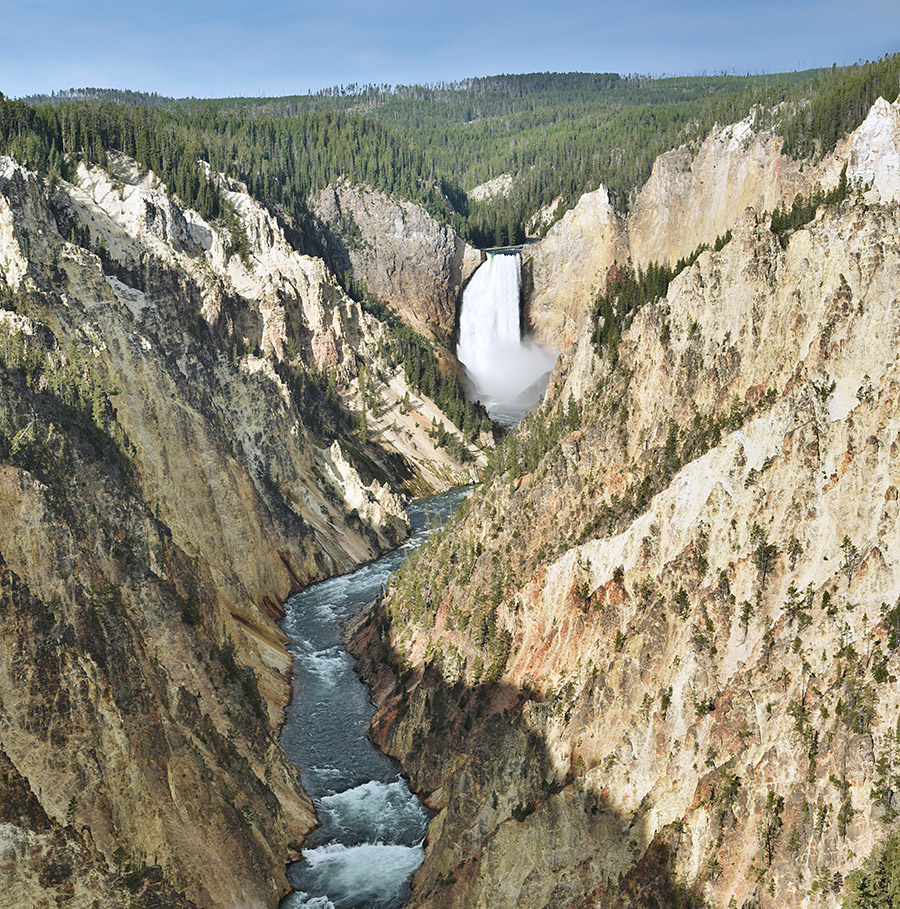
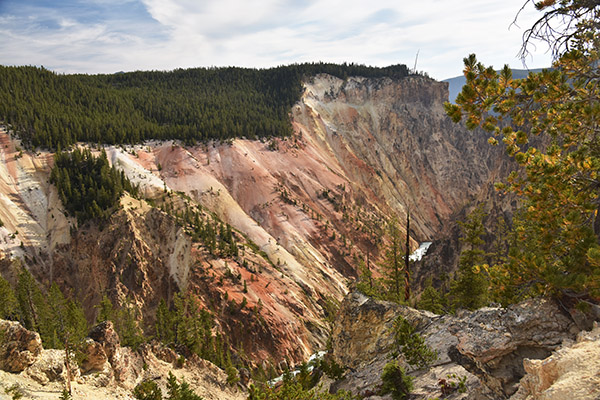
So, about that big photo above: That’s Yellowstone Falls on the Yellowstone River. There are something like 10 waterfalls in Yellowstone National Park. I’ve only seen the one above. That means I have at least nine reasons to return.
Back to the story. I did mention it was cold riding into Yellowstone that morning, didn’t I?
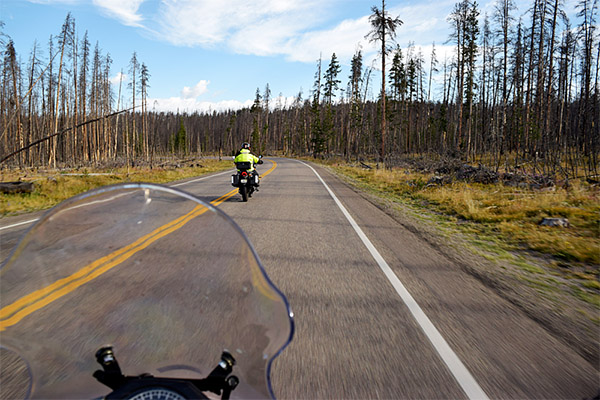
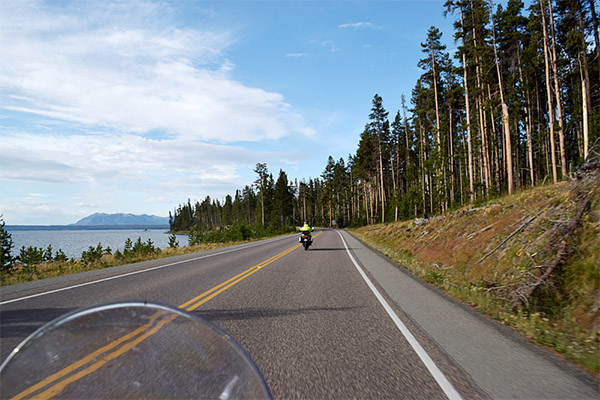
Following Baja John into Yellowstone. That trip was 6 years ago, and I still get cold looking at this photo.Another shot entering Yellowstone National Park from the east. That’s Baja John in front of me…we were dressed for the cold, but I think our guests found it to be a little colder than the weather they are used to in southern China.
The trip was a wild one…18 days on the road with a dozen guys from China, two from Colombia, and all on free motorcycles provided by Zongshen via CSC Motorcycles. CSC was the importer, I was the go-between spanning the CSC/Zongshen interface (and two continents), and while we were arranging the initial shipment Zongshen asked if I had any ideas to promote the bikes in the US. Wow, did I ever!
In Zongshen’s main offices, with key Zongshen execs viewing photos from my rides in the US and Baja. Sue grabbed this photo and it’s one of my favorites. Without realizing it, I was selling those guys on giving us 15 motorcycles to ride around the US. This looks like a staged photo. It’s not.
That ride became the Western America Adventure Tour, and it was a hoot. I mean, think about it: Every angry and ignorant asshole on the Internet was condemning Chinese bikes and here we were, with 15 of the things that had just arrived in America, setting off on a 5,000 mile ride from So Cal to Sturgis, west across the US to the Pacific Ocean, and then riding the Pacific coast back to So Cal. On that epic ride we didn’t have a single breakdown and that was giving the Internet trolls meltdowns. It was a grand adventure.
But I digress. Back to Yellowstone. On our ride, we hit every National Park along the way, and Yellowstone was one of the best. Prior to that ride, I’d never been to Yellowstone and I had always wanted to see it. And for good reason…it is (in my opinion) the quintessential National Park. Yellowstone is surreal, with sulfur-laden steams and ponds spewing forth, majestic views, waterfalls, bison, bears, deer, elk, wolves, geysers, and more. It was a first for me. I was a Yellowstone green bean.
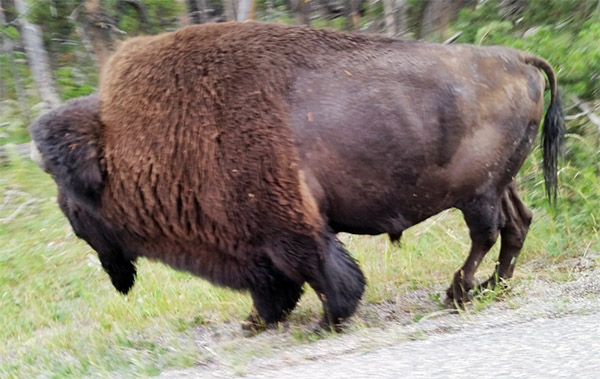
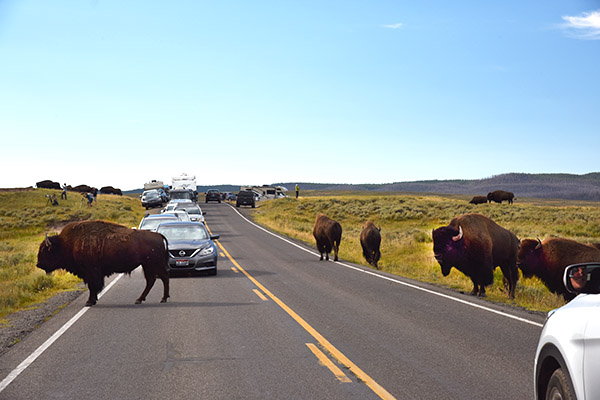
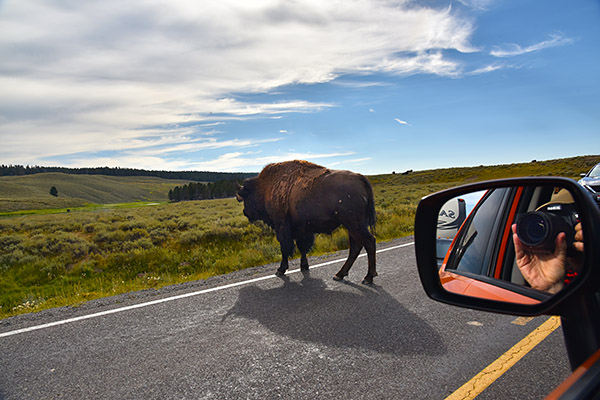
When we entered Yellowstone, we arrived so early the gates were unmanned and we entered for free. But it had been a long, cold ride in from Cody and we were nearly out of gas. My fuel light was blinking as we entered the park and I didn’t know for sure if there would be gas in Yellowstone. John felt confident there would be, and he was right. I saw the Sinclair sign up ahead, but before we got there, we had a close encounter of the bison kind. We were cruising along at about 30 mph, and all of a sudden I noticed this locomotive next to me. I was too slow to realize what it was until I was alongside, but our chase vehicle driver John (we had two Johns and one Juan on this ride) grabbed this photo…I had passed within 10 feet of this monster!
Just as I went past my big buff buddy above, he exhaled. In the frigid Yellowstone air, fog came out of his nostrils. It was like riding alongside a steam locomotive.
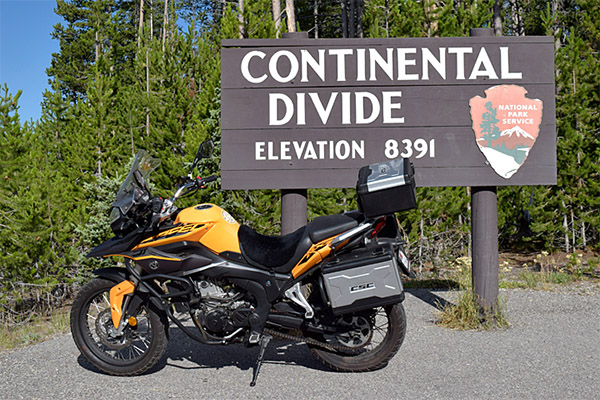
Here’s another cool shot in Yellowstone: The Continental Divide. We had crossed it several times on the ride to Yellowstone already, but I think this is the first time I stopped for a photo.
Sometimes the photos almost take themselves.
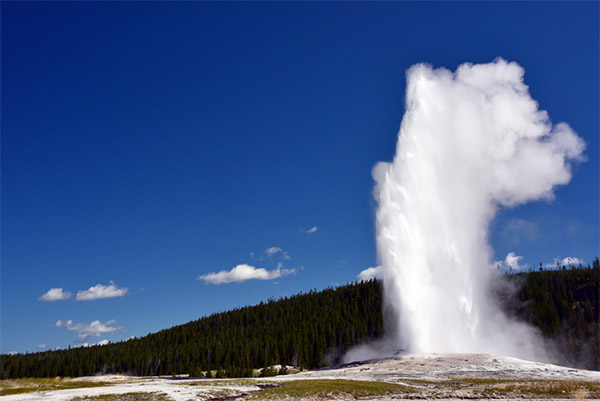
One of the many attractions in Yellowstone is Old Faithful. Here’s a shot of the geyser in its full glory.
It was one of those motorcycle rides that was so much fun it made me feel a little guilty. (That’s a Jewish thing; maybe some of our Catholic readers will understand it, too.) I felt bad because Sue wasn’t enjoying the trip with me. So I fixed that. A few years later Sue and I hopped in the Subie, pointed the car north, and a few days later I rolled into Yellowstone National Park again (this time with my wife). Naturally, I grabbed a few more photos.
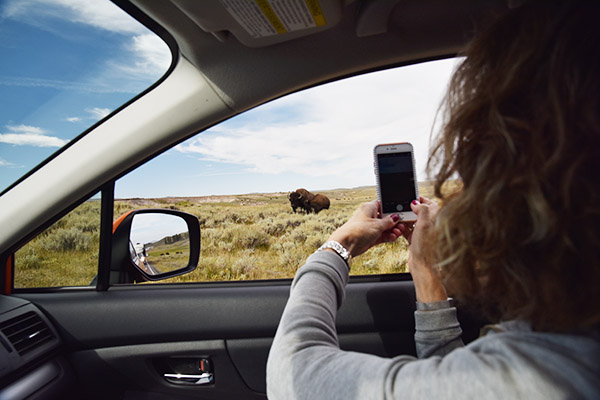
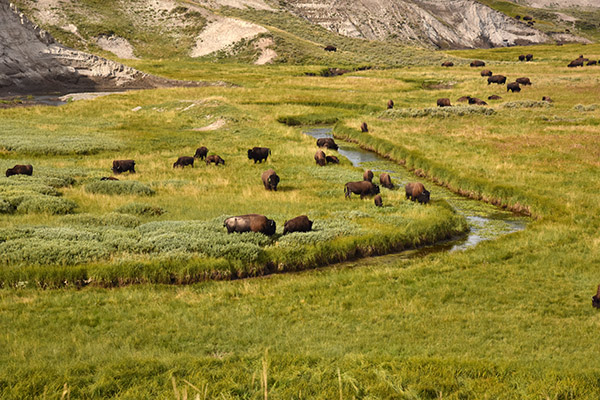
Peering into the valley carved by the Yellowstone River.Ah, the bison. This was really cool stuff.Click. Click. Click.A photo of Sue in the Subie photographing a bison.Wow.
I’m not a geologist, but geology seems to me to be a pretty interesting subject and there sure are a bunch of geological things in Yellowstone. Like the bubbling and burbling pits and pools you most definitely do not want to fall into.
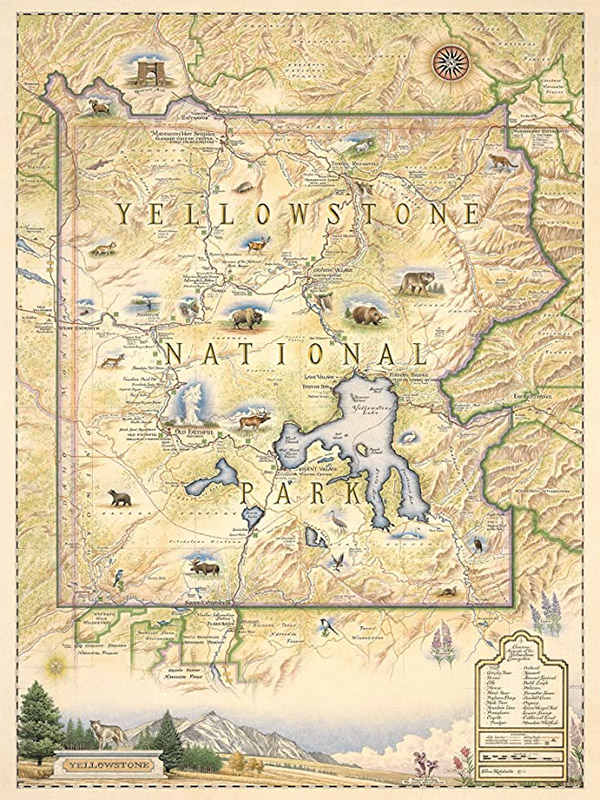
You get the idea. In doing a bit of Internet research on Yellowstone, I came across this Yellowstone map. It is a good way to get the lay of the land up there in Wyoming, but visiting Yellowstone National Park would be even better.
You can learn a little bit more about Yellowstone as a destination (and how to get there) by reading an article I wrote for Motorcycle Classics magazine. It’s a cool place and I’ve never met anyone who felt like visiting Yellowstone was anything other than a marvelous experience. Trust me on this: Yellowstone National Park belongs on your bucket list.
Never miss an ExhaustNotes blog:
Would you like to read more Motorcycle ClassicsDestinations articles? Hey, just click here or better yet, buy your own copy of Destinations.
One more thing…if you’d like to learn more about the RX3 motorcycle and our 5,000-mile Western America Adventure Ride, you should do two things: Buy yourself a copy of 5000 Miles at 8000 RPM, and watch Joe Gresh’s video:
We are living in interesting times. I like to read the news every morning with my first cup of coffee. This assessment and presentation by General Caine is worth watching in its entirety.
The presentation struck a lot of notes for me. I think you’ll enjoy it. I sure did.
This press release from Janus Motorcycles came in a few minutes ago:
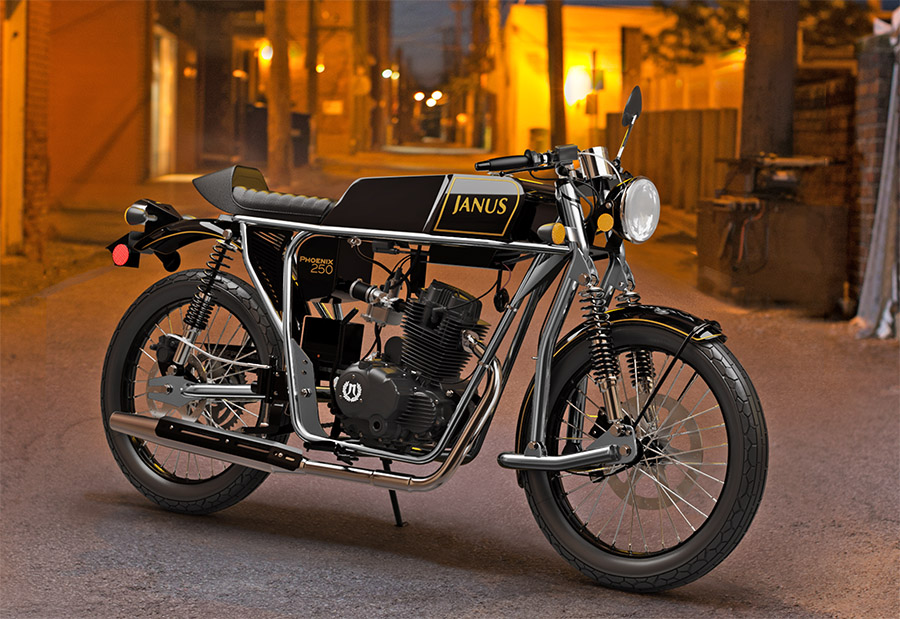
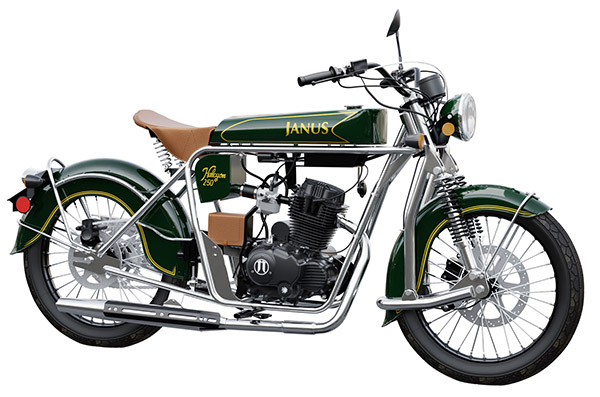
Goshen, IN — In celebration of ten years building classically inspired, lightweight machines, Janus Motorcycles is proud to announce the 10th Anniversary Edition Halcyon 250 and Phoenix 250 models—offering a rare opportunity for riders to own a piece of Janus history.
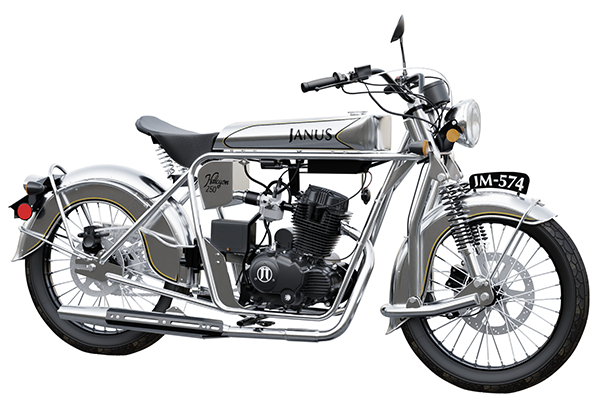
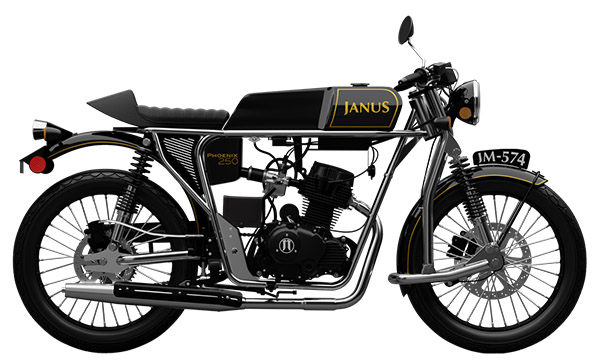
The Halcyon 250, Janus’ flagship model and a decade-long standard-bearer for accessible, elegant motorcycling, is joined once again by its rakish sibling: the Phoenix 250. Back by popular demand, this limited-production model pays homage to the café racers and GP machines of the 1960s and ’70s, with an aggressive stance, nimble handling, and a long, lean, Dunstall-inspired fuel tank. Offered only through July 4th, our Halcyon and Phoenix Anniversary Editions are the first to feature our new Super Chrome powder-coated frame—a brilliant, mirror-finish treatment that underscores the model’s raw, mechanical beauty.
Both Anniversary Editions include the following available options:
• Super Chrome powder-coated frames
• Special anniversary medallion logos on the airbox
• Silver-painted number plates
• Limited edition fuel caps
• Commemorative 10th Anniversary badge
“The Phoenix 250 has always held a special place in our workshop,” says Richard Worsham, Janus designer and CEO. “It’s an employee favorite. It’s lean and mean, and it distills what we’re about at Janus Motorcycles in a different way than our Halcyon line. We’re especially proud to see it return in this limited anniversary edition.”
Availability & Pricing
The Phoenix 250 is available for order through July 4th, 2025, at a price of $6,995. Customers can add anniversary edition options to their build a la carte.
The Halcyon 250 Anniversary Package can be added to any new Halcyon 250 order a la carte. Halcyon 250s start at $6,995.
Anniversary Promotion
To mark this milestone, Janus is also offering 10% off OR 1.99% financing for well-qualified buyers on standard Halcyon 250 or Gryffin 250 model. This promotional offer is valid through July 4th, 2025.
Janus Motorcycles stands for classic design, mechanical simplicity, and the joy of the ride. With this anniversary release, we’re celebrating not only a decade of craftsmanship—but the community of riders, builders, and ramblers who’ve made the journey with us.
For media inquiries, interviews, or test ride opportunities, please contact:
Grant Longenbaugh | grant@janusmotorcycles.com | (574) 538-1350 |
I’ve got a special place in my heart for the Janus motorcycles. I like small bikes and I like what Janus is doing. We rode with Janus in Baja, and I wrote a Motorcycle Classics feature article on the Janus 450. They are cool bikes and the Janus team are great people.
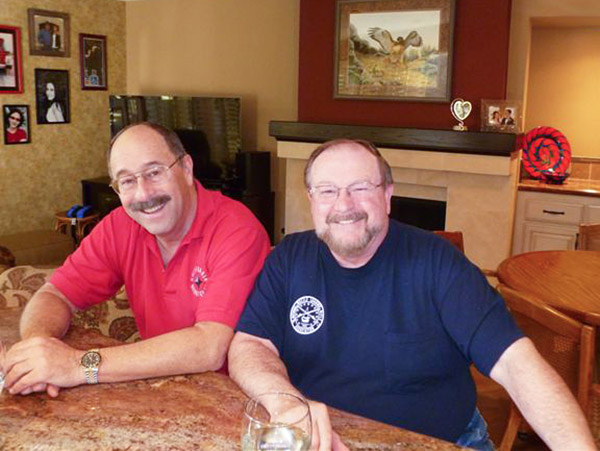
It’s good to have friends, and it’s even better to have friends that go back to your earlier childhood. I have a few of those, and the one I’ve known the longest is good buddy Paul. We were next door neighbors back there in rural New Jersey from the time we were babies. Our dads hunted, fished, and shot trap and skeet together when we were little. They were friends and it was natural that Paul and I were friends. We fished, explored the area’s woodlands, lakes, streams, and ponds, and generally got into all kinds of trouble together. In other words, we had fun, and that continues to this day.
That’s me on the left, and Paul on the right during a recent visit.
You have read some of my posts on my latest obsession: Pocket knives. Paul is what you’d call an enabler. He has an extensive collection of both pocket knives and fixed blade knives, including some that are absolute masterpieces. Paul is a craftsman, and he’s fabricated several fixed blade knives. He recently made one for me, and it’s become the touchstone piece of my modest knife collection.
Bowie Knife History
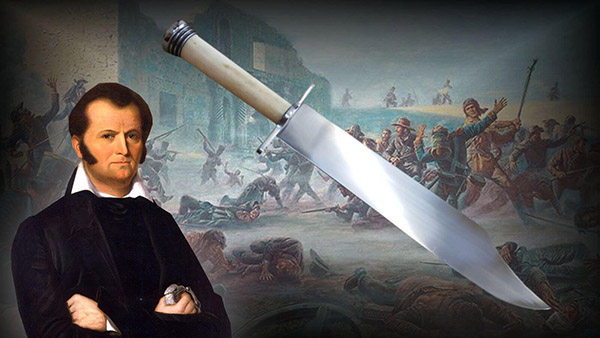
First, a bit of background on what a Bowie knife is. The term has come to denote a large fixed-blade knife with a handle, a guard (the piece between the handle and the blade), and the blade. Jim Bowie is the stuff of legends, a frontiersman in the early 19th century, a hero of the Texas Revolution, and a fighter who died at the Alamo. Although we don’t know with certainty, the Bowie knife design is generally credited to Jim Bowie, his brother, Rezin Bowie, and blacksmith Jesse Clifft. Legend has it that Rezin designed the a knife, with inputs from Jim, and Clifft crafted it from an old file (custom/hobby knifemakers sometimes similarly make knives from old files today).
Jim Bowie and the knife that bears his name.
Jim Bowie used the knife in the 1827 Sandbar Duel, where he used the knife to injure an enemy in a fight. The Bowie knife concept spread, and the term planted itself in our national lexicon. The knife became a frontier tool, equally adept in combat, in skinning and butchering animals, and as a general cutting and chopping tool. It has been carried and used by soldiers to this day; indeed, one could argue that the famed Marine Corps KaBar knife is a direct descendant of the Bowie. Numerous custom knifemakers offer various interpretations and takes on the Bowie concept, including famed knifemaker Randall Knives. William Westmoreland, whom I met once when I was in the Army, carried a Randall. Paul owns several Randalls and he’s trying to convince me I need one. So far, I’ve been able to resist taking that plunge.
My Custom Bowie Knife
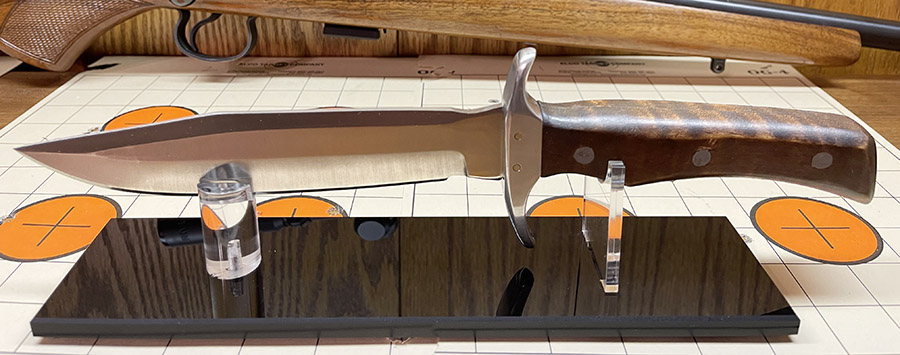
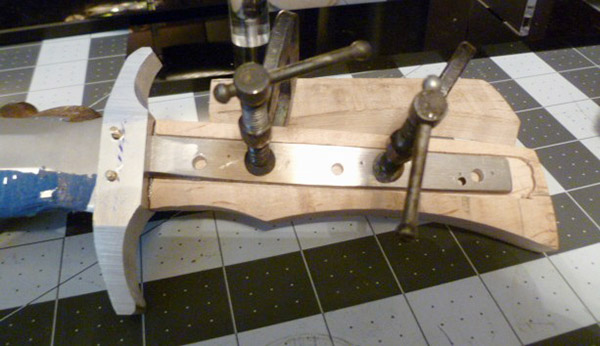
During a recent phone conversation with Paul, he mentioned that we was working on a new project. When I asked what it was, Paul told me I’d find out soon enough. And I did, when a package arrived at my front door with the Bowie knife you see in the photo on the top of this blog. It’s awesome. Paul also sent along photos showing a few of the steps involved with his making this knife.
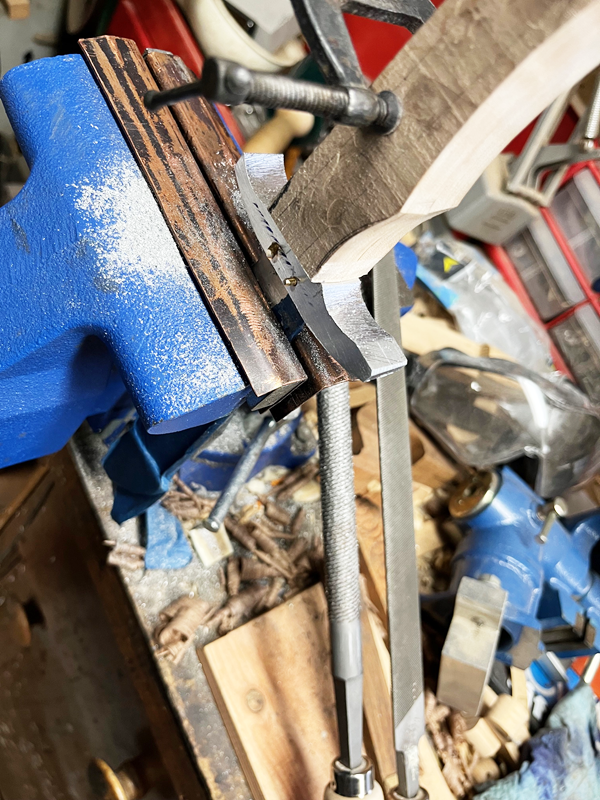
Fixing the curly maple handles in place.The guard and its brass rivets. Paul hand filed the guard to its final shape and polished it.
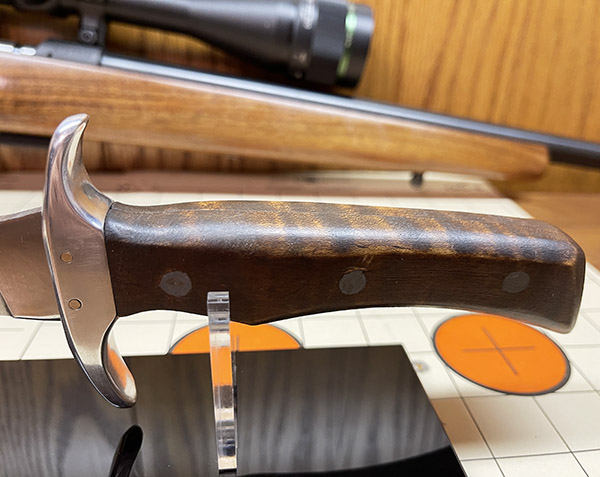
The knife’s handle is curly maple finished with nitric acid and one coat of TruOil. Paul has built a number of custom black powder rifles with curly maple, using nitric acid as the finishing agent. It’s not something for amateurs, as it requires special handling. Nitric acid causes the wood to darken, which brings out the figure in a piece of curly maple (as it did on my Bowie knife).
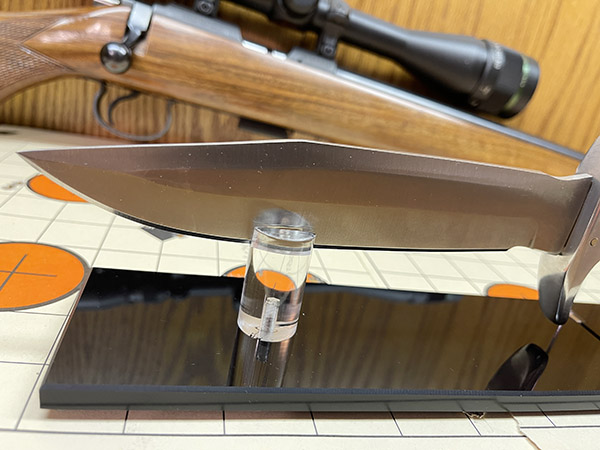
Here’s close up of Bowie’s blade:
My Bowie has a 7 1/2-inch blade.
Here’s a photo of the guard and the handle. Check out the figure in the curly maple.
The hand fitted and polished guard, and the nitric acid finished curly maple handles.
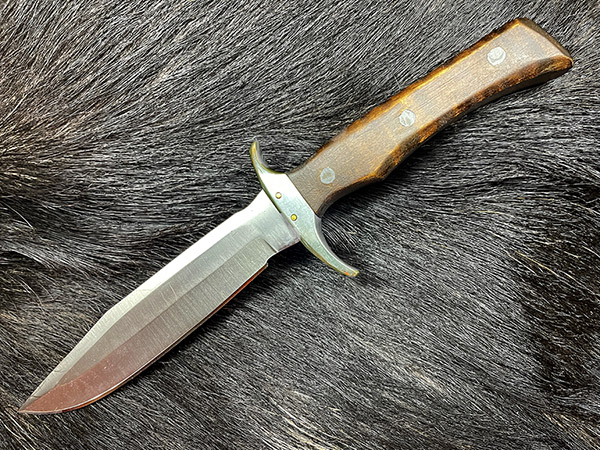
Here’s the finished knife, on top of a background I’ve used for many photos appearing here on ExhaustNotes.
My Bowie on top of a wild boar skin. I shot the boar on a hunt with Paul about 8 years ago.
This Bowie knife is a cool gift and a prized possession. Thanks much, Paul!
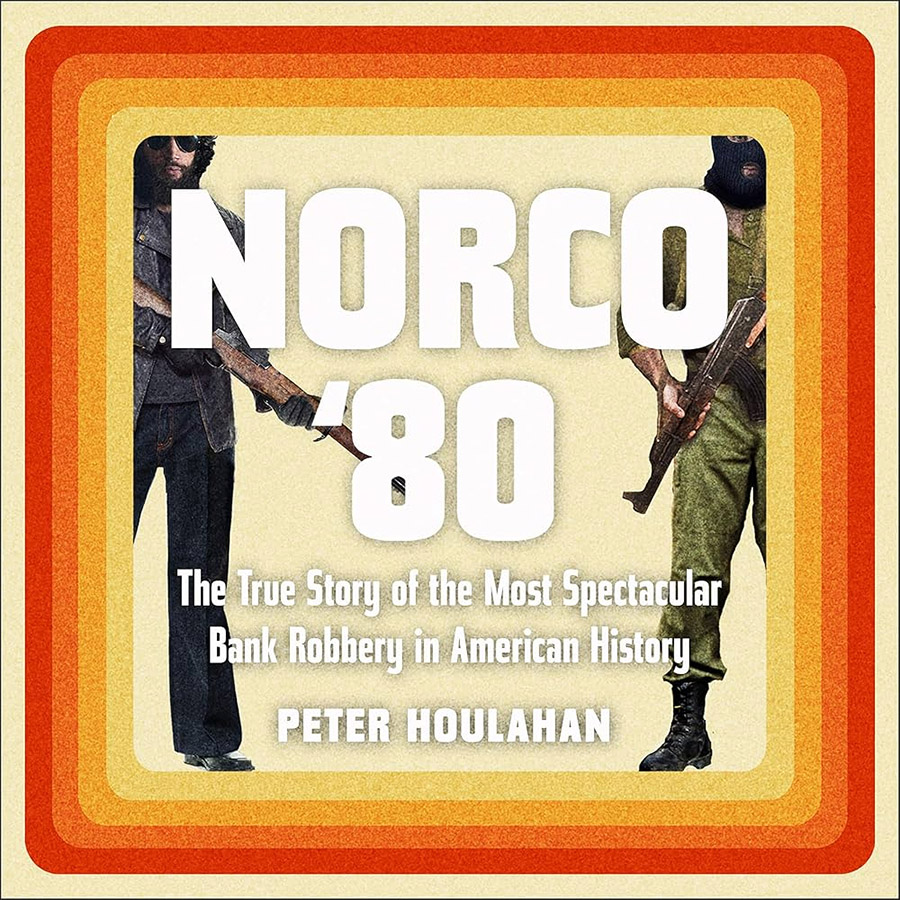
I moved to southern California in 1979 and settled in what we call the lnland Empire, which is the area that includes the Pomona Valley and extends east to San Bernardino. Basically, it’s everything south of the San Gabriel Mountains and east of the 57 freeway. How I ever missed the 1980 Norco bank robbery is beyond me. It was, as the cover of Norco ‘80 states, the most spectacular bank robbery in American history, and it went on to include a police pursuit up into the San Gabriels and the northern side of Mt. Baldy, which is just to the north of my home today. More than a dozen police officers were injured by the five bank robbers, a police helicopter was shot down, nearly 40 police vehicles were disabled or destroyed, and two of the robbers were killed during the pursuit. The remaining three were charged with 46 crimes including murder, murder with special circumstances, kidnapping, bank robbery, resisting arrest, and more. Found guilty, they received life without parole prison sentences.
I first heard about these events only a few days ago when good buddy Paul sent a YouTube link to me summarizing the crime. I was astounded I had not heard of it and I Googled for more info. Norco ‘80 came up in that search.
Peter Houlahan wrote Norco ‘80, and I couldn’t put it down. It’s true crime drama at its best. I read all 387 pages in three sittings. It’s that good. What made it even more compelling for me is that I am very familiar with all the locations described in the book and in the chase scenes that followed. The chase went right past the West End Gun Club, into the little village of Lytle Creek (where Gresh and I enjoyed a few cold ones last year), and on and up the dirt roads running through the San Gabriels (roads I explored on my RX3 and KLR 650 motorcycles).
At the time, police were armed with .38 revolvers. The bad guys had semi-auto handguns and assault rifles, and the effects of this imbalance resulted in the police not being able to stop these guys. This episode, posits the author, is what directly led to police departments nationwide equipping their patrol officers with military-style weaponry.
If you enjoy a good crime story (and a true one), check out Norco ‘80. You can thank me later.