It’s monsoon season here in New Mexico and the hard rain mixed with hail has me wasting time indoors…I mean tinkering with the Dream 305.
The most annoying problem on the black Dream was the clutch lever wouldn’t move. The cable was like a banjo string, the lever wouldn’t move and the kickstart spun freely. I guess the Dream doesn’t have primary gear start.
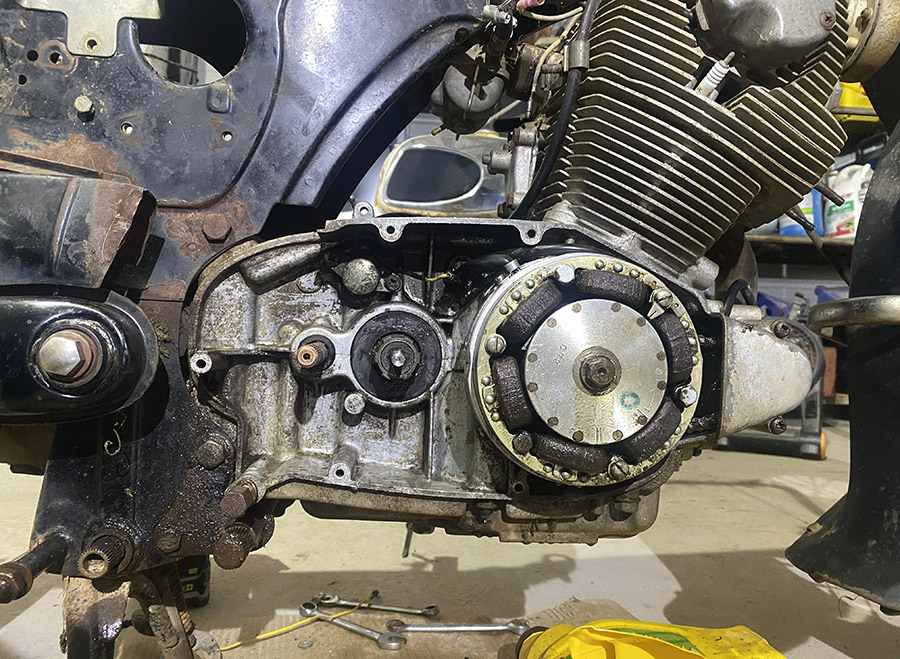
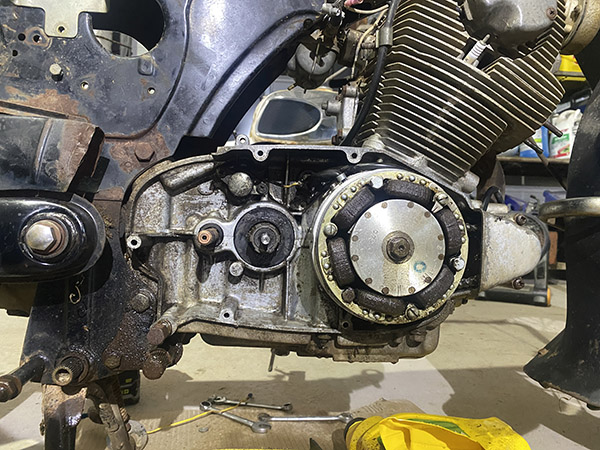
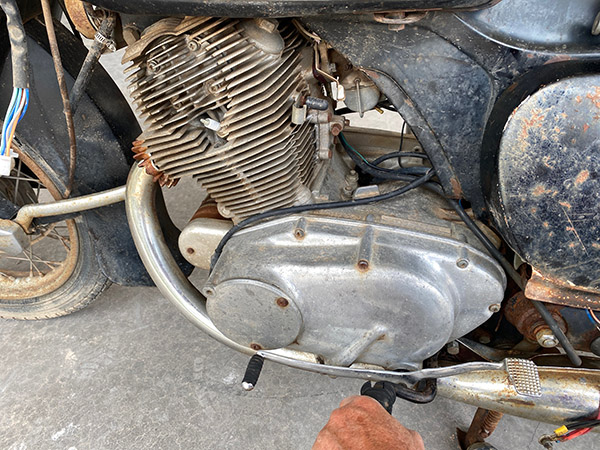
The clutch released after I removed the right cover. Several sessions of Gunk got it looking a bit cleaner.
I took off the right-side engine cover and that released the clutch. Once the cable was loose I slipped the cover back on and the kicker turned over the engine with a slipping gear sound.
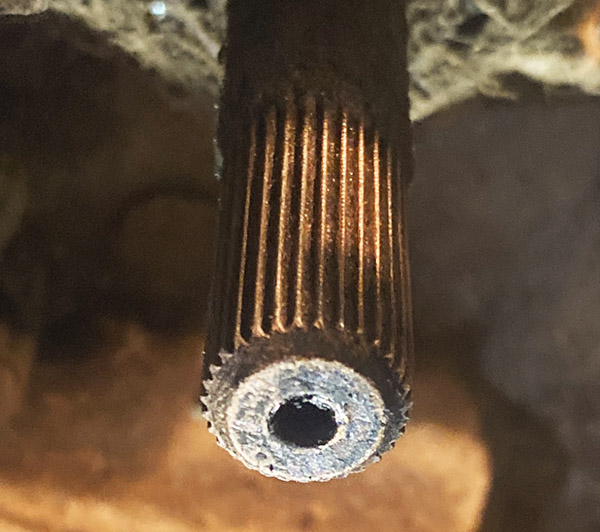
The kickstart splines look ok but the start lever slips. I’m thinking a keyway might solve the problem.
Turns out the kick lever slides onto the kickstart shaft and is kept from turning by shallow splines in the shaft and kick lever. My Dream must have been kicked a lot. I’m not sure how to fix the problem, maybe grind a keyway?
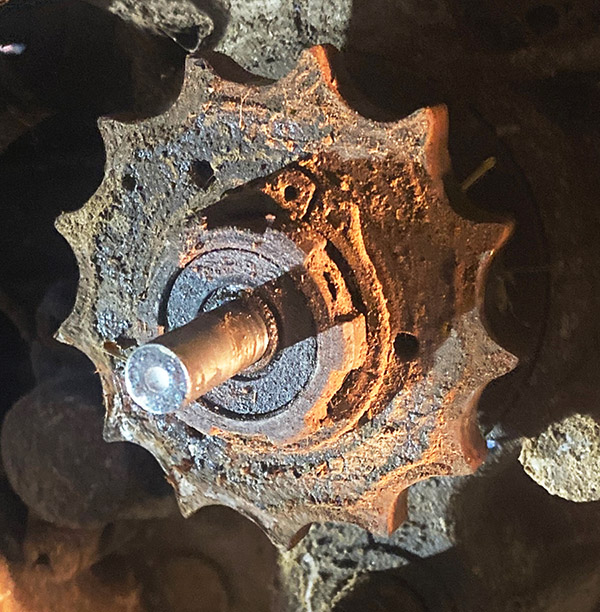
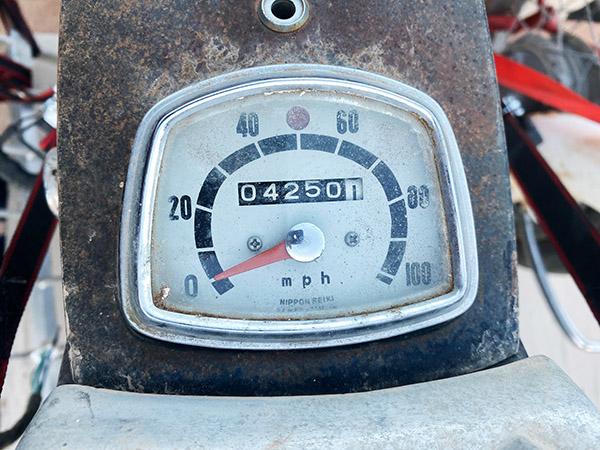
Sprockets don’t wear out this much in 4000 miles. I suspect the white Dream is the low mileage bike. This black Dream has been around the block.
The sprocket area was a greasy mess so I cleaned it up and removed the worn out countershaft sprocket. The kickstarter and the sprockets have me thinking the 4000 miles on the odometer isn’t accurate. The white Dream looks more like the low-mileage bike.
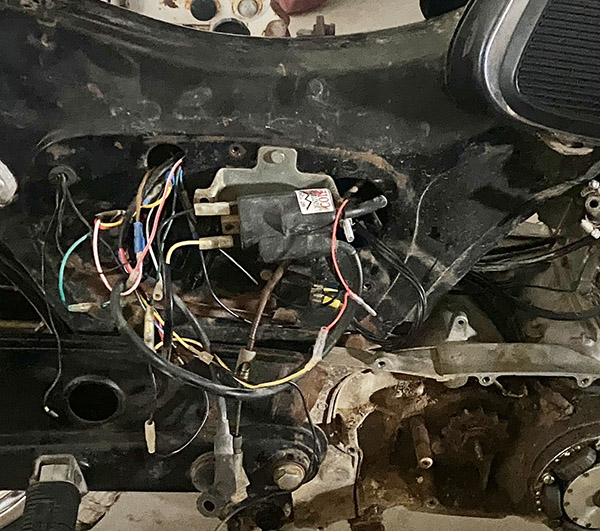
The wiring was a snarl of mismatched colors. When things get this bad it’s time to start over.
Moving on, the wiring was a mess. The main harness looks like it was new in the past 10 years. Everything else was a tangle so I removed all the wiring to get a clear view of the situation. I’ll start fresh if the engine proves usable.
I’m going to check the valve clearances but the round rocker covers are 23mm. I started easing into the cover with a large adjustable wrench but it felt like the aluminum might round off. 23mm is a socket I don’t have. I’ve ordered a socket from Amazon and when it shows up I’ll tackle the valves.
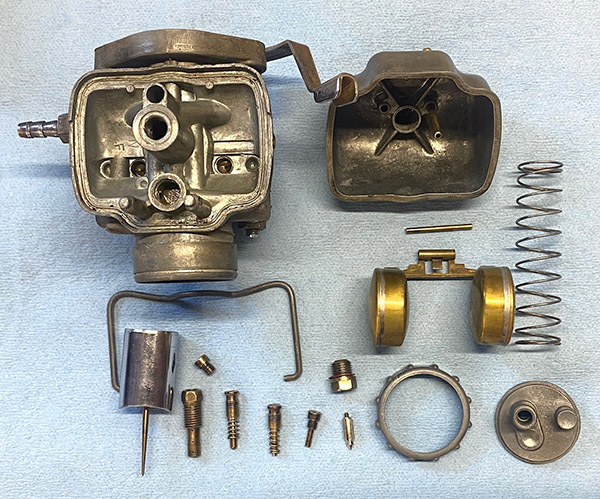
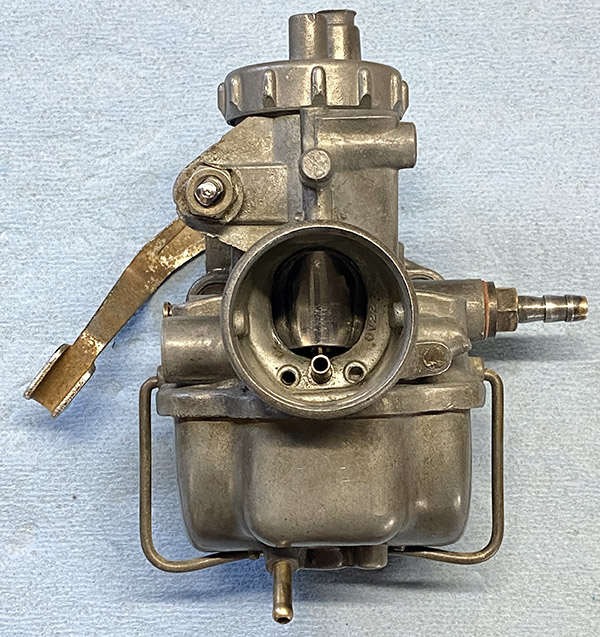
The carb bits looked good. The Dream is a simple machine to work on and tune.63 years old and doesn’t look a day over 40. The single small venturi and two, 150cc pistons promise many miles per gallon.
I also removed the carb for cleaning. At first glance it seemed not too bad and the second glance confirms it. Everything was in good shape inside so I reused all the bits.
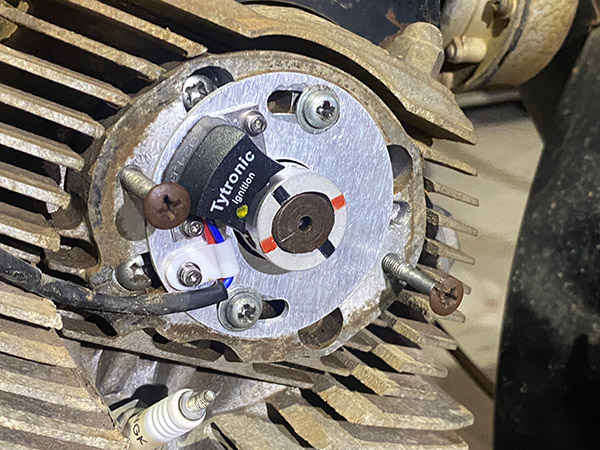
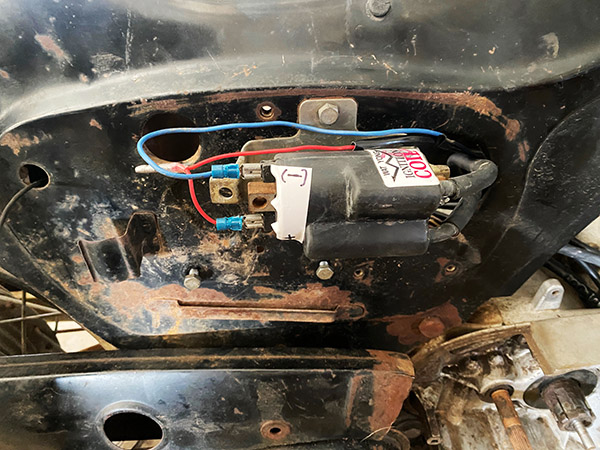
The Tytronic system is easy to connect once you have a diagram. I don’t like the single Allen head set-screw holding on the magnetic trigger.
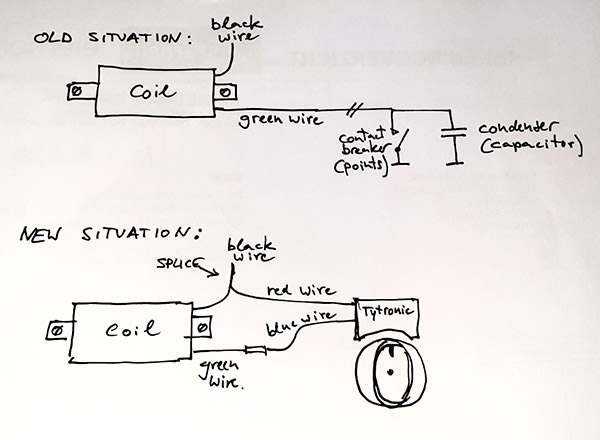
The Dream came with a Tytronic electronic ignition system. Whoever wired it connected the ground side of the coil in series with the condenser then to the ignition module. I don’t see how that can work. Condensers are used with points to help with arcing when the points break so why would an electronic ignition use one?
Thank you to the internet hero who took the time to draw a diagram. Something Tytronic should have done instead of their lame, verbal-to-text description.The simplified coil/ ignition wiring. Blue and red go to Tytronic module. Battery positive to red, battery negative to frame.
Clear information on the Tytronic set up wiring was hard to find. The factory instructions online used wire colors, most of the colors didn’t match what I have. I like a wiring diagram but all I found was “connect the yellow to the blue” type of stuff. Luckily some brave soul posted a diagram of his set up. I rigged the Tytronic as the line drawing showed. Next I used a test light across the coil connections to set the timing. It’s really simple. I hope the Tytronic actually works.
Oh, how I hate tank liner. Anyone using this crap is not professional.
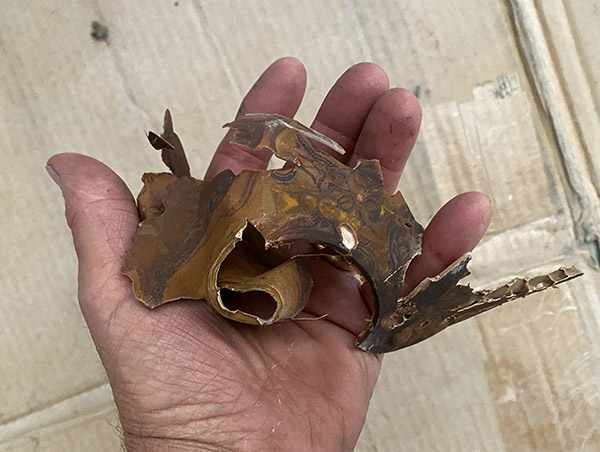
I’m kind of all over the map on the Dream but as issues are resolved you’ll see a more organized approach. The gas tank has that horrible tank-liner crap inside. It’s delaminating so I pulled some big pieces out. Now only 90% of the liner needs to be removed. There are very few occasions when tank liner is required. Don’t do it.
The near-term goal is to see if the engine is good. After that I don’t know where this project is going. I’m not spending any money on the bike or making a decision until I hear the engine run.
I recently watched two movies on the Titan submersible implosion and both were excellent. The first is Titan: The OceanGate Submersible Disaster, which is currently streaming on Netflix. The second is Implosion: The Titanic Sub Disaster, and that one is currently streaming on Max. The two movies offer different takes on how the events leading up to the disaster unfolded. Both are chilling in their depictions of the technical arrogance and unwillingness of the key guy, Stockton Rush, to recognize that Titan was moving toward failure.
I’ve spent a lot of my working days investigating product failures of all sorts, including serving as an expert witness on several cases and teaching engineering ethics in Cal Poly Pomona’s engineering school. Two factors are always present when fatalities occur: Engineering arrogance, and putting other factors ahead of safety.
Engineering arrogance refers to a misguided belief that a failure won’t occur (even though ample indications existed before a fatal event occurs) because we’re omnipotent, we’re smarter than everyone else, we’ve never experienced a failure of this nature before, or…well, you get the idea. On the space shuttle Challenger, NASA had experienced numerous o-ring failures prior to the one that killed the crew, but they ignored them because “we’re NASA and we’ve never lost a man in space” (that is an actual near-verbatim NASA management quote prior to the Challenger accident). Everyone knows the Takata airbag story; those folks experienced explosions during engineering development and product acceptance testing, yet they continued to sell these dangerous devices because they thought they would be okay. Takata airbags actually killed people in service and Takata continued to sell them. It’s surprising how often this feeling is present in the engineers who designed products that kill people unintentionally.
Incidentally, one time when I was giving a deposition the attorney representing a company whose product killed someone hit me with something I wasn’t expecting and he caught me off guard. He asked how I could criticize any one with my background in designing cluster bombs and other things that had, as their primary purpose, exactly that function: To kill people. I was floored and didn’t have a good answer. As sometimes happens, I had the perfect answer a few hours after the deposition had ended. My products, you see, had killing people as their purpose. Your products did not.
The other factor that is always present is putting other things in front of safety. Cost is a big one. Everyone knows about the Pinto and its propensity to burst into flame when rear-ended. Not everyone knows that the Ford Crown Victoria, Ford’s big sedan, had the same problem. The police knew about it, though, and they finally told Ford they wouldn’t buy any more Crown Vics unless Ford addressed the problem. Incredibly, Ford engineered a protective cage for the fuel tank and only sold it on the police automobiles. It was cheaper to keep paying out wrongful death lawsuits with the recipients signing nondisclosure agreements. There are lots of examples of this.
Both factors were present and both resulted in the Titan’s implosion. I’ll get off my safety soapbox now and leave you with a recommendation for watching both Titan: The OceanGate Submersible Disaster and Implosion: The Titanic Sub Disaster. They are both excellent documentaries.
Motorcycles, like cats, tend to find you when you’re not looking for either. I never wanted a Z1, but the 1975 Zed forced its way into my life. And now it’s Honda Dream 305s meowing at the door.
Low miles, if it runs at all it won’t be hurt too bad.
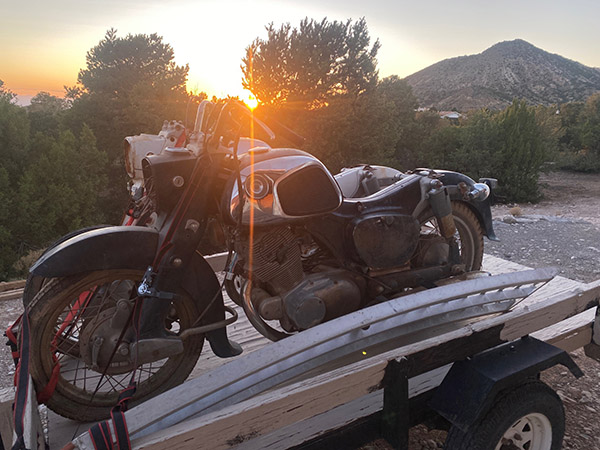
When I was 17 years old I had a 1960-ish Dream 305 built from an assortment of bikes I picked up for little money. History is repeating itself here and two 305 Dreams have occupied the ranch.
The darker it gets the better a Dream looks.
I’m running out of room for motorcycles in the shed. I have no time to mess with these bikes as my nesting has gone into overdrive. But the deal, the deal dammit, was too good to pass up.
De-gunked and pressure washed. It still looks rough.
The Black Dream is a 1962 model and is mostly complete. It looks like the one I had at 17 except mine was red. I guess mine is black now. Of course it needs a thorough going over and every nut, bolt and part needs attention. The engine ran when parked but then they all run right before they quit running.
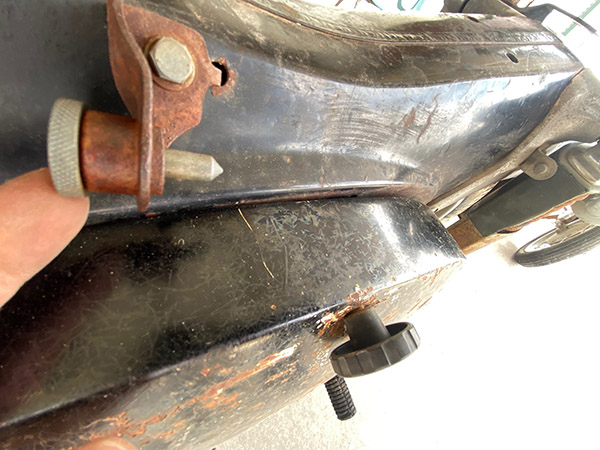
Tire pump holder. The tire pump Is long gone.
The white one has a nicer frame, with no dents or rust, I think it’s ’65-ish/’67-ish. I’d like to use the white frame but I only have a title to the black frame. I wonder if anyone would care?
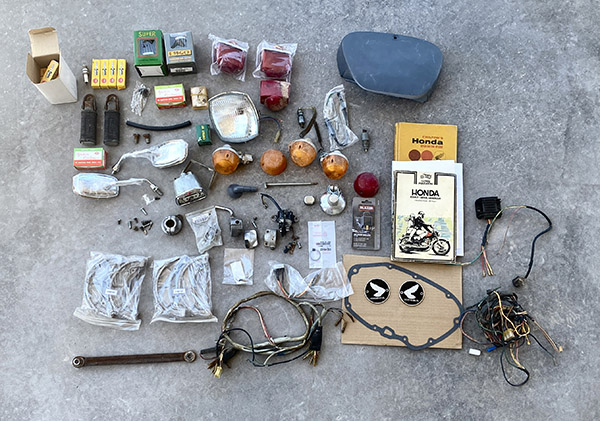
Darren bought lots of parts before he lost ambition. This cuts down on things I would need to buy.
Darren, the seller, was going to fix the black one but lost ambition, wisely in my book. He bought a bunch of bits and pieces and the bike came with 3 boxes of junk, a spare engine (status unknown) an extra gas tank and two seats.
I don’t need this hassle man. Why do I keep doing the same thing expecting different results? CT, wife of the year, knows a good deal and handed me cash, “Go get that pile.”
So far I’m not in very deep. Only $500 that I could have used elsewhere. I’ve inventoried the extra parts, de-gunked and pressure washed the bikes. I burned the pressure hose on the washer’s exhaust so add a new hose to the motorcycle cost.
I’d like to say the bikes cleaned up nicely but I’d be lying. So now I’m wondering why I took on another project when I have 23 unfinished projects. It’s an illness.
I have a few options: CT and I want to start an eBay store to get rid of all our junk. I could part out the whole mess and probably make more than I paid. I could go all in and restore one, complete, Dream, but Dreams aren’t worth much money and I would lose on the deal.
Or I could see just how cheap I can get the Dream safely operating, a challenge, like the Youtubers do. My first impression is tires and a seat cover, along with a headlight trim ring, are the major purchases needed. All the rest can be nursed back to usable-but-crappy level.
Between two engines I should be able to get something that runs and shifts. Black is easy to spray paint using rattle cans. And then what? Then what, man? Would I ride it? Sell it for a loss? The only positive spin is that it would give me something to write about.
Wow, things are hopping here! After a brief hiatus, we’ve got a series of great stories coming from Bobbie Surber and Joe Gresh. Bobbie’s been hopping around down there in Patagonia and Joe’s got a pair of Dreamy Honda resurrections in his shop. Mike Huber’s been busy, too. He’s hopping around Southeast Asia, currently playing mayor in Thailand, and he’s been working an exciting new project that we’ll announce shortly. The ¿Quantos Pistones? series is progressing nicely, and I’m discovering more photos of bikes gone by I didn’t know I had. I’ve got a blog or two coming up on testing bolt shims from good buddy Lance over at TriggerShims. These upcoming blogs are going to be good and it’s sure been fun.
But…
It’s time for me to hold out my tin cup again. With DOGE, the Big Beautiful Bill, and all that, our income has gone from bad to worse (pardon my brief foray into politics). You know that your subscription is free. We get all our money from your donations and Google ads. So do us a solid…click on those popup ads, and if you can, hit the Donate button below. We’d sure appreciate it.
Thanks, folks. Keep the shiny side up, and keep your powder dry.
Everyone has their kink. It may be guns, it may be watches, it may be old two-stroke motorcycles. I have a sweet spot for tire inflators. I must have 10 of the things, some are big and run off 240volt AC, some are so tiny they would fit inside a pack of cigarettes (if you smoked large cigarettes). Each inflator serves a specific need for me called “feeding my ego.”
13 minutes from flat to driving. That’s fast for these type of pumps.
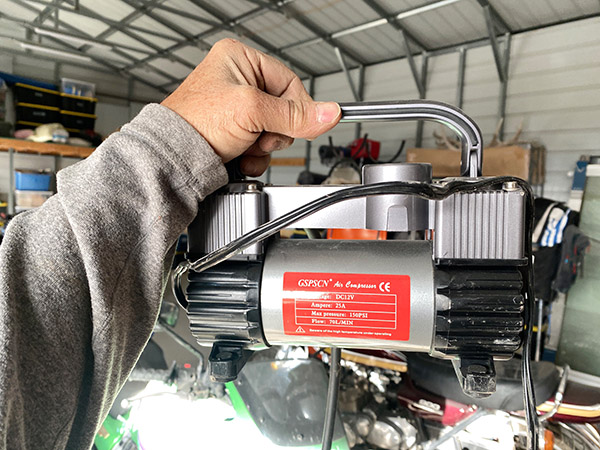
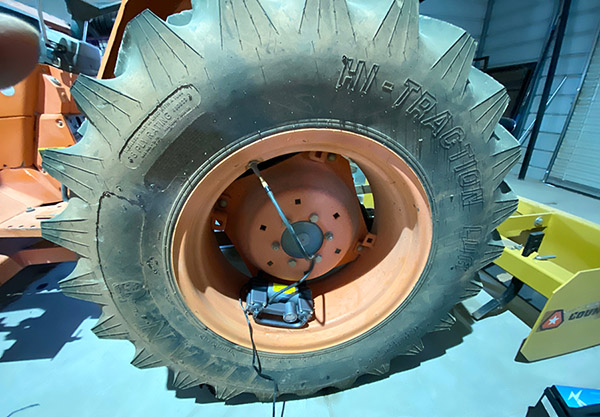
My latest inflator, the GSPSCN, is a real beast. Sporting dual heads (I wonder if one might be a dummy head?) this little unit moves some air. Connected to a car battery, the GSPSCN can inflate a giant tractor tire from zero to 20 psi in 13 minutes 6 seconds. And that’s not the impressive part. The impressive part is the pump stays cool over that long stretch. All, and I mean all, of my other 12-volt inflators get hot as hell filling up a standard car tire.
a nice, tidy little unit that moves lots of air.
Until the GSPSCN I figured that heating up was the nature of small compressors. I haven’t dismantled the pump because I don’t want to break anything but I suspect there are diaphragms instead of pistons used in the two, shallow-finned cylinders.
I’ve filled this tire dozens of times and the pump has not even gotten warm. The hose is a different matter.
I’ve used the GSPSCN a bunch because the tractor has a not-so-slow leak in the left rear tire. Overnight it leaks down to zero, only the stiffness of the sidewall keeps the tractor sitting somewhat level.
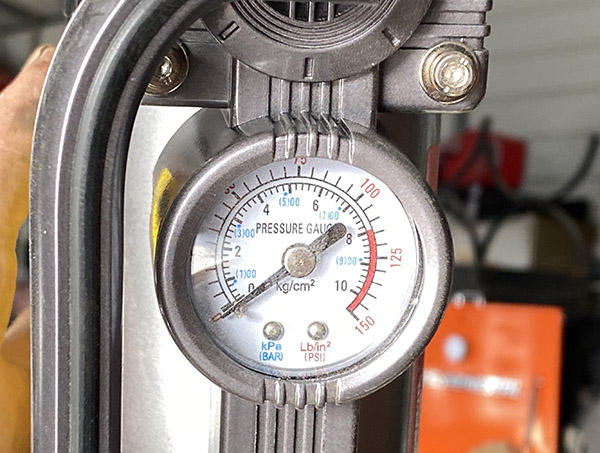
A more useless gauge I’ve never seen. I’ll index it one day when I run out of things to do.
Of course this wouldn’t be an ExNotes review if we didn’t find something to complain about. The biggest issue is the pressure gauge. The thing is way, way off: like 9-10 psi. It’s useless as delivered. That means you have to have a regular tire gauge to know the tire pressure. It’s a small thing but annoying. Now I need two tools to fill a tire. One day I’ll sit down and mark the dial with a few numbers: 20-30-40-50 psi. Why didn’t the manufacturer do that for me?
The power cord could be 5-6 feet longer. I can reach from the battery to all the tires on a Jeep but Jeeps are short. If you have a car, it would be OK. If you drive one of those big-ass, compensation trucks you’ll come up short yet again. The pump came with a coiled hose extension, but I would rather have a longer cord. Again, the extension is another thing to carry.
The air chuck is a screw type, like all these small compressors I would prefer a 90-degree quick connect style. On a motorcycle with two big disc brakes, it’s hard to get your hand in there to screw on the chuck.
Despite the above listed flaws. the GSP has become the pump I grab first for cars, trucks and tractors. The thing runs so cool I suspect it will last a while, unlike the hot ones that fail filling one tractor tire.
I give the GSP a 4-star rating. If the gauge worked, I’d bump it to 5-stars. Go to Amazon and search the brand name if you’d like one.
Having spent over four months in Thailand I was well overdue to experience a live Muy Thai fight event in a local stadium. Last Saturday with no real plans I decided I would do just that. Rather than purchasing online I went to the local stadium, and with the help of a friend, I chatted up the stadium owner (who loved Americans). Within a few minutes we had two ringside tickets for under half the price. This was probably the only time where I received an actual “American Discount.” In all my past travels the “American Discount” resulted in a 20% price increase. Either way, I was excited to witness one of these events live.
On the way to the stadium that evening my plan was to get dinner somewhere along the way. I noticed a nice Irish Pub. I’m not one to pass up an Irish Pub, especially in Thailand where I was well overdue for a change in cuisine. Corned beef, potatoes, and a couple Chang beers was a perfect change indeed. The pub would also be a great place to hang out, eat, and talk with some locals who were also attending the event. To add even more perfection to this scene they had Moto GP on the TVs in the bar. It was the perfect environment and just a short walk to the stadium for the fights after.
As we entered the stadium and sat in our seats I began chatting up the people to my left. They were from Australia, a country I was very fond of and had traveled extensively. It didn’t take long before we were engrossed in conversations of travel, Muy Thai (which I really knew nothing about), motorcycles, and pretty much everything under the sun. I made a comment to one of the Aussies wearing a NY Yankees hat (I hate the Yankees, obviously). I gave him a hard time about the hat as we continued to joke back and forth. It turned out the Aussie with the Yankee hat was fighting that evening so it’s probably good I didn’t go too far with the berating of the stupid Yankees.
As the fights were about to begin everyone stood for the Thailand National Anthem. Instinctively I faced towards the Flag of Thailand with my hands clasped in front of me in a respectful manner. It was at this moment I noticed everyone was facing towards me and not the Flag. I quickly turned 90 degrees to face the same way as the others when I noticed why this was. In Thailand you face the giant portrait of the King during the Anthem and not the Flag. The Aussies knew this and had a good laugh as they made the same mistake during their first attendance of one of these events.
The fights were a blast to watch. The fighters were very respectful of each other and the customs of their country. We watched maybe 15 fights or so throughout the evening. Sadly, our new friend didn’t win his match, but it was cool to hear the word “Australia” mentioned over the loudspeaker amongst all the other words in Thai which I couldn’t understand. It was a pretty solid Saturday evening and I was able to check seeing a Muy Thai fight off my Thailand to do list.
Case is a old-line American knife manufacturing company with roots that reach all the way back to 1889. I knew them as a pocketknife manufacturing company, and without really knowing anything about them, one of the first knives I purchased when my interest in pocketknives was rekindled was a Case Stockman (you can read about that knife here). I mentioned to good buddy and edged weapons rabbi Paul that I had purchased a Case, and he gave the company his seal of approval: “They’re an old line knife company, they’re made in America, and they’re good,” he told me. I didn’t know any of that when I purchased the Stockman, but it felt good to know Paul thought I had made a good decision.
The Case at hand…sorry, couldn’t resist that.
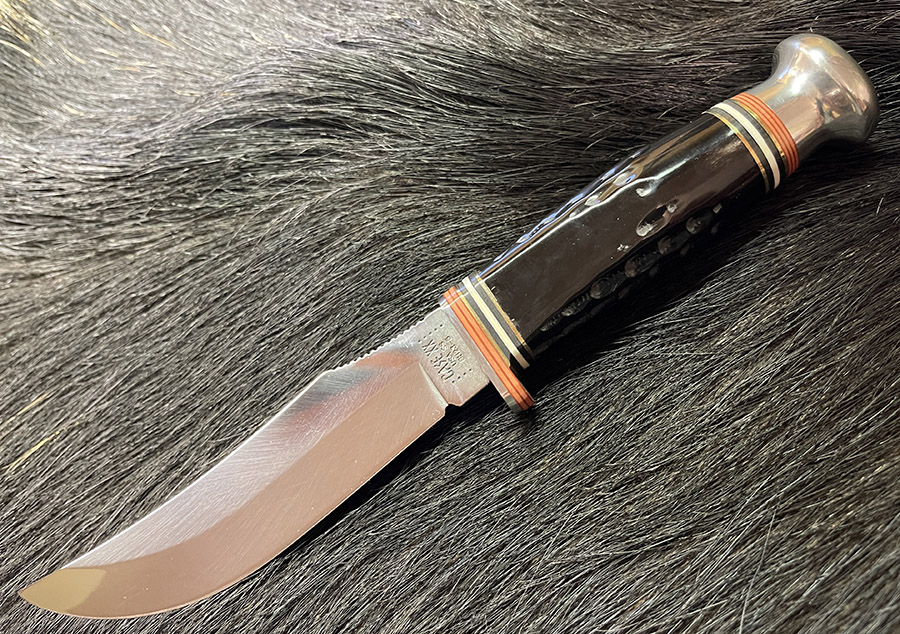
Not long ago I received an email from the Chicago Knife Company (an online retailer) offering a Case Hunter. The knife had my attention immediately for several reasons: It was a fixed blade Bowie/hunting knife (I didn’t know Case made such an item), it had a jigged buffalo horn grip, it was mirror finished, and the price was right. Buy now, a credit card number, free shipping, no sales tax, and it was on its way to me.
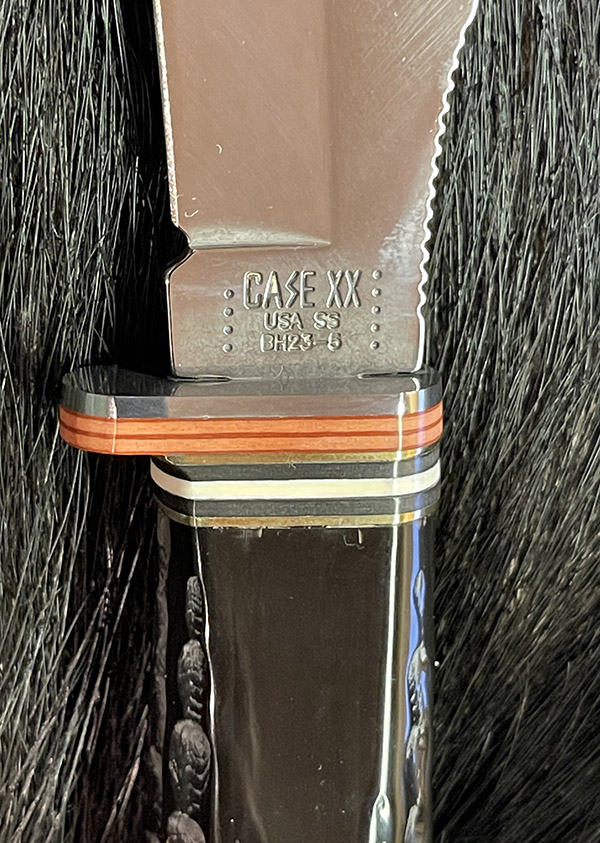
Made in America. Case has an American manufacturing history that goes back more than a century.
The Hunter arrived a few days ago, and it’s beautiful. I’m glad I ordered this one. For me, it’s a collectible. I won’t be wearing it in the field and I have no intentions of skinning or field dressing anything with it (as I watched our guide Tom do on a recent pig hunt in Arizona). I just enjoy looking at it.
To me, the knife feels a little small and a little bit light, although I’m not sure why it does. It has an overall length of 10 inches, a blade length of 5 inches, and a handle length of 4 inches.
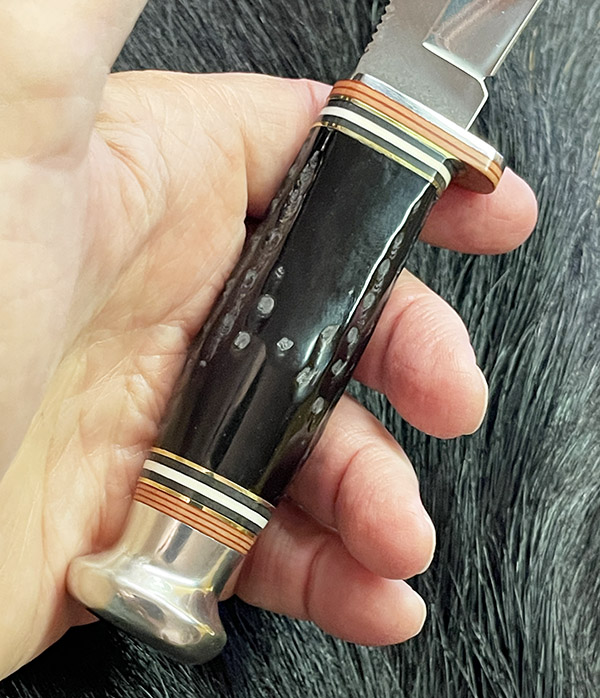
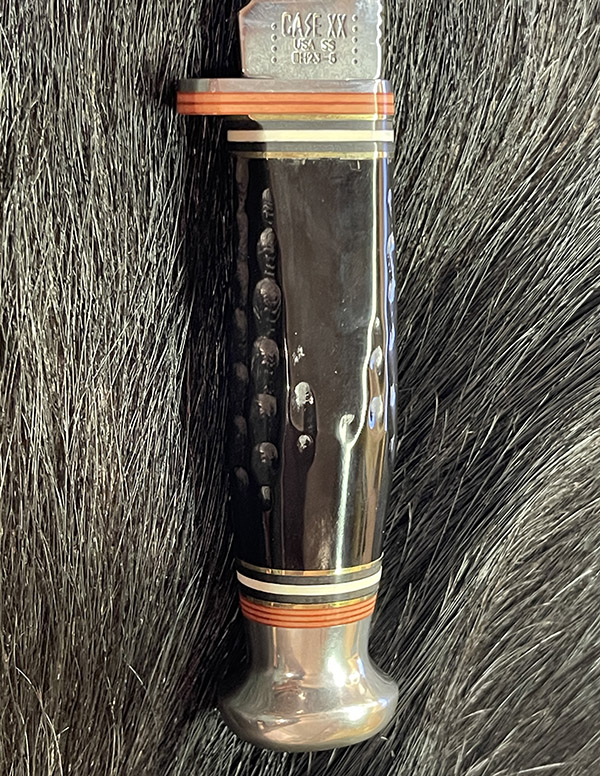
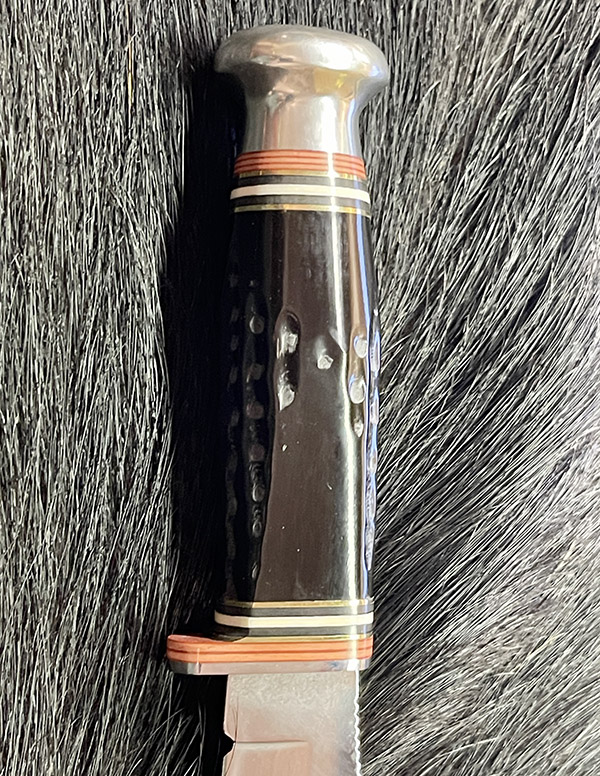
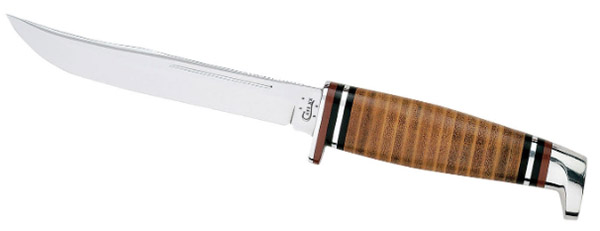
The polished buffalo horn grip from the left side.A view of the buffalo horn grip and spacers from the right side.As a potentially more usable grip, stacked leather is available.
The buffalo horn grip is highly polished. Maybe too much so, as it feels a bit slippery. That’s okay, I think, for something I intend to admire a lot and use little. If I was buying this knife as a tool (and not as a bit of artwork), Case also offers it with a stacked leather handle. That might be more practical.
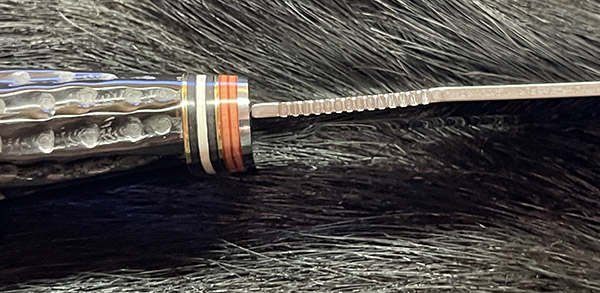
Serrations on top of the bade. The 5-inch blade is relatively narrow compared to some of my other knives.
The blade has a serrated edge along the top. Maybe that’s intended to be used for sawing. Again, it doesn’t matter to me. It’s decorative as far as I’m concerned. The pommel is cool, too. It’s polished aluminum and it looks great along with the knife’s red, yellow, white, black, and brass spacers.
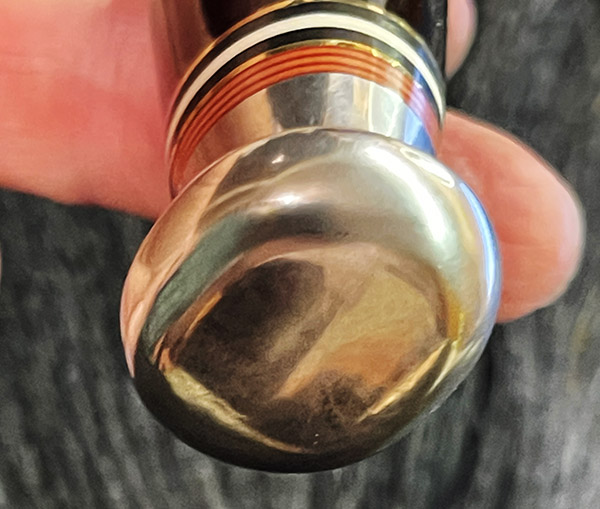
The Case Hunter’s polished aluminum pommel.
On the Chicago Knife Works site, the blade material is identified as H-2. Here’s what Google says about that steel:
H-2 steel has extreme corrosion resistance, especially in saltwater environments. Its composition uses nitrogen instead of carbon. It is described as tough and capable of holding an impressive edge. The strengthening process for H-2 steel involves intense rolling and cold-working, not traditional hardening and tempering. H-2 is an evolution of H-1 steel, while retaining its desirable properties and being easier to manufacture. It can attain a Rockwell hardness in the high 60s while remaining resilient.In summary, H-2 steel is used in some knives and offers exceptional corrosion resistance, toughness, and good edge retention.
The Case Hunter is not listed on the Case Knives website, but it is listed on the Chicago Knife Works site. I called Case to confirm it is still available, and it is. This is not a Chinese or Pakistani knife; it’s made in Bradford, Pennsylvania. A black leather sheath is included with the buffalo horn Case Hunter.
We are living in interesting times. I like to read the news every morning with my first cup of coffee. This assessment and presentation by General Caine is worth watching in its entirety.
The presentation struck a lot of notes for me. I think you’ll enjoy it. I sure did.
Gordon knives? You may think you’ve never heard of them, but maybe you’ve seen them without realizing what you were seeing. Gordon, you see, is the house brand for Harbor Freight knives. You know Harbor Freight: It’s where the folks who badmouth Chinese motorcycles buy their tools.
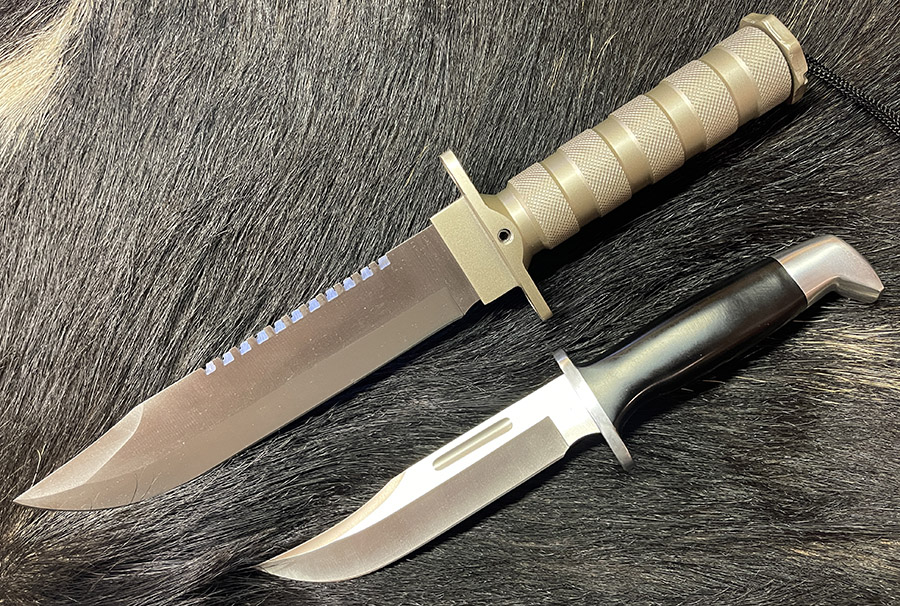
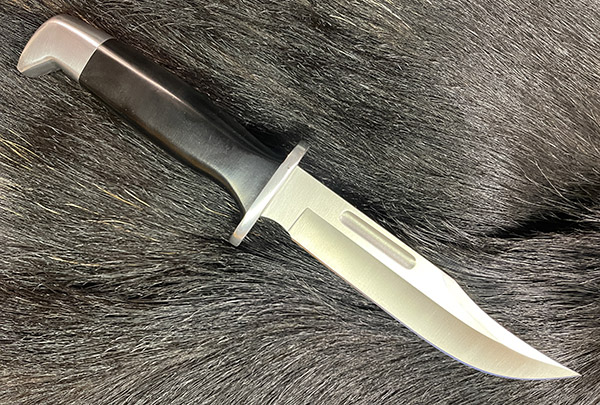
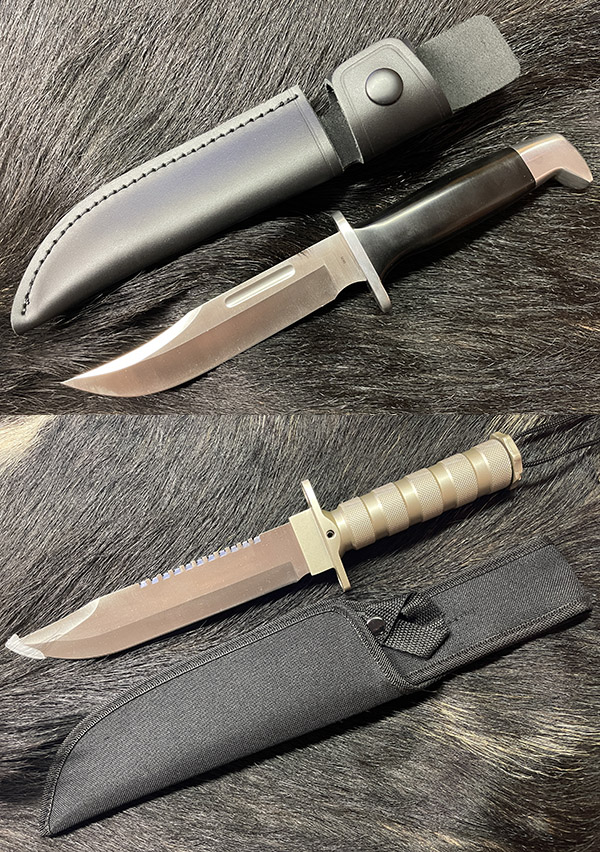
The Gordon Bowie. It’s a nice knife.
I don’t shop much at Harbor Freight these days, but it’s not because I think their stuff isn’t any good. I’m an old guy and I have all the tools I’ll ever need. But I still get the Harbor Freight ads, and one of them caught my eye recently. It was for what I initially thought was a Buck 119 hunting knife, but it wasn’t a Buck: It was a Gordon. They call it the Gordon Bowie/Hunting knife. So I rolled on over to my local Harbor Freight store to check it out.
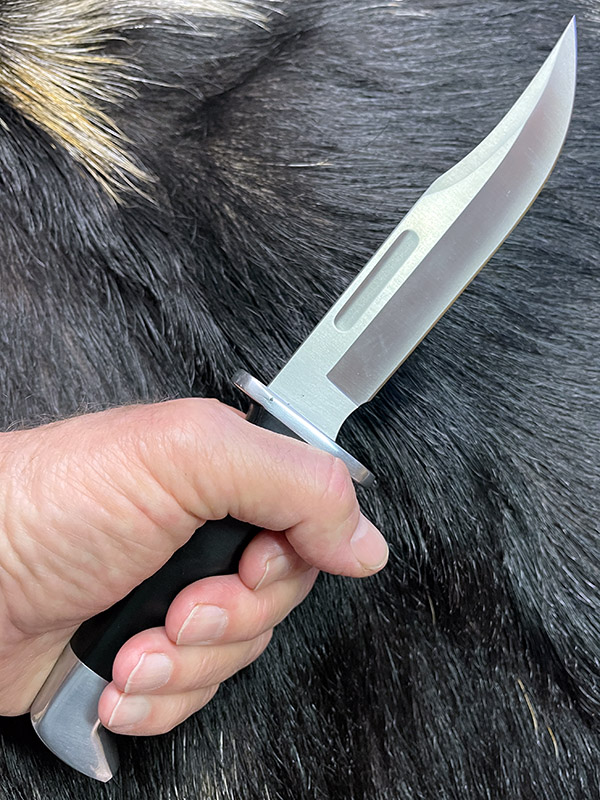
The Gordon has some heft to it. It seems to fit my hand perfectly.The Gordon Bowie has a 6-inch blade.
You can see the Gordon Bowie before you buy it because it’s packaged in a clear plastic bubble wrap container. Getting the knife out of that package was a bit of a challenge.
The Harbor Freight website lists the blade material as 7Cr17MoV stainless steel. Even though I had a course or two in metallurgy in my formative years, I wasn’t sure what that meant, so I Googled it:
7Cr17MoV is a Chinese stainless steel, often used in budget-friendly survival and kitchen knives, known for its good balance of hardness, corrosion resistance, and toughness. It’s essentially a modified version of 440A steel, with added vanadium to enhance strength and wear resistance. While it may not offer the best edge retention compared to high-end steels, it’s relatively easy to sharpen and is known for its durability under hard use.
A Buck 119 goes for about a $75. The Gordon? It’s a whopping $29.99. I had to take a look, and when I did, I liked what I saw. So I picked one up. At $30, I can take the risk of it not being perfect.
Then I noticed another Gordon knife hanging on the Harbor Freight display next to the Gordon Bowie. It was a monster that caught my attention (it was hard to miss, actually).
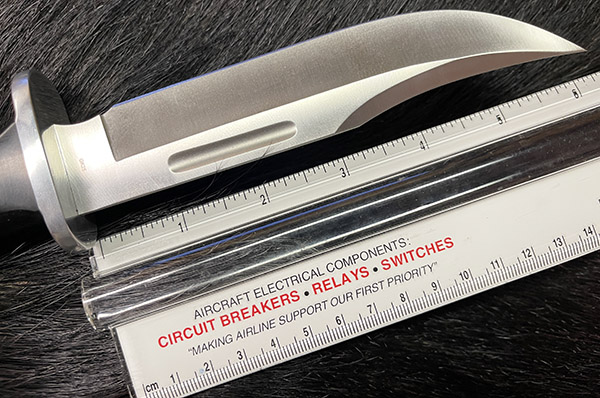
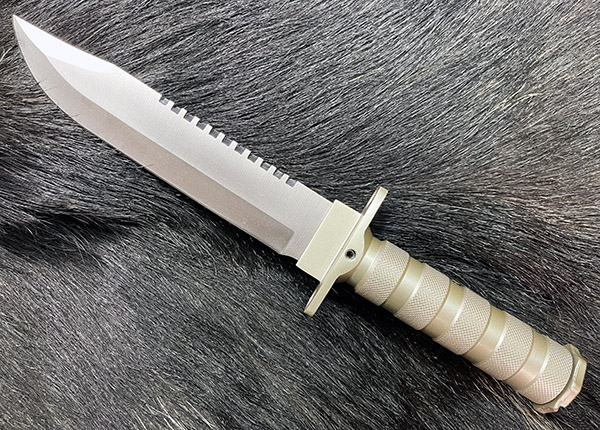
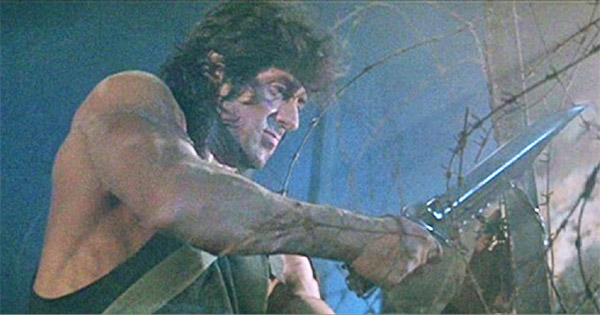
Visions of Sylvester Stallone as Rambo swam through my mind when I saw this Gordon. Check out the sawing serrations on top of the blade.
Harbor Freight calls the knife you see above their Survival/Hunting knife. In addition to its size, the other thing that grabbed my attention was the price. It was either $9.99 or $6.99. I couldn’t tell which, and I’ll return to that part of the story in a minute.
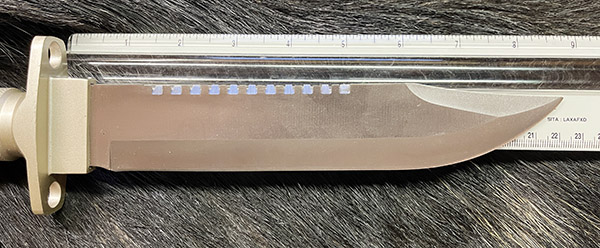
The Gordon Hunting/Survival knife has an 8-inch blade. It’s an impressive knife. I don’t know what impressed me more: The knife’s size, or its low price.
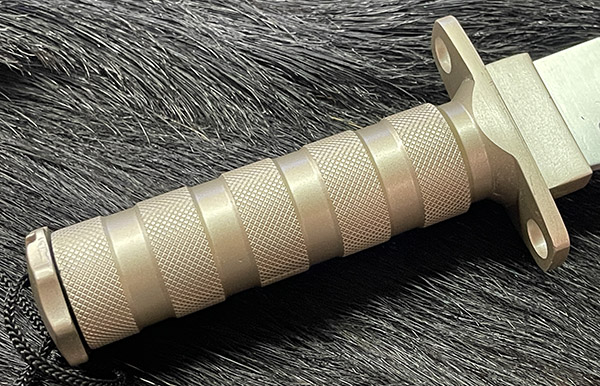
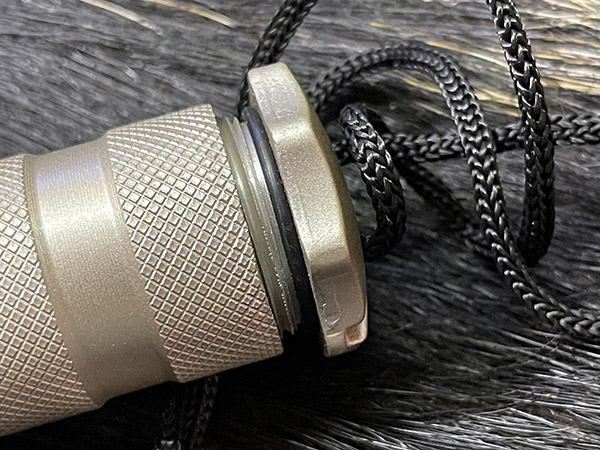
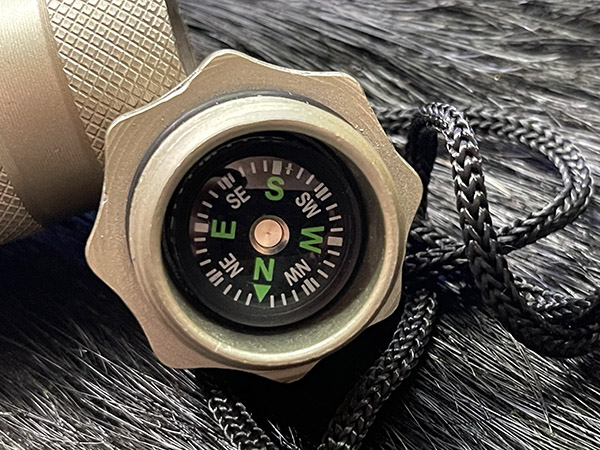
The gigondo Gordon is called their Hunting/Survival knife. It’s a monster with an 8-inch blade. The knife has a hollow handle with a cap that unscrews, and inside the cap, there’s a compass. Cool beans. A compass.
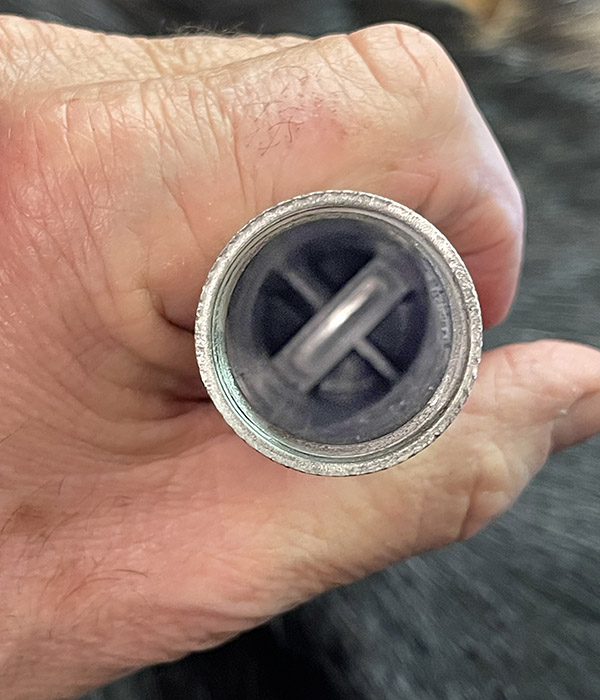
The Gordon Hunting/Survival knife handle. The end cap unscrews and you can store stuff inside the handle. Because the handle is hollow and made of aluminum, the knife feels much lighter than it looks.
When I later read the online reviews, one guy said the compass didn’t work. But you know those online reviews. Some folks would complain if you hung them with a new rope. Mostly these reviews consist of what emanates from the southbound end of a northbound bull. My compass works just fine.
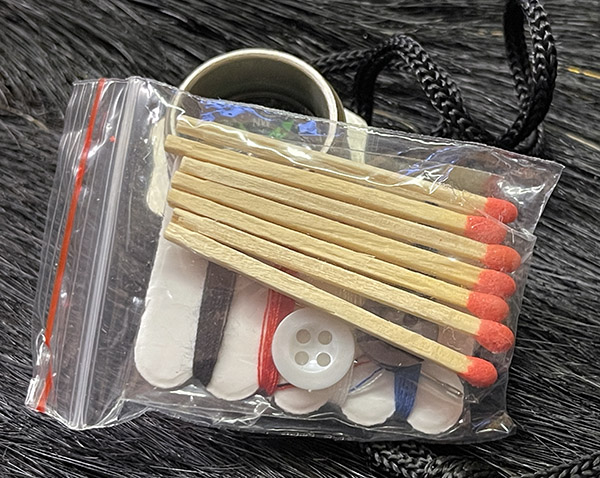
Gordon also gives you some thread, a few matches, and oddly enough, a button or two. It all fits in the handle and it’s focused on helping you survive in dangerous places. You know, like LA. In case you need to hack your way through some bamboo or you lose a button.
The handle’s cap is sealed with an o-ring.A compass inside the handle’s end cap.There’s room inside the handle to store the survival accessories that come with the knife, and maybe some other stuff.This little package of survival stuff came with the Grodon knife.
The Gordon survival knife is cool. It makes me feel like Rambo. Maybe that’s what it is supposed to do. The upper part of the blade has a sawtooth pattern milled into it. The blade is sharp. Is the metal any good? Hell, I don’t know, and I probably won’t find out. I’m not planning any expeditions into the Amazon basin, and even if I were, I probably couldn’t get on the airplane with this thing. Will it hold an edge? I don’t know that either. But at $9.99, if I can’t sharpen the thing I’ll just buy another.
The blade material is specified on the Harbor Freight website simply as “stainless steel.” A Reddit post by one of the many folks on the internet who post such things states that it is 8CR13MOV steel (I don’t know if that’s accurate, but it’s the only blade material reference I found). Here’s what Professor Google has to say:
8Cr13MoV steel is a popular Chinese stainless steel known for its good balance of performance and affordability, making it a common choice for budget-friendly knives. It offers decent edge retention, corrosion resistance, and ease of sharpening.
Both knives come with sheaths, not that I’ll ever use either. But it’s nice to know they’re there just in case I ever get the urge to make a Rambo movie.
The Gordon Bowie and Survival/Hunting knives both include sheaths in their incredibly low prices.
You know, it’s funny. The young lady cashier at Harbor Freight asked if I knew the price of the knives. I told her the 6-inch Bowie Buck 119 wannabe was $29.99, and the big Gordon survival knife was either $9.99 or $6.99. I explained that I wasn’t sure because there were two price tags on the larger knife. She explained that if I was a Harbor Freight member, I could buy the knife for the lower $6.99 price, but as a plain old Harbor Freight nonmember, I’d have to pay the higher $9.99 price. She went on to explain that the annual Harbor Freight membership fee is $29.95. I told her I didn’t want the membership because, like Woody Allen, I wouldn’t be a member of any organization that would have me as a member (I thought I was really on top of my game with that one, but my borscht belt shtick went right over her head). She then told me if I told her my email address, I could select one of four different prizes. As a guy who still gets excited opening a box of Cracker Jacks, her offer appealed to me. (I was really having a good day. I love going into any store that sells tools, I was getting two cool knives, and now I had a offer for another free prize.) I gave that young lady my email and she showed me a menu. I selected the convertible screwdriver. And finally, when she rang up the knives, she looked at the Buck 119 wannabe. “Why is this one so expensive?” she asked, pondering its $29.99 price against the much larger $9.99 survival knife.
Me? Not hardly. But I have the blade if they ever offer the role to me.
So there you have it. Are these knives any good? I think they are, but hey, at these prices, who cares?