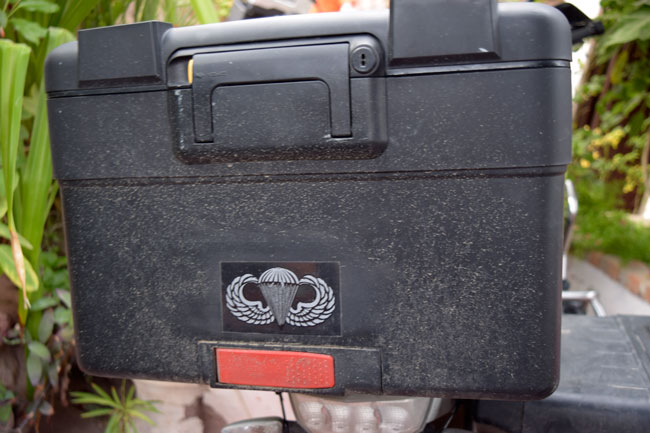
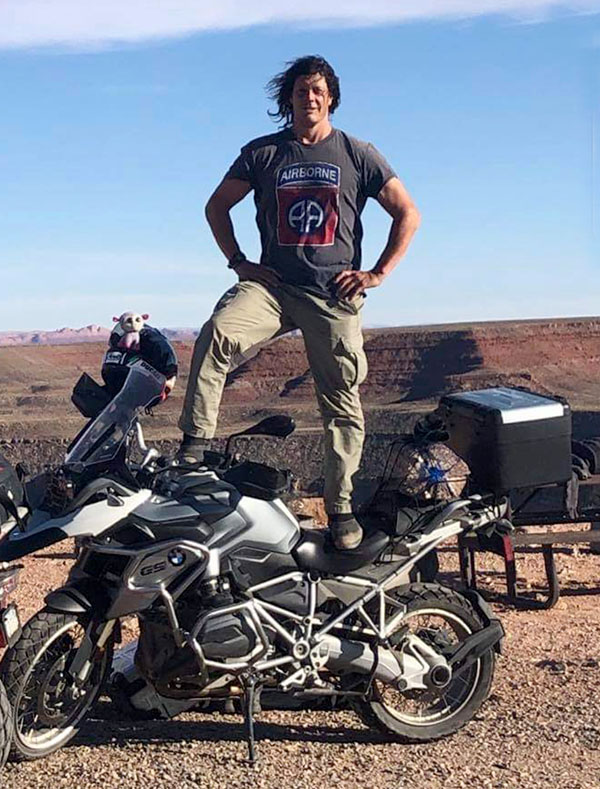
It was one of those crazy motorcycle adventure moments when a chance encounter leads to a lasting friendship. I was leading a group of maybe 10 guys on CSC RX3 motorcycles in Baja and we stopped to buy bottled gas from the capitalists along the Transpeninsular Highway in Cataviña. It was a crowded scene with two or three Bajaenos pouring gas from plastic water jugs into our motorcycles with bikes and bodies tightly crowded around. That’s when I noticed a tailpack on one of the bikes that looked different from the rest of our RX3s, and suddenly the difference hit me: It was bigger than the others and it had jump wings on the back.
Jump wings? That’s odd, I thought. I didn’t think any of the guys I was riding with was a fellow former paratrooper. That’s when I met Mike Huber. He hadn’t been riding with us; he just happened to get mixed into our group at the Catavina fuel stop.
Mike is a cool guy with a cool lifestyle. Most recently, that included a moto trip across Vietnam with his girlfriend, Bobbie. Mike published a story in ADVMoto, a magazine that has previouly published work by yours truly and Joe Gresh. Mike’s Vietnam adventure is here. I enjoyed reading it and I think you will, too.
One of these days, I keep thinking to myself. Vietnam must be one hell of a motorcycle destination. Good buddies Buffalo and his cousin Tim also rode Vietnam, and you can read that story here. It’s weird…I met both of those guys on a CSC Baja ride, too!
Most of us have seen the 1977 movie, Close Encounters of the Third Kind. It’s what we think of when we see Devils Tower (which I’ll get to in just a bit). Before I do, consider this question: Are there close encounters of the first, second, fourth, and fifth kind? The short answer is: Yes.
The concept of classifying suspected alien encounters came from a guy named Allen Hynek. Hynek defined the first three categories, and then two more were added. Here at ExhaustNotes, we try to formulate the questions you might have before you even know you have them, so we did. Here’s the answer to what has been keeping you up at night.
Close Encounters of the First Kind: These are viewings of unidentified flying objects less than 500 feet away. They are relatively rare, like seeing a GS 1200 actually in the dirt.
Close Encounters of the Second Kind: These involve unidentified flying objects with some sort of associated physical effect, like interference with your vehicle’s ignition or radio, animals reacting to a sensed alien presence, or an alien craft leaving impressions on the ground. They are things for which there simply is no earthly explanation. I think $1500 freight and setup charges on new motorcycles fall into this category.
Close Encounters of the Third Kind: This is the one we all know about. It’s when you climb to the top of Devil’s Tower for an alien rock concert and laser show. Seriously, though, the people who write these descriptions say a close encounter of the third kind involves things like seeing a living being inside an unidentified flying object. In the motorcycling world, I guess it would be like waving at a Starbuck’s-bound GS rider and having him return the wave.
Close Encounters of the Fourth Kind: This is when the aliens abduct you. I imagine it would be a lot like a free weekend at a posh resort, but you have to listen to the time-share pitch.
Close Encounters of the Fifth Kind: These involve direct communications between humans and aliens. These actually happen to me a lot, and they usually start with unsolicited cell phone calls for solar power, paying off student loans, extending car warranties, or contributing to a Hillary Clinton campaign. These people have to be from outer space. No Earthling would ever expect me to go for any of the above.
So there you have it. On to the topic of this blog, and that’s Devils Tower, Wyoming. It’s awesome, and if you haven’t made the trek it needs to be on your list.
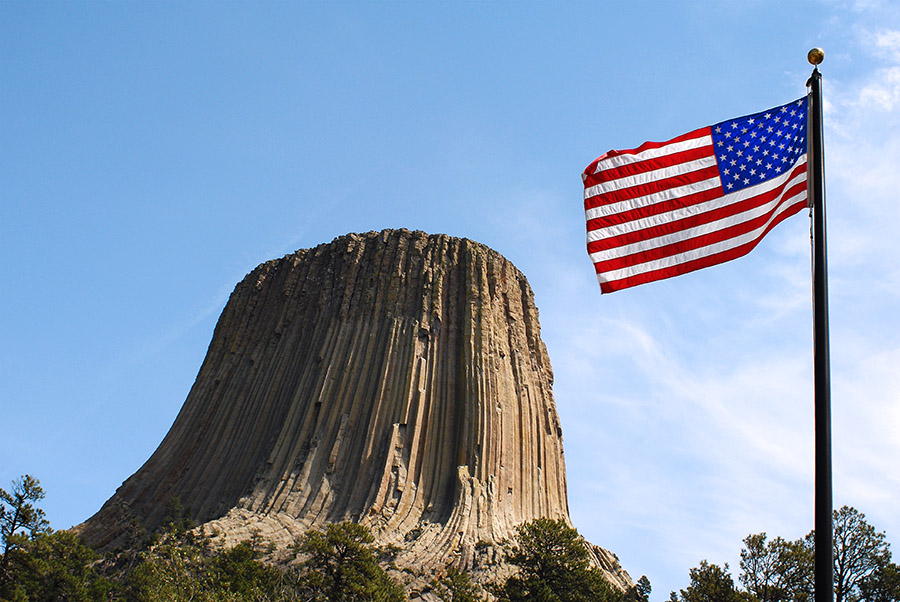
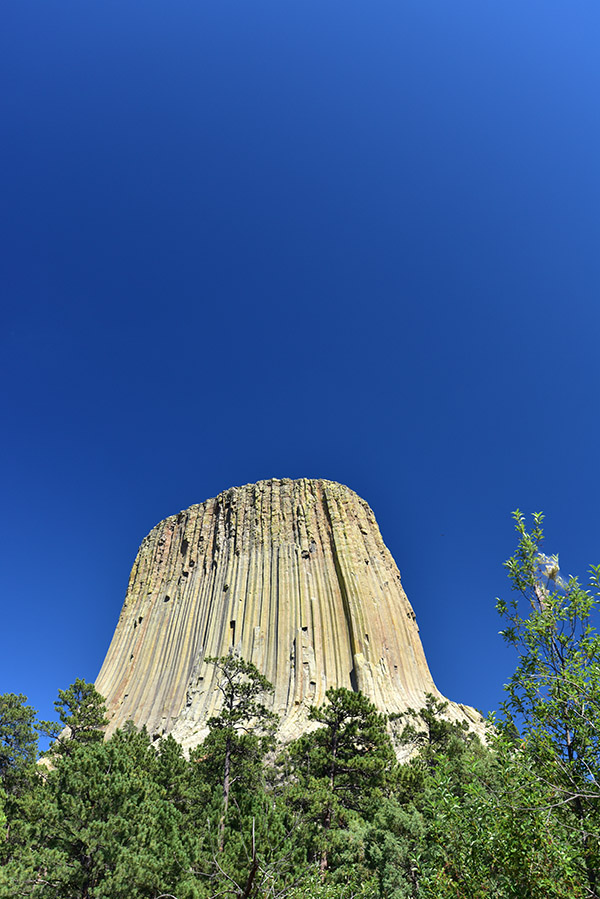
I first visited Devils Tower when we toured South Dakota’s Black Hills and Mount Rushmore in nearby South Dakota. Devils Tower was a short 90 miles to the west, I’d seen the movie, and I had to see the place in person. It was worth the trip. Instantly recognizable, the dark tower climbs 867 feet above its surroundings. Eerie is not too strong an adjective. The thing just looks other-worldly, and attributing the divine, the supernatural, or an extraterrestrial vibe to Devils Tower is a natural reaction. No fewer than six Native American peoples, Steven Spielberg, and U.S. President Theodore Roosevelt have done exactly that. I get it, and when you see Devils Tower in person, you will, too.
I also visited Devils Tower when we rode the RX3s through western America with a crew from China and Colombia (that’s what the video above is from). It’s in a good part of the country…Mt. Rushmore, the Black Hills, the Badlands, and more are in this area and the riding is awesome. If you ever do Sturgis, Devils Tower needs to be one of your stops, but it’s best to see this part of the world when the Sturgis Rally is not underway (there is such a thing as too many motorcycles, and the tattoos, open pipes, and body odor that goes with Sturgis gets old quickly).
One of the things that makes Devils Tower so dramatic is its distinctiveness; it just doesn’t look like it should be there. Even the experts can’t agree on how it came to be. The rock docs agree that it was formed by magma (molten rock) forcing itself up between other rocks; what they argue about is how this occurred. One camp holds that the formation was pushed upward by molten rock below, another that Devils Tower once was a larger structure worn down by erosion, and yet another feels the tower is the throat of an ancient volcano. To get geologic for a moment, it is a laccolithic butte (a wonderful term that could be applied to a few people I know) comprised of phonolite porphyry (dark-colored rock). Devils Tower is comprised of sharply-defined trapezoidal columns with four, five and sometimes seven sides. They look like they were machined, and in a sense, I guess they were.
The Lakota, Cheyenne, Crow, Arapaho, Shoshone and Kiowa Native Americans all treat Devils Tower and its surrounding regions as sacred ground. Theodore Roosevelt designated it the first U.S. national monument in 1906. Native American names for the monolith include mato tipila (bear lodge), the bear’s tipi, the bear’s home, the tree rock, and the great gray horn. An 1875 U.S. Army expedition misinterpreted one of the Native American names as Bad Gods Tower, and that became Devils Tower.
The Tower is visible from great distances — there’s no missing it or mistaking it for anything else — and the ride in provides varying perspectives. Once inside the National Park, you can walk to the base, you can take a hike around Devils Tower, or you can climb to the top. I’ve been there several times, and I think it’s one of our great destinations.
Gresh and I had a lot of fun with the Cult of the Zong, and we joked about the lines we’d be able to use after our 6,000-mile ride in the Ancient Kingdom. You know, little things we’d slip into a conversation like “as I was riding across the Gobi Desert” and “when we rode down off the Tibetan plateau” and others. We knew it would gave us the street cred we needed to converse with hardcore riders making the trek to Starbuck’s.
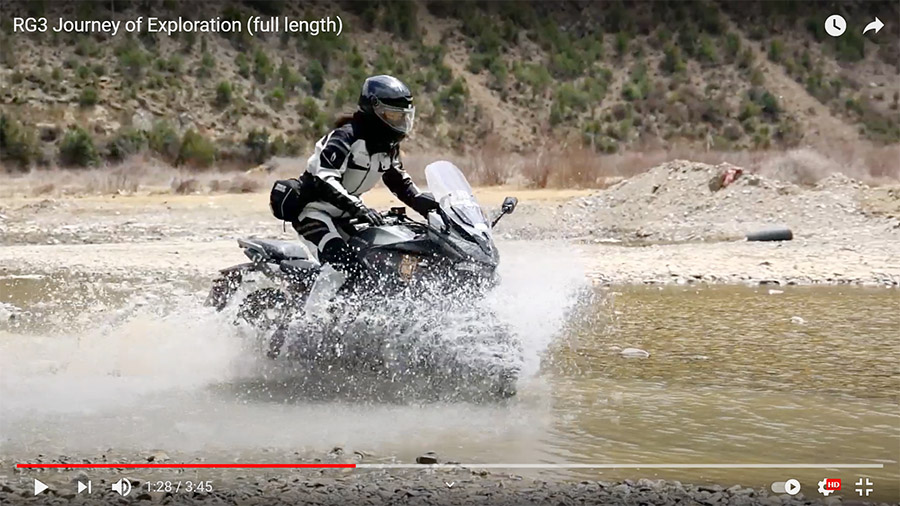
Zongshen puts together first class videos, and I always watch their new ones as they are released. One of my Zongshen favorites is the one they did on our China ride:
And another I enjoy is Joe Gresh’s video on that same ride:
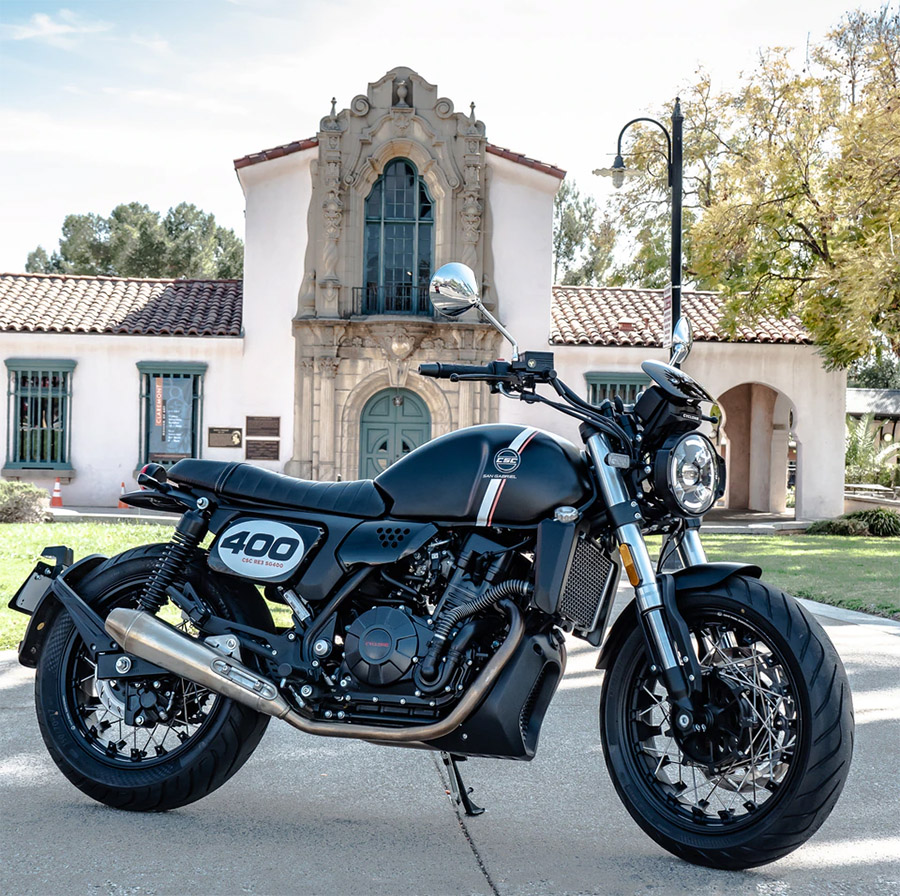
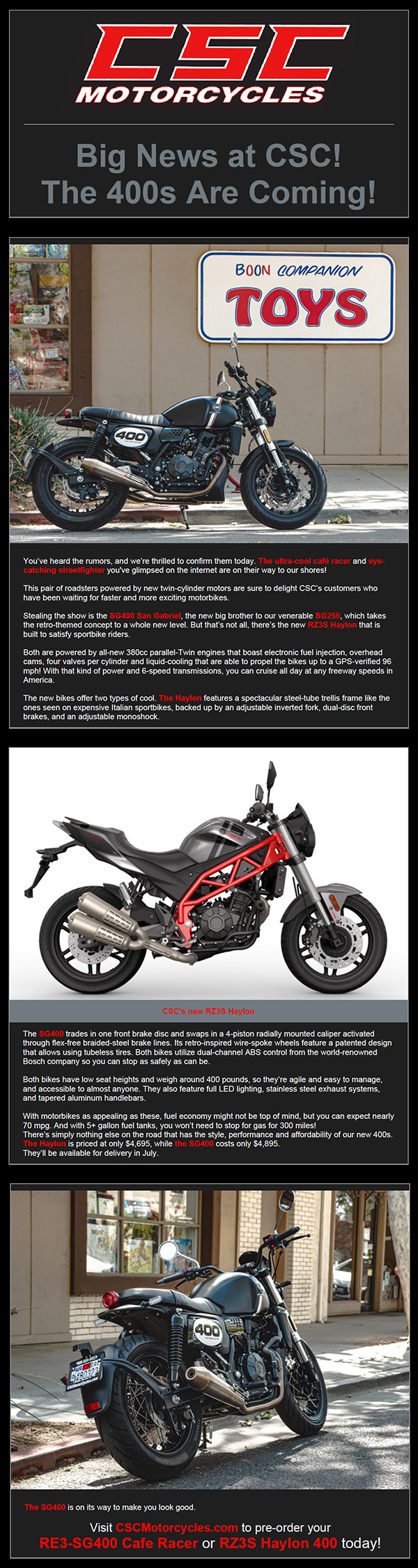
Boy oh boy, the 400cc market segment is hot. It was the RX4, then we learned the Janus 450cc Halcyon is coming, and now, CSC just announced two stunning 400cc twins! Check this out!
I’ve seen both bikes in person at CSC, and I can tell you the bikes look even better up close and personal than they do in the photos. CSC has quite an extensive line of motorcycles, electric motorcycles, and ebikes, and now these new 400cc twins will broaden their appeal even further. Check them out at the CSC Motorcycles website!
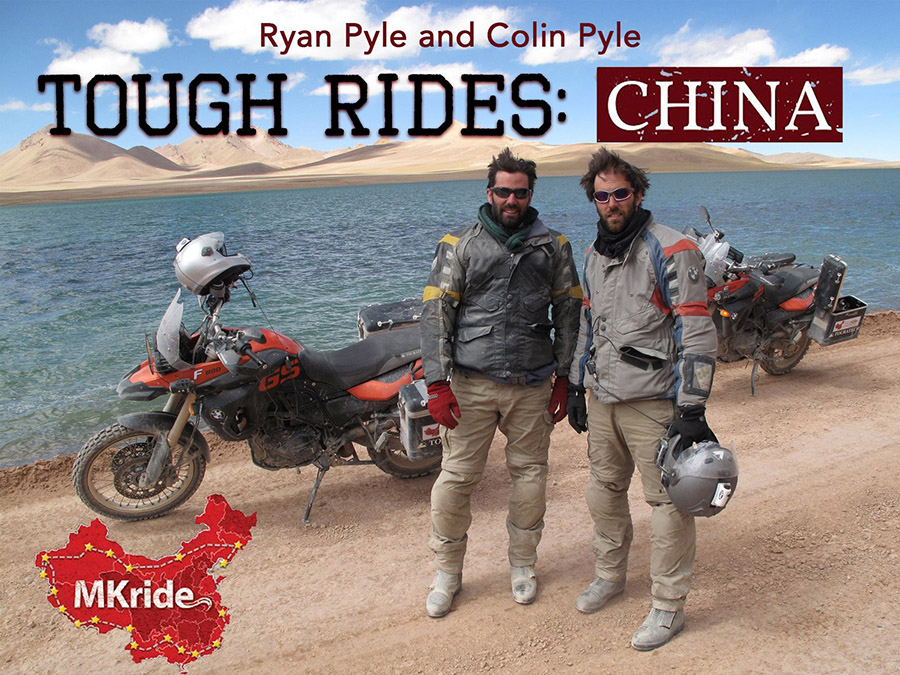
Here’s another Amazon Prime television show and video review. This one (as the blog title suggests) is on a series titled Tough Rides China. It’s about two Canadian brothers (Ryan and Colin Pyle) who circumnavigated China on BMW F800 motorcycles, and you can either watch it on Amazon Prime (if you have that streaming service) on your TV or on your computer.
The bottom line first: I enjoyed this 6-part series. A big part of that was because Joe Gresh and I rode around China with the cult of the Zong and we had a whale of a time, so it was easy to relate to what these two fellows did.
I didn’t think this series was as good as the one I reviewed recently about the two German dudes who rode from Germany to India (Himalaya Calling, which was a stellar production), but I still enjoyed it.
Surprisingly, the Pyle brothers’ BMWs broke down a couple of times during the trip, which suprised me. They were concerned about how long it would take to get parts and the lack of a strong BMW presence in China (now there’s a switch). For the record, our ten Zongshen RX1 and Rx3 motorcycles didn’t have a single breakdown during our ride. The Pyle brothers had breakdowns that mandated trucking the bikes significant portions of the trip (does GS actually stand for Go Slow?).
The Pyles also put their bikes on trucks when they wanted to get on the freeways because motorcycles are not allowed on some Chinese freeways. When Gresh and I were over there with the Zongers, we rode them anyway. It made me nervous that we rode around the toll gate arms (without paying the toll) and I asked one of our Chinese brothers about it. “We’re not allowed on the freeways, so if we tried to pay, they wouldn’t know what to do,” he told me.
Tough Rides China has a long introduction at the beginning of every episode, and it was the same in every episode. That became a bit distracting, and I blitzed through the lengthy and redundant intro after watching the first two episodes.
Tough Rides China featured the giant sand dunes and camels in the Gobi Desert around Dun Huang. Gresh and I were there. It was an awesome place, as was all of China. It really was the adventure of a lifetime.
Tough Rides China is part of a series. The Pyle brothers have done similar series in Brazil and India, too. I’ll have to look for those. While I didn’t think this series was as good the Himalaya Calling adventure ride we recently reviewed, it was still good and I recommend seeing it.
Never miss an ExNotes blog. Sign up here:
Would you like to read about the Zong trip when Gresh and I rode around China? Hey, just click right here!
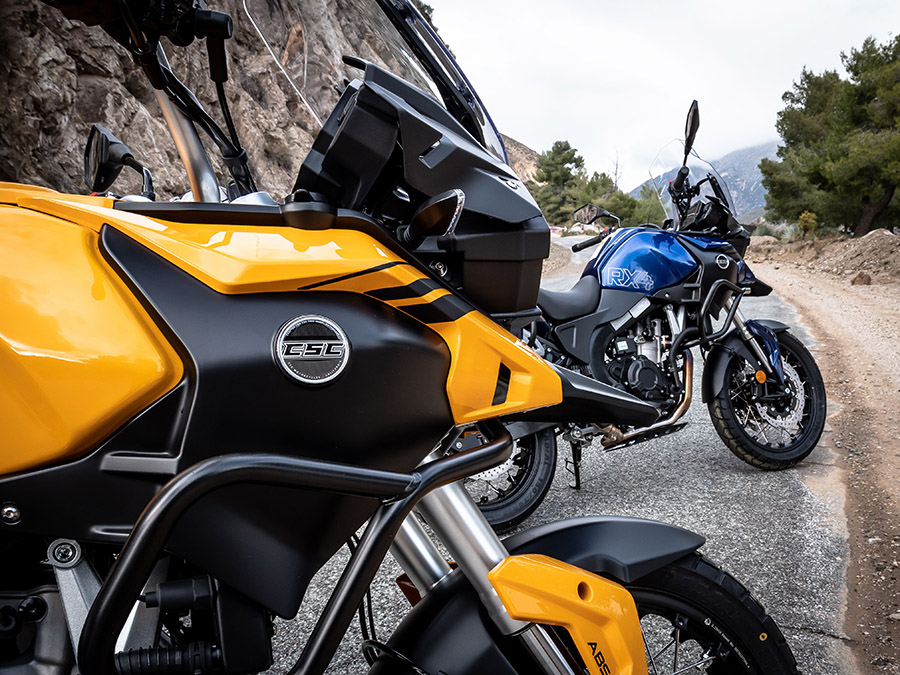
The new CSC RX4 is here, and they are moving out quickly from the CSC plant in Azusa, California. CSC Motorcycles is offering two colors on the new RX4, as shown in the photo above Steve Seidner recently sent to me. One is a vibrant yellow and the other is a deep, rich blue. I like them. If I had to pick one, I’d go with the yellow. Yellow just seems to work on ADV bike. There are a number of changes incorporated on the new RX4 motorcycles, as outlined in the CSC mailer below. The big ones are the spoked tubeless wheels, the new TFT dash, and a tire pressure monitoring system.
We tested the RX4 extensively when it first came to America and published a comparison between it, the CSC RX3, and the Kawasasaki KLR 650. You can see those reports here. I may well have been the first American to ever ride an RX4 when I was in China visiting the Zongshen factory not that long ago. I rode the prototype (literally a 450cc engine in an RX3), and on a subsequent visit, one of the early preproduction models.
Tooling around the Zongshen test track on a preproduction RX4…those were fun times.
I love traveling to China, and I particularly like visiting the Zongshen plant and Chongqing. It’s a city most folks haven’t heard of here in the US, even though at 34 million inhabitants it is one of the largest cities on the planet. With that, here’s the info from CSC Motorcycles:
Get More Than Ever! CSCMOTORCYCLES.COM
The new 2021 CSC RX4 is the motorcycle ADV riders have been waiting for. Powerful. Economical. Modern. The RX4 is an all-around versatile motorcycle that is perfect for real-world riding – including highway cruising, adventure touring, or simply commuting to work economically.
The 450cc single-cylinder, 4-valve, overhead cam, counter-balanced engine produces 40.2 horsepower and achieves a top speed over 95 miles per hour. The RX4 is water-cooled and equipped with Delphi fuel injection and electric start. The bike features a six-speed transmission.
The new RX4 includes an adjustable windscreen, comfortable touring seat and foot pegs with removable rubber inserts. The RX4 features an all digital TFT Display Gauges: dash with digital speedometer, tachometer, odometer, trip odometer, fuel gauge, gear indicator, neutral light, temperature gauge, clock, turn signal and high beam indicators, and Bluetooth connectivity for caller ID. Above the dash there are USB and 12-volt charging outlets included as standard equipment.
The new CSC RX4 includes a 300-watt alternator to power accessories with two prewired outlets under the seat.
The RX4 features LED turn signals and brake light plus LED day-time running lights. The headlamps are controlled by an automatic light sensor. The RX4 has a standard 5.3-gallon gas tank with locking cap. With fuel consumption exceeding 60 miles per gallon, the RX4 has an honest range approaching 300 miles.
The CSC RX4 is outfitted with spoked wheels, black anodized aluminum rims and 80/20 tubeless tires.
The RX4 comes standard with molded side cases, mounting racks and a TALL rear top box – which is large enough for a full-face helmet. Or RX4 owners can select the OPTIONAL package of Tourfella aluminum side cases and rear top box, all with custom side pannier and rear mounting racks.
The CSC RX4 is an unmatched value in the adventure motorcycle category. The powerful and economical 450cc motor is paired with a huge list of standard features that cannot be duplicated elsewhere.
CSC RX4 Standard Features:
450cc liquid-cooled engine, 4-valve, overhead cam, with counter-balancer.
Long maintenance intervals (5,000-mile valve adjustment) and easy repairs backed by a full Owner’s Manual and online service tutorials.
US Delphi EFI system.
6-speed transmission.
Stainless steel twin pipe exhaust.
5.3-gallon fuel tank with locking gas cap keyed to ignition.
All Digital TFT Display Gauges: dash with digital speedometer, tachometer, odometer, trip odometer, fuel gauge, gear indicator, neutral light, temperature gauge, clock, turn signal and high beam indicators.
Adjustable windshield.
12-volt and USB charging outlets on dash.
LED turn signals and brake light.
Dual-flash hazard lights.
3D Anti-fog headlamp with LED day-time running light. Low light sensor with handlebar switch controls.
300-watt alternator.
Automotive-type waterproof connectors under the seat. An optional handlebar-switch for accessory outlets is available.
Adjustable inverted front forks with anodized finish. Fork lock keyed to ignition.
Adjustable rear shock absorber.
Large diameter dual front and single rear disk brakes with ABS.
Front 110/80-19 spoked wheel with tubeless dual sport tire, black aluminum rim.
Rear 150/70-17 spoked wheel with tubeless dual sport tire, black aluminum rim.
Tire Pressure Monitoring System {TPMS}.
Front and rear mud guards, with added rear lower mud guard.
Steel engine skid plate. An optional full coverage aluminum skid plate upgrade is available.
Frame-mounted engine guards.
Comes standard with molded luggage. An upgraded aluminum luggage package is available.
Wide foot pegs with removable rubber inserts.
Passenger foot pegs and grab rails.
Tapered aluminum handlebars with bar-end weights.
Dual rear view mirrors.
Ergonomic rider and passenger seat.
Available Colors: Fire Yellow or Saphire Blue.
The RX4 is covered by a ONE YEAR unlimited mileage warranty.
If you’re a serious international adventure rider, the RX4 is one of the best motorcycles available. I believe it is one of the six best motorcycles you can take into Baja if you are seeking a great bike at a super price. You can read more about the new RX4 on the CSC blog.
This is a blog that is sure to be controversial and elicit a few comments. It attempts to answer a very specific question: Which motorcycles are best for Baja?
As a qualifier, let me mention a few things up front:
Most of my Baja riding is on asphalt, and that necessarily colors my opinions. Yeah, there’s a lot of great dirt riding in Baja, but I am a streetster at heart. Your mileage may vary.
You don’t need to spend $30K on a Baja blaster. What good is driveway jewelry if you are afraid to get it dirty and if you’re constantly worried about where you parked? In Baja, a big, heavy motorcycle (ADV-styled or otherwise) puts you at a disadvantage. I am not a fan of huge displacement, tall, expensive motorcycles. For real world riding (especially in Baja), monster motorcycles are more of a liability than an asset. Even that new one that’s 20 years late to the party.
What I think you need in Baja is a comfortable bike with range. There are places where you can go more than a hundred miles between fuel stops, and you need a bike that can go the distance. That means good fuel economy and a good-sized fuel tank.
Luggage capacity is a good thing, but if your bike doesn’t have bags, you can make do with soft luggage. In fact, I’d argue that soft luggage is better, because it’s usually easier to detach and bring in with you at night.
With that said, here goes:
CSC’s RX3
Say what you want about Chinese bikes, and say what you want about smallbore bikes, I’m convinced my 250cc CSC RX3 was the best bike ever for Baja.
The RX3 tops out at about 80 mph and that’s more than enough for Baja’s Transpeninsular Highway (the road that runs from the US border all the way down to Cabo San Lucas). The bike is comfortable and it gets 70 mpg. The fuel tank holds over 4 gallons. I could carry everything I needed (including a laptop, a big Nikon and a couple of lenses, and clothes) in the bike’s standard panniers and topcase. I also carried tools and spare parts, but I never needed them. It was superbly well suited for Baja exploration, as I and more than a few others know. One more thought…before you pummel me with the inevitable “Ah need at least a thousand cc” comments, take a look at our earlier blog, Why a 250?
Kawasaki’s KLR 650
I owned a 2006 KLR 650 Kawasaki for about 10 years. I bought it new and I loved the thing. I think it is one of the best bikes I’ve ever ridden in Baja. Yeah, it was a little tall, but once in the saddle I had no problem touching the ground.
The Kawi didn’t come with luggage, but I bought the cheap Kawasaki soft luggage panniers and a Nelson Rigg tankbag and I was good to go (I didn’t need the obligatory KLR milk crate). Although the KLR was heavy, it did surprisingly well off road (especially running at higher speeds over the rough stuff), and I did more offroad riding with the KLR than I have with any of the other motorcycles I brought into Baja. It averaged 56 mpg, and with its 6-gallon gas tank, I could make the trek between El Rosario and that first Pemex 200 miles further south without stopping for fuel.
I’ve never taken an RX4 into Baja, but I’ve ridden both (the RX4 and Baja) enough to know that it would do well down there. Think of the RX4 as an RX3 with more top end, more acceleration, and a bit more weight. It’s got the luggage and the ground clearance for extended travels with some offroad thrown in, and it also gets about the same fuel economy as the RX3. Fit and finish on the RX4 is superior (it’s almost too nice to take offroad). The RX4 is a lot of motorcycle for the money. The pandemic hit our shores not too long after the RX4 did, or I would have seen more of the RX4 south of the border.
Genuine’s G400c
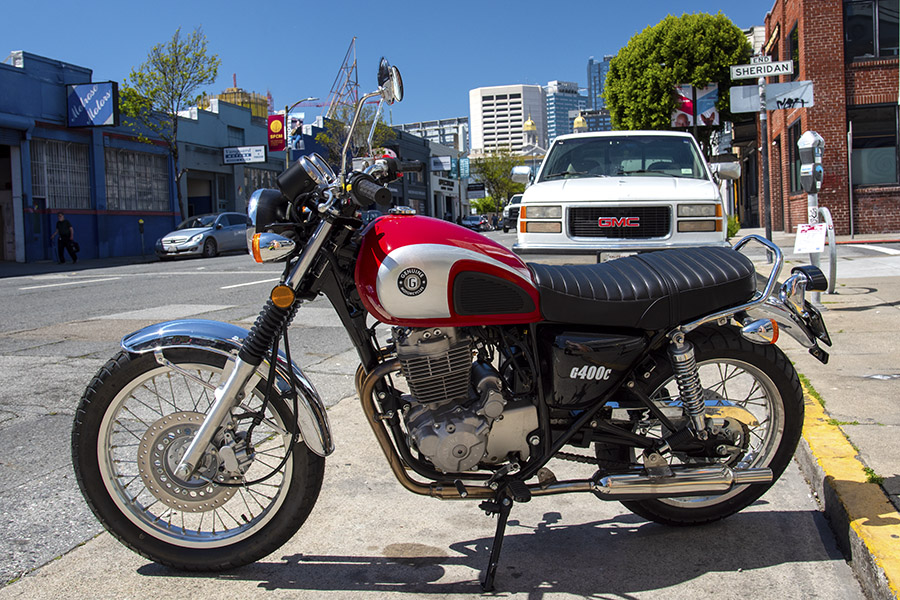
I rode Genuine’s new G400c in San Francisco, courtesy of good buddy Barry Gwin’s San Francisco Scooter Center, and I liked it a lot. It’s compact, it has adequate power, it has an instrument layout I like, and it’s a fairly simple motorcycle.
I think with soft luggage, the Genuine G400c would make an ideal Baja blaster, and the price is right: It rings in right around $5K. With its Honda-clone 400cc motor (one also used in the Chinese Shineray line and others), it has enough power to get up to around 90 mph, and that’s plenty for Baja. I rode a different motorcycle with this powerplant in China and I was impressed. I think this would be an ideal bike for exploring Baja.
Royal Enfield’s 650 Interceptor
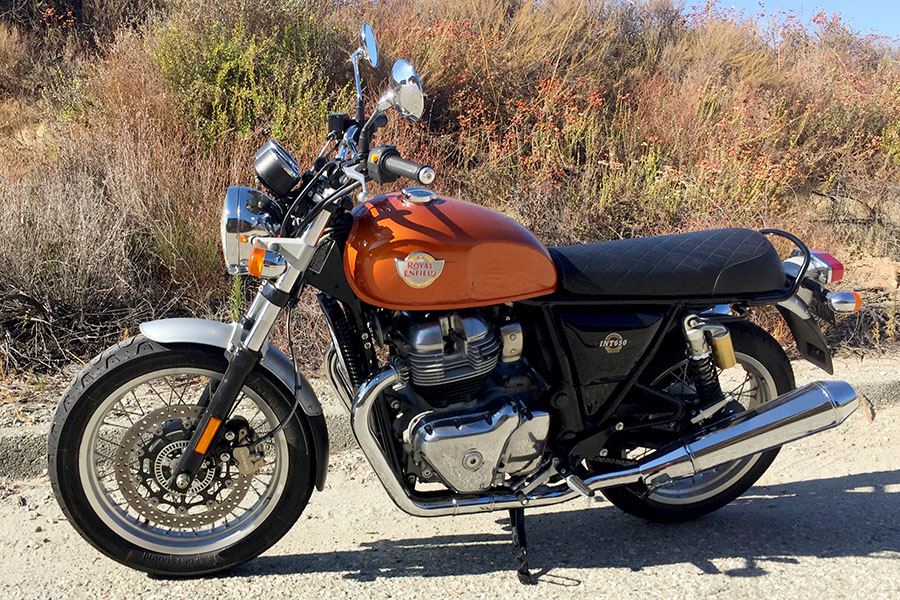
Yeah, I know, the new Enfield Interceptor is a street bike with no luggage. But with a Nelson Rigg tailpak and Wolf soft luggage, the Interceptor was surprisingly in its element in Baja. Gresh will back me up on this.
We had a whale of a time exploring Baja on a loaner 650 Enfield (thanks to Enfield North America and good buddy Bree), and I liked the bike so much I bought one as soon as I could find a dealer that didn’t bend me over a barrel on freight and setup. There’s one parked in my garage now. The bike is happy loping along at 65-70 mph, it’s comfortable (although I’ll be the first to admit it needs a sheepskin cover on that 2×4 of a seat), and it gets 70 miles per gallon. I wouldn’t take it off road (except maybe for that 10-mile stretch to go see the cave paintings in the Sierra San Francisco mountains), but like I said at the beginning of this conversation starter, I’m mostly a street rider.
Royal Enfield’s 400cc Himalayan
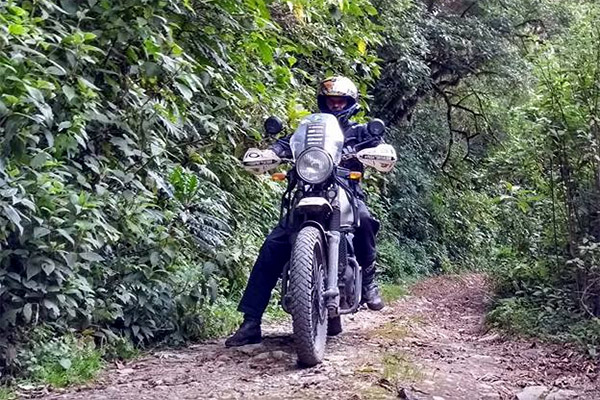
I’ve seen these but not ridden one yet. Good buddy Juan Carlos, a great guy with whom I rode in Colombia, has gone all over South America on Enfield’s new Himalayan and he loves it (that’s his photo below). Juan knows more about motorcycles than I ever will, and if Juan says it’s good, it’s good.
I like the look of the Himalayan and I like its single-cylinder simplicity (come to think of it, with the exception of the Enfield Intercepter, every bike on this list is a single). 400cc, I think, is about the right size for Baja. The price is right, too. Royal Enfield is making fine motorcycles that won’t break the bank. I think the Enfield Himalayan would be a solid choice for poking around the Baja peninsula, one that probably has the best off-road capabilities of any bike in this list.
I’m sure I’m ruffling a few feathers with this piece, and I’m doing that on purpose. I’ve been taking pot-stirring lessons from Gresh (that’s him in the photo at the top of this blog). We’d like to hear your comments if you disagree with any of the above. Do us a favor and leave them here on the ExNotes blog (don’t waste your time posting on Facebook as that stuff will scroll on by and be gone; ExNotes is forever).
All the above notwithstanding, I’ll add one more point: The best Baja motorcycle for each of us is the one we have. You can ride Baja on just about anything. I’ve been to Cabo San Lucas and back on everything from a 150cc California Scooter to a Harley Heritage Softail cruiser. They’re all good. Don’t put off a trip because you don’t think you have the perfect motorcycle for a Baja adventure. Baja is the best riding I’ve ever done.
Please visit our advertisers and click on the ads!
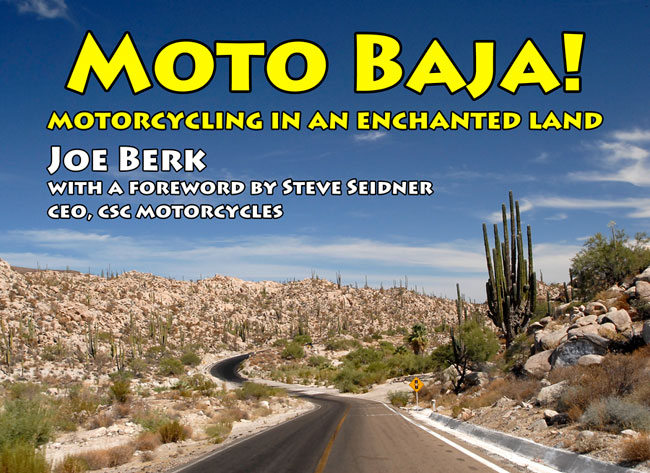
I’ve done a lot of riding on a lot of different motorcycles in Baja. You can read all about that in Moto Baja!
Heading into Baja? Make sure you insure with BajaBound, our choice for the best motorcycle insurance in Mexico!
Never miss an ExNotes blog. We cover an eclectic mix of topics, including motorcycles, travel, bicycles, construction, guns, reloading, all kinds of product reviews, and more. Subscribe here for free:
I think most motorcycle videos are silly, including the ones I’ve done (and I’ve done a few). It’s a personal preference…videos (compared to the written word and good photography) dumb down whatever they cover, and I would much rather read a good article with great photos than watch a video. But on occasion I’ll stumble across a video I enjoy. I recently encountered a couple that hit home for me. One compares the Royal Enfield 650 to the Kawasaki W800, and the other compares the Enfield to a Triumph Bonneville.
Back in the day (the 1960s), British vertical twins ruled the roost, and of those the Triumph Bonneville was the king. My father rode a 1966 Triumph Bonneville, and I’ve owned a number of Triumphs from the ’60s and ’70s. They were (and still are) awesome motorcycles. It just makes sense to me that ’60s-era British vertical twins are a platform deserving of the sincerest form of flattery (i.e., copying), and apparently, the modern incarnations from Kawasaki, Royal Enfield, and Triumph do exactly that. Well, maybe not exactly, but enough to let you imagine you’re Steve McQueen.
These videos are fun to watch. The narrators are funny as hell and there are some great quotes. One was, “I’m not even going to try to keep up with you on the way back…you just take care of yourself and watch out for buffalo.” That quote reminded me of Gresh’s video when he entered a corner a bit too hot on a Harley Sportster and famously said, “It handles pretty well when it’s out of control.”
The video editing and imaging in these two videos are superior (way better, in my opinion, than what you see from the self-proclaimed videomeisters here in the US). And the tech content is light years ahead of the typical vlogger tripe clogging up our bandwidth.
Enjoy, my friends.
Here’s a fun fact: All three of these bikes (the Royal Enfield Interceptor, the Kawasaki W800, and the Triumph Bonneville) purport to copy British vertical twins, yet none of these bikes are British. The Enfield is made in India, the Kawasaki is made in Japan, and the Triumph is made in Thailand.
I ride a Royal Enfield 650. I like my Enfield, and for the money, the Enfield has to be one of the best buys ever in motorcycling. Gresh and I already did a road test of the Enfield in Baja, and you can read our reports on it here. One of these days in the near future I’ll do a road test my current Enfield and tell you what it’s like to own one of these grand machines, but I’ve got another road test I’m going to post first. That’s on the 250cc CSC RX3, 5 years in. Good buddy Sergeant Zuo over in Lanzhou has 50,000 miles on his RX3 and it’s still going strong.
I am enjoying my Enfield, and I just found a bunch of Enfield accessories available online through Amazon. I’ll poke around on there a bit later today.
Stay tuned, folks. More good stuff is coming your way.
Riding in a group is a lot like sex: Most of us think we’re better at it than we really are.
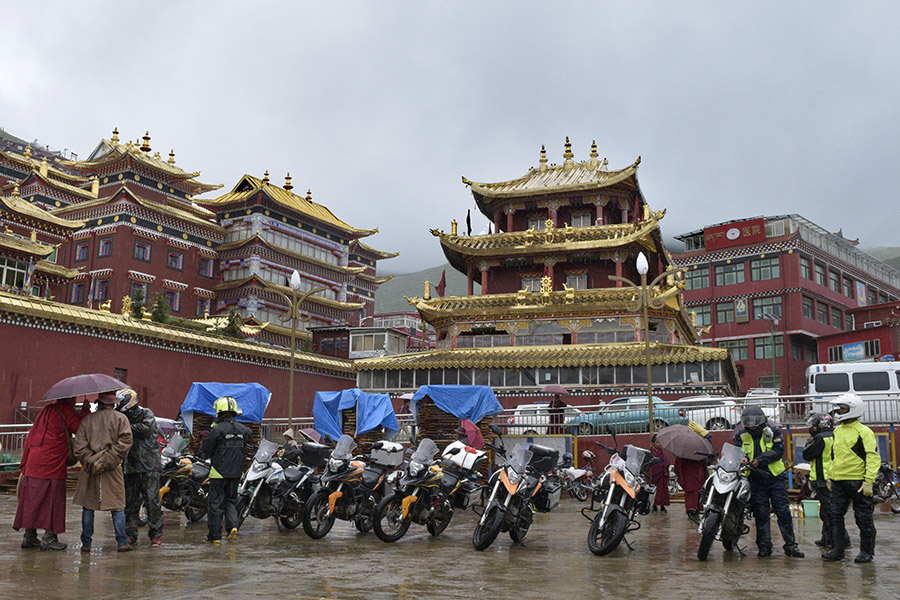
This blog focuses on how to play well with others on a group ride. It’s told from the perspective of a guy who has organized and led group rides (that would be me) and who has been a participant on group rides (that would also be me). You can have a lot of fun on a group ride and go places you might not otherwise go, like Seda in the photo above. Seda is a town that will take your breath away…it’s the largest Tibetan Buddhist school in the world, it took days to reach, and I would have never visited it had I not done so on a group ride. You can read all about that in Riding China.
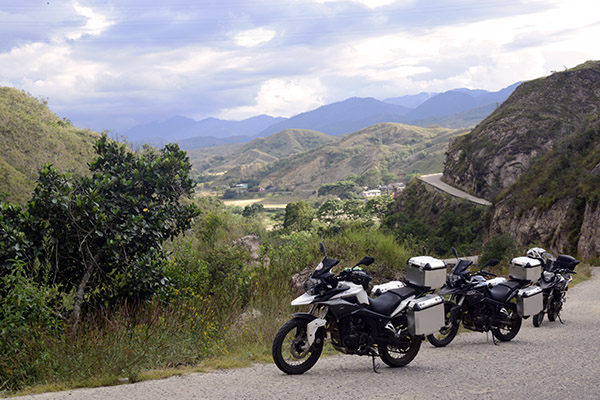
Riding AKT Motos RS3 motorcycles in the Andes Mountains. This was a fabulous group ride organized by AKT Motos and my good buddies Juan and Carlos. The RS3 is a carbureted RX3. You can read that story in Moto Colombia.
I make a distinction between organized group rides and simply taking a ride with a buddy or two. This article is not about rides in that second category. In this blog, I’m describing organized rides with several riders, rides that are usually put together by a club, a dealership, and on occasion, by a manufacturer (like the ride I did with AKT Motos through the Andes Mountains in Colombia).
Tip 1: Don’t Be A “Maybe” Rider
If you’re not sure, don’t commit to the ride. Don’t be a guy who says he might go if he can get off work, or if his girlfriend says he can go, or if he feels like going that day, or any of the myriad of brainless “ifs” folks put on their potential participation. You know the drill…you start out with a whole platoon of guys who say they’re going, a week before the ride it’s down to five people, and the morning of the ride it’s you and one other guy. If you can go, put on your big girl panties and go. If you’re not sure, don’t say anything.
Tip 2: Don’t Invite Others Without Checking First
I’ve had this happen to me a few times when I’ve planned rides: Folks I invited invite others. Consider it from this perspective: I invited you because I think you’d add something to the ride and I think I know how you ride. I don’t know other folks you might want to invite, I don’t know how they would fit in the group, and I don’t know how they ride. My suggestion is this: Ask the ride organizer if you want to invite someone else. Don’t just invite others along.
If it’s a marque-specific ride, don’t invite others along who ride other motorcycles. The ride organizer is promoting a manufacturer’s motorcycle. It’s weird; folks would badmouth Chinese motorcycles but then get their shorts in a knot because we wouldn’t allow other brands on the CSC Baja rides (you can read about those in 5000 Miles at 8000 RPM and Moto Baja). Call Brand X and complain to them if they don’t have a ride for you; don’t bitch at me because I don’t want your bike sneaking into my marketing photos.
Tip 3: Don’t Ask To Join The Ride Along The Way
This seems to be a recurring request, and the only thing I can attribute it to is laziness and that all-too-common sense of “You don’t understand…I’m special.” It doesn’t seem to matter if we’re organizing a 300-mile ride or a 5000-mile ride. There’s always that guy who doesn’t want to ride an extra 15 miles to join the group at the starting point. He wants the group to pull off the highway to meet him somewhere along the way.
Don’t do this, folks. Either make it to the start of the ride or stay home. The ride organizer has enough going on without adding additional stops to save you 15 miles (and we don’t want to inconvenience everyone else who made it to the start point). Find those big girl panties. Pull ’em on.
Tip 4: Attend the Pre-Ride Briefing
If there’s a pre-ride briefing, go to it. Ride organizers do this to provide critical information and to emphasize safety. Don’t ask if you can skip the pre-ride briefing.
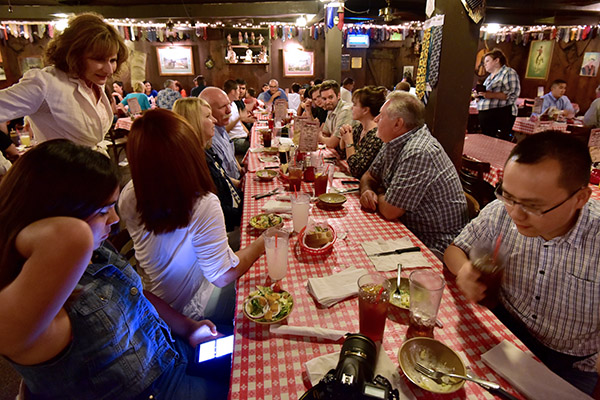
A combined dinner and pre-ride briefing before our Western America Adventure ride. It was an awesome ride: 15 guys, 5000 miles, and no mishaps.
Tip 5: Don’t Push Alternative Routes
Trust me on this: The ride organizer has put a lot of thought into the route. I know when I plan a ride I have a lot of things in mind (start times, how long the ride will take, getting in before dark, the group’s safety, things to see along the way, the route, fuel stops, etc.). If you have a better idea, do your own ride.
If the group isn’t going somewhere you want to go, you might ask the ride organizer privately if it would be okay to split off, see what you want to see, and then meet up with the group later that night (or just finish the ride on your own). I’ve had guys do this and I’m fine with it. What ride organizers don’t want is a debate during the pre-ride briefing.
Tip 6: Arrive Early
This is so obvious it almost seems silly to mention it. When I plan a ride and specify a departure time, that’s when we’re leaving. If you’re not ready to go at that time, we’re leaving anyway. I won’t delay the group because you can’t get there on time.
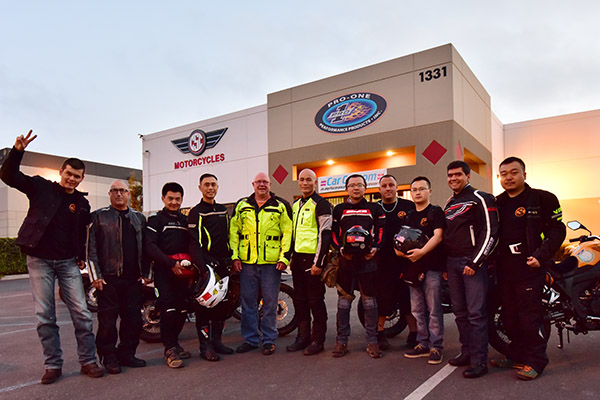
It was the morning we departed California for a 5000-mile ride through the western United States. Everyone was there on time except the chase truck driver. Always show up early for any group ride.
Tip 7: Arrive Fully Fueled
Stop for fuel someplace close to the departure point and fill up, and do so such that you can arrive for the start on time. There are few things more frustrating than a rider who announces he has to stop for fuel when the group is ready to leave.
This applies to breakfast, too: Eat your breakfast early, unless the group plans to stop for breakfast. I’ve had guys announce when the group was ready to leave that they needed to eat first. Seriously?
Tip 8: Make Sure You and Your Bike Are Ready
If you need to adjust your chain, check your oil, charge your cell phone, clean your faceshield, tweet, post on Instagram, adjust your jockstrap, or any of the other things I’ve seen guys do at the start of a group ride, do all that before you arrive. I used to ride with a guy named Dick who did that sort of thing constantly, and he always did it just as we were ready to leave. “Wait a second,” Dick would say, “I think my chain is loose.”
Yep, I needed to clean my faceshield. But I didn’t make anyone wait while I did so.
The advice here is simple: Don’t be a Dick. Do whatever you need to do so that you’re ready to roll at the designated departure time.
Tip 9: Keys, Gear, and Mount Up (in that order)
Put your key in the ignition before you suit up, suit up, and then get on your bike. Don’t get on your bike before you put on your gear, and don’t pull your gloves on when your key is still in your pocket. I know, this all sounds obvious. But people do these things. I’ve seen guys drop their bikes because they suddenly realize they need to put on their helmet, jacket, and gloves as the group is leaving. They’ll jump on their bike, try to balance an 800-pound motorcycle while pulling on their gear, realize the key is still in their pocket so they have to remove their gloves…and in the middle of it all: Bam, down goes the bike. Dick used to do that all the time.
Put the key in the ignition, suit up, and then get on your bike. And do it so when the group is ready to leave, you are, too.
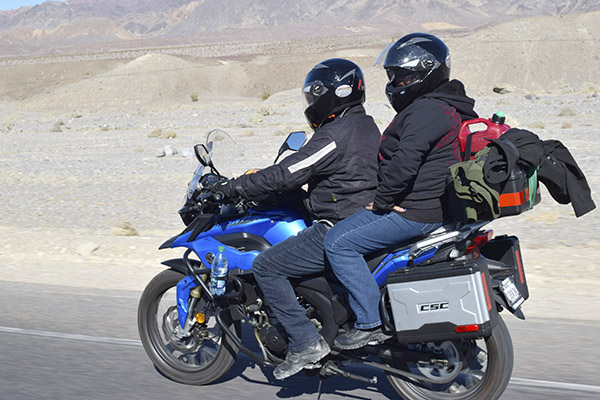
Velma and Orlando at speed in Death Valley. She was wonderful…always on time and always reminding Orlando that orange is the fastest color.
One more point on this: If you want to bring your significant other along and he or she is one of those people who takes a long time getting ready, explain that motorcycle rides are different. They just are. If your significant other can’t adapt, maybe you need another significant other.
Tip 10: Refuel When Everyone Else Does
Your ride organizer will have considered the bikes and their fuel ranges and selected stops accordingly. Don’t assume you can make it to the next fuel stop when everyone else is refueling. I’ve had guys do this and then run out of gas at inconvenient times and in inconvenient places. One guy did so coming home from a Baja ride. We spent the night in Tecate and fueled the bikes there, but for whatever reason, he decided he had enough gasolina and he didn’t top off. He ran out of gas on I-5 somewhere north of San Diego. For all I know, he’s still sitting by the side of the road.
Tip 11: Keep Your Helmet On At Gas Stops
A fuel stop can be 10 minutes if everyone pulls up to a pump, keeps their helmet on, and is efficient. Or it can be 45 minutes or more if folks take their helmets off, start kibitzing and posting on social media…you know. Listen to what the ride organizer says about this during the pre-ride briefing. I like to keep my helmet on and keep things moving.
Drink enough to stay hydrated. Use the restroom every chance you get, even if you don’t have to (so you won’t have to while underway).
Fuel stops are a good place to use the rest room, too, but be quick about it. Most ride organizers will make a pit stop every hour or so (hey, we’re mostly a bunch of full-figured mature prostate patients), so take advantage of every stop and hit the head.
Tip 12: Eat With The Group, and Be Nice
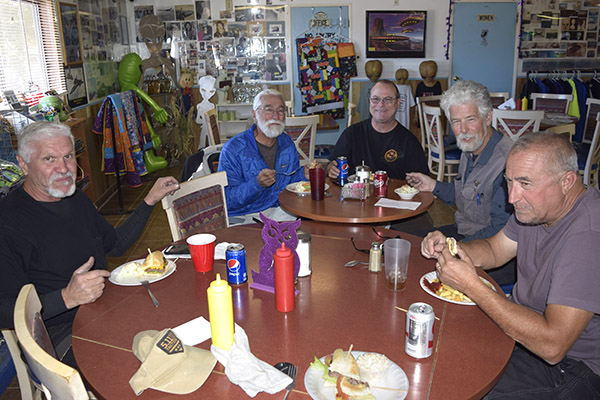
Don’t decide you don’t like the restaurant the ride leader selects for lunch and wander off looking for your idea of the perfect place, and don’t suggest different places to eat when the group stops at a restaurant. Give the ride leader credit for having thought about things like how long it takes to get served at a restaurant, cost, etc. On the wandering off thing, I’ve had guys do this and I left without them when we were finished eating. Sometimes they got back in time and sometimes they didn’t, but I wasn’t going to inconvenience everyone else waiting for my vagabundos to rejoin the group.
If you’ve ever worked in a restaurant, you know large groups are tough. The wait staff may be leery of your group for a couple of reasons…you’re a bunch of people dressed like Power Rangers (so you may be a little intimidating), and most groups tend to leave scanty tips (or no tip at all). Be nice and leave a good tip. The ride organizer probably has a relationship with the restaurant from prior visits, and he ‘ll probably want to bring other groups on subsequent rides. Don’t poison the well.
That ketchup bottle belongs where you see it. Gresh knows this now. We are not alone.
Don’t take up other tables by stacking your helmets, your jackets, and other stuff on them. Leave other tables free for the restaurant’s other customers.
Some folks take forever choosing from the menu, or they have special requests (you know, put this on the side, add this but subtract that, can I get goat cheese instead of American cheese, etc.). That makes things difficult for the restaurant and the other riders. Choose from the menu, be quick about it, and don’t delay the group.
Here’s another thing I want to mention: I’ve ridden with guys my age or older who mostly look like me, yet they somehow feel compelled to hit on the wait staff. For the record, I’m overweight, I’m bald, and I’m not tall, dark, or handsome. Read that sentence again, because whether you realize it or not, I may have just described you. Do you really think a young woman working in a restaurant is going to be impressed by a short, fat, and not-so-handsome guy three times her age hitting on her? Give it a break, guys.
Tip 13: Ride Safely
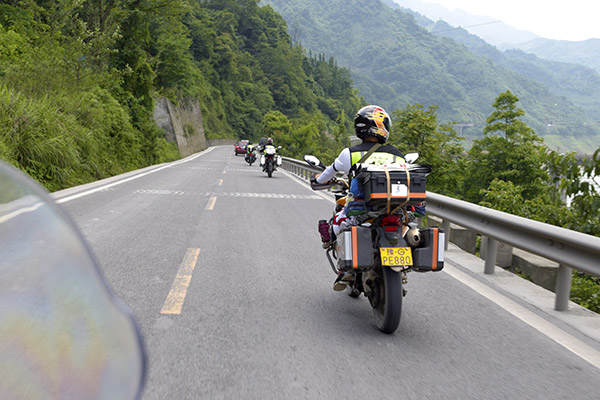
Safety trumps everything else on a group ride. Go to the safety briefing, ride in a staggered formation, don’t crowd the rider in front of you, and don’t try to carry on a conversation by riding alongside another rider.
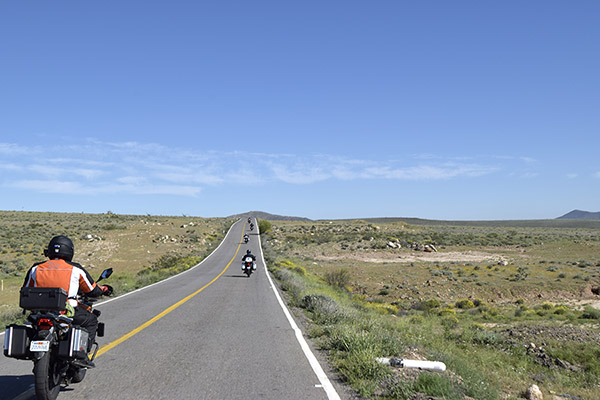
Good spacing and a staggered formation make for a safe ride. If you’re wondering, I shot this photo in Baja.
Riding in a group also means keeping up…you don’t want to tailgate the rider in front of you, but you don’t want to ride so slowly that it opens up huge gaps in the group.
If a traffic light changes to red, don’t blow through it just to keep up with the group. The ride leader will most likely stop to wait for you. You should know the route so that if you do get separated, you can join the group down the road. And if a car needs to change lanes to exit in front of you, allow it to enter and cross your lane.
Finally, know your capabilities and consider the group. If you’re a loud-pipes-saves-lives kind of rider and the group is a bunch of loud-clutches-saves-lives canyon carvers, you may be praying at the wrong church. If the group is riding at a pace beyond your capabilities, drop out and ride your own ride. Don’t get in over your head, and don’t assume because the guy in front of you made it through that corner at 80 mph you will, too.
Tip 14: Avoid Alcohol During the Ride
I’ll only ride with folks who won’t drink at all on a ride. Once the bikes are parked for the evening, that’s another story, but during the day, it’s no booze. Period. I’ve played the game with guys who think they can have a beer during the day. Then it becomes two. Then three. Nope. Not gonna happen. Not with me.
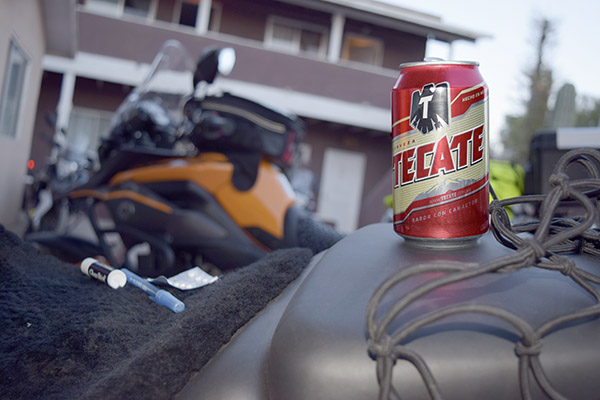
Nothing is better than a Tecate with lime and rock salt around the rim once the bikes are put away for the evening.
There are liability issues here, and it’s likely that folks sponsoring a ride simply won’t risk the extra exposure that goes with allowing alcohol consumption on a ride.
Tip 15: Be An Extremely Careful Photog
You can have a great motorcycle ride or you can make a great video, but you can’t do both at the same time.
If you want to do a video on the road, get a mount (Ram makes good gear) to mount your Go Pro or cell phone to the bike so you don’t have to screw around holding it or looking through a viewfinder while you ride. If you’re using a wide angle lens, don’t try to make up for it by crowding the rider in front of you to get a better view of his bike. Safety first all the time is the rule here.
If you’re using a digital camera for still shots, never try to use the viewfinder or look at the LCD screen to compose the shot while you’re riding. Digital film is cheap: Take a bunch of photos without looking through or at the camera. One or more of your photos will be good. You can’t control your motorcycle trying to compose a photo, and you put yourself and the riders around you at risk if you attempt to do so.
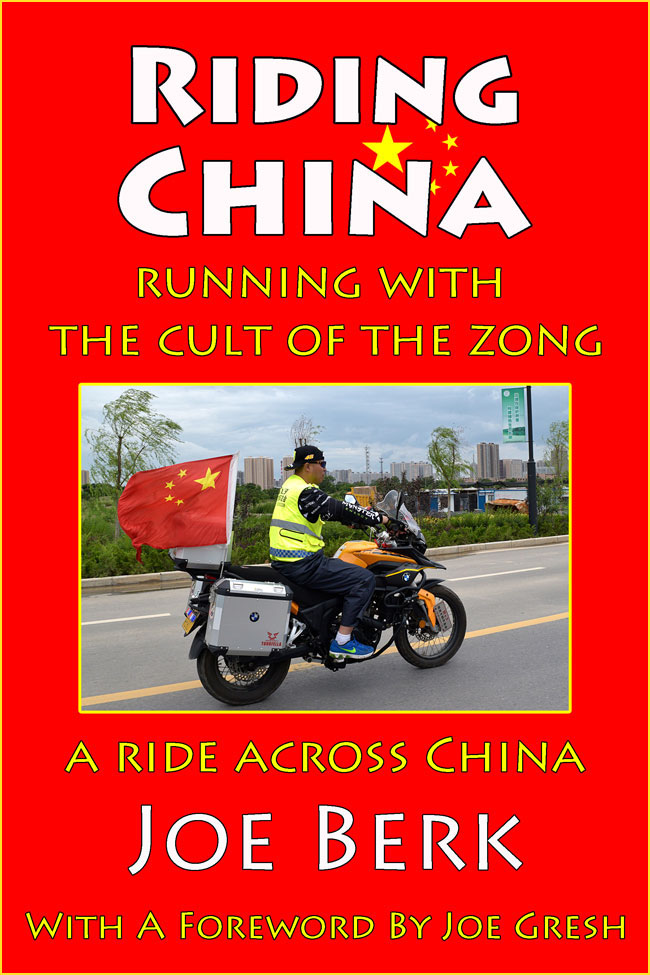
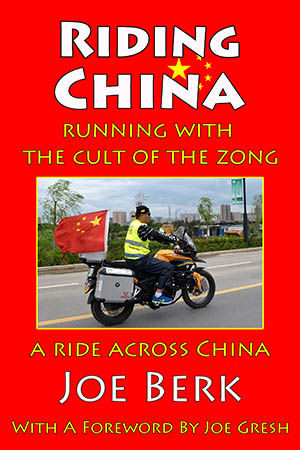
Riding China. Buy the book (don’t wait for the movie). It was a glorious 6,000-mile group ride without a single incident.
Last point on this topic: Don’t delay the ride so you can get the perfect photo or an artistic video. There’s a lot more at stake here than the number of likes you’ll get on Facebook.
Tip 16: Pay Attention To Your Turn Signals
Keep an eye on your turn signals. Dick used to put his turn signal on, he’d make the turn, and then he’d ride the next 72 miles with his turn signal flashing. Again: Don’t be a Dick.
Tip 17: Pack Your Bike Safely
One time I rode with bunch of guys from the place I was working at the time, and the plan was for a 3-day trip to San Felipe. I had my KLR, there was another guy on an FJR, and there was another guy on a full dress Harley. We met up at a Denny’s and I was shocked, although I guess I shouldn’t have been. The Harley guy’s bike had saddlebags and a tailpack, and he still had a bunch of stuff strapped down on his rear seat and the top of the tailpack. “I brought everything I needed for the three days,” Mr. Harley announced (his name wasn’t Dick, but it could have been).
I had everything I needed, too, and it was all in the tankbag on my KLR (including a camera). I pointed that out to my portly V-twin buddy. Learning how to pack (and what to pack) comes with experience, I guess. New riders tend to overpack. I used to do that. I travel light now.
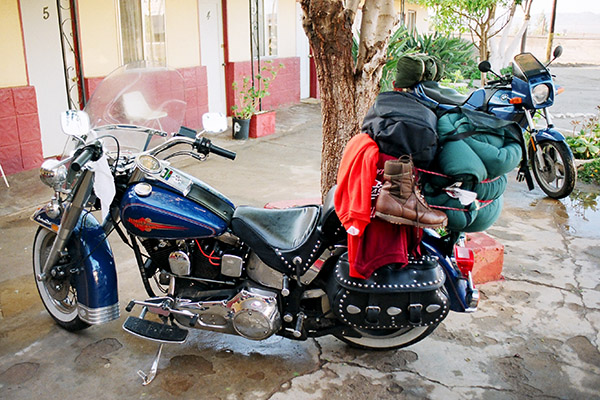
My Harley on one of my first Baja rides. Cue in the music from the Beverly Hillbillies.
The drill on a ride for me is this: If I can’t get it into the panniers and the tailpack, I don’t need it. And that includes tools, a laptop, my camera, and a couple of lenses. I mentioned this on one of the week-long CSC Baja rides, and one of my friends said, “I don’t know how you do it. I have the same bike with the same bags, and I still need to strap a bag down on the rear seat to hold everything. And I only brought enough underwear to change every other day.”
My response? “You brought underwear?”
Tip 18: Let Others Know If You Bail
If you’re going to leave the ride, let others know. It’s okay to do that; it’s not okay to do it without letting anybody know and just disappearing. That happened to me once in Baja and it scared the hell out of us. You don’t want to make people nervous (and maybe become the object of a search party, like we had to do in Baja) by simply changing your mind about the ride or the route. Be a nice guy and let someone know if you’re going to bail.
So there you have it. If I’ve offended anyone with the above list, my guess is you’re young and you’ll probably get over it. If not, mea culpa. And if you have more suggestions on how to ride well in a group, we sure would like to hear them. Please leave your comments here on the ExNotes blog (don’t post your comments on Facebook; be one of the cool kids and post them here).
Ride safe, folks. And ride extra safe if you ride with a group.
Help keep us going: Please click on the popup ads!
Never miss an ExNotes blog! Sign up for free here!
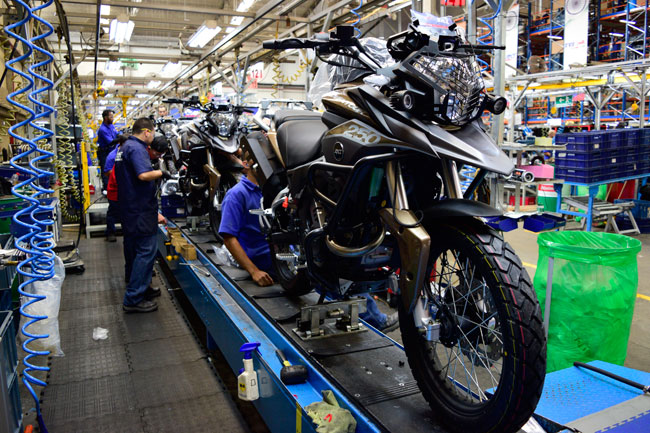
After zipping through the Andes Mountains in Colombia for a week on RS3 motorcycles with my good buddies Juan and Carlos (the RS3 is the carbureted version of the RX3), I spent a day in the AKT Motos plant. AKT Motos is the importer and assembler of Zongshen motorcycles in Colombia.
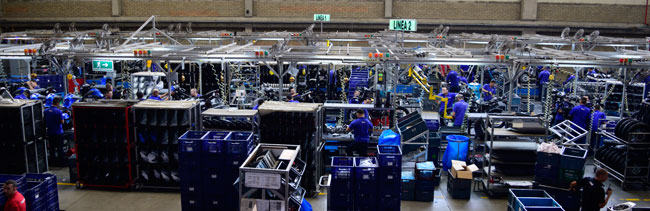
The AKT factory was impressive, and not just because of the fact that they make motorcycles there. I’ve been in and around factories for most of my life. There are good ones and there are bad ones. I can tell the difference as soon as I walk in just by looking at the people who work there and the condition of the facilities. The vibes were all good…AKT is a good place to work and the people there love what they do.
Here’s the AKT Moto assembly line:
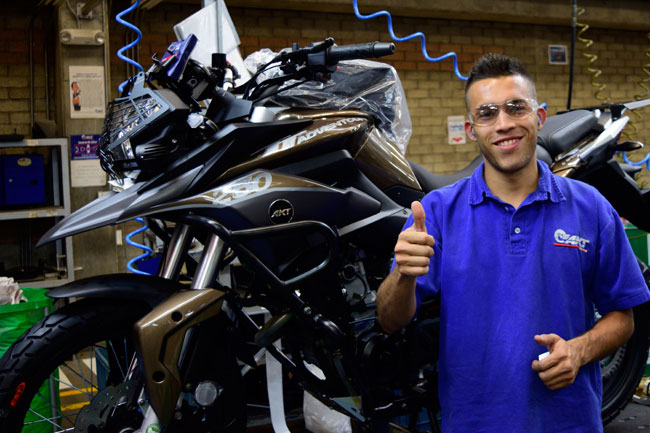
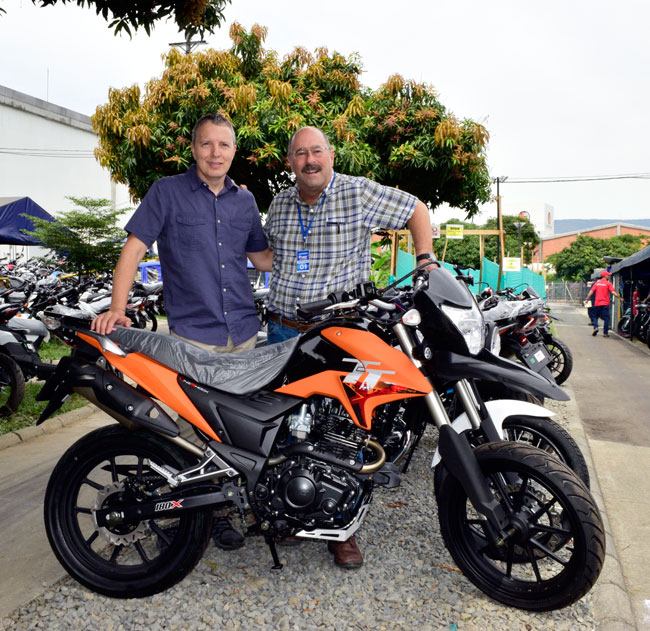
Juan Carlos grabbed the photo below of yours truly with Enrique Vargas, AKT Moto’s General Manager.
Here’s a video showing the AKT Motos plant in action:
Enrique is a genuine nice guy and he’s the real deal. He rides a different AKT Motos motorcycle to work every day (in Medellin traffic, that’s no small feat), and he races motocross on the weekends. Enrique is the guy who invited me on the Colombia trip, and I had a wonderful time on that ride. You can read about the adventure in Moto Colombia, our book about the ride through Colombia. It was the ride of a lifetime, and the book makes a great gift.
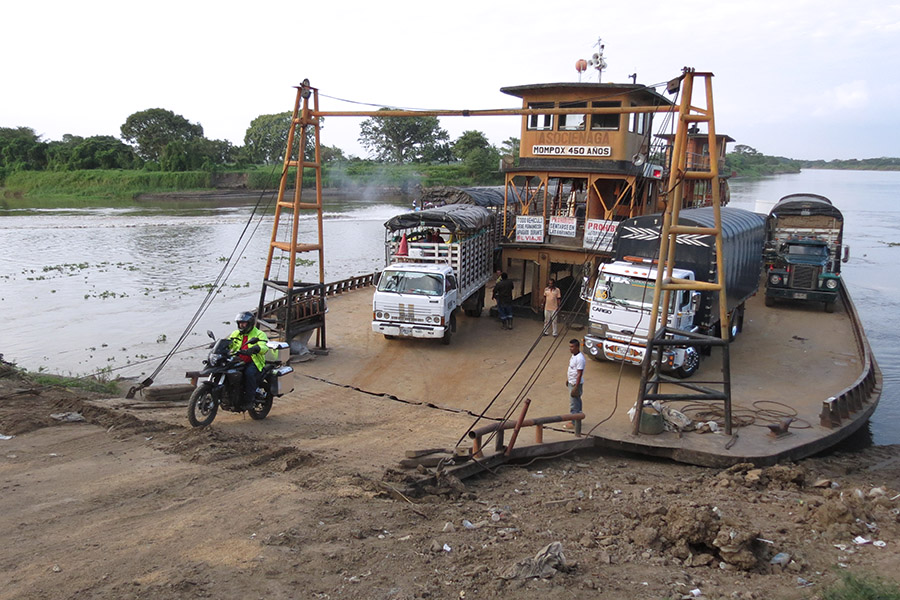
That photo at the top of this blog? It’s yours truly leaving the ferry that had carried us down the Magdalena River to Mompox, one of my favorite places in the world and unquestionably one of the more exotic spots I ever visited on a motorcycle. Here’s a video I did on that ferry ride with a few scenes in Mompox at night, and another riding through the Andes.



 available online through Amazon. I’ll poke around on there a bit later today.