We’d been on the road for about a month, riding a big loop through most of China. It was the ride of a lifetime, Zongshen was picking up the cost, and we were having a ball. It was me, riding compadre Joe Gresh, and Sergeant Zuo, our fearless retired Chinese Army Sergeant Major. I’d be hard pressed to identify any other single month in which I’d so much fun. Great riding, great companions, great roads, great food, and great photo ops. My book , Riding China, is about that ride and it included a chapter on Luoyang; here’s a quote from it leading up to the photo above:
It was dark when we walked home, and I watched people riding by in the sultry summer night air on their motor scooters. I knew I had to capture at least some of it for the blog and for this book, so I went back to the room for my Nikon and the 24-120 lens. I cranked the ISO up to 3200 and let her rip. It was great.
The technique is called panning; you swing the camera to stay on a moving subject, which freezes the subject and blurs the background to convey a sense of motion. Not every photo turns out using this technique, but when one does, it’s spectacular.
We stayed in Luoyang for two nights, and it was a well-earned rest we all needed. Those were good times. I miss the guys we rode with.
The above photo is one of many included in Riding China. If you would like to read more about that ride, pick up a copy!
As a kid growing up in the ’50s, I watched a bunch of cowboy movies and TV series. One was The Rifleman, starring Chuck Connor. Unlike most of the TV shows in which the hero carried a Colt 1873 Single Action Army revolver (a “six shooter”), Connor’s character carried a Winchester 1892. The rifles he used recently went up for auction, and the price attained was stratospheric.
It had to happen: Good buddy and frequent ExNotes blogger Mike Huber wrote a book! Mike’s book is A Trip Into The Moment, published by Native Book Publishing. You should buy it now from Amazon. Here’s the back cover blurb:
We are a literary bunch, us ExNotes writers. Joe Gresh and I published a collection of our favorite stories not too long ago, and I’ve penned (or keyboarded) a few myself. Here’s a link to the Gresh and yours truly book, A Cup O’ Joes:
Want to lose weight, ride faster, and impress your friends? Add our books to your library and drop a Huber, Gresh, or Berk quote from time to time. Better yet, buy a copy of each of our books and post this blog’s link on your social media (it will help with sales)!
The Stringer is a recently released show on Netflix. It tells the story behind a photo most folks my age remember well: The 1972 Vietnam War photograph of a little girl, Phan Thị Kim Phúc, who was severely burned by a napalm bomb dropped by a South Vietnamese aircraft.
The story goes like this: Nguyễn Thành Nghệ is the photographer who actually took the photo. Nghệ was a stringer (a freelance photographer). When he sold the photo to Carl Robinson at the Associated Press, the guy in charge (Horst Faas, who died in 2012) decided to attribute it to Nick Ut, an AP staff photographer. Robinson felt uncomfortable about doing so, but did as he was told. Ut was present at the scene when the photo was taken and willingly accepted credit for the photo, although he had to know he had not taken it.
The photo went on to win the 1973 Pulitzer Prize for Spot News Photography, the World Press Photo award for Photo of the Year, and the George Polk News Photography award. It made Nick Ut’s career.
Carl Robinson went public with what he had been told to do 50 years later (which would be 2022). The Netflix show (The Stringer) presents compelling arguments that Nghệ , not Ut, was the actual photographer. The Associated Press rejects these claims and still attributes the photo to Ut; World Press Photo accepted Nghệ’s authorship and stripped Ut of its award.
Not included in the movie are the details of Phan Thị Kim Phúc’s life after the 1972 napalm bombing. She endured multiple surgeries and great pain in the years after. Ms. Phúc grew up in what become communist Vietnam and subsequently moved to Cuba, where she became a pharmacist and married. While living in Cuba, she was on a flight to Moscow when she left the plane during a stop in Newfoundland and requested political asylum in Canada (which was granted). Today, Ms. Phúc is a Canadian citizen. She leads several international foundations focused on helping children who are war victims.
The Stringer is one of the better shows I’ve seen recently. If you are a Netflix subscriber, it’s one I recommend you not miss.
I’ve always held a fascination for turtles and tortoises. It started when I was a kid growing up in New Jersey. We lived in a rural part of the Garden State, and although you might be surprised to read it, a good variety of turtles and tortoises lived in the lakes, streams, and wooded areas around our home. Box turtles, wood turtles, spotted turtles, painted turtles, snapping turtles, alligator snappers, and more. As a kid, I caught a few of these, kept them as pets for a while, and then released them. Mom planted a strawberry patch in the field behind our house, and it was a safe bet that you could usually find a box turtle or two sampling the goods. It was a cool place to grow up.
On a recent trip to Singapore, Sue and I were casting about for something to do one weekend. We’ve been to Singapore several times, we’ve seen most of the sights, and we wanted to see something new. A quick Google search pointed us to Singapore’s Live Turtle Museum. It’s on the other side of the island from where we usually stay (the hoity-toity Orchard Road area). We hopped into a cab in front of our hotel and the cab driver gave us an odd look when we told him our destination.
The cabbie told us we might have some difficulty getting back “from the other side” but I thought I knew better. Singapore is not that big, I reasoned. Boy, was I ever wrong.
The ride to the Turtle Museum was about 45 minutes, and the second half of that was fairly desolate. Northern Singapore looks completely different from the Singapore I knew, which is a locale of wide boulevards, fancy cars (think Ferraris, Rolls Royces, and Bentleys), fancy hotels, and high-end shops. In fact, it seems about every other store on Orchard Road is a Rolex or Breitling authorized dealer. Not so on the other side. It’s jungles and grassy plains. And one Turtle Museum.
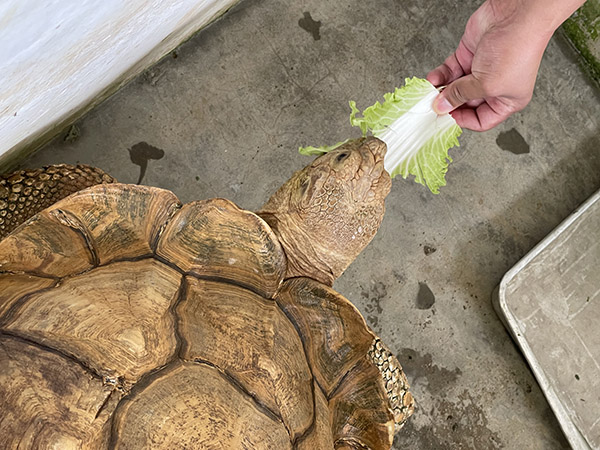
Once we entered the Turtle Museum, one of the first things we noticed is that you can buy lettuce to feed to the tortoises. Tortoises love lettuce. Feed one a little lettuce and you have a friend for life.
Sue bought some lettuce, fed it to a tortoise, and it was her new best buddy.
The Turtle Museum had many different species of tortoises and turtles. I’ll caption the photos with the various species.
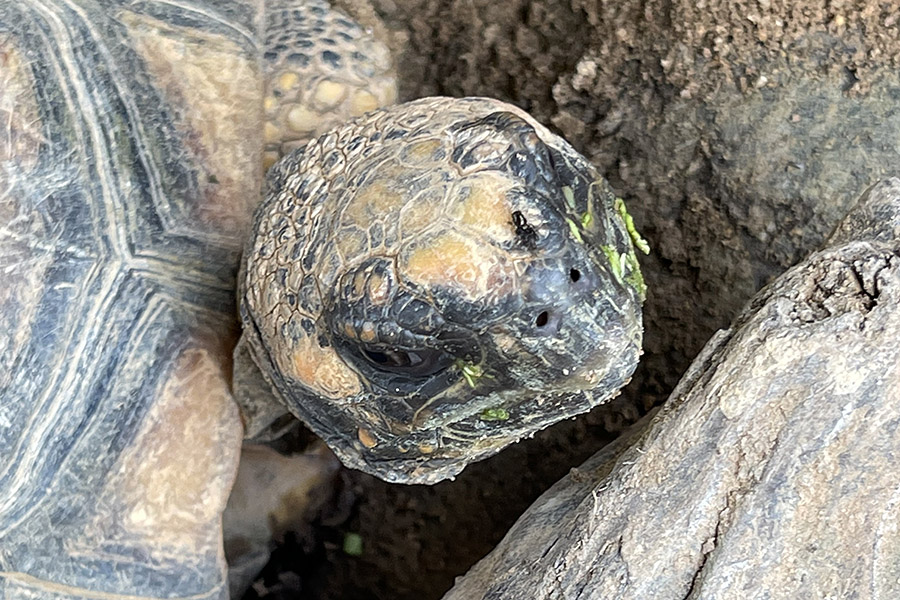
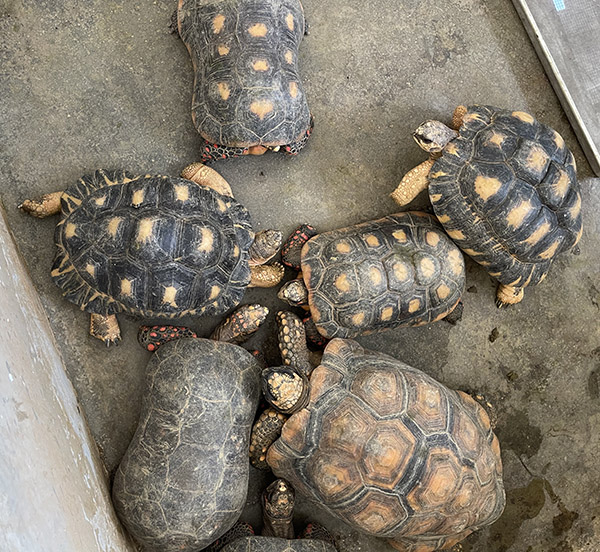
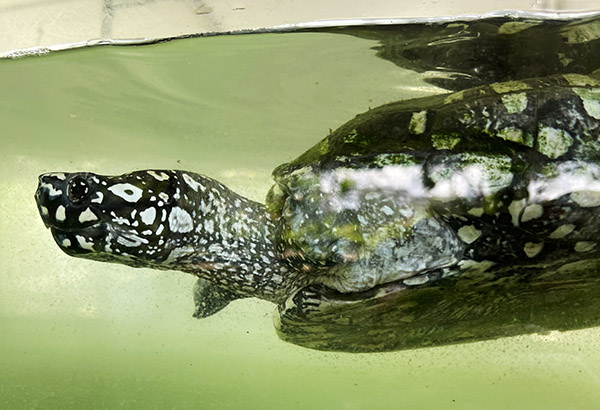
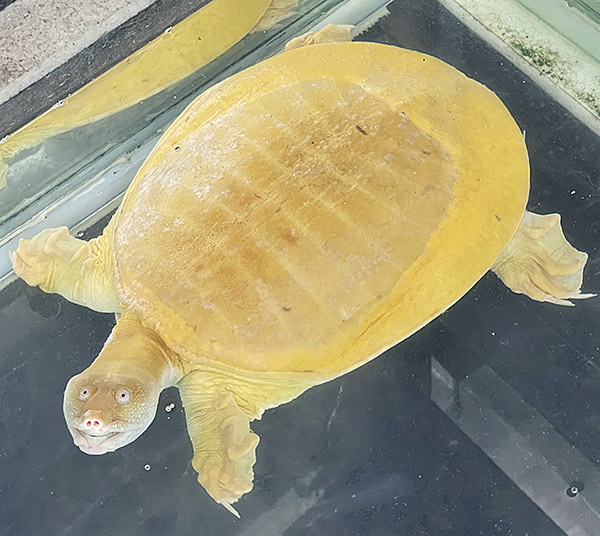
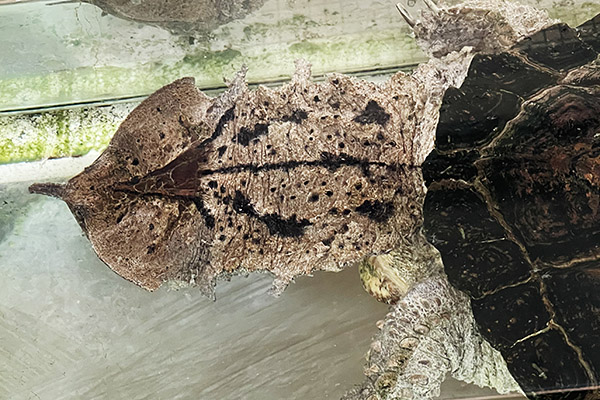
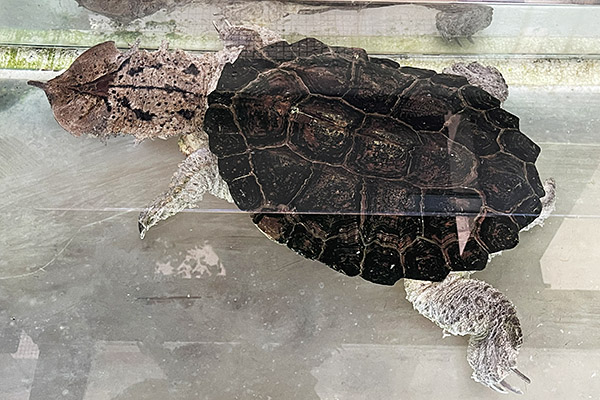
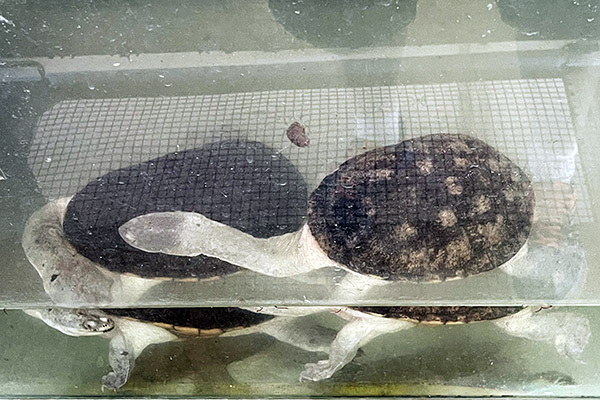
These are African spurred tortoises, also known as Sulcata tortoises. The can get as big as 100 pounds. They dig burrows down as deep as 20 feet to escape the heat in Africa.These are red-footed tortoises from South America. They are found from Panama to Argentina. They will grow as large as 14 inches and they live about 50 years.Here’s an Indian Star tortoise. They can be found in the grasslands and forests of India and Sri Lanka.This is an Indian Spotted Pond turtle. They are an endangered species.This is an albino Pig-Nose turtle, also known as a Fly River turtle.A closer view of the Pig Nose turtle. You can see how it gets its name. This species is found in northern Australia, southern New Guinea, and West Papua. It is a unique freshwater turtle; it’s the only species with flipper-like feet (similar to sea turtles).Here’s a strange one: The Mata Mata turtle. It takes the word “camouflage” to a new level.Another view of the Mata Mata turtle. It’s native to South American streams, stagnant pools, marshes, and swamps in the Amazon River basin.This is a Snake Necked turtle, a species found in Australia and southern New Guinea. They use their long necks to snap up prey.
So there you have it: The Turtle Museum in Singapore. I enjoyed it right up to the time we left. Because the Museum is in such a remote location, there were no cabs waiting outside when we were ready to return to our Orchard Street hotel. Neither Sue nor I could get a signal on our cell phones, and there was no wireless coverage, either, so that ruled out calling a cab. To compound the problem, Singapore doesn’t have Uber of Lyft. We went back to Museum’s office area; fortunately, the office had Internet access and they secured a taxi for us. We had to wait a while for our ride, but that was okay. We had a good time. It was something different, and we saw a part of Singapore we had not seen before.
I thought I could skip this one in our ¿Quantos Pistones? series. After all, who ever thought there could be a 7-cylinder motorcycle?
But I was wrong. Much to my surprise, there are actually at least a couple of 7-cylinder motorcycles out there. I’ve never seen one, but they exist. One is comparable to the 5-cylinder machine based on the Kawasaki two-stroke engines; the other is an aircraft radial-engined affair.
The JRL Cycles Lucky 7 used an engine originally intended to be a replacement engine for aircraft that used a radial engine. They only built four of these (one prototype and three production bikes). It’s an interesting footnote in any discussion of motorcycle powerplants, I guess. But the thing looks goofy to me, and its chopperesque ergonomics pretty much guarantee it would be unrideable. You can read more about it here: JRL Cycles Lucky 7 – A Radial Engined Production Motorcycle
The other motorcycle I found online with a 7-cylinder engine is the aforementioned Kawasaki. Here’s a video that does a good job describing it:
The real treat in the above video arrives in the last minute or two, when you can hear it run. It’s worth watching.
So what’s next? Have much milk is left in the cow? Have we exhausted all possible motorcycle engine configurations in our ¿Quantos Pistones? series? Nope. Stay tuned…the Eights are coming up!
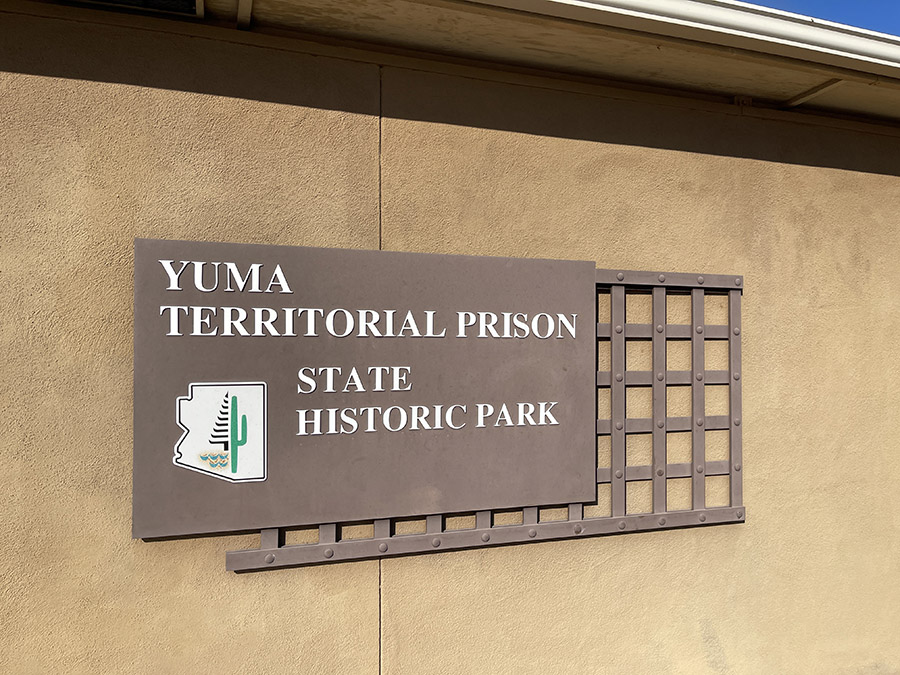
There were four territorial prisons in the early western United States: Wyoming, Montana, Idaho, and Yuma. I’ve been to two of them. Sue and I visited the Old Idaho State Penitentiary last year (it was awesome), and most recently, the Yuma Territorial Prison tucked away in the southwestern corner of Arizona. Years ago, I’d been to the Yuma Territorial Prison on a motorcycle ride with good buddy Dick Scott. It was way more primitive then; it wasn’t much more than a few remains of the original prison with not much identified. That’s not the case today.
After catching up with John at dinner over fish tacos the night before, we had a nice breakfast the next day at the Yuma Denny’s (don’t laugh, it’s my favorite place for breakfast when I’m on the road). After that, it was on to the Yuma prison.
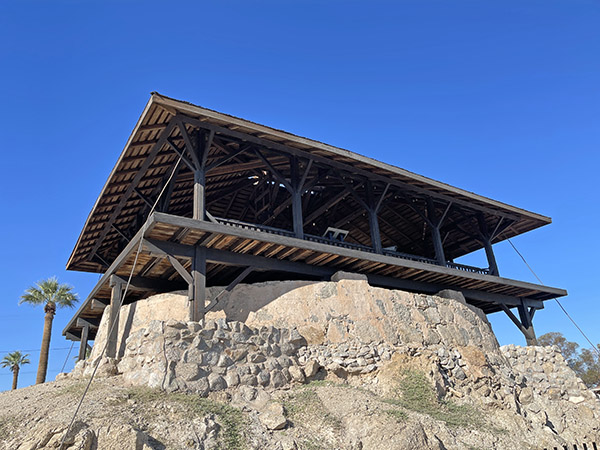
The Tower overlooking the Yuma Prison.
On this trip, Sue and I were on our way home after visiting the Buddy Stubbs Motorcycle Museum in Phoenix (it was awesome) and we decided to divert down to Yuma to visit with my motorcycle riding and hunting buddy, Baja John. It was a good visit.
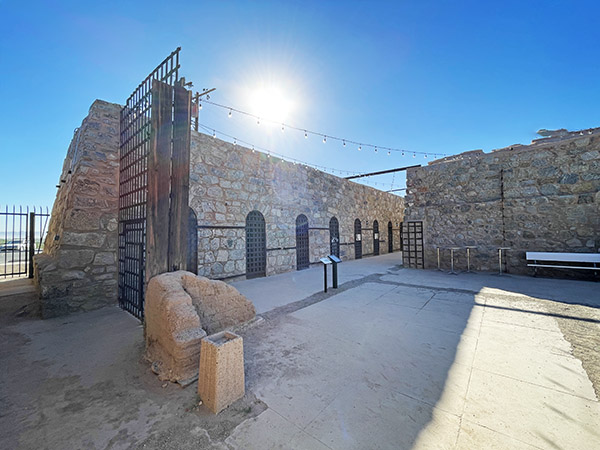
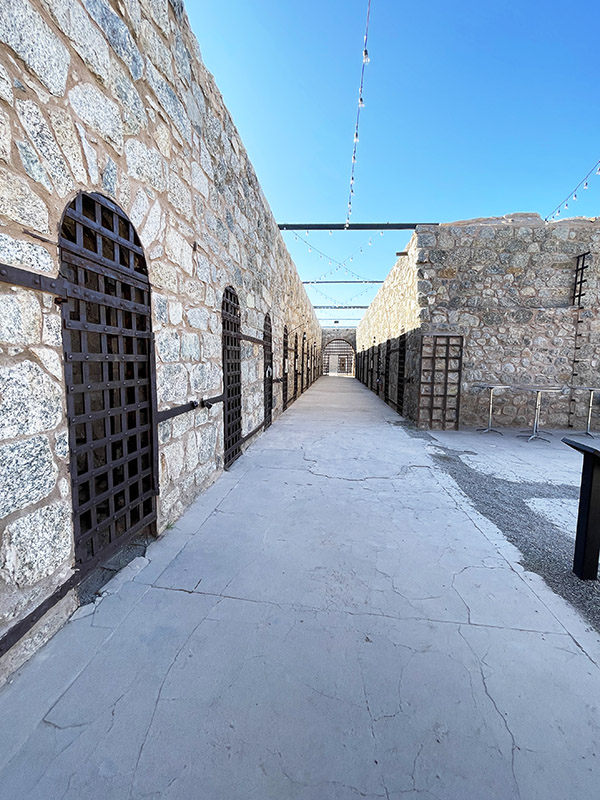
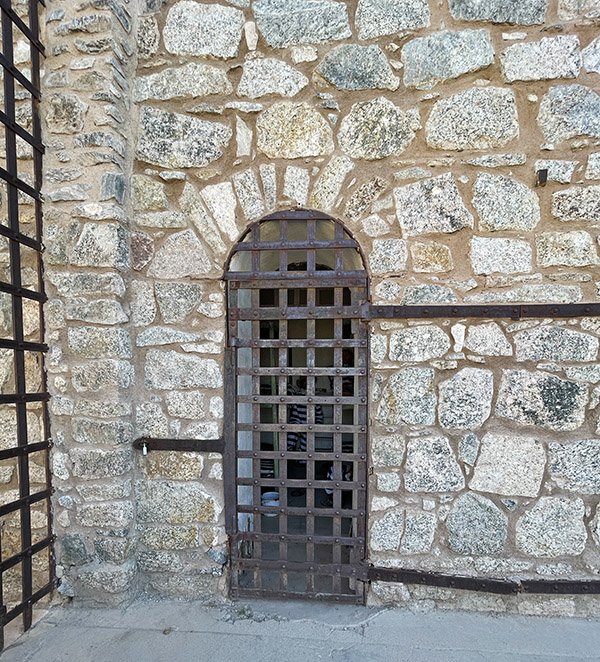
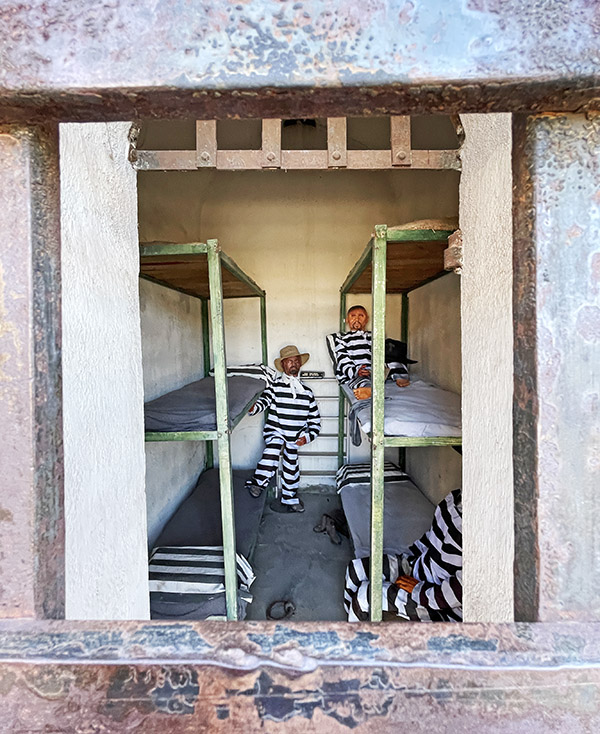
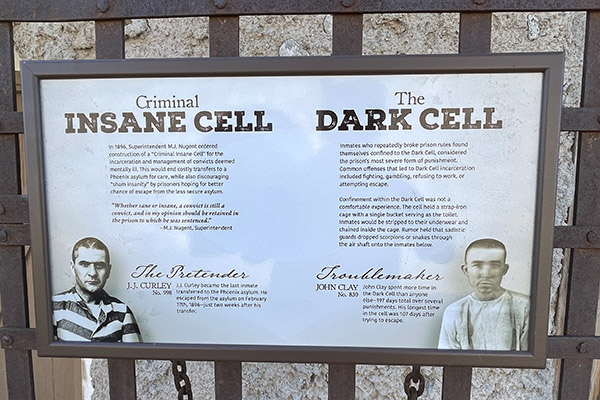
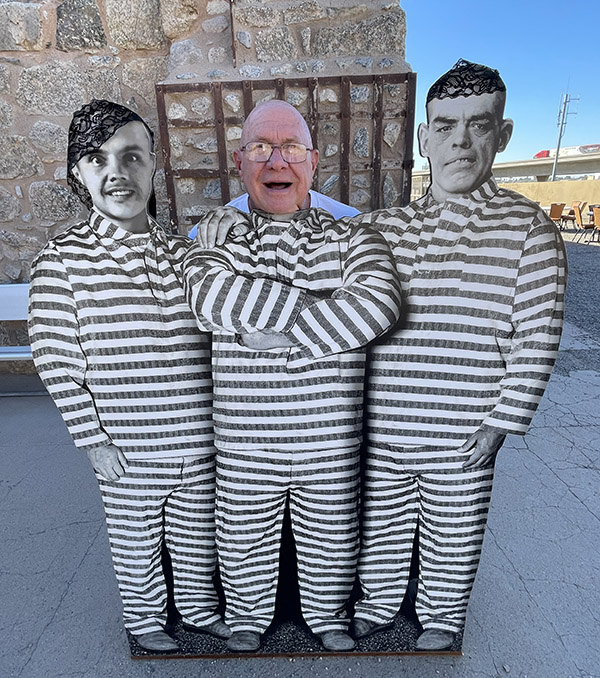
Yuma often sees temperatures over 110 degrees, and sometimes 120 degrees, during the summer months. It must have been brutal being incarcerated there.Bleak. Desolate. Dehumanizing. I see nothing wrong here.If you were an inmate, you’d be home now…Six to a cell. Impressive. High density housing.The Yuma Prison apparently had some interesting houseguests.
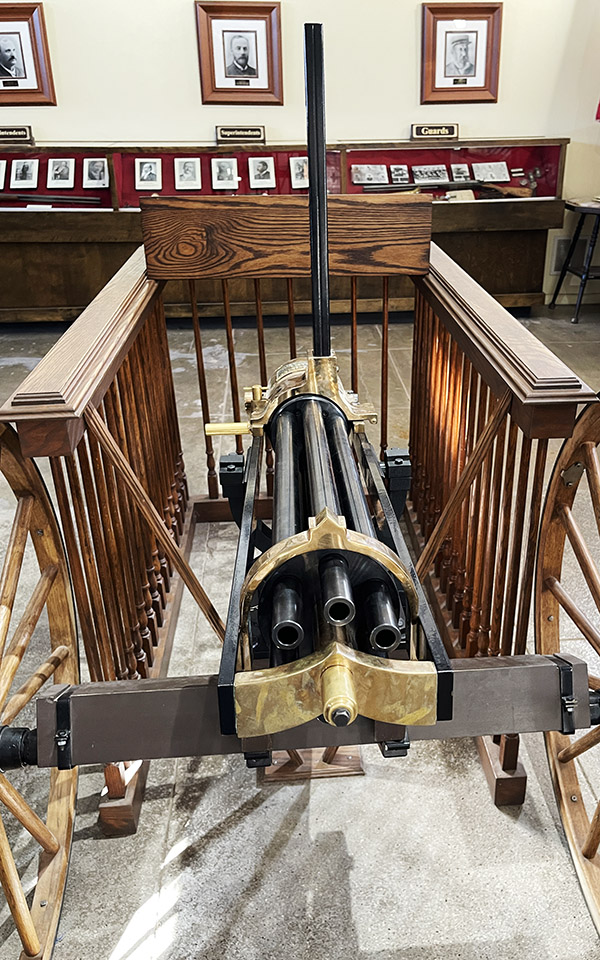
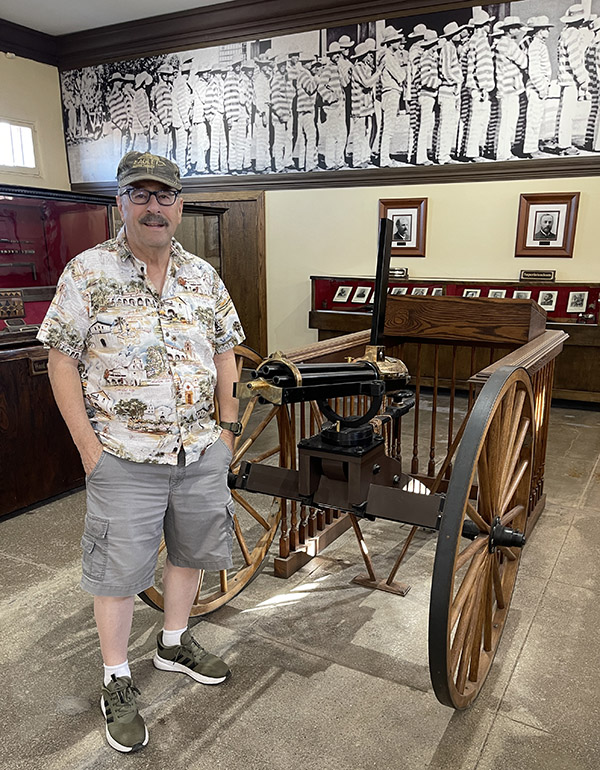
As soon as you enter the Yuma Territorial Prison State Park, there’s a very nice museum. One of the displays that immediately caught my eye was a Gatling Gun.
A Gatling in the Yuma Prison museum.The obligatory Gatling pose.
I like Gatling guns. You should, too, and as I always say, don’t way for the movie. Buy the book…
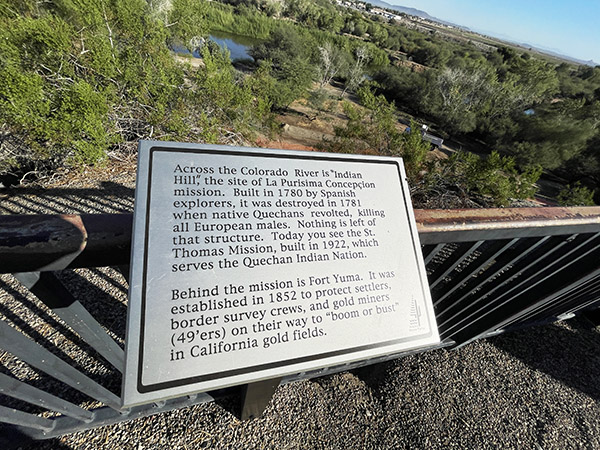
As mentioned above, Yuma is located in the southwestern corner of Arizona directly across the Colorado River from California. It was an interesting and vital stop for many ’49ers who entered California seeking gold. There are scenic overlooks that allow a clear Colorado River view.
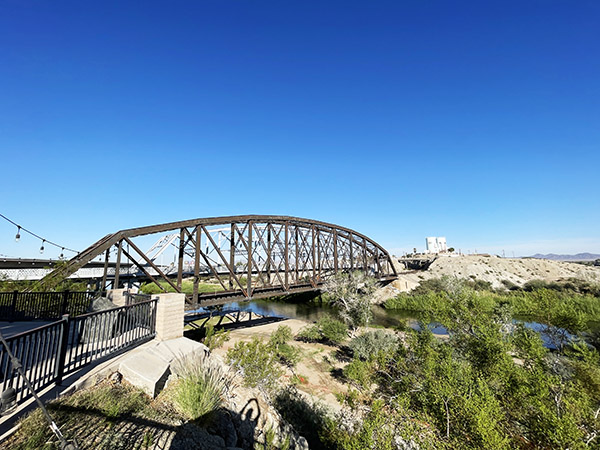
That’s the Colorado River, and just across it lies California, the home of high gas prices and left-wing lunacy.A railroad bridge across Colorado.
We had a good time at the Yuma Prison State Park. John is still there, hoping to get out soon based on good behavior. We’ll see.
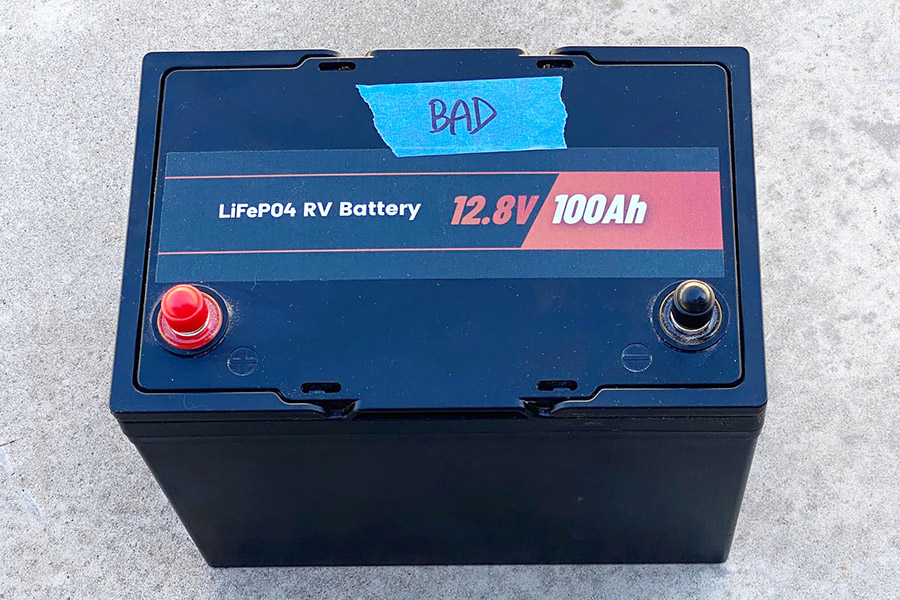
You’ve probably read the story of my new, solar, mondo lithium battery bank. It consists of 16, 12-volt, 100ah lithium batteries and so far is working well. What you don’t know is I actually have 17 lithium batteries.
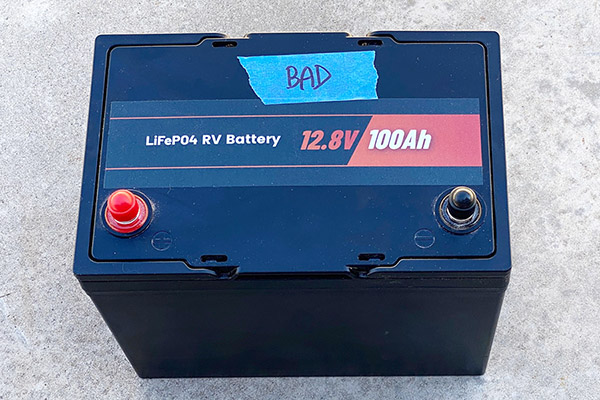
This one was dead on arrival. Before tossing it, I decided to see what’s in the box.
When I ordered the batteries one of them was dead on arrival. Like zero volts. This is a huge red flag because the LiFePo battery is know for its ability to hold a charge for long periods of time. I tried connecting a battery charger to the thing but all I got were sparks.
CT contacted the seller and they said it’s normal and to jump the battery with another (good) battery. I tried that and got even bigger sparks. The thing was shorted internally. CT went back and forth with them, and they wouldn’t send another battery. They did give us a refund, though, so it was all good and I bought another battery of a different brand.
Once the new bank was online and operating well, I broke down all the shed-filling, cardboard packaging for 17 batteries and hauled it off to the La Luz dump (a very fine dump). This left me with a lone, dead lithium battery. I was going to toss it out anyway, so I decided to open it up and see what a lithium battery looks like inside.
The top part of the battery box snaps into the bottom but I didn’t know that, so I set the circular saw to about 1/16″ depth and (after taking the battery outside in case it burst into flames) cut the top off.
The top part was still attached. I didn’t want to cut any deeper because I had no idea what was inside. Wedging a flat-head screwdriver under the saw-cut lip and working it around the perimeter of box released the lid. Turns out I didn’t need the circular saw. After removing the lid, the internal parts easily slid out of the box, all in a nice, neat tray.
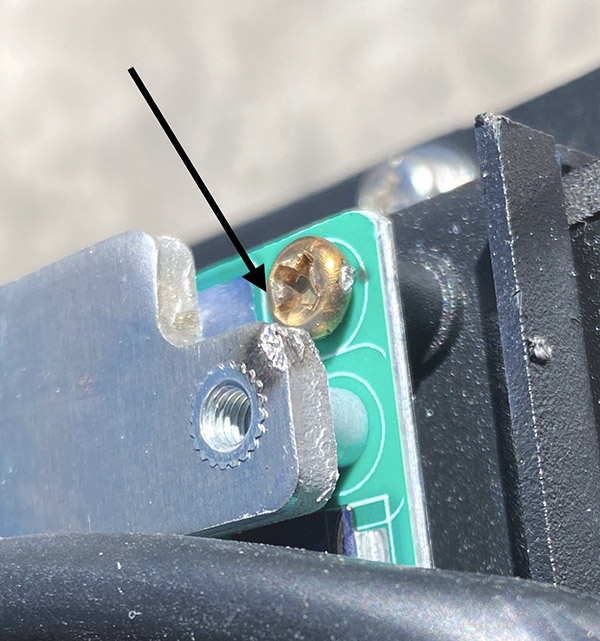
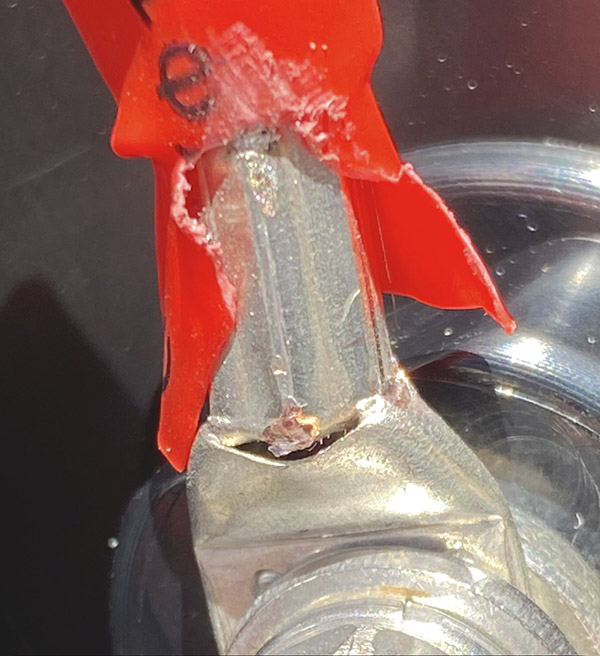
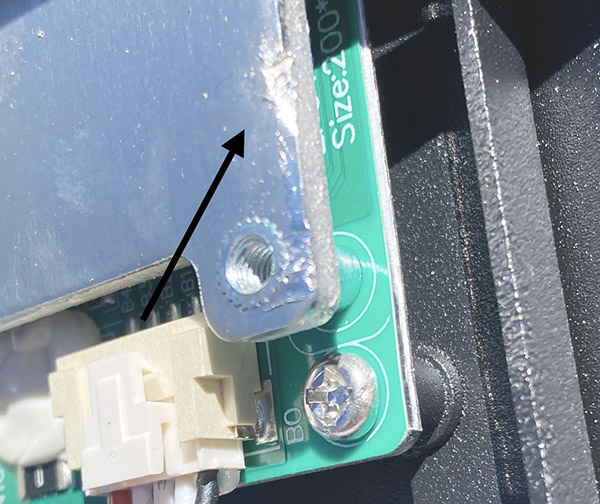
Once the thing was apart the problem was obvious. Both the positive and negative wiring to the output posts were shorted out on the big, metal plate. The shorted metal plate covers the battery monitor circuit board.
This is where the battery was shorted.Insulation chafing on the positive side.Another shorted area.
The negative switch is how the battery monitor connects the internal bits with the external world. Over charge the battery? The battery monitor switch switches it off. Short out the battery? The battery monitor switch switches it off. Drain the battery too low? The battery monitor switch switches it off. For all I know there’s a high/low temperature cut off in the thing.
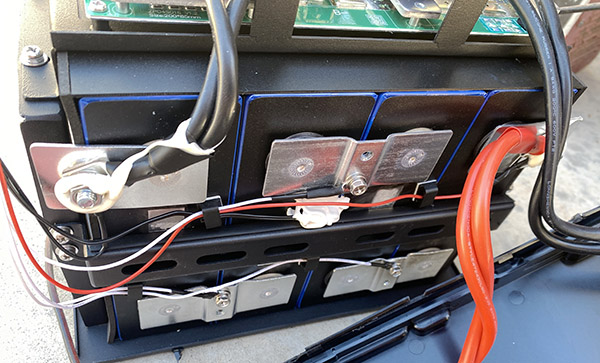
The heart and soul of the battery are these four big 3+volt, 100ah cells wired in series by those welded jumpers.
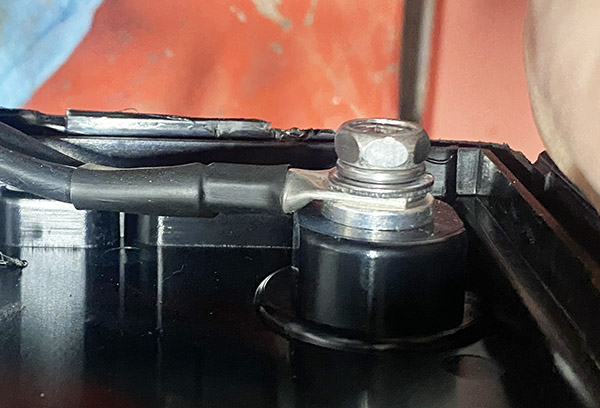
It turns out whoever built the battery put the terminals to the output posts on upside down. This moved the barrel/crimp part of the wire connection that much closer to the metal plate.
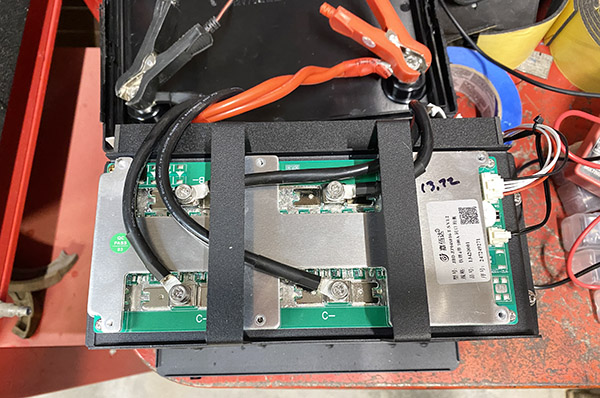
Under the metal plate sits the battery monitor system board. It connects to each individual cell and also saved the battery from bursting into flame from the short circuit.
All things considered, if you’re going to screw up the battery this was the least damaging way to do it. Since the + and – were directly shorted before it got to them, the electronics and lithium cells weren’t involved the short circuit. The battery monitor system kept the thing from burning up due to the short.
I added a bit of insulation to the burned areas that were shorted.
Once the lid was off and the source of the short removed, the battery showed voltage again. Pretty cool. I gave the battery a charge and all seemed normal. I load tested the thing at 100 amps and it held voltage fine. You know what this means.
The fix was as easy as flipping these connections 180 degrees. Photo shows the connection already flipped. The other way they contacted metal.
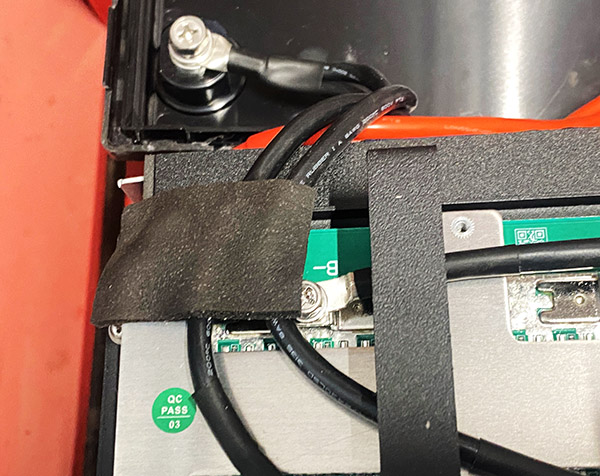
The fix was as simple as flipping the wire terminals over allowing that extra 3/16″ clearance. I reassembled the guts into the battery and snapped the lid back on and now I have an extra, good lithium battery. While technically it’s a free battery I have some time in the repair. Now I know what’s inside the black box. I’ll probably run some gorilla tape around the box so the iffy lid attachment stays put and call it a win.
I haven’t done a knife story in awhile, but that doesn’t mean I haven’t been buying. Some of these online knife stores’ websites are addictive, and the Chicago Knife Works site certainly falls into that category. It’s fun just perusing their offerings. Sometimes, I’ll see something that piques my interest and then I’ll search on a feature that a particular knife has. That occurred recently when I saw a folder I likes with bone handles (or scales, to use knife aficionado terminology).
Bone as a scale material is intriguing to me, partly because I like the way it looks, partly because it looks like ivory, and partly because of a recent visit to the fabled Colt Custom Shop in West Hartford, Connecticut. When I saw an artist crafting custom grips on a Colt 1873 Single Action Army, I asked about the material (knowing that ivory was no longer available). The answer, as good friend and Colt factory guide Tim told me, was bone. Giraffe bone, to be specific. I would never have imagined.
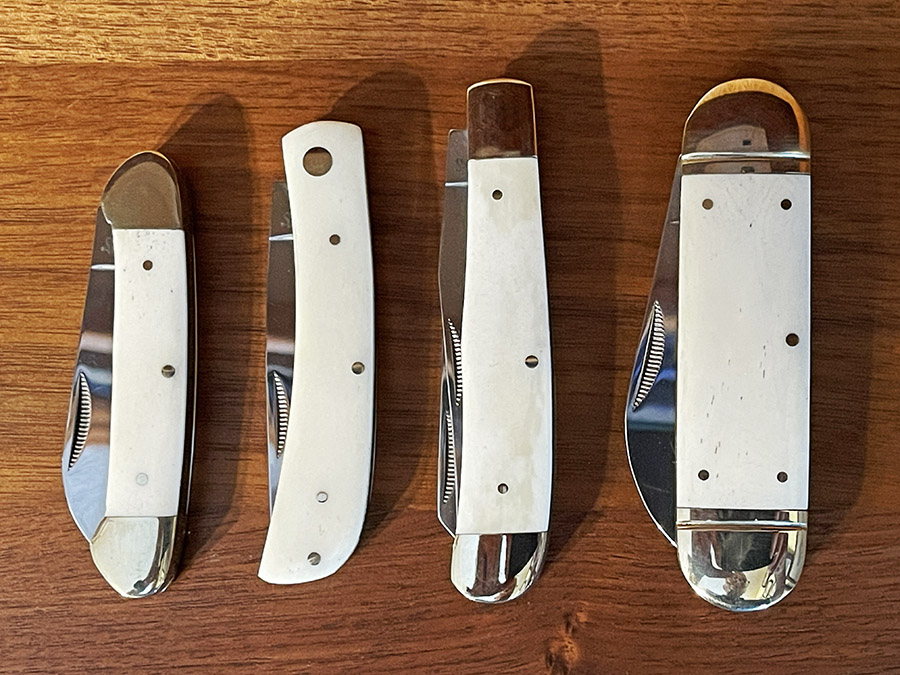
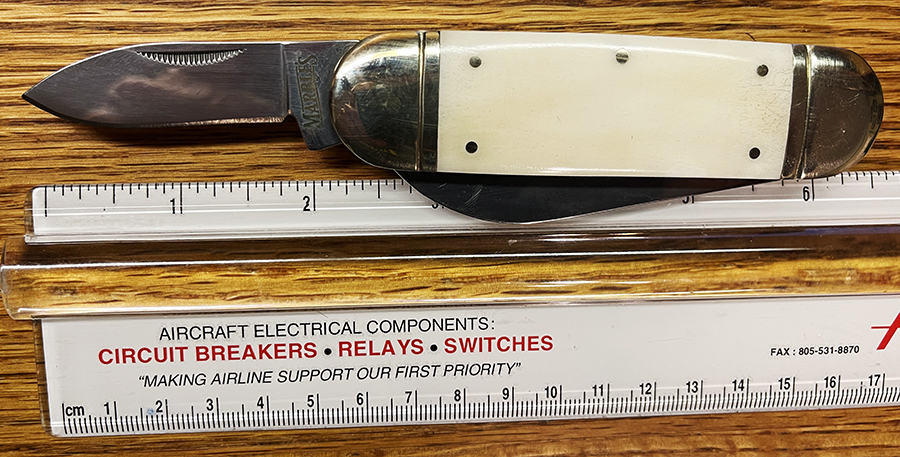
Anyway, to get back to the main attraction, I saw a Marbles folding knife with white bone scales on the Chicago Knife Works site and I liked it, so I searched on all Marbles folders with bone scales. What the site’s search returned was intriguing.
I liked every one of the knives I saw, and Chicago Knife Works‘ prices are so reasonable I pulled the trigger on all of them. Cheap fun, and they looked good on the Chicago Knife Works site. They arrived a few days later (all the above, with shipping, was only about $50), and I can tell you they look even better in person.
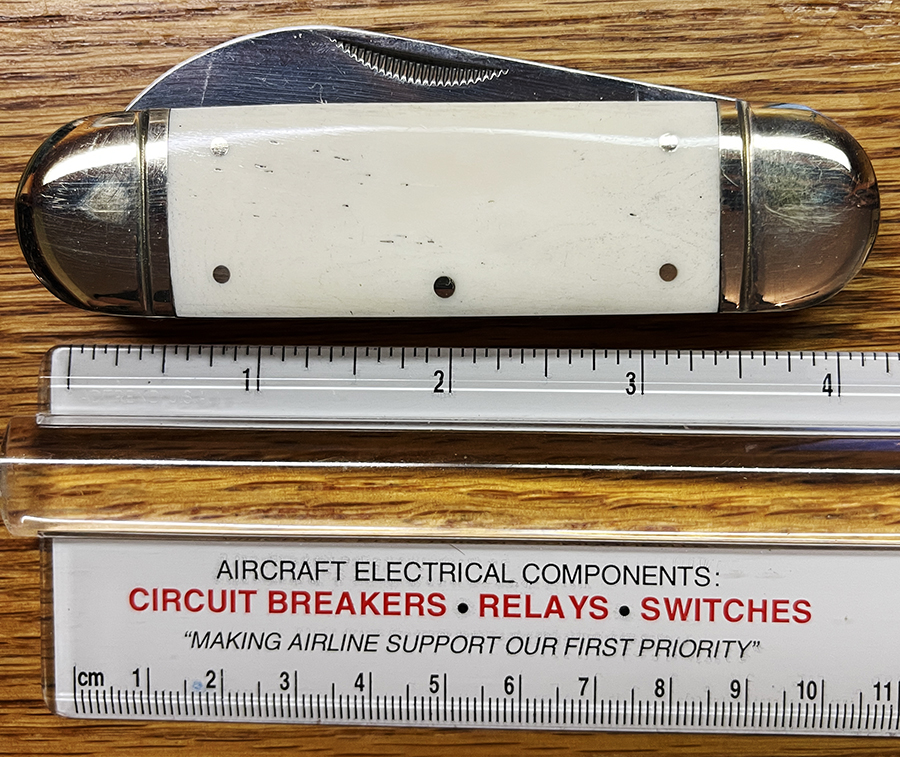
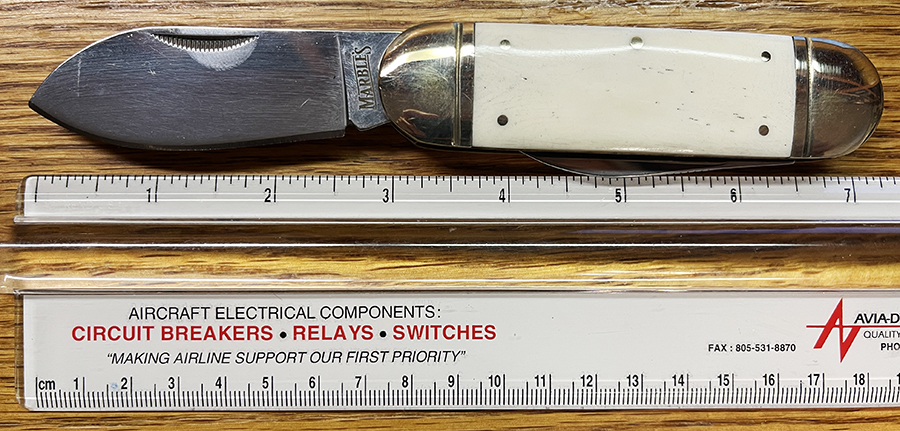
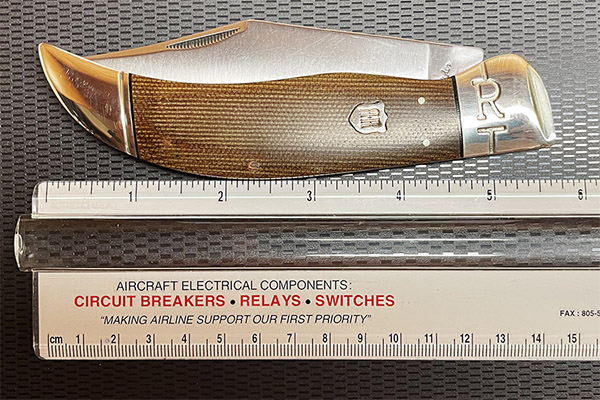
All the knives are appealing, and I like the white bone appearance. The canoe style is one I’ve written about before, and in my opinion, it is about the perfect-sized pocketknife for pocket carry. It has two blades and both are razor sharp. The work knife (also known as a sodbuster) is a single-bladed knife and its name comes from the fact that it is designed to be used by a working man (like a farmer). The trapper knife (as you might have guessed) is the design preferred by trappers. It has two blades: One with a clip point and the other with a spey blade (we’ve mentioned those before; my Case Stockman knife also has a spey blade). And finally, there’s that gorgeous two-bladed sunfish knife, which is a big knife. It gets its name from its sunfish-like shape.
The Sunfish is a physically big knife, as the following photos show:
I can’t say which of the above knives I like the best, so I’ll cut to the chase and tell you that I like them all. So much so, I continued the quest for knives with white bone scales.
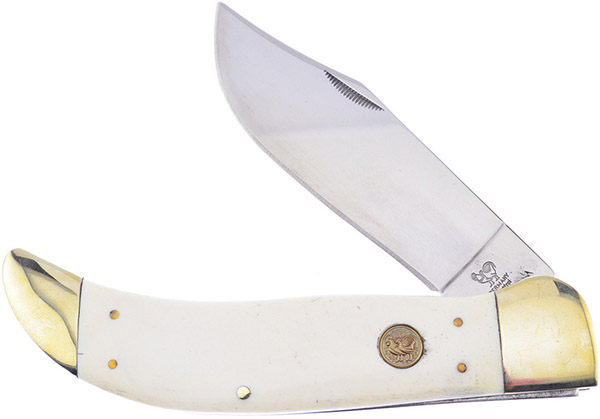
Most recently, I purchased a large folder (the Rough Ryder Deer Slayer) from another knife supplier only because Chicago Knife Works didn’t have it in stock. I’ve written about it before.
I like the look and size of the Deer Slayer so much that I started poking around to see if that knife was available with white bone scales. It was. The manufacturer this time is Hen and Rooster, and I was able to order it from Chicago Knife Works.
I guess I should say the importer, not the manufacturer, as I suspect the same manufacturer makes knives for several importers with slight differences to meet the importers’ marketing strategies. I don’t have the Hen and Rooster knife yet, but when I get it, I’ll post a few photos in a future blog.
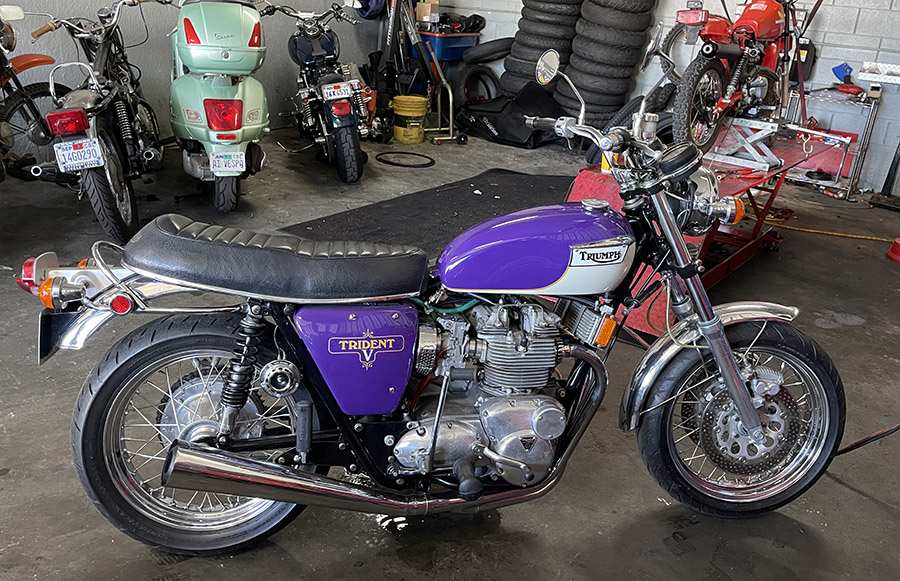
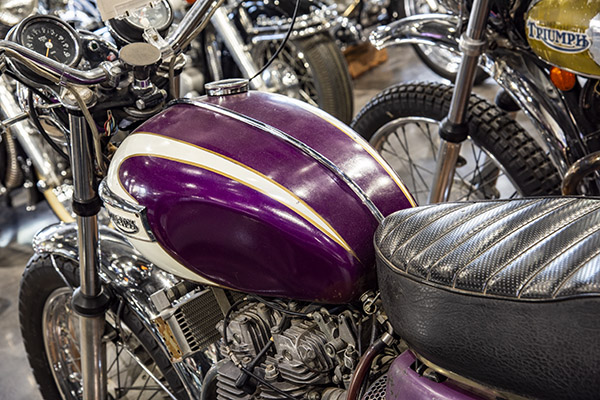
I stirred up a few comments last week with that photo of Emma Booton’s 1972 restomod Triumph Trident and its glorious purple color. This week, I visited the Buddy Stubbs Motorcycle Museum in Phoenix, Arizona (a wonderful place, and the subject of an upcoming ExNotes blog) when I happened to spot an original ’72 Trident 750cc triple. Its original purple paint was what Triumph called Regal Purple.
You know, Emma was right. Roto Rooter purple, the color you see on her bike in the photo atop this blog, is much nicer. That’s my opinion, and if you don’t agree with me, I am okay with you being wrong.
There are a lot of motorcycles in the Buddy Stubbs Museum, and each has a story. Watch for our upcoming blog on this Phoenix destination.It presents a regal appearance, don’t you think?
The original Triumph is a nice motorcycle, and it has the advantage of being original (including the original paint geometry, with Triumph’s familiar scallops). But given the choice, Emma’s Triumph gets the nod here.





 We are a literary bunch, us ExNotes writers. Joe Gresh and I published a collection of our favorite stories not too long ago, and I’ve penned (or keyboarded) a few myself. Here’s a link to the Gresh and yours truly book,