Reloading Part II: The first steps

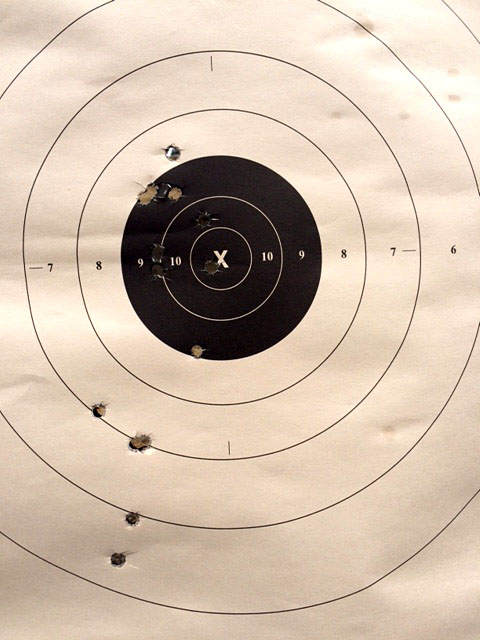
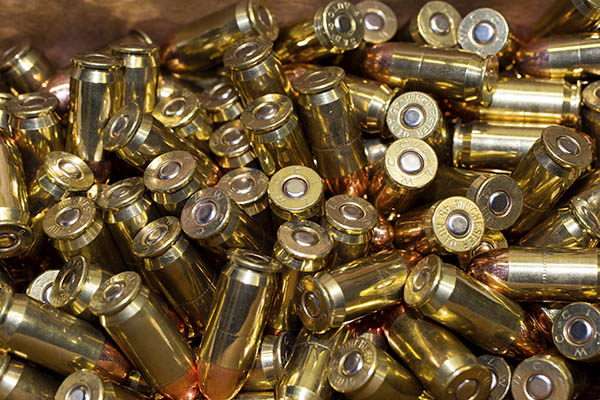
Reloaded .45 ACP ammunition. Bright, shiny, and far more accurate than factory ammunition in my Colt and Rock Island 1911 pistols.  I’ve got the targets to prove it.

In our first post on this topic, we talked about the equipment and components needed for reloading the .45 ACP cartridge.   In this blog, we talk about the reloading process.  We won’t cover all of it here (we’ll get about halfway through), and we’ll cover the rest of the process in a subsequent blog or two.  In our first blog, we discussed the basic equipment.  In this blog, we’ll talk about a few more bits of equipment that I use, but they are not essential.  You can get by without them.

If you want to catch up with the first blog on this topic, you can do so here.

Let’s say you’ve been to the range, you’ve made .45-caliber holes in your targets, and you’ve collected your spent brass.   That’s the only part of the reloading process I don’t like…at my age, bending over and picking up all that brass is a pain-in-the-you-know-what.   But I still do it.  In fact, if I see somebody leaving brass on the ground, I’ll collect it.  I grew up collecting brass to reload, and leaving brass at the range feels to me like a crime against nature.

So we’re home, and you’ve got your fired brass…
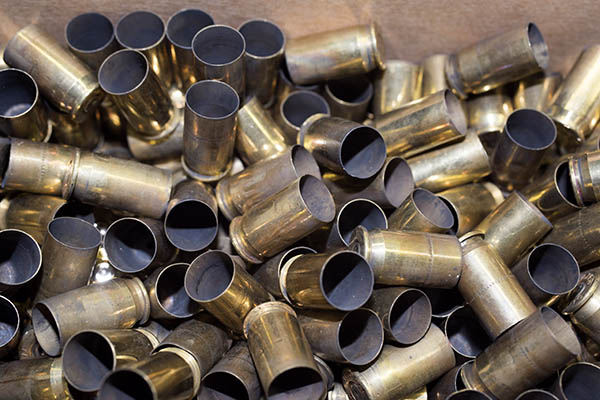
Fired .45 ACP brass.  I just can’t leave brass at the range.  To me, it’s like leaving cash on the ground.

This next step I’m going to show you is an optional one, and that’s cleaning the brass.   You don’t need to do this, and I reloaded .45 ammo for a lot of years without ever cleaning my brass.  I always do it now, though, and I do it for two reasons:  Cosmetics and accuracy

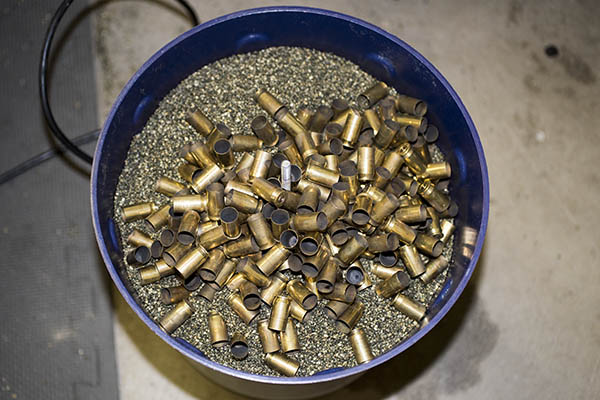
Here’s how I go about doing it.   I dump the brass into my vibratory tumbler and let it rock for a couple of hours.
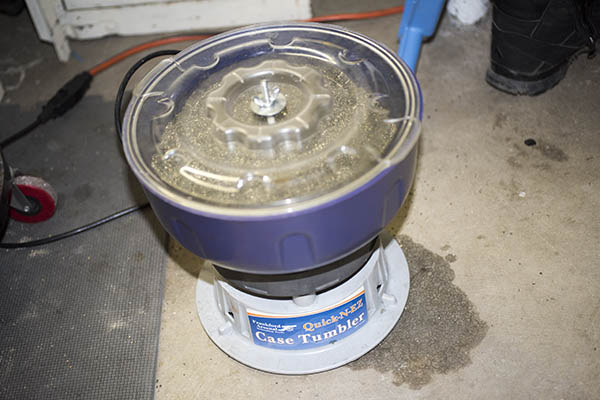
My Frankford Arsenal vibratory cleaner. I call it a tumbler. It has corn cob media. You unscrew the butterfly nut on top, remove the cover, and dump the fired brass into the media.
Here’s the tumbler with the cover removed and the brass placed on the media. The cover goes back on and I let the thing vibrate for a couple of hours.

Like I said above, I tumble my brass.  One of the reasons is that I like bright, shiny ammo (it just looks cool).  But a far more important reason is that it makes the ammo more accurate.   When you tumble the brass, you’re cleaning it on the inside and the outside.  The outside is cosmetic.  The inside affects the grip the brass case has on the bullet.  We’re not interested in making it shiny on the inside; we’re interested in making that grip consistent.   I’ve found over the years that a consistent inside case surface (where the case interfaces with the bullet) makes for a more accurate cartridge.   It’s extremely significant in a rifle (I’ve seen 100-yard groups shrink from 3 inches to a quarter of an inch in my .30 06 Model 70 Winchester just by tumbling the brass).  The accuracy improvement in a handgun is not that significant, but it’s still there.   You don’t have to do this (you can reload the brass without tumbling it), but it’s something I do.

Here’s what the brass looks like after it’s been tumbled….
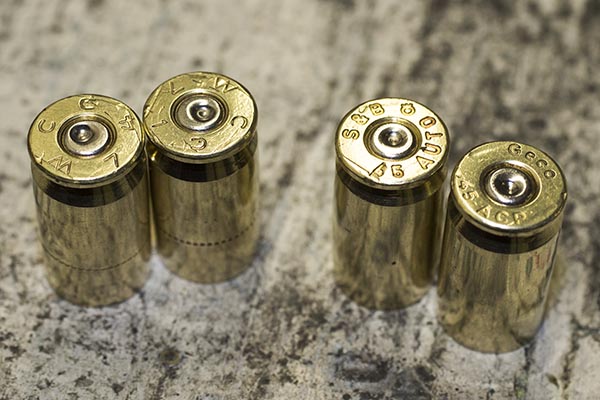
Squeaky clean and shiny. Fired, cleaned brass.

Now we’re ready to start the resizing operations.   We’ll want to get our ammo trays ready…
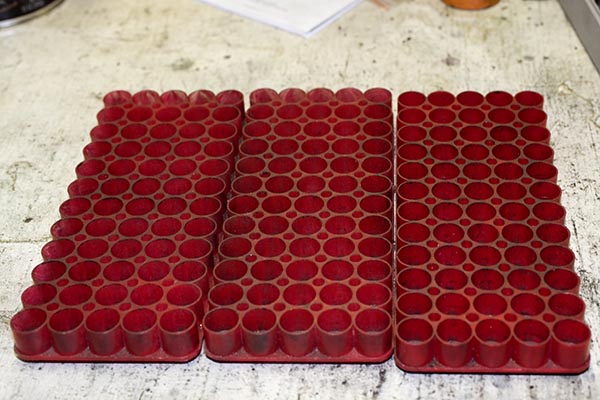
Reloading trays. Each tray holds 60 rounds, but I only load 50 in each one.

The next step is to install the first of our reloading dies (the resizing die) in the press.  We’re going to use this die to squeeze the cartridge case back to its unfired case diameter and simultaneously knock out the fired primer.
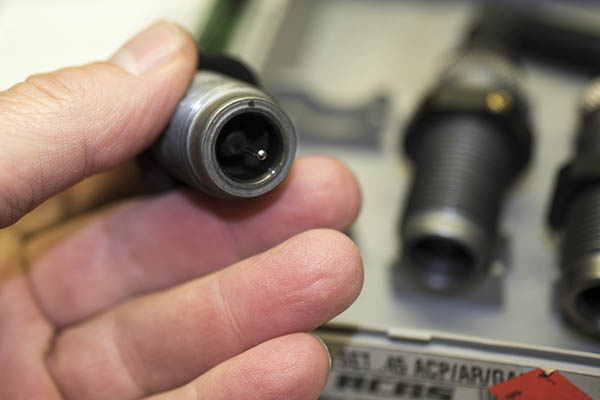
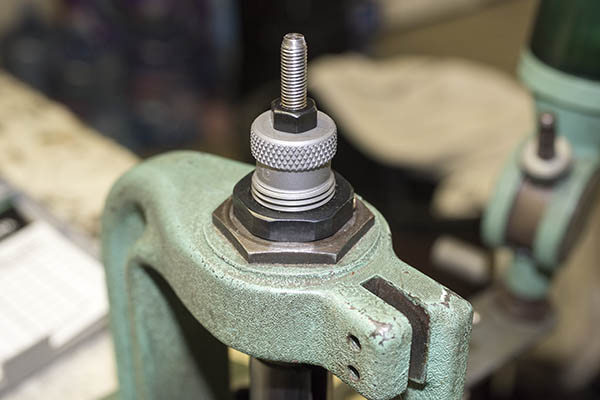
The resizing die. Note the protruding pin; it’s what pushes the old primer out of the brass case.
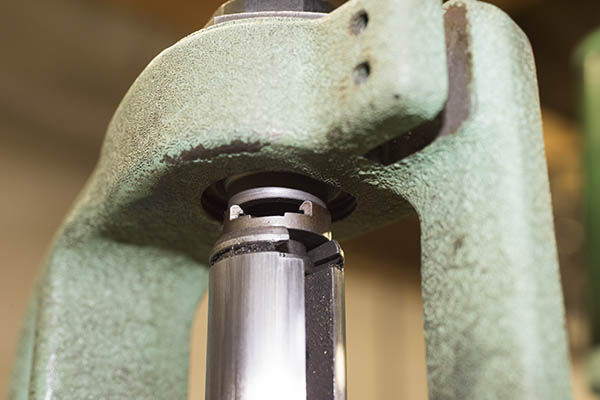
The resizing die, threaded into the reloading press.  Note the large locknut at the base.
With the shell holder installed on the press ram, we fully elevate the ram, thread the resizing die down to contact the shellholder, withdraw the ram slightly, turn the die in just a bit more, run the ram up, and then lock the die in place with its locknut.  What we want is to feel a slight “knuckle over” when the ram is fully elevated.

At this point, we’re ready to start resizing and depriming cases.  Here’s what that looks like.
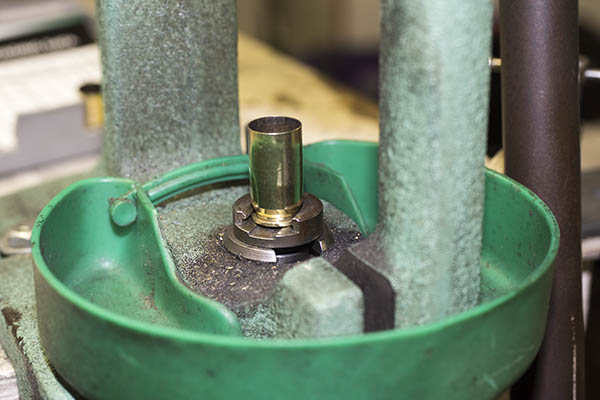
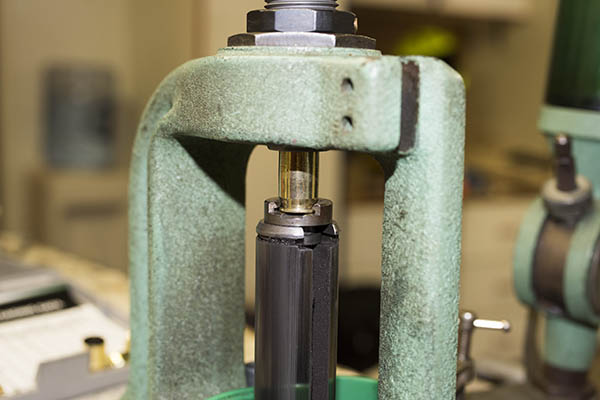
A case in the shellholder.  When we raise the ram, it will be resized and the old primer will be pushed out.
The ram is raised all the way to the top of its stroke. Here we see the case just starting to enter the resizing die. You don’t want to get your finger caught between the die and the fired case (don’t ask me how I know). The ram will go up until the shellholder contacts the bottom of the sizing die.  As that occurs, the case is resized to its original diameter, and the primer is pushed out of the case.

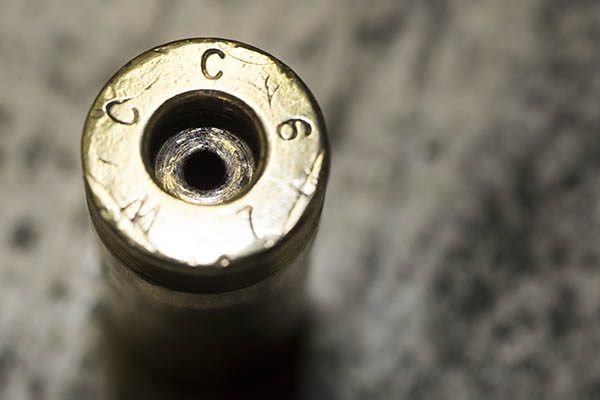
This is what the case looks like after it has been resized.   Note that the primer is no longer in the case.  Also, note how funky the primer pocket is.  It’s gunked up with combustion residue.
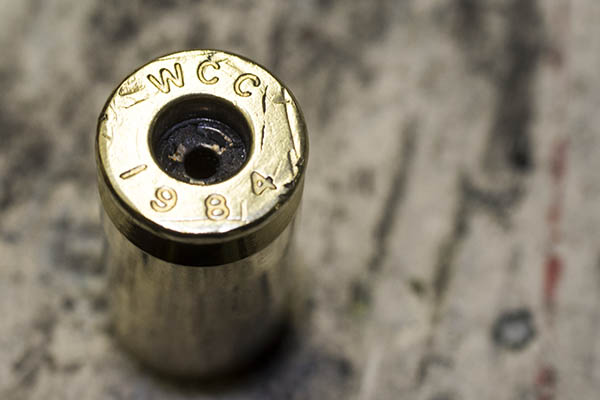
A resized, deprimed case. Note the combustion reside remaining in the case’s primer pocket.  And yes, I’ve been reloading this case since 1984.  I’ve got some that are even older.  .45 ACP brass lasts a long time.

As each case comes out, I’ll place it in the reloading tray, like you see below.
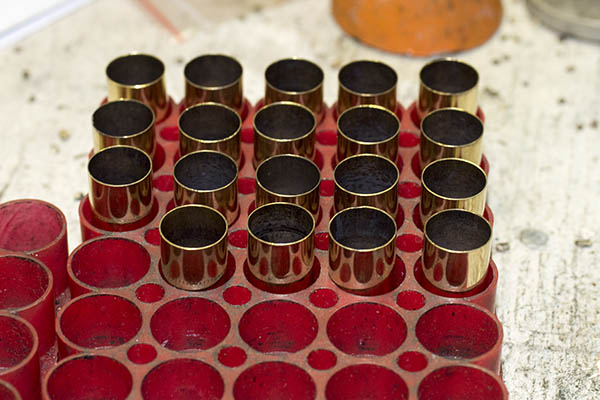
Resized and deprimed cases in the reloading tray.

When I reload, I’ll generally do between 20 and 200 rounds in a batch.   I reloaded 150 rounds in this batch.
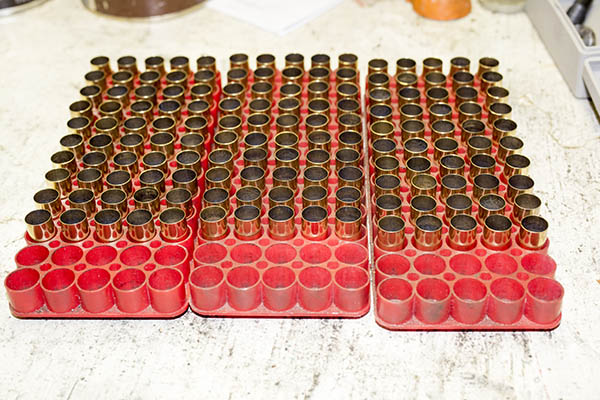
150 resized and deprimed cases.  Note that there are 10 empty spaces in each tray.

I use reloading trays that hold 60 rounds, and the reason I like these is that for a group of 50 cases I can track which case I’ve performed an operation on and which ones remain.   Each time a case undergoes a reloading step, I move it over such that I always have 1o open spots between the cases that have undergone a reloading step and those that have yet to undergo the step.

Ah, but those primer pockets.  Remember how dirty they were after we pushed the primers out?  Well, this is another optional step.  I clean the primer pockets.  I do each case manually, one at a time, using a primer pocket cleaning tool.
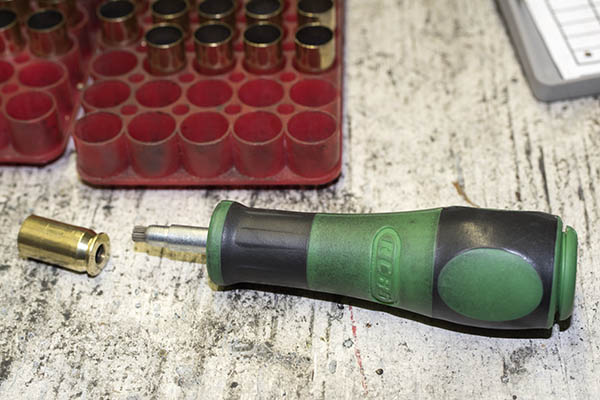
The primer pocket cleaning tool. It’s a primer-pocket-sized wire brush, and it removes the primer pocket combustion residue.
A cleaned primer pocket.  It doesn’t need to be bright and shiny; we just want to remove the clumps of combustion residue so the new primer can fully seat.

Like I said, primer pocket cleaning is optional.  I reloaded for a lot of years and won more than a few matches without primer pocket cleaning, but these days I do it on every case.  The reason we want the residue gone is that the residue can interfere with the new primer seating fully in the case (we’ll talk more about that in the next .45 ACP reloading blog).   Having the primers all seated to the same depth will theoretically make for more accurate ammunition (less variability always equals more accuracy).  It won’t effect functioning if the primers are at slightly different depths in a 1911, but if you’re reloading ammo for a revolver, a primer that is seated above flush (one that sticks out beyond the cartridge case base) can interfere with the cylinder turning.

At this point, we’ve got cleaned, resized, and deprimed cases.  We’re ready to bellmouth the cases, install the primers, charge the cases with propellant, and seat the new bullets.

So that’s it for now.  Stay tuned; this series will continue right here on the ExNotes blog!
Reloading Part I: Equipment and Components

The finished product:  Reloaded .45 ACP ammunition. This handcrafted ammo is tailored for my 1911, and it is much more accurate than factory ammunition.  Our blogs on reloading will cover the equipment and components needed, and the steps involved, in reloading ammo for the .45 Automatic.

I’ve had a few requests for a blog on reloading.   You know, not just favored loads for different cartridges, but how to go about reloading.  I know it can be a bit intimidating if you’ve never done it, but (trust me on this), learning how to reload adds an entirely new dimension to shooting, and many of us view reloading as being as much fun as shooting.  In fact, one of my friends often jokes about shooting…he says it’s what we do so we get to reload ammo again.

A very cool guy named Roy Johnson taught me how to reload when I was in the Army.   I was assigned to Fort Bliss, Texas, and Roy ran the Rod and Gun club there.  Roy was a colorful El Paso fixture, and they named the road to the Rod and Gun club Roy Johnson Lane when he died.  I was 22 years old when Roy taught me how to reload, and I’ve been reloading ever since.

I thought I would approach this topic in two or three parts, with the first blog focused on the equipment and components you’ll need to reload, and a subsequent blog or two on the actual reloading process.  I had to pick a cartridge, so I thought I would start with the first one I learned to reload:  The .45 ACP.

With that as a backdrop, here we go…


Reloading reverses the process of firing a bullet, and reversing that process requires several pieces of equipment.

One part of the equipment list is the dies that force the fired brass case back into shape (the brass expanded during firing) and knock the used primer out of the case.

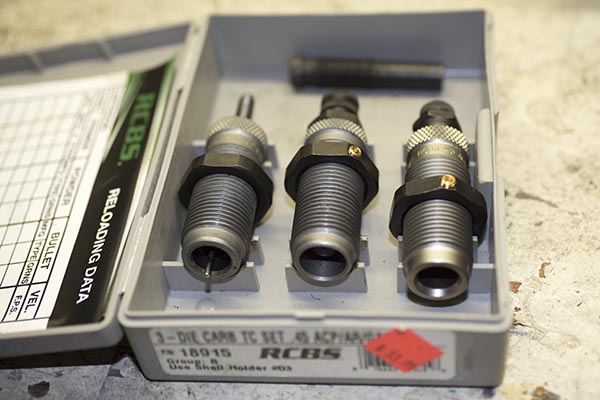
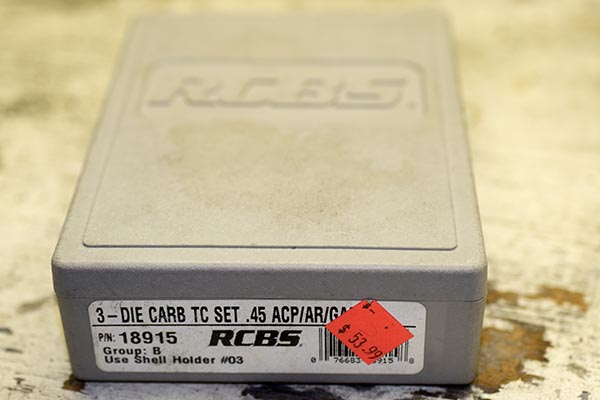
A set of RCBS carbide dies for the .45 ACP cartridge.
A die set consists for a pistol cartridge typically includes three dies. From left to right, they are the resizing die (it sizes the brass case back to original dimensions and punches the primer out of the case), the expander die (it opens and flares the case mouth to accept the new bullet), and the seating die (it seats the new bullet in the case and removes the case mouth flare).

I stick with RCBS dies, as I’ve learned over the years they work best, but there are other manufacturers out there.  I also use Lee dies for a few of the cartridges I reload (they are typically less expensive than RCBS dies, and they are as good).  An added advantage of the Lee dies is that they include the shellholder with the die set, so you don’t have to buy a separate shellholder and pay extra for it.  I don’t care for Hornady dies, but as they say, your mileage may vary.  I’m the guy doing the writing here, so I’ll share my experiences and preferences, and I like RCBS and Lee.  A new set of RCBS carbide dies are a little north of $50; Lee dies are typically $10 to $15 less than the RCBS dies (and like I said earlier, the Lee dies come with a shellholder).

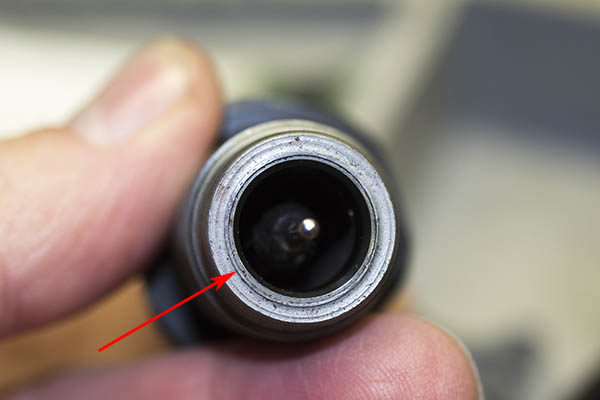
The business end of the carbide resizing die. The red arrow points to the carbide insert.

I use carbide dies for pistol cartridges.  A carbide die has a super-hard carbide insert that interfaces with the brass case, and it allows you to squeeze the case back to its unfired configuration without having to lubricate the case first.  The downside is that carbide dies are slightly more expensive than non-carbide dies.  For straight-walled pistol cartridges, there are three dies in a set.  We’ll discuss in more detail what each does in Part II of this series.

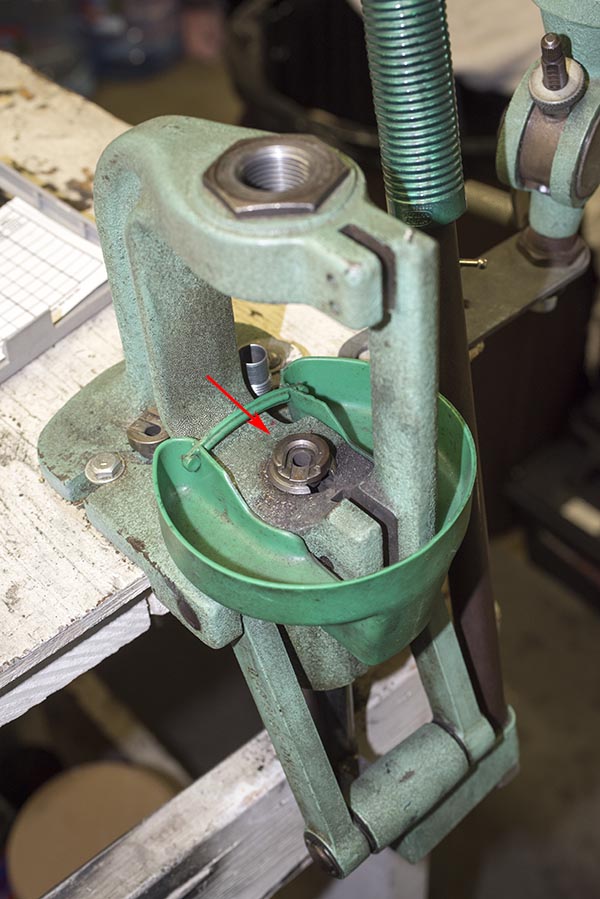
You will also need a reloading press and a shellholder for the brass cartridge case.   I use an RCBS Rockchucker press I bought new nearly 50 years ago when Roy Johnson taught me how to reload.  A good press lasts forever.

The RCBS Rockchucker reloading press. A good one lasts forever. The red arrow points to the shell holder. Different cartridges take different shell holders. We’ll see how all this stuff is used in Part II of our reloading series.

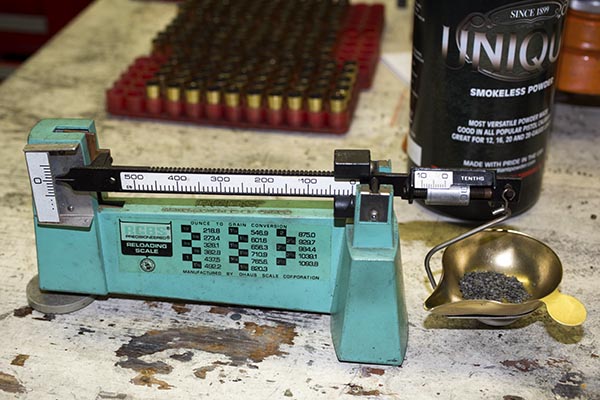
A scale is necessary for measuring propellant charges (also referred to as powder).   Several companies offer scales specifically designed for reloading.

My RCBS reloading scale. Like the Rockchucker press shown above, I’ve been using this for a half century.

It’s a good idea to have reloading trays for the cartridges.   These are relatively inexpensive, and they seem to last forever, too.

Reloading trays. These hold the brass cases we are going to reload, and allow for easy tracking and inspection of each reloading process step.

A powder dispenser allows you to dispense the correct amount of propellant in each cartridge case.

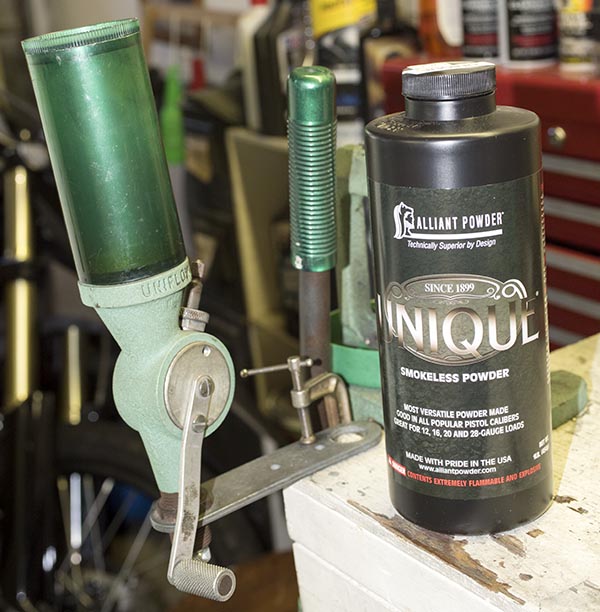
A powder dispenser, and the propellant I like to use for loading .45 ACP ammunition. I bought that dispenser back in the day, along with the scale and the press. My preferred propellant is Unique.

At this point, we’ve covered the equipment necessary; let’s now turn to the components.  One is the propellant you see in the photo above.  As seen in the photo below, for the .45 ACP cartridge, I prefer Unique.

You’ll need previously-fired cartridge cases.  You can also buy new brass that has never been loaded if you don’t have any, or you can buy factory ammo, shoot it, and save the brass.  I don’t think I’ve ever purchased new brass for the .45 ACP, mostly I had plenty available from my days in the Army.  The .45 ACP cartridge is a relatively low-pressure cartridge, and the brass seems to last forever.  I’ve been reloading the brass you see here for a long time.

Fired .45 ACP brass. It’s dirty. I usually polish mine, but it’s not necessary that you do so. We’ll talk more about that in the next blog.
Polished .45 ACP brass. It cleans up well and it seems to last forever (look at the stamps on the two cases on the left).

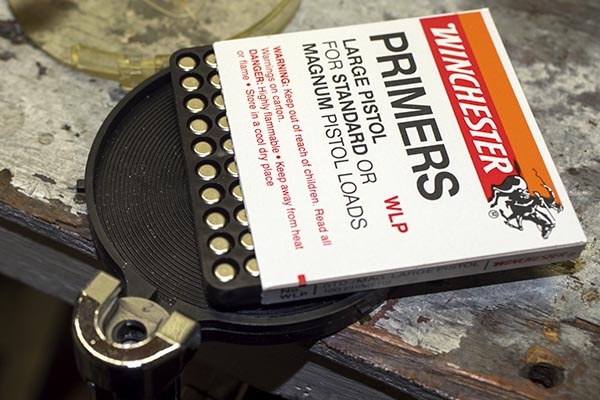
You’ll need primers.  The primer is the little cap that the firing pin strikes when you pull the trigger.   There are two or three companies making primers these days.  I usually buy whatever the shop has in stock.  I haven’t found that primers make a difference in accuracy or reliability for handgun shooting.

Winchester primers. We’ll talk about the tool you see below the primers, and how to install the primers, in the next blog.

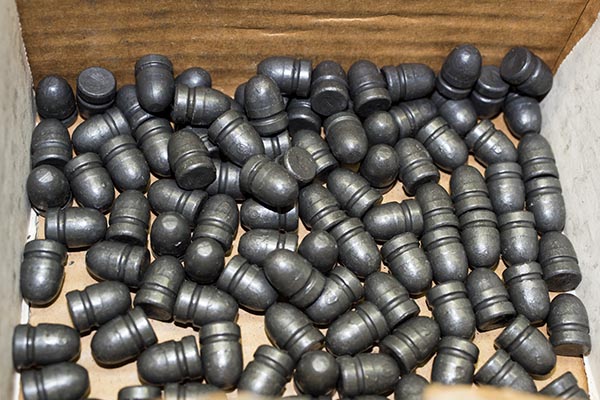
And finally, you will need bullets.  I’m using moly-coated 230-grain roundnose lead bullets these days, like you see in the photo below, mostly because I have a bunch of them in my reloading locker.  Many other bullet configurations are available.

Bullets. I usually buy them in boxes of 500 because I do a lot of shooting. There are different kinds of bullets available, but that’s a discussion for another time, too. If you’re just starting out and you’re reloading .45 ACP ammo, my advice is to get a 230-grain roundnose bullet in either cast or jacketed flavors. It will feed reliability in nearly any 1911. We’ll talk more about this in the next blog, too.

There’s one other item I strongly recommend you purchase, and that’s a reloading manual.  These manuals list different loads for different cartridges and different bullets and propellants.  The whole idea here is to experiment with these combinations (within the parameters provided by the manuals) to find the recipe that produces the best accuracy and reliability in your gun.  My preference is the Lyman manual, as it lists different bullet manufacturers and cast bullets, too.  You can buy manuals from the bullet manufacturers, but the downside there is they only show data for their bullets.

You can buy all of the equipment separately (as I did a long time ago) or you can buy a complete kit that has everything you need to get started.   RCBS has a kit that goes for about $350.  Lee has a similar kit for a lot less (about $150), and it will get you into the reloading game.  I have a friend who bought the Lee kit a few years ago, he uses it to reload .308 Winchester ammo for his Model 700 Remington, and the ammo he makes routinely delivers 1/2-inch groups at 100 yards.  With either kit, you’ll need to buy the dies required for the cartridge you wish to reload, and the components as described above.

You might be wondering:  Where do you buy this stuff?  Most gun stores sell reloading equipment and components.  Cabela’s and Bass Pro are two that come to mind.  You can also buy components and equipment online from places like Amazon, Midway, Natchez Shooter’s Supply, Grafs, and other places.  Buying the energetic components online gets a bit more complicated (propellants and primers), but the stores can fill you in on that.  In most areas, there’s usually a shop that is known for being the best in your neck of the woods for reloading stuff, and you can find these places with a quick Google search or by asking around.

So there you have it.  I’ve described the equipment and the dies you’ll need to reload the .45 ACP, but the procedures I’ll describe in subsequent blogs will be the same for nearly any handgun cartridge (.38 Special, .537 Magnum, .380, 9mm, .40 S&W, .44 Magnum, and .45 Colt).  All you need will be different dies and shellholders, and of course, different types of bullets.

Our next reloading blog will cover the first steps of the reloading process.  Stay tuned; it’s coming up!


Read our other Tales of the Gun stories for the loads we prefer.  Disagree with anything above or want to toss your $0.02 into the discussion?  Hey, there’s a comments section below and we’d love to hear from you.

One last thing…ever wonder what the “ACP” stands for in .45 ACP?  Well, here you go…wonder no more.

Another Tale of Two .45s…

We’ve done “A Tale of Two Guns” pieces before here on the ExNotes blog, and we’ve specifically done a “Tale of Two .45s.”  That earlier piece was on the Rock Island Compact 1911 and a Smith and Wesson Model 625.  The Rock Island Compact has become my favorite handgun and it’s the one I shoot most often.  I wondered:   How much accuracy am I giving up by shooting a snubbie 1911?

When I call the Compact a snubbie, I’m referring to the fact that it has a shorter barrel. You know, a standard Government Model 1911 has a 5-inch barrel, and the Rock Island Compact has a 3.5-inch barrel.  There’s nothing inherently more or less accurate about a shorter versus longer barrel.  What could make an accuracy difference, though, is the sight radius (the distance between the front and rear sights).  The longer barrel 1911 has a longer sight radius, and that theoretically should make it more accurate.

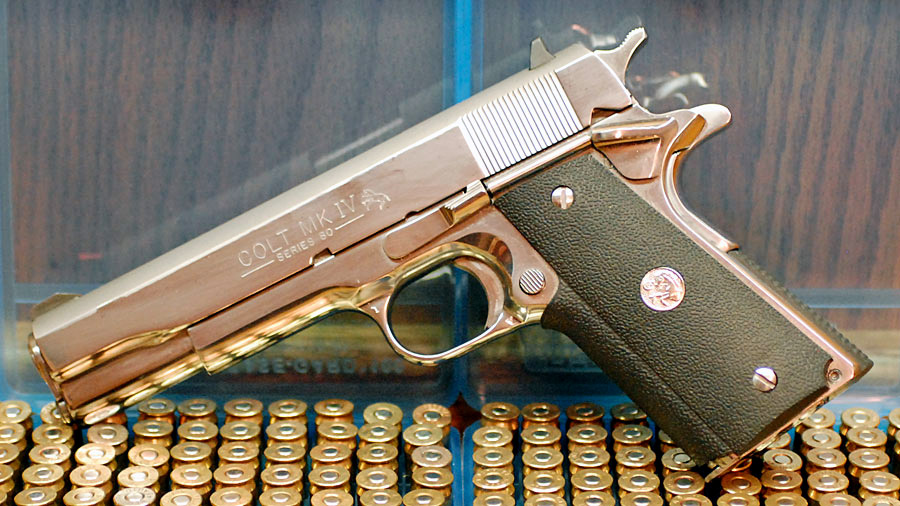
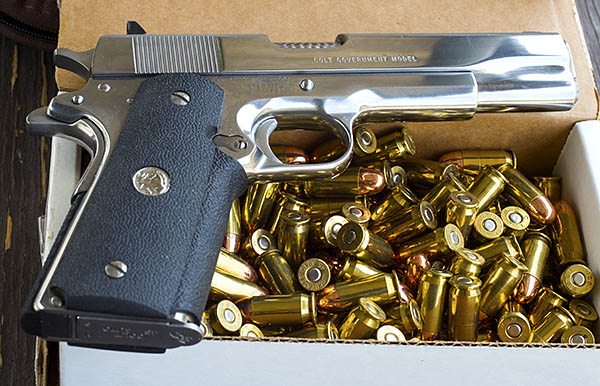
A Colt bright stainless steel full-sized 1911 Government Model, along with a box of reloaded .45 ACP ammo. The standard 1911 barrel length is 5 inches, and that’s what this handgun has.  This particular 1911 has been extensively customized, with a view toward extreme reliability.
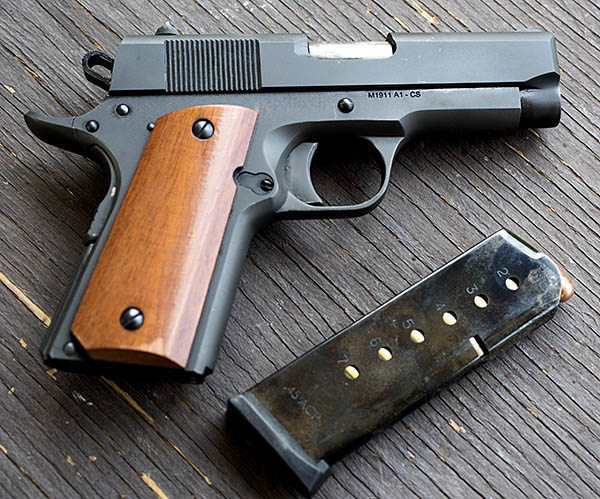
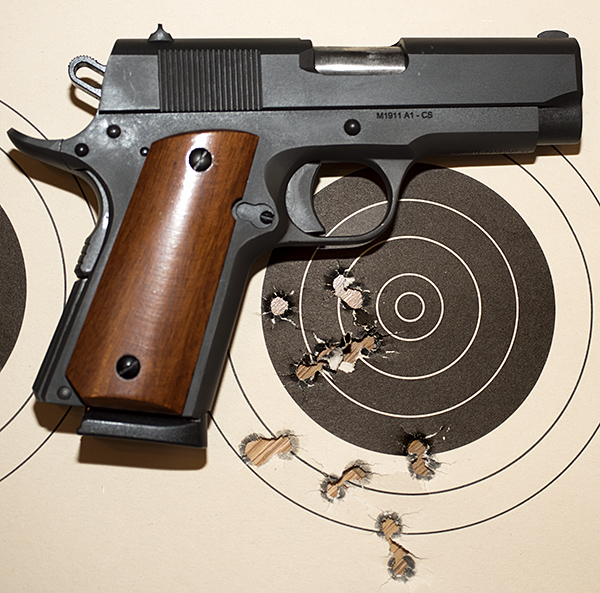
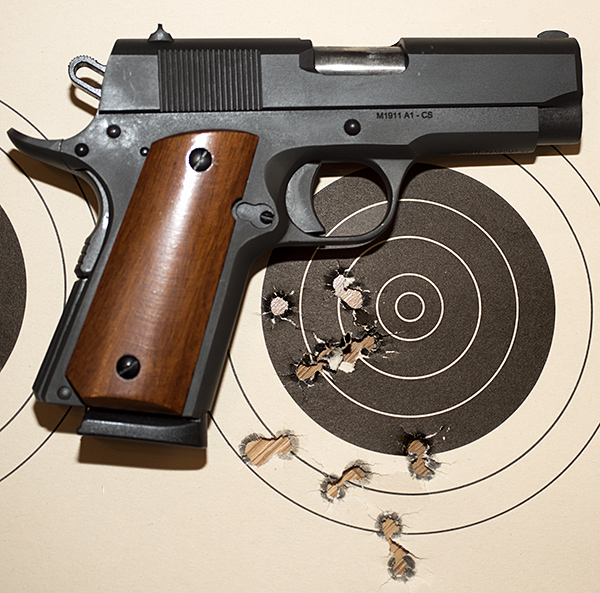
The Rock Island Compact 1911. This inexpensive .45 auto has a 3.5-inch barrel. It’s become my favorite handgun.

I was taught to shoot the 1911 by one of the best. Command Sergeant Major Emory L. Hickman, a US Army Marksmanship Training Unit NCO, taught me the basics (you can read about that here). I’ve been shooting the .45 since 1973, and I’ve been reloading ammo for it about that long, too. I used to be pretty good, but I’ve slowed down a bit. Hey, speaking of that…here’s a video of me playing around at the range with the Colt bright stainless .45 auto…

The video above is real time…it’s not been modified from the video that came straight out of the camera. But I couldn’t leave it alone. My choices were to spend about a zillion hours on the range and maybe shoot up another zillion dollars of ammo to get really good, or to just use my video editing software to have a little fun. I went for Door No. 2…

Okay, enough goofing around. Let’s get serious, and get to the real topic of this blog.  I went to the range with the two 1911s shown above with two objectives in mind.  I wanted to test different loads to see which was the most accurate in each gun, and I wanted to see if there really was a difference in accuracy between a standard size 1911 and the Compact.

I brought along different loads with two different propellants (Unique and Bullseye) and several different bullets (a 230-grain moly-coated roundnose, a 230-grain plated roundnose, a 200-grain plated roundnose, and a 200-grain cast semi-wadcutter).  I fired all groups at 50 feet from a two-hand-hold, bench-rest position.   All groups were 5-shot groups.  I then measured the groups and took the average group size for each load.

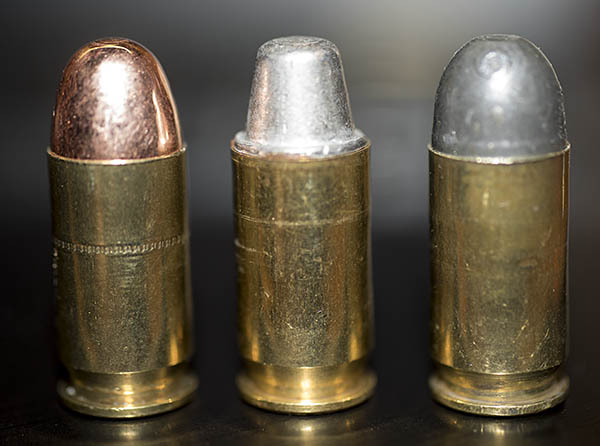
Different .45 ACP bullet configurations. From left to right: A 200-grain roundnose plated bullet, a 200-grain cast lead semi-wadcutter bullet, and a 230-grain moly coated cast bullet.

I know that using a hand-held approach as I did is not the way to eliminate all variability except that due to the gun and the load, and my inability to hold the gun completely steady was a significant contributor to the size of the groups I shot.  A better approach would have been to use a machine rest (you know, the deal where you bolt the gun into a rigidly mounted support), but like my good buddy Rummy used to say, you go to war with the Army you have.  I don’t have a machine rest, so all you get is me.

Because I introduced so much variability into this accuracy assessment, I thought I would throw out the largest group for each combination of load and gun, and take the average of the four best groups.   I did that, and then I did it again by throwing out the two largest groups for each combination of load and gun.   Doing so predictably made the averages smaller, but the relative ranking of the different loads from an accuracy perspective pretty much stayed the same.   That’s good to know.

Before I get into the results, let me tell you a bit about the two handguns. The Compact 1911 is a stock handgun, as delivered from the factory, with the exception of a Klonimus extractor (which I installed because the factory extractor failed after about 1000 rounds). The Colt has been extensively customized by my gunsmith (TJ’s Custom Gunworks in Redondo Beach), with a view toward 100% reliability with any ammo.  That handgun is probably worth $2500 as it sits now. The Compact 1911 can be had for a little over $400.

Okay, that’s enough background.  Let’s get to the bottom line…

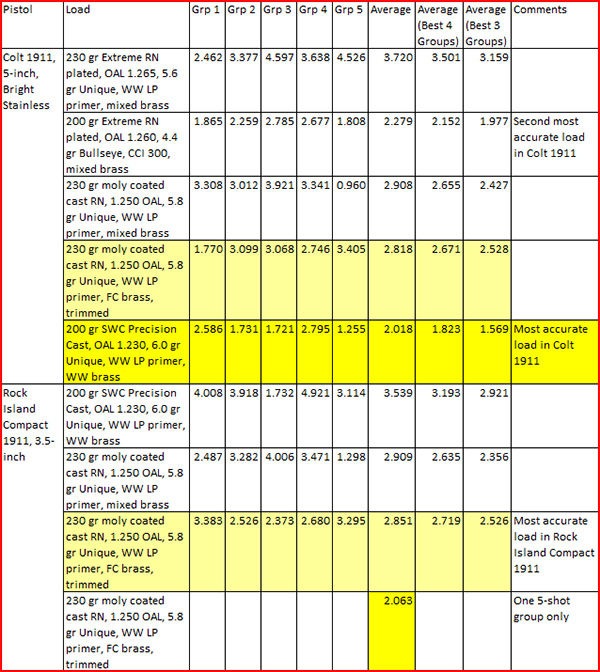
Interesting stuff, to be sure.  Most of the variability you see in the above table (and you can see that there’s a lot) was me.  A machine rest would have provided for better groups, but you get what you get, and what you get here is me.

As I expected, the 5-inch 1911 is a bit more accurate than the Compact. The best average group with the full size Colt 1911 was 2.018 inches.  The best average group with the Compact was 2.851 inches.   Okay, so at 50 feet that’s 8/10 of an inch difference, and as they say, that’s close enough for government work.  What was surprising was how accurate the Compact is.  You really don’t give up much in accuracy between the two guns.  And, look at the last row of the above table.  I fired one group with the Compact (and what is now my preferred load) that hung right in there with the Government Model.  More on that in a second.

In the Rock Island 1911, the 230-grain moly bullet was the most accurate load I tested.  After I did the five groups to get an average group size, I fired one more group with this load in the Compact and it was a scant 2.083 inches.   Yeah, this gun is accurate enough.

In the Colt, the most accurate load was with the 200-grain semi-wadcutter bullets over 6.0 grains of Unique.   This load fed flawlessly in both the Rock Island Compact and the Colt.  My Colt has been throated to feed semi-wadcutter bullets; the Rock Island has not been (usually, a 1911 requires that the feed ramp be opened up and polished, or throated as we say, to feed semi-wadcutter bullets).  But the 200-grain semi-wadcutter load failed to eject twice in the Compact.  The Compact is fussy about ejection, and the two failures convinced me that this load won’t work reliably in the Rock Island without additional work.  For now, I’m sticking with the 230-grain roundnose load.  It’s completely reliable for both feeding and ejection.

You’ll notice that one of the Government Model five-shot groups with the 230-grain moly coated bullet and 5.8 grains of Unique was a tight 0.960 inches.  The bottom line is that this load is a good one.  Yeah, the other groups with that load were larger: It’s that shooter variability thing again. Both the Compact and the Colt are capable of greater accuracy than what I could do.

The moly-coated 230-grain bullets shot tighter groups in the Colt than did the plated 230-grain Extreme plated bullets.  That’s consistent with my observations over the years.  Cast bullets seem to be more accurate than plated bullets in any of the .45 autos I’ve shot.  But, the 200-grain roundnose plated bullet did pretty well in the Government Model, too.   I didn’t test that load in the Compact.

The bottom line to all of the above:  My standard .45 Auto load is going to be 5.8 gr of Unique with the 230-grain moly coated cast roundnose bullet.  It fired the best overall group (at 0.960 inches) in the Colt, and it was the best load for the Compact.  This load functions well in both guns, with no anomalies in feed or ejection, and it’s accurate.  The only problem I may have is that moly coating fell out of favor some time ago, and I don’t know if any one is still offering moly-coated bullets. I have a stash of the 230-grain moly bullets, so I’m good for a little while.  After that, it’s back to the loading bench and the range to find the next favorite load.

Regarding the two handguns, I love them both.  That bright stainless Colt Government Model has had a lot of work done to it (a Les Baer barrel, custom fitting, porting and polishing, engine turning, and Millet Hi-Viz sights).  The Rock Island Compact can be had new for something a little north of $400.  It’s a phenomenal value.  The Compact is a lot more concealable, and surprisingly the recoil is only very slightly more than the bigger Colt.  And, as I showed above, it’s accurate.   The Rock Island is a hell of a 1911 at any price, but at it’s current price, the Rock Island is an absolute steal.  I like the look of the Compact, too.  The Parkerized finish, simple wood grips, and low profile fixed GI sights remind me a lot of the 1911s I carried when I was in the Army, and I like that.


Check out our other Tales of the Gun stories here!

Want great deals on targets?  Click here.

Click on those popup ads!

A tale of four 1911s…

My good buddy Paul, whom you’ve already read about on the ExNotes blog, is a retired aerospace engineer who has way more talent than me in the gun-tinkering arena.  During one of our shooting expeditions, Paul brought along an interesting 1911…a .45 that he had re-barreled to shoot 9mm.   There’s not a simple proposition, but hey, Paul’s good at this stuff and his 9mm conversion shot well.   Then, a few months ago, we had a discussion about the merits of the .38 Super cartridge.  That’s a round similar to the 9mm, but the case is longer, allowing for more propellant.  The result?  The .38 Super’s velocity is substantially higher than a 9mm (the .38 Super is roughly equivalent to a .357 Magnum).

Well, one thing led to another, I guess, and I received an interesting photo and email from Paul a few days ago…

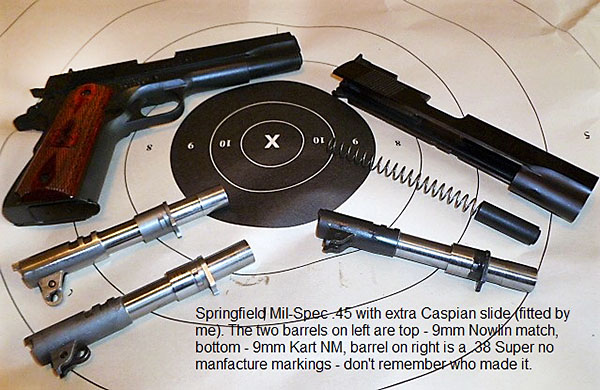
A four-fer, so to speak….a 1911 that can shoot .45 ACP, .38 Super, 9mm, and .22 Long Rifle.

Joe:

I started this project about 5 or 6 years ago. My intent originally was to buy a stainless steel Springfield 1911 9mm target pistol. At the time they were very scarce and wait time was close to a year at an inflated price. I then decided to purchase a mil spec .45 and buy a Caspian 9mm slide, barrel and slide components to convert the .45 to 9mm. I said to myself that if I was going this far with the project that I would buy a .38 Super barrel and have a pistol that will convert into a .45, 9mm, and .38 Super. I did the Caspian slide and 9mm Nowlin barrel fitting first, a few months after I originally purchased the pistol.

I shot the pistol in 9mm conversion at Joe’s range a few years back and it performed very well. The .38 Super conversion was put on hold until now. I purchased a new oversized bushing and three different barrel links to get the correct lockup, which arrived from Brownell’s a few days ago. I recontoured the barrel and fit the bushing to barrel, and then to the slide. This took 3+ hours to do with a 0.0005″ to 0.001″ tolerance fit on all surfaces. Link and lockup fitting were next.

When I fit the link to the barrel, a job that I thought would take 10 minutes, it actually took 1.5 hours.  That barrel must have been a budget-manufactured barrel because the workmanship was poor in the link recess and not deep enough to allow the link to fully seat. I’m glad I have a milling machine. The lockup is now solid and everything cycles as it should.

I think it’s ready to test fire but first I have to reload some ammo for it. I’m going to do a Cerrosafe casting of the bore to see what the diameter is. The spec for the bullet diameter for the .38 Super is 0.356-inch and the 9mm it is 0.355-inch. I have some Berry’s plated bullets that are 0.356 but I’m not sure if they are 115 or 124 grains. I want to use 124 to 130 grain bullets. I do have a fair amount of 124 gr semi-wadcutter cast bullets that I did many years ago for my Colt 9mm target bullet experiment but I never sized or lubed them (looks like I’ll be bringing out the bullet sizer/luber). Not too sure that this style of bullet will cycle, but it’s worth a try.

I also purchased a .22 LR conversion kit for this pistol about four years ago, which I have also previously shot. So, now this 1911 Springfield Mil Spec will shoot .45 ACP, 9mm Luger, .38 Super, and .22 LR when it’s finally finished…how neat is that!

Paul

That’s awesome, Paul…and thanks for taking the time to explain your approach and for the photo.  It’s a cool handgun and having that kind of versatility is a slick concept.  I think it has to be especially satisfying knowing that you built it yourself.


We’ve found that folks who ride are frequently into guns, and vice versa (like good buddy Paul).  It’s why we include interesting Tales of the Gun stories on the ExNotes blog.  Want to see more?

A bad influence?

I may be that kid your mother always warned you about. You know, the bad influence. The one who might do something she wouldn’t like, and then you follow suit. Moms live in fear of guys like me.

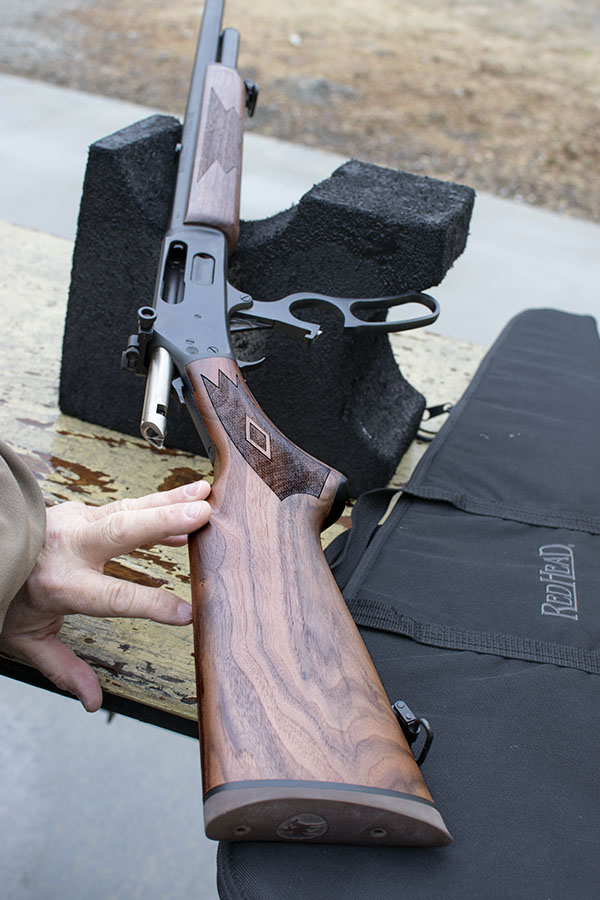
Paul’s .45 70 Marlin 1895. These are impressive rifles.

When it comes to guns, I am pretty sure I’m the guy she had in mind. On more than a few occasions, I’ll get fired up about a firearm (no pun intended), and then several of my friends will buy the same thing. It’s happened with Mosin-Nagants, 1911 .45 autos, Ruger No. 1 rifles, and most recently, big-bore Marlins. Caliber .45 70 Model 1895s, to be precise. Several of my friends now own these rifles and they are a hoot. One of these days we’ll have one of our informal West End Gun Club matches and restrict it to .45 70 rifles only. That should be fun.

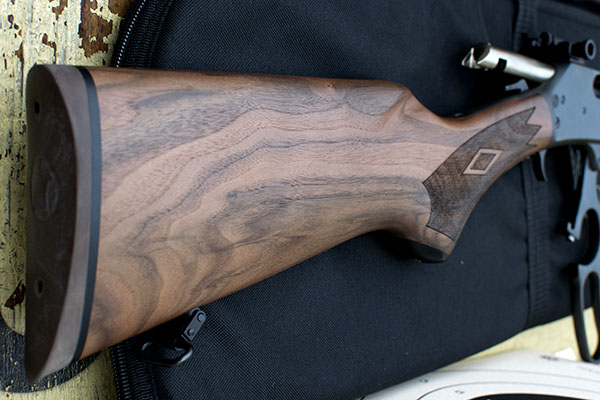
Paul and I both appreciate fine walnut, and Paul’s recent purchase of his brand-new Marlin is no exception. It’s unusual to see wood this highly figured on a production rifle. Take your time, peruse what’s available on Gunbroker.com on a regular basis, visit every gun store you can, and every once in a great while you find something like this.

I was in northern California last week and that’s always a good opportunity to visit with my good buddy Paul and send a little lead downrange. Well, maybe not a little. You see, Paul recently purchased a .45 70 Marlin 1895, and these rifles send lead downrange at the rate of 400 grains a shot. There are 7,000 grains in a pound. Do the math…that’s a big-ass bullet. Hell, they used to use these things for shooting buffalo.

There’s no way I’d ever shoot one of these magnificent creatures, but back in the day when the buffalo hunters did, more often than not they were using a .45 70 rifle. I grabbed this photo on a recent trip to Tennessee.

The Marlins are great rifles, and you can pick up a 45 70 Model 1895 for around $600 if you shop around for a bit. Marlin was acquired by Remington a few years ago, and their quality took a hit during the transition as they moved production from the old Marlin factory in Connecticut to the Remington plant in New York. Judging by the recent rifles I’ve examined (including Paul’s), the quality issues are all in the rear-view mirror now. The new Marlins sure shoot well, too.

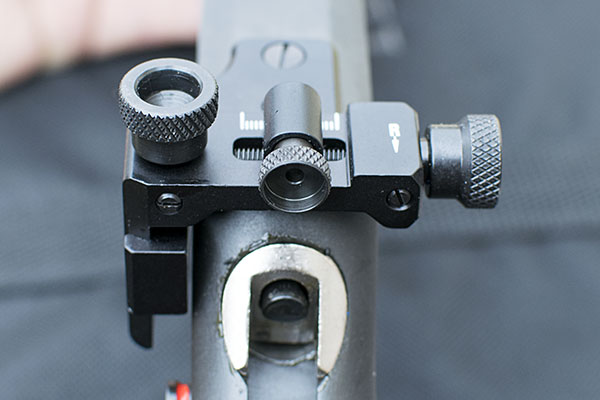
A Williams peep sight on Paul’s Marlin. If you know what you’re doing (and Paul does) these can shrink your groups significantly.

Paul added a Williams aperture rear sight to his 1895, and this was the first time he shot it. I had spotting duties. The first round went low left about 10 inches, and then Paul walked succeeding rounds up and to the right by adjusting the rear sight as I called the shots to him. It didn’t take too many shots to zero the rifle, and from that point on, it was simply a question of evaluating which of several different handloads grouped best. Paul had prepared test rounds using Unique and IMR 4227 propellant, all using the Missouri 400 grain cast lead bullet. The winner was 13.0 grains of Unique behind the mighty Missouri slug. At 50 yards, this load grouped well.

The target. Low, adjust, a bit higher, adjust some more, and well, you get the idea. It took only a few shots to get the Marlin dialed.

We were at a Santa Clara County public range and it was a rainy day, but we managed to have fun on both the rifle and handgun ranges. We shot the .45 70 and then my personal favorite handgun, the 1911 .45 Auto.  Yep, Paul had his 1911 out, and we had fun with it, too.

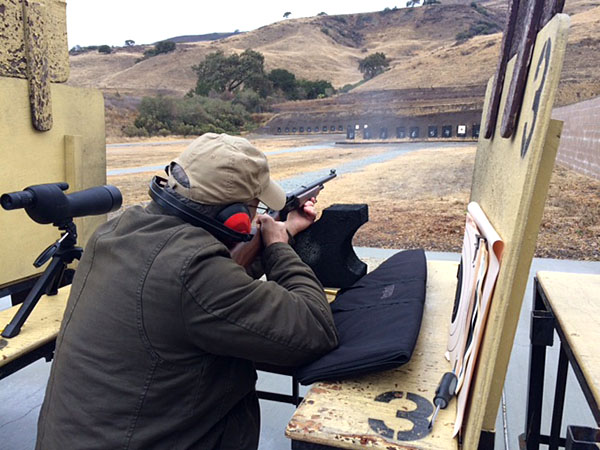
Paul shooting his 1895 at the local gun club.

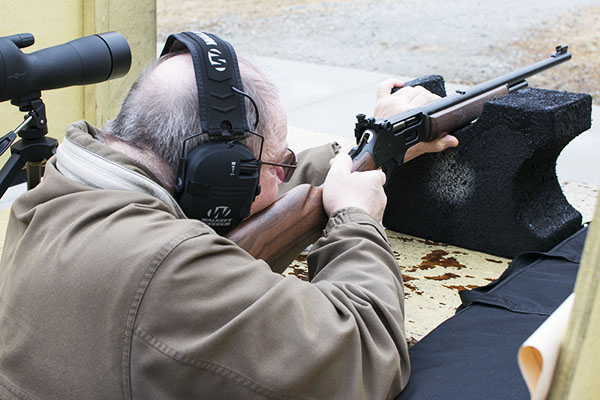
Paul let me try the Marlin. He tried to capture the muzzle blast, but timing the camera to the shot is tough.

Yours truly behind the 1895. From the rear, Paul and I could be twins. We’ve been shooting buddies for more than 60 years. This photo shows the smoke just after I fired, and that’s good enough.
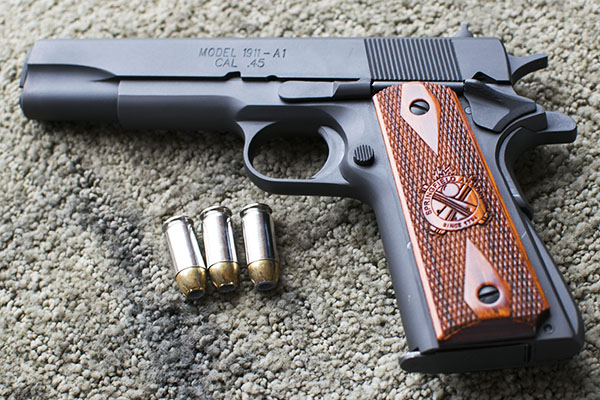
Paul’s “Mil Spec” model Springfield 1911. These are fine guns, way better than what I carried in the Army.

Other folks on the range are always intrigued by the .45 70 cartridge. Compared to the most common rounds seen on rifle ranges these days, they’re huge.  The perception is that the recoil must be horrendous. It can be if you load near the upper end of the propellant charge spectrum, but at the lower powder charge ranges, these guns are a lot of fun. That’s a topic for another blog, one that will appear here soon. Stay tuned!


Want to read our other ExhaustNotes Tales of the Gun stories? Just click here!

A tale of two .45s…

This is an interesting story about the development of the .45 ACP 1911 and a sister military sidearm, the 1917 revolver, and maybe a little more. To really appreciate the history of these two guns, we need to consider three cartridges (the .45 Colt, the .45 ACP, and the .45 AutoRim), and four handguns (the 1873 Colt Single Action Army, the Model 1911 Colt, the Model 1909 Colt revolver, and the Model 1917 revolvers).  Wow, that’s a mouthful. But it’s a fascinating story.

So what is this story about? A tale of two .45s, or of four?

The Two .45 Handguns

Well, it started out as a tale of two…the 1911 Rock Island and my Model 625 Smith and Wesson.  But I’m getting ahead of myself.   Read on..

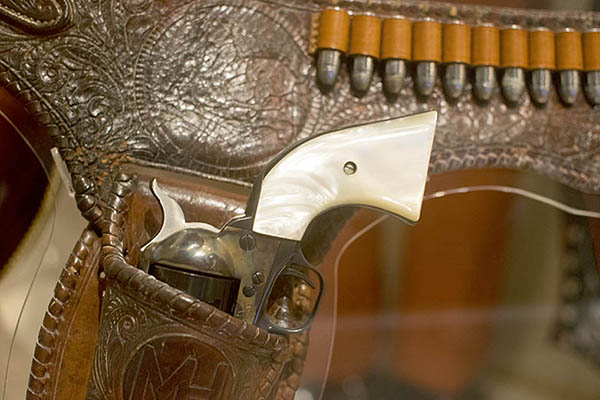
The 1873 Colt Single Action Army, chambered in .45 Colt (the cartridges you see on the gunbelt). If you grew up watching cowboy movies (like I did), you know this gun well.

.45 ACP Historical Perspective

To best understand this, we need to go back to 1899, and maybe as far back as 1873.  Yep, this tale goes back a century and a half.

In 1899, the Philippine-American War started (it’s also known as the Philippine Insurrection).  We sent US Army troops armed with .38-caliber revolvers, Krag rifles, and 12-gauge shotguns to put down the insurrectionists (the Moros), and we found out the hard way that the .38 just wouldn’t cut it as a military sidearm.

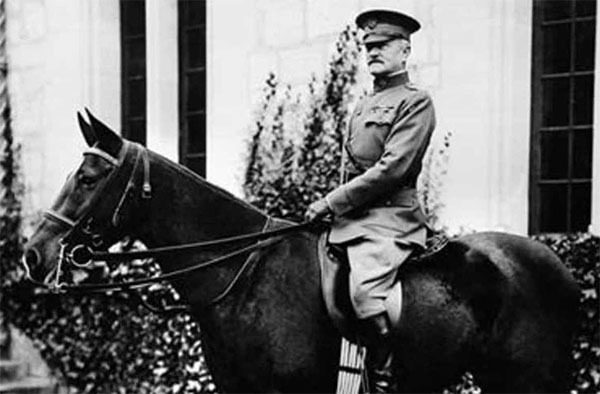
General John J. “Black Jack” Pershing, who was a captain during the Philippine Insurrection. He had direct experience using the .45 Colt Single Action Army during the American Indian wars. Pershing was America’s only 6-star general, a rank never attained by anyone else. He fought Indians, he chased Pancho Villa in Mexico, and he commanded American troops during the first World War.

In response to this, or so the story goes, the Army tried all kinds of handgun ideas, including the then-new 9mm Luger. There was a lot more to the story than just the concept that the .38 wasn’t enough gun, but it’s the version that is most frequently bandied about and we’ll stick with it to keep things simple. You hear about drug-crazed Moro insurgents, you hear about religious fanatics, and more. I don’t know which parts are true and which parts are, to use a current term, fake news. But I do know that as a result of that war, the Army wanted a handgun with more power.

The idea of a semi-automatic handgun was cool, but the Army thought the Luger was too complicated and the 9mm cartridge wasn’t much better than the .38. The .38 and 9mm bullets are essentially the same diameter (one is 0.356 inches, the other is 0.358 inches), and neither had enough knockdown power.

Our Army went back to an earlier cartridge, the .45 Colt, a rimmed cartridge used in the old 1873 Single Action Army Colt. It’s the six shooter that you see in the old cowboy movies (the one holstered in the photo at the top of this blog). The old 1873 was a single action sixgun (you had to pull the hammer back for each shot). By the time the Moro Wars rolled around, both Colt and Smith and Wesson had double action revolvers. On those, all you had to do was pull the trigger (that cocked the action and fired the weapon). To meet the new need in the Philippines, Colt manufactured double action revolvers (their Model 1909) chambered in the .45 Colt round. The Army was all for it, and they felt it met their needs (at least on an interim basis).

An interim solution to the unstoppable, presumably drug-crazed Moro insurrectionists…Colt’s Model 1909 revolver in .45 Colt, the same cartridge used by the Colt 1873 Single Action Army.

Having played with the Luger, though, the Army liked the idea of a semi-automatic handgun. But that puny 9mm round wasn’t enough back in those days, so the Army invited firearm manufacturers to submit larger caliber automatic pistol designs.

The 1911

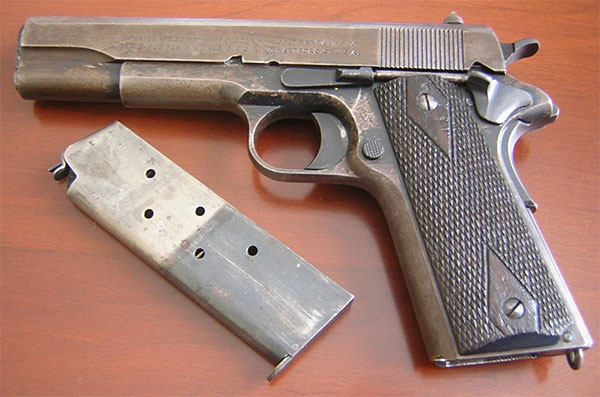
The winner, of course, was John Browning’s 1911 design, and the .45 auto came into being as the US Army Model of 1911. It was a new gun and a new cartridge. The 1911 couldn’t shoot the rimmed .45 Colt cartridge used in the 1873 Peacemaker and Colt’s double action Model 1909 handguns. Instead, it used a new .45 ACP round (“ACP” stands for Automatic Colt Pistol), which fired the same big .45-inch-diameter bullet in a rimless cartridge case (actually, the cartridge has a rim, but the rim is the same diameter as the rest of the cartridge case, and that allowed it to work in the new semi-auto).

The 1911 Colt Auto. The new automatics used the rimless .45 ACP cartridge. The .45’s claim to fame is its tremendous stopping power.

The 1917 Colt and Smith and Wesson Revolvers

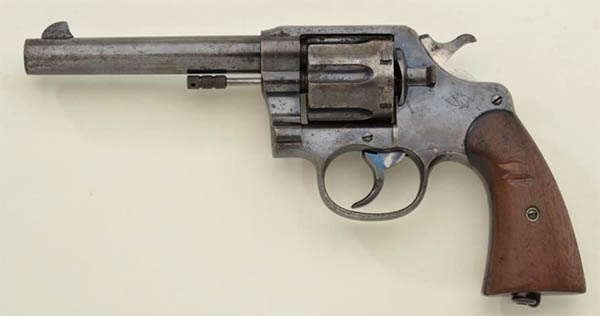
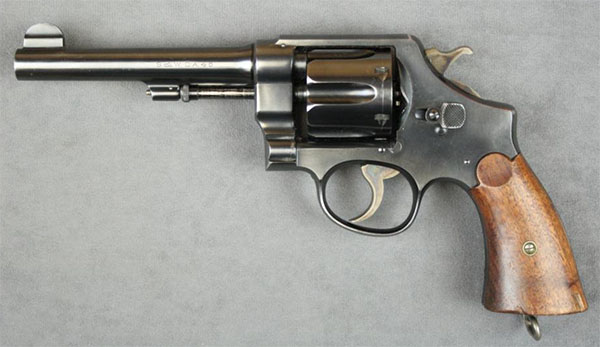
Fast forward a few more years and World War I started. The Army’s preferred handgun was the 1911, but there weren’t enough of the new semi-autos. Colt, and Smith and Wesson came to the rescue by modifying their earlier big bore revolver designs to shoot the .45 ACP cartridge, and the Army issued these as the Model 1917 revolver.

A US Army 1917 Smith and Wesson. These are beautiful revolvers. The gizmo beneath the grips is a lanyard attach point, which tied the gun to the soldier who carried it.

The 1917 double action .45s were phased out of the Army a few years after World War I ended, and they were sold as surplus to the public (things were different back then). Model 1917 revolvers are highly collectible today. I owned an original GI issue Colt Model 1917 back in the 1970s, when you could pick them up for about a hundred bucks. I loved that revolver, but I stupidly sold it 40 years ago. (When discussing firearms, the phrase “stupidly sold” is inherently redundant. Like nearly all of the guns I’ve sold, I wish I still had it.)

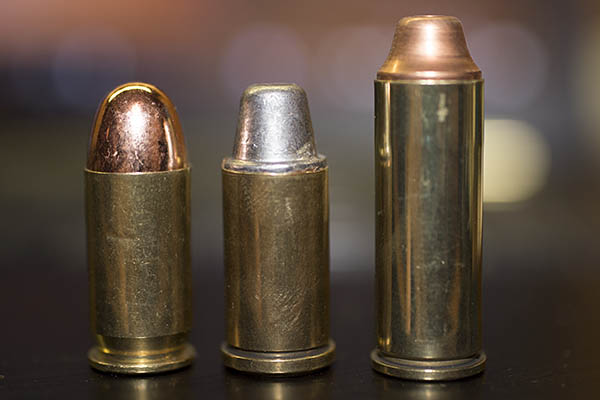
The three cartridges, all in .45 caliber. The one on the left is the .45 ACP, as used in the Model 1911 automatic and the Model 1917 revolver (and my Model 625 revolver). The one in the middle is the .45 AutoRim, which is essentially the .45 ACP but with a rim (that allows it to be used in the Model 1917 revolver and its descendants without a star clip). The one on the right is the old .45 Colt, which has been around since 1873 and is still a popular revolver round.

The 1911 .45 auto? It continued as the official US Army sidearm for the next seven decades. I carried one when I was in the Army. Like a lot of shooters, I think it is the best handgun ever.

In 1985, the Army replaced the 1911 with the 9mm Beretta. That (in my opinion) was a dumb move, and apparently the Army ultimately came to its senses with regard to the Beretta, but they stuck to the 9mm Luger round (now the NATO standard pistol cartridge) when they went to a Beretta replacement. The Beretta is being replaced by yet another 9mm (the SIG).

The Model 625 Smith and Wesson

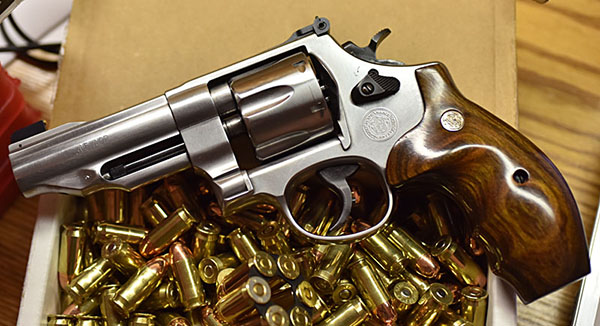
No matter; there are still many of us who consider the 1911 in .45 ACP the ultimate sidearm. I’m one of those guys, but I’m also a huge fan of the double-action revolver in .45 ACP. The good news for me (and you, too, if you’re a .45 auto fan) is that Smith and Wesson still makes a modern version of their double-action revolver in this cartridge. It’s the Model 25 Smith (or, in stainless steel, the Model 625), and it’s a direct descendent of the old 1917 revolver.

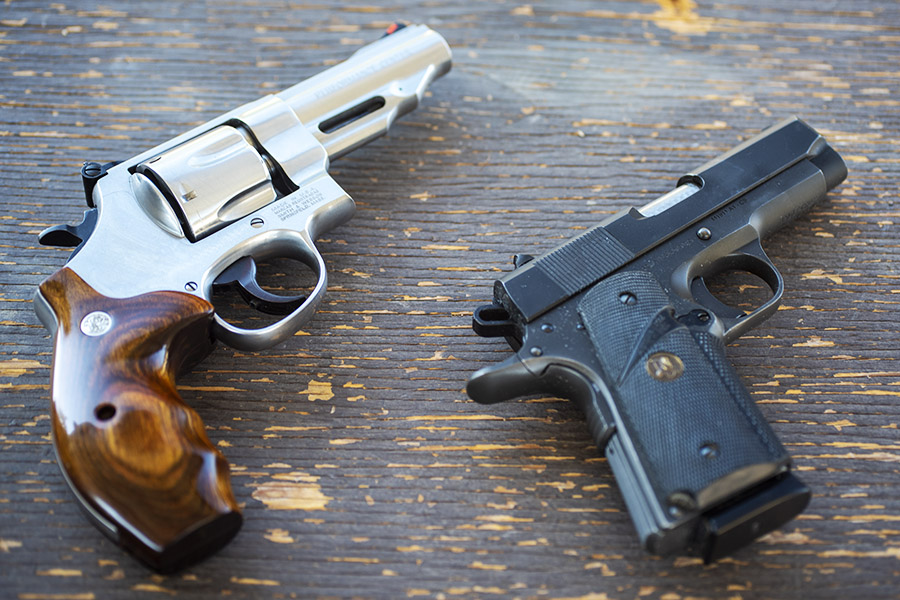
A Model 625 Performance Center Smith and Wesson, and my reloaded .45 ACP ammo.

The Rock Island 1911 Compact

I am a lucky guy. I own both the .45 ACP Model 1911 and the .45 ACP Smith Model 625. You’ve read the earlier ExNotes blog about my Rock Island Compact 1911. It’s a sweet shooter and, at just under $500, it’s a hell of deal. And that Model 625?   Wow.   The Performance Center is Smith’s custom shop, and that revolver is accurate.  It should be; it costs twice what the Rock Island 1911 goes for.   But both guns are great, and I love shooting both.

A Rock Island Arsenal Compact 1911, the subject of an earlier ExNotes blog.

I had both of my .45s out at the range yesterday, and I had a blast (pun intended). Yeah, the revolver is a more accurate handgun than the 1911, but like we used to say in the Army, both are close enough for government work.

.45 ACP Accuracy

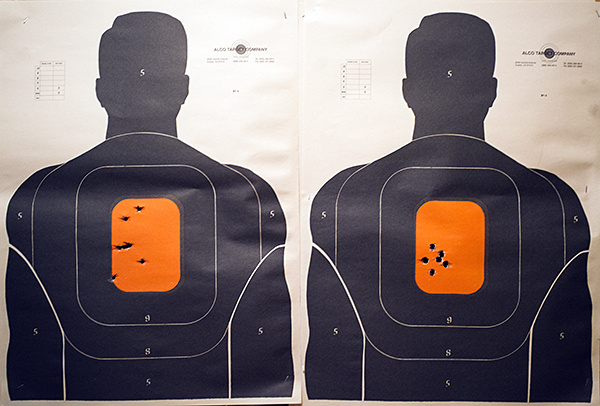
So just how well do these guns shoot?  The short answer is very, very well.  After running through a couple of hundred rounds, I thought it might be a good idea to set up two targets, side by side, and fire six rounds at each (the first six with the 1911, and the second six with my revolver).  That’s exactly what I did, and it’s the final photo for this story…

Two targets at 50 feet, with six rounds each. The one on the left was with the Compact 1911, and the one on the right was with the big Smith and Wesson Model 625. Are both guns accurate? You bet! They’re close enough, as they say, for government work…

Hit those pop up ads!  It’s what keeps the lights on!


The Follow Up:  Another Tale of Two 45s

If you enjoyed this post, be sure to see the follow up:  Another Tale of Two 45s!

The Gatling Gun

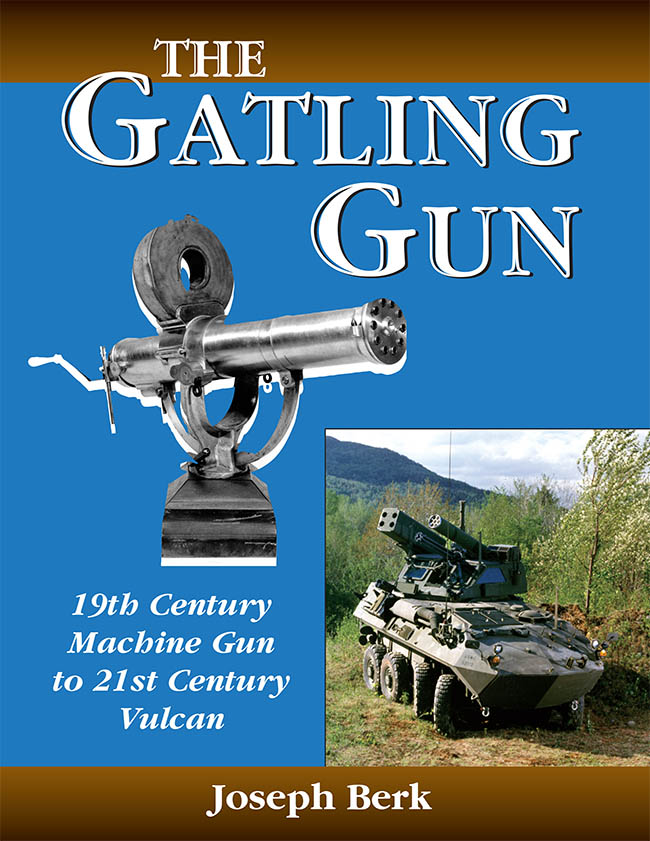
Incidentally, if you like reading about guns and their history, you might want to pick up a copy of The Gatling Gun.   I wrote that book, and it covers the early days of the Gatling (the Civil War), the transition to a modern weapon system after World War II, and modern Gatling applications on high-tech weapon systems.  I worked on many of these systems, and I worked for the company that manufactured 30mm ammo for the A-10 Warthog.  You can read all about that in The Gatling Gun, available from Amazon.


Help us keep the lights on:


Want more gun stories?  You can see all of our gun articles here on Tales of the Gun!


Like what you see here?  Hey, sign up for a free subscription to the ExNotes blog!

The 1911

I’m a huge fan of the 1911, going all the way back to 1973. That’s when I graduated college and headed off to the Army. I went to college on an ROTC scholarship, and I had the same spot in the Corps of Cadets as Colin D. MacManus did when he graduated a few years before me in 1965. Captain MacManus was killed in action in Vietnam, and every year after that, his family awarded a Colt 1911 to the graduating senior who held his position. I was that guy in 1973, and that was my first .45 auto.

Back then, times were different. I had to get a permit to own the .45, but it was more a formality than anything else. We could shoot in our backyard, we often did, and my father and I couldn’t wait to put the .45 through its paces. Like I said, we couldn’t wait, but that was only one thing we couldn’t do. The other was hit the target. We set up a target 30 feet away (a soda can), and trying as best we could, the only thing we hit was the ground halfway between us and that soda can. A lot of dirt flew.  There’s a lot of lead buried in what used to be our backyard.  Don’t tell the EPA.

Fast forward a few weeks, and I got lucky. The Army sent me to graduate school, and the ROTC detachment got a new Sergeant Major, one Emory L. Hickman. Sergeant Major Hickman had spent most of his career in Vietnam and the Army Marksmanship Training Unit, where the finest pistoleros in the world live. He was the real deal: A warrior and an expert pistol shot. I told him of my plight (the evasive can of pop) and he laughed. The Sergeant Major schooled me on the fundamentals of handling the 1911, he coached me on the pistol range, and he taught me how to put those big old 230-grain FMJ bullets pretty much exactly where I wanted them to go. Thank you, Sergeant Major Hickman.

Fast forward several decades and dozens of 1911s later, and that brings us to this morning at the West End Gun Club, where I and my Rock Island Compact 1911 did, once again, what the old Sergeant Major taught me to do.

And about that Rock Island 1911…it’s a short little thing, and it’s a blast to shoot. Around here in the People’s Republic of Kalifornia, Rock Island 1911s go for $500 brand new (that’s a tremendous value). They are inexpensive, but they are not cheap. The Rock Island 1911 is a real handgun with its Parkerized finish, all steel construction, wood grips, and GI sights (none of that black plastic silliness here). It reminds me a lot of the 1911s I carried in the Army. I love shooting my Rock Island Compact, it hits well, and I can still put my shots where I want to.  Sergeant Major Hickman would be 92 years old today if he was still around (I’m guessing he’s not); wherever he is, he’d be proud. He taught me well.


More Tales of the Gun are here!


Never miss an ExNotes blog:


Hit those popup ads!