ExNotes Review: Shenzhen 4000 Inverter Generator

By Joe Gresh

My nesting work here at the ranch is taking me further away from electrical power. A 100-foot extension cord isn’t cutting it anymore. The little Harbor Freight Tailgator has been a trooper, but 700-watts isn’t enough for the electric jackhammer or two concrete mixers at once, and besides that the urge to spend money is strong.

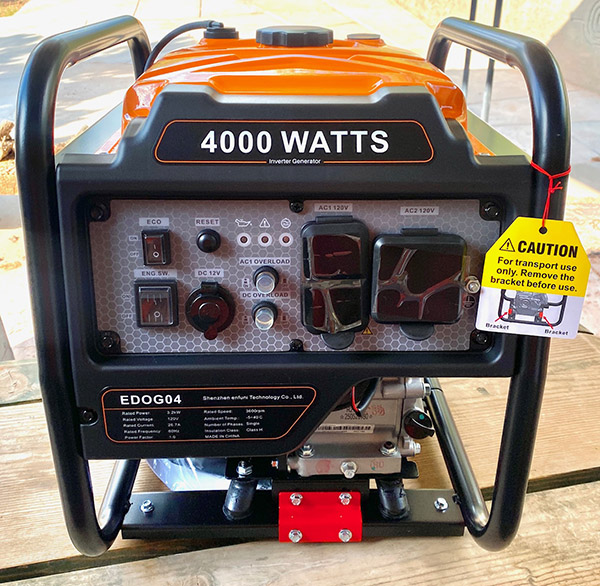
Lots of buttons and outlets on the 4000. A 12-volt cigarette lighter outlet is unusual for cheap stuff.
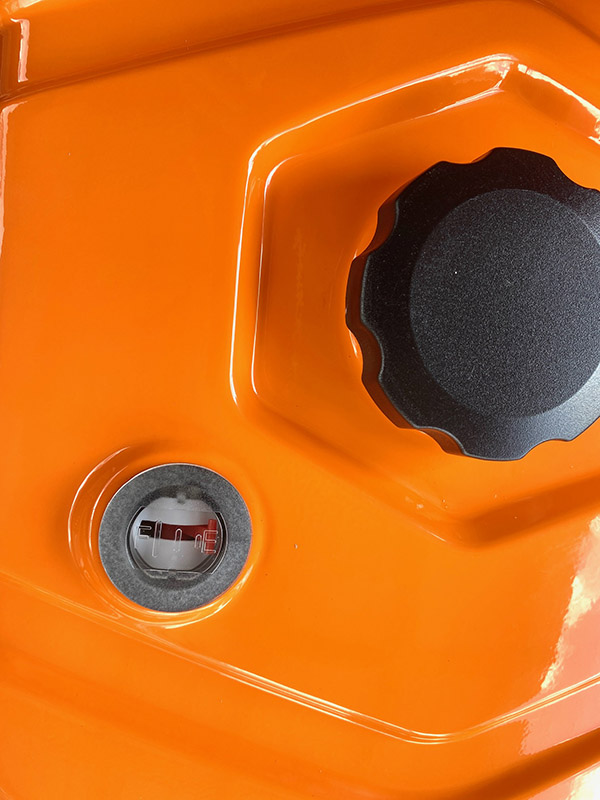
A cool little fuel gauge is fitted to the top of the tank.
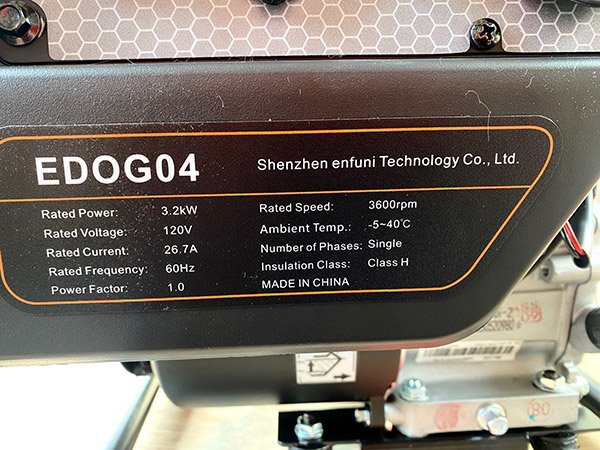
Rated 3200 continuous and 4000 surge, the ‘Zhen seems to power most anything up to 26 amps. That’s  four times as much as the Tailgator.
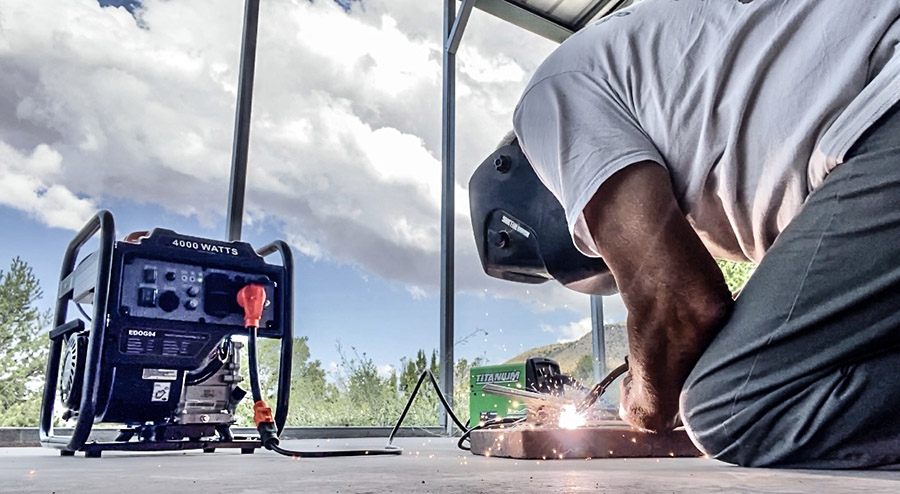
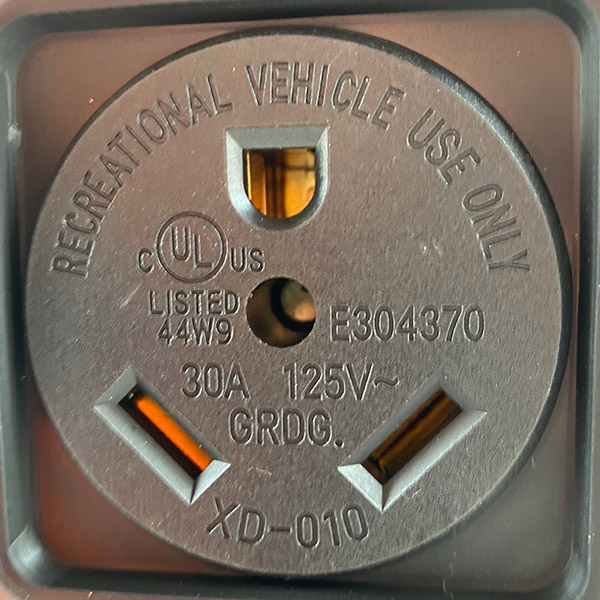
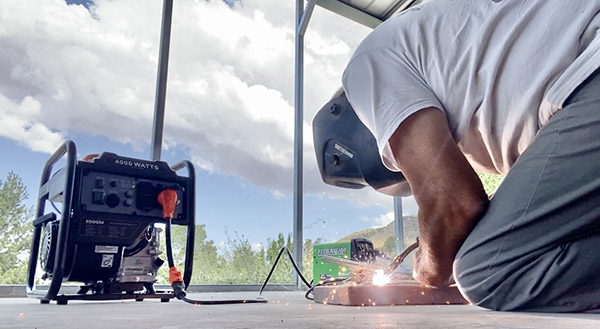
The 30-amp, RV-type plug is great for welding.
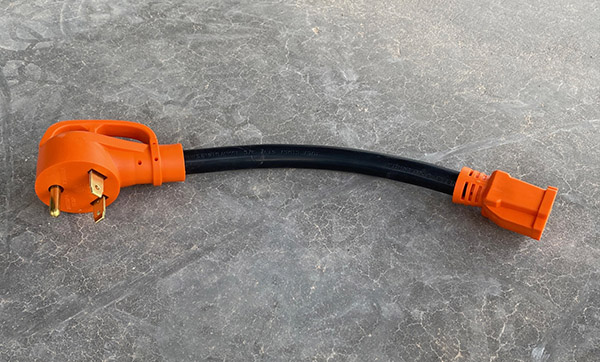
But you’ll need an adaptor to plug your light duty flux core into the 4000.
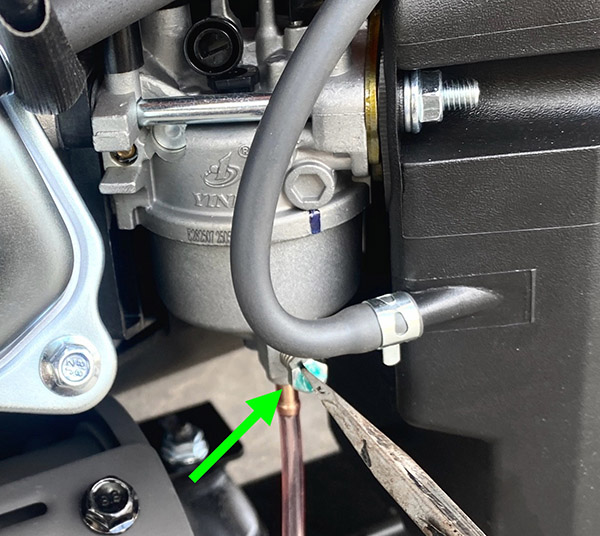
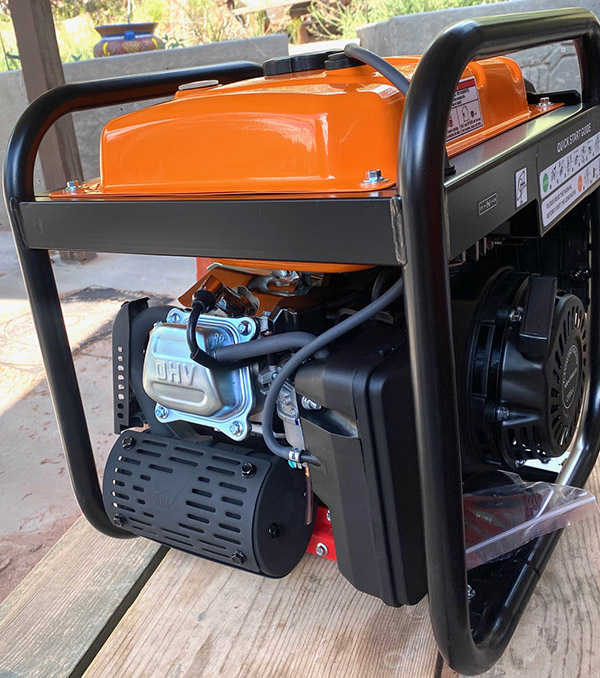
This handy float bowl drain is a must-have for today’s crappy, alcohol laced fuel. Drain it after every use.
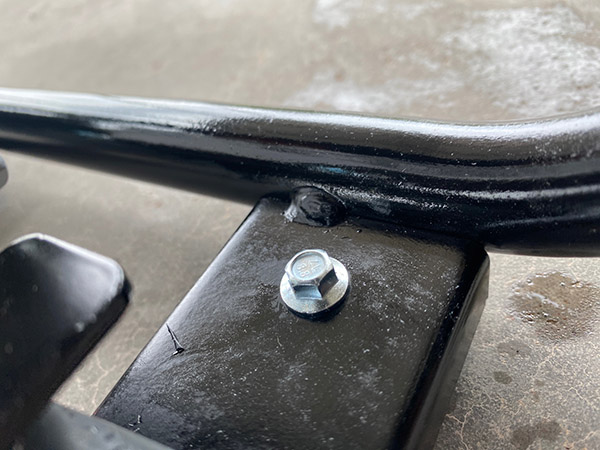
I’d like to see a little more weld on the frame. It would only take 30 seconds.
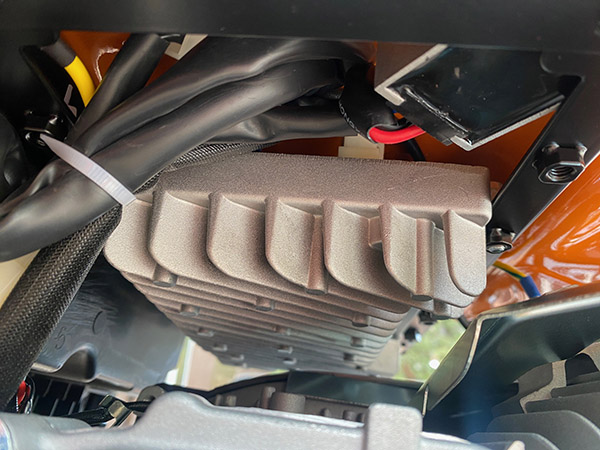
The inverter lives under the fuel tank. This is where the magic happens converting DC into AC.
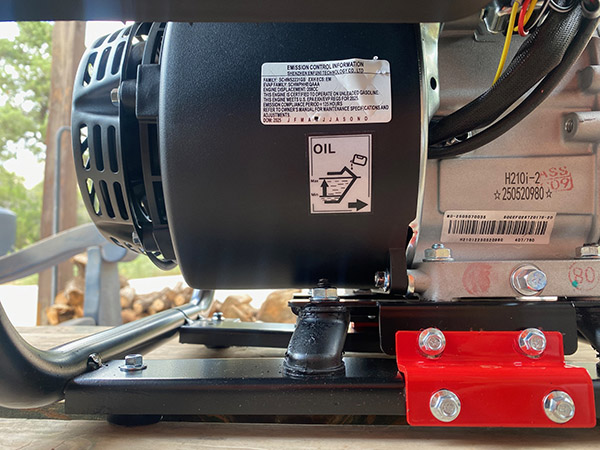
Unlike a normal genset that hangs the AC portion off of the crankshaft opposite the pull start, the Shenzhen incorporates the power source inside the blower area and the rope start.
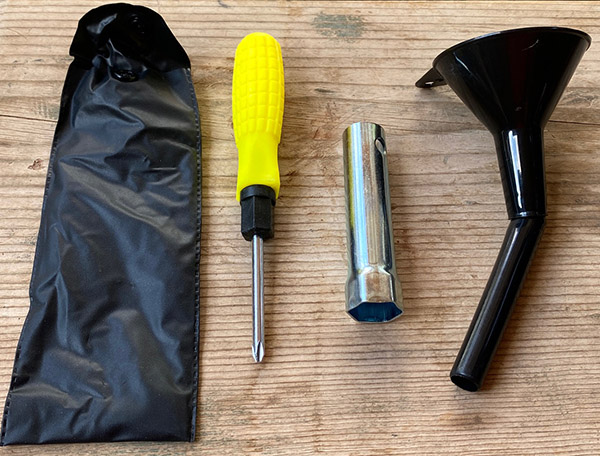
The generator came complete with a cute tool kit. You won’t get far with it but the thought counts.
The muffler isn’t super quiet like a Honda but it costs a lot less. The ShenZhen is around 63 decibels using my seat of the ear dyno.

I have more than the usual number of generators: in addition to the Tailgator, there’s a 10,000-watt Italian-Honda mash up and a 9,000-watt Predator (also from Harbor Freight), but both of those machines are heavy and hard to move on the steep and rocky New Mexico terrain we are currently beating into submission.

I wanted something light-ish that I could toss in a truck or carry downhill to a terracing job. It needed to have enough juice to run my equipment loads and if it could power the flux-core welder, that would be ideal.

At 60 pounds the Shenzhen 4000 seemed like the way to go. Amazon reviews on the generator were mostly good.

The ‘Zhen 4000 is an inverter-type generator. Unlike a standard AC generator which must run at a steady RPM to make 60 cycles per second, an inverter generator makes DC power (zero cycles or one endless cycle, depending on how you look at it).  That DC is then converted to AC by an inverter.

The advantages to inverter-type generators are several:

    1. The engine RPM can vary according to load making the unit more economical for powering lighter loads. At full load there probably isn’t much difference.
    2. The frequency can be tightly controlled, putting out 60 hz regardless of the load.
    3. The sine wave form can be cleaner with less noise. Small generators induce jagged wave forms due to the slight increase/decrease in crankshaft rotation speed through the engines power cycle.
    4. There’s less noise at lighter loads, because the engine speed can be slowed to meet demand.

The disadvantage to inverter-type generators is basically a more complicated generator with more parts to fail. There is a slight efficiency loss converting DC to AC voltage but it’s kind of a wash (see Item 1 above)

The Shenzhen I bought from Amazon was $299. Now that I’ve bought it, my ever-alert Facebook algorithm is sending fly-by-night offers for the same unit at $149. If you can get it for that price without being scammed, it’s a hell of a deal. $299 isn’t bad either.

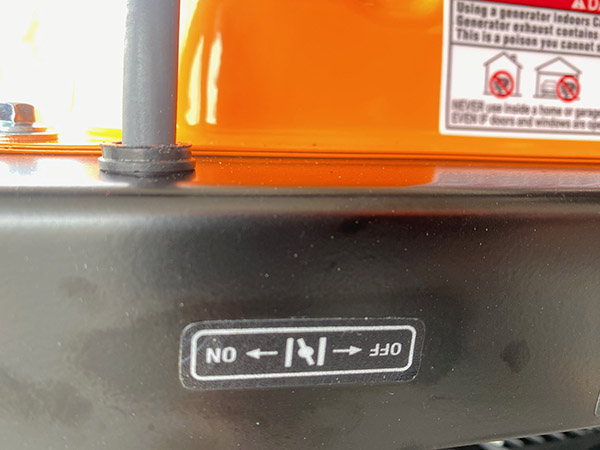
The choke was labeled backwards which led to a lot of rope pulling. It might be ok in the southern hemisphere but around here we peel the sticker off and flip It over.

The unit started right up once I realized the choke was labeled backwards and seems to have plenty of power. It runs my little flux core welder better than a regular receptacle. I’m mobile!

Time will mention under its breath if the ‘Zhen holds up and I’ll be sure to let you know if it’s junk. For now, it’s the real deal.

The Shenzhen 4000 runs the flux core welder nicely. I can crank it all the way up, a setting that pops a 15-amp breaker after a minute.

Join our Facebook ExNotes page!


Never miss an ExNotes blog:


Help us keep the lights on:


Don’t forget: Visit our advertisers!


Two Kool Kamp Kings

By Joe Berk

Sue and I were in Reno last month to visit the National Automobile Museum.  Like most places, Reno isn’t what it used to be.  The downtown area is a bit sketchy and I didn’t feel comfortable at all walking around.  That said, we had a good time at the Auto Museum and a good time in Reno.  As is my habit, I checked online to see if there were any interesting gunstores in town, and the online info for one in particular caught my eye: Willey Brothers Firearms.  Unlike the others, Willey’s ad emphasized the kind of guns I’m interested in (blue steel and walnut, not the black plastic tactical junk one mostly sees in gun stores these days).  Willey Brothers lived up to its ad:  The firearms were interesting, including the used guns.

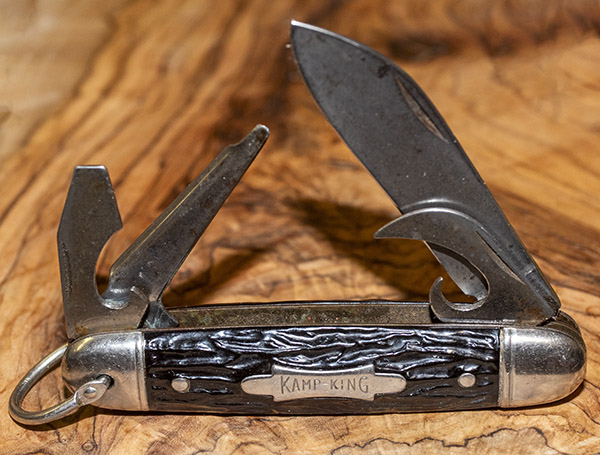
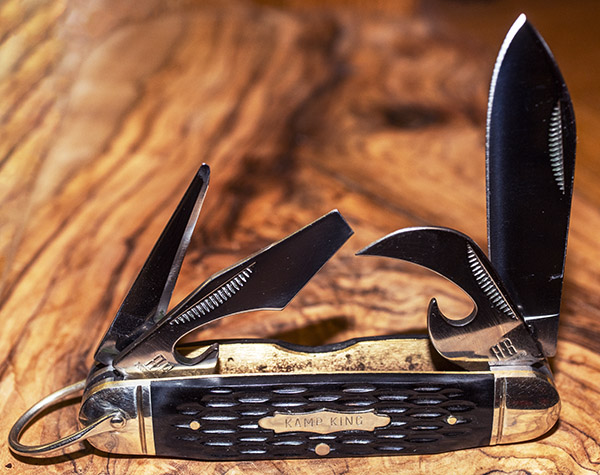
The old Imperial Kamp King knife I bought at a gun store in Reno, Nevada. It has a combination bottle opener/scredriver, an awl for punching holes and undoing knots, a can opener, and a main blade. This one is about 50 years old, and it is in great shape.

Nothing in the gun offerings was interesting enough, though, to make me want to go to the bother of shipping it to the Peoples Republik of Kalifornia, but I noticed the store had a few used pocketknives for sale.  One in particular caught my eye:  An old Imperial Kamp King that was in nice shape.  I was interested in it because it has the same four-bladed configuration as my old Cub Scout knife.   At $25, it looked like a good deal, so I paid the asking price and Sue and I were on our way.  When I got home, I cleaned it up with a bit of Kroil penetrating oil and 0000 steel wool. I think it was made in the 1950s or 1960s (that’s a guess on my part, although if I studied the video included below, I’d probably be able to narrow it down more).

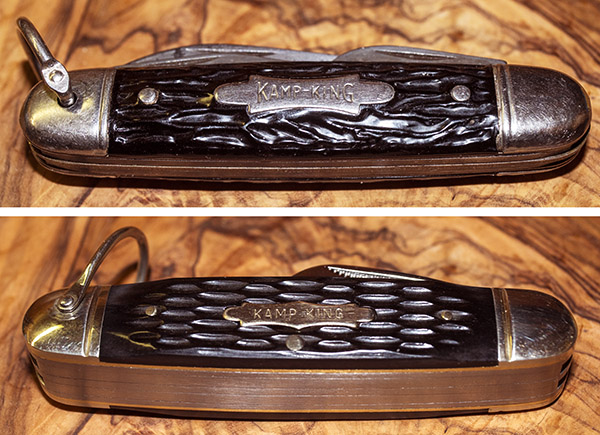
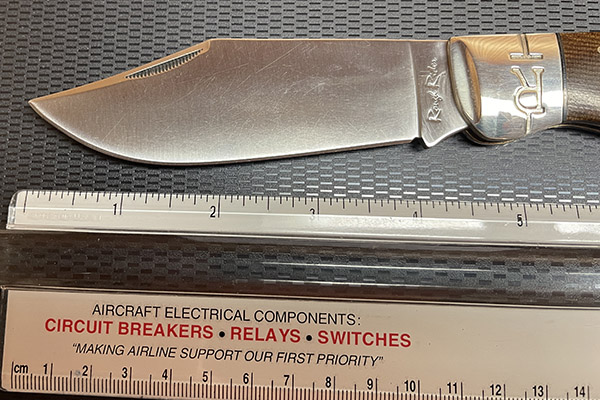
The new Rough Rider Kamp King, with the same blades as the original. This is a very high-quality knife, and I can tell you that the main blade is razor sharp (don’t ask me how I found out).

That got me thinking.  There’s a company called Rough Rider (not the condom company) that makes a current version of the Kamp King.  I recalled seeing that knife when scrolling through the offerings from Chicago Knife Works (which is actually located in Marion, Virginia).  The CKW Kamp King was only $16.94, and the more I thought about it, the more I knew I had to have it (admittedly, the thought process did not take long).  Move to cart, buy now, and in went my credit card number.

Chicago Knife Works has great prices and terrible shipping.   It takes 10 to 12 days from the time I’ve placed orders with these guys until whatever I order actually ships.  I don’t mean until it gets here; I mean until it actually leaves the CKW facility.  I don’t know if that’s because CKW is just pokey, or if they don’t keep much in stock and they order their knives from China when I place an order.  I suspect it’s the former, as every time it’s taken an inordinate amount of time to ship and I send them an email to complain (I did that every time I’ve ordered anything from them).  Then I’ll get an automated response from Chicago Knife Works telling me they’re sorry (which I already knew) and they have so many orders they just can’t get to them all in a reasonable amount of time.  And every time when I wrote to complain about taking to long to ship, well, CKW ships my order the very next day.  I should get smart and complain about the shipping delay as soon as I place an order, I guess.

My new Rough Rider Kamp King arrived a few days ago and I’m impressed.  It is a really nice knife that dimensionally is pretty true to the older ones that were manufactured in America.  The quality on the new Chinese Kamp King is really good.  The fit and finish are superb, and it just doesn’t look or feel like a cheap knife.

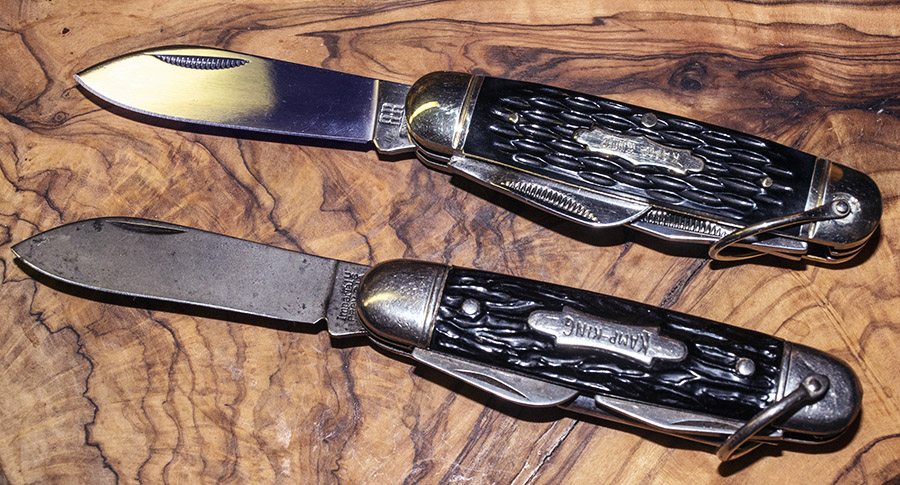
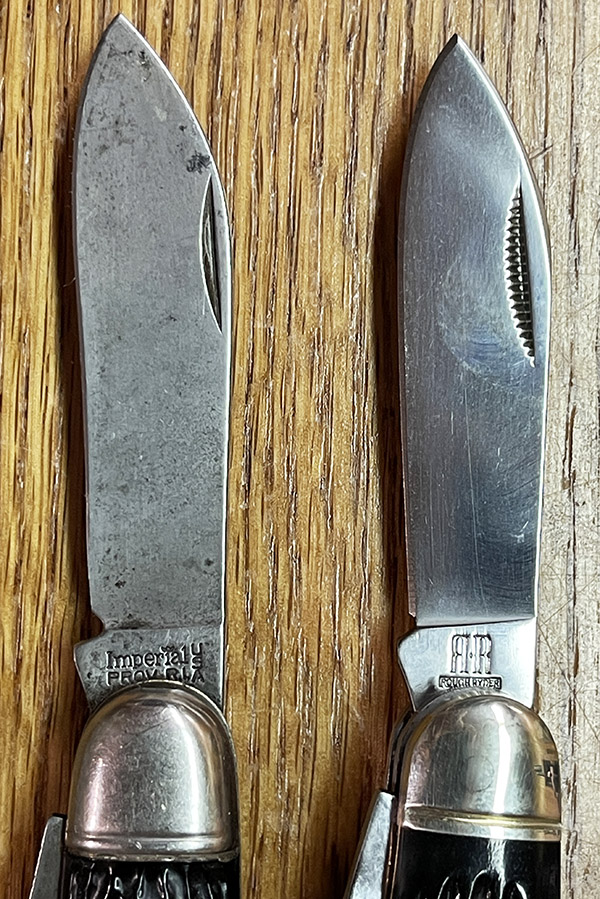
The old Kamp King (top), and the newer one (bottom). The dimensions are the same. For $16.94, the new one is a great buy.

The other reason I ordered the new Kamp King is that I wanted to compare it to a Marbles Scout King I had purchased from Chicago Knife Works about six months ago.  I thought it might be the same knife as the Marbles, but it is not.  The Marbles knife is a bigger, heftier version of the Kamp King.  I suspect they are both manufactured by the same knife company in China, but I don’t know this.  The appearance of the two new knives (even though the dimensions and the scales are different) is so similar that I’d bet both come out of the same factory somewhere in the Peoples’ Republic (and I’m talking about China now, not Kalifornia).

The original Kamp King was manufactured by Imperial in Providence, Rhode Island. The new one is produced somewhere in China; most likely in Yangjiang City, China’s knife-making capital.

I Googled the topic and although I couldn’t find the specific Chinese company that makes these knives, I learned that China’s primary knife-manufacturing region is Yangjiang City in Guangdong Province.  It’s been China’s knife-making center for more than 1,400 years and is home to several knife companies.  I’d sure like to visit that area someday.  I’ve been to Providence, Rhode Island (where the original Kamp Kings were manufactured).  A visit to Yangjiang City would be interesting. I’d probably come home with a suitcase full of interesting and inexpensive knives.


Join our Facebook ExNotes page!


Never miss an ExNotes blog:


Help us keep the lights on:


Don’t forget: Visit our advertisers!

A Tale of Two Bowie Knives

By Joe Berk

Well, maybe it’s three.  A little while ago I wrote about a custom Bowie knife good buddy Paul crafted for me.  That knife was a surprise gift, I like it a lot, and it fit in nicely with the rest of my collection.

A surprise gift from good buddy Paul: A custom Bowie knife.

Paul then sent a photo of a curly maple Bowie he made for himself, and I liked it so much I offered to buy it.  Not so fast, Paul said.  He’s keeping that one, but he offered to make another one just like it for me.  One thing led to another, and I decided to go ahead with the curly maple Bowie.  And then I decided to get yet another Bowie, this time with a white Micarta handle.  Paul told me about a block of Micarta he’s had for 40 years, and he thought it would do nicely.  Over the years, the Micarta had taken on a beautiful yellow hue similar to real ivory.

Lifelong good buddy Paul with some of his Randalls and a few other toys. I’ve known Paul longer than any other person on the planet.

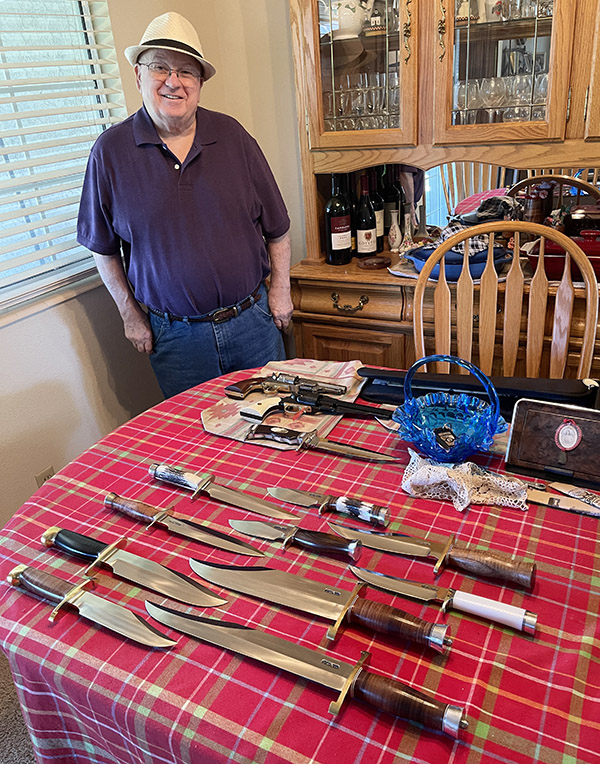
Paul is an experienced and serious knifemaker, and he is also a collector.  He has the nicest collection of Randall knives I’ve ever seen, as well as a bunch of other high-end knives.

Now, on this business of Bowie knives:  In the previous Bowie blog (to which I provided a link above), I wrote briefly about the history of Jim Bowie and the knife that bears his name.  And speaking about bears, some of you might be thinking about Davy Crockett, a Bowie knife, and the myth surrounding his encounter with a bear.  Congressman Crockett’s ursine encounter is but a story; it’s not historical fact.  It likely came about as the result of the song, “The Ballad of Davy Crockett.” As our President might say: It’s fake news. There’s no proof it actually occurred. But it’s fun to think about.

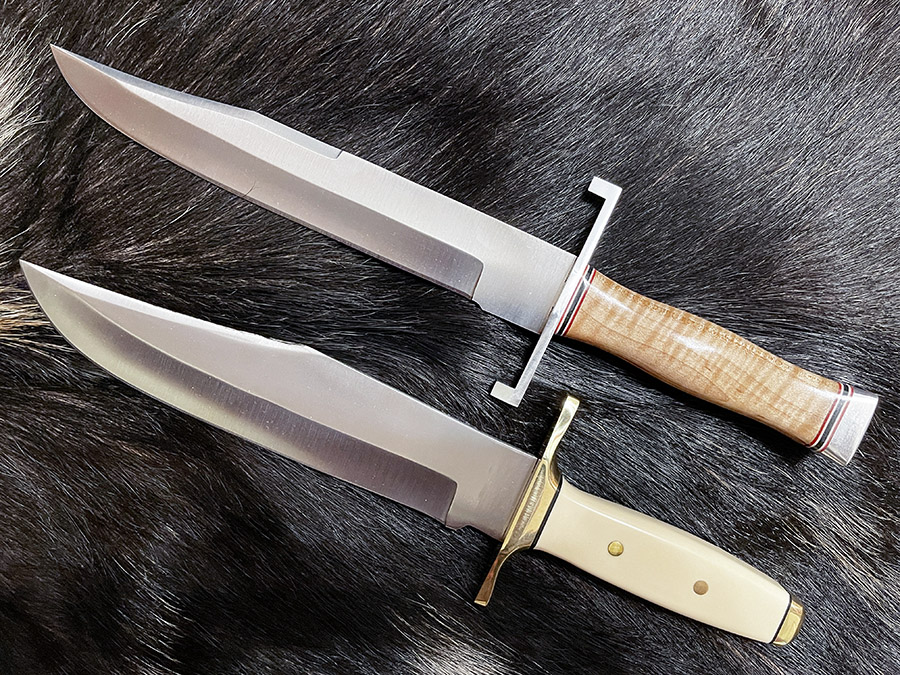
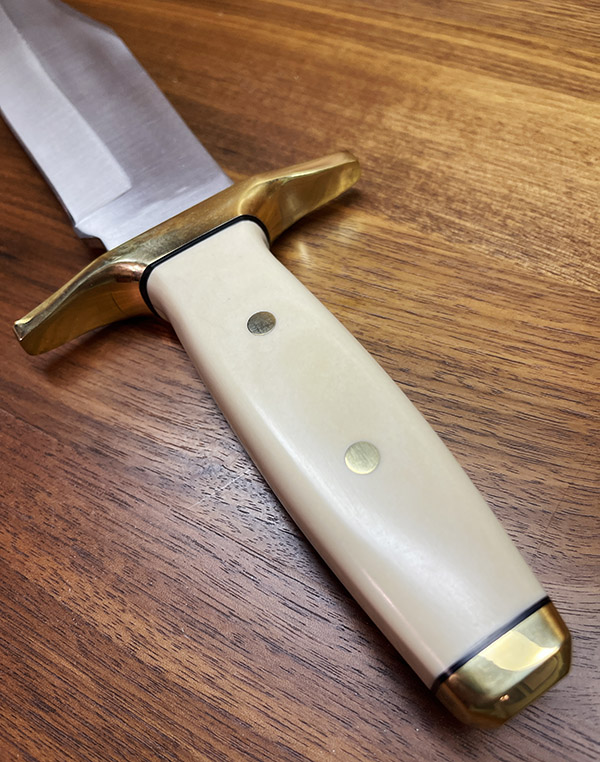
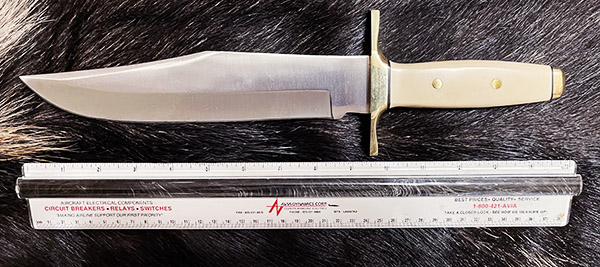
My two recent custom Bowie acquisitions are both massive knives.  The Micarta-handled bowie has a blade length of 9 3/4 inches and an overall length of 14 7/8 inches.  It’s a huge knife with a gorgeous brass guard.  It is simply stunning.

The Micarta Bowie. The handle, the brass guard and pommel, the blade, the brass pins, and the Micarta handle make for a beautiful custom knife.
A close up shot of the craftsmanship on the custom Bowie handle. It is an exquisite knife.
Big boys, big toys: Both of these knives are huge. The Micarta-handled knife has a good feel to it.  The ruler you see above is 15 inches long.

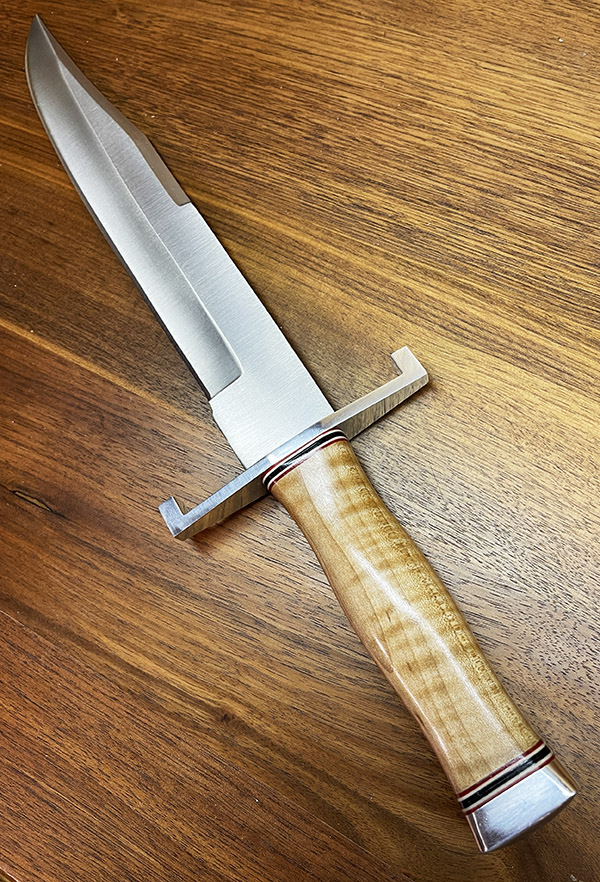
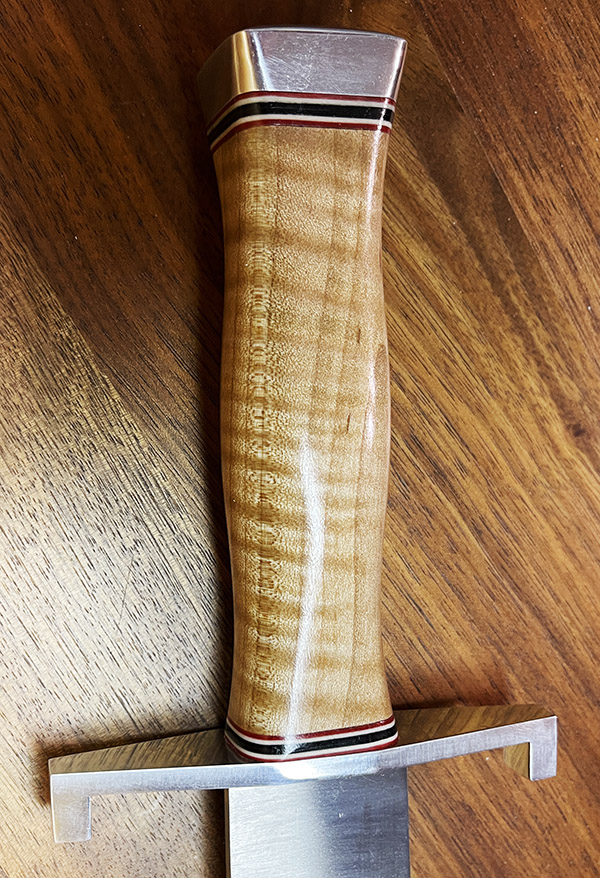
The curly maple custom Bowie knife is the one that got all this going.  When I saw the one Paul had crafted for himself, I had to have one.  I absolutely didn’t need it, but I wanted it.  I wanted one just like Paul’s, and he came through. It’s a beautiful knife.

Paul does beautiful custom work. You should see his black powder rifles; they are equally impressive. This knife just looks right.
The workmanship on both knives is superb. The guard and the pommel are beautiful bits of aluminum hand filed and finished by Paul. There are a lot of hours in these knives, and it shows.
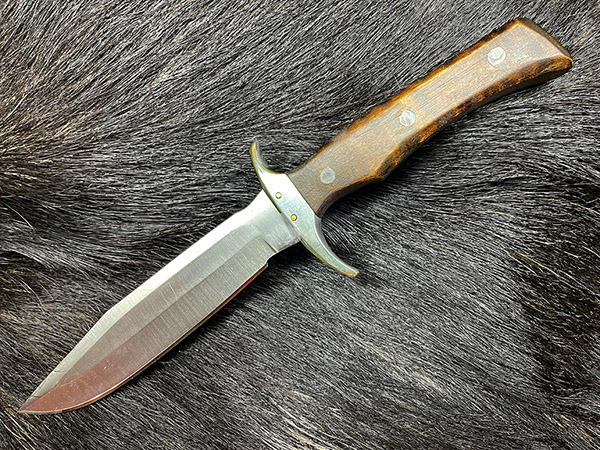
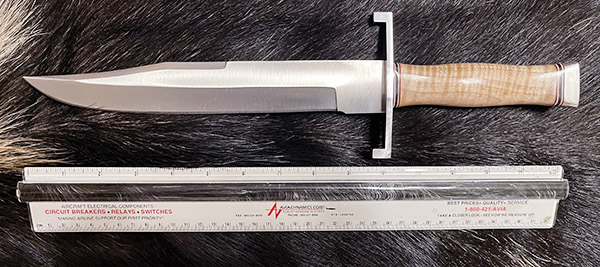
Curly maple, custom everything: This is a beautiful Bowie knife.  The background for this photo and others in this blog is an Ossabaw hog skin.  I shot it on a hunt with Paul in Arizona about 10 years ago with a curly-maple-stocked Model 70.

The curly maple knife is even bigger than the Micarta knife (the blade length is 10 inches and the handle is 5 1/4 inches, for an overall length of 15 1/4 inches).  Although it’s bigger, the maple knife is noticeably lighter than the Micarta Bowie due to its more slender blade, the aluminum guard and pommel, and the curly maple handle.  Both are big, big knives.  Huge, actually.

Paul asked for my inputs during the design of both knives, and he kept me posted with photos as the knives came together.  It was fun, and I now own the two beautiful Bowies you see in this blog (three, if you count the first one).  They are stunning knives, they are built exactly as I wanted them, and they are a magnificent addition to my small collection.

You know, we have bears here in southern California. Lots of them, apparently.  One was in the backyard of a home just a half-mile from ours few days ago.  Bears, be forewarned.  Thanks to Paul, I’m ready.


Join our Facebook ExNotes page!


Never miss an ExNotes blog:


Help us keep the lights on:


Don’t forget: Visit our advertisers!

ExNotes Review: MidwayUSA Soft Rifle Case

By Joe Berk

I don’t usually buy things with features I don’t need, but I made an exception for MidwayUSA’s soft rifle case.  I needed a couple of soft rifle cases because some of mine had worn out (the zippers were tearing on a couple, the inner lining was snagging on the front sight on another, the handle broke on one, etc,).  Usually, I spend about $10 or $12 on a rifle case because the only thing I really use them for is bringing a rifle to or from the range.  In the past, I’ve purchased them when visiting Bass Pro or Turner’s.

I buy a lot of reloading components from MidwayUSA, so that’s where I went for the cases.  MidwayUSA usually ships either the day I order anything, and they have that $100 free shipping threshold.  At $26.24, their Heavy Duty Scoped Rifle Case was more than I wanted to spend, but hey, I would only need to order four of the things to get my free shipping.  I am a sucker for that free shipping deal.

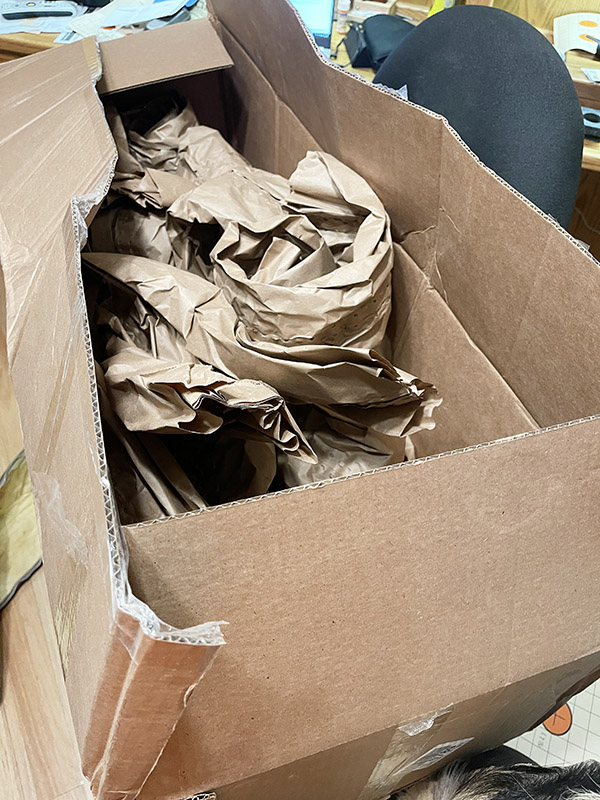
The cases arrived quickly, and MidwayUSA packaged them well.  They arrived in a single large box with plenty of padding.  You could have shipped a body in the box (it was that big). Each case was in a separate plastic bag.  It’s funny when you think about it:  Carefully packing a case in a box to protect it from damage when the purpose of the case is to protect things from damage.

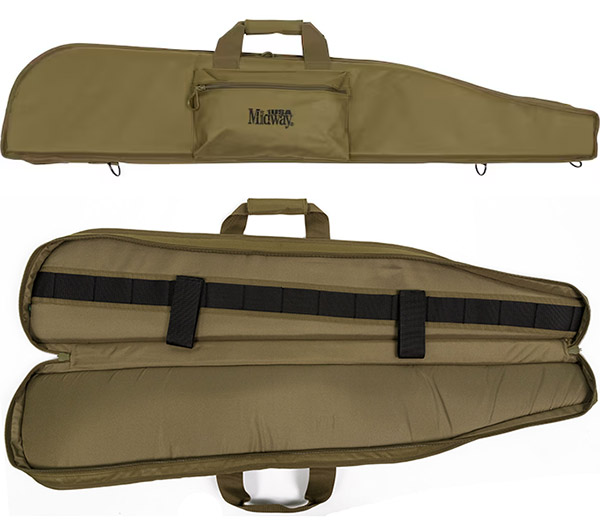
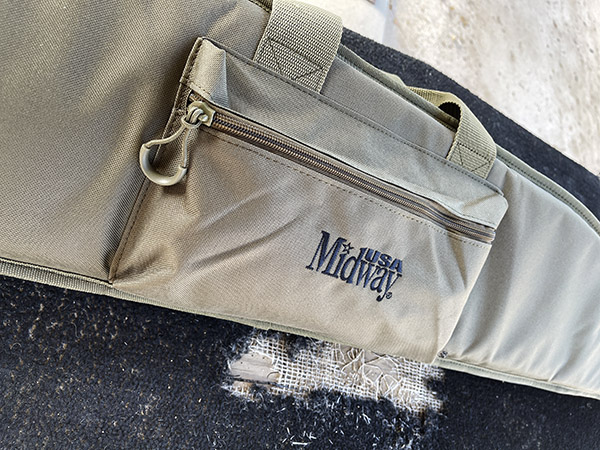
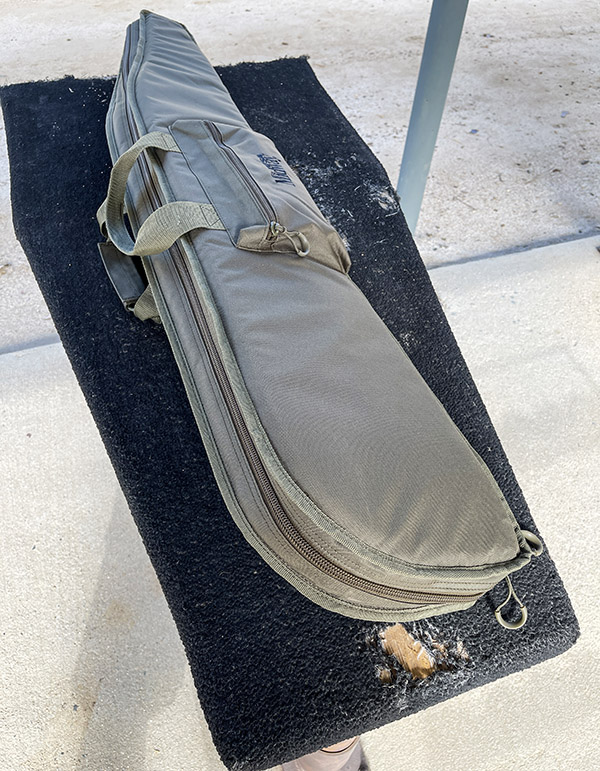
The rifle case itself is impressive.  It’s wider than usual and it has heavier padding on the sides.  The zippers are higher quality than what I usually see on rifle cases.  Inside, there are a couple of Velcro straps to secure a rifle (that’s a feature I don’t need, but it’s a nice touch).  The case has a carrying strap so you can carry it from the shoulder (yet another feature I don’t need, but some folks might).  There’s an exterior zippered pocket, presumably for carrying ammo.   I used it for the Velcro retainers and the shoulder strap, so I guess it came in handy.

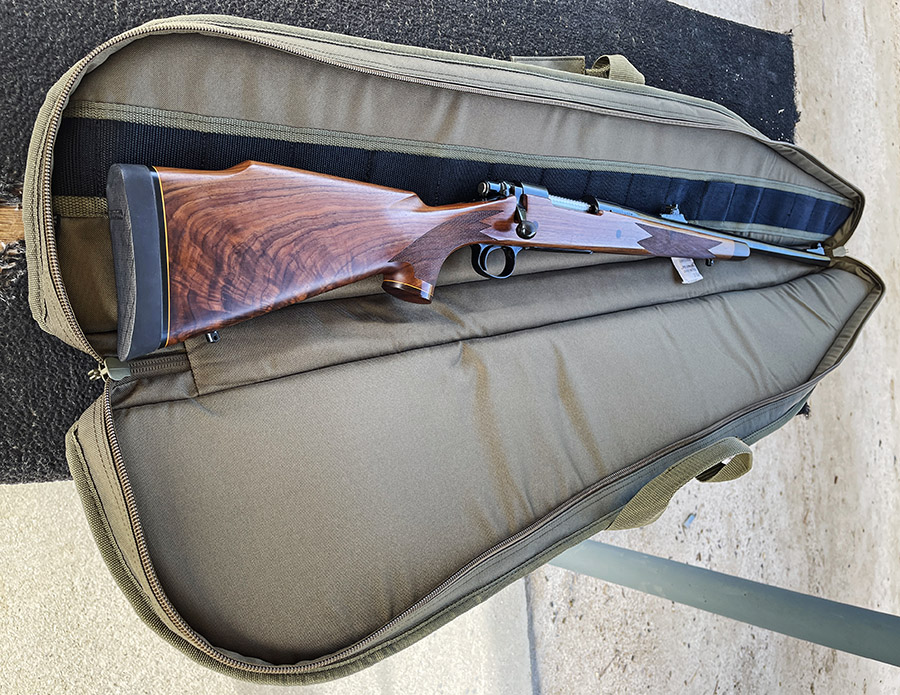
I was worried about the case being big enough to accept get some of my longer barreled rifles, but there’s plenty of room.  I have a couple of long action bolt rifles with 26-inch barrels, and the MidwayUSA case swallowed those with ease.  You can see that in the photo at the top of this blog.

The cases can be had in olive green, desert, or black.   I bought the olive green version in a nod to my alma mater (the US Army).

Overall, I give the case 10.0 points (out of a total possible 10 points).  I knocked it down a half a point because it had things I didn’t need, but then I gave it a half point back for MidwayUSA’s free (and speedy) shipping.  If you are in the market for a rifle case, this is a good one.


Pro Tip:  Never store a firearm in a soft case (or a holster) for an extended period of time.  The case or the holster will hold moisture and lead to rusting.  Take the weapon out regularly and wipe it down with an oiled rag.


Join our Facebook ExNotes page!


Never miss an ExNotes blog:


Help us keep the lights on:


Don’t forget: Visit our advertisers!

Patagonia, Part 1: Southbound

By Bobbie Surber

Some trips are booked on a whim. Others are slow-brewing obsessions. For me, Patagonia was both myth and magnet—pulling at me for over a decade until, finally, I said yes.

From the rhythm of Santiago to the wild edge of Torres del Paine, onward to the granite spires of Fitz Roy, and finally to the end of the world in Ushuaia – this journey began long before the first step.

Some dreams grow slowly, quiet things that live inside you for years, waiting for the right season. In the spring of 2025, I finally answered Patagonia, a land that had lived in my imagination for over a decade.

This five-part series is a love letter to that journey: the W Trek in Torres del Paine, the trail to Fitz Roy, epic glaciers, the emotional and raw beauty of our stay in a turn-of-the-century estancia, and the weeks of awe, grit, and the stillness in between. But before it began, it started here—with four grounding, soul-resetting days in Santiago.

Santiago: A Soft Landing in the South

We arrived on a warm March evening, a little weary from 24 hours of travel. It was our first time traveling in the southern hemisphere together, and the city welcomed us with a gentle kind of grandeur – equal parts aged colonial elegance, unique barrios, and the Andes rising in the distance like a promise.

Santiago surprised me. I expected a pleasant stopover in a city I had yet to explore, but what we found was something deeper: a soulful pause. The city is a seamless blend of past and present – where the Metropolitan Cathedral anchors Plaza de Armas with 18th-century dignity, and just a few blocks away, the creative heartbeat of Barrio Lastarria pulses through cobbled streets lined with wine bars, coffee shops, pisco bars, bookstores, and tucked-away galleries.

We gave ourselves four full days to settle in, slow down, and breathe before the hard miles ahead. We wandered without a plan through Santiago’s romantic, tree-lined streets, lingered over café con leche, and sampled seafood so fresh it felt like the ocean hadn’t even noticed it was missing yet.

We ate slowly, laughed easily, and always – always – had room for a round (or two, or three) of Pisco Sours. There’s something about their sharp, citrusy kick and frothy top that made us pause mid-conversation just to savor. We debated in earnest the merits of Chilean vs. Argentine piscos – aged in sherry flasks vs. clear and youthful expressions. They became a little ritual we both looked forward to at the end of each day.

At night, Barrio Lastarria – our temporary home – transformed. Crowds gathered in the streets as fire dancers performed to the rhythm of drums, laughter, and clapping hands. It felt like a celebration – not just of the city, but of being alive, present, and open to whatever might come next.

One golden afternoon, after a locals’ lunch from the nearby green market, we climbed Cerro Santa Lucía, the small hill where Santiago was founded. From the top, the view stretched beyond colonial rooftops and high-rise towers to the distant edge of the Andes. The wind caught my hair, and I stood quietly, thinking: It’s all really happening.

Santiago didn’t rush us. She cradled us in her warmth and rhythm – and without even trying, helped me remember why we came. She held the silence between what I was leaving behind and the transformative journey ahead.

Packing, Repacking, and Trusting the Journey

When we weren’t exploring the city, I was sprawled across the Airbnb floor, turning our room into a staging ground for our gear. Santiago’s quiet charm and youthful energy balanced the task at hand: preparing for the wilderness ahead.

I repacked my backpack more times than I want to admit – agonizing over every ounce.

Do I really need a second base layer?
Will this hold up to Patagonia’s infamous wind?
Are we actually ready for what’s coming?

Eventually, I stopped trying to pack perfectly and started packing with intention – and trust. The truth is nothing can fully prepare you for Patagonia’s rawness. At some point, you just have to take a leap of faith and go.

Flying South: The Landscape Begins to Shift

From Santiago, we boarded a flight to Puerto Natales, Chile – the gateway to Torres del Paine National Park. As the plane sliced its way southward, the landscape shifted – flat plains giving way to jagged peaks, glacier-fed rivers, and a coastline shaped by wind and time.

Puerto Natales welcomed us with its signature mix of remoteness and warmth. It’s a small, rugged town perched along the edge of Seno Última Esperanza – the Last Hope Sound, a stunning fjord that reaches inland from the Pacific Ocean. With snow-dusted peaks in the distance and steel-gray water stretching out before us, it felt like we had reached the last outpost before stepping off the map.

Colorful corrugated metal buildings lined the streets, most weatherworn but vibrant, standing defiant against Patagonia’s legendary wind. The town is modest but full of charm – local cafés, gear shops, friendly bakeries, and hostels nestled between homes and small restaurants. Everything feels like it belongs here – resilient, practical, but with soft edges.

After a 30-minute shuttle journey from the airport, we checked into our hotel for the next two nights. Our room sat just a short walk from the water’s edge, where fishing boats rocked gently in the inlet and clouds drifted low across the mountains beyond. The cold air felt cleaner, sharper – like the world had been distilled to its purest elements: rock, wind, water, sky.

That evening, Tom and I bundled up and walked along the costanera, the long waterfront promenade that hugs the fjord. The sky was moody and low with clouds, the wind tugging at our jackets. Seabirds dipped low over the water. In the distance, the silhouette of the mountains we came for was just barely visible, blurred and waiting.

We didn’t speak much. We didn’t need to. We were here. The adventure was about to start.

What’s Next: Hiking the W Trek

In Part 2, I’ll take you inside our six-day trek through Torres del Paine: past hanging glaciers, through lenga forests, clomping up to the famous Towers – a dream I’ve held so long come true – ending along the windswept shores of Lago Grey. It was a hike that tested us, shaped us, and left us completely in awe.

If you’ve ever dreamed of Patagonia – or are planning your own trek – drop a comment or question below. I’d love to hear from you.

Patagonia Prep Tips

If Patagonia is on your list – or already on your calendar – here are a few tips from our experience that might help you prepare, both practically and mentally:

      1. Ease into it with Santiago.  Give yourself 2–3 days in Santiago to rest, adjust to the time zone, and mentally downshift. Patagonia can be physically demanding, so it’s worth arriving grounded. Plus, Santiago is a beautiful, underrated city full of soul, food, and architecture.
      2. Pack for all four seasons.  The weather in Patagonia is famously unpredictable – you can experience sun, sleet, hail, and 50mph winds all in a single day. Prioritize a quality waterproof shell (jacket and pants), a layering system (base layers, fleece, insulated puffy), windproof gloves and a beanie, and trail runners or hiking boots that are well broken-in.
      3. Repack with intention, not perfection. You will overthink your gear (everyone does). Don’t aim for flawless – aim for flexibility. Trust that you’ll adapt on the trail. Patagonia will shake loose whatever you didn’t need anyway.
      4. Download maps and offline essentials. Many areas in Patagonia have little to no cell service. Download maps on Maps.me or Gaia GPS, as well as offline translations (Spanish), weather apps, and your itinerary. Print any confirmations – especially for Refugio’s or border crossings.
      5. Carry both cash and cards.  While larger towns accept credit cards, many places in Patagonia – including transport, markets, and smaller cafés – prefer Chilean or Argentine pesos in cash. ATMs can be unreliable, so plan ahead.
      6. Train your body for multi-day hikes. If you’re doing the W Trek or Fitz Roy trails, it helps to prepare with at least a few local hikes beforehand, especially back-to-back days. Work on carrying a loaded pack for long distances.
      7. Prepare mentally for the elements.  Patagonia rewards patience, grit, and presence. Some days are full of awe. Others are full of wind and sore feet. You may not always get postcard views – but the rawness is part of what makes it unforgettable.
      8. Early Reservations.  For Torres Del Paine Park you will need to make early reservations  for your camping or lodging. You cannot enter the park without showing your lodging confirmation.

Join our Facebook ExNotes page!


Never miss an ExNotes blog:


Help us keep the lights on:


Don’t forget: Visit our advertisers!

Movie Reviews: The Titan Documentaries

By Joe Berk

I recently watched two movies on the Titan submersible implosion and both were excellent.  The first is Titan: The OceanGate Submersible Disaster, which is currently streaming on Netflix.  The second is Implosion: The Titanic Sub Disaster, and that one is currently streaming on Max.  The two movies offer different takes on how the events leading up to the disaster unfolded.  Both are chilling in their depictions of the technical arrogance and unwillingness of the key guy, Stockton Rush, to recognize that Titan was moving toward failure.

I’ve spent a lot of my working days investigating product failures of all sorts, including serving as an expert witness on several cases and teaching engineering ethics in Cal Poly Pomona’s engineering school.  Two factors are always present when fatalities occur:  Engineering arrogance, and putting other factors ahead of safety.

Engineering arrogance refers to a misguided belief that a failure won’t occur (even though ample indications existed before a fatal event occurs) because we’re omnipotent, we’re smarter than everyone else, we’ve never experienced a failure of this nature before, or…well, you get the idea.  On the space shuttle Challenger, NASA had experienced numerous o-ring failures prior to the one that killed the crew, but they ignored them because “we’re NASA and we’ve never lost a man in space” (that is an actual near-verbatim NASA management quote prior to the Challenger accident).   Everyone knows the Takata airbag story; those folks experienced explosions during engineering development and product acceptance testing, yet they continued to sell these dangerous devices because they thought they would be okay.  Takata airbags actually killed people in service and Takata continued to sell them.  It’s surprising how often this feeling is present in the engineers who designed products that kill people unintentionally.

Incidentally, one time when I was giving a deposition the attorney representing a company whose product killed someone hit me with something I wasn’t expecting and he caught me off guard.  He asked how I could criticize any one with my background in designing cluster bombs and other things that had, as their primary purpose, exactly that function:  To kill people.  I was floored and didn’t have a good answer.  As sometimes happens, I had the perfect answer a few hours after the deposition had ended.  My products, you see, had killing people as their purpose.   Your products did not.

The other factor that is always present is putting other things in front of safety.  Cost is a big one.  Everyone knows about the Pinto and its propensity to burst into flame when rear-ended.  Not everyone knows that the Ford Crown Victoria, Ford’s big sedan, had the same problem.  The police knew about it, though, and they finally told Ford they wouldn’t buy any more Crown Vics unless Ford addressed the problem.  Incredibly, Ford engineered a protective cage for the fuel tank and only sold it on the police automobiles.  It was cheaper to keep paying out wrongful death lawsuits with the recipients signing nondisclosure agreements.  There are lots of examples of this.

Both factors were present and both resulted in the Titan’s implosion. I’ll get off my safety soapbox now and leave you with a recommendation for watching both Titan: The OceanGate Submersible Disaster and Implosion: The Titanic Sub Disaster.  They are both excellent documentaries.


Join our Facebook ExNotes page!


Never miss an ExNotes blog:


Help us keep the lights on:


Don’t forget: Visit our advertisers!

Case Buffalo Horn Hunter

By Joe Berk

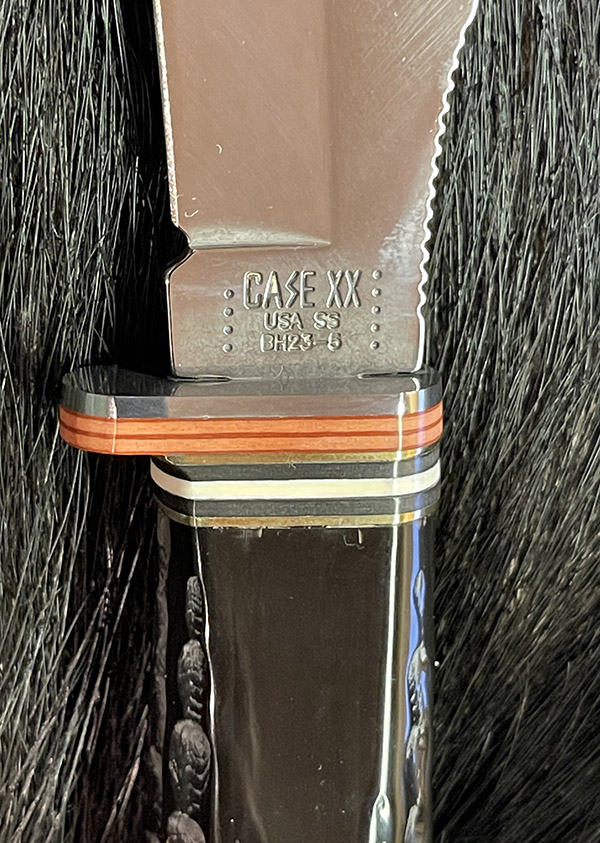
Case is a old-line American knife manufacturing company with roots that reach all the way back to 1889.  I knew them as a pocketknife manufacturing company, and without really knowing anything about them, one of the first knives I purchased when my interest in pocketknives was rekindled was a Case Stockman (you can read about that knife here).  I mentioned to good buddy and edged weapons rabbi Paul that I had purchased a Case, and he gave the company his seal of approval: “They’re an old line knife company, they’re made in America, and they’re good,” he told me.  I didn’t know any of that when I purchased the Stockman, but it felt good to know Paul thought I had made a good decision.

The Case at hand…sorry, couldn’t resist that.

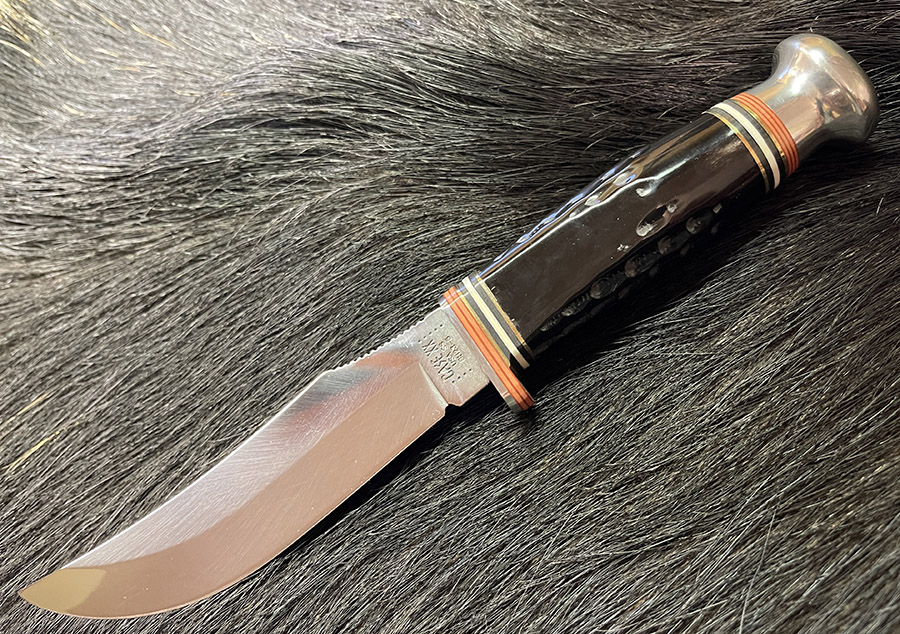
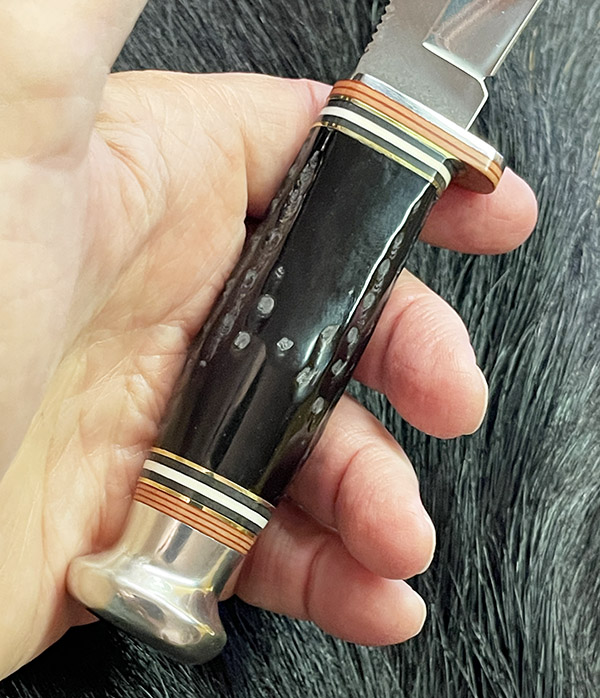
Not long ago I received an email from the Chicago Knife Company (an online retailer) offering a Case Hunter.  The knife had my attention immediately for several reasons:  It was a fixed blade Bowie/hunting knife (I didn’t know Case made such an item), it had a jigged buffalo horn grip, it was mirror finished, and the price was right.  Buy now, a credit card number, free shipping, no sales tax, and it was on its way to me.

Made in America. Case has an American manufacturing history that goes back more than a century.

The Hunter arrived a few days ago, and it’s beautiful.  I’m glad I ordered this one.  For me, it’s a collectible.  I won’t be wearing it in the field and I have no intentions of skinning or field dressing anything with it (as I watched our guide Tom do on a recent pig hunt in Arizona).  I just enjoy looking at it.

To me, the knife feels a little small and a little bit light, although I’m not sure why it does.  It has an overall length of 10 inches, a blade length of 5 inches, and a handle length of 4 inches.

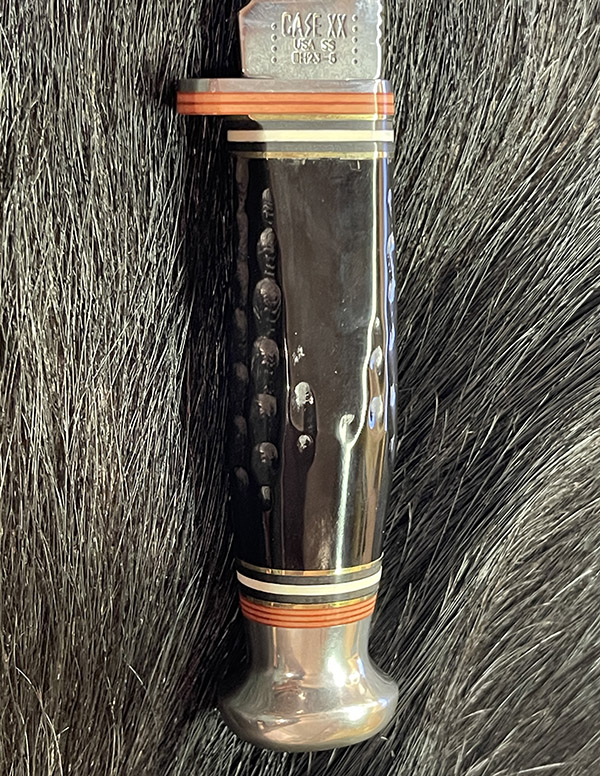
The polished buffalo horn grip from the left side.
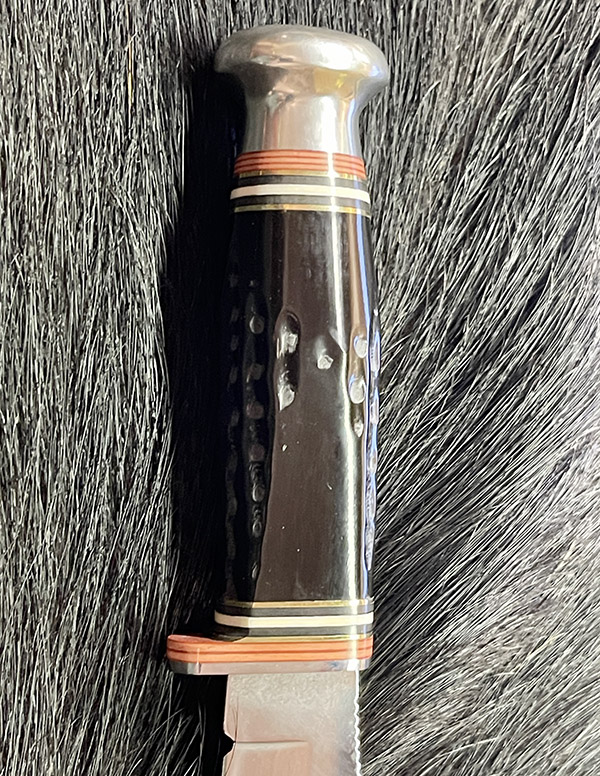
A view of the buffalo horn grip and spacers from the right side.
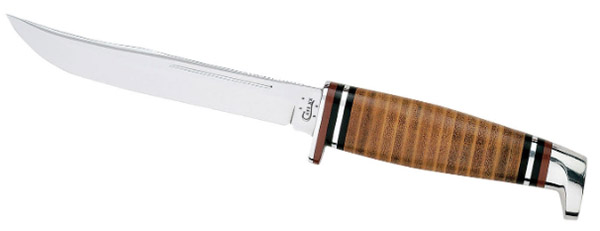
As a potentially more usable grip, stacked leather is available.

The buffalo horn grip is highly polished.  Maybe too much so, as it feels a bit slippery.  That’s okay, I think, for something I intend to admire a lot and use little.  If I was buying this knife as a tool (and not as a bit of artwork), Case also offers it with a stacked leather handle.  That might be more practical.

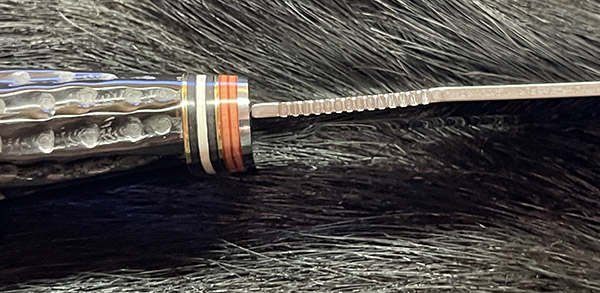
Serrations on top of the bade. The 5-inch blade is relatively narrow compared to some of my other knives.

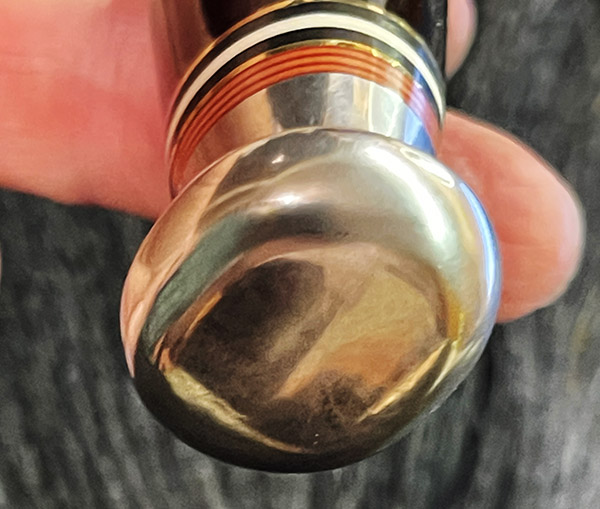
The blade has a serrated edge along the top.  Maybe that’s intended to be used for sawing.  Again, it doesn’t matter to me.  It’s decorative as far as I’m concerned.  The pommel is cool, too.  It’s polished aluminum and it looks great along with the knife’s red, yellow, white, black, and brass spacers.

The Case Hunter’s polished aluminum pommel.

On the Chicago Knife Works site, the blade material is identified as H-2.  Here’s what Google says about that steel:

H-2 steel has extreme corrosion resistance, especially in saltwater environments. Its composition uses nitrogen instead of carbon.  It is described as tough and capable of holding an impressive edge.  The strengthening process for H-2 steel involves intense rolling and cold-working, not traditional hardening and tempering.  H-2 is an evolution of H-1 steel, while retaining its desirable properties and being easier to manufacture. It can attain a Rockwell hardness in the high 60s while remaining resilient. In summary, H-2 steel is used in some knives and offers exceptional corrosion resistance, toughness, and good edge retention. 

The Case Hunter is not listed on the Case Knives website, but it is listed on the Chicago Knife Works site.   I called Case to confirm it is still available, and it is.  This is not a Chinese or Pakistani knife; it’s made in Bradford, Pennsylvania.  A black leather sheath is included with the buffalo horn Case Hunter.


Join our Facebook ExNotes page!


Never miss an ExNotes blog:


Help us keep the lights on:


Don’t forget: Visit our advertisers!

Gordon Knives

By Joe Berk

Gordon knives?  You may think you’ve never heard of them, but maybe you’ve seen them without realizing what you were seeing.  Gordon, you see, is the house brand for Harbor Freight knives.  You know Harbor Freight: It’s where the folks who badmouth Chinese motorcycles buy their tools.

The Gordon Bowie. It’s a nice knife.

I don’t shop much at Harbor Freight these days, but it’s not because I think their stuff isn’t any good.  I’m an old  guy and I have all the tools I’ll ever need.  But I still get the Harbor Freight ads, and one of them caught my eye recently.  It was for what I initially thought was a Buck 119 hunting knife, but it wasn’t a Buck: It was a Gordon.  They call it the Gordon Bowie/Hunting knife.  So I rolled on over to my local Harbor Freight store to check it out.

The Gordon has some heft to it. It seems to fit my hand perfectly.
The Gordon Bowie has a 6-inch blade.

You can see the Gordon Bowie before you buy it because it’s packaged in a clear plastic bubble wrap container.  Getting the knife out of that package was a bit of a challenge.

The Harbor Freight website lists the blade material as 7Cr17MoV stainless steel.  Even though I had a course or two in metallurgy in my formative years, I wasn’t sure what that meant, so I Googled it:

7Cr17MoV is a Chinese stainless steel, often used in budget-friendly survival and kitchen knives, known for its good balance of hardness, corrosion resistance, and toughness. It’s essentially a modified version of 440A steel, with added vanadium to enhance strength and wear resistance. While it may not offer the best edge retention compared to high-end steels, it’s relatively easy to sharpen and is known for its durability under hard use.

A Buck 119 goes for about a $75.  The Gordon?   It’s a whopping $29.99.  I had to take a look, and when I did, I liked what I saw.  So I picked one up.  At $30, I can take the risk of it not being perfect.

Then I noticed another Gordon knife hanging on the Harbor Freight display next to the Gordon Bowie.   It was a monster that caught my attention (it was hard to miss, actually).

Visions of Sylvester Stallone as Rambo swam through my mind when I saw this Gordon. Check out the sawing serrations on top of the blade.

Harbor Freight calls the knife you see above their Survival/Hunting knife.  In addition to its size, the other thing that grabbed my attention was the price.  It was either $9.99 or $6.99.  I couldn’t tell which, and I’ll return to that part of the story in a minute.

The Gordon Hunting/Survival knife has an 8-inch blade. It’s an impressive knife.  I don’t know what impressed me more:  The knife’s size, or its low price.

The gigondo Gordon is called their Hunting/Survival knife.  It’s a monster with an 8-inch blade.  The knife has a hollow handle with a cap that unscrews, and inside the cap, there’s a compass.  Cool beans.  A compass.

The Gordon Hunting/Survival knife handle. The end cap unscrews and you can store stuff inside the handle.  Because the handle is hollow and made of aluminum, the knife feels much lighter than it looks.

When I later read the online reviews, one guy said the compass didn’t work.  But you know those online reviews.  Some folks would complain if you hung them with a new rope.  Mostly these reviews consist of what emanates from the southbound end of a northbound bull.  My compass works just fine.

Gordon also gives you some thread, a few matches, and oddly enough, a button or two.  It all fits in the handle and it’s focused on helping you survive in dangerous places.  You know, like LA.   In case you need to hack your way through some bamboo or you lose a button.

The handle’s cap is sealed with an o-ring.
A compass inside the handle’s end cap.
There’s room inside the handle to store the survival accessories that come with the knife, and maybe some other stuff.
This little package of survival stuff came with the Grodon knife.

The Gordon survival knife is cool.  It makes me feel like Rambo. Maybe that’s what it is supposed to do.  The upper part of the blade has a sawtooth pattern milled into it.  The blade is sharp.  Is the metal any good?  Hell, I don’t know, and I probably won’t find out.  I’m not planning any expeditions into the Amazon basin, and even if I were, I probably couldn’t get on the airplane with this thing.  Will it hold an edge? I don’t know that either.  But at $9.99, if I can’t sharpen the thing I’ll just buy another.

The blade material is specified on the Harbor Freight website simply as “stainless steel.”  A Reddit post by one of the many folks on the internet who post such things states that it is 8CR13MOV steel (I don’t know if that’s accurate, but it’s the only blade material reference I found).  Here’s what Professor Google has to say:

8Cr13MoV steel is a popular Chinese stainless steel known for its good balance of performance and affordability, making it a common choice for budget-friendly knives. It offers decent edge retention, corrosion resistance, and ease of sharpening.

Both knives come with sheaths, not that I’ll ever use either.  But it’s nice to know they’re there just in case I ever get the urge to make a Rambo movie.

The Gordon Bowie and Survival/Hunting knives both include sheaths in their incredibly low prices.

You know, it’s funny.  The young lady cashier at Harbor Freight asked if I knew the price of the knives.  I told her the 6-inch Bowie Buck 119 wannabe was $29.99, and the big Gordon survival knife was either $9.99 or $6.99.  I explained that I wasn’t sure because there were two price tags on the larger knife.  She explained that if I was a Harbor Freight member, I could buy the knife for the lower $6.99 price, but as a plain old Harbor Freight nonmember, I’d have to pay the higher $9.99 price. She went on to explain that the annual Harbor Freight membership fee is $29.95.  I told her I didn’t want the membership because, like Woody Allen, I wouldn’t be a member of any organization that would have me as a member (I thought I was really on top of my game with that one, but my borscht belt shtick went right over her head).  She then told me if I told her my email address, I could select one of four different prizes.  As a guy who still gets excited opening a box of Cracker Jacks, her offer appealed to me.  (I was really having a good day.  I love going into any store that sells tools, I was getting two cool knives, and now I had a offer for another free prize.)  I gave that young lady my email and she showed me a menu.  I selected the convertible screwdriver.  And finally, when she rang up the knives, she looked at the Buck 119 wannabe.  “Why is this one so expensive?” she asked, pondering its $29.99 price against the much larger $9.99 survival knife.

Me? Not hardly. But I have the blade if they ever offer the role to me.

So there you have it.  Are these knives any good?  I think they are, but hey, at these prices, who cares?


Like our knife stories?   We have more, you know.

A Custom Bowie Knife
A Buck Canoe
Buck, Cold Steel, and Chinese vs. US Quality
Man, This Is Scary
A Tale of Two Pocketknives
A Stag Film?
Texas Rangers Smith and Wessons
The Buck Stopped Here
The Buck Stops Here


Join our Facebook ExNotes page!


Never miss an ExNotes blog:


Help us keep the lights on:


Don’t forget: Visit our advertisers!

A Custom Bowie Knife

By Joe Berk

It’s good to have friends, and it’s even better to have friends that go back to your earlier childhood.  I have a few of those, and the one I’ve known the longest is good buddy Paul.  We were next door neighbors back there in rural New Jersey from the time we were babies.  Our dads hunted, fished, and shot trap and skeet together when we were little.  They were friends and it was natural that Paul and I were friends.  We fished, explored the area’s woodlands, lakes, streams, and ponds, and generally got into all kinds of trouble together.  In other words, we had fun, and that continues to this day.

That’s me on the left, and Paul on the right during a recent visit.

You have read some of my posts on my latest obsession:  Pocket knives.  Paul is what you’d call an enabler.  He has an extensive collection of both pocket knives and fixed blade knives, including some that are absolute masterpieces.  Paul is a craftsman, and he’s fabricated several fixed blade knives.   He recently made one for me, and it’s become the touchstone piece of my modest knife collection.

Bowie Knife History

First, a bit of background on what a Bowie knife is.   The term has come to denote a large fixed-blade knife with a handle, a guard (the piece between the handle and the blade), and the blade.  Jim Bowie is the stuff of legends, a frontiersman in the early 19th century, a hero of the Texas Revolution, and a fighter who died at the Alamo.  Although we don’t know with certainty, the Bowie knife design is generally credited to Jim Bowie, his brother, Rezin Bowie, and blacksmith Jesse Clifft.  Legend has it that Rezin designed the a knife, with inputs from Jim, and Clifft crafted it from an old file (custom/hobby knifemakers sometimes similarly make knives from old files today).

Jim Bowie and the knife that bears his name.

Jim Bowie used the knife in the 1827 Sandbar Duel, where he used the knife to injure an enemy in a fight.  The Bowie knife concept spread, and the term planted itself in our national lexicon.  The knife became a frontier tool, equally adept in combat, in skinning and butchering animals, and as a general cutting and chopping tool.  It has been carried and used by soldiers to this day; indeed, one could argue that the famed Marine Corps KaBar knife is a direct descendant of the Bowie.  Numerous custom knifemakers offer various interpretations and takes on the Bowie concept, including famed knifemaker Randall Knives.  William Westmoreland, whom I met once when I was in the Army, carried a Randall.  Paul owns several Randalls and he’s trying to convince me I need one.  So far, I’ve been able to resist taking that plunge.

My Custom Bowie Knife

During a recent phone conversation with Paul, he mentioned that we was working on a new project.  When I asked what it was, Paul told me I’d find out soon enough.  And I did, when a package arrived at my front door with the Bowie knife you see in the photo on the top of this blog.  It’s awesome.  Paul also sent along photos showing a few of the steps involved with his making this knife.

Fixing the curly maple handles in place.
The guard and its brass rivets. Paul hand filed the guard to its final shape and polished it.

The knife’s handle is curly maple finished with nitric acid and one coat of TruOil.  Paul has built a number of custom black powder rifles with curly maple, using nitric acid as the finishing agent.  It’s not something for amateurs, as it requires special handling.  Nitric acid causes the wood to darken, which brings out the figure in a piece of curly maple (as it did on my Bowie knife).

Here’s close up of Bowie’s blade:

My Bowie has a 7 1/2-inch blade.

Here’s a photo of the guard and the handle.  Check out the figure in the curly maple.

The hand fitted and polished guard, and the nitric acid finished curly maple handles.

Here’s the finished knife, on top of a background I’ve used for many photos appearing here on ExhaustNotes.

My Bowie on top of a wild boar skin. I shot the boar on a hunt with Paul about 8 years ago.

This Bowie knife is a cool gift and a prized possession.    Thanks much, Paul!


Join our Facebook ExNotes page!


Never miss an ExNotes blog:


Help us keep the lights on:


Don’t forget: Visit our advertisers!

El Puerco Times Two: Part 1

By Joe Berk

It had been way too long since I hunted pig, and that was a character flaw I aimed to correct.  Baja John immediately said “Hell, yeah” when I asked if he wanted to join me on an Arizona pig hunt, and it was game on.  I’ve known John for half my life, and that means I’ve known him for a long time.  We’ve done a lot of trips through Mexico and elsewhere on our motorcycles.  We know how to have fun.

My Ruger No. 1 in .30 06. It’s a long time favorite. I mounted a 4X Redfield the year I bought the Ruger, and it’s never left the rifle.

Getting ready for the hunt was nearly as much fun as the hunt itself.  I knew I’d be bringing my 200th Year .30 06 Ruger No. 1A with me.  It’s a rifle I’ve owned and hunted with for 50 years.  You’ve read about it before here on the ExhaustNotes blog.  On a previous hunt, I used Hornady’s 150 grain jacketed softpoint bullet in my Model 70 Winchester and it worked well.  I had not developed a load with that bullet for the Ruger, though, so I set about doing that.  The secret sauce was 51.0 grains of IMR 4064, which gave an average velocity of 2869.3 feet per second (with a tiny 14.1 feet per second standard deviation) and great accuracy.  The load was surprisingly fast for the Ruger’s 22-inch barrel; the No. 1 shot this load at the same velocity as my Weatherby’s 26-inch barrel.

A week before the hunt, I checked the Ruger No. 1’s zero at 100 yards. The first shot from a cold and oiled barrel was a scosh high; the next two were right on the money. The rifle was ready.

I knew I needed binoculars, which I already had, and a way to carry ammo (which I didn’t have).  I found a cool belt-mounted ammo pouch on Amazon; the next day it was delivered to my home.

A cool little belt-mounted ammo pouch. It costs $8 on Amazon.

I had everything I needed; I loaded the Subie and pointed it east.  We would hunt on the Dunton Ranch, about 325 miles away in Arizona.  The weather was going to be a crapshoot.  Everyone was predicting rain, and they were right.  We would be lucky, though.  It would be overcast and rain a lot, but not while we were in the field.

My six-hour ride under gray skies to Kingman was pleasant.  It rained a bit, but it stopped just before I reached Kingman.  Sirius XM blasted ’50s hits the entire way.

On the road to the Dunton ranch. I had a travel mug full of coffee Sue had prepared for me. I enjoyed the drive.

When I arrived at the Ranch, Tom (our guide) met me.  John wouldn’t be getting in until later that evening.  Tom asked if I wanted to hunt that afternoon, before Baja John arrived.  You bet, I said, and we were off.

Ossabaw hogs in Arizona.  They are an even-tempered pig.  They are what Tom calls “meat pigs.”

Scott Dunton keeps his ranch stocked with at least three flavors of hog, including Russians and Ossabaw pigs.  I had not seen a Russian boar on my last hunt, and I would not see one on this hunt, but that’s okay.  It’s good to set goals in life, and one of my goals is to someday get a Russian boar.  It didn’t happen on my Dunton Ranch pig hunt a decade ago, and it wouldn’t happen on this trip, but we started seeing Ossabaws almost immediately.  Wikipedia tells us that the Ossabaw pigs are descendants of feral hogs on Ossabaw Island, Georgia.   The Ossabaws were originally released on that island by Spanish explorers in the 16th century.  Imagine that.

Tom and I set out and like I said above, we saw Ossabaws fairly quickly.  I told Tom that I really wanted to get a Russian.  “They’re smaller, they’re harder to find, they’re nocturnal, and they’re mean,” Tom said.  “Some boys out here last week got a nice one.”  He told me he could set me up in a blind, but the odds of seeing a Russian were low.

A while later, we came upon a group of Ossabaws.  Tom had a rangefinder and he scoped the distance at 117 yards.  “What do you think?” he asked.

My mind was racing.  I started thinking about Mike Wolfe on American Pickers.  He often says the time to buy something is when you see it.  You don’t know if you’ll ever see it again.  I thought it would be cool to have John there when I shot a pig, but I didn’t know if we would see any later.  I wanted a Russian; these were Ossabaws.  But they were there.  I could hear Mike Wolfe:  The time to shoot a pig is when you see one.  “Can I shoot one of these and then take a Russian if we see one later?” I asked.

“You can do whatever you want,” Tom said.

Tom set up his tripod, which is a cool field version of a rifle rest.  I had never used one before (I’d never even seen one before).  I looked at the Ossabaw 117 yards away through the 4-power Redfield.  The hog was standing broadside to me.  Fifty years ago, I used to shoot metallic silhouette pigs that were a third that size at three times the distance (385 meters, to be precise), with no rest, shooting offhand.   But that was 50 years ago.  My eyesight isn’t what it used to be, my ability to shoot a rifle offhand isn’t what it used to be, and hell, I’m not what I used to be.

It was time.  I rested the Ruger in the tripod rest and held on the hog’s shoulder.  I watched the reticle sashay around against the hog’s dark form and started applying pressure to the Ruger’s trigger.  Things felt right.  I was in the zone.  I didn’t hear the shot, and I didn’t feel the recoil, as is always the case for me when hunting.  The hog fell over, away from me, just as a metallic silhouette javelina would do.

“That was a nice shot,” Tom said.  I don’t think he said it because I was the client.  He probably sees a lot of misses out here from other clients.  The hog’s rear legs twitched in the air.

“Should I put another round in him?” I asked Tom.

“No, he’s gone,” Tom answered. “It would just destroy more meat.”  I looked again and the hog was still.

Success: 117 yards, my Ruger No. 1, and an Ossabaw hog.

We walked up to the hog.  I could see where the bullet entered (satisfyingly just about where I had aimed).   I was surprised; I could not find an exit wound.  When I .30 06’d a hog at the Dunton Ranch on my last visit, the bullet sailed right through.   Not this time, though.  More on that later.

I posed with my Ossabaw for the obligatory Bwana photo.   Tom and I struggled to roll El Puerco over.  We tried to lift it onto the back of the truck and could not.   Tom told me he needed to get the trailer (which had a winch), and he told me he would drop me off at a blind.  “You might see a Russian come by,” he said.   That was enough for me.  “I’ll come back out here later with John to pick you up.”

I got comfortable in the blind, which overlooked a watering hole about a hundred yards away.  I scoped everything I could through my binoculars, imagining every rock and bush in my field of view might be a Russian.  I felt like a Democrat looking for the imaginary Russians (I really wanted to see one, but they just weren’t there).  A small group of Ossabaws showed up at the watering hole.  I watched them through my binoculars.  They did what pigs do, and then they started meandering around a bit. Towards me.

An Ossabaw hog just outside the blind’s window. Were they coming for payback?

Golly, I thought.  The Ossabaw hogs were getting close.  Then, they literally walked right up to the blind.  I could feel it rock around as the pigs rubbed up against the walls.  They know, I thought.  I had shot Porky (or maybe it was Petunia?) and it was payback time.  They had come for me.

I could hear the pigs grunting just below the blind’s window.  I remembered my iPhone.  I took a picture, holding the phone just outside the window.  I don’t mind sharing with you that I was more than a little bit afraid.  My Smith and Wesson Shield and its nine rounds of hot 9mm ammo were back in the Subie.  The sportsman-like snob appeal of hunting with a single-shot rifle suddenly didn’t seem like such a good idea.  I had my one round I could put in the chamber, but I wouldn’t be able to reload quickly enough if the pigs wanted to exact their revenge on me.  One shot.  I was the Barney Fife of pig hunters.

Nah, I thought, these are just pigs being pigs.  Or were they?

If you crank up your computer’s volume all the way up and listen, you can hear their grunts.

After the pigs had their fill of terrorizing this septuagenarian New Jersey refugee, they wandered off.   My heart rate returned to its normal bradycardic 50 bpm or so.  I went back to glassing the surrounding vista.  Nobody’s going to believe this, I thought.

An hour or so later, Tom and Baja John were back in the truck.   No Russians had wandered by.  I was glad John had made it okay but I was disappointed I had seen no Russians.  I imagined I knew what Adam Schiff must have felt like when Robert Mueller testified before Congress.   Where the hell are these Russians?


Stay tuned: El Puerco Part 2 airs tomorrow!

Join our Facebook ExNotes page!


Never miss an ExNotes blog:


Help us keep the lights on:


Don’t forget: Visit our advertisers!