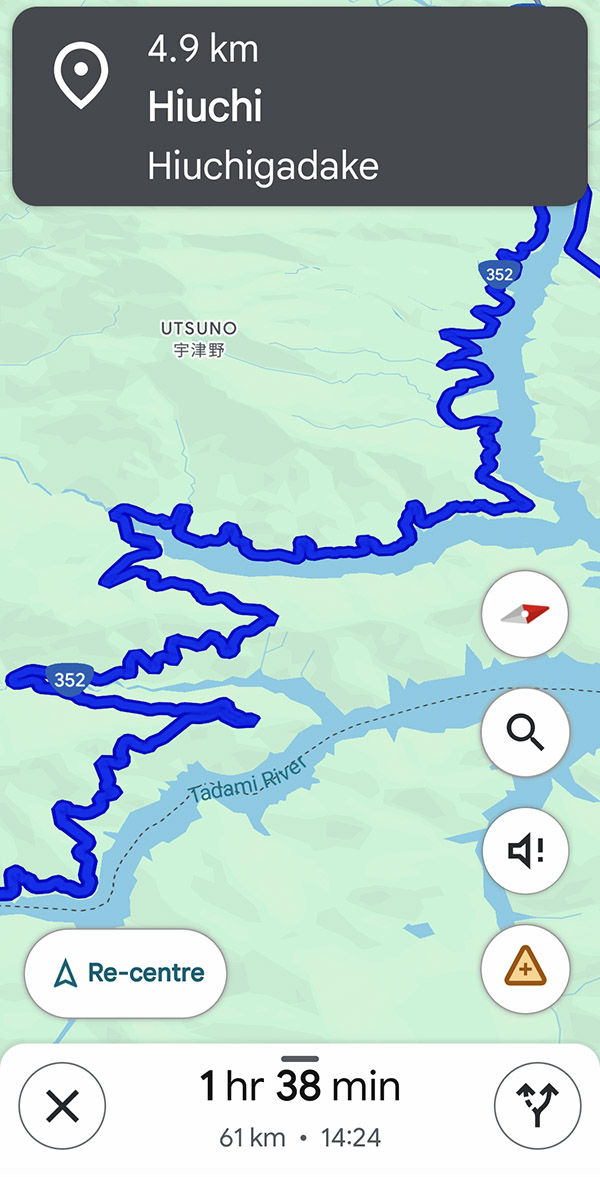
As I wrap up writing about my experience motorcycling in Japan, I am starting to notice that for the most part it was a fairly uneventful 8 days. I didn’t crash, I didn’t get arrested, and I stayed mostly on paved roads. I prefer minimal planning on my motorcycle adventures. This allows plenty of flexibility to adjust for roads, weather, and highlights I discover along the way. Every morning my routine was to just wake up, look for what I thought looked like a fun path on the map while having a coffee and go. Throughout the day if I stumbled upon other riders, I would obtain current road reports from them, but otherwise it was just fire up the bike, smile, and enjoy whatever came my way.
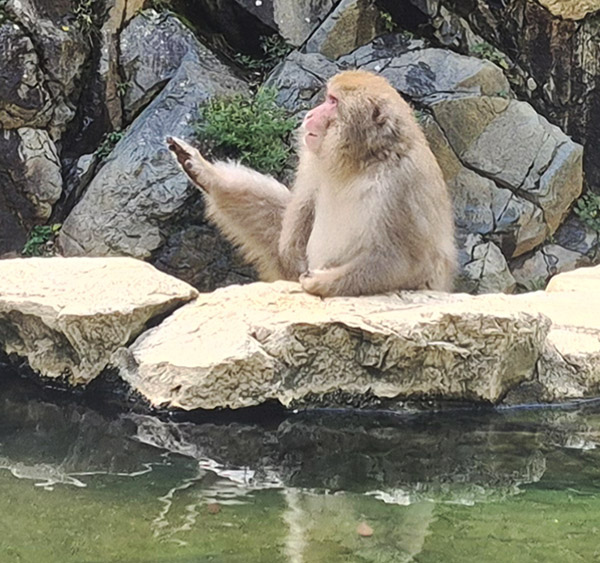
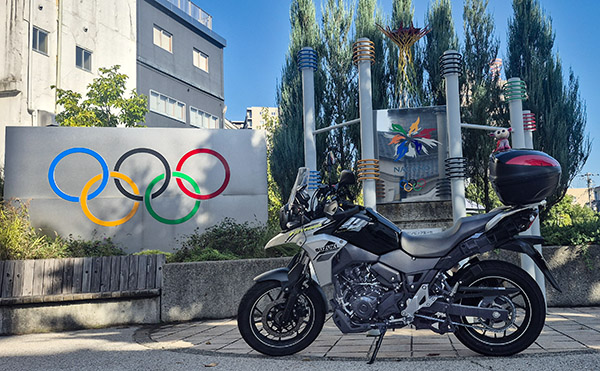
Along my ride there were a few highlights I made it a point to hit, such as a hike to see the snow monkeys bathing in hot springs, and a short stop in Nagano to visit the home of the 1998 Winter Olympics. Usually, I spent lunches or coffee breaks in tiny Japanese villages that few tourists are fortunate enough to experience.
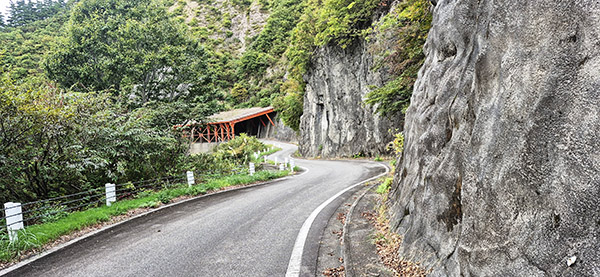
Other than driving on the opposite side of the road, most of this journey felt so similar to a fall ride through New England. Which for me was paradise with roads and tunnels that followed rivers flowing out of the Japanese mountains down to the sea. The tunnels were quite frequent and some of them were extremely long with minimal infrastructure once I entered them.
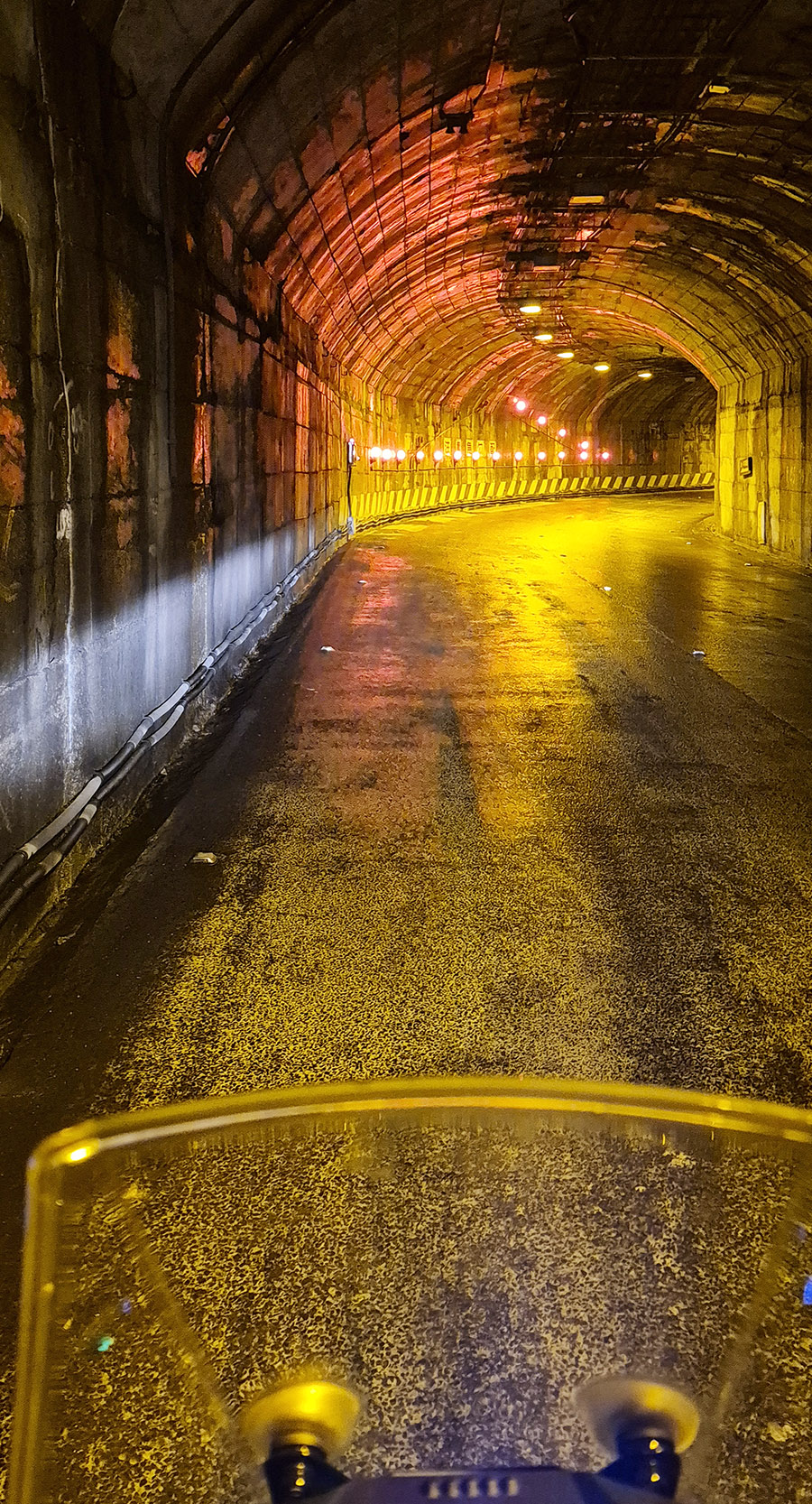
The Hida Tunnel was close to 6 miles long and was like going through a cave as there was just the rock above with water flowing in, and it was freezing cold. Between the minimal lighting and reflection of the water at times, I lost all depth perception and it became almost impossible to tell if and when there was a corner coming up. Upon exiting the tunnel, I pulled over to warm my hands and take a breather in the sun only to learn it was a dead end and I’d have to return through the cold dark dampness again to get back on track.
One of my favorite things about motorcycling in Japan was that no matter how cold or wet I was throughout the day each evening, I was almost always guaranteed to have an onsen (natural hot springs) in my hotel. These onsens were the perfect way to warm up and cap off a day of riding, especially if I had a cold and wet ride that day.
Throughout the 8-day motorcycle trip I hit a plethora of topography. This ranged from beachfront roads to mountain passes with the roads the width of a golf cart track with mirrors on every corner so I could forecast how wide I had for turns, to pine forests with sweepers that went on for hours. Although motorcycling Japan for me proved uneventful, it did not mean it wasn’t fully appreciated. Japan is a country I fell quickly in love with and will visit again.
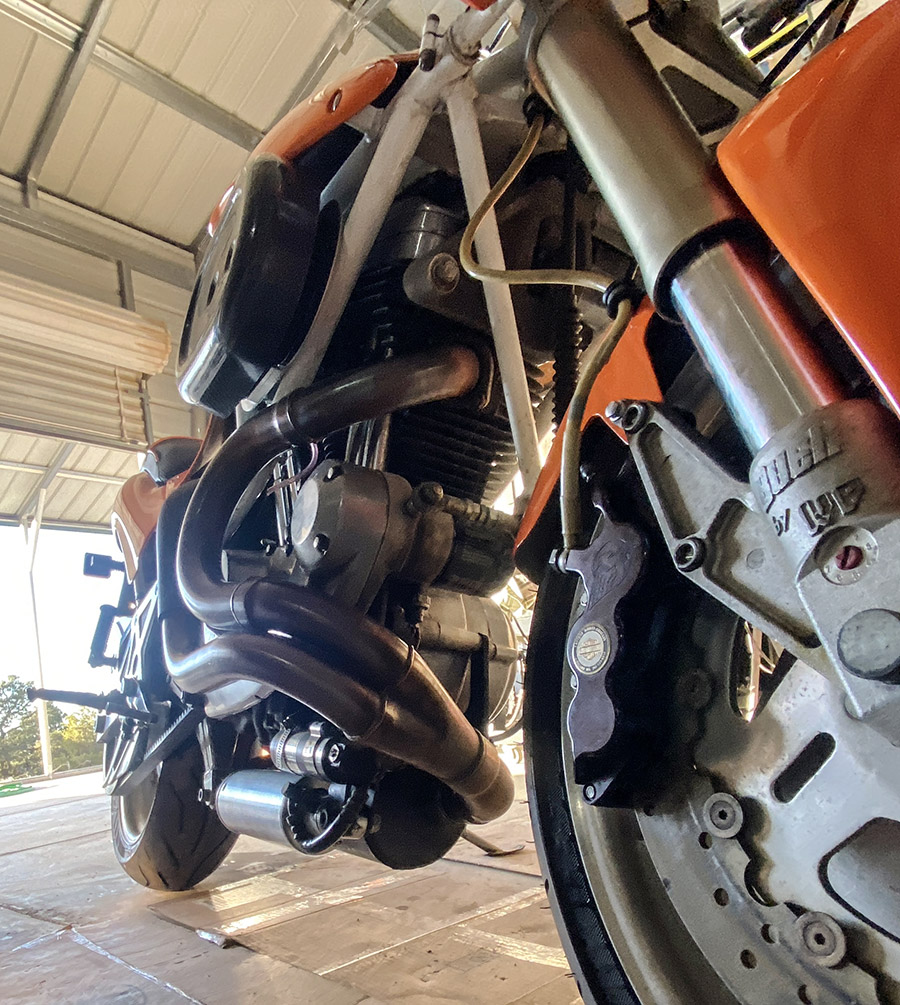
I’ve kind of lost count on which Buell installment dealt with the muffler falling off. The story was about how the muffler was held on by a T-bolt clamp on the header pipe (basically a heavy-duty hose clamp) and two vertical brackets that located the rear of the muffler. Those vertical brackets would come loose letting the muffler slide back into the wheel. In that previous story I welded the rear bracket so the muffler couldn’t slide back unless the bolt was removed. This setup no longer relied on the clamping force of fasteners alone.
I thought I had it fixed, a common misconception that I have frequently, and both the muffler bolts of my belt-and-suspenders repair vibrated out. The muffler fell off again. Most riders would write this off as a bad design on Buell’s part, but I look at it as a challenge. Just like Lucy always pulled the football away from Charlie Brown the Buell keeps snatching success away from me.
The Buell lives and dies in real time. No waiting around for Honda-like reliability to finally fail. Each individual Buell-ride has a beginning, a middle and an end. The end being something to fix. And sometimes fix it again.
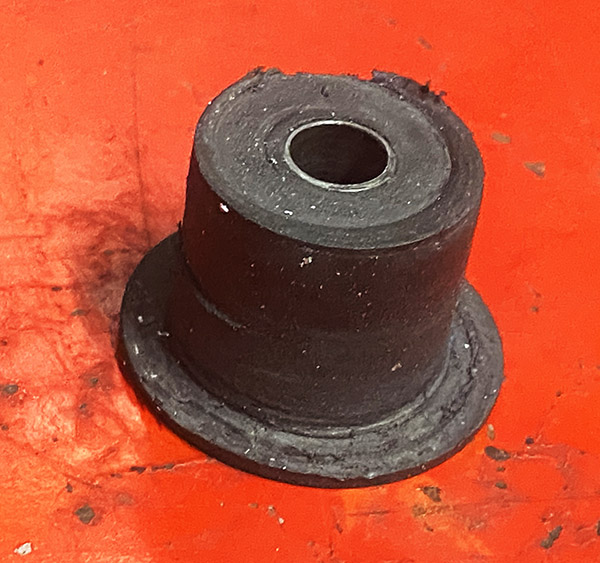
There were two of these. One is on the road a few miles ahead of the bolts that fell out.
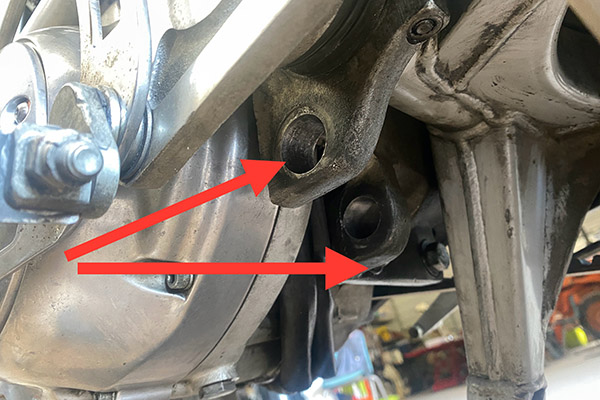
When the muffler bolts fell out one of the two rubber bushings fell out also. These bushings fit into two holes cast into the Buell’s engine crankcases. It was a good system and I should have used Loctite or safety-wired the bolts the first time.
I wasn’t in the mood to hunt online for another bushing and the thin, molded-in tube preventing the rubber from crushing made me wary of really cranking down on the muffler bolts. I decided to take things into hand and make two new bushings since it’s as easy to make two as it is one.
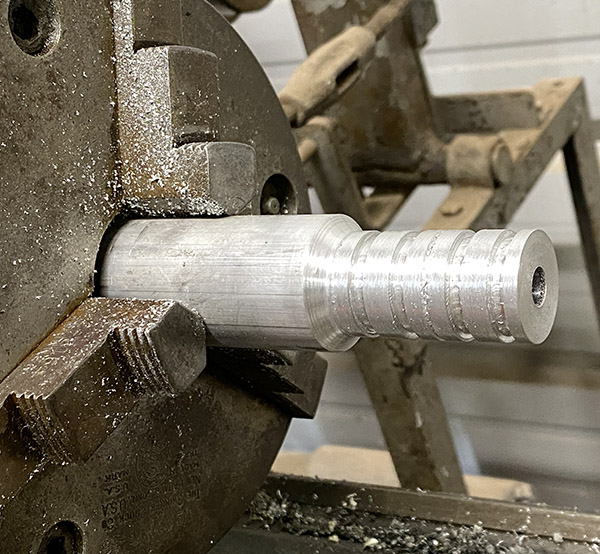
I’ll need a better cut-off tool but you can see, two is as easy as one.
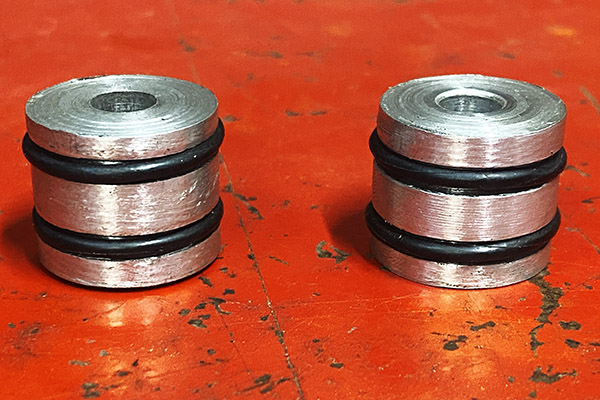
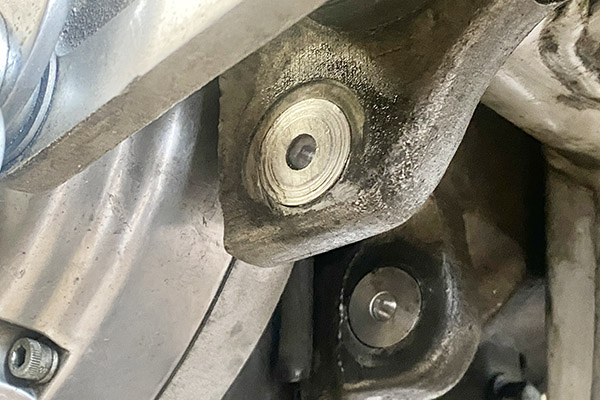
I have plenty of aluminum round stock and the crude bushings I spun out would shock a real toolmaker. I added a couple of grooves for o-rings to cushion the aluminum. Regardless, I now had something I could tighten a bolt against as much as I wanted. Putting the hangers back together I used nylon locknuts on fresh bolts hoping to slow down the rate of failure.
The finished bushings.Harley cast in a couple of sturdy mounting holes on the Sportster crankcase.The bushings are slightly longer than the mounting holes allowing for tight bolts with a bit of give for the shaky Sportster engine.
On yet another long test rides the bolts stayed tight and the muffler did not fall off. Lucy-1, Joe-1. I’m adding checking the muffler bolts to my pre-flight inspection list until this fix proves permanent.
After years of Kawasaki perfection, knowing every ride will be successful, I’m loving the Buell’s humanity. The Buell needs a steady handful of wrenches and ingenuity. Riding and tinkering with the thing brings me back to my youth of edger-powered minibikes roaring through the hot, humid Florida nights. Riding those old minibikes was a crash engineering course. You learned fast or you pushed the thing. So far, I haven’t needed to push the Buell.
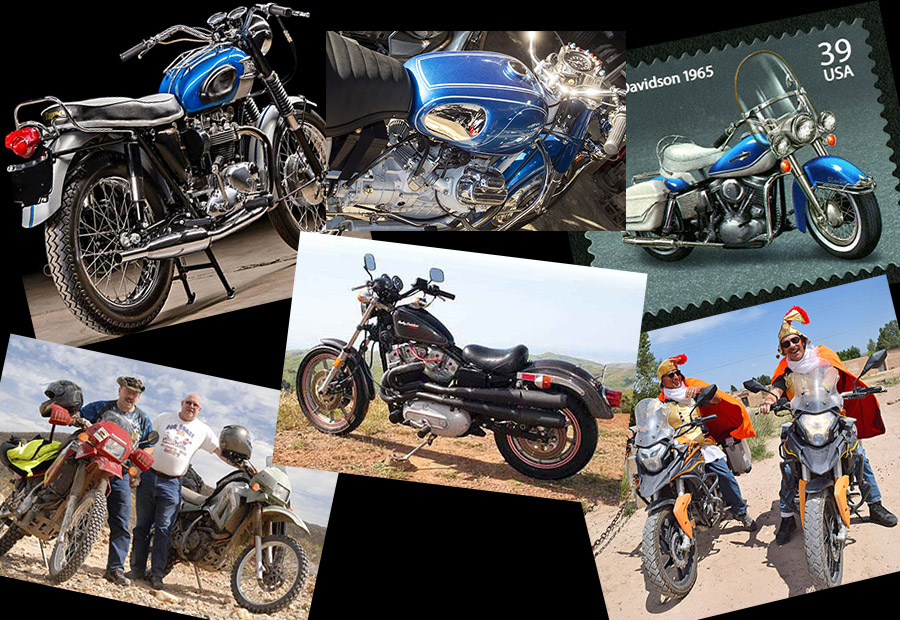
Like most of you, I spend a lot of time thinking about what I’d park in my garage if I had the money and the space for a motorcycle collection. At various times in my life I’ve owned several motorcycles at the same time and I’ve sort of realized the dream I describe here (at least in terms of how many motorcycles I owned), but this blog describes something different. The bikes I owned in the past came about as the result of having the time and the money when something cool caught my fancy. This time, I’d start from scratch and define what would go into my ideal collection. Gresh and I have theorized and fantasized and written about this in the past (see our Dream Bikes page). Here, I’m starting from scratch and I’m limiting myself to six motorcycles (just because I think that should be the right number of bikes). You might be surprised at some of my choices.
1965 Triumph Bonneville
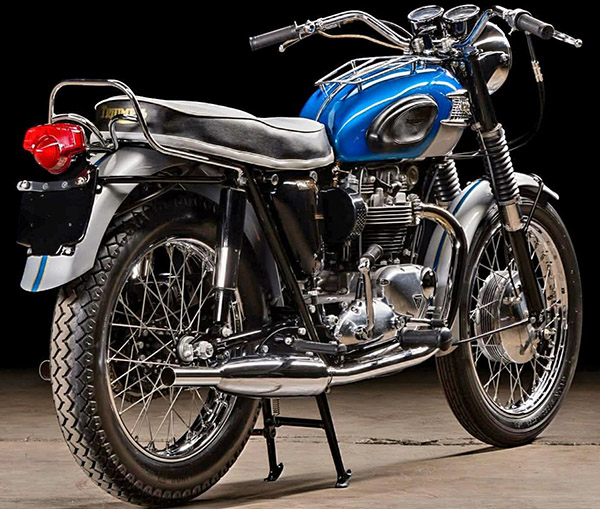
When I was a kid in high school, one of the seniors (a fellow named Walt Skok) bought a new Triumph Bonneville. I thought it was the most beautiful thing I’d ever seen, and I wanted one. Later in life, I bought, rode, and sold several Triumph Bonnevilles, but I never scratched that itch for a ’65 model. Someday…
To me, everything about the 1965 Triumph Bonneville was perfect: The colors, the exhaust system, the exhaust notes, the tank parcel grid, the design symmetry, the little decal recognizing Triumph’s world speed record, and more. I always wanted one and I still do.
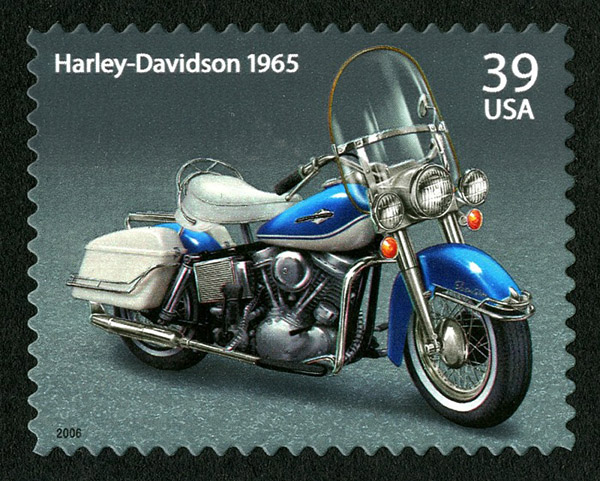
1965 Harley-Davidson Electra-Glide
I’ve owned a couple of Harley full dressers, but the one I always wanted was the 1965 Electra-Glide. That year was the first year Harley offered electric starting and it was the last year of the panhead engine (which I think is the best-looking big twin engine Harley ever made).
The ’65 Electra-Glide is another bike that, in my opinion, was styled perfectly. I like the tank contours, the 1965 paint design, the panhead engine’s look, the fishtail mufflers, the saddlebag contours, the potato-potato-potato exhaust note, and more. Apparently, my thoughts about this motorcycle’s intrinsic beauty are also shared by the U.S. Post Office (see the above postage stamp). The ’65 Electra-Glide is the bike I used to think about as a teenager when I rode around on my Schwinn bicycle, imagining that my Schwin was a Harley.
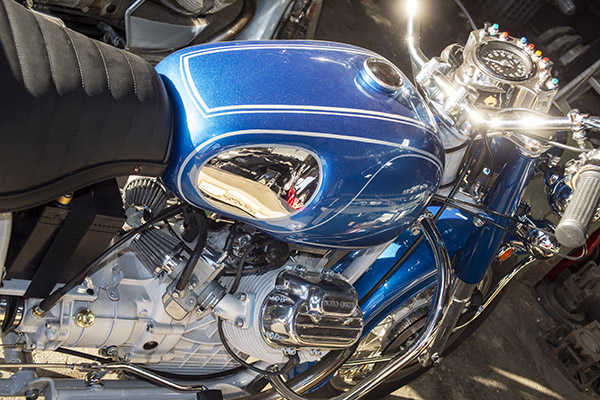
Cycle Garden 1974 Moto Guzzi El Dorado
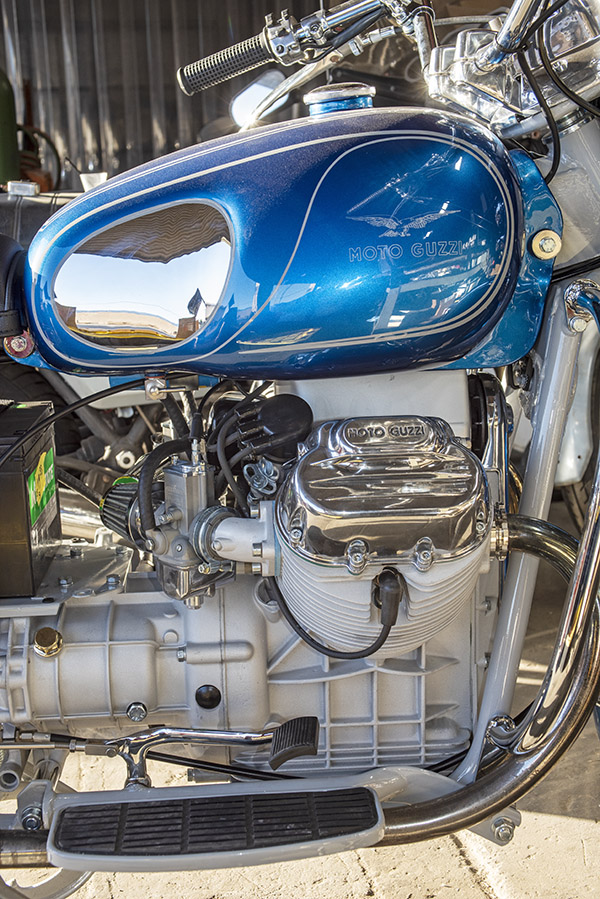
Ah, a Cycle Garden Guzzi. This is one I tumbled to only recently. I’ve been writing a series of articles for Motorcycle Classics magazine, and one of the shops that’s been helping me is Moe Moore’s Cycle Garden in Indio, California. I always thought the mid-1970s Moto Guzzi were stunning in their stock and restored configurations. Then, during one Cycle Garden visit, I saw a custom bike that Moe and his crew had assembled for a client.
The bike was a 1974 police motorcycle, but it painted in a breathtaking battleship gray and metallic blue paint theme. I could see myself riding it, rumbling through the open roads and magnificent landscapes of Baja. It is a motorcycle that is firmly on my list.
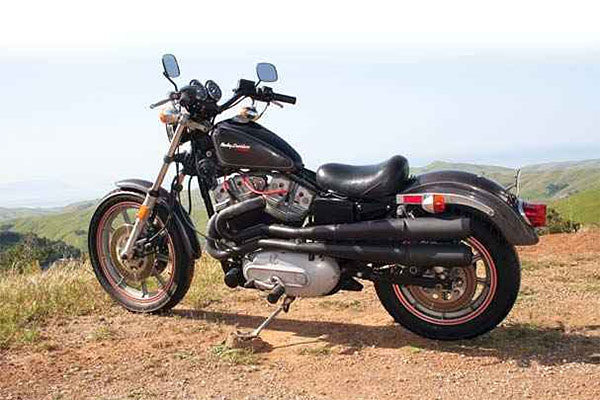
1983 Harley XR-1000
I wrote a Dream Bike piece about this during the first year of the ExhaustNotes.us blog’s existence, and the thing that struck me about it was that Joe Gresh told me I’d beat him to it…he was thinking about doing a Dream Bike piece on the same motorcycle.
I’ve never owned or ridden an XR-1000. Come to think of it, I never heard one run. I could have bought an XR-1000 new for around $8K when they were new, but I didn’t have a spare $8K laying around in those days. It’s another one of those motorcycles bikes for which I think the visual and visceral appeal is perfect. Maybe someday I’ll get to scratch that itch.
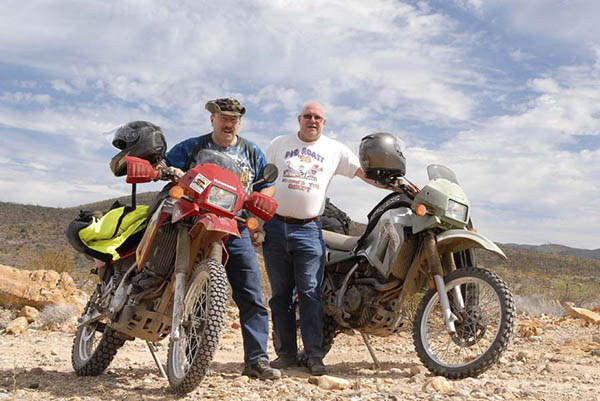
2006 Kawasaki KLR 650
To me, this is an interesting choice with which some might take issue. I don’t care. I loved my KLR 650. Lifelong good buddy Baja John had one, too. That’s Baja John and yours truly somewhere in Baja in the photo below.
The KLR 650 is one of my all time favorite motorcycles. Mine was a first-gen KLR, and I think those are more desirable than the second gen bikes. My KLR was perfect for exploring Baja, and I did a lot of that on it. It had just the right amount of power, it was simple (except for the shim-and-bucket valve adjustments), it was a very comfortable motorcycle (the ergos were perfect), and it was inexpensive. I bought it new in 2006. It was one of the best motor vehicles (of any kind) I ever owned. If you’re wondering why I sold it, so am I.
2015 CSC RX3
The CSC RX3 motorcycle is another bike that I thought was just perfect for me. I covered a lot of miles in Baja and elsewhere in the world on it.
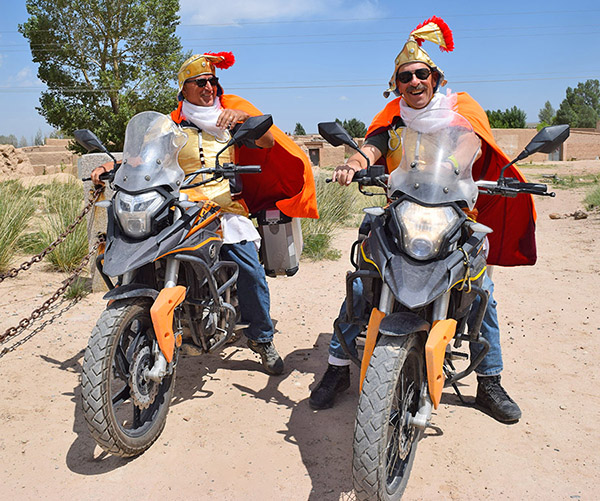
I think a 250 is the perfect size for a motorcycle (you can read why here). I traveled through a lot of the world on one: Through the American West, Mexico, the Andes Mountains in Colombia, and China (with Joe Gresh; Joe and I are in the photo above auditioning for a Chinese gladiator movie). All those trips and all those miles were awesome, and the RX3 didn’t miss a beat on any of them. I almost cried when I learned Zongshen discontinued the RX3, and if they were to bring it back (which they should), I would no doubt be riding the world and blogging the RX3’s virtues again.
There you have it. It was fun thinking about this, writing this blog, imagining the above six motorcycles parked in my garage, and riding them in different parts of the world. A quick mental tally tells me I could make the above wish list a reality for something around $120K in today’s dollars. Hmmmm…I don’t have a spare $120K laying around, but maybe if a few of you hit that donate below…
What about you? What would be the ideal collection you’d like to see in your garage? Let us know in the comments below.
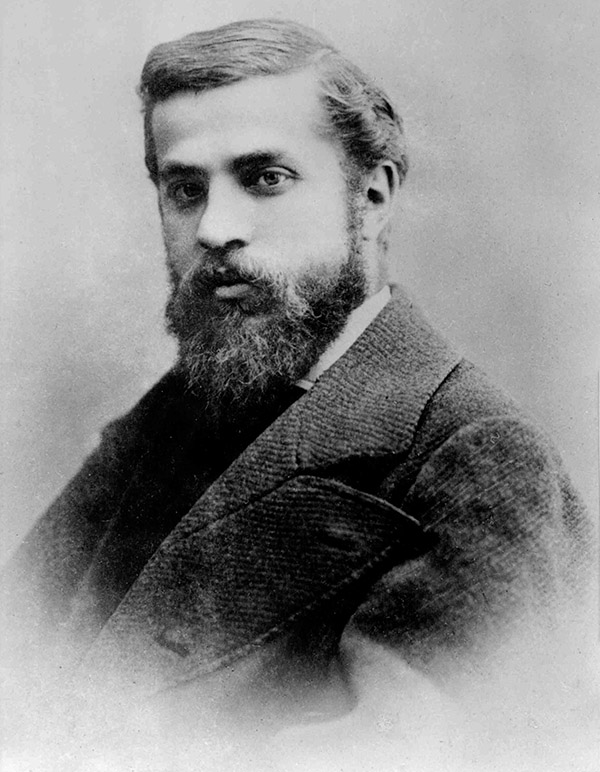
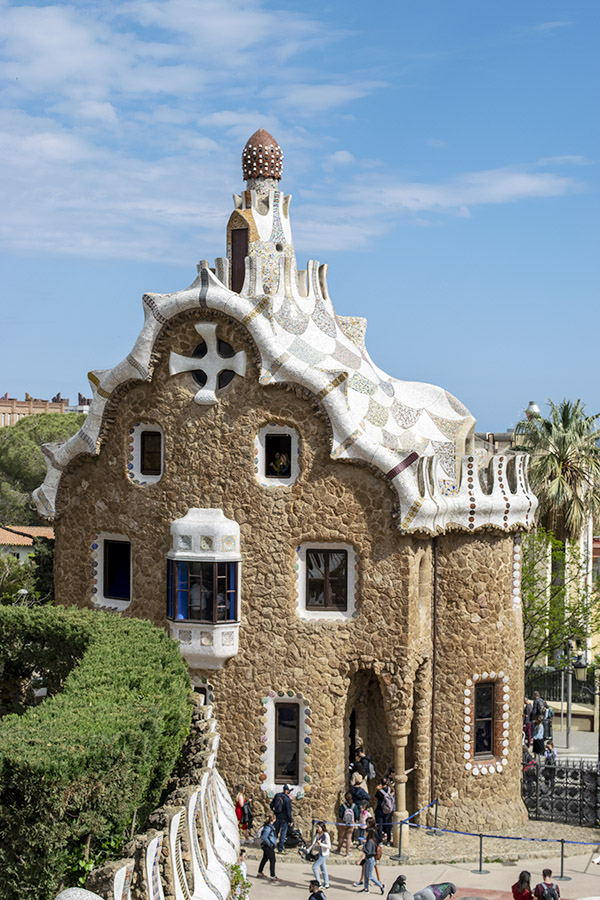
About two years ago Sue and I visited Spain and Portugal. I posted more than a few blogs during that trip, but not enough on Antoni Gaudí. Gaudí was a Spanish architect who lived from 1852 to 1926. He was clearly a genius. I wish I had known more about him before we went to Barcelona; I would have appreciated what I was seeing more. Better late than never, and after our trip I started reading and studying his life. This was an amazing man.
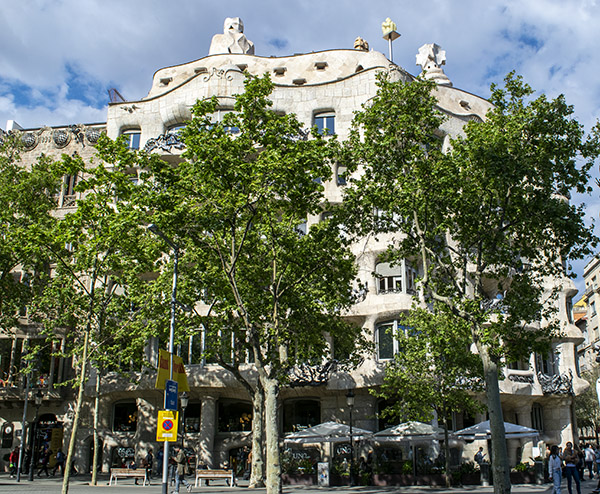
We visited three of Gaudí’s works in Barcelona: The Park Güell, the Casa Milà apartment building, and the Sagrada Familia.
Park Güell
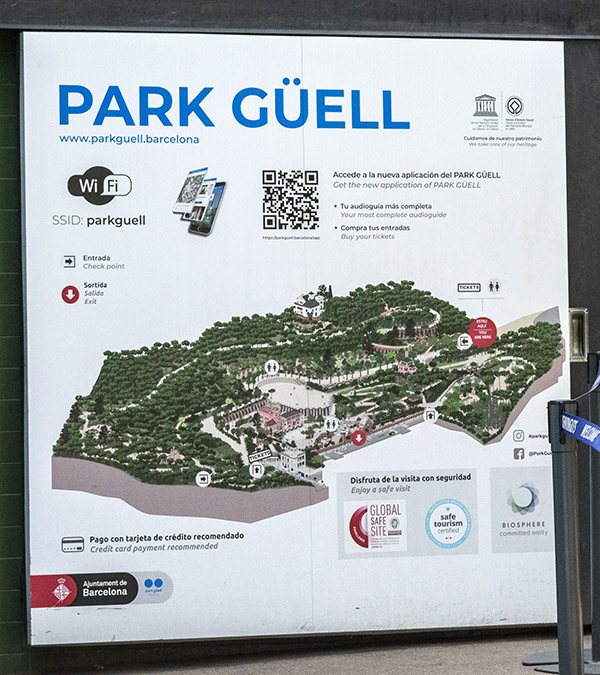
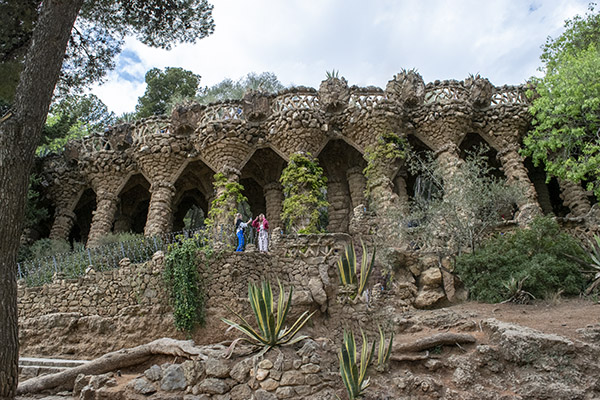
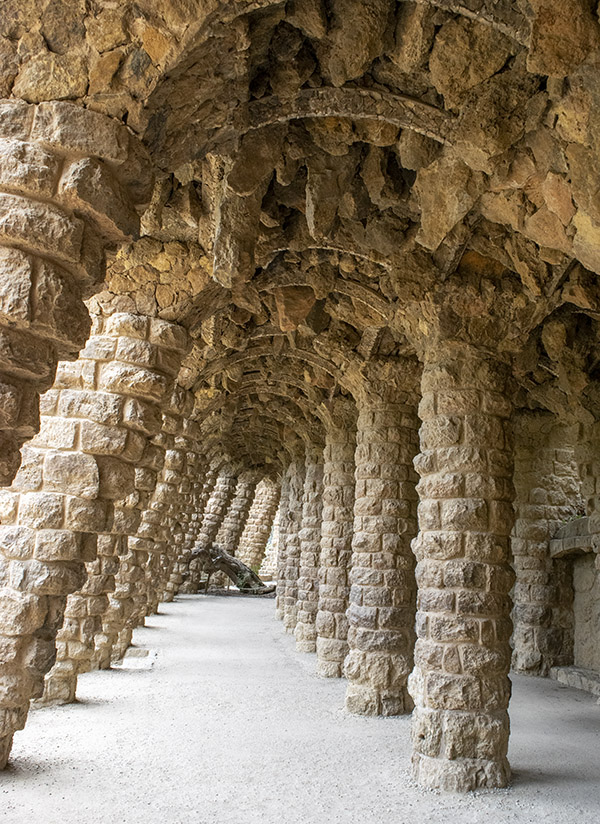
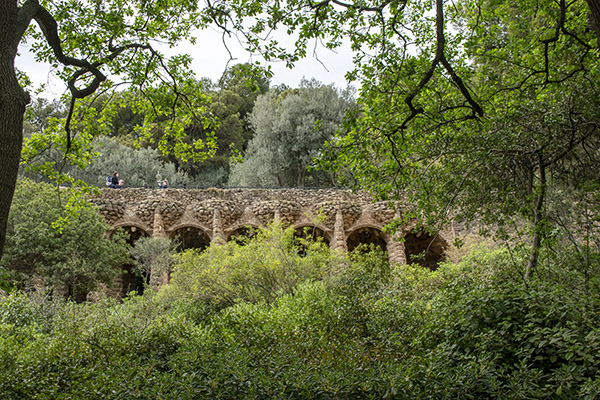
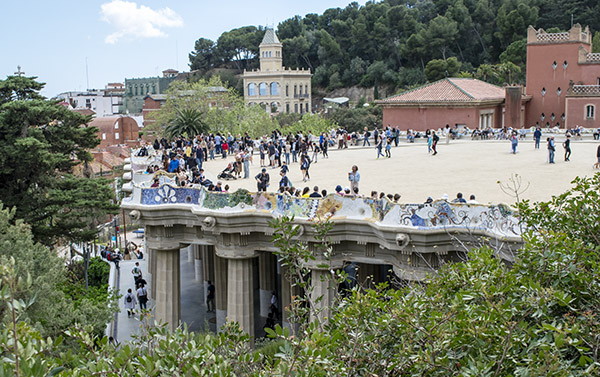
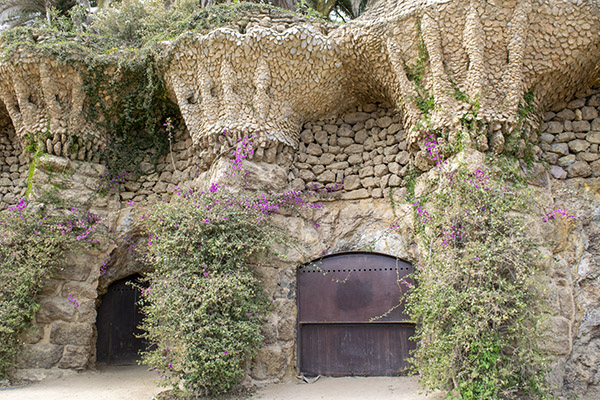
One of our first stops in Barcelona was the Park Güell. Park Güell was commissioned by Eusebi Güell in 1900, a Catalonian businessman, when he enlisted Gaudí to incorporate several properties he already owned into the park. The photo ops were everywhere we turned, from the sculpted tunnels to the paths to the buildings and the sculptures.
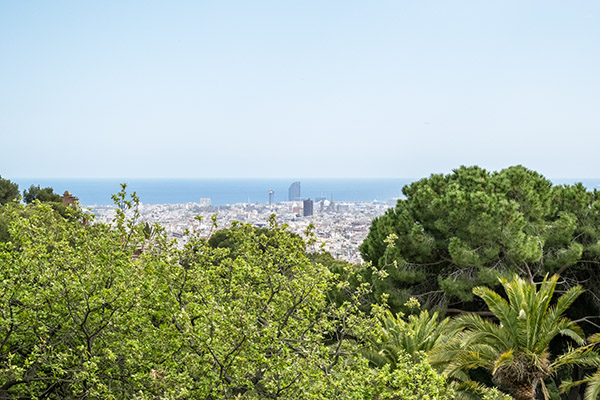
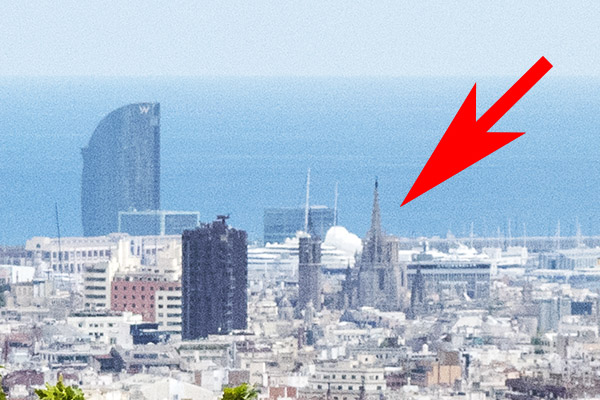
When wandering Park Güell, I noticed that we could overlook the city of Barcelona and see all the way to the Mediterranean. I snapped a photo or two, without realizing that my photo included the Sagrada Familia (it’s in a photo below, identified by a large red arrow). I’ll talk about that more in the next part of this blog.
If you look closely, you can see the Sagrada Familia from Park Güell.
Casa Milà
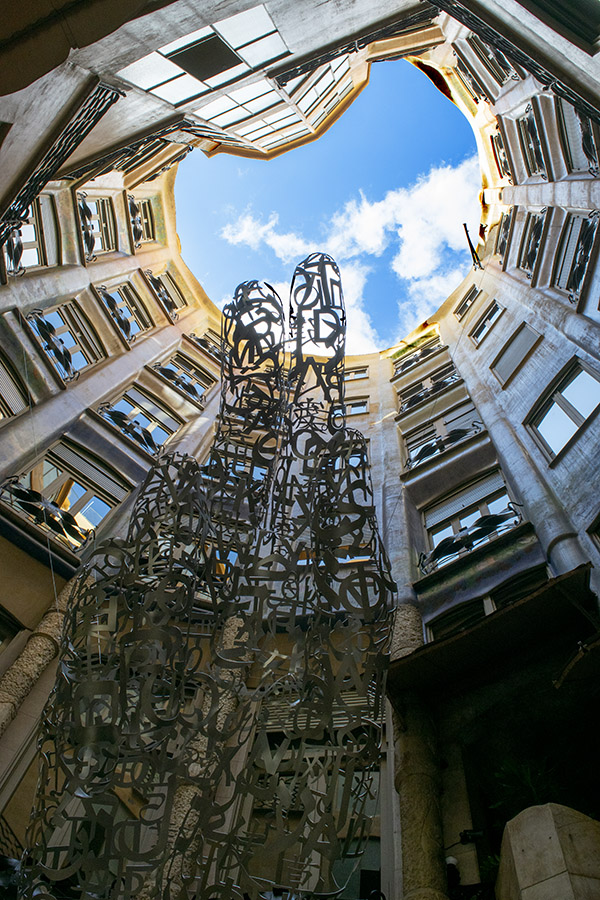
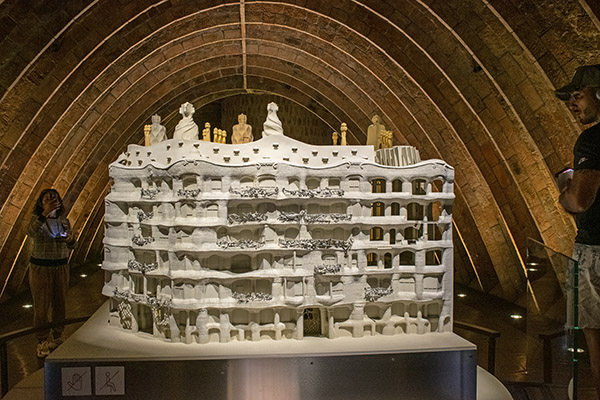
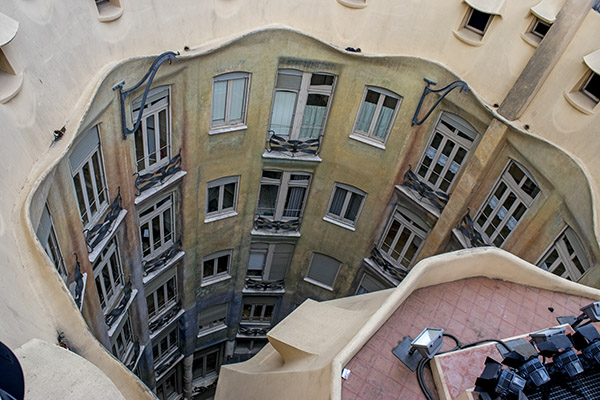
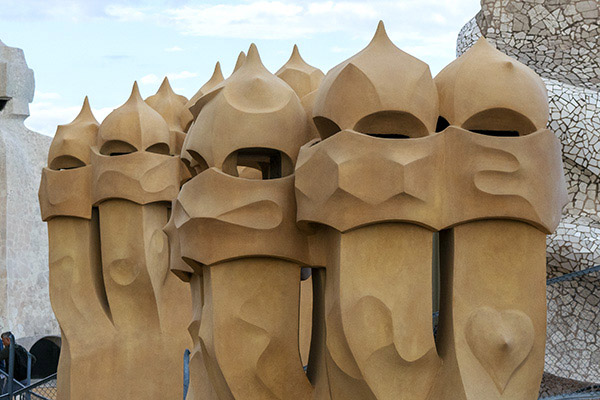
Casa Milà is another famous Gaudi work. Completed in 1912, it was initially an apartment building. Today it is a UNESCO World Heritage site. Like Park Güell, Casa Milà suggests a Dr. Suess-like whimsiness in its design. The structure is a giant loop, with an opening surrounded by the apartments. The roof contains many sculptures, with some that double as chimneys. When we visited Casa Milà, our guide asked if one reminded us of anything. It did. You’ll see it one of the photos below. George Lucas saw it, and it became the inspiration for Star Wars storm troopers. Another one of the photos below shows a model. Gaudi preferred to design with models and use these as the basis for the larger work.
The Sagrada Familia
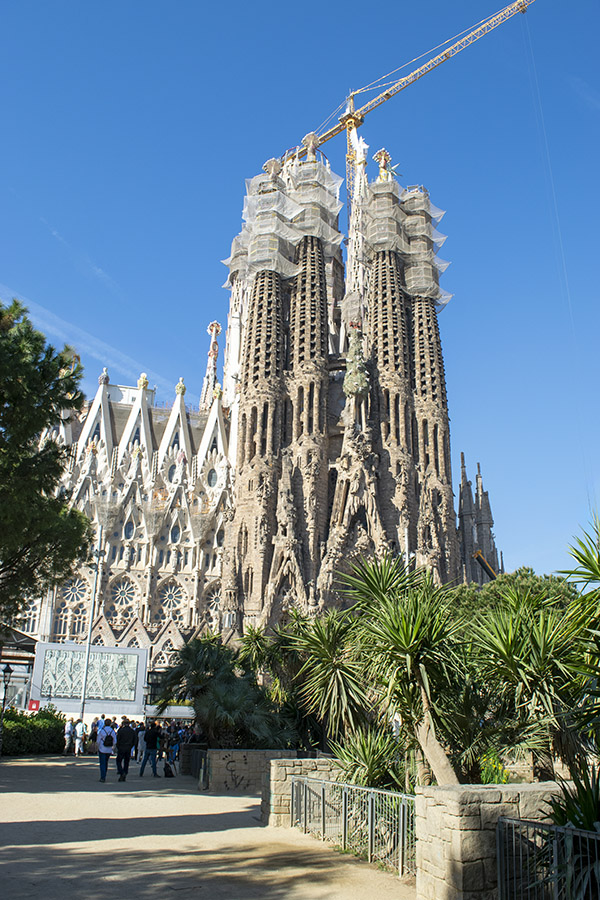
Talk about a long-running construction project: Barcelona’s Sagrada Familia temple has been under construction for 140 years, and it’s not finished yet. We heard that it would be finished in another 15 years, but who knows?
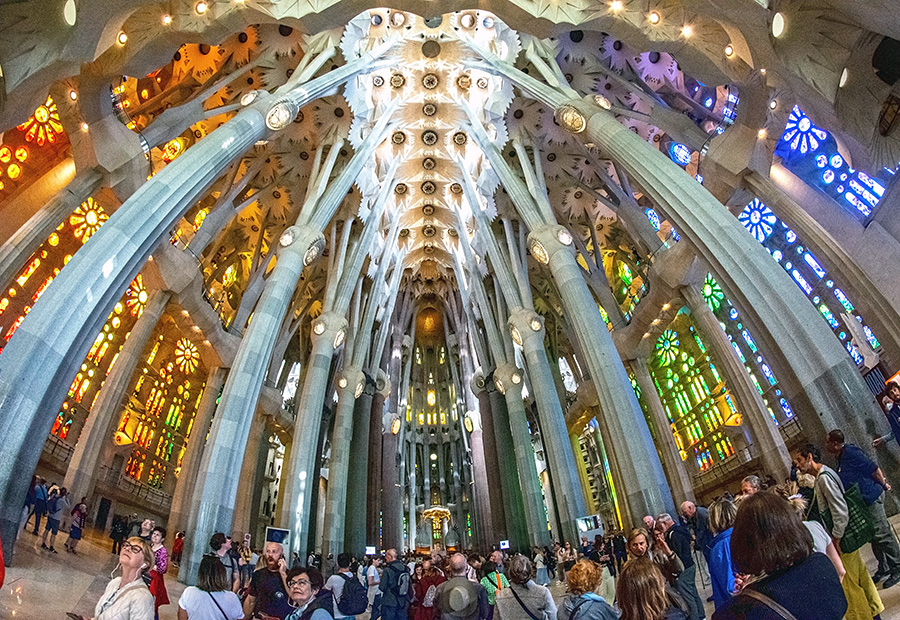
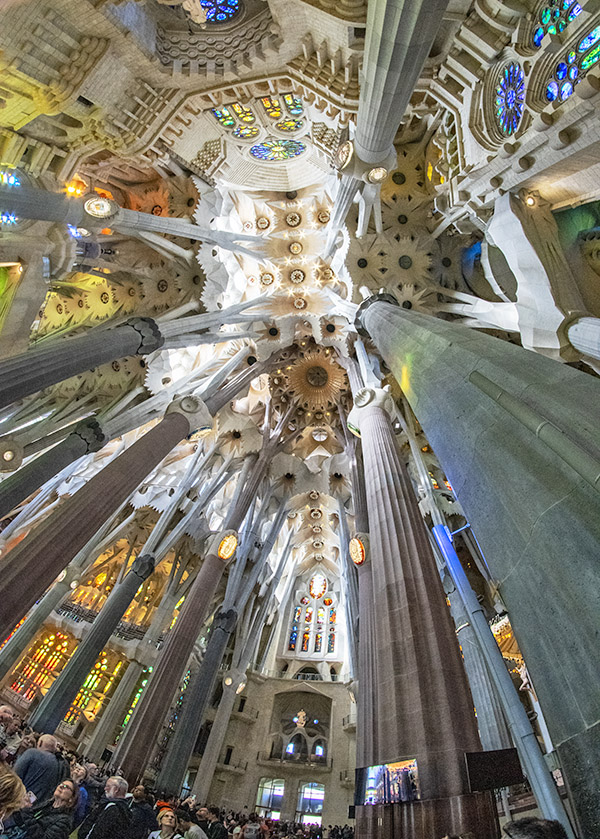
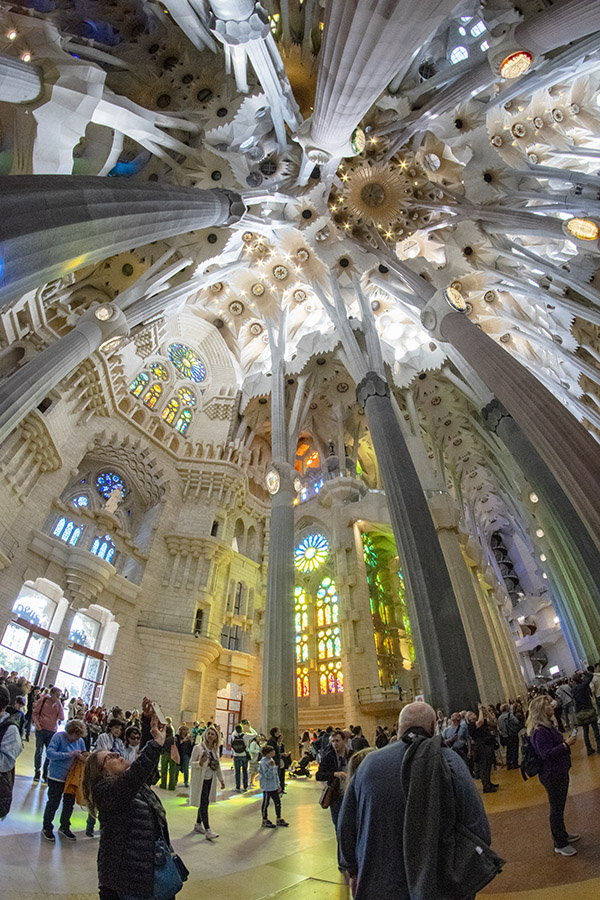
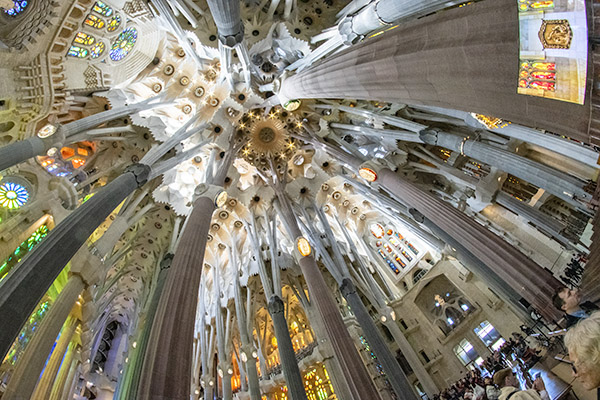
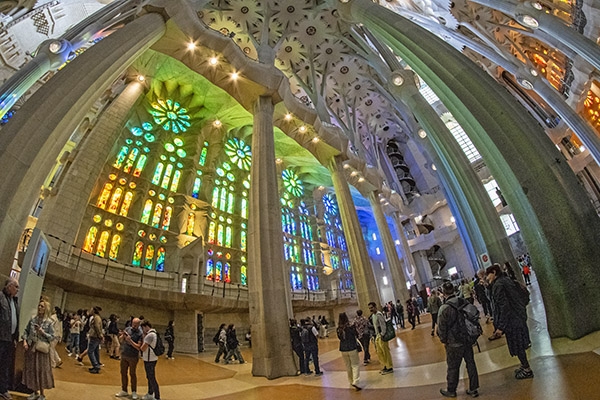
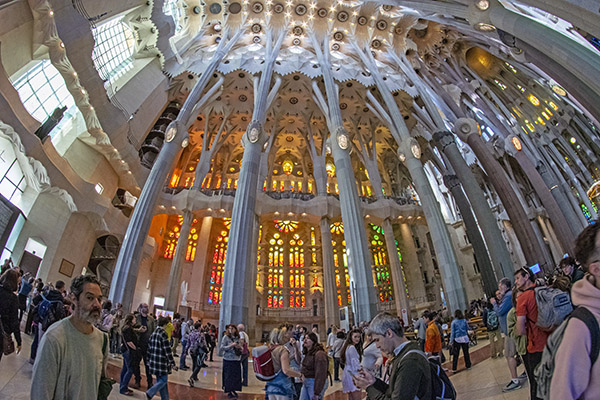
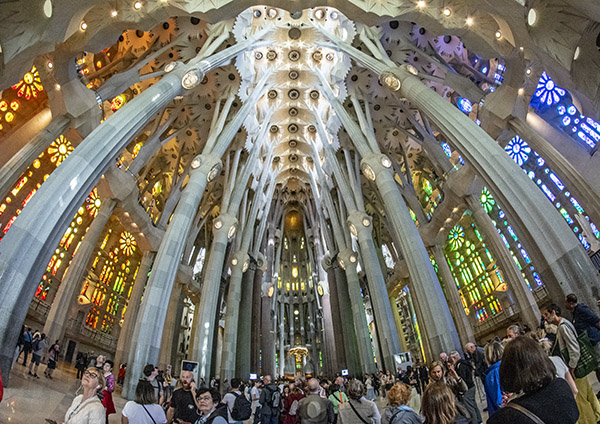
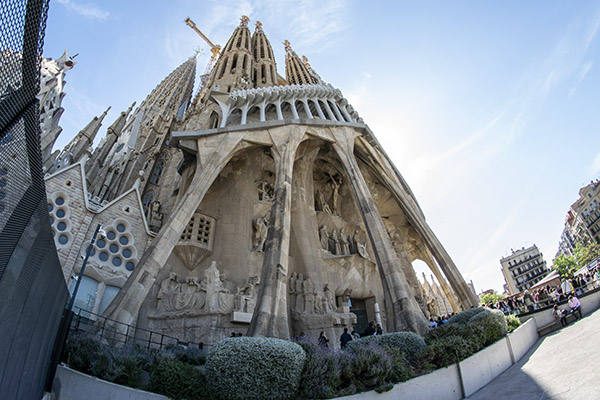
The construction schedule notwithstanding, the Sagrada Familia is an active church, and if entering it does not make you a believer, nothing ever will. To say it is impressive would be a massive understatement. You have to see the Sagrada Familia to understand the excitement, the grandeur, and the genius of its design. The exterior has that same Dr. Suess/Harry Potter mystique. Once you are inside, the feeling is not one of being in a building; it is more like being in a well-illuminated and immense living creature. The illumination comes from the building’s stunning stained glass, designed with colors tuned to the light from Barcelona’s sunrise and sunset.
Words like those you are reading here don’t do justice to the Sagrada Familia. It is a place that has to be personally experienced to get a feel for its magnificence. I’ll return to Barcelona someday, and you can bet that I’ll visit the Sagrada Familia again.
Antoni Gaudí was a bit of a dandy in his younger days. In his later years, he stopped taking care of himself and basically dressed like a homeless person. He died as a result of being struck by a Barcelona streetcar. When he was injured, people did not realize who he was (they thought he was a vagrant). Antoni Gaudí’s remains are entombed in the Sagrada Familia, perhaps his greatest and certainly his most widely-known work. The Park Güell, the Casa Milà apartment building, and the Sagrada Familia are not the only projects Antoni Gaudí created. I’d like to search for and visit more of Gaudí’s works when I return to Spain.
When Sue and I visited Spain and Portugal, I didn’t take my Nikon D810 and it’s 24-120mm lens (as I usually do). The weight of that camera and lens has become too much for me to carry around. I won’t bore you with the specifics of my age-related infirmities; I’ll simply share that I’m not what I used to be. But I’m still kicking and typing, and for this trip, it was my much smaller and lighter Nikon D3300 and its smaller 18-55mm lens. I also had a lightweight, non-zoom, non-metering Rokinon 8mm fisheye lens, which I used more than I expected to (it proved to be a very capable lens). The D3300 and these two lenses (along with a bit of post-production PhotoShop tweaking) created the photos above. The interior photos were all shot at high ISO (in the range of 800 to 3200), which accounts for the graininess in some. Mea culpa.
I believe I am skipping ahead a couple countries I experienced in 2025, but I really wanted to write about one of my favorite ones (that being Japan). This country opened me up to its unique culture and really welcomed me. As with previous places I visited, I did minimal to no planning ahead, outside of my arrival in Tokyo. This is the best way to travel, with no schedule or time constraint pressures.
I am usually comfortable with no planning, but before arriving in Tokyo (one of the largest cities on earth), I was feeling overwhelmed. Within 30 minutes of landing I learned there was no need for those feelings, though. Tokyo is one of the most organized, safest, cleanest, and well laid out cities I have ever visited. As I traveled through Japan for the next five weeks, I learned the people are some of the most beautiful in the world, and that is coming from someone who has seen quite a bit of the world.
Being overly social and making friends everywhere, I happened to have a friend in Tokyo. I met Maico when I was traveling through Peru in 2012 and we kept in touch over the years. She owns a cute little coffee shop called Ami Cono (AmiCono) just two train stops outside Shibuya Crossing (a popular tourist destination).
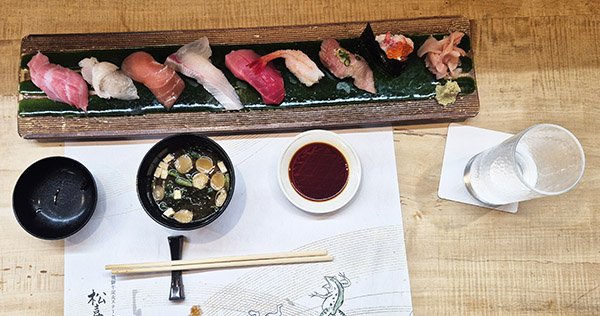
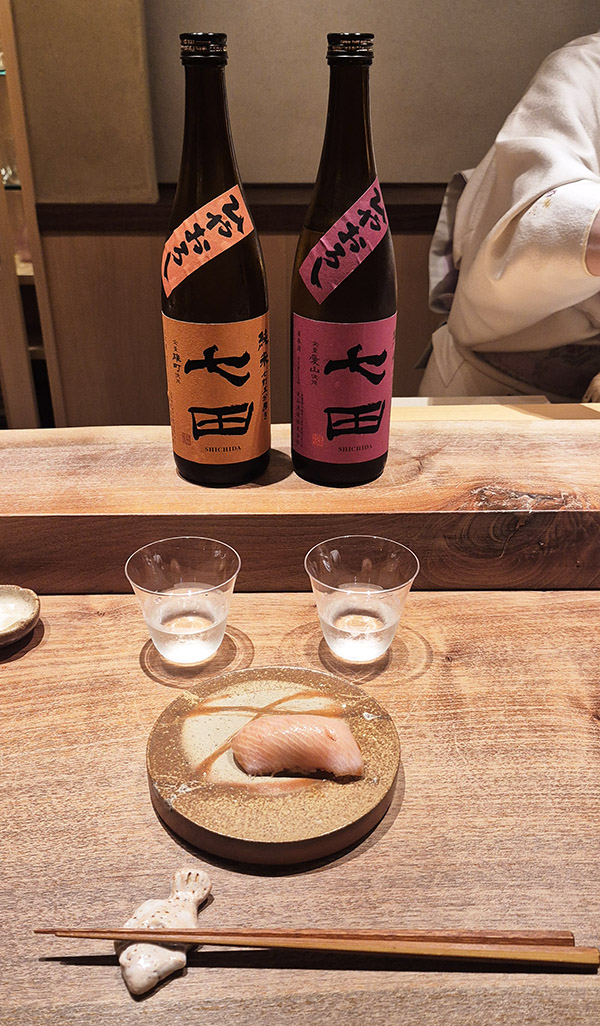
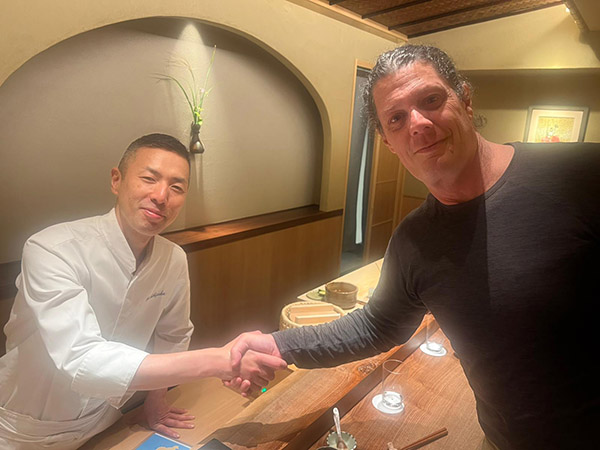
I met Maico at her gelato shop and as we were reconnecting, she offered to take me out to dinner. Of course, I wanted sushi and she knew just the place! The restaurant was called Hiro Ishizaka, it was Michelin rated and much more than I expected. We spent the better part of three hours there as the owners (a husband and wife team) kept an endless train of sushi and saki coming at us until we couldn’t eat anymore. I feel fortunate Maico was able to get us a reservation, as they only served six people per evening.
As the evening came to a close, the other two couples left and Maico and I stayed to chat with the owners. It turned out the husband was a motorcyclist and being that I was about to rent a motorcycle that Monday for a week (or so), he and I had a deep conversation (mostly through Google Translate) on different roads to ride.
It was a great welcome to a new country. I was now armed with the knowledge of some great motorcycle roads and a few other highlights to add to my ever-growing list. I was ready to ride Japan!
We need your support! Do what you can to help ExNotes stay in the black!
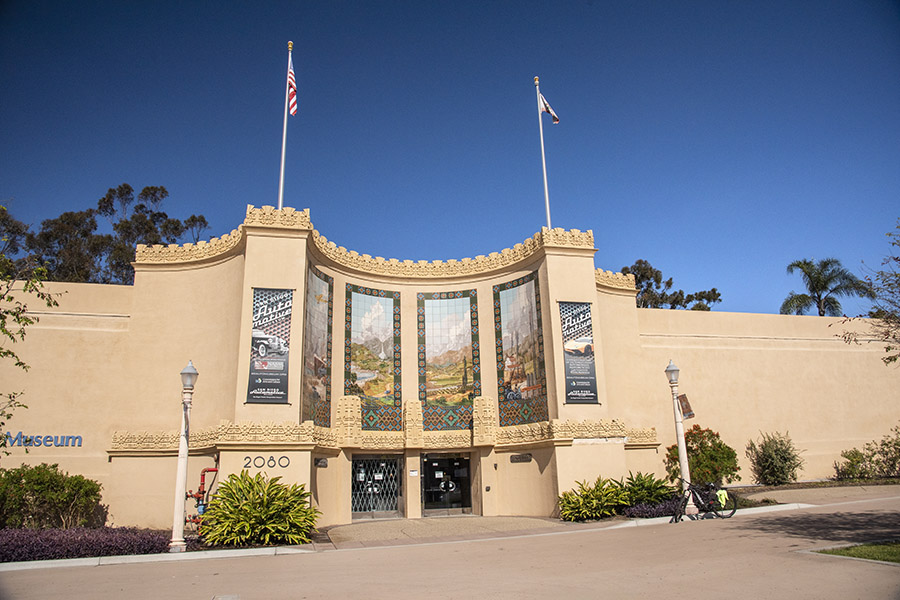
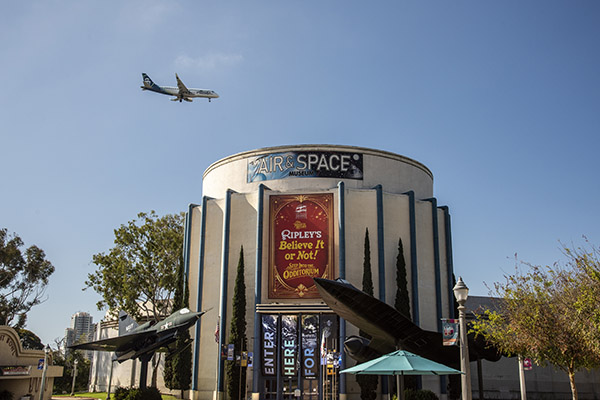
The building you see above is the San Diego Automotive Museum. Take a good look at it…the sculpted trim, the mosaic panels, and its architectural splendor. We’ll touch on those topics again at the end of this post.
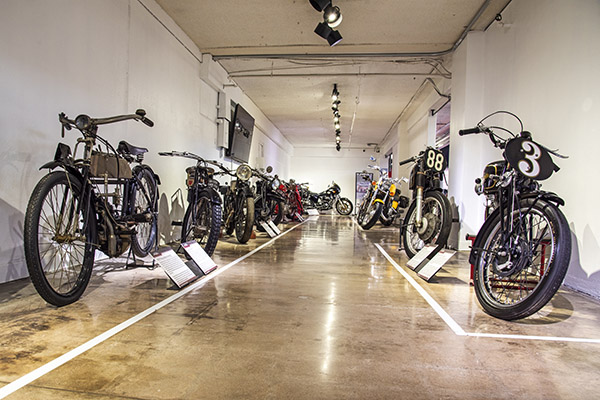
Our travels this year have focused mainly on motorcycle museums. Why, then, you might ask, an automotive museum? The name (i.e., an automotive museum) suggests four-wheeled transport. But the San Diego Automotive Museum popped up when I Googled motorcycle museums, and when subsequently searching the definition of “automotive,” I learned that the word can be used to describe anything related to or concerned with motor vehicles, including motorcycles. In the case of the San Diego Automotive Museum, it does indeed relate to motorcycles. In fact, much to my surprise there are as many motorcycles in the San Diego Automotive Museum as there are cars.
The main motorcycle display area in the San Diego Automotive Museum. In addition to the dozen or so motorcycles in this hall, the Museum has other motorcycles displayed in other locations.
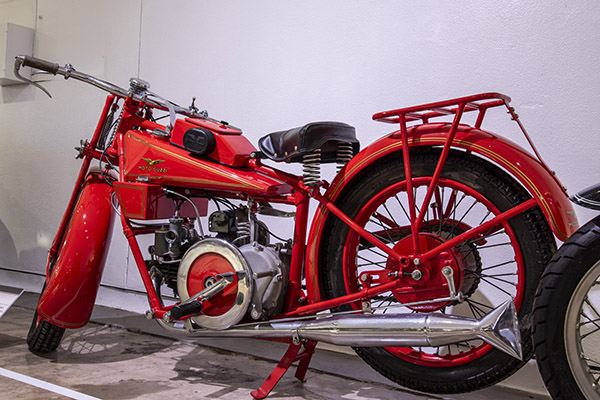
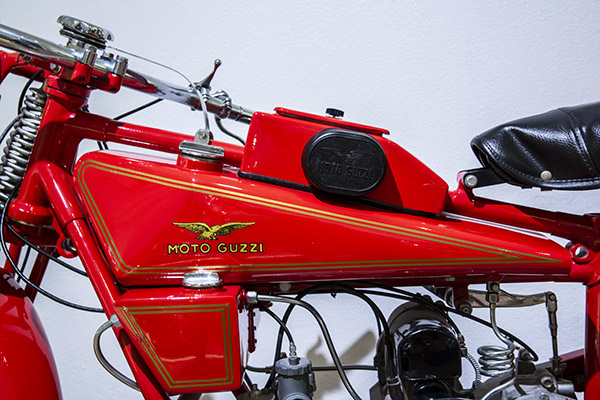
Some of the motorcycles in the display hall were ones I had never heard of, and as a guy who’s been fascinated with motorcycles since the early 1960s, that’s saying something. I’ve been doing some great things with Cycle Garden in Indio, California recently for Motorcycle Classics magazine, and I’ve always been interested in the V-twins from Mandello del Lario, so any day I see anything associated with that marque is a good day. Ever hear of the Dondolino? Yeah, me neither. It almost sounds like an Italian restaurant’s signature dish.
The Moto Guzzi Dondolino, and to be specific, this is a 1951 model. It means a small swing, as one would have for a child. The Dondolino…I like that. Check out the bologna slicer flywheel.Another shot of the Dondolino, this time a close of the fuel tank.
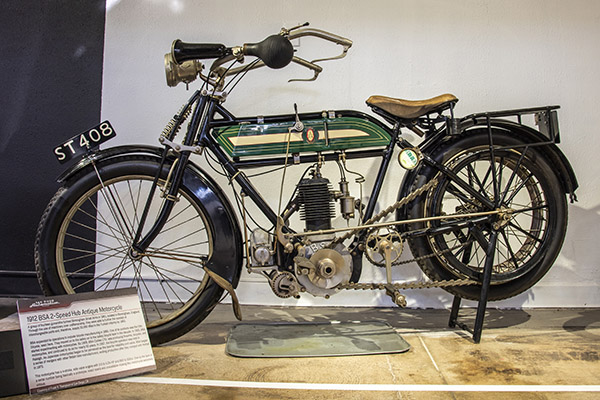
Another one that was fascinating for several reasons, not the least of which was its paint treatment, was a 1912 BSA single. Surprisingly, the Museum operations manager told me flash photography was okay (in most museums it is not). It was hard getting decent photos in the display hall, even though I shoot raw photos (not jpegs), as the raw photo format preserves all photo data (jpegs compress the data). The display hall was lit with tungsten lighting, which always make getting good color balance difficult. Even though the the raw photos allow for color temperature adjustments in Photoshop, it was tough getting these right.
The 1912 BSA single. Check out the bulb horn.
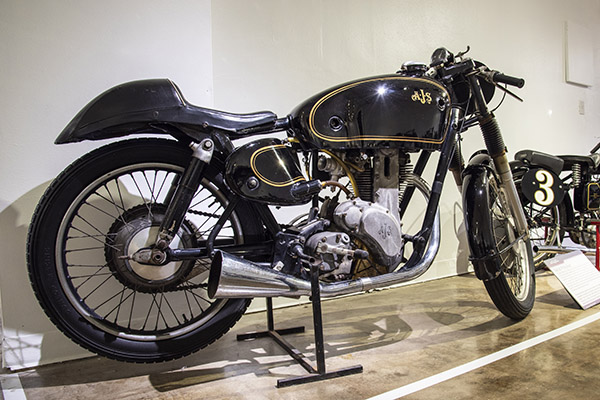
The Museum has a beautiful AJS motorcycle on display. Some of you older folks and more serious students of the motorcycle may know of the original A.J. Stevens and Company of Great Britain, which manufactured motorcycles from 1909 to 1931. AJS sold to Norton, and ultimately became part of Norton Villiers in 1966. That company went belly up a few years ago. Several organizations picked up the Norton name and tried to make a go of it; to my kn0wledge, none succeeded (although I haven’t checked in the last month or so, so maybe yet another Norton-named manufacturer snuck in). The AJS name has been revived as a small bike manufacturer, or rather, a name attached to 125cc motorcycles made in China by Jianshe.
A 1948 AJS 7R “Boy Racer.” The colors are classic. Note the megaphone exhaust.
You know, AJS is indirectly (and partly) responsible for the CSC name. When founded in 2010, today’s CSC was initially known as the California Scooter Company. The California Scooter Company manufactured Mustang replicas (the Mustang was a small American motorcycle made in the 1950s). The name, California Scooter Company, caused us no end of grief because people would look at the little Mustangs and ask, “is it a motorcycle or a scooter?” We always explained how “scooter” was a slang term for a motorcycle. I wanted to tell people they were too stupid to ride if they didn’t know the difference (but in an unusual display of politeness I never did). Ultimately, we shortened “California Scooter Company” to “CSC” based on the industry’s history of three-letter acronyms for company names. You know: BMW, BSA, KTM, AJS, etc. Then the questions changed to “What does CSC stand for?” I couldn’t resist that one and my answer was immediate: Chop Suey Cycles.
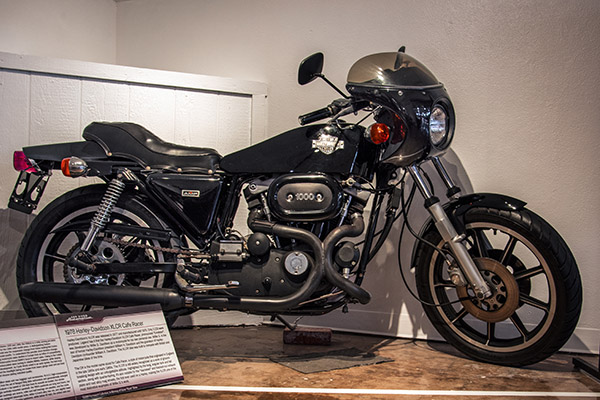
To get back to the main attraction (the San Diego Automotive Museum), both ends of the main motorcycle display hall are anchored by big American V-twins. One is a 1978 XLCR Harley Cafe Racer, which I think is one of the most beautiful motorcycles Harley ever made. The other end of the display hall has a garish chopper, one from a company appropriately named Big Dog. In an act of photographic mercy, I didn’t get a photo of it.
The Harley Cafe Racer. Always wanted one, never bought one. They were a shade over $3,000 in 1978 when new. I came close to buying one back then, but I didn’t pull the trigger.
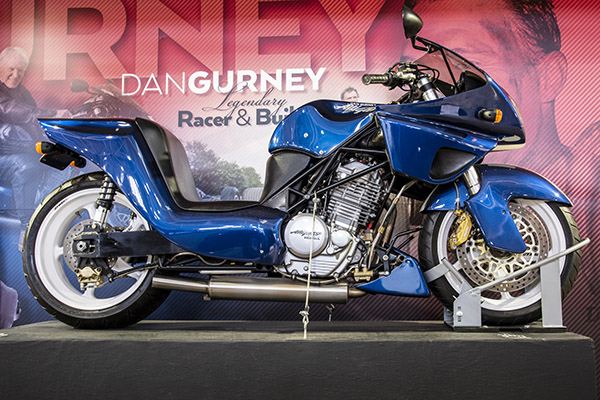
Moving outside the motorcycle exhibit hall and into the rest of the Museum, as mentioned earlier there are motorcycles displayed throughout the other displays. One of the first is a Dan Gurney Eagle. Dan Gurney was a famous automobile racer who formed a company that mounted Honda engines in a frame in a manner that positioned the rider low in the bike. The seating arrangement was said to improve handling. Maybe it does. To me, it just weird, and rider visibility has to be terrible. I think I would look weird (or weirder than usual) when stopped with my legs splayed out to the sides.
A Dan Gurney Eagle. Weird, huh? The concept never caught on.
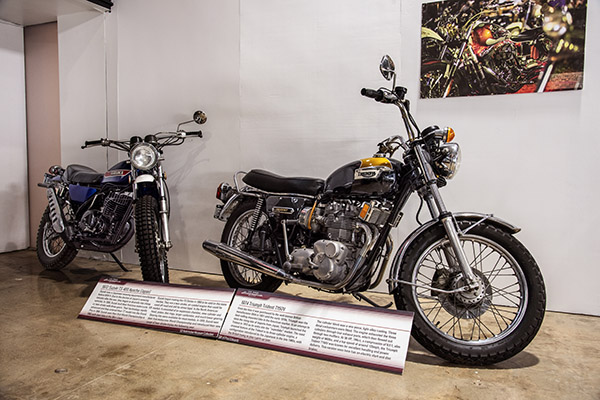
As soon as you enter the Museum, there’s a 1974 Triumph 750 T150V Triple on display (along with a two-stroke Suzuki 400cc dual sport). The Triumph Trident was supposed to be Triumph’s answer to the Honda 750 Four, but it was too little, too late. The Honda was far ahead of its competition. Triumph ultimately went out of business a few years later.
A 1972 Suzuki Apache and the Triumph Trident 750.
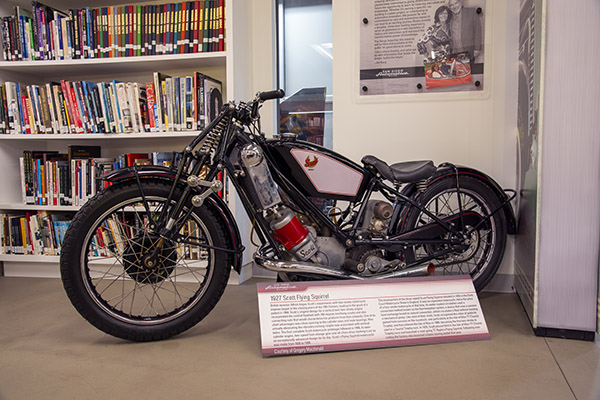
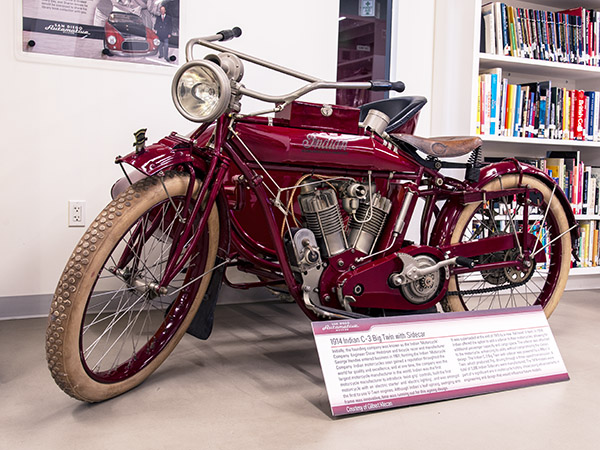
The San Diego Automotive Museum has a library, and our host explained to us that they are often visited by elementary school classes. Students use the library for homework assignments related to automotive topics. There are a couple of interesting motorcycles in the library. One is a Scott two-stroke (another motorcycle I had never seen before); the other is a 1914 Indian V-twin with a sidecar.
A 1927 Scott Flying Squirrel.A 1914 Indian C-3 with Sidecar.
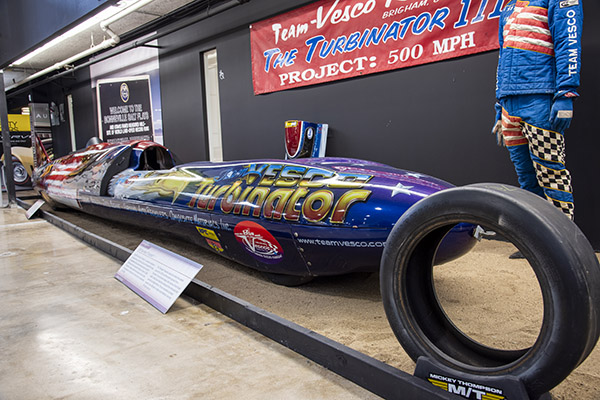
In the Museum’s main display area, there’s a land speed record streamliner that at first I thought was a motorcycle. You know, kind of like the land speed record Triumph that hit 247 mph back in the 1960s (Triumph included a “world’s fastest motorcycle” decal on every bike). But this vehicle wasn’t a motorcycle; it actually had four wheels beneath its narrow body work. The Vesco Turbinator is powered by a helicopter engine, and it set a world speed record for wheel-driven (as opposed to jet propelled) vehicles.
The Vesco Turbinator. It set a world speed record for wheel-driven vehicles, cracking the 500-mph barrier.
I poked around a bit on the Internet and found this very cool YouTube of the Turbinator’s Bonneville speed run:
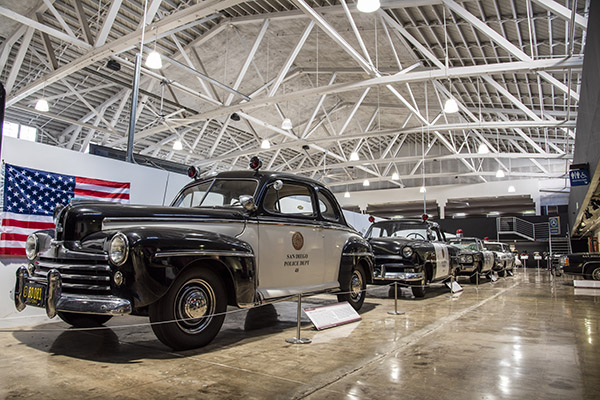
There were several kinds of cars on display, including an interesting collection showing the evolution of police cruisers.
The San Diego Automotive Museum has an impressive display of police cruisers.
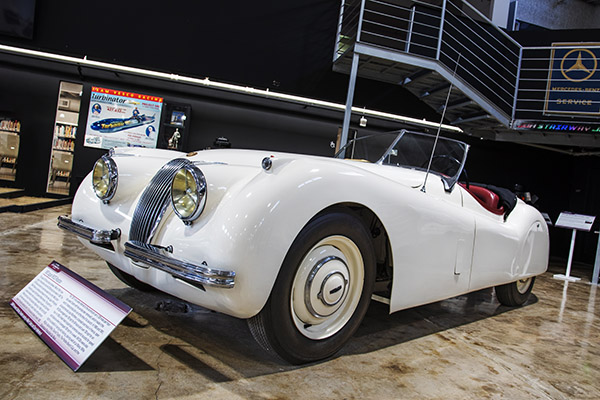
One of my dream cars has always been the XK-120 Jaguar, and the San Diego Automotive Museum had one on display.
This sure is a beautiful automobile.
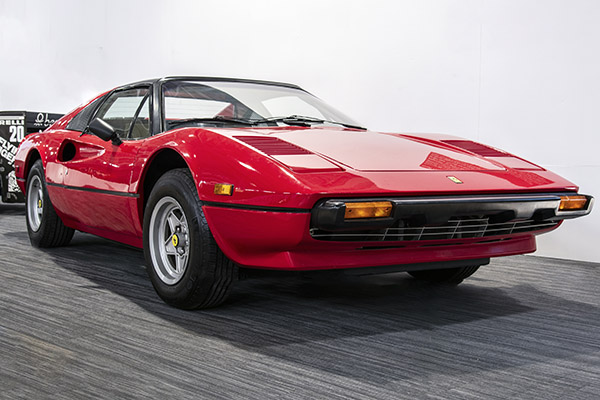
Do you remember Tom Selleck’s first television series, Magnum P.I.? The Museum’s displays include the Ferrari 308 from that show.
Thomas Magnum’s Ferrari. It was beautiful then and it’s beautiful now. I was surprised at its small size.
When I first moved to southern California nearly 50 years ago, we had traffic, but not like we do today. We read a lot of stories about billionaires leaving California, but as far as I can tell, it feels like a lot more people are here now. I think our population is increasing. High density housing and traffic are out of control. Back in the 1970s, it was no big deal to hop on my Electra Glide, head south, and arrive in San Diego two hours later. Today, that same trip is at least three hours, and that certainly was the case when Sue and I visited the Automotive Museum a few days ago. We have more freeways than we did 50 years ago, but the traffic is horrendous and it still takes longer to get anywhere. That said, our ride the other day was an easy hundred-mile stint south on Interstate 15 to California State Route 163, and then a right turn into Balboa State Park.
Although the drive down to San Diego was long, I didn’t mind. It had been at least 30 years since I’ve been to Balboa Park. It’s a national treasure. The Park covers 1200 acres, and it is one of the oldest parks in the U.S. The land was originally reserved in 1835. Balboa Park contains 17 museums and 18 botanical gardens. It also has theaters, restaurants, and the world-famous San Diego Zoo. The whole affair is managed by the San Diego Parks and Recreation Department.
As we chatted with our new friends in front of the San Diego Automotive Museum, they told us about the Air and Space Museum facility originally being built by the Ford Motor Company. It is directly under the flight path in to San Diego’s Airport. From the air, the Air and Space Museum looks like a Ford V-8.
After visiting the Automotive Museum, Sue and I wandered outside and shot a few photos of the building (including the one at the top of this blog). It was a glorious day, the kind that makes living in southern California a treat: 70 degrees, essentially no humidity, and not a cloud in the sky. As I wrestled with the big Nikon 810 and its 24-120 lens, we noticed two older gentlemen sitting at a table in front of the Museum. They watched me taking photos, and that led to a 45-minute conversation about life in general, getting old, being retired, enjoying days like the one we were enjoying, and Balboa Park. The two were both nearly 80 years old. One had been the architect for the Automotive Museum’s remodeling a few decades ago; the other had designed and built the ornate trim you see around the top of the Museum. They regaled us with stories about the Automotive Museum building, the Museum’s donors, and more. It was a pleasant morning, made all the more interesting with this conversation.
The way to take in Balboa Park (if you haven’t been here before) is not to do it the way we did (i.e., driving down for a half-day visit to the San Diego Automotive Museum). A better way to enjoy Balboa Park is to spend several days in San Diego. San Diego is one of the world’s great cities, and Balboa Park is its crown jewel.
You could spend a week just in Balboa Park, but there are many other fun things to do in and around San Diego, many of which we’ve written about before. The San Diego Zoo is one of the world’s great zoos, and it’s good for a full day (or two). There’s the USS Midway Museum, which can only be described as magnificent. The Deer Park Winery and Auto Museum is just a few miles up Interstate 15, with its magnificent collection of convertibles and wines. Mexico is just a few miles south, with Tijuana on the other side of the border, Tecate and its culinary delights an hour or so to the east, and all of Baja starting as soon as you cross the border. Baja is magnificent; it offers some of the best riding in the world. The restaurant scene in San Diego can only be described as spectacular, but don’t get waste time or money in the high-priced tourist eateries in San Diego’s Embarcadero area. If you want authentic Italian cuisine, navigate your way to Volare’s (it’s one of San Diego’s best kept secrets).
So there you have it: The San Diego Automotive Museum and a few other San Diego attractions. If you haven’t been to this magnificent city, San Diego is a destination that should be on your bucket list.
Even though I was an IT (information technology) Project Manager for 12 years, a weak point of mine happens to be IT. Yes, IT.
As an IT team leader one of my greatest strengths is not only placing others in positions where they can excel, but ensuring I do the same for myself. Living in Colombia I happened upon a new challenge. One morning my laptop refused to connect to the Wi-Fi. The laptop I had been using the past two or three years was gifted to me by a friend. This laptop had sort of “fallen off a truck,” or was “found in the alley.”
My guess is the problem I was now faced with was due to the organization it “belonged to” running an audit. I am certain the audit didn’t dig the Colombian IP address, so the laptop was terminated. I now had to purchase a new laptop here in Medellin, Colombia. Shouldn’t be a big deal, right?
Not the case, of course.
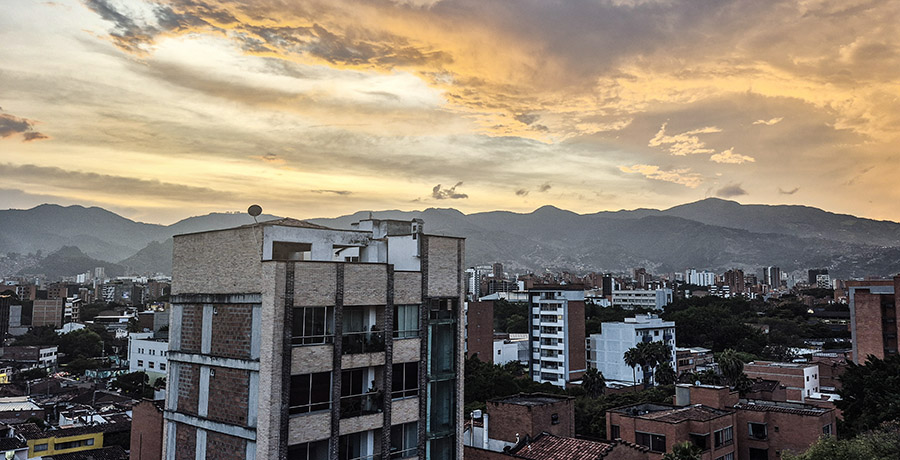
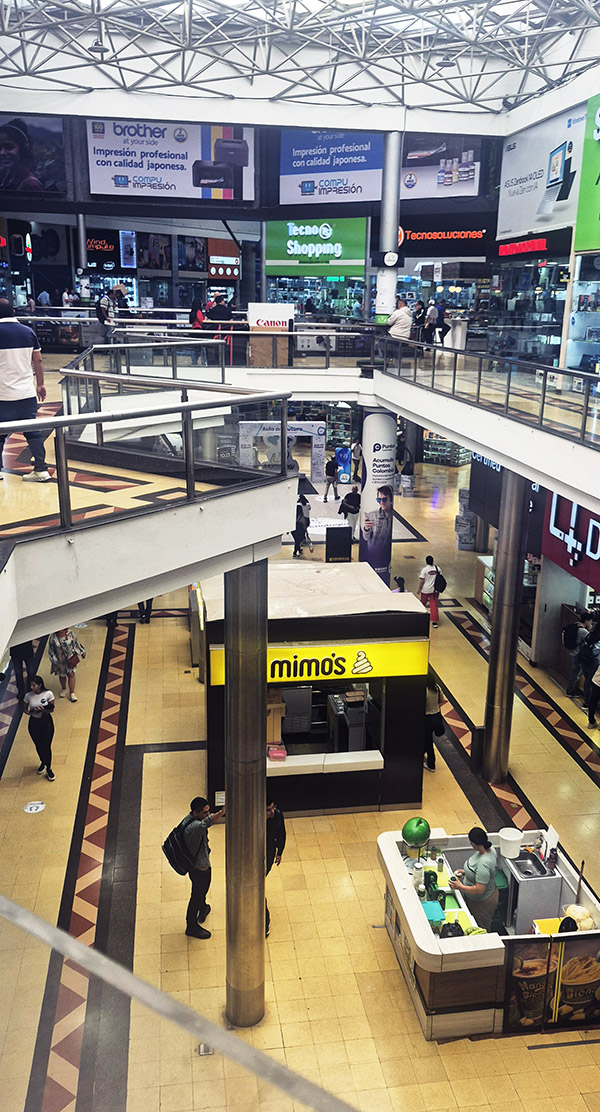
Finding a mall in Medellin wasn’t difficult. It was a huge modern three-story mall with nothing but IT and telecom stores. It was a bit overwhelming. I Googled reviews as I walked through the mall and it didn’t take long to settle on a store. I found a representative that spoke decent English to bridge the gap with my never-ending Spanish stumbling. He recommended a few basic machines. I began more research on reviews and picked out a basic laptop that would suffice (mainly for writing ExNotes pieces).
After installing Windows and basic MS apps, I returned to my apartment and noticed something was off. The keyboard was in a different format. It was a Spanish QWERTY layout. OK, not a huge deal: I could learn a new keyboard. What really confused me is they loaded the software for a standard American keyboard. This meant the keys did not match many of the symbols. I learned this on my own, but not before walking the streets of Medellin with my laptop asking locals to assist me. No one else could figure it out, either. This was becoming frustrating, but some relief that it wasn’t my incompetence that caused it.
Returning to my apartment, and after a bit more Google research, I learned to toggle the keyboard to the QWERTY format to match the keyboard, which is where it will stay. Yes, I am sure I could exchange the laptop and hunt down one with a normal keyboard, but what fun would that be?
I will be in South America for quite some time (more on that in another blog), so I thought I would just embrace the change. Also, it is now easier for me to do “¡” and “¿” symbols to impress the locals.
We need your support! Do what you can to help ExNotes stay in the black!
Coming up…more on Cycle Garden and their impressive work on Moto Guzzi and other Italian motorcycles!
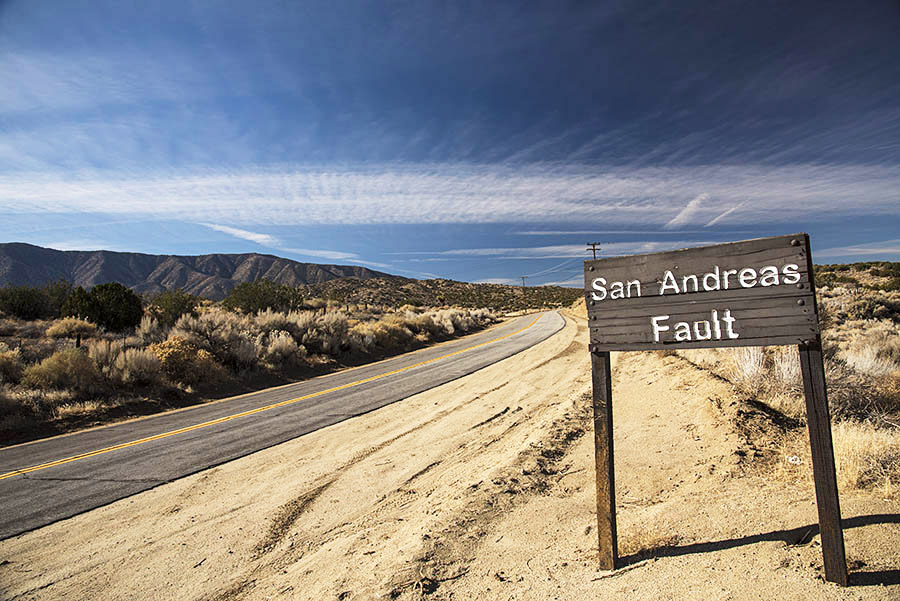
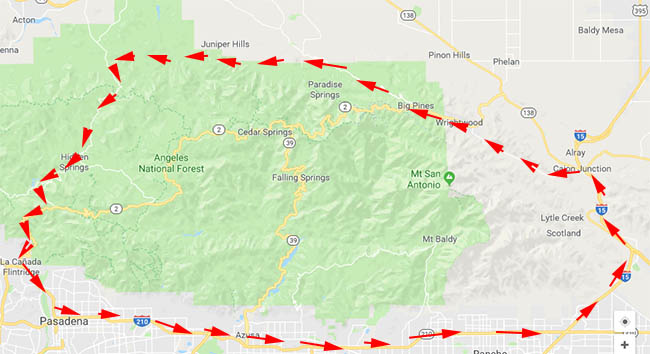
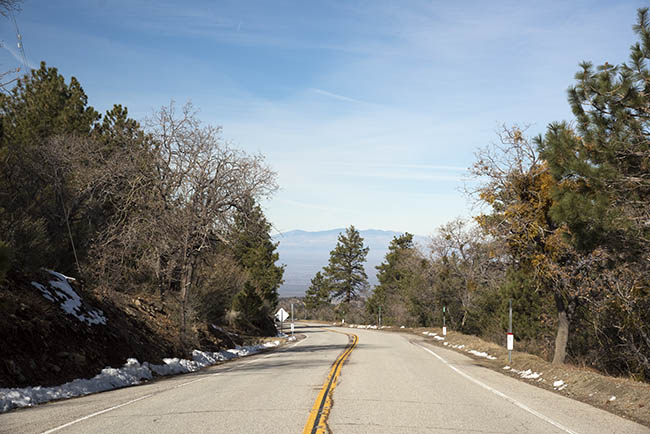
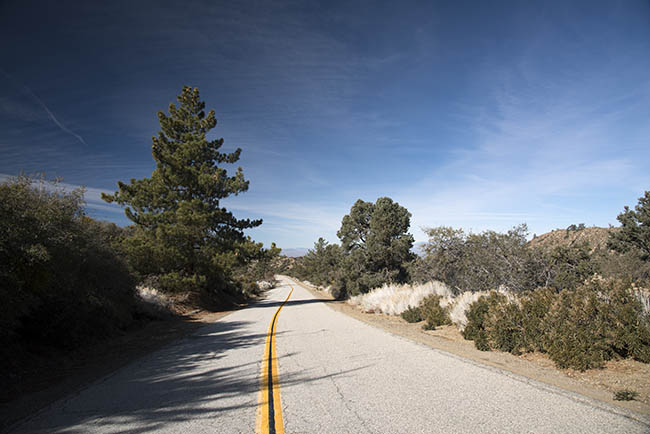
The photo above is another one of my all-time favorites from one of my all-time favorite local motorcycle rides here in southern California. It’s a circumnavigation of the San Gabriel Mountains, and it takes you right over the San Andreas Fault.
The route. This is a beautiful ride. It takes 4 or 5 hours to complete.
The ride is beautiful, especially on the northern side of the mountains along the southern edge of what we call the High Desert.
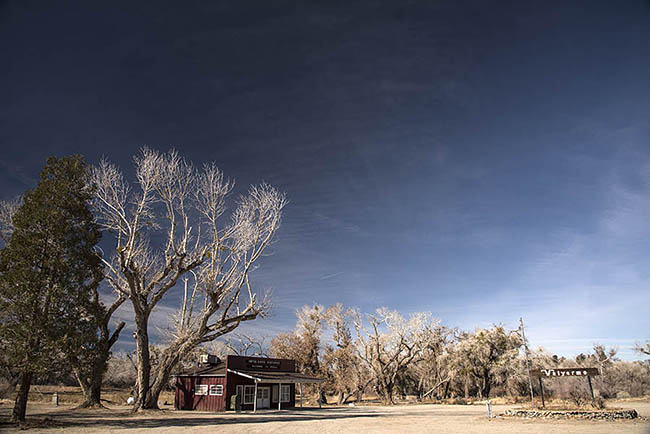
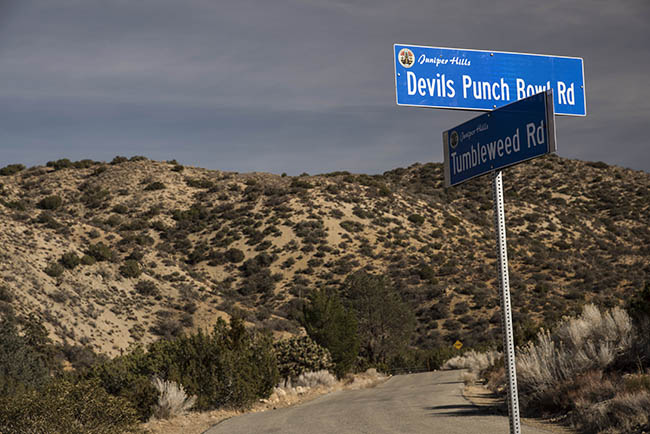
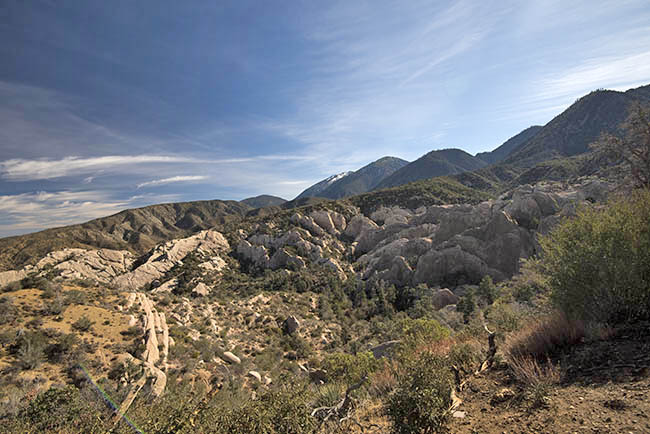
Valyermo, a nice spot to stop for a photo.Scenes on the north side of the San Gabriels. Note the snow still on the sides of the road.Descending toward the High Desert.The intersection of Devil’s Punch Bowl Road and Tumbleweed. Turn left and it will take you to the Devil’s Punch Bowl on the San Gabriel’s northern slope.The Devil’s Punch Bowl.
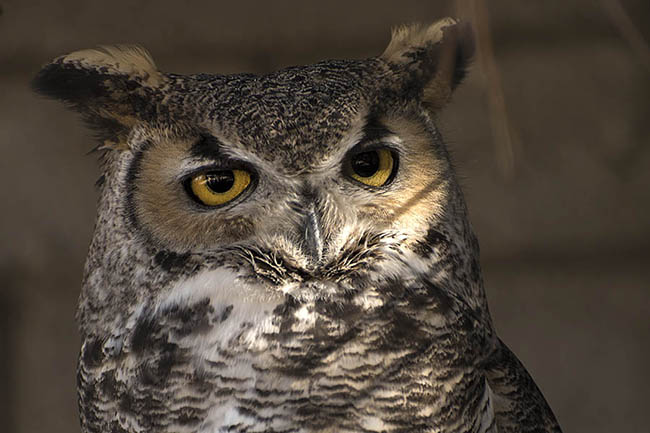
If you’re taking this ride, there’s a cool ranger station at the Devil’s Punch Bowl County Park. The park has several exhibits, including Squinty, an owl with an injured eye park personnel rescued.
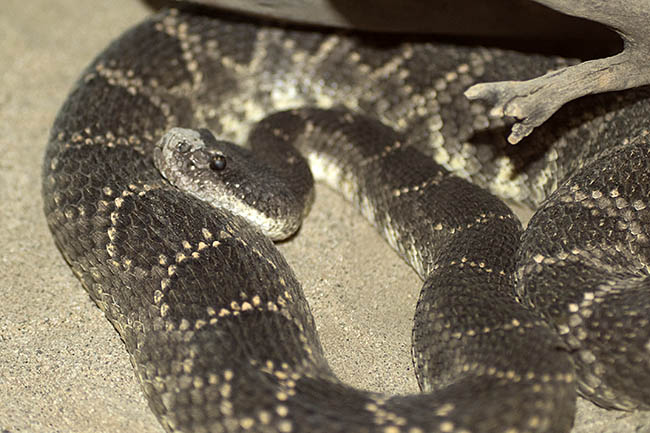
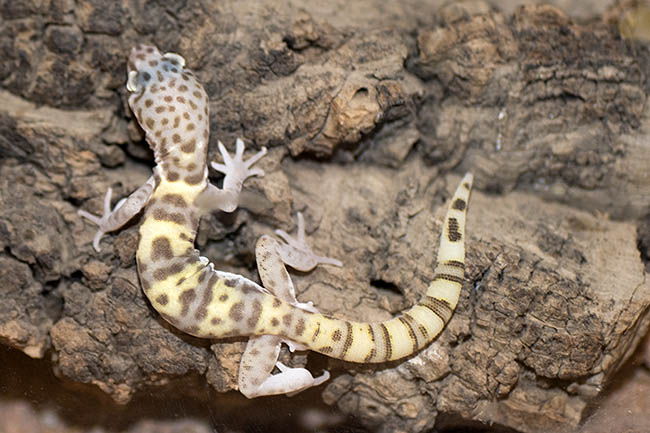
Squinty says hello.Yes, indeed. A Western Diamondback in a cage. There are many, many more in the hills and in the desert.A Western Banded Gecko at the Devil’s Punch Bowl County Park. These are very beautiful.
We have a bunch of other phavorite photos here on the ExNotes site. The Phavorite Photo series came about as a result of a suggestion from good buddy Peter. Peter, thanks much!
Earlier Phavorite Photos? You bet! Click on each to get their story.
I had stopped at the perfect place for my morning coffee. Not only did the owner know of less chaotic roads, but the coffee shop was at the exact location to turn off to hit these mostly unexplored roads. I quickly finished my coffee and was out the door in minutes.
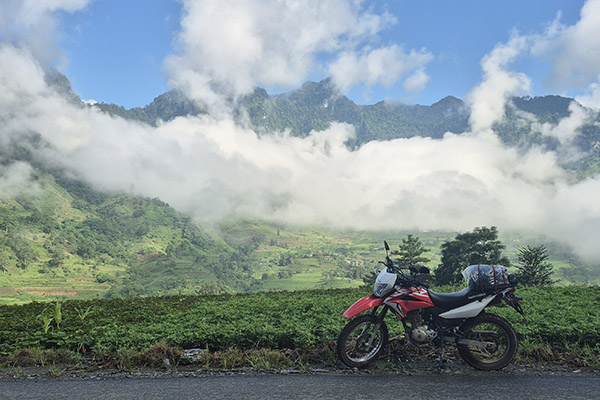
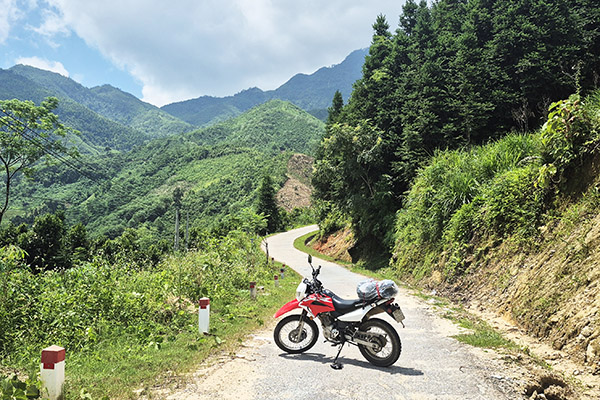
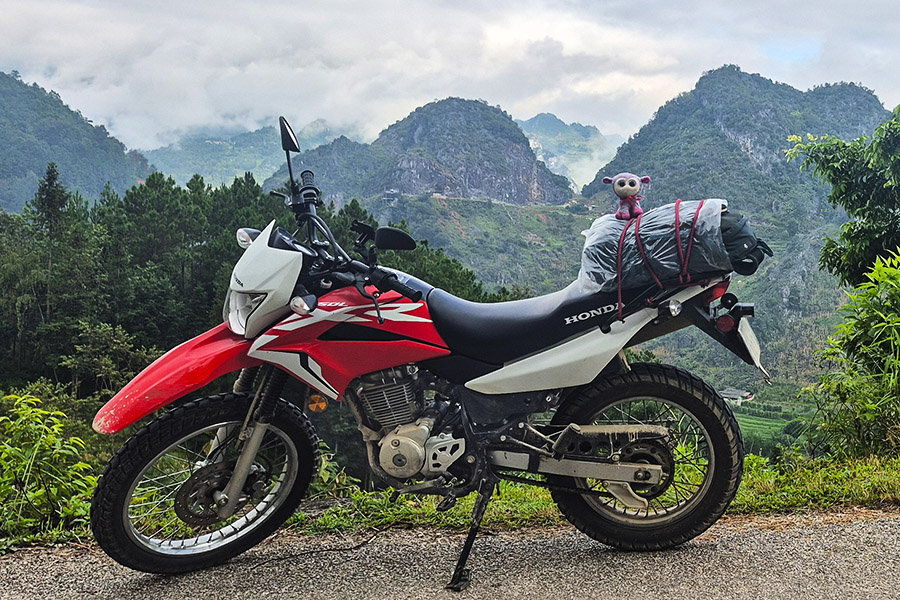
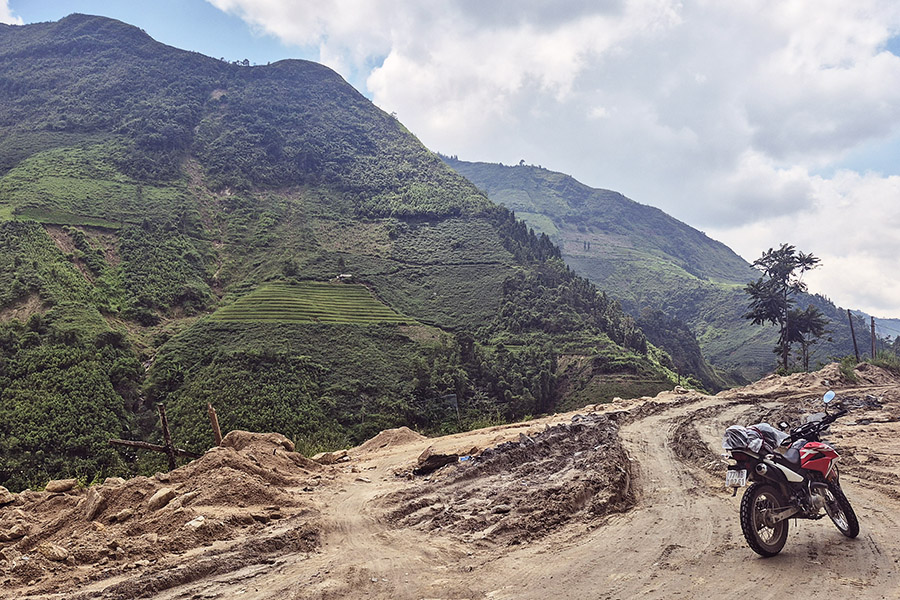
This would be the Vietnam I was looking for. No congestion, no traffic stops, just miles of mountain switchbacks. This new chosen path didn’t come without a bit more adventure, too. Over the next five days I didn’t see one Westerner or tourist. None. The village homestays I chose were so far off the beaten path I don’t even think many of the locals had ever seen a Westerner. Communication was strictly between my charades and some Google Translate. The more rice wine I drank at the end of the evening, the less I relied on Google and the more colorful my charades became.
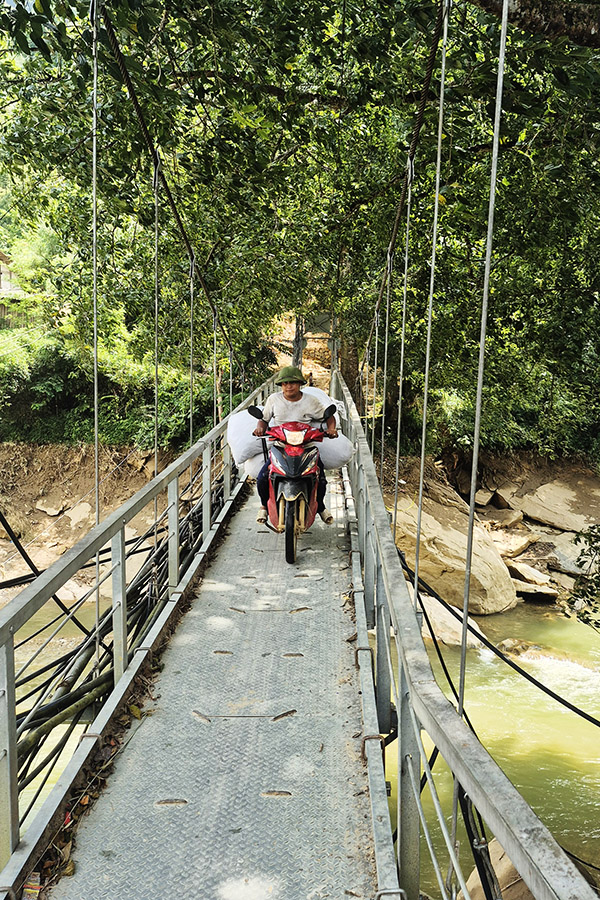
The roads were beautiful as the paved switchbacks disappeared into the lush jungle mountains and became dirt. Some had precarious places with mudslides that consumed the dirt along these roads. On more than one occasion I would be filled with confidence as I successfully negotiated these obstacles, only to be put in my place as a 10 year old girl on a scooter would overcome the same obstacles (but one-handed as her other hand was busy texting). Talk about an instant ego check.
The days actually became very isolating with the empty mountain roads, and even emptier villages where I found myself staying. On more than one occasion I found myself alone in a rundown hotel room having ramen for dinner by boiling water from a tea kettle. Those moments were overshadowed by the adventure that always arrived the following day as I chose new mountain roads. It was exactly the experience I desired while motorcycling Vietnam.
For the next five days I hardly saw pavement or even other vehicles. When I would stop for a break at a viewpoint or for a drink of water there was absolute silence. Even if there had been noise, the dense jungle would have absorbed it. The jungle even consumed the sound of my moto crashing into the rocks when I occasionally lost focus. It wasn’t dense enough to absorb my pain-induced swearing as I reinjured my broken rib from my Thailand crash.
After nine days I returned to the sensory overload of Hanoi, which came in the form of massive traffic and chaotic roundabouts. I had completed the Ha Giang Loop. It was such an epic road. The greater accomplishment was leaving the tourist trap loop and experiencing the true, raw, and mostly unexplored roads of Vietnam.
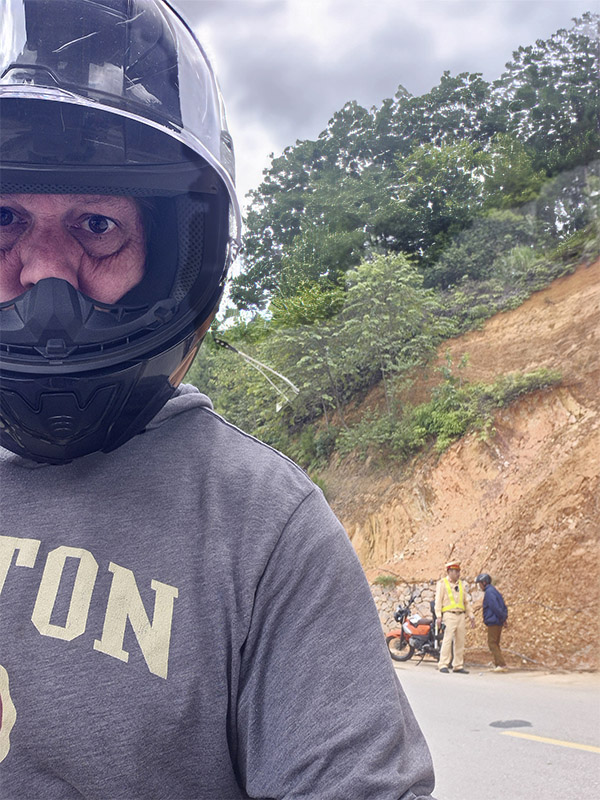
Awakening the following day, I was eager to begin my second day on the Ha Giang Loop in northern Vietnam. Thankfully, the remainder of my first day on this road went without further incidents with local law enforcement.
As I continued northward in this beautiful mountainous region there wasn’t a day that went by where I wasn’t pulled over at least once. The officers I had paid the 8 million Dong to were true to their word as each time I was pulled over at license checkpoints the officer would pull out their phone and scroll through the many photos of tourists until I would stop them. “Right there! That’s me. See? I paid.”
The police officers then signaled me to be on my way. Outside a few verbal warnings to slow down, the police check points just became part of my daily routine as my journey continued.
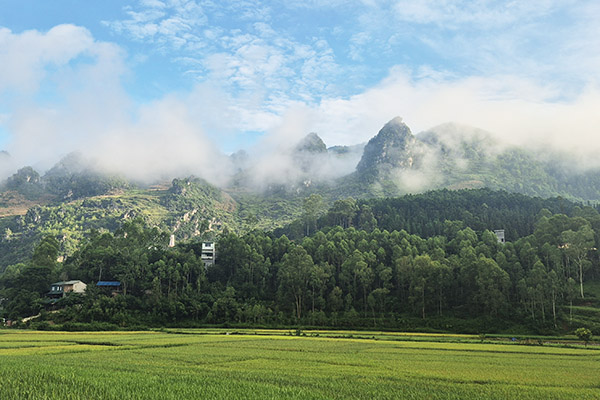
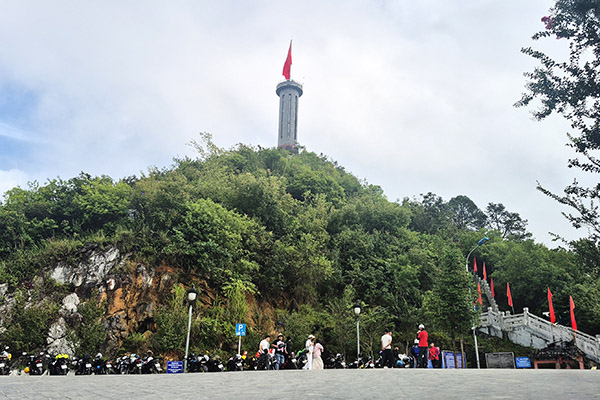
Hitting the Vietnamese North Pole was one of my objectives along this ride. Starting off early in the morning was the best way to go. The early start was not only to avoid police check points and tourist traffic, but also to watch the mystical fog burn off the mountains as I weaved my way north. The roads were in pristine condition. The only thing more pristine was the green mountain views that unfolded as I powered through the corners. It was wonderful to have the road to myself, outside of the few meandering water buffalos that lazily crossed in front of me every so often.
Every day as afternoon approached, the police check points would appear. After a few days of constantly being pulled over to scroll through the police text thread, point out my photo, and on occasion be given a breathalyzer test (Vietnam has zero tolerance for driving under the influence), it began to get old. The road was filled with rental scooters. Most carried Westerners.
After four days of riding along the Ha Giang Loop, I reached my limit. I’d had enough of tourists, police stops, and crowds. Tigit Rental had written a solid itinerary, but at this point I needed more solace. I pulled into a coffee shop to see if there was another route I could take to deviate from the Ha Giang Loop (and there was). I hit smaller, less traveled roads. The coffee shop owner must have seen the frustration on my face as I zoomed through maps and roads to explore on my phone.
Using Google Translate with the shop owner, I described what I was looking for in terms of roads and a Vietnam experience. She quickly pointed out a direction. The roads she identified were remote and they met my criteria. The path would also send me north along the Chinese border, and then loop down to Hanoi. This would get me away from the Ha Giang Loop chaos.

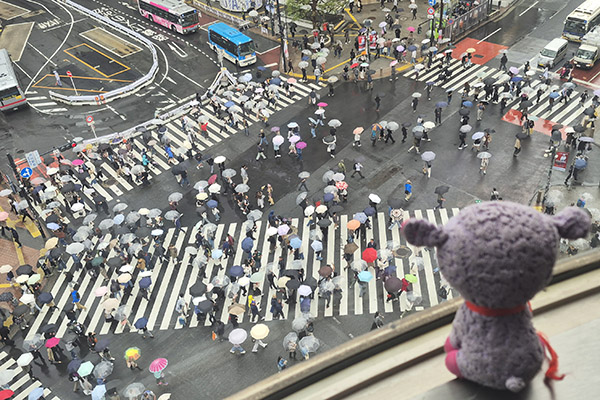 I am usually comfortable with no planning, but before arriving in Tokyo (one of the largest cities on earth), I was feeling overwhelmed. Within 30 minutes of landing I learned there was no need for those feelings, though. Tokyo is one of the most organized, safest, cleanest, and well laid out cities I have ever visited. As I traveled through Japan for the next five weeks, I learned the people are some of the most beautiful in the world, and that is coming from someone who has seen quite a bit of the world.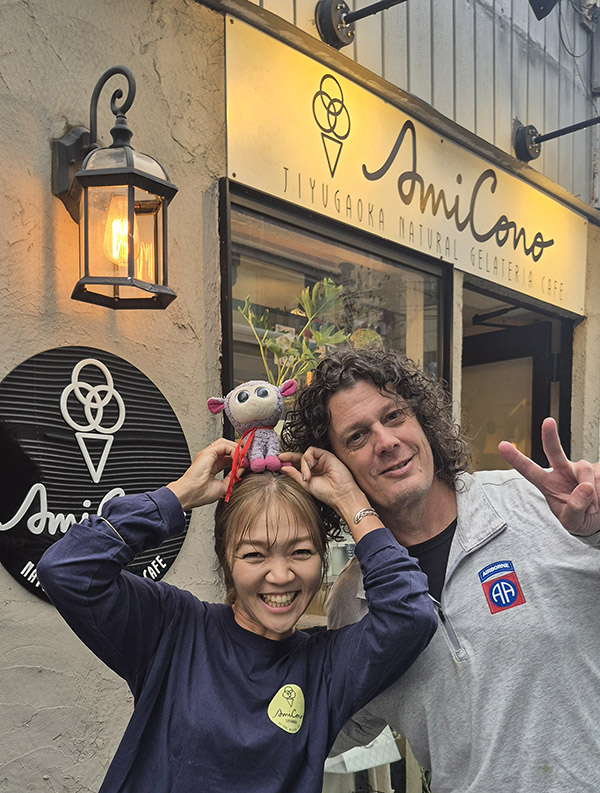


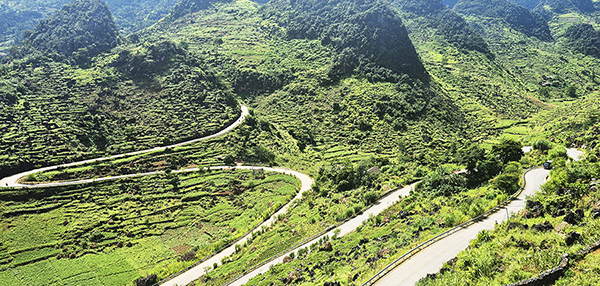 This would be the Vietnam I was looking for. No congestion, no traffic stops, just miles of mountain switchbacks. This new chosen path didn’t come without a bit more adventure, too. Over the next five days I didn’t see one Westerner or tourist. None. The village homestays I chose were so far off the beaten path I don’t even think many of the locals had ever seen a Westerner. Communication was strictly between my charades and some Google Translate. The more rice wine I drank at the end of the evening, the less I relied on Google and the more colorful my charades became.