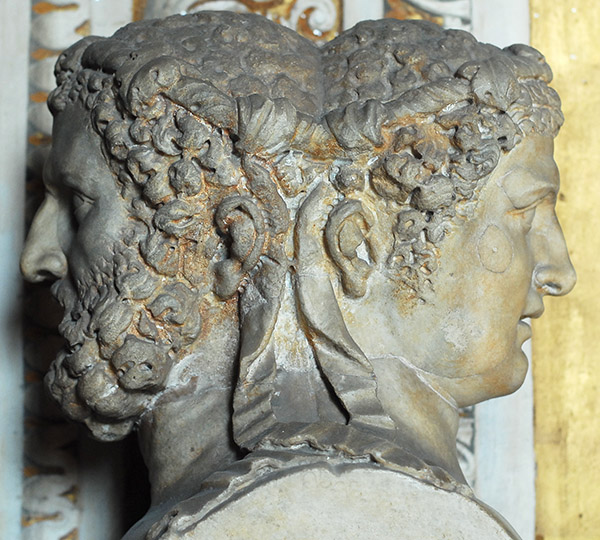
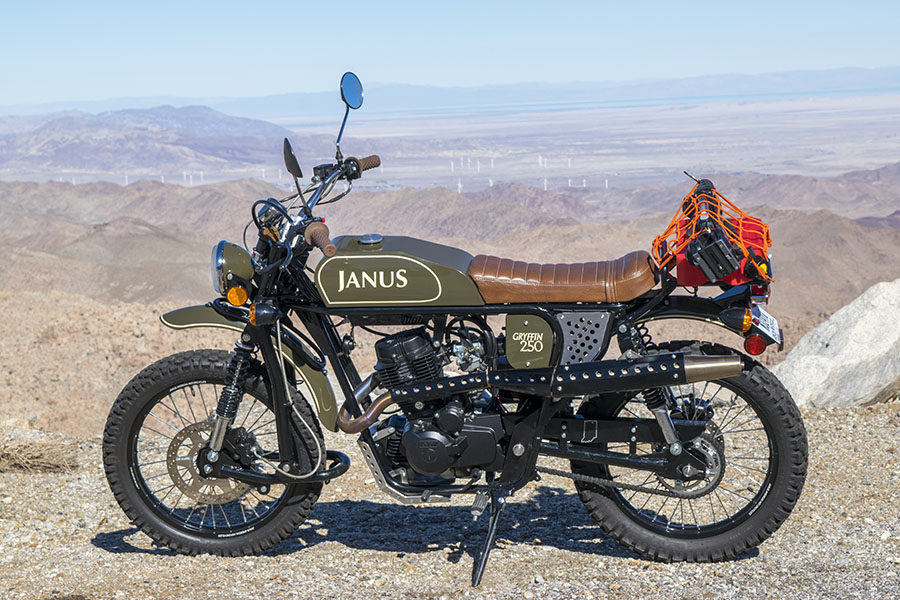
Janus, the Roman God of Transitions, symbolizes looking to the past and the future. It is a fitting name for Janus Motorcycles, a company building ultra-high quality modern motorcycles with classic styling from the 1920s and 1930s.
The Roman god Janus on display in the Vatican.
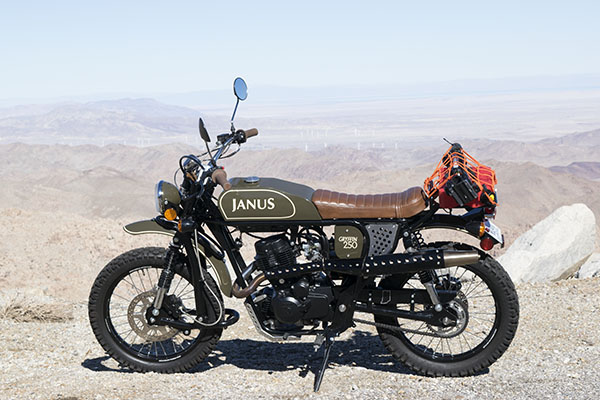
You may remember a couple of years ago I rode northern Baja with the Janus guys. It was a great ride (any ride in Baja is) and the Janus is a great motorcycle…a gem of a bike handcrafted in Goshen, Indiana. I had a wonderful time and I loved riding the Janus Gryffin.
The Janus Gryffin on Baja’s Rumarosa Grade.
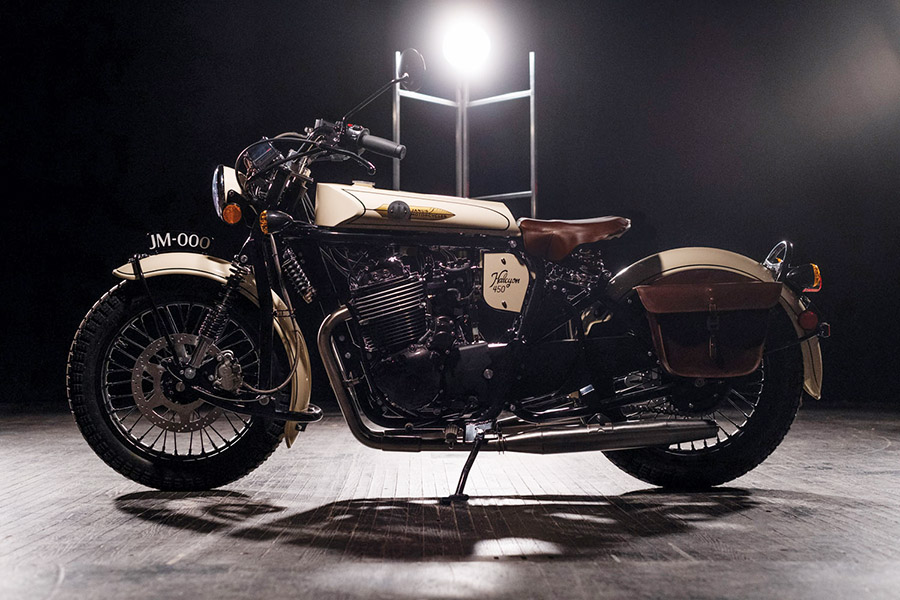
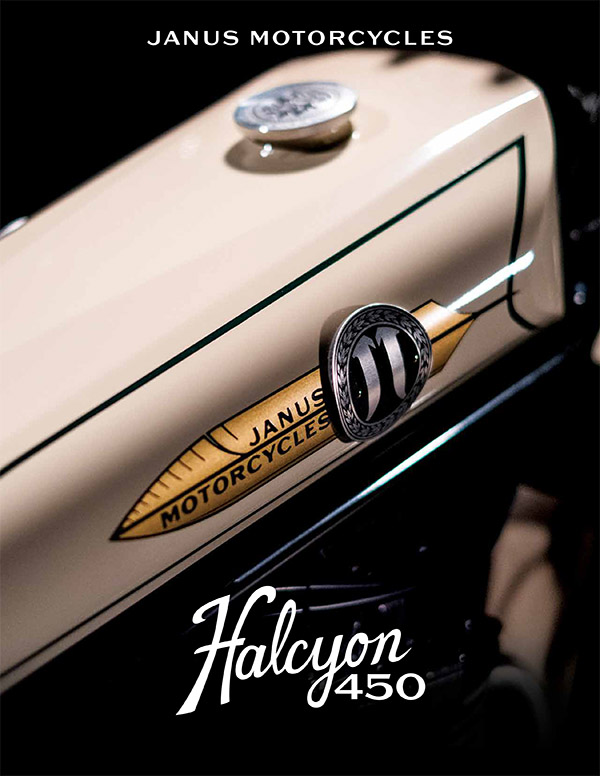
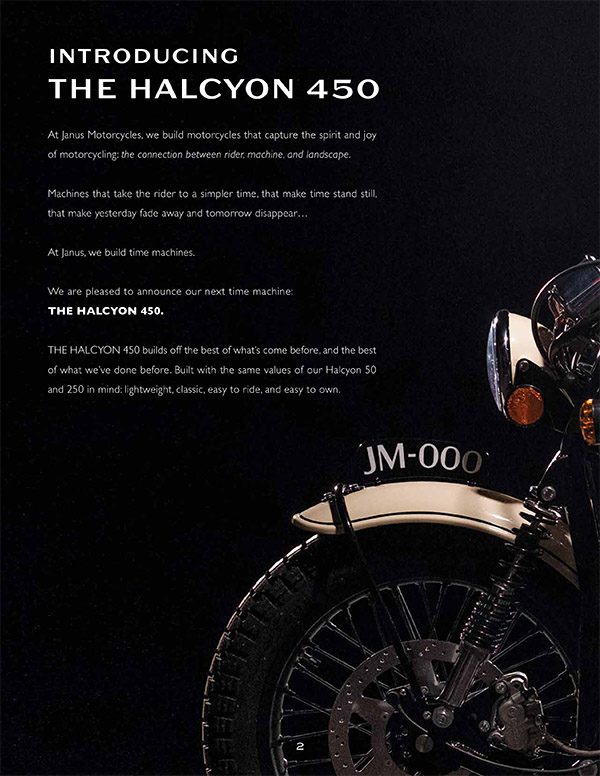
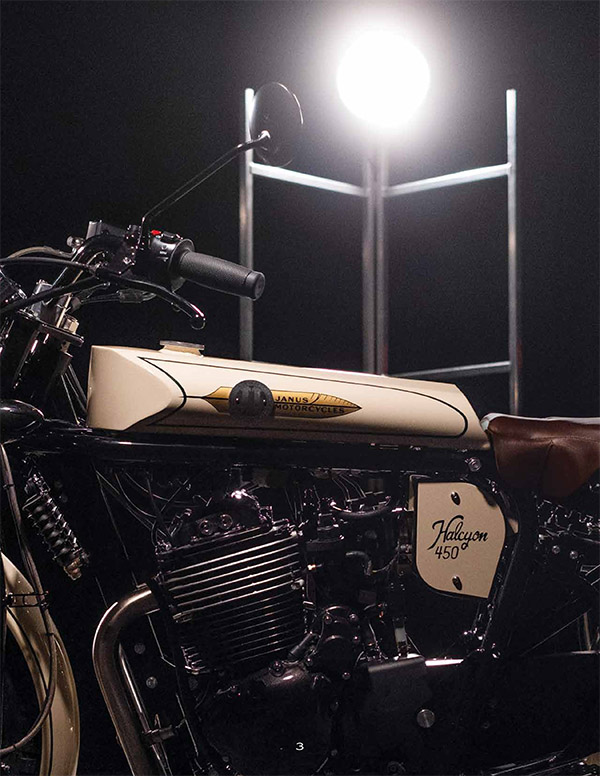
Well, those boys in Goshen don’t sit still. The bike I rode was powered by a 250cc CG Honda clone engine and it was a hoot, but the Goshen guys had bigger plans. Janus announced today that they are introducing a new Halcyon with a 450cc engine. I’ll let the press release below, the Janus videos, and the brochure do the talking. Watch both videos; you’ll enjoy them.
Janus Motorcycles Releases New Halcyon 450 Model
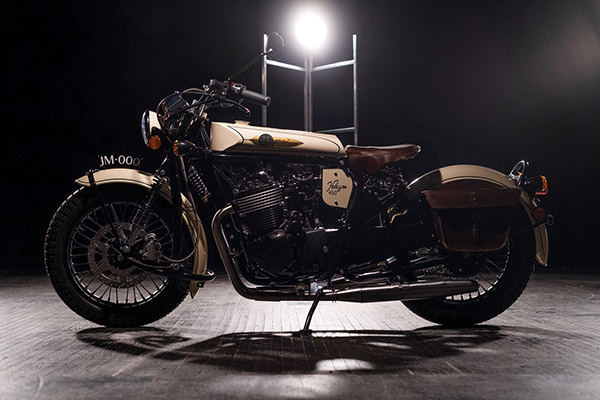
Goshen, Indiana (March 8, 2021) — After 18 months of confidential development, Janus Motorcycles of Goshen, Indiana is unveiling their newest model, the Halcyon 450. Building off the best of what they offered in their 250 line, the Halcyon 450 features a higher top speed, a rear suspension, performance brakes, and several new hand-crafted details.
“Our 250 series owners love the light weight, hand-built features, and classic lines of the 250 series. With the Halcyon 450, we’ve worked to refine those features while improving the top speed and ride comfort. We’re extremely proud of the result,” says General Manager Grant Longenbaugh.
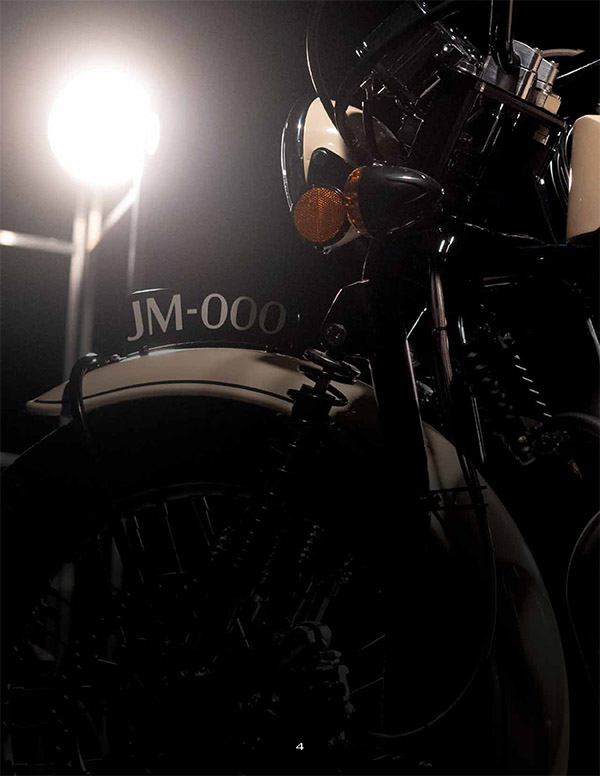
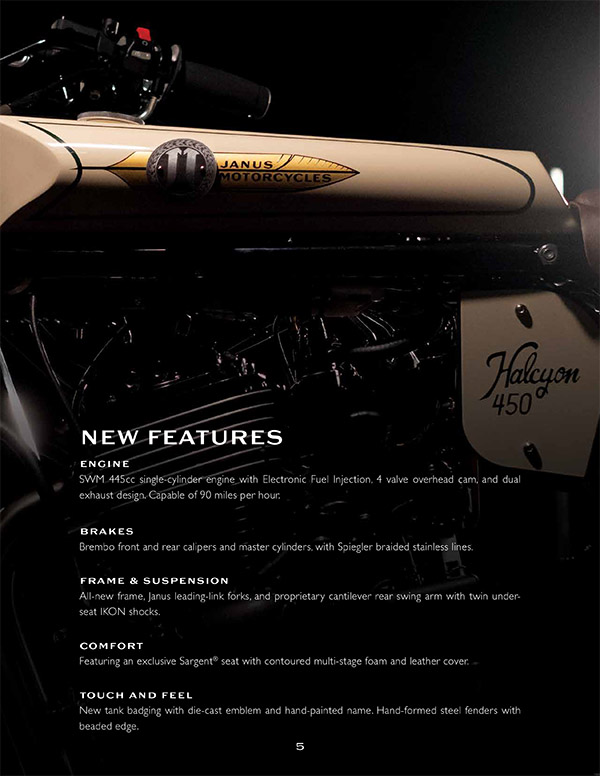
The Halcyon 450 features an SWM 445cc single-cylinder four valve engine with EFI, Brembo brakes, Sargent seat, and a new proprietary cantilever rear suspension.
Production is slated to begin in early June, with several units completed weekly.
Co-founder Richard Worsham says, “Like the 250, the 450 is a manifestation of what we believe is the spirit of motorcycling: the connection between the rider, machine, and landscape.” “We’re very excited to share that spirit with more and more riders,” he continued.
Janus Motorcycles uses a network of craftsmen in the Northern Indiana area (many of whom are Amish) to manufacture nearly all of their body work including the frame, fuel tanks, leather storage, and stainless steel exhausts. They are made to order and can be personalized with various paint, pinstripe, and finish options.
Janus was recently featured on Jay Leno’s Garage and the New York Times.
The 2021 Halcyon 450 starts at $13,500, and customers may reserve their bike with a deposit.
There you have it, folks. I like this new Halcyon, and the spec that stands out for me is the weight: Just 360 lbs! Watch the ExNotes blog; we’ll have more info on Janus and the new 450 in future posts.
If you would like to read about our Janus Baja ride on the 250cc Gryffin and Halcyon motorcycles, you can do so here!
This press release from BajaBound came in recently and we want to share it with you:
BIG NEWS! Baja Bound is very excited to announce our new Baja Saver Mexican auto insurance policy! The Baja Saver is a heavily discounted policy for travel in Baja California, Baja California Sur and Sonora that is available for six month or annual coverage. The Baja Saver offers up to a 60% discount compared to full territory Mexican insurance policies! Check out all of the Baja Saver features here:
Since the essential travel orders are still in place we are rolling this out as a great option for expats and folks commuting across the border for work. We look forward to getting back to everything we love about Baja and hope to see you south of the border soon!
¡Viva Baja!
We always use BajaBound Insurance whenever we visit Mexico, and we’ve found it to be the best.
I’ve spoken with several folks who are in Baja, and although there is an essential travel order in place, it’s not enforced. Folks tell me that they can easily cross the border in both directions. Baja John tells me that life is Baja is much the same as it is here in the US, with folks social distancing, restaurants offering outdoor dining and socially-distanced tables, and people wearing masks. John mentioned that on a couple of recent holidays, there were roadblocks north of San Felipe and Ensenada and if you couldn’t prove Baja residence, you would have to turn around, but the roadblocks were only present during the holidays.
Gresh and I have been talking about venturing into Baja in another two or three months. I am looking forward to it. In the meantime, if you want to vicariously relive a few of our adventures in beautiful Baja, check out our Baja and Epic Rides pages!
Joe Gresh raised an interesting topic with his recent blog on motorcycle quantity. You know, how many motorcycles are too many? That blog got a lot of hits and tons of comments on Facebook. It seems like he struck a nerve.
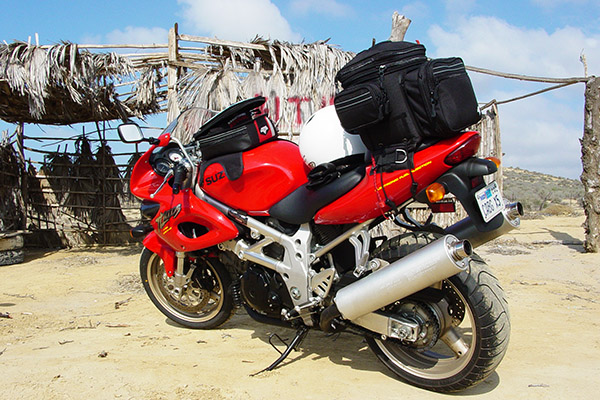
The most motorcycles I ever owned at one time was five, which pales in comparison to Gresh’s shop full of motos and maybe the collections of a few other people I know. When my collection hit that peak, I had a Triumph Daytona 1200, a Harley Heritage Softail, a Suzuki TL1000S, a Honda CBX, and a KLR 650. That was about 20 years ago. There was no rhyme or reason to my collection and no central theme guiding the contents of my fleet. I just bought what I liked. In those days I had more money than brains, but don’t interpret that to mean I was rich. I just never had a lot of brains. Most folks who know me recognize that pretty quickly.
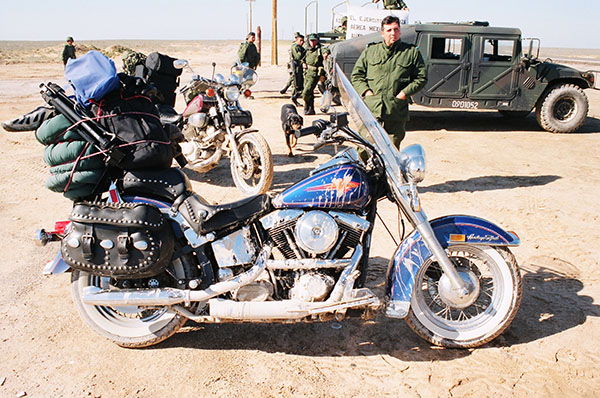
My Harley Softail in the muddy plains outside Guerrero Negro, Baja California Sur. There’s a kitchen sink in there somewhere.The Triumph Tiger. Good, but tall and very heavy. It was essentially a sport bike with excess suspension travel and ADV cosmetics.Me with a buddy currently in the witness protection program, and my Honda CBX. It was a surprisingly competent touring motorcycle.The Triumph Speed Triple. One of my buddies nicknamed it the Speed Cripple, which became true for me.Ah, the yellow locomotive. My Triumph Daytona 1200. Delightfully crude and fast. I loved this bike and I rode the 2005 Three Flags Classic on it.Turning sportbikes into touring machines…my TL1000S somewhere in Baja. This was a seriously fast motorcycle.
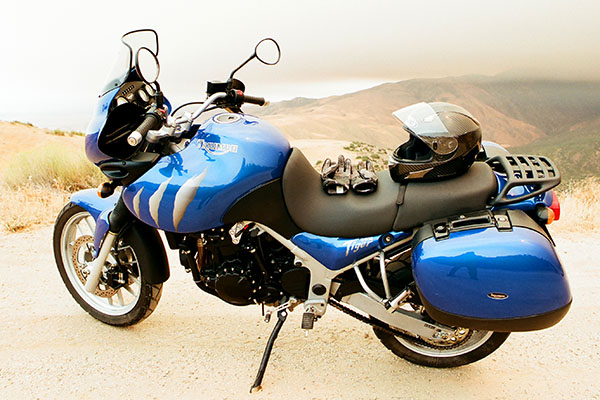
I seemed to hover around that number (five, that is) for a while. Other bikes moved in to displace one or more of the above, most notably a Triumph Tiger and then a Triumph Speed Triple. Those were fun, but they’ve gone down the road, too.
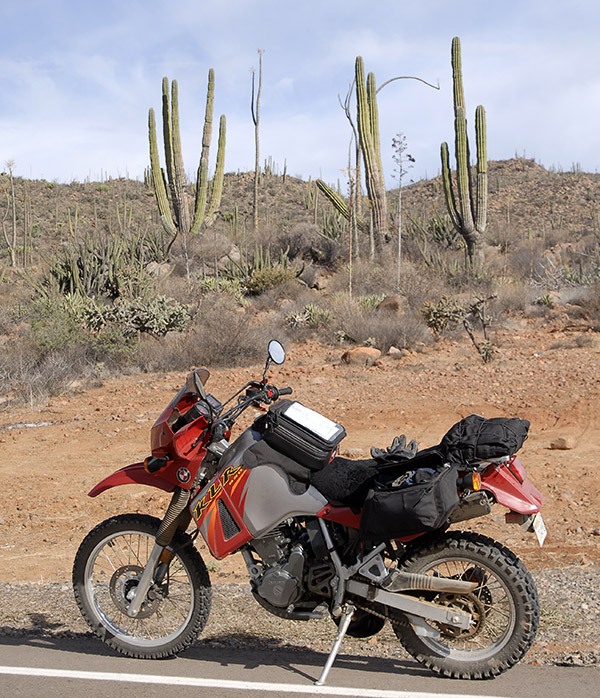
One of my favorite former motorcycles for real world adventure riding…the Kawasaki KLR 650 in its natural surroundings (Valle de los Cirios in Baja).
Which one did I enjoy riding most? That’s easy. It was the KLR 650. The KLR 650 was the bike that led me on an arc toward smaller motorcycles, like the CSC RX3 and then a TT250. I was a bit player implementing Steve Seidner’s decision to bring those motorcycles to America. The 250s were a lot of fun. I sold off all the big bikes and only rode 250s for a few years, then I fell in love with the new Royal Enfield 650 Interceptor when it hit the market, and suddenly I was back up to three.
But three, for me, was too many. I haven’t been riding much in the last few years for a lot of reasons. The pandemic put a dent in any big travel plans (YMMV, and that’s okay), and constantly moving the battery tender around and cleaning the TT250’s jets was getting old. I couldn’t move anything in my garage because there was so much stuff crammed in there, and I had to park the TT250 under the rear porch awning. I don’t have a separate workshop area and I don’t pour concrete (I don’t have Mr. Gresh’s talents, but even if I did, it looks like too much work to me), so hanging on to a big motorcycle fleet was not in the cards.
My TT250. I’ve ridden it in Baja, too. It sold the day after I placed an ad for it a couple of weeks ago, and at the asking price. This bike held its value well.
Badmouthing Facebook has become trendy, but I’ll tell you that Facebook Marketplace came to the rescue. I already had a ton of photos of my motorcycles and whipping up ads for the TT250 and the RX3 literally took only seconds. I checked Kelly Blue Book values, picked prices only marginally below what a dealer would charge, and both bikes sold quickly. The TT250 sold the day after I listed it; the RX3 took one additional day.
All the China haterbator keyboard commandos said Chinese bikes had no resale value. Like everything else they posted, they were wrong. The haters said Chinese bikes were unreliable (they were wrong), the haters said you couldn’t get parts for them (they were wrong), the haters said they were built with slave labor (I’ve been in the factories, and they were wrong), and they said they had no resale value (and they were wrong about that, too). My 6-year-old RX3 with 20,000 miles on the clock went for 69% of its original MSRP, and my 5-year-old TT250 with 3,000 miles went for 74% of its original MSRP. That’s pretty good, I think. And both sold right away. Not that I was in a hurry to sell. I probably could have held out for more.
My current sole ride (or is that soul ride?), the Royal Enfield Interceptor 650 on Baja’s Highway 1 south of Ensenada. At this point in my life, one motorcycle is enough. Your mileage may vary.
So I’m down to one motorcycle, and that’s the Enfield. For me, at this point in my life, one motorcycle is the right number (your mileage may vary). I’m on to other “how many” questions now, like how many guns are too many, and how many bicycles are too many. The answer to both of those questions is something south of my current number, but those are topics for future blogs.
Never miss an ExNotes blog! Did you know you can subscribe for free?
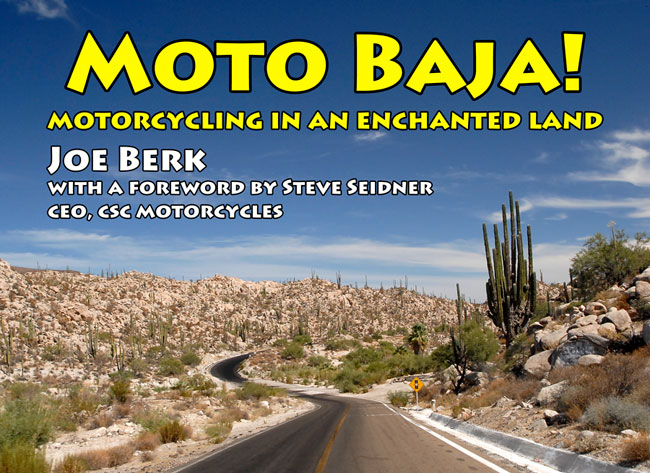
There’s lots of Baja photos in this blog, and for good reason. Baja is one of the best places on the planet for poking around on a motorcyle. Check out our updated Baja page, and pick up your copy of Moto Baja!
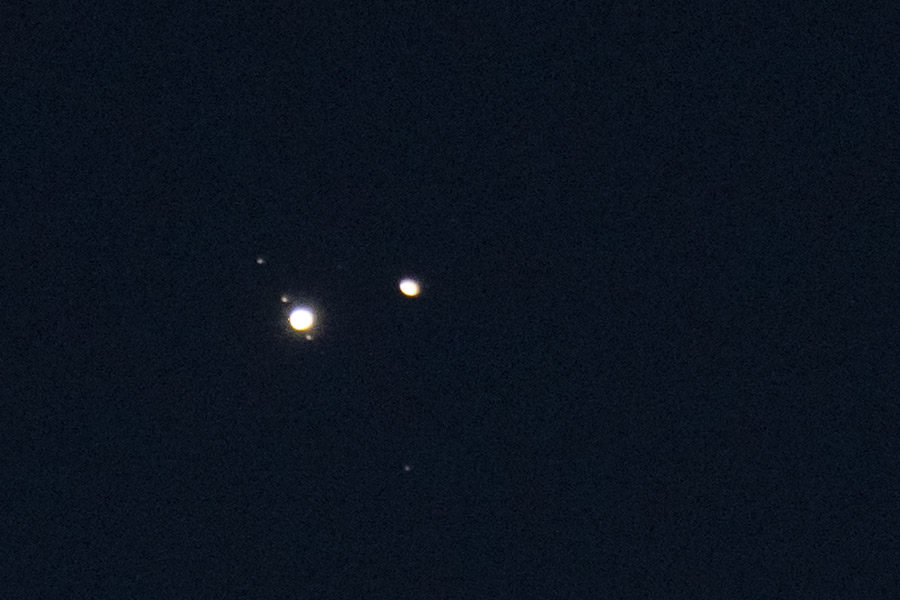
Some folks called it the Christmas Star, but it’s actually Jupiter and Saturn, two planets that came into alignment earlier this week. It won’t happen again for another 800 years, they tell us. I don’t really have the right lens for this sort of thing and I was fumbling around in the dark trying to find the right shutter speed and aperture. Yeah, I could have done better, I suppose…I would have liked to get the two planets a lot sharper. The one on the left is Jupiter, and it’s a cool 500 million miles out there (you can see all four of Jupiter’s moons). The planet on the right is Saturn; its oblong shape is due to the rings around Saturn. Saturn is 750 million miles away.
So here we are: Christmas 2020. Our best wishes to you and your families for the holidays. Christmas is different this year, and it has been a different year in many ways. The Covid 19 pandemic has dominated nearly everything in 2020, and like everyone else, we sure will be glad when this curse is in the rear view mirror. One of my daughters works in the healthcare field and she was one of the first to receive the vaccine earlier this week. We’re hoping to all get vaccinated in the next few months. Sue and I will get prioritized because we’re geezers (some of you are, too). 2021 will be a better year.
We’ve been staying home, which is what most folks here in the Peoples Republik of Kalifornia are doing these days. It’s tough being on lockdown, but there are still things worth doing. A couple of nights ago we watched a live Blind Boys of Alabama concert (that’s them above) on the computer and it was awesome. We’ve seen the Blind Boys in person a couple of times. If you ever have a chance to listen to this gospel group, don’t let it get away. Trust me on this; these guys are amazing.
I’ve been catching up with a lot of my friends the last few days…some on Facebook, some on Facetime, some on the phone, and one or two in person at the rifle range.
Baja John and I caught up via Facetime yesterday (that’s him above with his family at home in Mexico). I miss riding Baja with John; we’ve done some great rides down there.
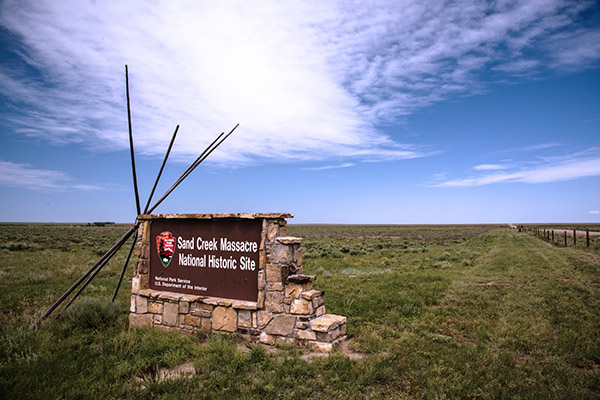
Other than that, we’ve been homebodies for the last several weeks. I’ve been doing a little writing, a little blogging, a little reloading, and a little shooting. The Sand Creek Massacre National Historic Site story just published in Motorcycle Classics (I was there in 2019); you can read it here but you would do better to subscribe to the magazine…it really is a first class publication with awesome stories and photography.
So that’s it for today. Here’s hoping Santa was good to you, and here’s another wish for a happy and healthy 2021. Merry Christmas, folks!
We want you! Sign up here for a free subscription to ExNotes!
We’re starting a new series here on ExNotes, and it’s one I think you’ll enjoy: A series on our favorite hotels in Baja. There are some great places to stay in Baja, and unlike hotels here in the US, they are not part of any big hotel chains. I love exploring Baja, and the hotels are part of the experience.
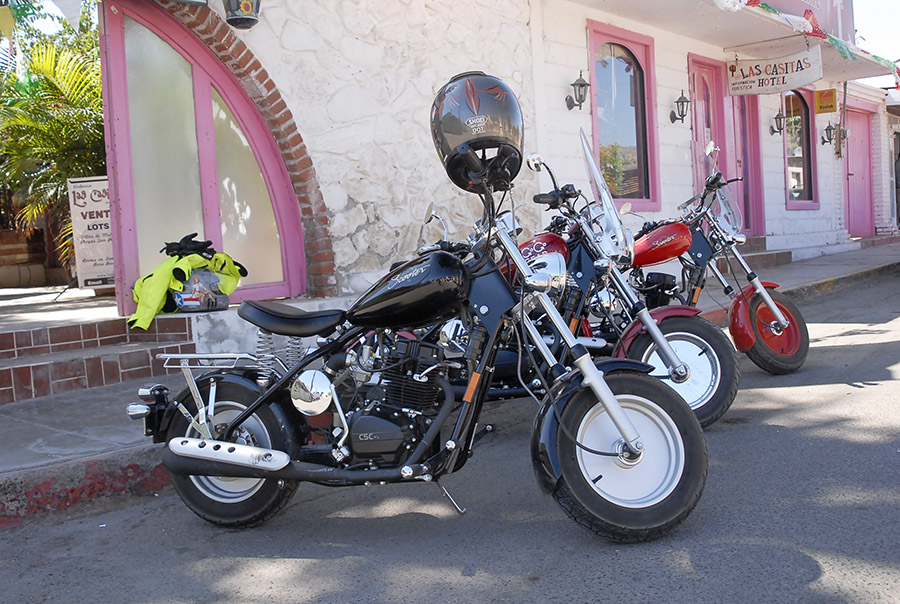
That’s enough introduction…let’s get to my all time favorite Baja hotel first: The Las Casitas Hotel in Mulegé. It’s the hotel you see those little CSC-150 Scooters parked in front of in the big photo above.
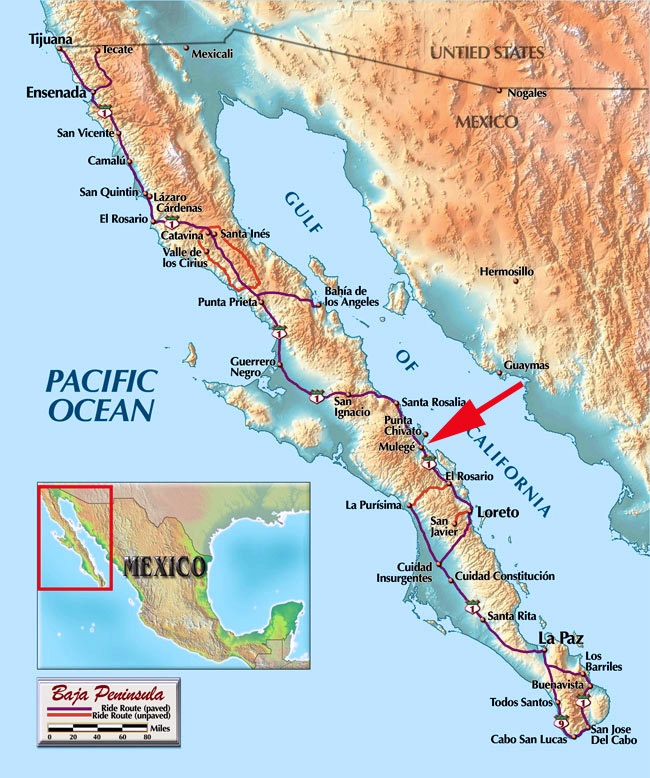
Mulegé is a special place. It’s about 630 miles south of San Diego, and you can get to it by either riding south from Tijuana on Mexico Highway 1, or you can take what is now a paved road all the way down from Mexicali on the Sea of Cortez side. Either ride is stunning.
Mulege is on the Sea of Cortez about 600 miles down the road from the border.
One note we always add on any Baja story is to make sure you have Mexican insurance before you enter Baja. Our recommendation is to go with BajaBound (the insurance we always use).
Mulegé is one of my favorite towns in Baja, and the Las Casitas just adds to the experience. It’s not hard to find. Just bear to the right at the first fork in the road as you enter Mulegé and you’ll be there (the official address is Valle Vadero 50 Colonia Centro 89518 Mulegé, Baja California Sur, Mexico). But like I said, it’s not that hard to find, and if don’t find it immediately, you’ll like riding around in Mulegé. If you want to make a reservation, you can reach the hotel at lascasitas1962@hotmail.com or you can call +52 615 153 0019.
The Las Casitas has two locations…the original one, and then one a block or two away. The original location includes a bar and a restaurant, and when I’m in Mulegé I put both to good use.
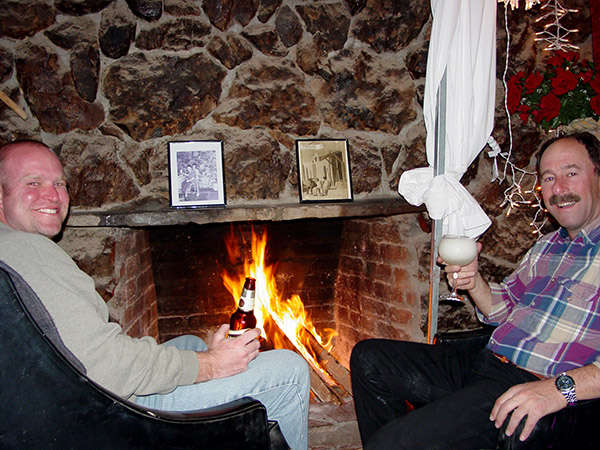
Good buddy Brian and yours truly at the Las Casitas Hotel, kicking back after a long day on the road.
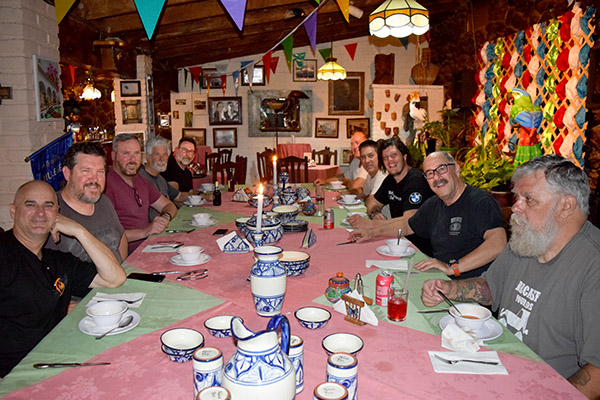
Francisco Javier Aguiar Zuñiga is the proprietor (he has been for 40 years). Javier is an all around nice guy. If you’re going there with a group, let him know and he’ll prepare a special meal. I’ve done that on group tours I’ve led through Baja, and every meal at the Las Casitas has been a treat.
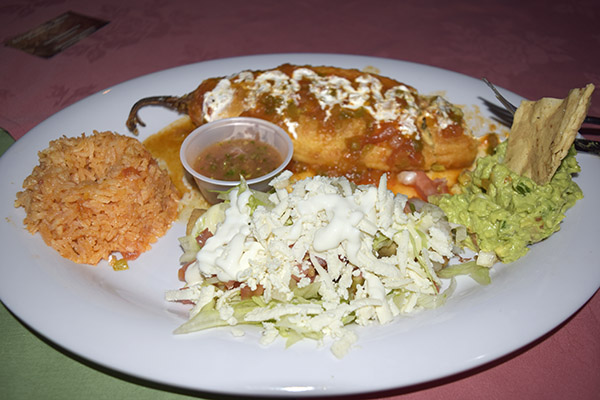
Dinner in the Las Casitas Hotel during one of the CSC Baja expeditions.Chile rellenos, as prepared and served by Javier and the staff at the Las Casitas Hotel. They were exquisite. Being right on the Sea of Cortez, the seafood is outstanding, too. Breakfasts are spectacular.
You know, I looked through my photos for the restaurant, and to my great surprise, I could only find a couple. I think that’s an indication of just how good things are there…the hospitality and the cuisine are so fabulous (and I enjoy both so much) that I only had my camera out a couple of times. The breakfasts are outstanding, too…Javier always has fresh orange juice ready to go, and trust me on this, you want to try it.
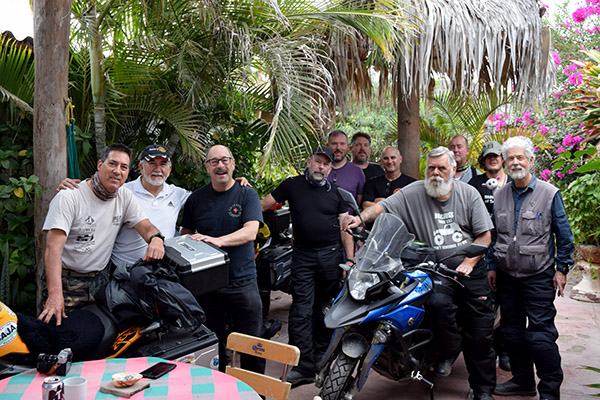
A great group of graybeards posing for photos in the Las Casitas Hotel courtyard. Javier is second from the left.
The Las Casitas has a central courtyard that is distinctly tropical in appearance and feel, and for good reason: Mulegé is only a few miles north of the Tropic of Cancer, where the tropics officially begin. Javier will let you park your motorcycle into the courtyard, although I don’t know that it’s necessary. On one of my trips, we overindulged in Negro Modelos and margaritas in the Las Casitas lounge and left our bikes parked on the street that night. They were just fine the next morning.
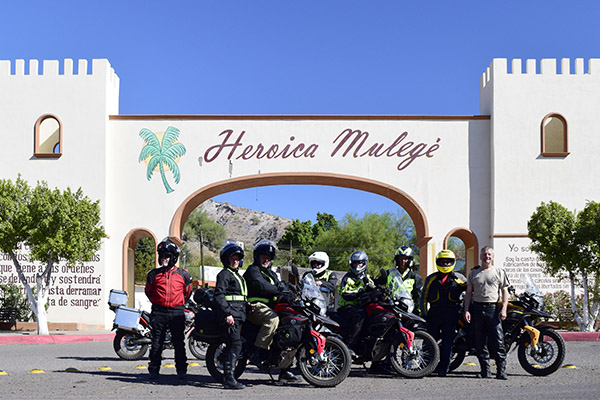
Entering Mulegé. The Mulegénos kicked our butts in the 1800s, but all has been forgiven and you’ll be treated like royalty today.
The town calls itself “Heroica Mulegé.” During a dinner at the Las Casitas one evening I was telling the story behind that name. The Heroica part has to do with the Mexicans holding off a much larger military force, except as I relayed the tale I couldn’t remember who they were fighting. “It was you,” Javier politely reminded me, and indeed it was. All this happened during the 1846-1848 Mexican-American War. As you might guess, relations have improved since then.
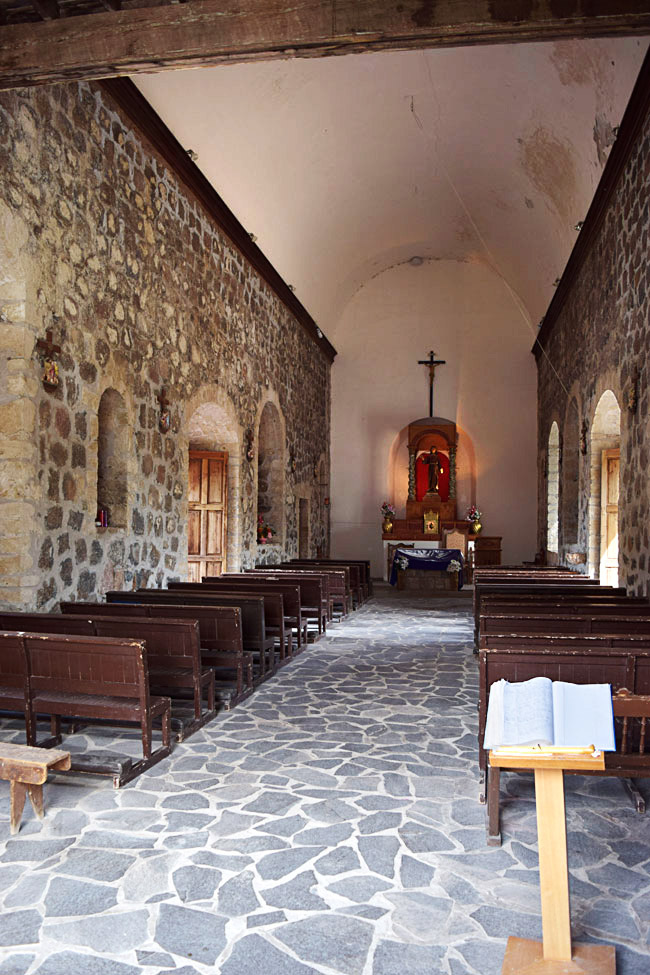
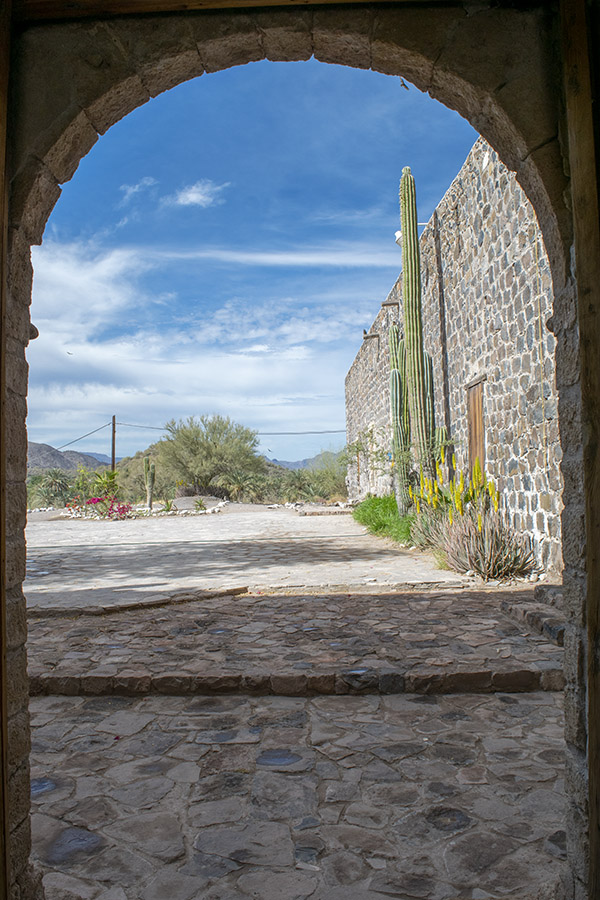
When you visit, be sure you make time to stop by the Misión Santa Rosalía de Mulegé (it’s one of the original Baja missions).
Inside the Misión Santa Rosalía de Mulegé.The view looking out from inside the Misión Santa Rosalía de Mulegé. There’s an observation deck up top, too, with a commanding view of Mulegé’s date orchards and the Rio Mulegé.
Mulegé also has an historic prison that is now a museum. Let me tell you how good life was (and is) in Mulegé: Back in the day, prisoners were allowed to leave during the day to work, and the prison had no bars. Things were so good in Mulegé that no one (including the prisoners) wanted to leave. I can understand why. You will, too, when you visit this magnificent little gem of a town and the Las Casitas Hotel. They are two of Baja’s best kept secrets.
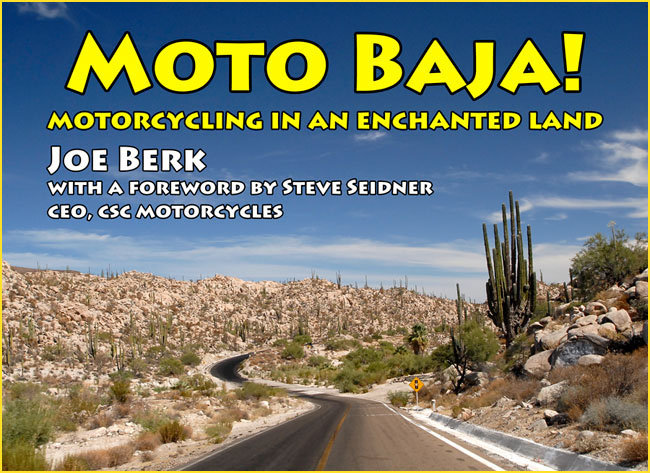
If you’re planning a Baja trip, there are two books we’d like to suggest you consider to gain more insight into what Baja has to offer. The first is, of course, my book on motorcycling in Baja, Moto Baja. It’s good. The other is Jennifer Kramer’s Tijuana to Los Cabos, which is another excellent resource.
One more thing…if you’re making the trek into Baja, you’ll want to capture great photos, folks. You want a good single lens reflex digital camera for an adventure like Baja, and Nikon’s D3500 is one of the best. It’s what I shoot. Gresh works his magic with a comparable Canon digital camera, and they’re good, too.
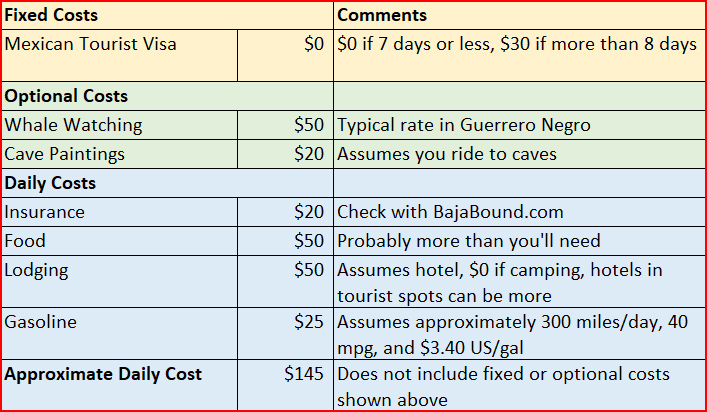
From time to time, I hear this question: How much cash should I take to Baja? Costs have gone up in Baja (like everywhere else), but Baja is still a cheap date. How much you’ll need will depend on your tastes, how much you drink, and where you stay. To cut to the chase, when I ride in Baja, I’ll take a thousand bucks with me if I’m going to be there for a week, and I always come home with money in my pocket. You can bring a credit card to Baja, but once you get out of the tourist spots (Ensenada, San Felipe, Loreto, La Paz, and Cabo), Baja is mostly a cash proposition. In these tourist spots, costs will be more in line with what you’d pay in the US for food and lodging, too. You can’t depend on being able to use your credit in the smaller towns and at the more remote gas stations.
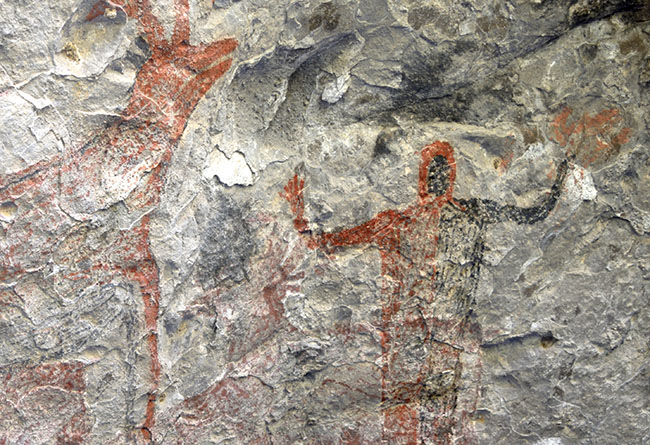
Expenses in Baja will include food, gasolina, lodging, and if you’re going to see the whales or the cave paintings, the cost of admission for those things. Figure on $50 for a half-day whale-watching tour (it’s worth every penny, in my opinion); the cave paintings a little less. Both are great things to see (many folks describe them as life-changing, and I’m in that category). If you plan to have a drink or two at night, you’ll need a bit for that, too.
Gasoline prices in Baja are usually about the same as they are in California. That’s usually works out to something north of $3 per gallon. They sell it by the liter and it’s easier to pay in pesos, but they’ll take dollars at an exchange rate that is not usually in your favor. It’s best to have pesos and pay in the native currency. You can see our earlier blog on fuel in Baja for more information.
Food is inexpensive if you eat in other than touristy restaurants. My friends think I’m a genius at finding good spots to eat in Baja, but my secret is simple: I just look for the spots with lots of cars and pickups parked in front. It works every time. I’ll usually budget $25 US a day for food. It’s easier to pay in pesos, but most restaurants will also take dollars. I might add this: I’ve never had a bad meal in Baja. I could write a book just about the restaurants down there. There are many hidden treasures. We’ve listed a few on our Baja page.
Hotels are typically between $25 and $70 per night outside of the tourist towns. In the smaller spots, $25 seems to be the norm. In the more well known hotels (like Malarrimo’s in Guerrero Negro), it’s going to be more like $70 per night. The rooms won’t be fancy, but they will be clean, and if you’re like me, you’re not going to be riding Baja as a hotel critic.
Don’t forget your Baja insurance. You have to get a separate insurance policy for your motorcycle when you go into Baja, and based on my 30-plus years of riding south of the border, BajaBound Insurance is the best. You should purchase it online before you cross into Mexico, and the BajaBound website makes that easy to do.
If your stay is going to be longer than a week, you’ll need to pay for a Mexican tourist visa (a week or less is free). The cost for a tourist visa is $30. You can (and should) pick up your tourist visa as soon as you cross into Mexico.
Here’s a summary of how the above stacks up (all amounts are in US dollars):
As I mentioned at the start of this blog, when I go into Baja for a weeklong trip, I’ll usually start with $1000 in my wallet and I usually return with money left over. In the event you do need more cash, there are banks in the larger towns with ATMs, and they’ve always worked for me.
We have much more information, including suggested riding itineraries, on our Baja page. You can read about some of our great rides in Baja here.
Want more info on exploring Baja on a motorcycle? Pick up a copy of Moto Baja!
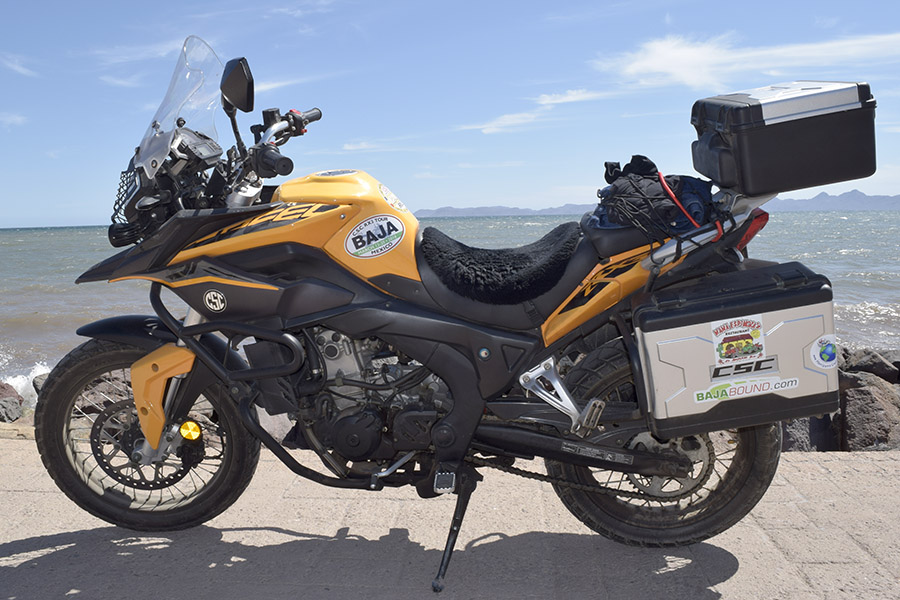
I think CSC gets $3995 for a new RX3 these days, and that’s with all the goodies…skid plate, luggage, ABS, 300W alternator, auxiliary accessory switches, the 19-inch front wheel, and probably a few more things I don’t know about. That’s my RX3 in the photo above. I’ve been riding it for more than 5 years. For the Sinophobic haterbators out there, I’ve never found any fish oil in it, I’ve spent substantial time in the factories where they make the RX3 and there are no children chained to the manufacturing equipment, and the Zong techs are most definitely not slave labor. My RX3 has been and still is a good motorcycle.
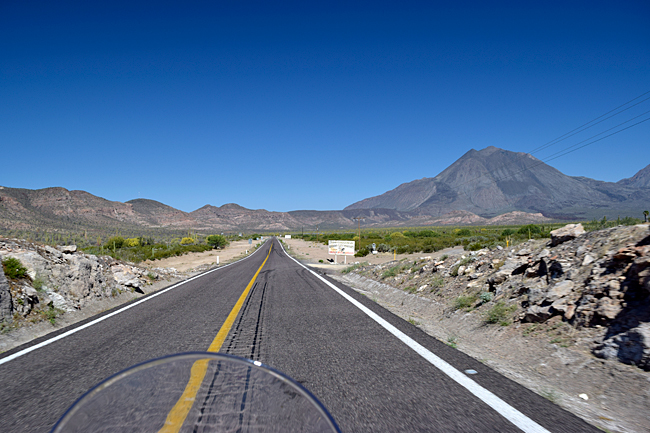
Looking over the windshield, on the road in Baja.
I know you can buy a used Sportster for what a new RX3 costs if you shop around; the topic comes up nearly every time I mention the price of an RX3. It’s a silly thought, actually, because I’m still looking for that prospective buyer who is trying to decide between a used Sportster and a new RX3. I’ve been on that quest ever since I started writing about the RX3 six years ago, when the keyboard commandos first started pushing the used-Sportster-in-lieu-of-an-RX3 argument.
Here’s a hot flash: That person (the dude or dudette struggling with such a decision) doesn’t exist. You either want an ADV motorcycle, or you want a used bar-hopper with “much chrome” (as the Sportster ads often highlight). I have never met, or even heard of, somebody pondering whether they should buy a used Sportster or an RX3.
Behold: The financial equivalent of a new RX3.
I hear the same kind of keyboard drivel when Janus motorcycles are mentioned. They’re stunning motorcycles, and I’ve had good times riding them through northern Baja. Invariably, though, the used Sportster financial comparison will emerge. Janus is always polite in their responses. Me? I’m a noncombatant and I don’t respond to such Internet drivel. If you want a used Sportster, it’s a free country. Go for it.
To listen to the keyboard commandos, there must be a lot of folks out there dreaming about used Sportsters. Maybe that’s the answer to Harley’s problem. Even though motorcycle sales in general are up sharply since the pandemic started, Harley’s sales most definitely are not. In fact, to read The Wall Street Journal, Harley is circling the drain. Not to worry, though, because I think I have the answer: Rather than rewiring or hardwiring or screwing around with $30K electric motorcycles, or hiring high-priced executives with zero motorcycle experience (as they seem to love to do), Harley should simply stop production and only traffic in used Sportsters. There would be no need for a factory; that’s a huge savings right there. More savings? Harley wouldn’t need to spend anything on advertising; there’s a potful of worldwide web wannabe wizards pushing used Sportsters already doing that for free.
Used Sportsters. Who knew?
Back to my RX3: I’ve covered a lot of miles on it here and overseas. I had it out this Sunday charging through the smoke we call breathable air here in the Peoples Republik of Kalifornia. I hadn’t ridden the RX3 in a couple of months, but it started right up (like it always does) and it’s still running strong (like it always has).
Good buddy Greg on the road to the cave paintings in Sierra San Francisco, Baja California Sur.
It’s kind of a funny story about how the RX3 came to America. I was in China on a consulting gig for another client when CSC asked me to poke around for a 250cc engine for its line of Mustang replicas. It’s funny in the sense that a lot of Internet people told us they’d buy the Mustang if only the bike had a 250cc engine (instead of its 150cc engine). I found a source for the 250cc engine (Zongshen; they weren’t very hard to find). CSC put the 250cc Zong engine in the Mustang and sales…well, they remained essentially the same. All those yahoos who said they’d buy one if the bike had a 250cc motor? They went MIA. I don’t know what they did after CSC introduced the 250cc engine, but they sure didn’t buy a new Mustang. Ah, I take that back…I do know what they did…they posted more comments on Facebook. It’s hard work being a keyboard commando, I guess, and it’s lonely down there in those basements. But they kept at it. Why buy a CSC Mustang, they said. You could buy a used Sportster for that kind of money, they said. Actually, most of the CSC Mustangs were optioned up by their customers so much that their cost approached and sometimes exceeded what a new Sportster would cost, but that’s neither here nor there.
A 250cc CSC Mustang, accessorized to the max.
The arrangement with the Big Z was a good one, and it led directly to things like the RX3, the RX4, the City Slicker, the TT250, the SG250, and more. It’s how I came to own my RX3, and like I said above, I am still riding and enjoying it. Even though I could have bought a used Sportster.
Good buddy Kyle from China, somewhere in South Dakota’s Black Hills. Don’t worry; he’s not armed (and if you’re wondering what that’s all about, you can read that story here).
I’ve been up and down Baja lots of times with lots of RX3 riders. I’ve been across China, including the Gobi Desert and the Tibetan Plateau, and I’ve ridden around the Andes Mountains in Colombia. I’ve ridden to Sturgis, then back across the top of the US, and down the Pacific Coast with a bunch of guys from China. Gresh rode with me on a lot of of those rides. I know, I know, he didn’t get invited on the Colombia adventure, but hey, he didn’t invite me on the Russia ride, either. But to stay on topic: It’s all been on the RX3.
Riding into the Gobi Desert with Joe Gresh as my wingman. Or was I his? In 6000 miles and 40 days of riding across China, we did not see a single Sportster, used or new.
Those early RX3 rides were marketing demos, basically, designed to show a few guys having the time of their life and demonstrating to everybody else that the RX3 had real chops as an ADV bike. But don’t think I wasn’t nervous. We took 14 guys and one gal on a 1700-mile ride through Baja literally the same week the first RX3s arrived in the US from China (I was sweating bullets on that one), and then we immediately took another 12 or 15 guys from China and Colombia (and one motojournalist from Motorcyclist) on a 5000-mile ride from southern California to Sturgis, back across the top of the US, and down the Pacific coast on what was arguably one of the most highly-publicized (in real time, too) motorcycle publicity stunts ever. I was scared the entire time, thinking something might break and generate a lot of bad press. I guess I didn’t realize how well things were going until the last night of the trip, 4700 miles into it, when Gresh told me to relax. “You won, man,” he said. He was right. But just think: I coulda had that used Sportster.
Janus Motorcycles has a series of videos on their motorcycles, and this is the latest with Jordan and Josiah. There are few things that sound as good as a single-cylinder motorcycle accelerating, and that comes across loud and clear in the video. Enjoy, my friends.
Watching the Janus video reminded me of the Baja ride I took with Jordan and Devin (you can read about that adventure here). It was cool, riding the jewel-like, CG-engined, Janus motorcycles across northern Baja. We may do that again at some point in the Covid-free future and that would be fun. We sure had a great time on our Janus Baja adventure.
You can read about our other rides here, and more on things to see and do in Baja here.
Every once in a while we do a blog that covers a bunch of topics, and this is one of those times.
Good buddy Mike Huber and his friend Bobbie motorcycled Mexico (Baja, to be specific, almost another country all by itself), and he most recently published an excellent story about being stranded down there by the Covid 19 pandemic. It’s not often that we recommend another blog, but hey, Mike’s writing is outstanding and it’s a great story. Take a look; it’s very good.
My favorite motorcycle magazine (that would be Motorcycle Classics) sends out marketing emails on a regular basis, and in those emails they include links to past (and sometimes recent) articles. I write for MC, and the most recent email that slipped into my inbox included a link to my Destinations piece on Hearst Castle. You might want to read that story; I love Hearst Castle. It’s closed for the pandemic, but the pandemic won’t last forever. Hearst Castle will be there when it’s over.
We’re having a heat wave (both here in the Peoples Republik of Kalifornia and at Tinfiny Ranch). That prompted us to start a piece on riding in extreme heat. My first recommendation would be: Don’t. But things don’t always work out the way you want them to. I once rode the length of Baja on a Mustang replicas with several friends, and due to a lack of research on my part we did the ride in Baja’s hottest month (and that’s September). You can read about the 150cc Baja ride through Hell here. Do you have any advice for riding in high temperatures? Please share them with us (info@exhaustnotes.us) and we’ll include your recommendations here on the blog.
We have more motorcycle, gun and other stuff coming up, including info on Ruger’s new Custom Shop and their Super GP100 .357 Mag revolver, favored loads in the Henry .45 70 Single Shot, a piece on Turnbull’s iconic color case hardening and restoration services, a stunning (and tack-driving) Kimber with exhibition grade French walnut, the wrap-up of our ride through the Andes Mountains in Colombia, the Canton Fair, and for you fans of The Ten Commandments, making bricks without hay and mortar. And a whole lot more.
Good buddy Mike, a fellow former trooper who I met on a ride through Baja a few years ago, has been sort of stranded down there until recently. Mike and his good friend Bobbie went whale watching and they had a unique experience. Mike was kind enough to share the adventure with us. Here you go, folks.
So as someone who is always seeking adventure I may have gotten in over my head with this one. Not only am I three years in living fulltime off a motorcycle, currently in Baja due to a global pandemic, but why not throw in a rescue mission at sea just to ensure I have everything covered. Sure, why not?
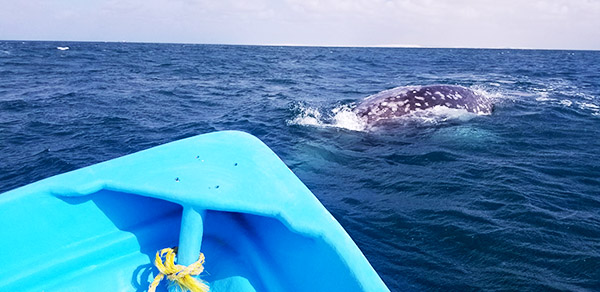
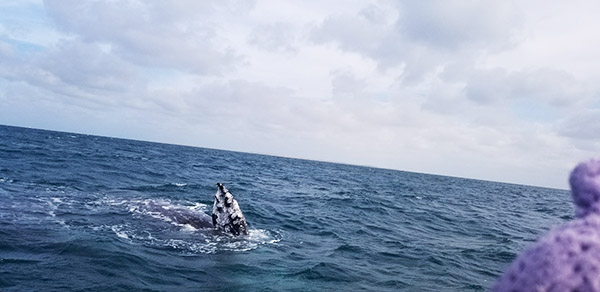
It was a dark and stormy night and the sea was angry…actually it was just a bit windy around mid-day when we decided to partake in a whale watching trip on pangas (small wooden boats) in Guerrero Negro, Baja, Mexico. It’s a magical encounter with nature as these majestic creatures, which are the size of a school bus. These gray whales come up to your panga and you can actually pet them and experience these animals at such a close range. It is just a magical experience…a life-altering experience.
We begin with a standard safety briefing and get bussed out to the docks, fitted with life vests, and we are all excited to get out and see these beautiful animals up close. Prior to boarding our panga I noticed another boat with 8 senior citizens leaving the same time as us and for a minute thought maybe we should jump in their boat as there were less people then our boat, but we chose to just stay where we were assigned with 12 people aboard.
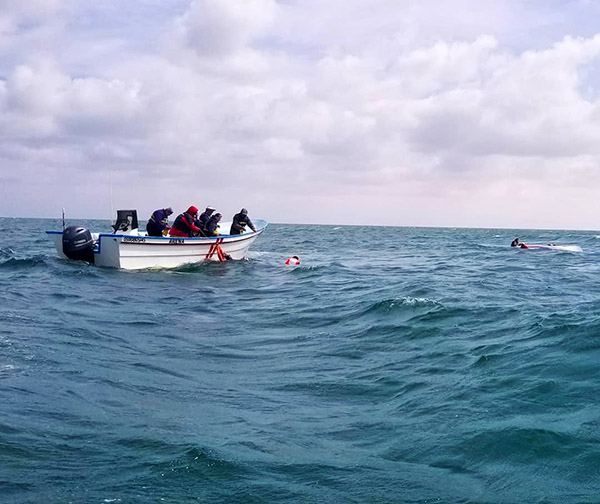
The tour was going pretty well, not great as there was a lot of chop in the bay, so the whales don’t get as close as we’d like since the boat was bumping up and down. As the tour seemed to be ending I noticed we were heading not towards shore but in a direction we hadn’t been. I first thought they had spotted more whales and soon saw a giant gray object in the distance. Once we got a bit closer I realized it was not a whale at all but a capsized panga with three people clinging to the upside-down vessel by the propeller. The reality set in as we saw others floating in the water along with backpacks, camera bags, and purses. I put everything I had into a waterproof compartment in my rain jacket and handed it to my girlfriend as I saw it was the panga with the eight seniors and I said “I guess I am going for a swim.”
As we moved in to begin rescuing people from the water I performed a headcount of those in the water. Knowing it was the panga with the seniors I had all nine (eight and the captain) accounted for and saw they all looked to be relatively well. Although it was windy, it wasn’t too cold. I also remembered from the safety briefing that there were no sharks in this part of the bay. We quickly realized no one was in immediate danger.
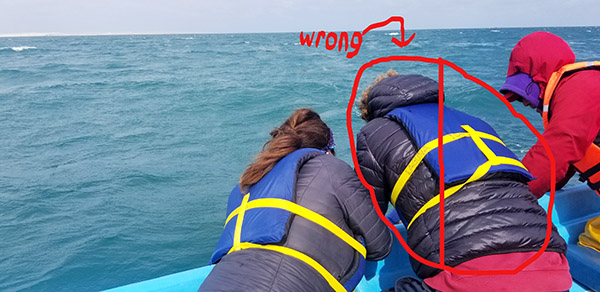
This is where it gets fun, sorta. As with all “disasters” there’s “that guy.” The guy that has to be a hero no matter how little they know. We were “fortunate” enough to have one on our panga (damnit). The captain of our boat spoke little English but was very competent and was trying to give directions that seemed to drown out by the time they reached us since the newly unelected hero was shouting his own directions on how to handle the situation best.
Knowing the people in the water were not in great danger I sat back on the far side of the boat as a ballast, shook my head, and let the hero begin to rescue people clumsily and haphazardly pulling them into our vessel incorrectly. While this was going on I kept contemplating the consequences of throwing him overboard and rescuing the remaining seniors myself. Would saving eight people but leaving one to swim back result in any criminal charges against me in Mexico? Luckily for everyone that was a fleeting thought.
One haunting moment that really still stands out is when the captain had to re-angle the panga to rescue the last three people clinging to the propeller. Those people thought we were leaving them and began shouting “Don’t leave us, please don’t leave us.” You could hear the fear and panic in their voices. Once we were angled our “hero” had realized his uselessness and backed off allowing us to properly load the remaining three people safely into the panga without issue.
The boat ride back to the docks was a quiet and bumpy ride. Everyone was soaked, including myself (and I never even left the boat). There were three ambulances at the docks by the time we had reached it. It was a great feeling that no one required them other than for warm blankets.
Feeling great being back on dry land (not as great as the nine that were in the water) we returned to the office where we met the owner of the whale tour company and began explaining our adventure in great detail, telling the story over tequila and tacos. He brought out his guitar and played requests for us for several hours.
Mike, that’s a hell of a story. I’m glad everyone got through it without injury. We actually read about that happening in Baja not too long ago. In all the times I’ve been whale watching, I’ve never seen that happen.
Hey, the rest of our readers: If you’d like to see more Baja whale watching, here’s the page you want!



 . It’s good. The other is Jennifer Kramer’s


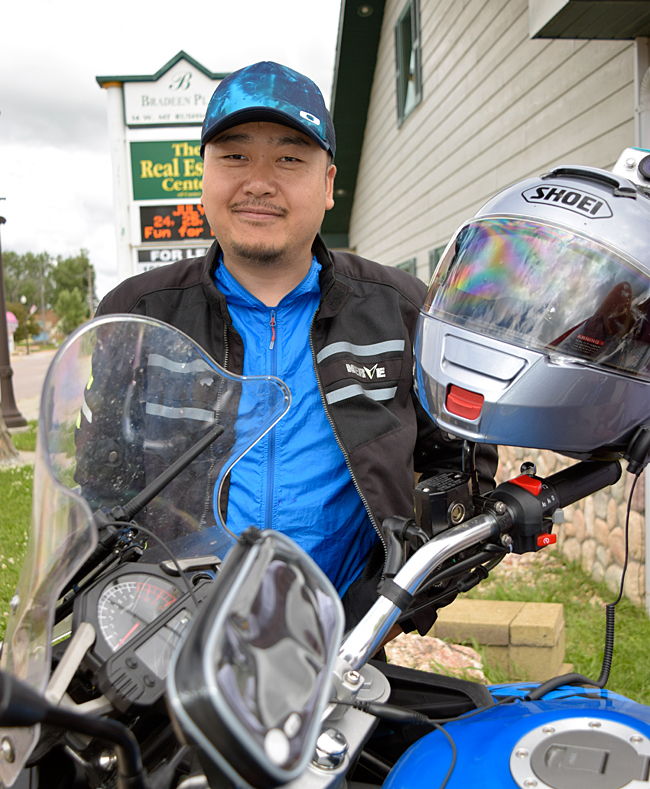
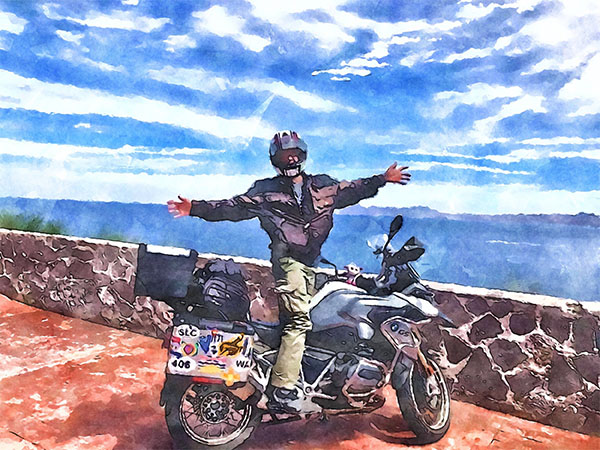

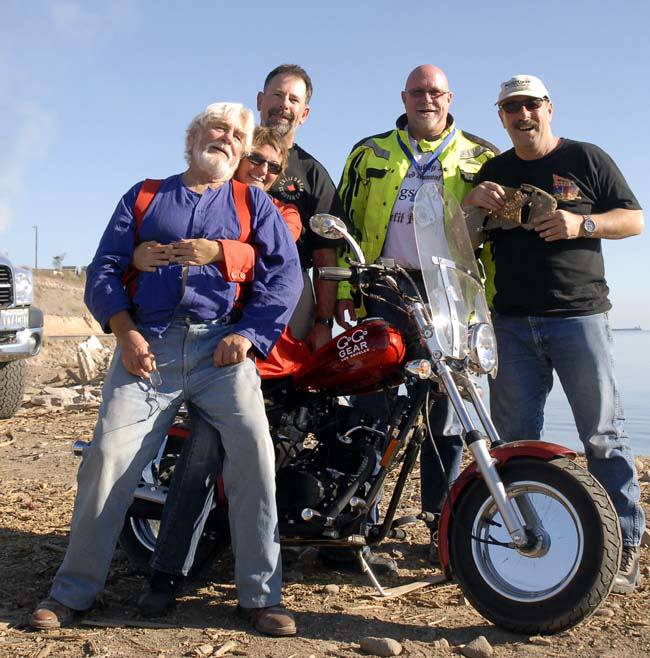

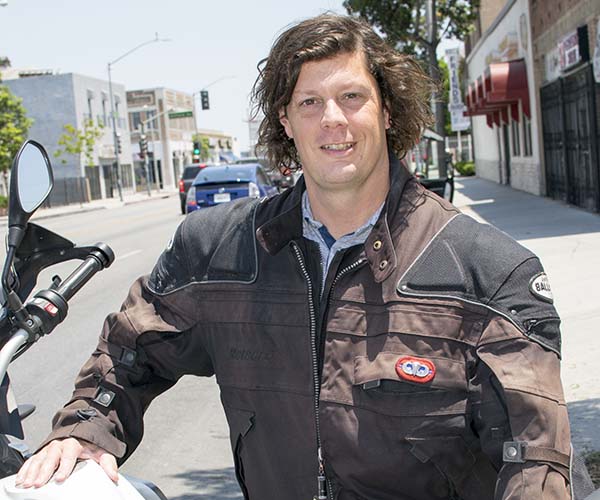 Good buddy Mike, a fellow former trooper who I met on a ride through Baja a few years ago, has been sort of stranded down there until recently. Mike and his good friend Bobbie went whale watching and they had a unique experience. Mike was kind enough to share the adventure with us. Here you go, folks.