When driving around Lake Superior (and all the Great Lakes), the waters appear to be calm. At least they do to me, and it feels kind of odd, because each of the Great Lakes are so big you can’t see the other side. In other words, from the shore they appear to be as big as the ocean, except there are no waves. But that’s not always the case. In stormy weather, the Great Lakes can get rough. In 1905, just one storm damaged 29 vessels. You might wonder: Is there that much shipping on the Great Lakes? The short answer is yes, and in particular, a lot of iron ore mined in Minnesota went by ship to Wisconsin and other locations. U.S. Steel alone had 112 ore-carrying ships in 1901.
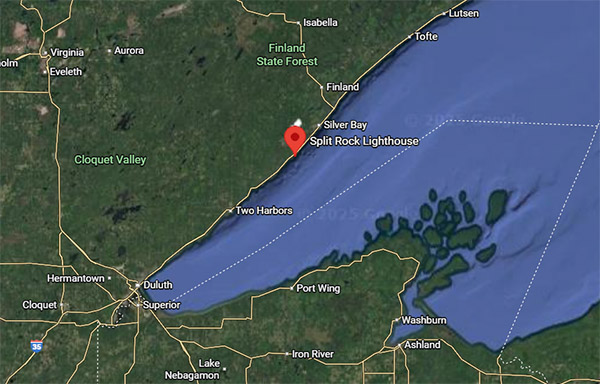
Split Rock’s location along Lake Superior. We rode there from Duluth.
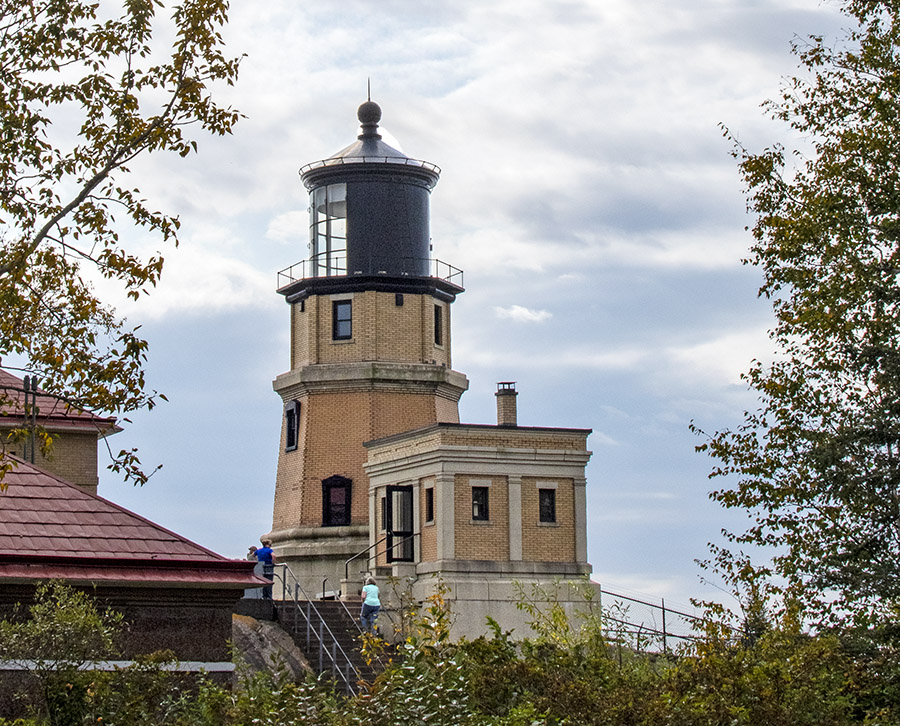
The U.S. Steel president lobbied Washington for a lighthouse along Minnesota’s rocky shoreline, and in 1907 Congress allocated $75,000 to build one. It became known as the Split Rock Lighthouse because the huge rock upon which it sits has a large vertical cleave.
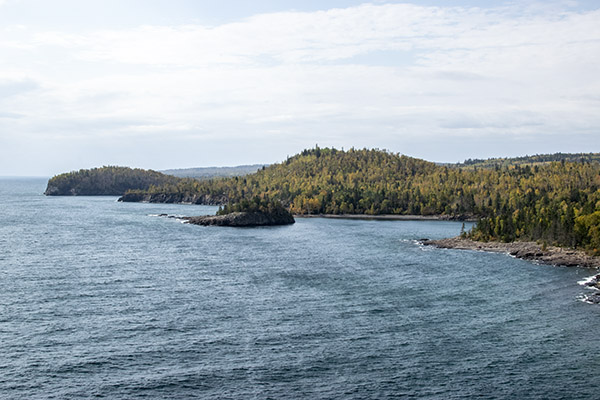
The Split Rock Lighthouse.A view of the Lake Superior shoreline from atop Split Rock.
Construction started in 1907 and finished in 1910, when the lighthouse was commissioned. The U.S. Lighthouse Service operated it until 1939, when all U.S. lighthouses came under U.S. Coast Guard. The Coast Guard is responsible for all lighthouses, but that no longer includes Split Rock. Split Rock shut down as a navigational aid in 1969. Other navigation systems such as Long Range Navigation (LORAN) and the Global Positioning System (GPS) now meet that role. Only five staffed U.S. lighthouses remain in service today; all others have been decommissioned or operate under automated control.
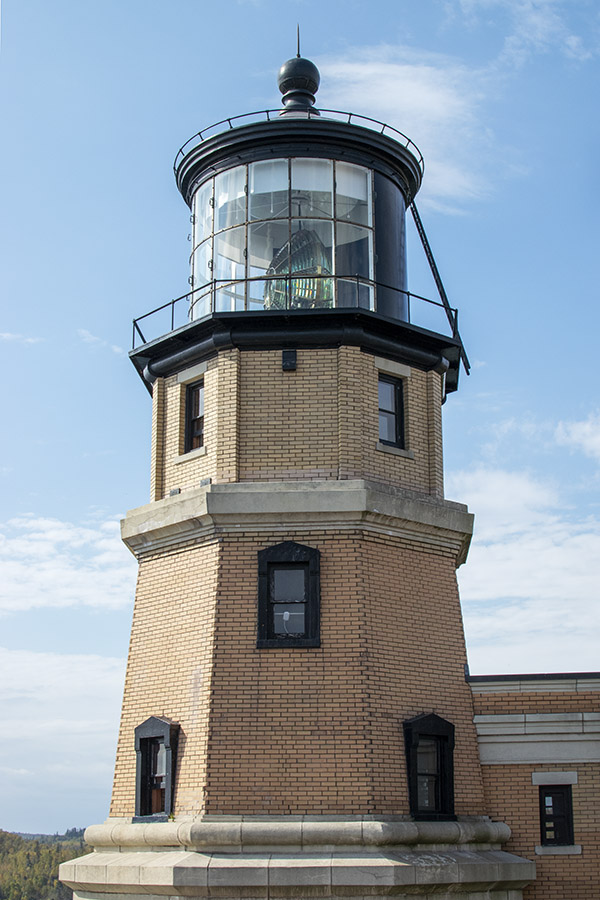
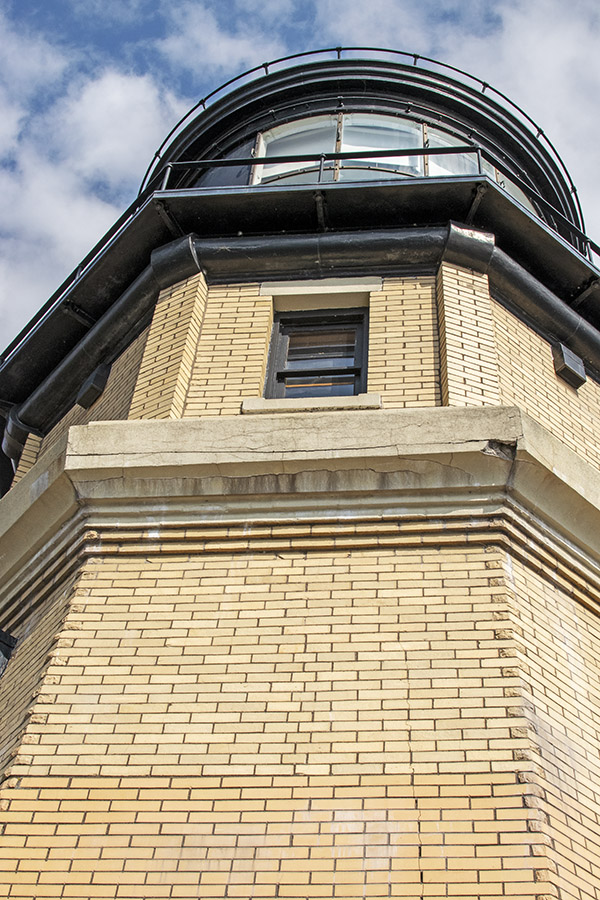
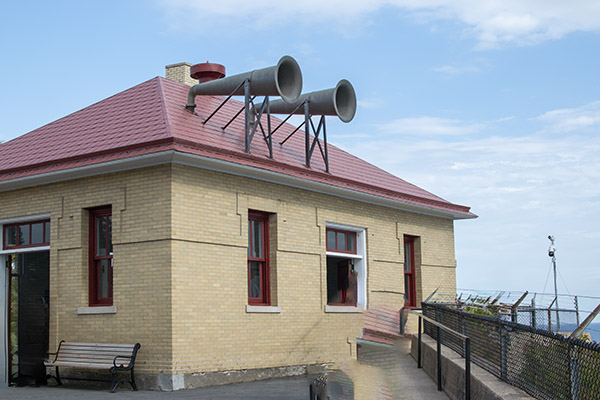
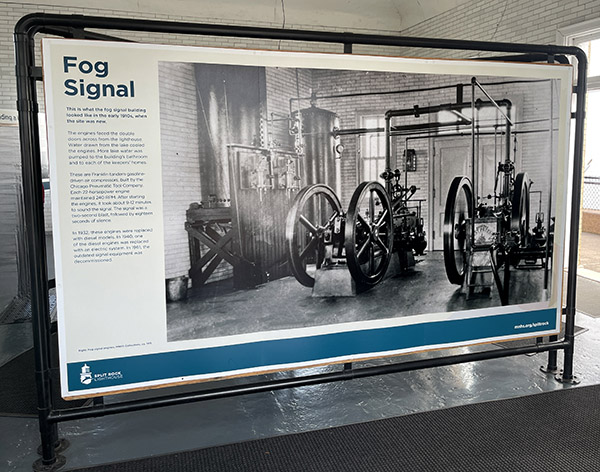
Looking up at the lighthouse tower from its base. I was armed only with my D3300 Nikon and a 35mm 1.8 prime lens. It’s a system you zoom with your feet (i.e., moving closer to or away from the subject). Sometimes there’s not enough room to move around.Foghorns atop the foghorn building. When they were operational, they sounded a 2-second blast every 18 seconds. They went out of service in the 1960s. The horns are activated once a year now.The foghorns were initially powered by two compressors driven by internal combustion engines. Cooling water for the engines was drawn from Lake Superior.
The site transferred to the State of Minnesota in 1971, and in 1976 control shifted to the Minnesota Historical Society. In 2011, it was designated a National Historic Landmark.
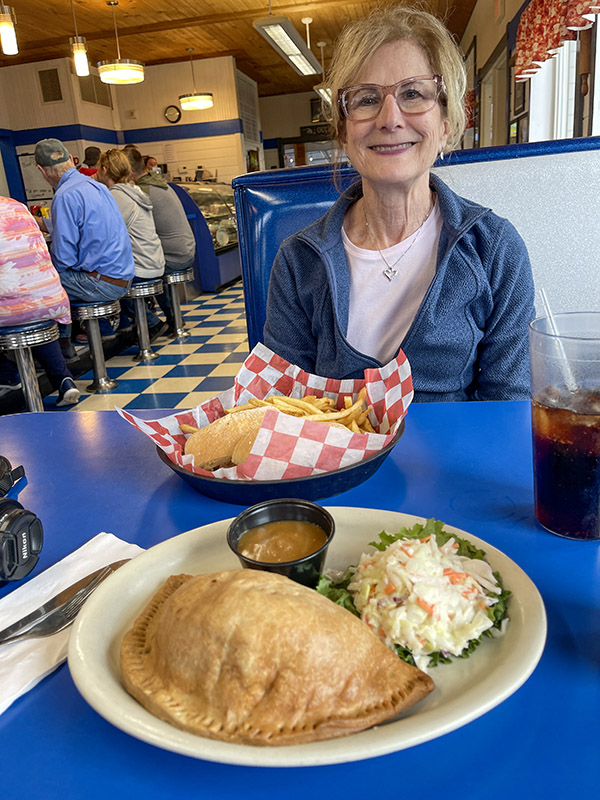
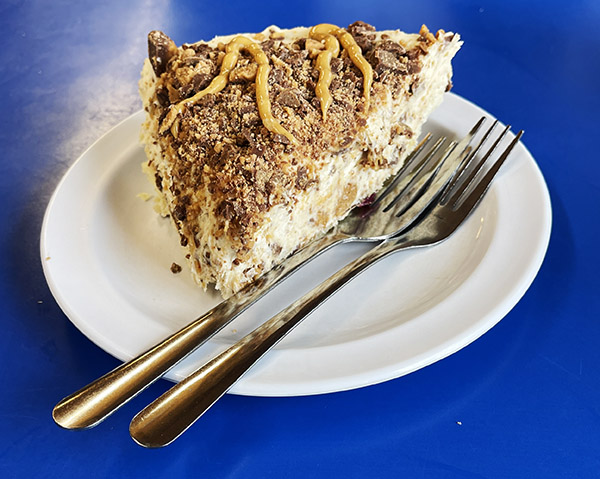
Susie had Betty’s fish and chips; I opted for the caribou chicken pasty. Both were excellent.We split a slice of Betty’s toffee cream pie for dessert. It was awesome.
The ride out to the lighthouse from Duluth (where we stayed for a couple of days) was beautiful. We followed Minnesota 61 north for 47 miles. It was a beautiful ride along the Lake Superior shoreline. On the trip north, we notice Betty’s Pies (a restaurant), and we stopped there for dinner on the way back. There was an hour wait to get in, but it was worth it.
After our dinner, there was a young couple parked next to us on a pair of sports bikes. The gal was on a nondescript Japanese bike; the guy was on a Triumph Speed Triple (and that definitely caught my attention). We followed them back along Minnesota Highway 61, and after a few miles they veered left on Scenic Drive (which follows the Lake Superior shoreline much more closely). That is an appropriate name. Scenic Drive took us directly into Duluth and our hotel. It was a fun day.
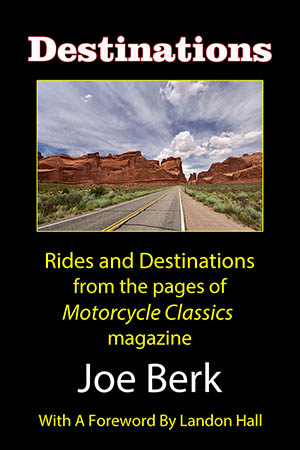
Looking for a great place to ride? Hey, that’s our specialty. I write about great Destinations regularly for Motorcycle Classics magazine. You can read about my favorites here:
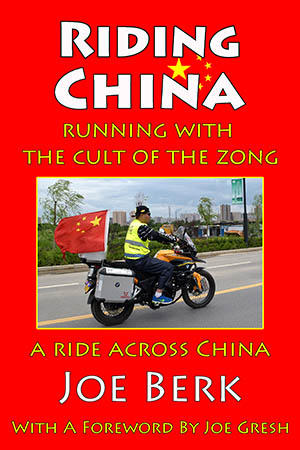
We’d been on the road for about a month, riding a big loop through most of China. It was the ride of a lifetime, Zongshen was picking up the cost, and we were having a ball. It was me, riding compadre Joe Gresh, and Sergeant Zuo, our fearless retired Chinese Army Sergeant Major. I’d be hard pressed to identify any other single month in which I’d so much fun. Great riding, great companions, great roads, great food, and great photo ops. My book , Riding China, is about that ride and it included a chapter on Luoyang; here’s a quote from it leading up to the photo above:
It was dark when we walked home, and I watched people riding by in the sultry summer night air on their motor scooters. I knew I had to capture at least some of it for the blog and for this book, so I went back to the room for my Nikon and the 24-120 lens. I cranked the ISO up to 3200 and let her rip. It was great.
The technique is called panning; you swing the camera to stay on a moving subject, which freezes the subject and blurs the background to convey a sense of motion. Not every photo turns out using this technique, but when one does, it’s spectacular.
We stayed in Luoyang for two nights, and it was a well-earned rest we all needed. Those were good times. I miss the guys we rode with.
The above photo is one of many included in Riding China. If you would like to read more about that ride, pick up a copy!
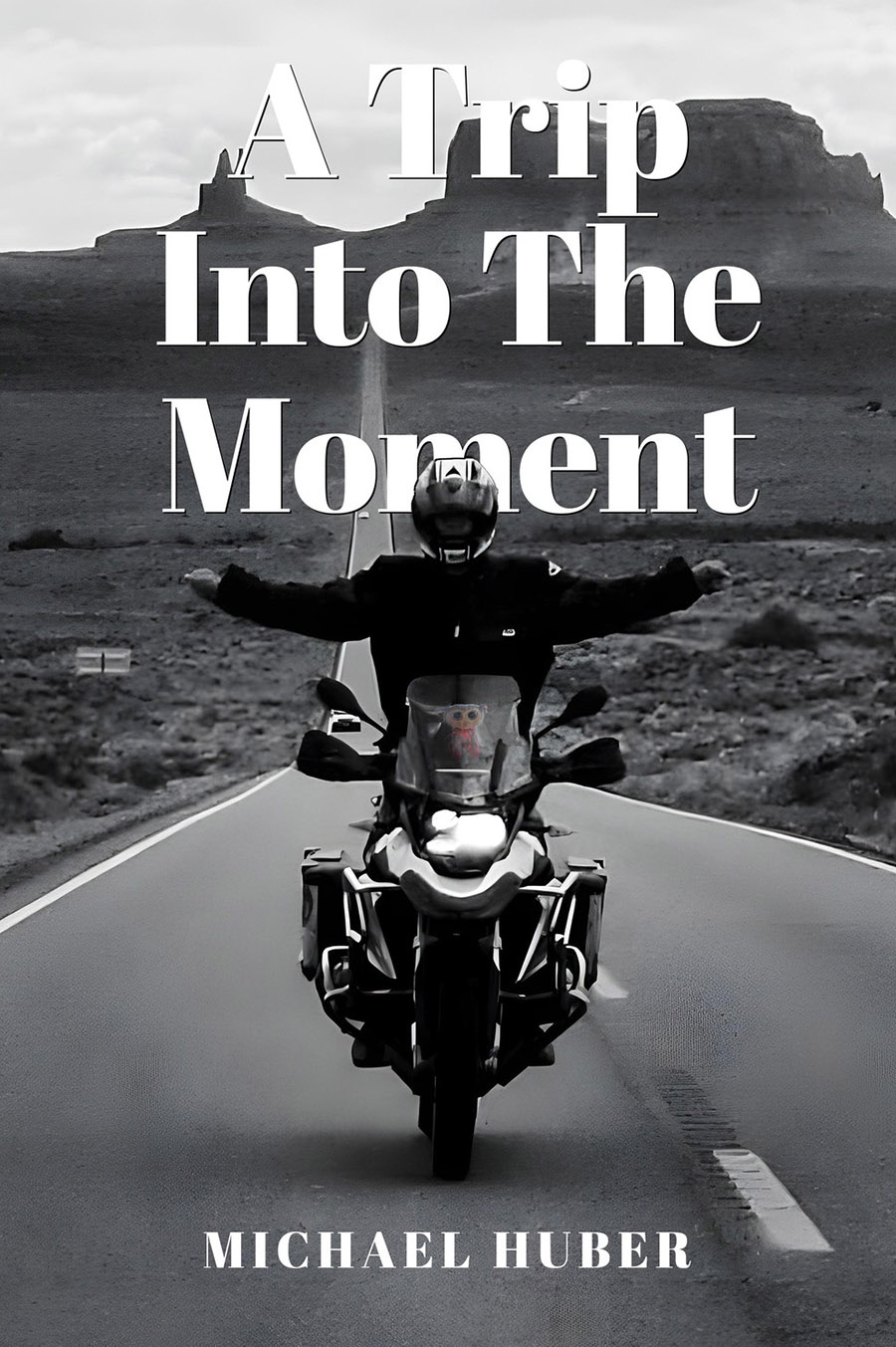
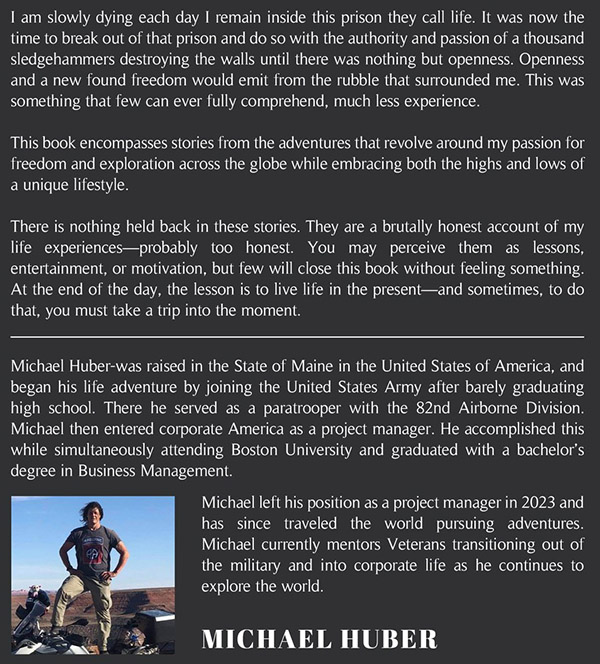
It had to happen: Good buddy and frequent ExNotes blogger Mike Huber wrote a book! Mike’s book is A Trip Into The Moment, published by Native Book Publishing. You should buy it now from Amazon. Here’s the back cover blurb:
We are a literary bunch, us ExNotes writers. Joe Gresh and I published a collection of our favorite stories not too long ago, and I’ve penned (or keyboarded) a few myself. Here’s a link to the Gresh and yours truly book, A Cup O’ Joes:
Want to lose weight, ride faster, and impress your friends? Add our books to your library and drop a Huber, Gresh, or Berk quote from time to time. Better yet, buy a copy of each of our books and post this blog’s link on your social media (it will help with sales)!
Listicles, Gresh calls them…articles based around the (fill in the number) best things to do, worst things to do, motorcycles, movies, and more. One of Gresh’s friends told him that lists get more hits than any other kind of Internet article. I was a bit skeptical when I first heard that, but Google Analytics doesn’t lie: When we do a listicle, our hits go up big time. And comments, too. We like comments. And a lot of this blogging game is about the hits and comments. Gresh’s The 5 Stupidest Ideas in Motorcycling, my recent The Big Ride: 5 Factors Affecting Daily Mileage, and other ExNote listicles…they’ve all done extremely well.
This listicle thing has me thinking in terms of the five best whatever when I’m spitballing new blog ideas, and the list du jour is on motorcycle books. It’s a topic near and dear to my heart and one we’ve touched on lightly before, although the emphasis in the past has usually been on a single book. I think I’ve read just about every motorcycle book ever published, and I particularly like the travel stories. That said, I think this introduction is long enough. Let’s get to it.
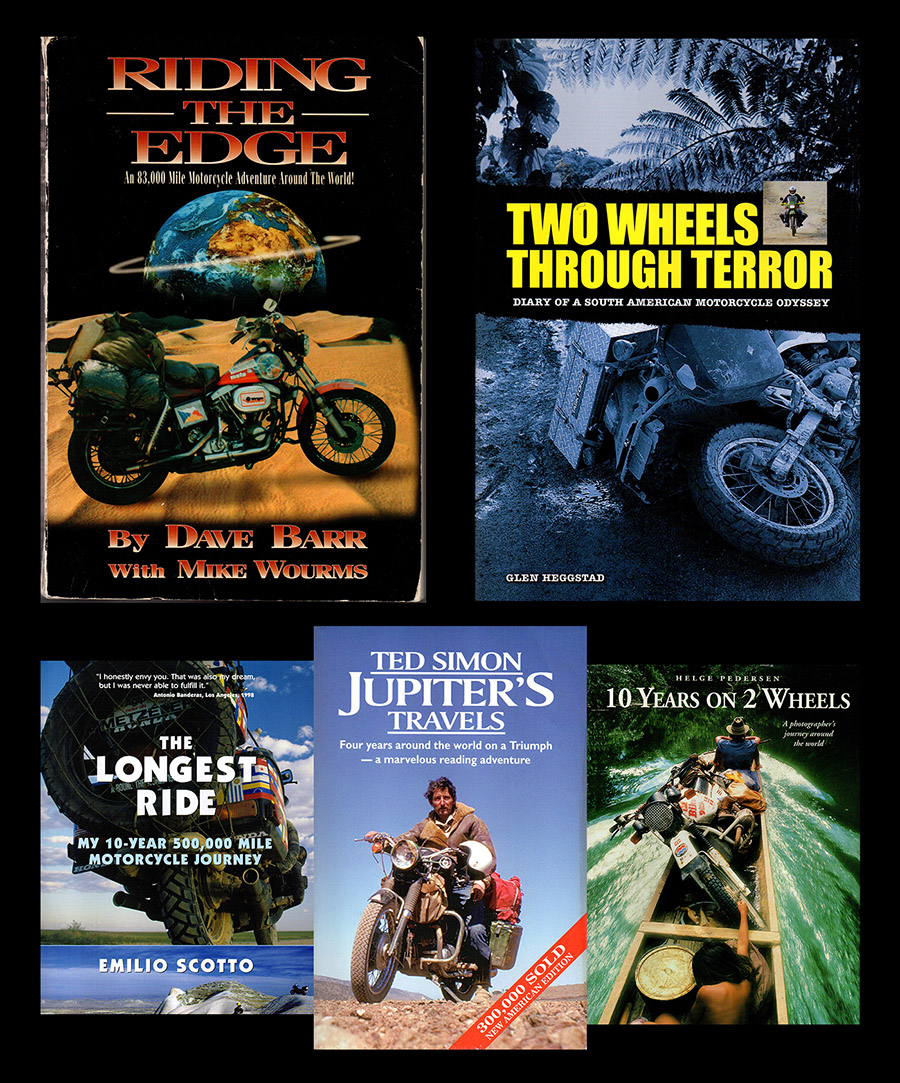
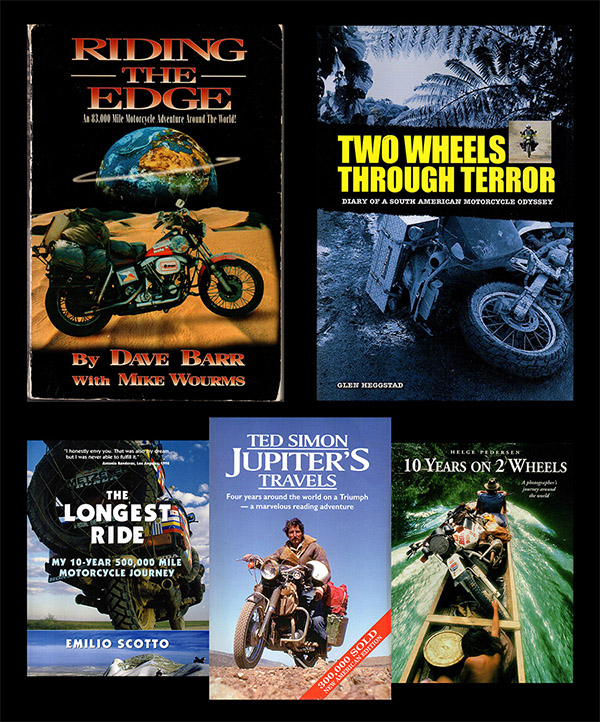
Riding the Edge
Riding the Edge, in my opinion, is the greatest motorcycle adventure story ever told, made all the more significant by two facts. The first is that Dave Barr, the author, did the ride after losing both legs to a land mine in Africa; the second is that Dave did the ride on a beat up old ’72 Harley Super Glide that had 100,000 miles on the odometer before he started.
I know Dave Barr and I’ve ridden with him. I can tell you that he is one hell of a man, and Riding the Edge is one hell of a story. The ride took four years, mostly because Dave pretty much financed the trip himself. He’d ride a country or two, run out of money, get a job and save for a bit, and then continue. I read Riding the Edge nearly two decades ago, and it’s the book that lit my fire for international motorcycle riding. None of the rides I’ve done (even though I’ve ridden through a few of the countries Barr did) begins to approach Dave Barr’s accomplishments. The guy is my hero.
Riding the Edge is written in an easy, conversational style. I’ve probably read my copy a half-dozen times. In fact, as I type this, I’m thinking I need to put it on my nightstand and read some of my favorite parts again. If you go for any of the books on this list, Riding the Edge is the one you have to read.
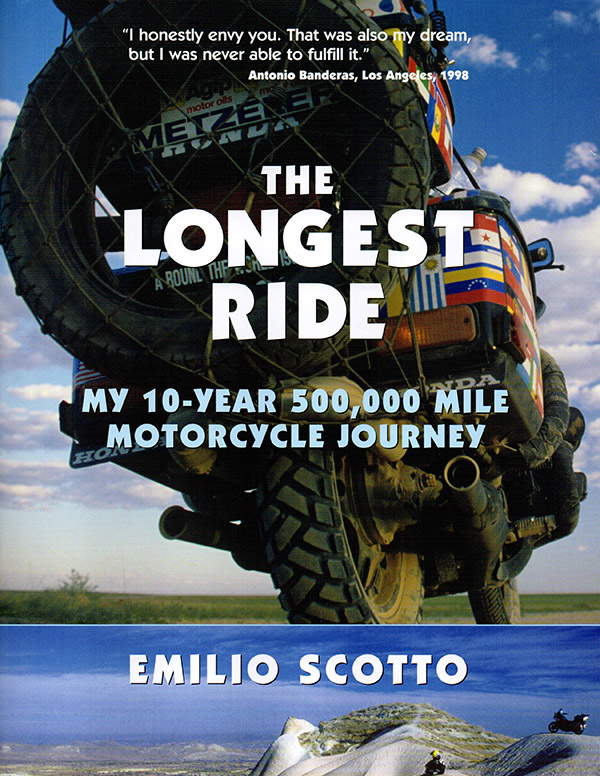
The Longest Ride
Emilio Scotto. Remember that name, and remember The Longest Ride. This is a guy who had never left his native Argentina, thought it might be cool to see the world on a motorcycle, bought a Gold Wing (which he named the Black Princess), and then…well, you can guess the rest. He rode around the world on a motorcycle.
Emilio took 10 years for his trip around the world, and he covered 500,000 miles in the process. He’s another guy who is good with a camera. I thoroughly enjoyed The Longest Ride. I think you will, too.
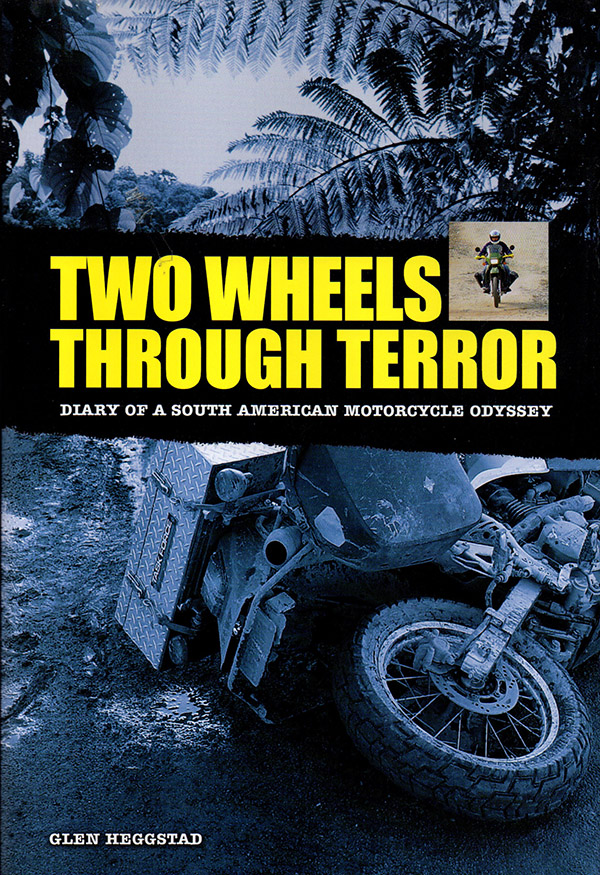
Two Wheels Through Terror
Glen Heggstad…that’s another name you want to remember. Mix one martial arts expert, a Kawasaki KLR 650, a kidnaping (his own), a trip through South America, and a natural propensity for writing well and you’ll have Two Wheels Through Terror. I love the book for several reasons, including the fact that Mr. Heggstad used a KLR 650 (one of the world’s great adventure touring motorcycles), the way he tells the story of his kidnaping in Colombia (a country I rode in), and his wonderful writing.
I’ve met Glen a couple of times. The first time was at a local BMW dealership when he spoke of his travels; the second time was at his booth at the Long Beach International Motorcycle Show. Glen is a hell of a man, a hell of a writer, and a hell of a fighter (all of which emerge in Two Wheels Through Terror). He is a guy who just won’t quit when the going gets tough. I admire the man greatly.
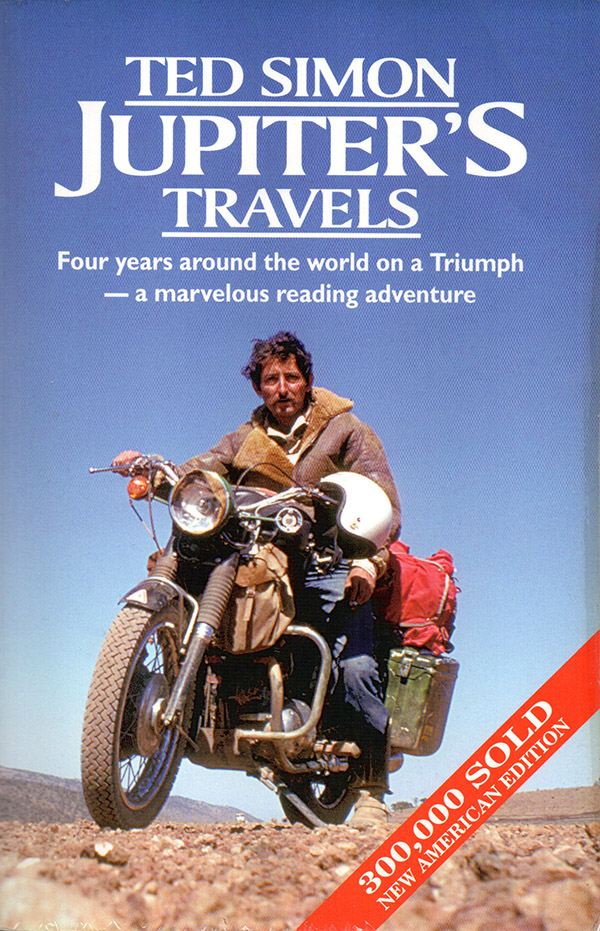
Jupiter’s Travels
Ah, Ted Simon, one of the granddaddies of adventure motorcycle riding. I’d heard about his book, Jupiter’s Travels, for years before I finally bought a copy and read it, and then I felt like a fool for not having read it sooner.
Jupiter’s Travels was one of the first books about riding a motorcycle around the world, and what made it all the more interesting for me was that Simon didn’t do it as a publicity stunt. No big sponsors, no support vehicles, no nothing, a lot like the other great journeys on this list. It was what the guy wanted to do, so he quit his job and did it. Simon’s bike was a 500cc air-cooled Triumph, and I liked that, too. I’m a big fan of the old British vertical twins (the Triumph was a state-of-the-motorcycle-art when Ted Simon did his ride). Trust me on this, folks: Jupiter’s Travels is a motoliterature classic, and it’s one you need to read.
10 Years on 2 Wheels
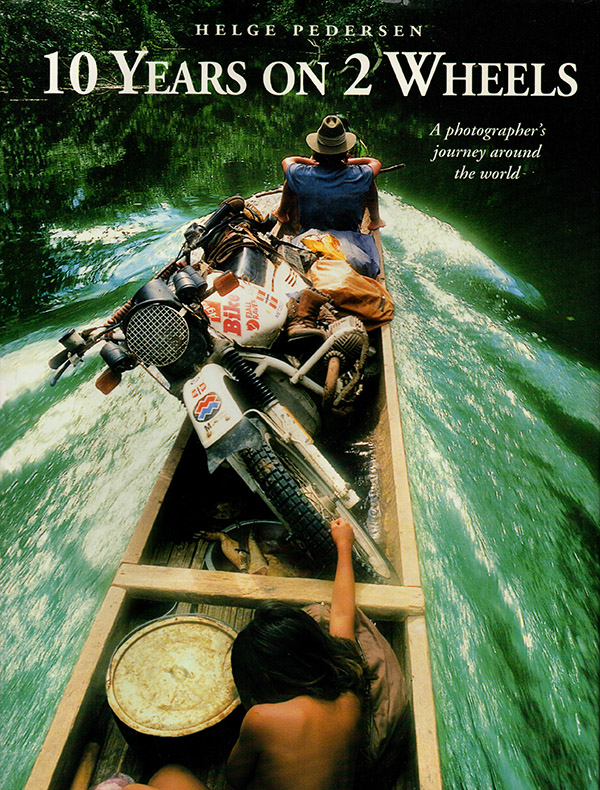
Helge Pedersen is another name you want to know. He is a phenomenal world traveler, writer, and photographer, and 10 Years on 2 Wheels is a phenomenal read.
What sets 10 Years on 2 Wheels apart is the photography, and you get a sense of that just by seeing the cover (this is one of those rare books that you can, indeed, judge by its cover). 10 Years on 2 Wheels is what inspired me to get serious about capturing great photographs during my travels, and Helge’s photos are fabulous (they’re art, actually). This is a physically large book, and that makes the images even more of a treat.
So that’s it: Our list of the five best motorcycle books. What do you think? Leave your comments and suggestions here. We want to hear them!
I don’t know much about Urals. I had a chapter devoted to the brand in the Police and Military Motorcycles book because their motorcycles kind of had a military flavor to them, I would see a Ural at the annual Griffith Park sidecar rally here in LA (it belonged to a guy who had swapped an 800cc BMW engine into it), and our good buddy Dan from Colorado had one (I knew Dan from the CSC rides into Baja). I guess the other thing I should mention is that we often sold CSC Mustang seats to Ural owners because the wait for a seat from Ural in Russia often took a year or more. On occasion when I’d hear the latest news about Putin’s military misadventure, I would sometimes wonder how that affected Ural Motorcycles. They were always a super-small niche marque; I reckoned that they probably weren’t selling anything since that stupid war began.
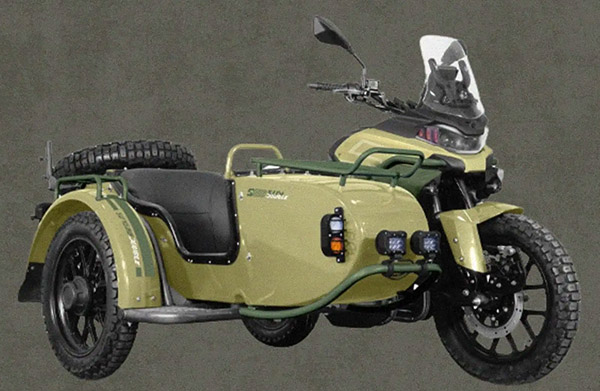
I guess I was right, as an email I recently received from Ural shows. Ural is taking a different tack: They’ve pretty much dropped the Russian-made WWII BMW clones (Ural moved to Kazakhstan, but to me, that’s still Russia), and now they’re hooking up with a Chinese manufacturer to make a smaller sidecar-equipped 500cc twin. They’re calling it the Ural Neo.
The 500cc Ural Neo. Projected list price is “under $15,000.”
Man, talk about stacking the marketing cards against you: A smaller displacement bike, a bike from a Russian (sort of) company, a bike made in China, and catering to the sidecar market (when was the last time you saw a bike in America with a sidecar?). I’m guessing they will be pricey, too, but hey, what do I know?
I have no idea how I made it onto a Ural email list, but here’s the letter from Ural:
Dear Friends,
If you know our history, you know this brand was never built in comfort. The challenges of the last five years and especially the move to Kazakhstan have made the legacy Urals impossible to produce sustainably. This led us to the decision to pause manufacturing of the new legacy models for export markets. It does not, however, mean that Ural is stopping. Instead, we are pulling (yet another) one-eighty in order to keep moving forward. Below is a letter from Ilya (a long read), that explains where we are, how we see the path forward, and the answers to some of your questions and concerns.
For new subscribers – welcome to the community! You caught us amid a big change. If your interest is solely in our legacy machines, please check inventory to find models that are still available at dealers in US, Canada and Australia. If you are interested in sidecars in general, feel free to subscribe to updates on Ural Neo.
For those of you who have followed the story for a while, our customers and supporters, we know this transition is not easy, and we don’t take your trust for granted. We want you to know that every decision we’re making right now is with your experience, your bikes, and your future support in mind.
Thank you for your patience and for sharing your stories, they keep us going every single day.
We wish you and your close ones a happy Thanksgiving and a happy upcoming holiday season!
Stay tuned for new developments.
The Team at Ural
A Letter From Ilya
“Dear Friends,
It’s been a while since our last update. Much of our time was spent on reorganizing the company and evaluating what is possible that would allow Ural to continue into the future. The complex challenges we faced required difficult decisions, sharp turns in direction, and more than a few leaps of faith.
Our recent post on our Facebook page – inviting riders to test-ride the new Ural Neo at one of our dealers – received a lot of attention. As with every mention of Neo, it brought out not only curiosity and support but also strong emotions, questions, and criticism.
We understand where those emotions come from. For most of you, Ural isn’t just a motorcycle – it’s a part of your personal story, the same way it’s a part of ours.
I still struggle to find the right words to describe what happened to Ural when the war began in 2022. The best way to describe it is this: it felt like our factory in Irbit had suddenly exploded. We had to make decision quickly. Some voices suggested stopping altogether, but this thought was dismissed almost immediately. Instead we moved final assembly to Kazakhstan.
This allowed us to continue building bikes. However, operating between two countries – one under sanctions and another with almost no infrastructure for a business like ours – proved to be extremely complicated. By late 2024, it was clear that this setup couldn’t last: we were losing money with every bike we built.
That’s when the idea of a lighter, street-oriented sidecar motorcycle in a different price segment began to take shape. Our original goal was to broaden our lineup and make better use of the infrastructure we still had. At the same time, we were searching for a longer-term solution for legacy bikes: exploring new suppliers, alternative assembly locations, and possible partnerships.
Then, in April 2025, the tariffs hit. Now not only was manufacturing inefficient – selling our motorcycles in our main market, the United States, had become nearly impossible.
Building in China and Staying Ural
When we started looking for ways to continue, we knew exactly what we didn’t want: to become a badge fixed on someone else’s product (and yes, we did have such offers). We wanted partners who understood sidecars and were willing to collaborate.
That search led us to Yingang, a family-owned motorcycle company with decades of experience making sidecar-equipped models for their local market. Their capabilities and willingness to work with us to refine the product made them the right fit.
Together, we began developing what would become the Ural Neo 500 – based on an existing platform, tested and refined with our input and oversight, built to our specifications and quality requirements.
What Ural Neo Is – And What It Isn’t
Ural Neo is not meant to replace our legendary 2WD sidecars. Legacy Urals gave generations of riders the kind of experience no other motorcycle could offer.
Neo is different. It’s modern, light and by far more approachable. It’s designed to bring new riders into the sidecar world, not to take anything away from those who already love it. If the 2WD models were still part of our lineup, Neo wouldn’t compete with them — it would complement them. Instead, it now continues Ural’s story in its own way.
Think of Neo as a bridge between Ural’s past and its future – a way to keep Ural’s name, spirit and know-how alive while we’re reinventing the company for the opportunities and challenges ahead.
Now let’s address some of the big questions.
Is production of classic Ural 2wd bikes stopped permanently?
We call it “put on pause”, which in plain English means we don’t know. What we can say with certainty is that we haven’t written it off entirely. The key for restoring the production, if it ever becomes possible, is to maintain documentation, equipment, tooling and, most importantly, our experienced engineers and skilled workers. We will be doing everything we can for as long as we can to support this infrastructure.
What’s going on at the factory in Irbit?
The Irbit factory is operational, although with a smaller team. Currently the factory is assembling a limited number of bikes for domestic market from existing stock of parts and components, and making spare parts for exports. The factory also performs contract assembly for a local vehicle manufacturer. The team in Irbit continues to work relentlessly to bring more business to the factory.
What’s going on with parts supply?
No sugarcoating here – the situation is tough. It’s hurting our reputation and the hard-earned trust of our dealers and customers. Parts are still coming to the country, but not in quantities or the regularity we need. Mainly it is caused by two factors: limited financing (especially when dealing with suppliers who require large minimum orders) and extremely complex logistics. We’re doing what we can to stabilize the supply chain, but realistically, it won’t improve overnight. The success of the Neo project will play a major role in helping us rebuild a reliable parts flow for all legacy bikes.
Why not move production to the U.S.?
We explored this and many other options, the numbers just don’t work. The replication of the manufacturing infrastructure would require multi-million-dollars investments. Even setting up an assembly in the U.S. is not feasible at this time, as logistical costs, wages and the costs of maintaining the facilities would drive retail prices out of reach for most riders.
Why in China?
China is the largest motorcycle manufacturing base in the world, with a vast ecosystem of specialized suppliers of parts and components. No other place in the world can manufacture sidecar bikes of comparable quality and as affordably priced.
The Neo 500 is built in China because it’s the right choice today, not because it’s the only choice we’ll ever make. As the project grows, we will continue to evaluate where and how future models should be built.
You shouldn’t put the Ural name on anything that isn’t original bike.
That’s exactly why this project is called Ural Neo. It’s a new chapter, and we fully acknowledge the difference. The alternative was losing Ural altogether. We’d rather see the name move forward than carved on a tombstone. We hope you would too.
The main appeal of Ural was its classic look. Without that vintage charm, who’s going to buy your new bike?
We know the Neo’s design and overall direction of the company don’t match what many of our long-time customers expected. But we don’t believe that appeal of the sidecar bikes begins and ends with nostalgia. A new generation of riders is discovering sidecars for different reasons – shared experience, practicality, and curiosity. Ural Neo is built for them – let’s give them a chance to decide if there’s something there.
How is Ural Neo financed? Why Ural is spending money on new project instead of supporting existing customers?
Ural Neo is structured, financed and operating independently from legacy business. A small group of long-term partners and investors – people who believe in the brand and in our team – provided the initial capital to develop, homologate and bring the new model to the market. We’re finalizing an additional funding round to ensure Ural Neo is set for successful launch.
When will we see Ural Neo at dealers?
The EPA/CARB certification unit is already in the country and we’re starting the certification tests in a couple of weeks. Additional demo units will arrive in the US late January – early February, and we’re planning demo-tour for February – April. The first production units are expected to start reaching dealer floors late May. We’ll share timelines and updates as we go.
***
We know the past few years have tested everyone’s patience and faith in Ural. But through all the challenges our goal hasn’t changed: to make sure Ural keeps going. Ural Neo doesn’t erase our history – it keeps our story, and yours, alive.”
— Ilya Khait
President, Ural Motorcycles
Will the above approach work for Ural? Hard to say. I think they’ll sail through the EPA/CARB certification process (China’s emissions requirements are tougher than ours). The cost and marketing challenges will the toughest hurdles, I think. Here are a few things they can do based on our success at CSC with the RX3:
Bring in enough spare parts to build the things. That was one of the biggest concerns RX3 buyers had, but it was non-issue. Steve brought in enough spares to cover any need. That quickly put the spare parts issues to bed.
Be enthusiasts, spend a lot of time on the bikes yourself, and blog the hell out of your rides and adventures. A lot of people followed the CSC blog, and that blog sold a lot of bikes.
Offer free online maintenance tutorials for your bikes. CSC did, and it became a strong selling point.
Sponsor a cool ride every year for your customers. We did that at CSC with the Baja rides, and people bought the RX3 bikes just to go on those rides. It was great, it built a real community, and it gained us a lot of coverage.
Keep the price low. People aren’t going to stand in line to pay a premium price to a Russian motorcycle company for a motorcycle made in China. I read that Ural is projecting a list price “under $15,000.” Good luck with that.
Probably the most significant factor and the best advice I can offer is to keep the price low. The second most significant one would be the company rides; they did a lot for us to prove our bikes’ reliability and to quickly build a community. Here’s one of my all-time favorite videos; it’s the one from our very first CSC Baja ride.
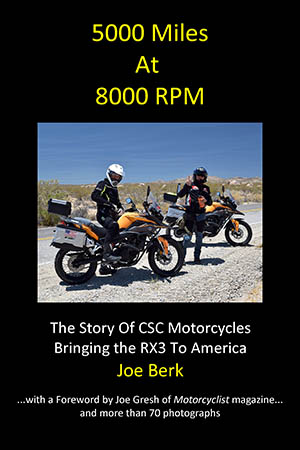
If you would like to read more about CSC’s marketing strategies in bringing the RX3 to America, and those sponsored motorcycle rides mentioned above, pick up a copy of 5000 Miles At 8000 RPM. Don’t wait for the movie.
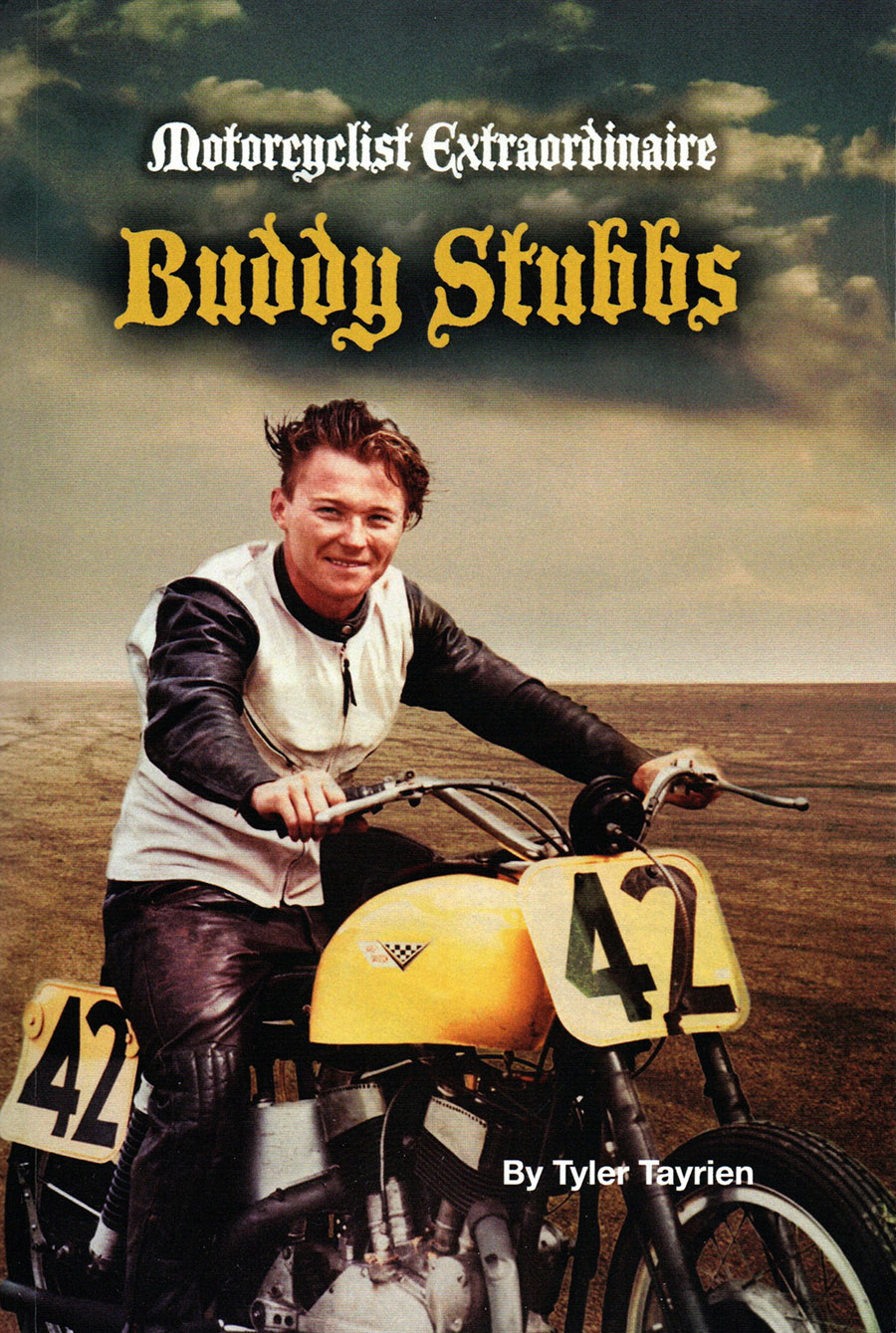
Not too long ago, I posted a blog about the Buddy Stubbs Motorcycle Museum in Phoenix, Arizona. Sue and I visited it for an upcoming Motorcycle Classics magazine Destinations piece. While I was there, I saw a book about Buddy Stubbs (Motorcyclist Extraordinaire: Buddy Stubbs), and I picked up a copy. I finished reading it last night and I thought I’d share my thoughts with you.
Written by Tyler Tayrien (who also wrote Arena, a book about Sam Arena’s motorcycle racing career), I’d give it a solid 8 out of 10 points. The subject matter is superb; the writing and editing are good but not great. I already wrote about Buddy Stubb’s history, his dealership, and a bit of his background in my recent blog about the Buddy Stubbs Museum, so I won’t go into that in too much detail here.
What’s great about Motorcyclist Extraordinaire: Buddy Stubbs is that the subject of this book (Mr. Stubbs) has had such an interesting life. It would be hard for a book covering this topic to be dull. What’s also great about the book is that Buddy Stubbs’ racing contemporaries are the guys I followed when I was a teenager and a young man: Riders like Dick Mann, Gary Nixon, Cal Rayborn, Roger Reiman, Bart Markel, Kenny Roberts, and others. These guys were the kings of flat track, motocross, and road racing back in the day, and reading about them from another rider’s perspective made the book even more interesting.
Motorcyclist Extraordinaire: Buddy Stubbs has a lot of photos, and maybe that’s one of its weak points, but I can’t blame the author for that. Most of the photos (maybe all of them) were from earlier printed photos shot with film, I’m guessing many were shot in black and white, and these were scanned for inclusion in the book. It’s hard to get a decent image using that approach, but when working with these kinds of archival prints, there’s really no other way to do it. The downside is that many of the photos are grainy and lack clarity. That’s not intended to be a criticism; it’s just an observation.
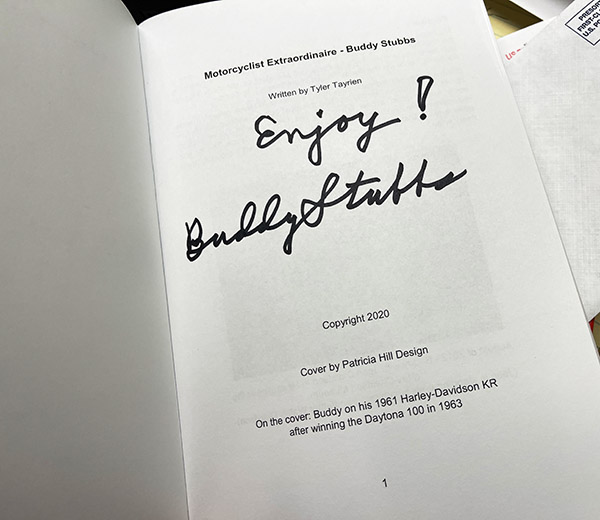
Motorcyclist Extraordinaire: Buddy Stubbs covers Buddy Stubbs’ life, his experiences in buying and building up the dealership, his marriages, his automobile and motorcycle racing, his cars, and the motorcycle museum. Mr. Stubbs is in his mid-80s today. I’m sorry I didn’t get to meet him while I was in the dealership, but I did get an autographed copy of his book. That’s cool.
My minor criticisms aside, I think that Motorcyclist Extraordinaire: Buddy Stubbs is an excellent read. My advice to you is to pick up a copy. I think you will enjoy it.
As the title implies, last week was quite a week, and a lot of it focused on Moto Guzzi stuff. The Roman gods are sending me a message, I think, but old age and big bucks will most likely keep my desire to own a vintage Guzzi suppressed. And there’s been some pocketknife stuff, too, leading into the age-old Chinese quality discussion. I’ll get to that in a minute.
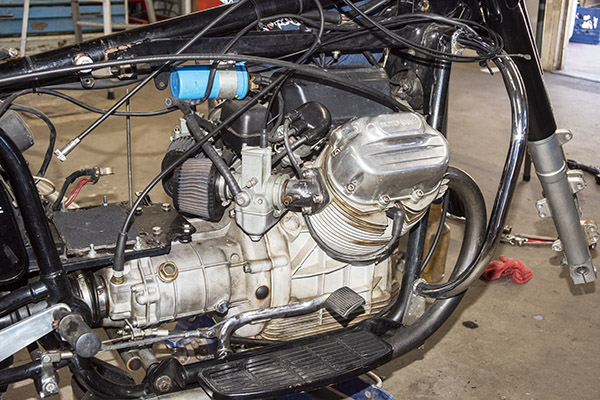
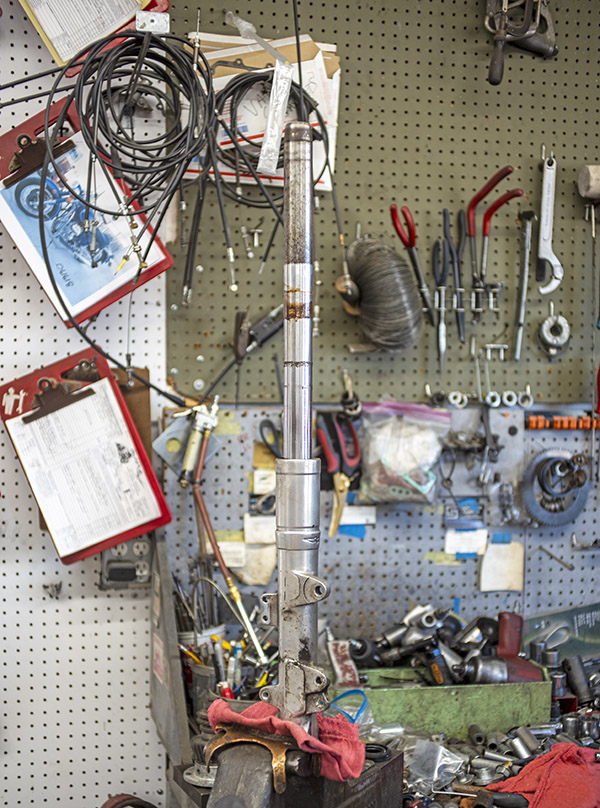
The guts of a Guzzi in the Cycle Garden shop. This is a cool place in a hot locale (temperatures sometimes approach 120 degrees in Indio).
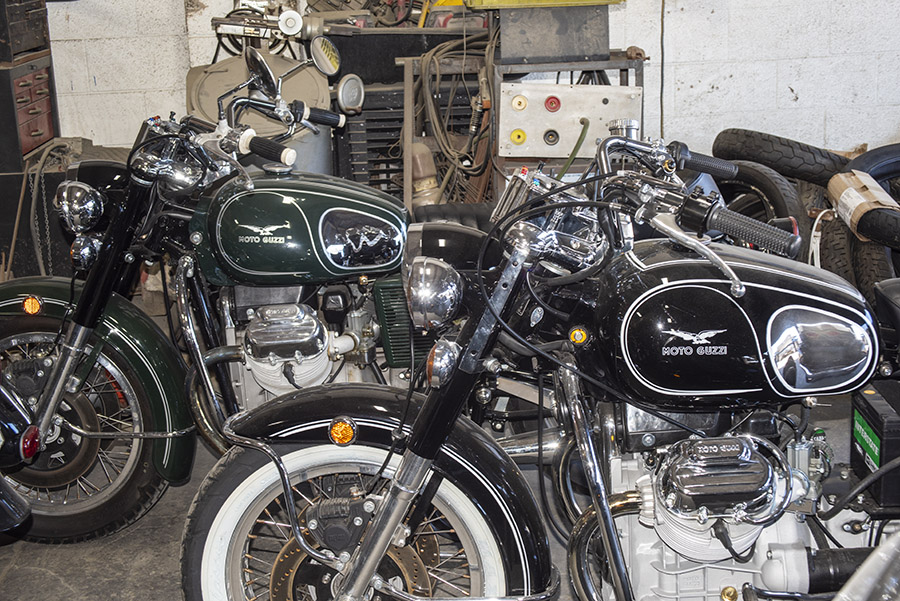
I spent Monday morning at Cycle Garden in Indio, California, getting tutored by good buddy Steve on the finer points of Guzzi fork rebuilding. It’s for a piece I’m doing on that topic, and the folks at Cycle Garden couldn’t have been more welcoming. These guys know their stuff, as well they should: They are the largest, busiest, and probably the best in the world at concours-level Guzzi restorations. I developed a bad case of the “I wants” for a restored Guzzi after seeing some of the bikes at the top of this blog, but it’s probably not in the cards.
Just forking around out in the desert…
After treating me to a cup of his famous home-roasted and ground coffee, Steve showed some of the bikes to me. There’s not a single part on a Cycle Gardens restoration Guzzi that isn’t touched during the restoration (both 0n the motorcycle and in the engine). How much? Somewhere in the neighborhood of $40,000 to $50,000. A look at any of the Cycle Garden bikes easily confirms the value is there. But my wallet is light enough already. Watch for more on the Cycle Garden shop; it’s amazing.
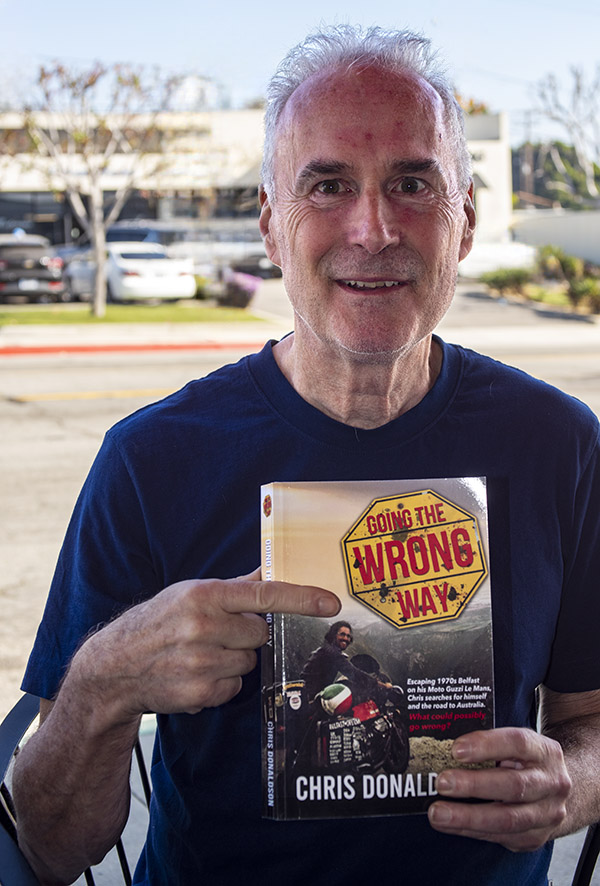
The man, the Moto Guzzi, and the legend: Chris Donaldson sitting across the table from yours truly. Buy the book on Amazon. Buy mine, too!
On Friday, I visited another Guzzi shop 130 miles to the west, this time to meet with and interview Chris Donaldson. Chris wrote Going the Wrong Way, the story of his ride around the world on a Moto Guzzi. He just flew into Los Angeles from Ireland to ride across the US. We had a nice meeting, and you’ll be hearing more about Chris in a subsequent blog.
One the pocketknife front, it’s been mostly good (and the good will be featured in upcoming blogs) with several new additions to the collection. But there’s been a couple of bad apples, and that’s increased my smarts about what to look for in a pocketknife.
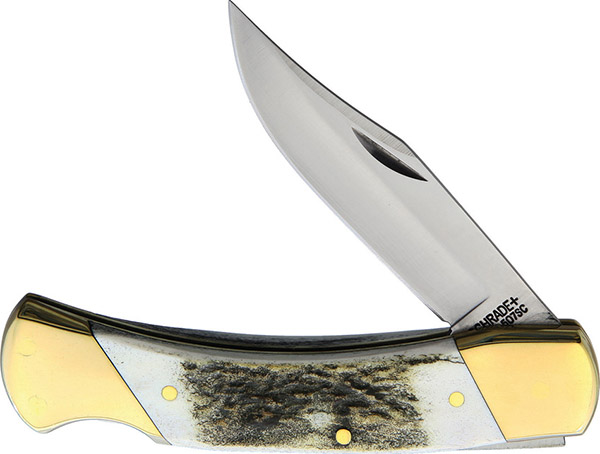
The Schrade stag-handled folding hunter. The blade wobbled in the knife body when closed. Back it went. I’m still waiting for a replacement. It’s made in China.
The first was a large Buck-110-style Schrade folding hunter with stunning stag grips. The knife arrived and I loved the look of it, but it had a defect. With the blade closed, it wobbled inside the knife body. In my opinion, it should have no side-to-side play, so back it went. I don’t want my money back; I just want a good knife. We’ll see what happens.
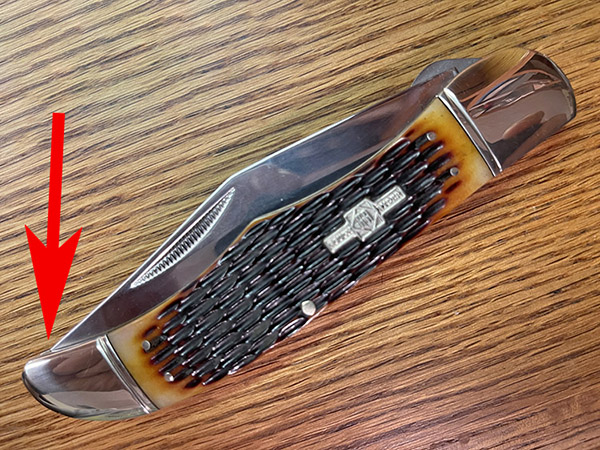
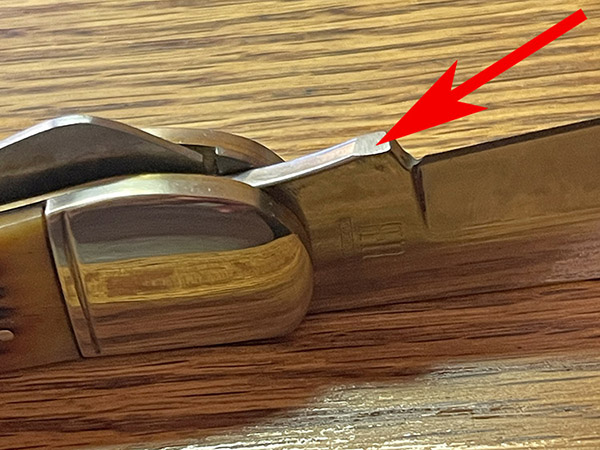
The Rough Rider Large Hunter. I love the design, but the knife is no good. The tip lies above the line of the knife body when the knife is closed. Muey malo, mi amigo. This is also a Chinese knife.
The next was another beautiful large hunter, this time from Rough Rider. It’s a beautiful knife, but it arrived with a different problem. On this one, when the knife is closed the tip of the blade sits slightly proud of the knife body, and that means you can catch your hand on it. Who would think to check for this? Apparently, not the folks who manufacture the knife, and not the folks who sell them, either. I bought one from Amazon, and I returned it the next day. I wanted the knife, though, so I ordered it again from Chicago Knife Works. Wouldn’t you know it? The replacement knife had the same problem. Size notwithstanding, it’s an inexpensive knife, but apparently they’re all bad (at least based on my sample of two).
The Rough Rider’s kick. Grinding it down didn’t fix the problem.
I tried grinding down the Rough Rider’s kick (the part of the blade that controls how far it goes into the knife body when it closes), but that didn’t fix the problem. It’s an inexpensive knife (only about $15) and I’m not going to bother returning it. I’ll just look at it from time to time. It will remind me that I’m not as smart as I sometimes think I am.
Stay tuned, my friends. There’s more coming your way.
The alarm rang early last week, and Sue and I were on the road at 5:00 a.m., pointed east on the 210 for the 5 1/2 hour trek to Phoenix and the Buddy Stubbs Motorcycle Museum. It was worth the drive out there.
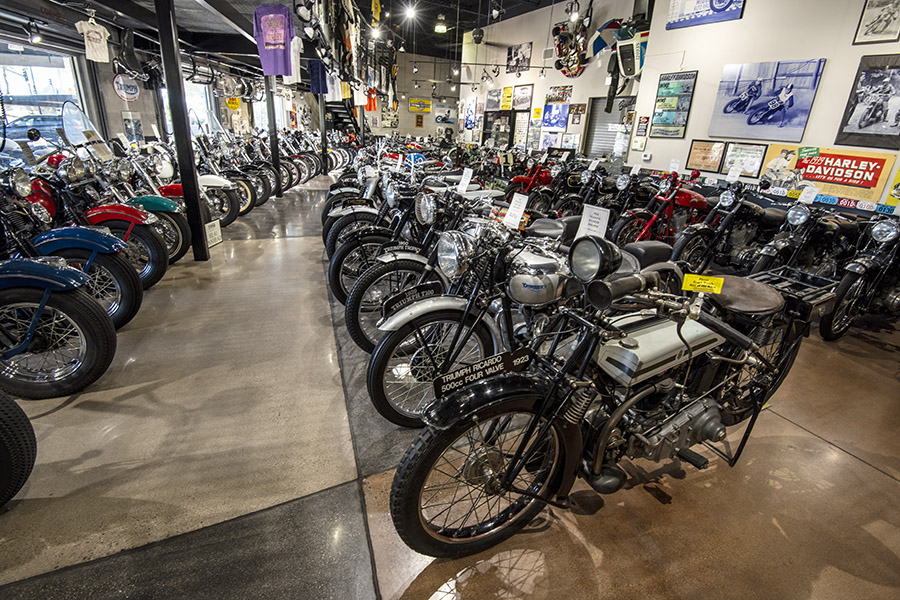
There are more than a few dealers who have a handful of bikes tucked into a corner of their showrooms they call a museum. Not so with the Buddy Stubbs Motorcycle Museum in Phoenix, Arizona. It’s the largest motorcycle museum in the American Southwest, and it’s one of the best motorcycle museums of the many I’ve visited over the last 30 or 40 years. I don’t say that lightly. This place is spectacular.
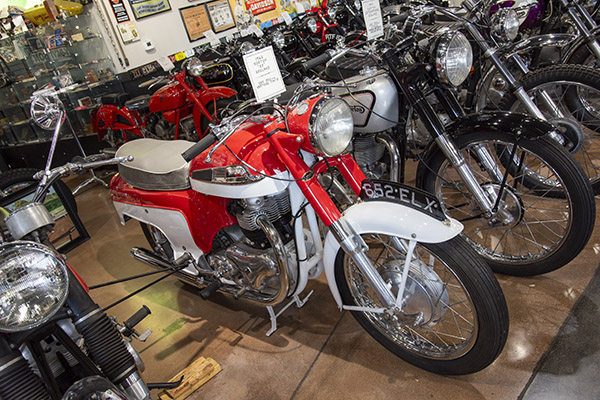
Many marques are well represented. This colors on this early ’60 Noron twin work for me.
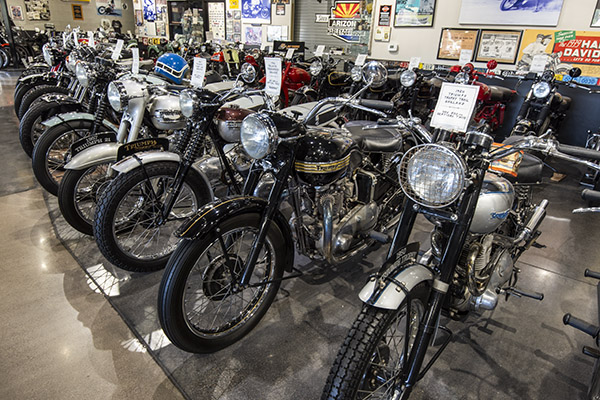
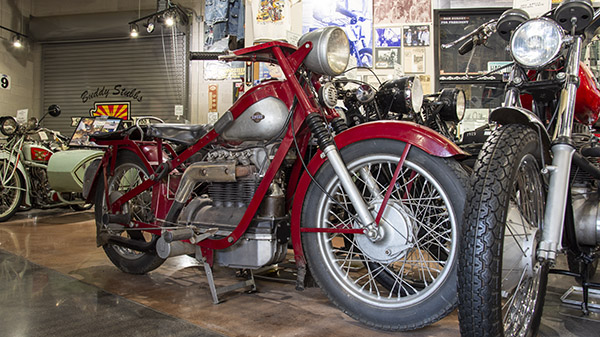
Sue and I visited the Buddy Stubbs Museum recently for an upcoming issue of Motorcycle Classics magazine, and I sure was glad we did. The Museum has 137 bikes (with 124 on display). You might think they’d all be Harleys, but you’d be wrong. All the cool stuff is there, and it’s all vintage. Harleys, Triumphs, BSAs, Vincents, BMWs, Excelsiors, Indians, and a bunch more. It seems like every motorcycle in the Museum has a story.
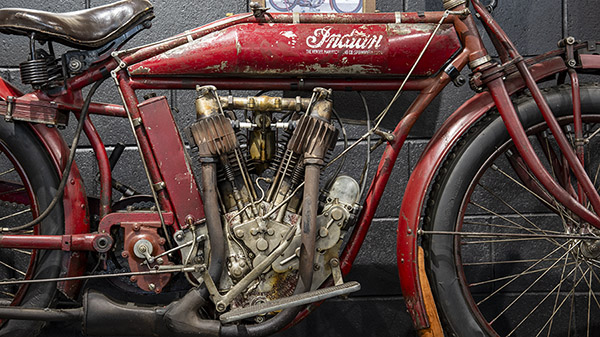
The 1913 Indian Buddy commuted on between dealership locations.
One of the stories is about the 1913 Indian in its original unrestored glory. You might recall that about 25 years ago Harley made their dealers build new and modern showrooms. Buddy Stubbs was one of those dealerships, and while the new location was under construction, Buddy rode between the old and new locations daily on that 1913 Indian. That’s cool.
Buddy’s Cannonball Excelsior. All the spares rode in the sidecar and there was no chase vehicle.
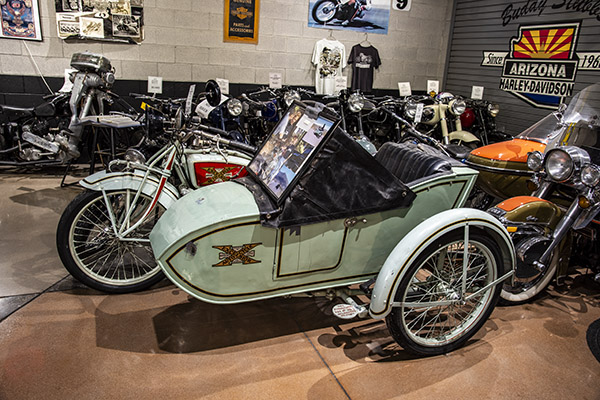
Another bike with a story is the 1915 Excelsior, with sidecar, that Buddy rode in the 2010 cross country Cannonball Run. Okay, you might be thinking a lot of guys did that. Yeah, but…and the “yeah, but” in his case is that a 70-year old Buddy Stubbs made the ride with no chase vehicle. He carried all the parts he thought he might need in the sidecar. Wow.
Yes, it’s the actual Electra-Glide in Blue. The real one that we all saw in the movie.
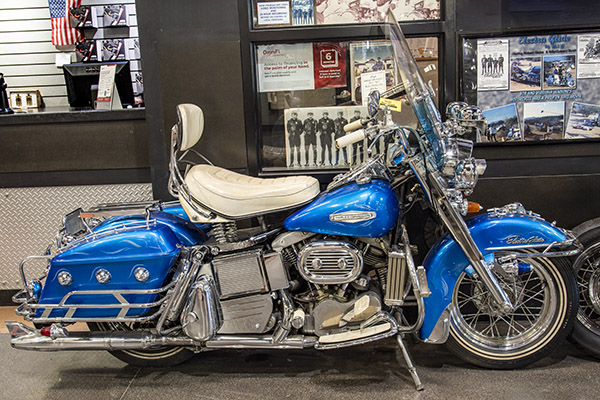
Remember the 1973 Electra-Glide in Blue movie? Buddy taught Robert Blake how to ride a motorcycle for that movie, and the motorcycle that Blake’s felonious motor officer buddy bought with stolen money (in the movie, not in real life) currently sits in the Buddy Stubbs showroom. Blake went on to a successful TV series (Baretta), and then he fell from grace when he murdered his wife (which he got away with in the criminal trial, although he was later found financially liable in a subsequent civil case). It’s tough to convict a movie star here in the Golden State.
The black T-Bird (second from right) was The Wild Ones backup bike.
Speaking of motorcycle movies, the grand-daddy of them all has to be Marlon Brando’s The Wild One. You will recall that Brando rode a Triumph Thunderbird in that movie. The producers kept a spare Triumph Thunderbird on set during the production. You know, just in case. That spare T-Bird is in the Buddy Stubbs Museum.
A four-cylinder Nimbus. It might have made it into our ¿Quantos Pistones? series had I seen it sooner.
There’s a whole section here on ExNotes focused on our dream bikes. Satisfyingly, several of those are in the Buddy Stubbs Museum, including lots of Triumph Bonnevilles, Harley Cafe Racers, and the Harley XR1000.
By any measure, Buddy Stubbs (who at age 85 is still with us) is an amazing man. You can even buy a book about Mr. Stubbs, which I did while visiting the dealership. I have a signed copy.
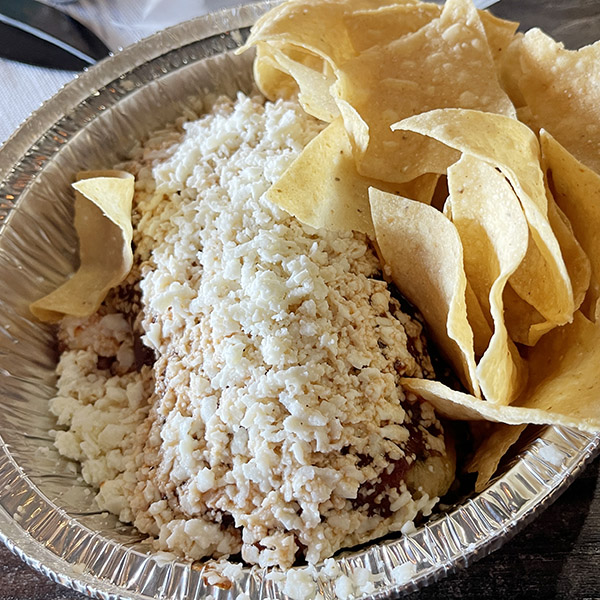
A chile relleno tamale. Muey bueno!
Hey, one more thing that I’d be remiss to not mention in this blog. Stop for lunch at the Tamale Factory, which is just 8/10ths of a mile up North Cave Creek Road from the dealership. I had the chile relleno tamale and Sue had the chicken version. Both were fantastic.
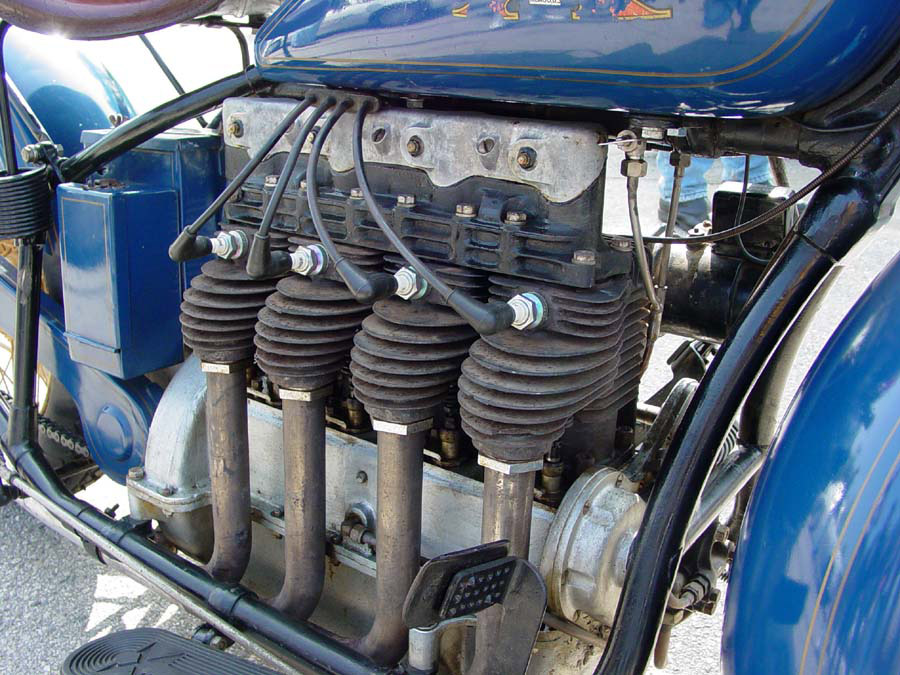
Fours? I’ve owned a few, and Lord knows I’ve sure seen a bunch of them. For starters, there’s the 1931 Excelsior-Henderson at the top of this blog (a photo that graces every one of our ¿Quantos Pistones? blogs). It’s not mine and I didn’t ride it. I was so interested in photographing that motorcycle, I didn’t realize I was standing next to Jay Leno until he took his helmet off. I’ve written about that encounter before.
Honda CB 750
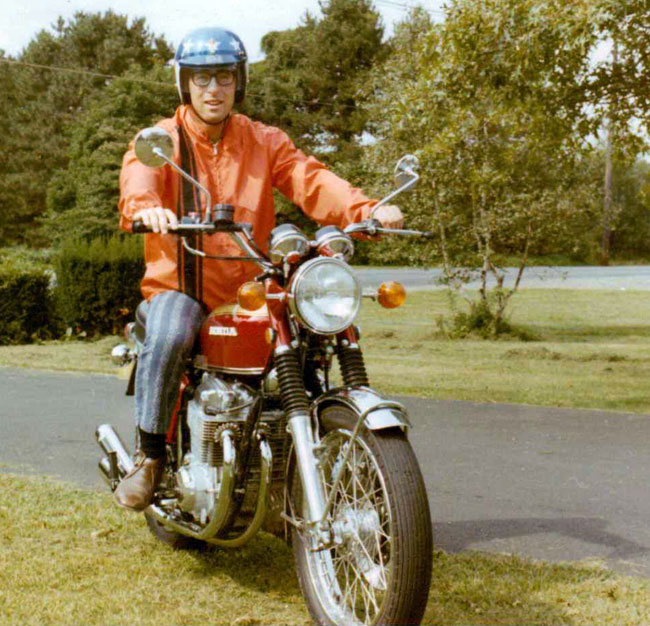
When the Honda CB 750 Four came on the scene in 1969, it turned the motorcycle world upside down. I thought the bike was interesting before I saw one, but I also thought I was a 650 twin kind of guy (you know, Triumphs and BSAs). The first 750 Four I ever saw accelerated past my house when I was way younger. It was a gloriously visceral and symphonic four. To a guy used to lopey Harleys and throaty Triumphs, the CB 750 sounded like an Indy Offenhauser. When I heard that high performance four-cylinder yowl, it was like walking through the jungle on a moonless night and having an unseen leopard suddenly scream a short distance away. It reached deep, took hold, and shook me mightily. I remember it like it happened yesterday. At that instant, I knew I would own a 750 Four someday soon. And I did.
Yours truly in the 1970s. Hard to believe it was more than 50 years ago. I loved that motorcycle.
Our family bought our motorcycles from Cooper’s Cycle Ranch in Hamilton, New Jersey. The CB 750 was $1539 out the door (I can’t remember what I had for lunch earlier today, but I remember that number), and my 750 was the color I wanted. Honda offered the 750 Four in four colors in 1971 (brown, green, gold, and candy apple red). I wanted a red one, and Sherm Cooper made it happen. It was a glorious bike. I rode it to Canada with a fellow Rutgers student (Keith Hediger, who had a white Kawasaki 500cc triple). That was my first international motorcycle trip. I rode it a lot of other places, too. It was a wonderful motorcycle. I wish I still had it.
Honda CB 500
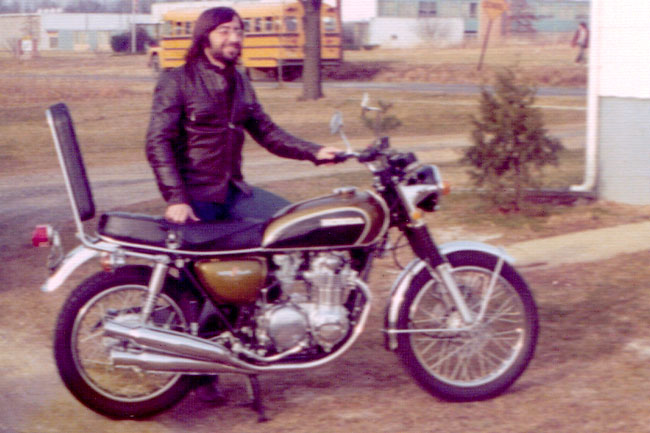
I owned two Honda CB 500 Fours. I bought one from good buddy John who was a high school and college classmate. I only put a few miles on before putting it on my front lawn with a for sale sign. It sold quickly. I liked the bike (it was very smooth), but I needed the cash for something else (I can’t remember what).
Good buddy John and the CB 500 I bought from him.
A similar opportunity popped up decades later when a guy at work had a metalflake orange CB500 for sale at Sargent Fletcher (an aerospace plant I ran in the 1990s). Metalflake orange was a factory color on the CB 500 Honda. At $500, I figured I could take a chance. I bought it, rode it a little bit, never registered the bike, and sold it with a Cycle Trade ad a couple of weeks later.
Suzuki Katana
This was a bike way ahead of its time. Wow, was it ever fast. In 1982, the performance was incredible. It would probably be tame by today’s hyperbikes, but back in the early ’80s, it was something else.
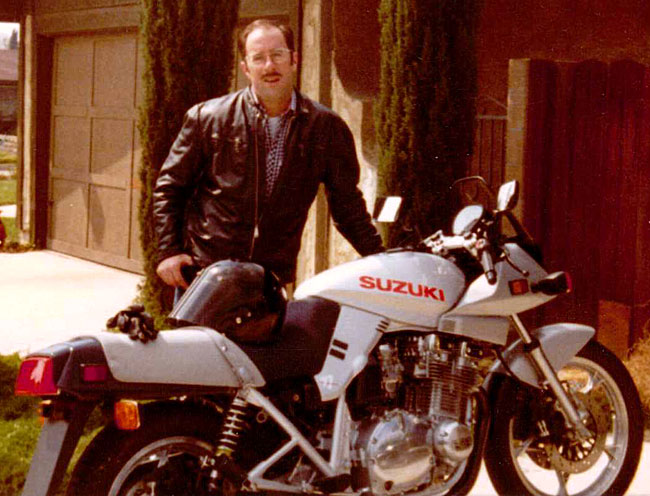
Me and my Katana. I still had some hair in the 1980s. Not much, but some.
Take a good look at that photo. The ’82 Katana you see above is the only vehicle (car or motorcycle) for which I ever paid over list price. When it first came out, it was pure unobtanium. Suzuki only made 500 initially. I think mine was No. 241. I paid $5500 for it, which was way over list price in 1982, and I had to go all the way to Victorville to find one.
I thought I had something special, but that only lasted a month or two. After the initial limited release, Suzuki made another 500, bringing the total number to 1,000. I found that troubling, and I felt cheated. Those sold quickly, too, so Suzuki went ahead and produced yet another 500. Those last 500 didn’t sell well at all (Suzuki had reached all the fools like me by then and the market for a bike like the Katana had been saturated). Suzuki had to discount the remaining bikes heavily to move them. That really pissed me off. It would be another 15 years before I would buy another Suzuki (that was my ’97 TL1000S). The way I was buying and selling bikes in those days, that was a long time.
The Katana was my first ever superbike. It was scary fast in 1982, and it would probably still be scary fast today. Thanks to Joan Claybrook and Jiminy Carter (remember those two?), the speedo maxed out at 85 mph (as if that would somehow slow anyone down).
The pipes were one of the coolest things on the Katana. They were what Suzuki called black chrome and they looked great. The instrument pod was cool, too. The tach and speedo needles moved in opposite directions, which made it seemed like the two needles were unwinding as you rowed through the gears. This was my first ever bike with low bars. I didn’t like them, but the rest of the bike was very, very cool. I sold the Katana when my first daughter was born. A fat lady knocked it over in a shopping mall pulling her car out of its parking space. I took that as an omen. Time to step away from riding for a bit. I wish I still had that motorcycle.
Suzuki went on to use the Katana name (a Katana is a Japanese Samurai sword) on other models, but they were never the same at that first 1982 Katana.
Triumph 1200 Daytona
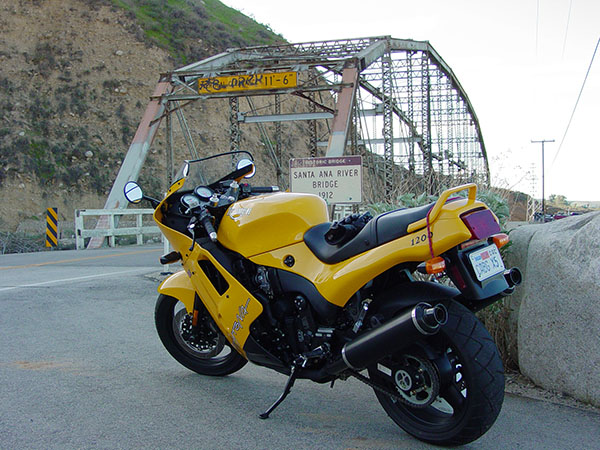
This was a fun machine. I bought when it was still brand new (but already 7 years old) on Ebay, thanks to an alert from my buddy Marty. It was $7,000. As soon as I won the auction, the next highest bidder contacted me and offered to buy it, but I turned it down.
The Locomotive. This was one of the best motorcycles I ever owned.
I’ve written about the Daytona before, and rather than reinvent the wheel, I invite you to read the more complete Daytona story here.
Honda Gold Wing
Back in the day, the initial Honda Gold Wing was a four, as they continued to be for several years. I thought I wanted one when the Gold Wing was first introduced (I was in Korea at the time and I saw the new Gold Wing in a Cycle World magazine). But I never acted on the urge to buy one and that was a good thing. I rode a friend’s a few years later and the bike had no soul whatsoever. It was boring beyond belief; I would not have thought any motorcycle could be that boring. But it was and it made me glad I never bought one.
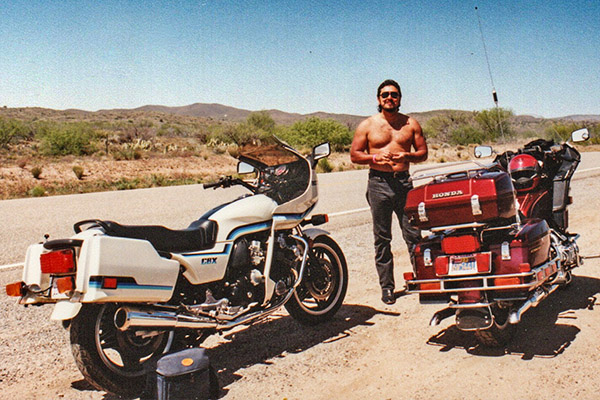
Somewhere in Arizona on a road trip in the ’90s. That’s my CBX (to be covered in a later ¿Quantos Pistones? blog), my buddy Louis V (who went into the witness protection program), and Louis’s Honda Gold Wing (the most boring motorcycle I ever rode). All the gear, all the time was definitely not Lou’s motto.
Guys who have Gold Wings seem to love them. Emilio Scotto rode one around the world and wrote a great book about it. Today, of course, Gold Wings are sixes. I’ve read that the handling on the new ones is great for a big bike. But they’re not my cup of tea. You may feel different about Wings, and that’s okay.
So there you go: My experiences with four-cylinder motorcycles. The configuration makes sense from a lot of perspectives. They can be powerful and they are an almost universal configuration on Japanese motorcycles. But they’ve grown too big for my liking. I know there have been smaller fours out there (the Honda CB350 Four comes to mind), but as I’ve matured (read: become a geezer), I like smaller bikes better. As always, your mileage may vary.
Missed our earlier ¿Quantos Pistones? stories on the Singles, the Twins, and the Triples? Hey, no problemo! Here they are:
I thought I’d read everything that had ever been published about traveling the world on a motorcycle. I’ve written about it on ExNotes, describing my favorites among all the books on this topic.
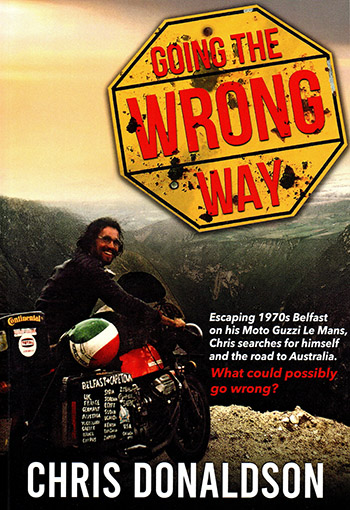
Notice that I’m writing in the past tense, and the reason for that is I most recently learned about another motorcycle saga that belongs on my best-in-class list: Going the Wrong Way, by Chris Donaldson.
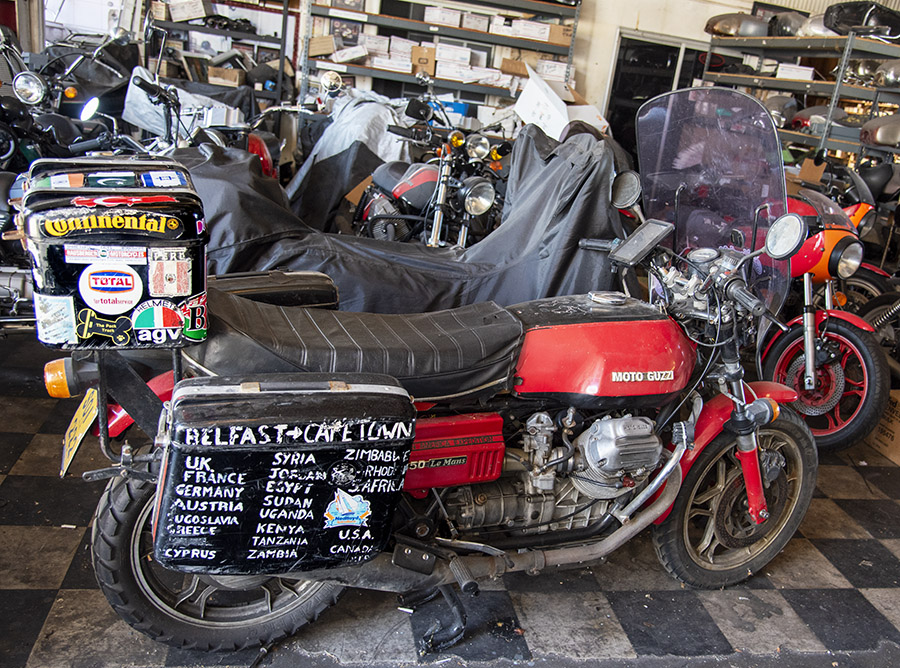
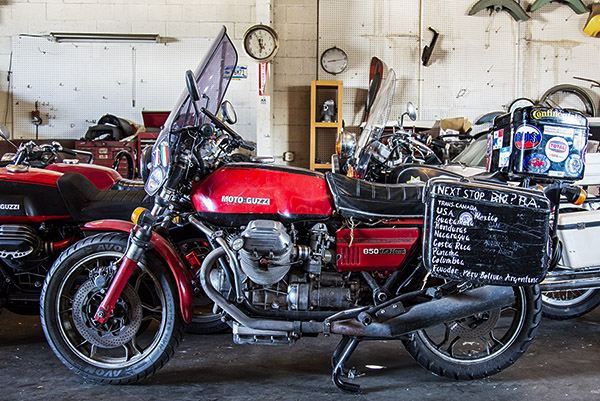
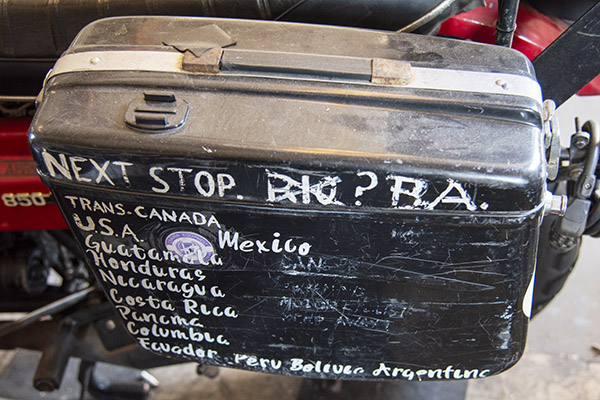
My newfound discovery came about almost by accident a few days ago when I visited with Moto Guzzi Classics, an independent Guzzi revival and maintenance facility in Signal Hill, California for a potential story I’m doing for the ExNotes blog and maybe one of the motorcycle magazines. The guys who run Moto Guzzi Classics are, in as few words as possible, both a bit eccentric and absolute subject matter experts. One of them, my new good buddy Wyatt, showed a few of the bikes in their shop to me, and one of those motorcycles belongs to Chris Donaldson. Chris is a Belfast boy (as in Belfast, Ireland) who is going around the around on a Moto Guzzi 850 Le Mans.
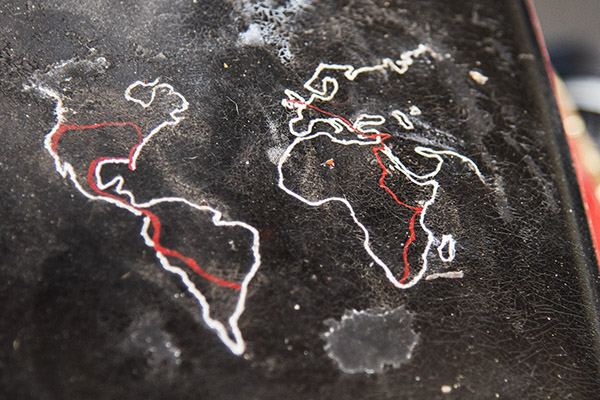
Man, there’s a lot to unpack in that last sentence. Belfast. Coming of age during The Troubles. Getting out of Ireland as a young man. Moto Guzzi, which has to be one of the coolest motorcycles on the planet (they’re like Harleys, but for people who like motorcycles). The Le Mans 850, which has to be one of the worst motorcycles in the world for world travel. Traveling the world (as in present tense). That’s right, the journey is not over, even though Mr. Donaldson started it many decades ago. Donaldson plans to continue his global conquest on the same motorcycle, which is one of the reasons why the bike you see here is currently in the queue at Moto Guzzi Classics in Signal Hill.
I’ve had a hard time putting the Going the Wrong Way down on my nightstand each night for the last several nights. I’d read until I couldn’t stay awake, and fall asleep reading it. Don’t get me wrong; the book is anything but boring. Just the opposite is true. It’s fabulous, and even though I couldn’t keep my eyes open because I was reading into the wee hours, I couldn’t stop reading. Going the Wrong Way has all the bike reliability stuff to keep an engineer interested, all the philosophical stuff to keep a philosopher awake, all the people stuff to keep a people person awake, all the border crossing drama stuff to keep a world traveler tuned in, and, well, I could go on, but I don’t want to spoil it for you. The writing is almost poetic. It’s that good.
Folks, Going the Wrong Way is a great read. Don’t just take my word for it; there are something like 1,394 Amazon reviews posted on this book (soon to be 1,395, when I write mine), which is really kind of stunning for a motorcycle travel book written by a rider with no sponsors. Trust me on this: Get yourself a copy of Going the Wrong Way. You can thank me later.
Our other book reviews (along with reviews on a lot of other things) are here.


 We are a literary bunch, us ExNotes writers. Joe Gresh and I published a collection of our favorite stories not too long ago, and I’ve penned (or keyboarded) a few myself. Here’s a link to the Gresh and yours truly book,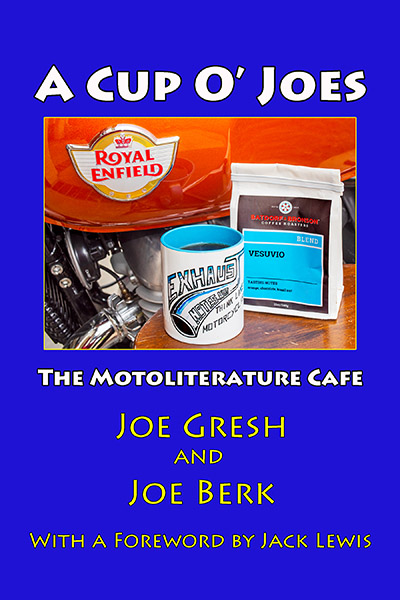
 , in my opinion, is the greatest motorcycle adventure story ever told, made all the more significant by two facts. The first is that Dave Barr, the author, did the ride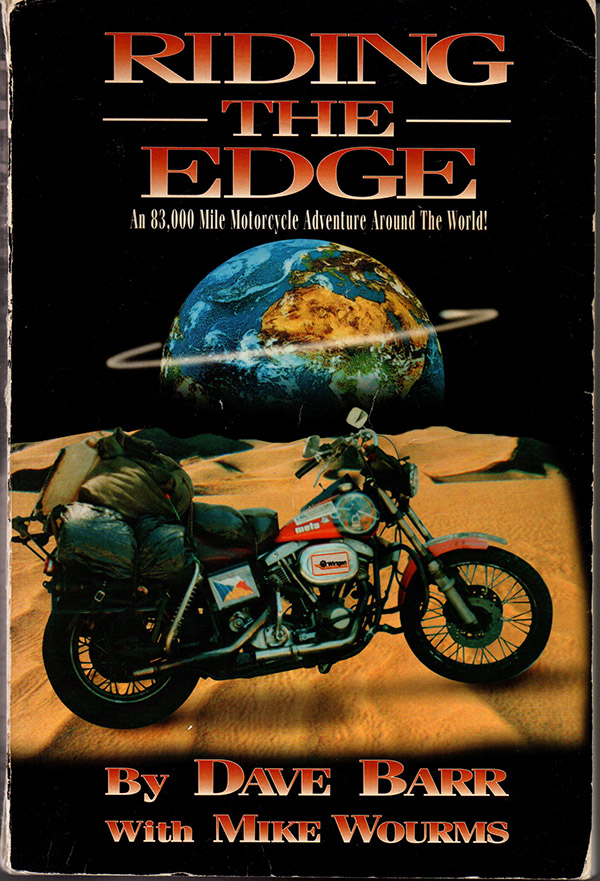
 What sets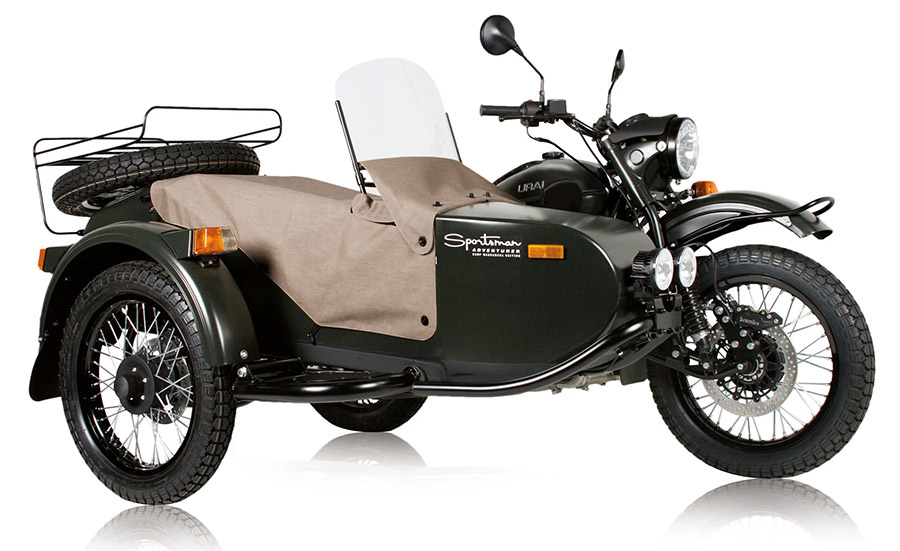

 I’ve had a hard time putting the