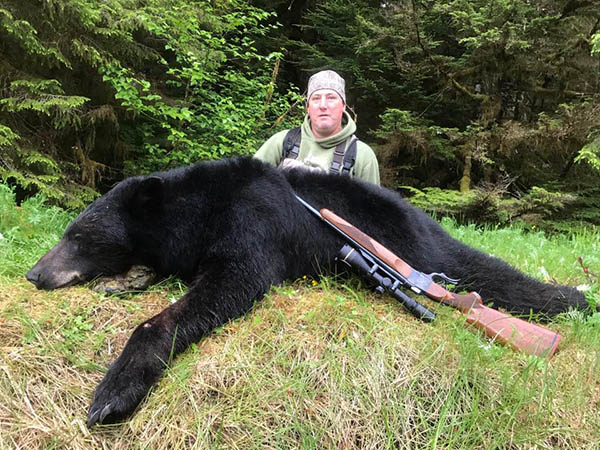
Good buddy Jason, a Ruger No. 1 in .338 Win Mag, and a 400-lb, 7-ft Alaskan black bear.
As the title of this blog implies and in this case, my good buddy Jason was literally loaded for bear. For several years I had owned a Ruger No. 1 single-shot rifle in .338 Win Mag. That’s a monster of a magnum. I had never fired the rifle and I sold it to Jason. He told me he was going on a bear hunt in Alaska (something I’ve always wanted to do), and I was happy to the see the rifle go to a good home. Most recently, Jason sent the photo you see above and a recap of his hunt to me to share here on the ExNotes blog. Here you go, folks!
It all started in 2016 when I purchased my first Ruger No. 1 in 338 Win Mag from Joe. I’ve always wanted a Ruger No. 1, but I already had a Winchester Model 70 in 338 Win Mag. I planned to go on a bear hunt in 2018, so what I did was sell my Winchester Model 70 to my best friend, who went on the bear hunt, too. I would be using my Ruger No. 1. So this is a story about me and my new rifle and our quest for a big Southeast Alaskan black bear. It was a guided hunt through Alaskan Coastal Outfitters.
Our base camp was on a boat and in the evening we would take a skiff and cruise around all the little islands and bays looking for the right bear. We saw lots of bears (a lot of sows with cubs). We also saw a lot of boars. On Day 4 of our hunt we saw a really nice bear. We got as close as we could without spooking him. My guide told me to get out of the boat and he held the boat still for me. Then, as I was pulling my leg over the side of the boat I got hooked on to the edge of the boat and I fell face down in 8 inches of water.
The bear ran off and my beautiful Ruger No.1 was laying in 8 inches of salt water, so we raced back to the boat, took the rifle apart, and cleaned it up so it was like new.
The next day we went out again and this time I was extra cautious not to fall in when we came across the bear you see in the picture. He was about 300 yards from the skiff when we spotted him. We got as close as we could without spooking him, which was about 140 yards, and my guide kept on asking me if I could make the shot. I always answered “yes, no problem.” I lay down and rested my rifle on my pack. Wouldn’t you know it, I had to lay down in a little creek so I got wet again. We lay there for what seemed to be an eternity. My guide made sure it was a boar and not a sow. Finally, he gave me the OK.
Just then, the bear turned so he had his back to me (so I couldn’t shoot). It gave me an opportunity to situate my follow-up shot. I decided the quickest way to get a follow-up shot (if I needed one) was to shoot with the next round in my hand.
The bear finally turned broadside and I dropped the hammer. I hit him just behind the shoulder and he dropped. My guide backed me up with a 375 H&H rifle, but he didn’t need to fire it. The bear went down, and when we reached him, we saw he was the monster he appeared to be from a distance. The bear measured 7 feet and weighed about 400 lbs.
Jason, that’s an awesome story and a magnificent photograph. I was sorry to see that rifle go, but it obviously went to a good home and you sure put it to good use. You know, it takes a real sportsman to do what you did…going after bear with a single-shot rifle. Congratulations on a successful hunt, and thanks much for sharing your adventure with us here on the ExhaustNotes blog!
Would you like to write a guest blog for ExNotes? It could be a gun story, a hunting story, a motorcycle story, or any other idea you think might work for our audience. If you have an idea, please let us know at info@exhaustnotes.us. If we publish your story, you’ll get a signed copy of Destinations with our compliments and gratitude!
Sometime in the late 1970s, when I was an engineer on the F-16 program at General Dynamics in Fort Worth, Texas, I visited a company called National Water Lift somewhere in the Great Lakes area. What we bought from NWL had nothing to do with water (they made the F-16’s hydraulic accumulators). It’s a lead into this story, which is about my Browning B78 rifle. You see, every time I had to visit one of these distant places on my business travels, it was an opportunity to check out the gun shops in the area. Which I did, and the one that stuck in my mind had a Browning B78.
The B78 was a competitor to Ruger’s No. 1 single-shot rifle, and the design was basically a resurrection of the old Winchester High Wall. Ruger did surprisingly well with the No. 1 back in the 1970s (the idea of a single-shot rifle was intriguing to me and many others), and I guess Browning wanted in on the action (pardon the pun).
Rugers outsold Brownings probably 10 to 1 (or more) in those days because they were less expensive and Ruger’s marketing was better. But the Browning was (and still is) a very elegant rifle. I saw one at that store (I want to say it was in Kalamazoo, Michigan, but I can’t remember for sure), and it was nice. It was a 30 06 and it had an octagonal barrel, which was all very appealing. But the Browning was a good $100 more than the Ruger and in the 1970s, that kind of money was out of my reach.
Fast forward 40 years, the Great Recession was upon us, and all kinds of exotic and collectible rifles were popping up on Gunbroker.com (a firearms auction site). I saw what appeared to be a nice B78 on Gunbroker, with an octagonal barrel, in God’s caliber (that would be .30 06), and I pounced. I paid too much, but we never say it that way. I bought too soon. Yeah, that works. I just bought too soon.
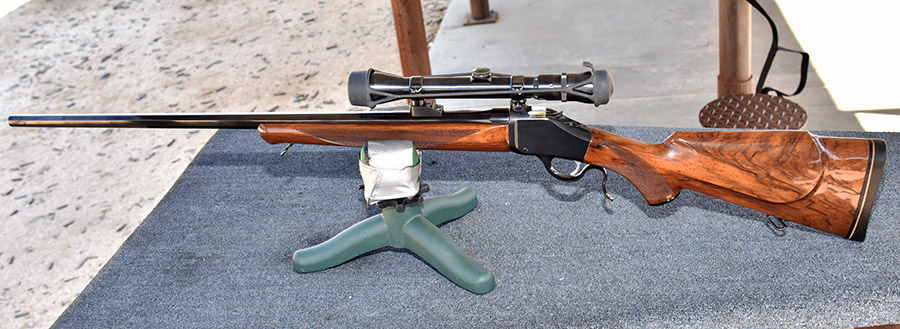
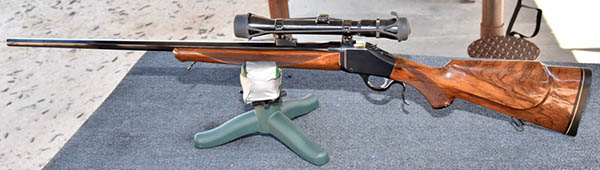
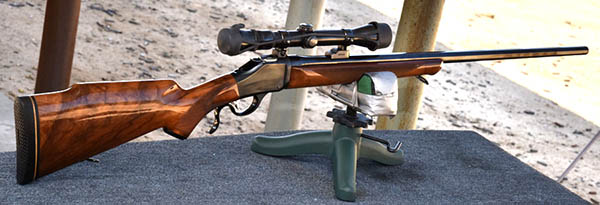
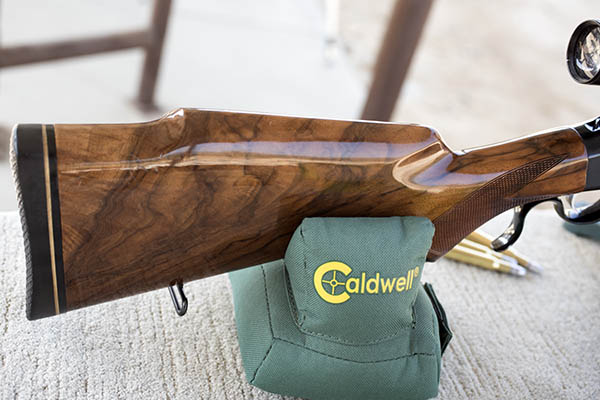
A earlier photo from one of my first range trips with the Browning B78. .30 06, one shot, great walnut, an octagonal barrel…this rifle is elegant.The B78 is sharp from either side. That’s a Weaver 2×7 scope, and it gets the job done.
After I bought the B78, I wanted to put a period-correct scope on it (you know, from the 1970s) and I found a nice Weaver 2×7 on another auction site. Weavers are good scopes and the ones from the 1970s were blued steel and made in America. It was just what the doctor ordered, and it looks right at home on my B78.
My B78 is used, and it’s got a few nicks and dings on it. But the metal work is perfect, and the walnut is (in my opinion) exhibition grade. Take a look, and you tell me.
Good wood. This is exhibition grade walnut……and it has fine figure on both sides.
I’ve owned the B78 for about 10 years now, and it’s been a lot of fun. I’ve never seen another B78 on the rifle range, and I’ve certainly never seen one with an octagonal barrel. It’s just a cool firearm. But it is finicky. It likes heavier bullets and with the right load it’s accurate, but getting there took a lot of experimenting, a little bit of forearm re-bedding, and a lot of load development. I’ve got two loads that do very well in it…one is a heavy-duty jacketed load, and the other is a cast bullet light load. The heavy load is with a 180 grain Remington jacketed softpoint and a max load of 4064 (I’ve shot three-quarter-inch groups with this load at 100 yards). That load has big recoil, but it’s tolerable. I tried 180 grain Nosler bullets (that’s a premium bullet), but the rifle does way better with the less-expensive Remington bullets. That’s a good thing, because I found a good deal on 900 of those bullets and they have a home on my reloading bench now.
My cast bullet load is a short-range low power load, and it’s recoil is almost nonexistent compared to the jacketed load. It’s a 180 grain cast lead bullet (with a gas check) and 17.0 grains of Trail Boss power. After zeroing the Browning for the jacketed bullet load mentioned above at 100 yards, I had to crank the scope up a cool 85 clicks to bring the cast bullets back on paper at 50 yards (I was surprised there was that much adjustment in the scope). But wow, those cast bullets at 50 yards cloverleafed consistently. It was essentially putting them through the same ragged hole. At 100 yards, getting the cast bullet load back to point of aim involved another 25 clicks of elevation on the Weaver, and again, I was surprised there was that much in the scope. At 100 yards, the cast load groups opened up to about 2 ½ inches, and that’s still okay. What’s nice is I can shoot the cast bullet load all day long. The barrel doesn’t heat up and the recoil is trivial. As you might imagine with a load like this and the gas-checked bullets, there was virtually no leading.
When I go for deer later this year, it’s going to be with this rifle. One shot. I think that’s all I’ll need. We’ll see.
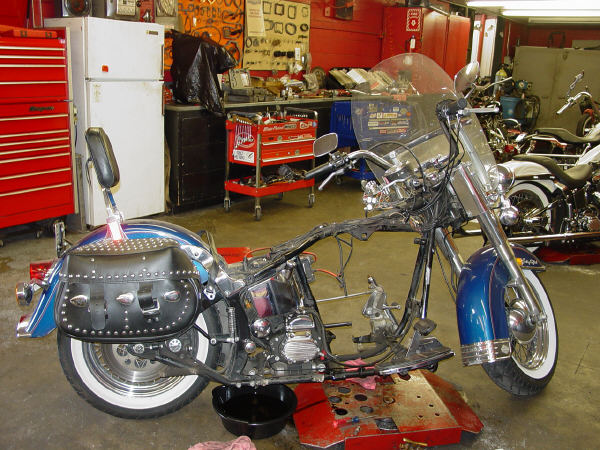
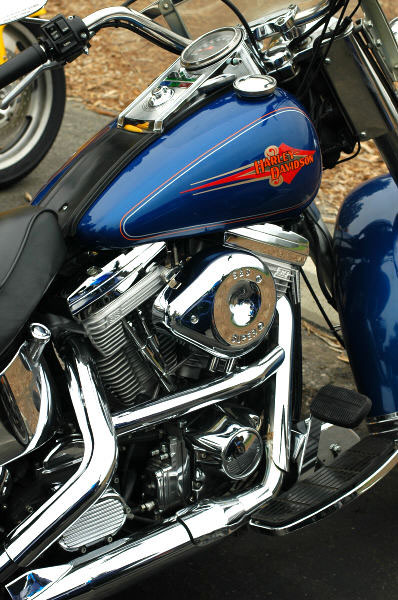
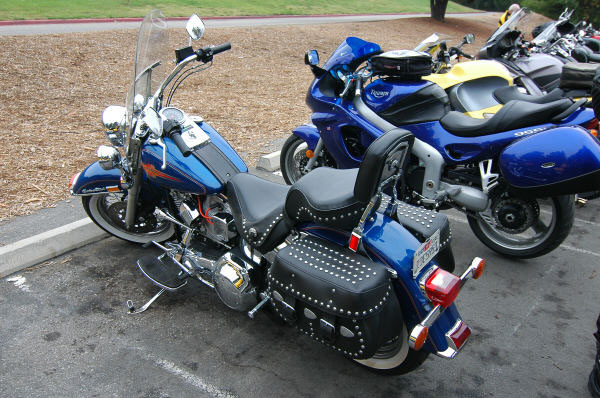
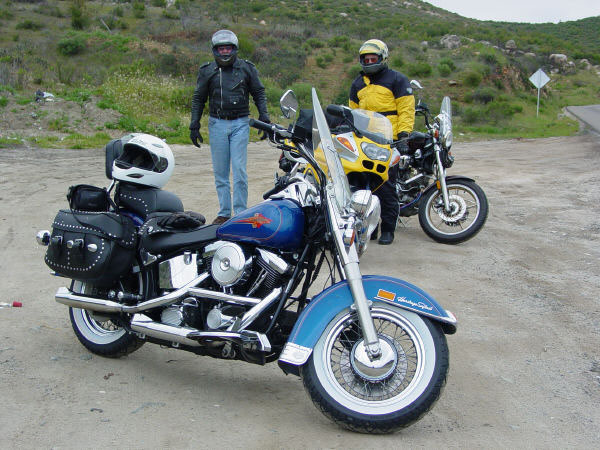
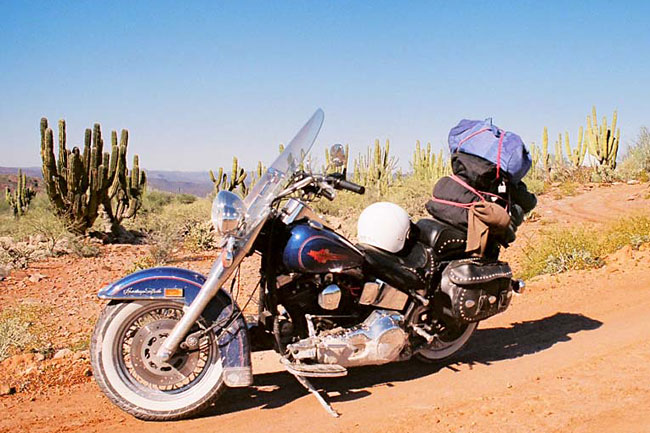
My ’92 Softail Harley. After losing a lot of weight.
So this all got started on a trip to Baja. My beloved ’92 Softail started clanging and banging and bucking and snorting somewhere around Ensenada. I was headed south with my good buddy Paul from New Jersey (not the Paul I grew up, but another one). It was obvious something wasn’t right and we turned. It wasn’t the end of the world and the Harley did manage to get me home, but I could tell: Something major had happened. The bike was making quite a bit of noise. I had put 400 miles on it by the time I rode it back from Mexico. I parked the Harley, got on my Suzuki TL1000S, and we changed our itinerary to ride north up the PCH rather than south into Baja. That trip went well, but there was still the matter of the dead Softail.
Here’s where it started to get really interesting. My local Harley dealer wouldn’t touch the bike. See, this was around 2005 or so, and it seems my Harley was over 10 years old. Bet you didn’t know this: Many Harley dealers (maybe most of them) won’t work on a bike over 10 years old. The service manager at my dealer ‘splained this to me and I was dumbfounded. “What about all the history and heritage and nostalgia baloney you guys peddle?” I asked. The answer was a weak smile. “I remember an ad with a baby in Harley T-shirt and the caption When did it start for you?” I said. Another weak smile.
I was getting nowhere fast. I tried calling a couple of other Harley dealers and it was the same story. Over 10 years old, dealers won’t touch it. I was flabbergasted. For a company that based their entire advertising program on longevity and heritage, I thought it was outrageous. Chalk up another chapter in my book, Why I Hate Dealers.
A friend suggested I go to an independent shop. “It’s why they exist,” he said. So I did.
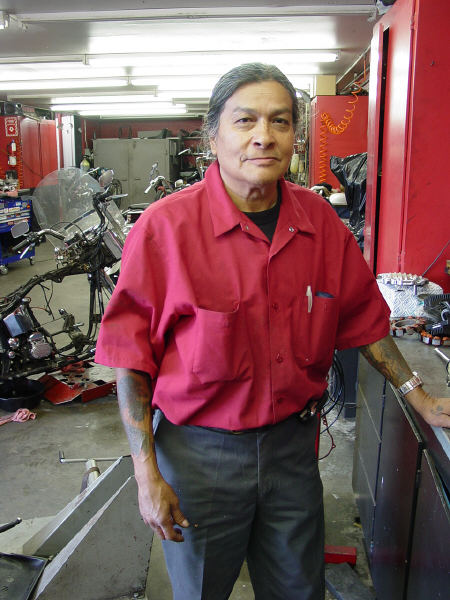
Here’s my internist…Victor, of the Iron Horse cycle shop. That’s my Harley in the background.
There was this little hole-in-the-wall place on Holt Boulevard in Ontario, in kind of a seedy part of town, near where the local Harley dealer used to be. The Iron Horse. You gotta love a shop with a name like that. The guy who ran it was a dude about my age named Victor. I could tell right away: I liked the shop and I liked Victor. I got my Harley over there and I stopped by a few days later to hear the verdict: The engine was toast.
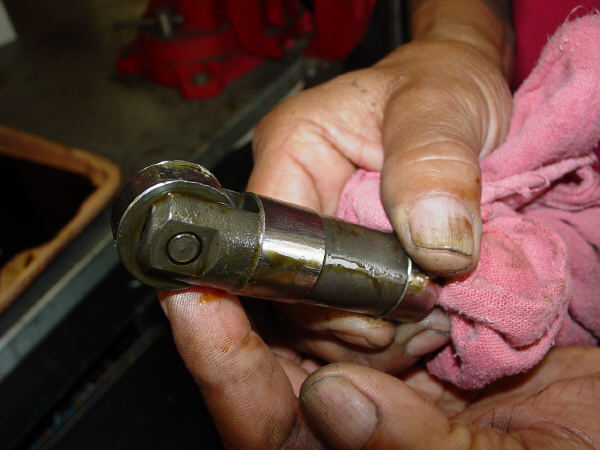
“What happened here,” said Victor, “is that one of your roller lifters stopped rolling, and it turned into a solid lifter. When I did that, the cam and the lifter started shedding metal, and the filings migrated into the oil pump. When that stopped working, the engine basically ate itself….”
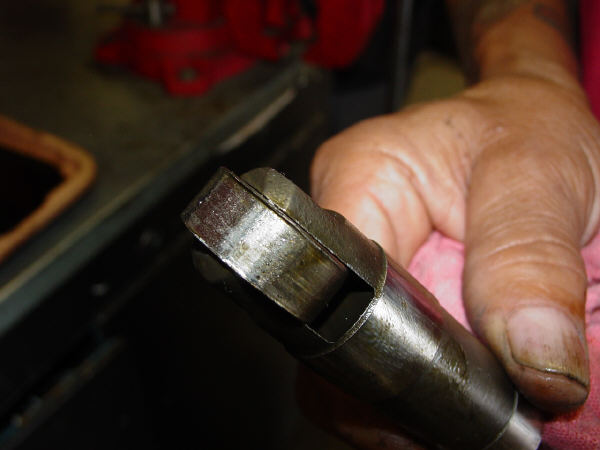
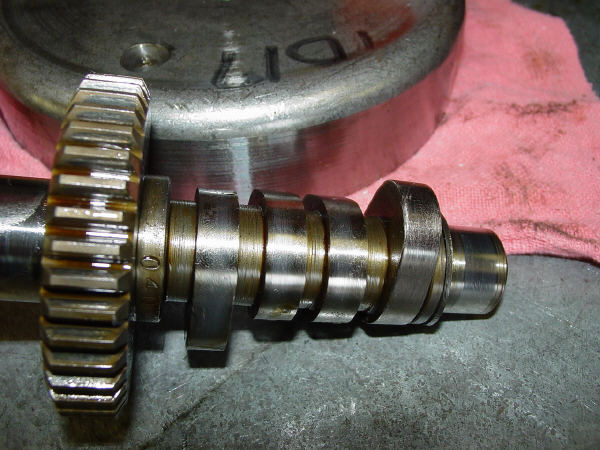
An Evo motor roller lifter that stopped rolling. The needle bearing in this lifter failed, and departed for points south. And north. And east and west. You get the idea.The cam wore a path into the roller. That metal had to go somewhere, and where it went was the oil pump.
“You’ve got lots of other things not right in your motorcycle, too,” Victor explained. “The alternator is going south, your cam got chewed up, the oil pump is toast, the belt is tired, and you’ll probably want to gear it a little taller to reduce the vibration like the new Harleys do.”
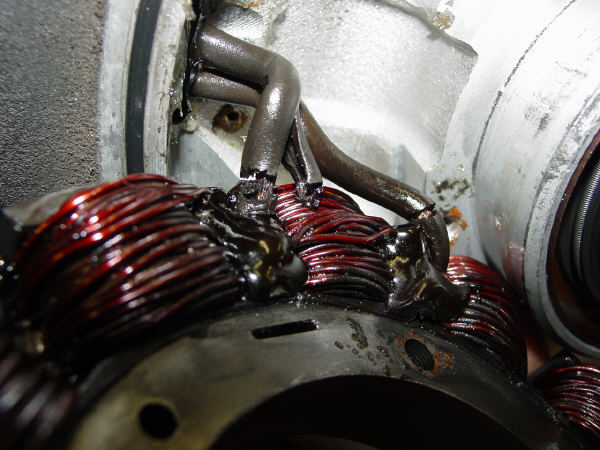
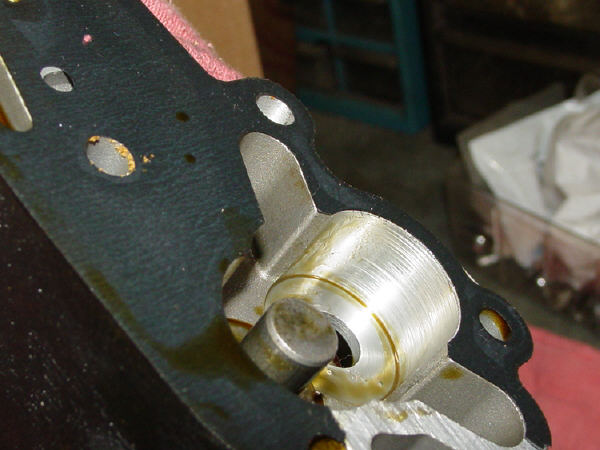
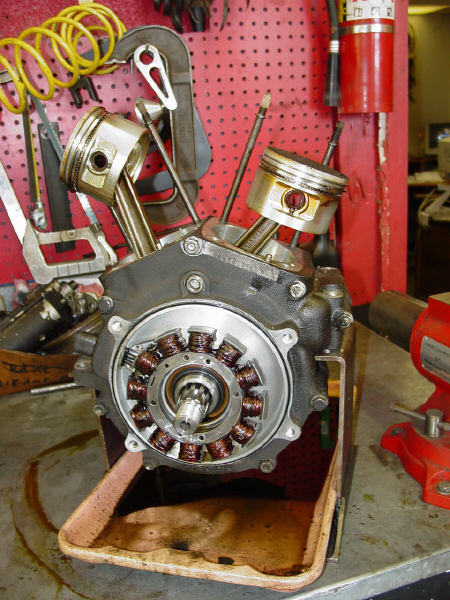
Here’s what the failed lifter did to the Screaming Eagle cam. Note the surface on the right most lobe.Victor showed me that my alternator was getting close to failing. Look at the insulation on the output lines. Yep, I would need a new one of those, too.Here’s what happened when the metal dust and needle bearing bits got into the oil pump. Note the abrasions on the inner surface.Another neat shot. It was kind of cool to see what was flying up and down underneath me during those 50,000 miles I put on the Harley over the last 14 years.
Victor gave me a decent price for bringing the engine back to its original condition (in other words, a rebuild to stock), but it wasn’t cheap. Then he offered an alternative.
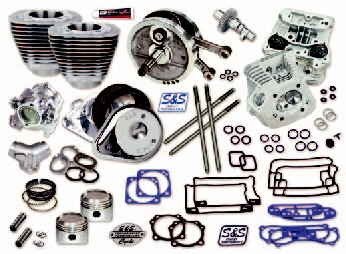
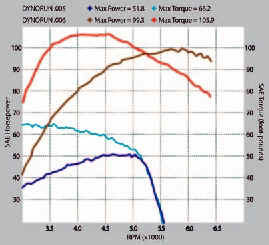
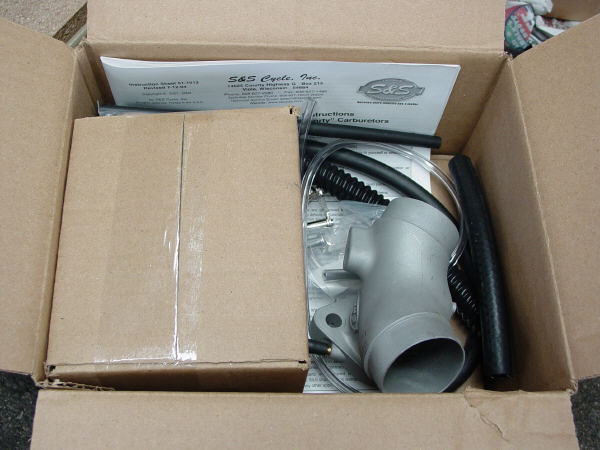
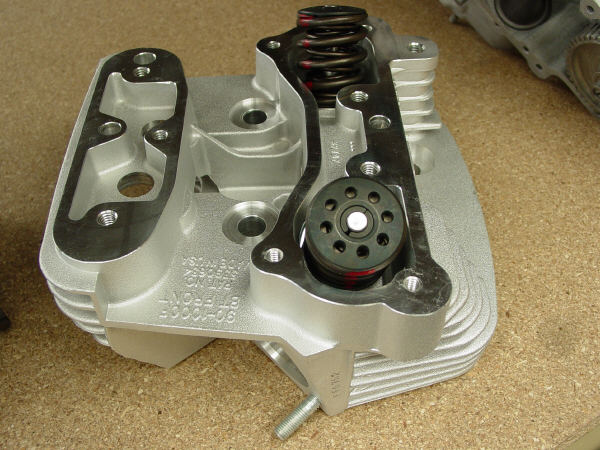
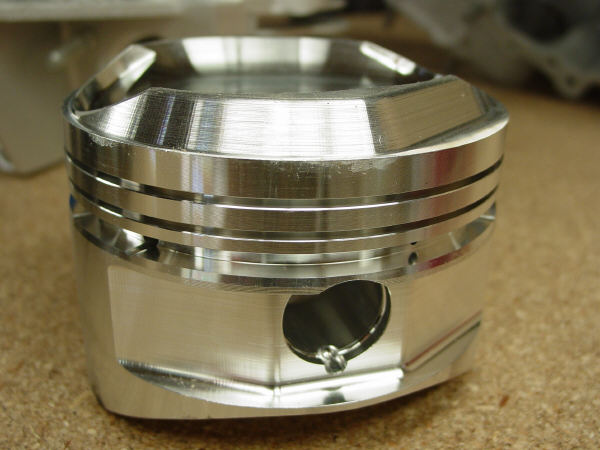
“I can rebuild it with S&S components for about the same price,” he said, “and that’s with nearly everything new except the cases. We’ll keep the Harley cases because then the engine number stays the same, and it’s still a Harley. It would be a 96-inch motor instead of an 80-inch motor, and I think you’d like it. It would be about the same price as rebuilding it with Harley parts. You’d get new pistons, rods, flywheels, and nearly everything else. I’d have to take the cases apart and get them machined to accept the S&S stroker crank and cylinders, and we’d reassemble it with new bearings. Oversized S&S forged pistons would go in with a 10.1:1 compression ratio, and that means you’d have to run high test. Oh, yeah, there’s new S&S heads, a new manifold, and a new S&S Super carb. And an S&S cam.” Then he showed me the components in a brochure, and another chart that showed the difference in power.
All the S&S stuff that would go into my new motor. I was getting excited. This was going to be cool.Twice the horsepower, and twice the torque. What’s not to like?
It was an easy decision. For the same money it would cost to bring the Harley back to stock, I could get it redone as a real hot rod. For me, it was a no-brainer. My days of bopping around on a 48-hp, 700-lb Harley would be over. The horsepower would double. Bring it on!
My Harley was still running on the original belt drive, and I had Victor replace that, too. And as long as the belt was being replaced, I went with Victor’s recommendation to swap to taller sprockets. That would give the bike a bit more top end and cut some of the vibration at cruising speeds.
I wrote a check and asked Victor to call me when the parts came in. I wanted to photograph the whole deal. Victor said he would, and I stopped at the Iron Horse frequently over the next several weeks.
The S&S manifold for my new engine.Check out the gorgeous S&S cylinder head.And how about this machined-from-billet piston? These would kick the Harley’s compression ratio up to 10.1:1.And here’s the S&S cam.
I was enjoying this. The parts didn’t come in all at once, and that was fine by me. I enjoyed stopping in at the Iron Horse and taking photos. It was something I looked forward to at the end of each day. It was really fun as the motor came together. Victor asked if I wanted the cylinders and cylinder heads painted black like they originally were, or if I wanted to leave them aluminum. It was another no-brainer for me: Aluminum it would be!
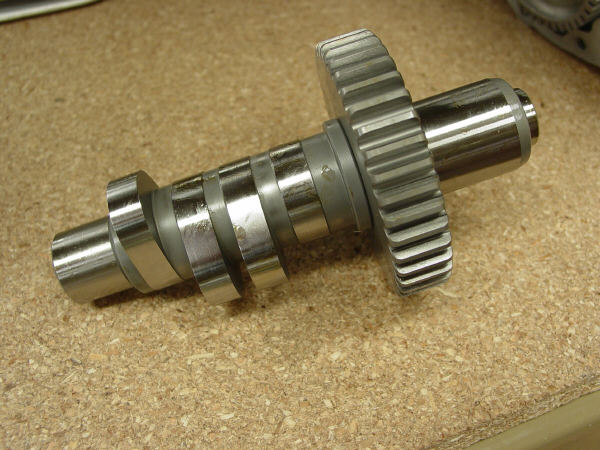
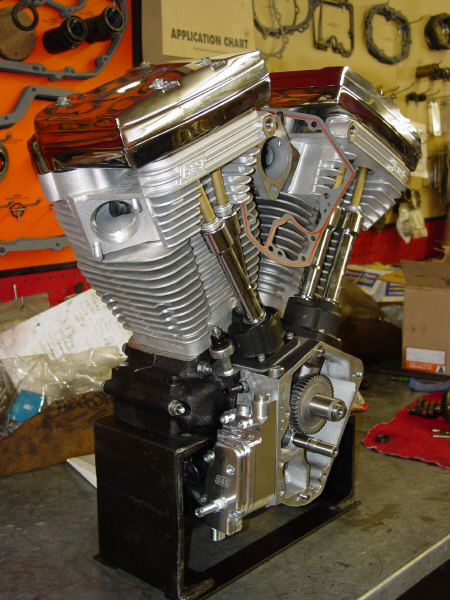
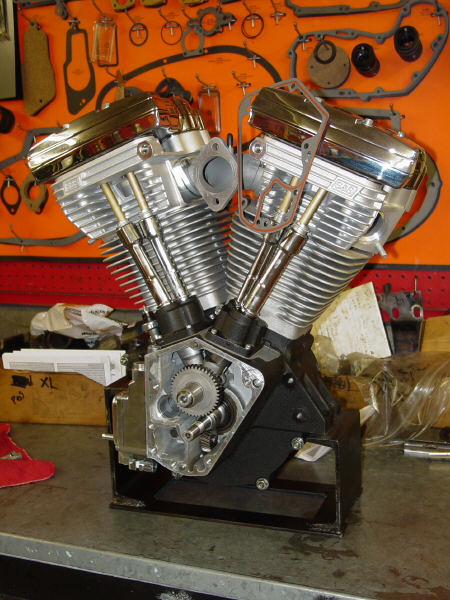
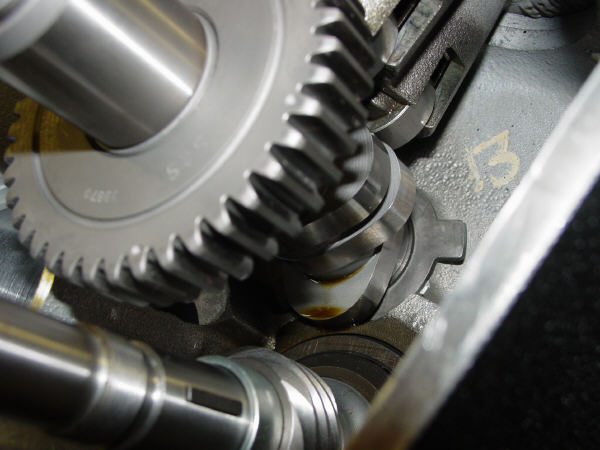
My S&S motor being assembled. The cases and the valve covers were about the only Harley parts left in the motor.Isn’t it beautiful? Another view of the S&S 96-incher coming together.Here’s a closeup of the cam and one of the roller lifters just above it.
One day not long after the motor went together I got the call: My bike was ready. It was stunning and I rode the wheels off the thing. Here’s the finished bike…my ’92 Softail with the S&S 96-inch motor installed.
It’s beautiful, don’t you think?
The S&S motor completely changed the personality of my Harley. I had thought it was quick when Laidlaw’s installed the Screaming Eagle stuff back at the 500-mile service, but now, at 50,000 miles with the S&S motor, I wasn’t in Kansas anymore, Toto. In the 14 years I had owned my Harley previously, I had just touched 100mph once. Now, the bike would bury the needle (somewhere north of 120mph on the Harley speedometer) nearly every time I took an entrance on to the freeway. This thing was fast! Fuel economy dropped to the mid-30-mpg range, but I didn’t care. My Harley was fast! The rear tire would wear out in 3,000 miles, but I didn’t care. The Harley was fast! It ran rich and you could smell gasoline at idle, but I didn’t care. Did I mention this thing was fast?
You might think I would have kept the Harley and put another zillion miles on it, but truth be told, my riding tastes had changed and I only kept it for another year after the rebuild. I was riding with a different crowd and I had a garage full of bikes, including the ’95 Triumph Daytona 1200 I’ve previously blogged about, my Suzuki TL1000S, a pristine bone-stock low-mileage ’82 Honda CBX, and a new KLR 650 Kawasaki. You wanna talk fast? The TL and the Daytona were scary fast. Yeah, the S&S was a runner, but fast had taken on a new definition for me.
And then one day, it happened. My wife had asked me to pick up something at the store while I was out seeking my fortune on the Harley, and when I came home, I realized I forgot to stop for whatever it was. I could have gone out on the Harley again, but for whatever reason, the KLR got the nod instead.
The bottom line: I had back to back rides on the S&S Softail and the KLR, and that’s when it hit me: I had bought the KLR new for about what I had in the S&S motor. The KLR was quicker at normal speeds, it handled way better, it was a much smoother and more comfortable, and it was more fun to ride. That was a wake-up call for me. The Harley went in the CycleTrader that day, and it sold the day after that. Regrets? None. I’d had my fun, and it was time to move on.
My Harley Softail stories seem to be hitting the spot (how’s that for alliteration?), and I mentioned in an earlier blog that I’d tell you about my gangster whitewalls. I keep my promises.
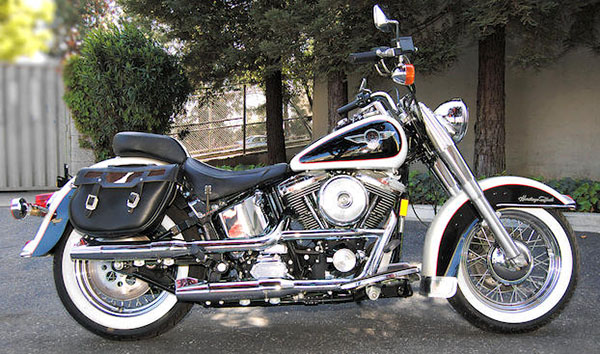
I need to provide some context here, and that entails telling you about two other vehicles. One is what might well be the most beautiful motorcycle Harley-Davidson ever made, and that’s the 1993 Heritage Nostalgia. Quickly dubbed the Moo Glide by whoever did the dubbing in those days, it was a stunning motorcycle. It was essentially a Heritage Softail, but what the Milwaukee maestros did was they painted the thing white with black panels, they dropped the windshield, they made the leather saddlebags smaller, and they left off the windshield.
Harley-Davidson didn’t stop there. The next steps were cowskin inserts on both the saddlebags and the seat, but it just wasn’t a brown leather insert. Nope, it was from whatever breed of cows have that black and white fur, and Harley left the fur on. It worked nicely with the bike’s black and white paint treatment. The motorcycle was stunning.
The 1993 Harley FLSTN, also known as the Moo Glide.
But wait. There’s more. The V-twin virtuosos had Dunlop add a new part number to their catalog, and that made the motorcycle a home run. The Dunlop dudes took the stock Harley blackwalls and added luxurious wide whitewalls. They (whoever “they” was) called them gangster whitewalls. You know, like Al Capone in a V-16 Cadillac or a Duesenberg. The effect was visually arresting. Literally. It stopped me in my tracks the first time I saw a Moo Glide. But I’ll get to that in a second.
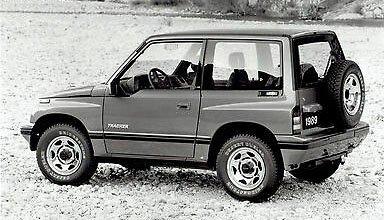
The second vehicle (remember, I said I needed to provide some context here) was my 1989 Geo Tracker. Well, actually, it was made by Suzuki, but GM did their badge engineering schtick and they sold it under the GEO Tracker label.
A 1989 Geo Tracker. Mine looked just like this. It was a great little truck.
I saw the very first one of these to arrive in So Cal at our local Chevy dealer, when I stopped to pick up a radiator hose for another Chevy I owned that needed, well, a radiator hose. I liked the Tracker immediately. It was small (a big plus), it was a 4×4 (that appealed to me), and it was a good-looking little truck. My stop for a radiator hose turned into a new car purchase.
As it turned out, I bought the very first Geo Tracker in southern California, and that got me on an early adopter marketing list. I’ve probably been paid to look at new concept cars from a half a dozen manufacturers maybe ten times over the years, but that’s a story for another time.
To get back to this story, I loved that Tracker and I really racked up the miles on it. That’s sort of the point where I’m going with this story. I got more miles out of a set of tires on that Tracker than any vehicle I’ve ever owned. I was at 78,000 miles on the Tracker’s original tires (Bridgestones, as I recall) and they were still going strong. My wife wanted me to get new tires just because of the miles. The Tracker was a small car, and in 1993, a set of tires just like the ones from the factory were $275. Nah, I told her, I can get another 10,000 miles out of these tires. I wasn’t going to spend $275 for tires if I didn’t need to. Money doesn’t grow on trees, I said, and $275 was a lot of money.
So, let’s get back to the point of this story, and that’s my Harley. I had my ’92 Softail in at Laidlaw’s for a scheduled service, and as I recall, I only had about 2,000 miles on its second set of tires. They were blackwalls, just like the bike came with from the factory. They had plenty of life left in them. But at Laidlaw’s I saw my first Moo Glide and my reaction was Wow!
Jerry Laidlaw saw me eyeing the Moo. He knew I wasn’t going to buy a new motorcycle so soon, but he also smelled blood in the water. “We have those gangster whitewalls in stock,” he said.
“How much?” I asked.
“$350 for the pair,” Jerry said.
I didn’t blink an eye. “Let’s do it!”
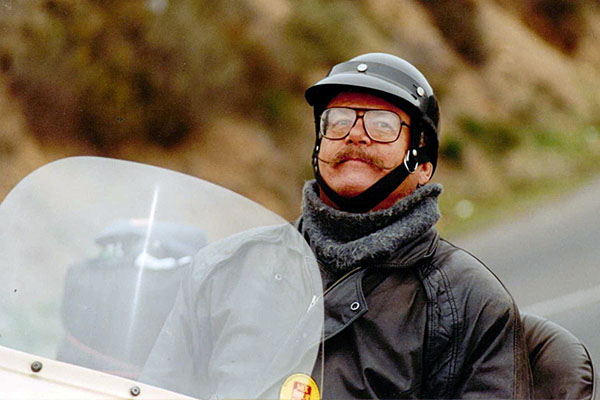
Yours truly, somewhere in Baja in the mid-’90s, proving that helmet hair is a real hazard if you have any hair at all. And yeah, with my gangster whitewalls.
I managed to get all the cables routed and connected. The electrical wiring is concealed inside the large diameter front down tube along with the clutch and throttle. Mini Motor Madness was looking sharp but there were still a few more details to attend.
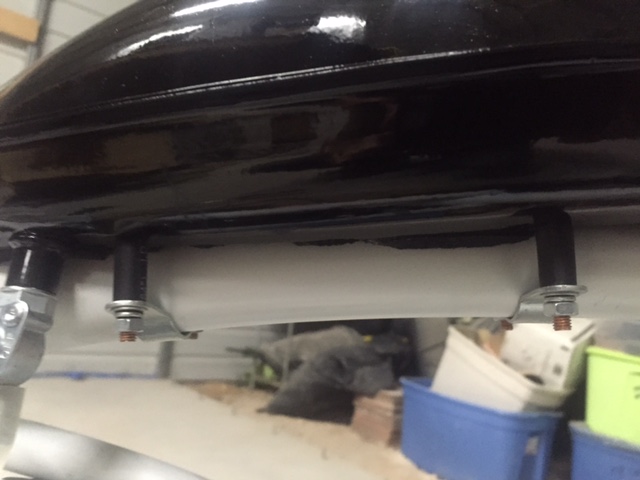
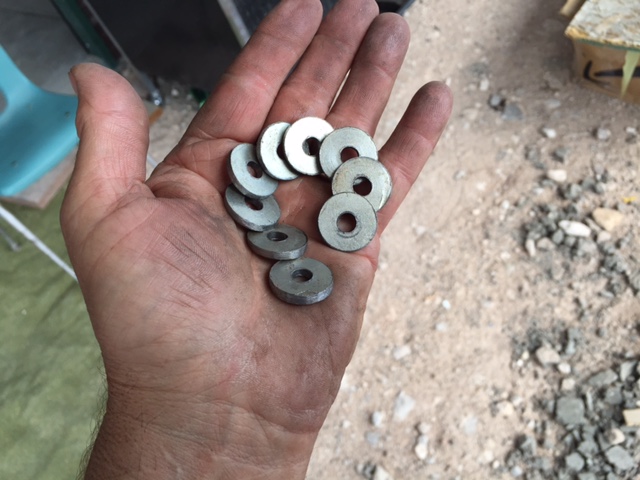
The cute little gas tank has studs spot-welded onto the underside of the tank. Thin brackets fit onto these studs and clamp the tank to the top frame tube. Except that the brackets are so thin they distort when tightened. The studs needed a few spacers to give the nuts something to tighten against.
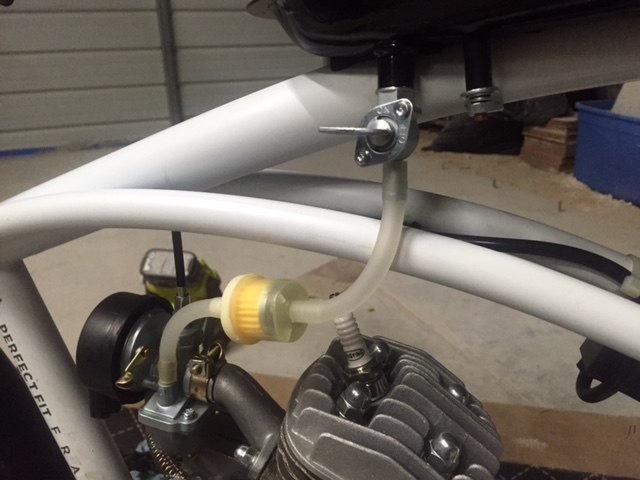
From there it was a simple matter to connect the supplied fuel line and filter. The fuel line feels like silicone, it’s very soft and flexible, I don’t think it will need clamps. The kit came with a rubber gasket for the fuel petcock but it looked like the gasket would squirt out the side when the petcock was tightened. I used Teflon tape instead. It hasn’t leaked so far. So many little pieces came with this kit. It really is complete.
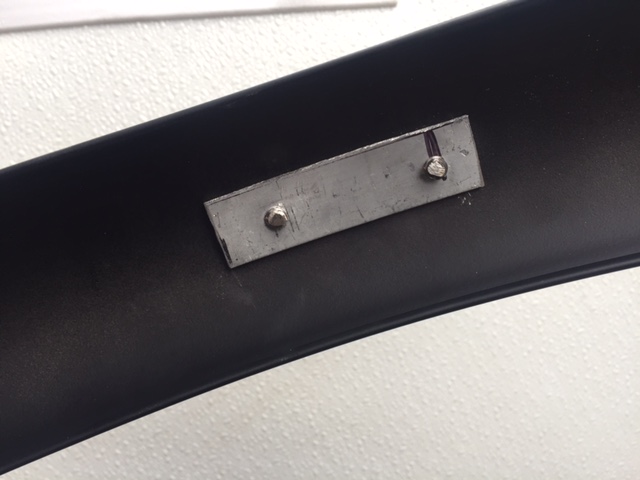
The Wal-Mart fender supports were made from ultra thin sheet metal. Just by looking at them I created a fracture. I cut some scrap L angle aluminum into braces and made a backing plate to spread the load a bit. Hopefully the fender won’t tangle in the wheel.
Long time Mini Moto Madness readers will recall the chain alignment issue I was having in an earlier episode. I meant to get back to the problem but the bike was nearly complete. I had to hear it run, man. I turned on the gas, pedaled down Tinfiny’s steep, rutted driveway, popped the clutch and the little motor fired right up. For about a second.
There was a loud grinding noise from aft and the rear wheel locked up. The chain, never really happy with the set up, was tangled in the rear wheel. It was so bad a 3-link section was missing! Luckily, the kit chain was extra long to suit many different bicycles and I was able to splice in a section, making sure to peen the pins after fitting.
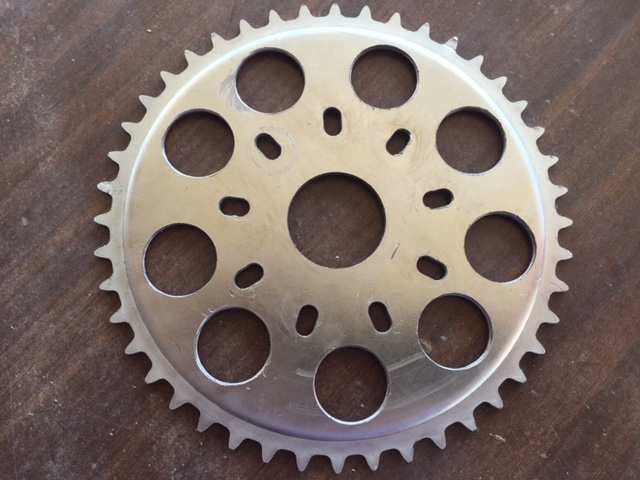
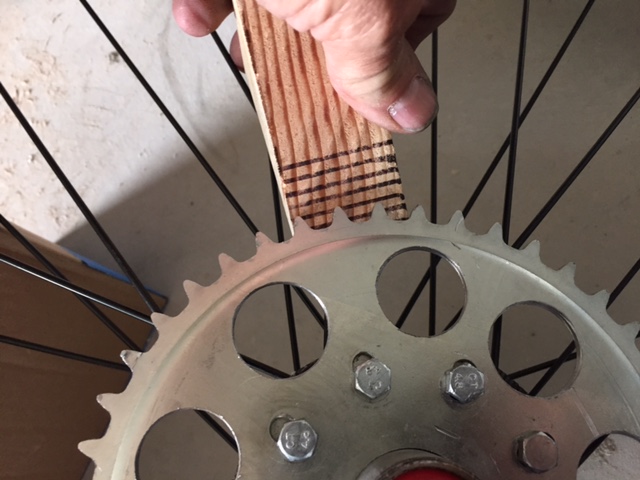
To ride this puppy I’d have to bite the bullet and take that damn rear sprocket off (again!) and fit spacers. Like I said earlier, this kit is complete. It had everything needed to shim the sprocket, although the shims were a little harder to access.
After butchering the sprocket for shim stock I reinstalled the rear sprocket. Now on their 3rd round trip the elastic stop nuts were losing elasticity but I was all in, I had to ride the beast. The sprocket was a tad wobblier than I remember but my patented sprocket-tuning tool allowed me to true up the mess to a reasonable level.
And it worked! The little beast fired up and settled into a retro idle, the smoke poured from the recommended 16:1 fuel mix ratio. I live in a steep, hilly area and the bike is geared too tall. I don’t know how fast it goes (that will have to wait for the full exhaustnotes.us road test) but it’s faster than any coaster brake bicycle should be going. The gearing would be ok in Florida but at 6000 feet elevation with 1st gear hills all around it’s Light Pedal Assist all the way.
I’ve ordered a 48-tooth sprocket to replace the stock 44 and my front brake should be here any day now. I’m calling this a win! The kit project is complete in my mind. So there! I finished one. The next phase will be modifications to make the rig suitable for my situation.
So I had my new Harley, a gorgeous blue ’92 Heritage Softail, and it was a shockingly beautiful motorcycle. Yeah, some of the styling touches were a little hokey, but in a good way. I never even knew what a concho was before I bought the Softail, but I knew after I owned it. I became a Harley-riding cowboy. The conchos made the bike complete. How I ever made it to 40 without conchos I’ll never know. I had them now, though, and they just looked right. My Softail was a fashion statement. It made me look good and it made me feel good. I loved that bike.
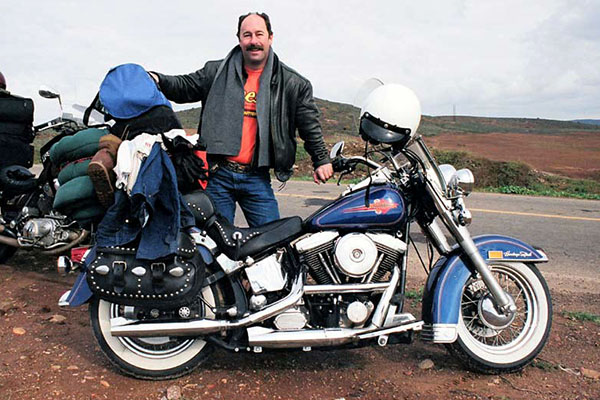
My ’92 Softail on a Baja ride to San Felipe. Good buddies Baja John and Marty rode with me on that one. Those gangster whitewalls? That’s a story for another blog.
There was only one problem, and it was a big one: The Softail was a dawg. It was a 700-lb lump that couldn’t get out of its own way. I’ve already spoken about how unreliable my ’79 Electra-Glide was, but that old clunker would get up and choogy, and it would have walked away from my new ’92 Softail in a drag race. I mean, the thing was slow. When I gave it more throttle going up a hill, it seemed like the only result was a deeper moan. It sure didn’t go any faster.
I worked in El Monte in those days and the nearby dealer was a famous one in southern California, Laidlaw’s, and I felt comfortable with them. I knew Bob Laidlaw, their founder, and I knew his son Jerry, and I knew both to be straight shooters. When it was time for the Softail’s first service at 500 miles, that’s where I went. Laidlaw’s has since moved to a larger, more modern facility in a better neighborhood, I’m guessing at Harley-Davidson’s insistence, and it’s still a great place. But I liked the old location better. Like I described for Dale’s in the last blog about buying my ’92, the old Laidlaw’s facility had that crusty old motorcycle shop schtick, and I liked that. You know, grease on the floor, a funky shop area, and guys who looked like their lives revolved around motorcycles and tattoos. Guys with calibrated arms who knew how much torque to apply to a 9/16 by feel alone.
I went to Laidlaw’s on an overcast Saturday morning for that first service, and Jerry wrote the service order. After completing it, he looked at me and asked: Anything else?
“Yeah,” I said. “The thing’s a dog.”
Jerry smiled. He knew. This wasn’t his first rodeo.
“They lean them out pretty good from the factory,” he said.
“So what do guys do?” I asked.
Another Jerry smile. “Well, most guys get a new cam, punch out the pipes, rejet the carb, and put the Screaming Eagle air filter in.”
“How much is that?” I asked. I could see this smoking past another $1500 without stopping to look back.
“It’s about $500,” Jerry answered. Hmmm, that wasn’t as bad as I thought it would be.
“So how much would everything be,” I said. “You know, the 500-mile service and the cam and carb and pipes and all the rest?”
“It’s $500 for everything,” Jerry answered, “including the 500-mile service.”
I could hardly believe what I was hearing.
“Let’s do it,” I said. I mean, I know a good deal when I see one. I hung around, as Jerry told me the whole thing would be a couple of hours. In the meantime, it had started raining, and I had no raingear. I walked across the street to some sort of an Army-Navy-99-cent store and bought a $3 rain suit.
In those days, it was no big deal to hang around in the service area and watch the techs work on your bike. The guy who was working on mine was a long-haired dude with lots of tattoos and a friendly smile. He held this giant steel toothpick-looking sort of tool that was essentially a ¾-inch-diameter rod sharpened to a point in one hand, and in his other hand he had a sledge hammer. He stuck the persuader into the end of one of my fishtail mufflers and whacked it with the sledge hammer. Then he repeated the process on the other fishtail. With a big grin, he said, “Adios, baffles!”
Then it was the carb work and the air cleaner replacement. And then it was the Screaming Eagle cam, which actually was pretty easy to install in the chrome cone on the right side of the engine. Then he buttoned it all up.
I finished my cup of coffee, donned my el cheapo raingear, paid my bill, and fired up the Harley.
Good Lord!
It was a completely different motorcycle. It sounded way better than it had before the Screaming Eagle cam work and exhaustectomy. It had been transformed from a smothered, anemic, pathetic, wheezing sort of thing into living, breathing, fire-snorting, spirited motorcycle. It reeked raw power and it had attitude. The idle was lopey and assertive, like a small block Chevy with an Isky cam and Hooker headers. My Harley rocked back and forth on its axles with each engine rotation. It was telling me: Let’s go! I think I’m pretty good at turning a phrase and I’m doing my best here, folks, but trust me on this: It’s hard to put into words how complete and total my Harley’s transformation was. It kind of reminded me of the first time I ever threw a leg over a Triumph Bonneville (I was 14 when that happened, and when Laidlaw’s tuned my Softail I was 14 all over again).
So I rolled out into the rain for my 30-mile ride home and I was afraid to whack the throttle open. I thought the rear wheel would break loose on the wet pavement; it felt that powerful. The rain and the clouds, I think, made the Harley’s Exhaust Notes (love that phrase) sound way mo better. I was there, man.
The year was 1991, and the last thing in the world I was thinking about was buying another motorcycle, and within the confines of that thought, the very, very last thought I would have ever had was buying a Harley-Davidson. I had previously owned a ’79 Electra-Glide I bought new in Texas, and that bike was a beautiful disaster. I called it my optical illusion (it looked like a motorcycle). I wrote about the bad taste it left in an earlier blog. Nope, I’d never own another Harley, or so I thought when I sold it in 1981.
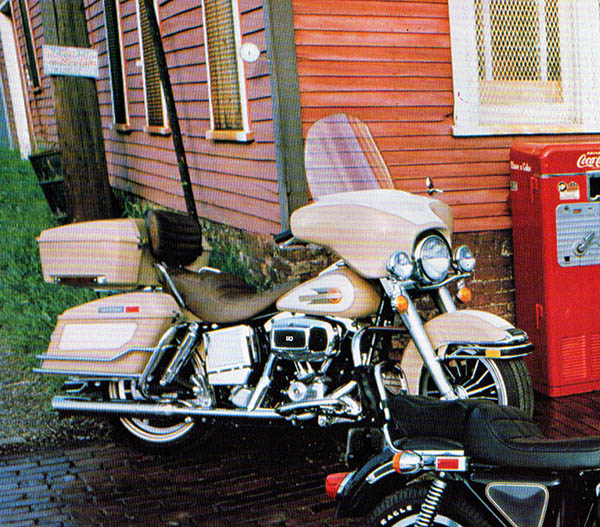
My ’79 Electra-Glide Classic, as shown in the 1979 Harley catalog. It was the most unreliable and most beautiful motorcycle I ever owned. I wish I still had it.
But like the title of that James Bond movie, you should never say never again. I was a big wheel at an aerospace company in 1991 and I was interviewing engineers when good buddy Dick Scott waltzed in as one of the applicants. I had worked with Dick in another aerospace company (in those days in the So Cal aerospace industry, everybody worked everywhere at one time or another). Dick had the job as soon as he I saw he was applying, but I went through the motions interviewing him and I learned he had a Harley. DIck said they were a lot better than they used to be and he gave me the keys to his ’89 Electra-Glide. I rode it and he was right. It felt solid and handled way better than my old Shovelhead.
Dick Scott on his ’89 Electra-Glide. The day after I took this photo in Baja, Dick died when he crashed his motorcycle.
That set me on a quest. I started looking, and after considering the current slate of Harleys in 1991, I decided that what I needed was a Heritage Softail. I liked the look and I thought I wanted the two-tone turquoise-and-white version. The problem, though, was that none of the Harley dealers had motorcycles. They were all sold before they arrived at the dealers, and the dealers were doing their gouging in those days with a “market adjustment” uptick ranging from $2000 to sometimes $4000 (today, most non-Harley dealers sort of do the same thing with freight and setup). There was no way in hell I was going to pay over list price, but even had I wanted to, it would have been a long wait to get a new Harley.
One day while driving to work, a guy passed me on the freeway riding a sapphire blue Heritage softail, and I was smitten. Those colors worked even better for me than did the turquoise-and-white color combo. The turquoise-and-white had a nice ‘50s nostalgia buzz (it reminded me of a ’55 Chevy Bel Air), but that sapphire blue number was slick. Even early in the morning on Interstate 10, I could see the orange and gray factory pinstriping, and man, it just worked for me. It had kind of a blue jeans look to it (you know, denim with orange stitching). That was my new want and I wanted the thing bad. But it didn’t make any difference. Nobody had any new Harleys, and nobody had them at list price. I might as well have wanted a date with Michelle Pfeiffer. In those days, a new Harley at list price or less in the colors I wanted (or in any colors, actually) was pure unobtanium.
The Harley Softail I bought at Dale’s Modern Harley. I negotiated a hell of a deal. I kept that Harley for 12 years and rode the wheels off the thing. I’ve since learned how to pack a little better.
So one Saturday morning about a month later, I took a drive out to the Harley dealer in San Bernardino. In those days, that dealer was Dale’s Modern Harley (an oxymoronic name for a Harley dealer if ever there was one). Dale’s is no more, but when it was there, it was the last of the real motorcycle shops. You know the drill…it was in a bad part of town, it was small, everything had grease and oil stains, and the only thing “modern” was the name on the sign. That’s what motorcycle dealers were like when I was growing up. I liked it that way, and truth be told, I miss it. Dealerships are too clean today.
Anyway, a surprise awaited. I walked in the front door (which was at the rear of the building because the door facing the street was chained shut because, you know, it was a bad part of town). And wow, there it was: A brand new 1992 Heritage Softail in sapphire blue. Just like I wanted.
Dale’s had a sales guy who came out of Central Casting for old Harley guys. His name was Bob (I never met Dale and I have no idea who he was). Bob. You know the type and if you’re old enough you know the look. Old, a beer belly, a dirty white t-shirt, jeans, engineer boots, a blue denim vest, and one of those boat captain hats motorcycle riders wore in the ‘40s and ‘50s. An unlit cigarette dangled from one corner of his mouth. His belt was a chromed motorcycle chain. I’d been to Dale’s several times before, and I’d never seen Bob attired in anything but what I just described. And I’d never seen him without that unlit cigarette. Straight out of Central Casting, like I said.
“What’s this?” I asked Bob, pointing at the blue Softail.
“Deal fell through,” Bob answered. “Guy ordered it, we couldn’t get him financing, and he couldn’t get a loan anywhere else.”
“So it’s available?” I asked.
“Yep.”
Hmmm. This was interesting.
“How much?” I asked.
“$12,995, plus tax and doc fees,” Bob answered, walking back to his desk at the edge of Dale’s very small showroom floor.
$12,995 was MSRP for a new Heritage Softail back in 1992. That would be a hell of a deal. Nobody else in So Cal was selling Harleys at list price.
I followed Bob to his desk and sat down. I was facing Bob and the Harley was behind me. Bob was screwing around with some papers on his desk and not paying any particular attention to me.
“I’ll go $11,500 for it,” I said.
Bob looked up from his paperwork and smiled.
“Son,” he said (and yeah, he actually called me “son,” even though I was 40 years old at the time) “I’m going to sell that motorsickle this morning. Not this afternoon, not next week, but this morning. The only question is: Am I going to sell it to you or am I going to sell it to him?”
Bob actually said “motorsickle,” I thought, and then I wondered who “him” was. Bob sensed my befuddlement. He pointed behind me and I looked. Somebody was already sitting on what I had started regarding as my motorsickle. That guy was thinking the same thing I was.
“Bob,” I began, “you gotta help me out here. I never paid retail for anything in my life.”
“That’s because you never bought a new ’92 Harley, son, but I’ll tell you what. I’ll throw in a free Harley T-shirt.” I couldn’t tell if he was joking or if he was trying to insult me, but I didn’t care.
I looked at the Harley again and that other dude was still sitting on it. On my motorcycle. And that’s when I made up my mind. $12,995 later (plus another thousand dollars in taxes and doc fees) I rolled out of Dale’s with a brand-new sapphire blue Harley Heritage Softail. And one new Harley T-shirt.
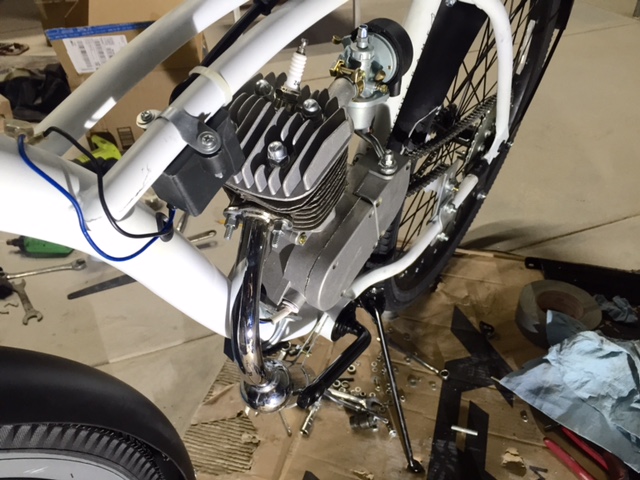
Not only do I rarely finish projects, it takes forever for me not to finish them. I’m a slow worker. I get bogged down in details and miss the big picture. Details like the front engine mount on Mini Moto Madness. The front down tube on the Huffy is a large diameter pipe and the smaller, cast in semi-circle on the engine crankcase will not fit. The engine kit comes with a steel adapter plate and a U-bolt that fits the fat tube but the thing looks like hell.
I got to thinking and planning, figuring on a chunk of aluminum to fit the two different pipe diameters, holes drilled, cuts made, longer bolts, it was getting out of hand, man. This time I was able to catch myself. What the hell am I doing? Every other mini motor I looked at used the stock mounting plates so I said, “Screw it.” and went with the popular choice. Right there is a two-day labor saving decision.
With the motor firmly in place I spent some time on the chain drive. The rear fender came in contact with the chain so I had to trim it and roll the sharp edge. It’ll need a paint job and stronger brackets but I’m going to wait until the mechanical is done before tackling cosmetics.
It’s almost impossible to get two chains to agree on length so the mini motor kit comes with an idle roller for tension adjustment. The idler also turns the chain angle upwards before the lower frame tubes get narrow, keeping the chain from rubbing. I don’t like the thing but I’m not sure what to do about it. My rear sprocket is slightly misaligned; the chain doesn’t jump off the sprocket but it sure favors the hub side. To center the chain the rear sprocket needs to go outboard 1/16” so that means making a spacer and reassembling the sprocket onto the wheel. I’m also considering adjusting the countershaft sprocket instead. I’ve decided to deal with this situation later.
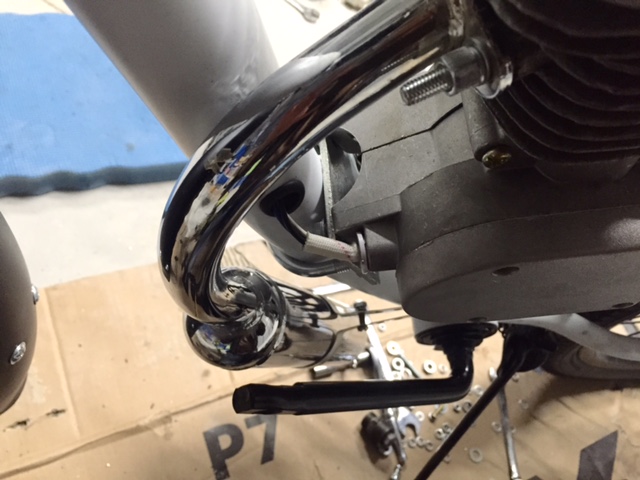
The pretty chrome exhaust pipe didn’t quite clear the Huffy’s crank arms. I didn’t want to mess up the chrome by cutting and welding the pipe so instead clamped the exhaust flange in the vise and twisted the pipe a few degrees. The pipe twisted beautifully with no wrinkles or kinks. The crank arms clear with room to spare. Sadly, the chrome plating did not go along with the program and delaminated. Pro Tip: Buy the kit with the black painted exhaust. It’s easier to modify for your particular bike.
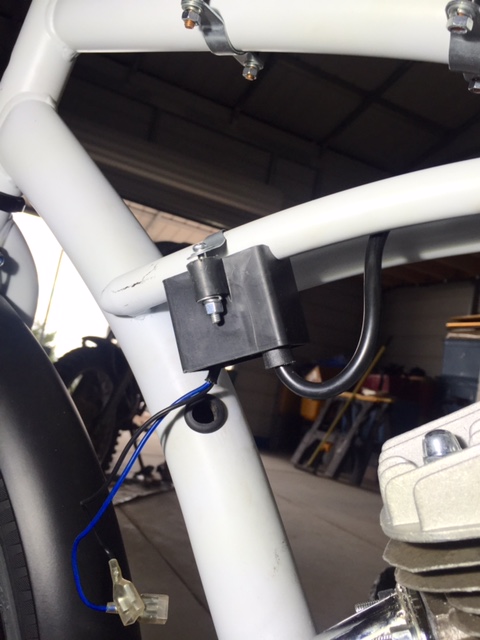
The ignition coil was a straightforward install. I’ve upped the difficulty rating by routing the wiring through the frame. Most of these bike builds look cluttered with wires and cables. I’ll run the controls inside the frame as much as possible.
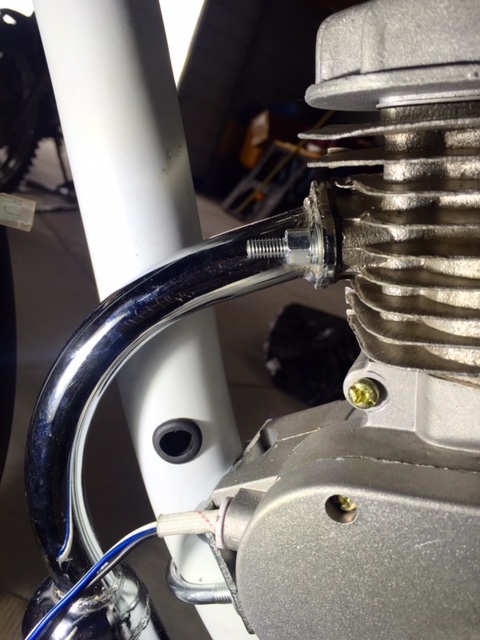
The rotor output wiring will also run internally. I’m sure this will end in tears but I saved a lot of time not fabricating a front engine mount so I’m using that time credit to tidy up the job.
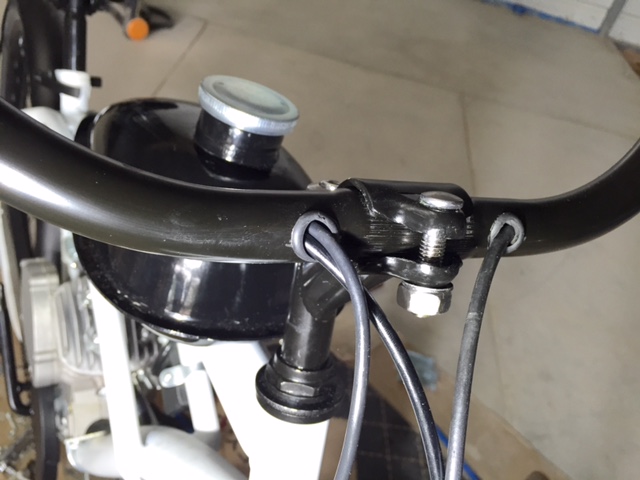
The other sloppy area on these builds is the handlebar. Unlike a motorcycle, there is no speedometers or bodywork to hide the throttle/clutch/kill wiring. I’ve drilled holes and snaked the stuff through the bars. It looks cleaner to me. Yes, I’ve weakened the handlebars. I’m willing to risk a crash from structural failure in support of aesthetics. We are all artists and it’s about time we started living like it.
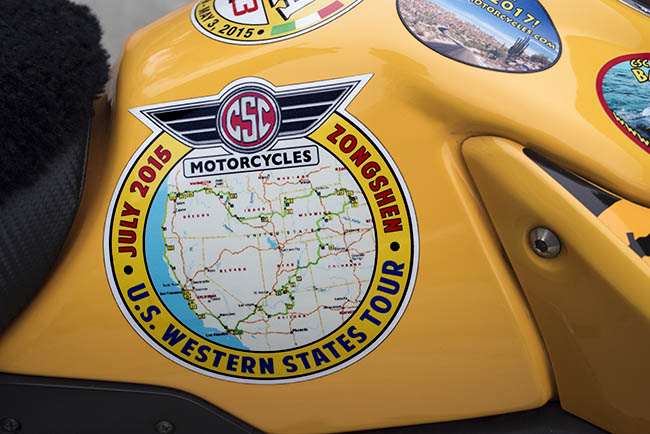
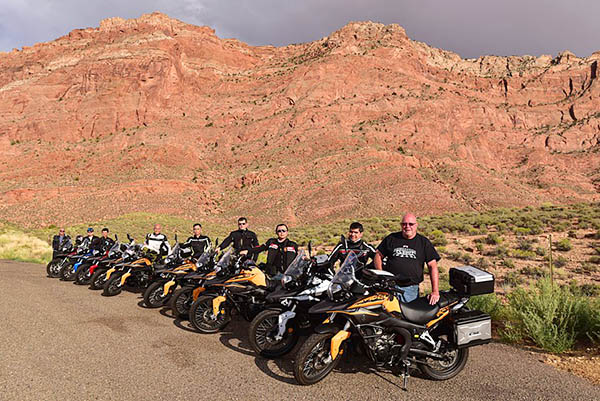
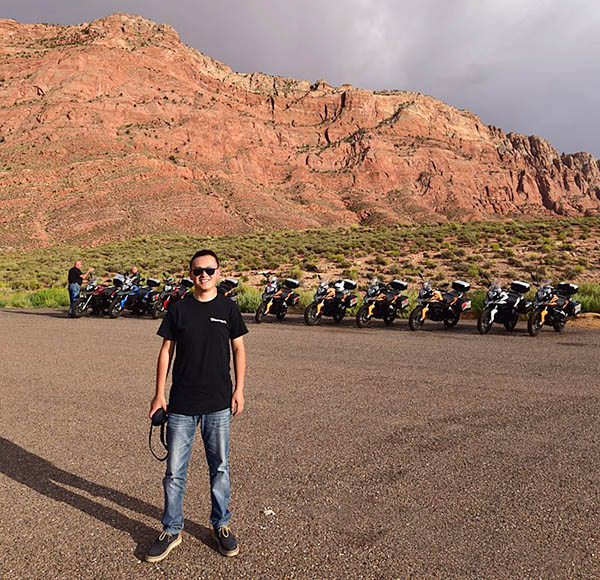
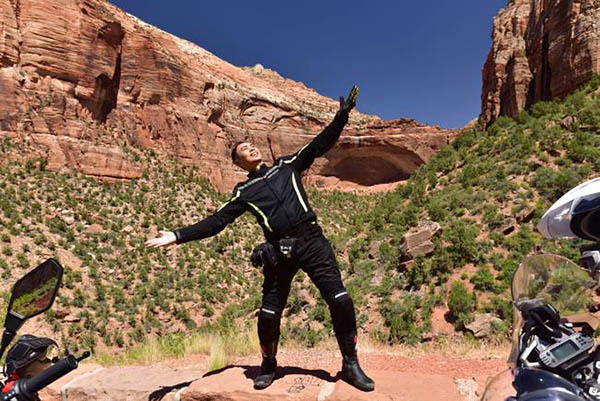
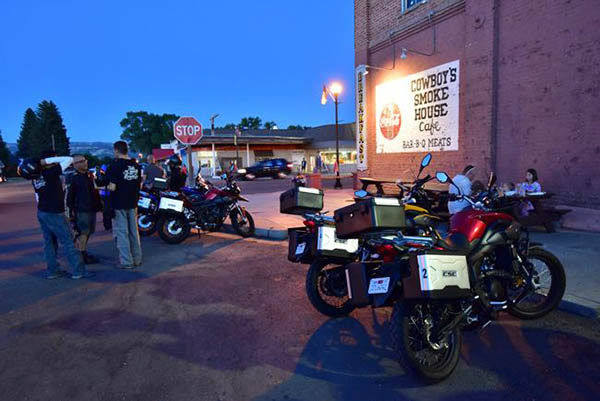
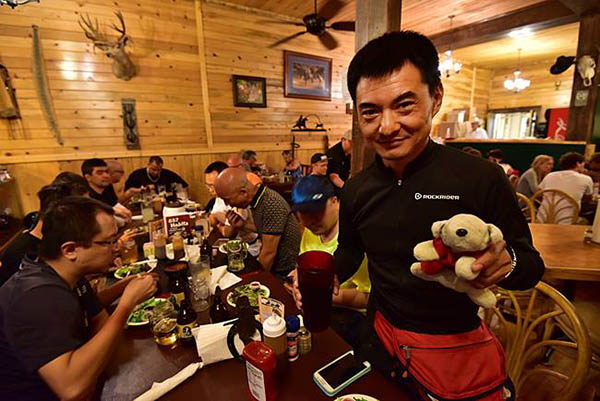
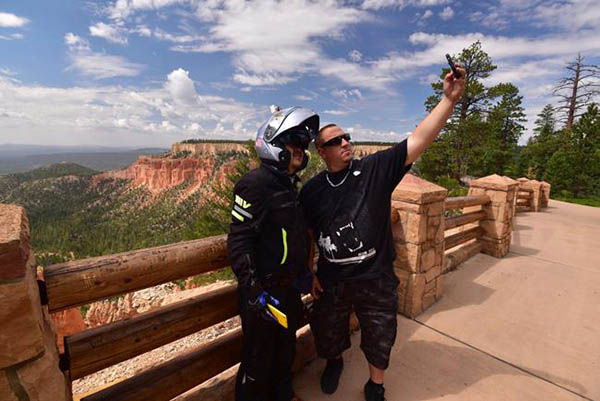
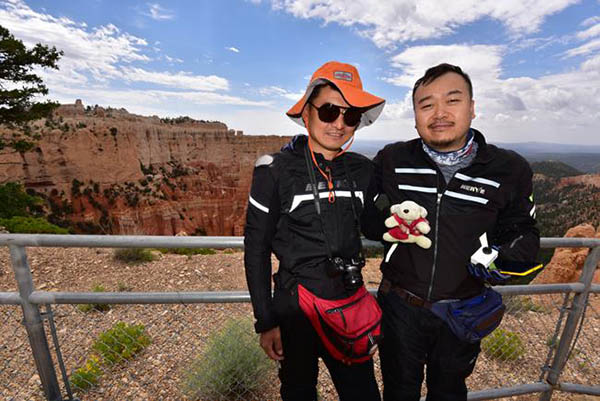
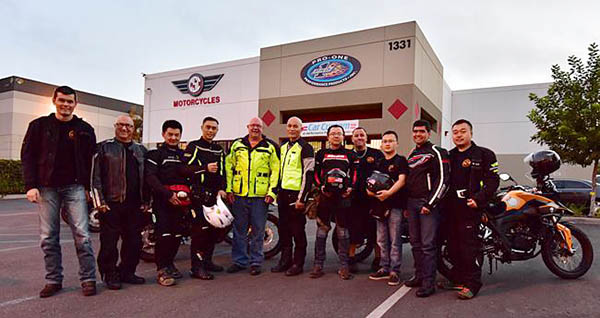
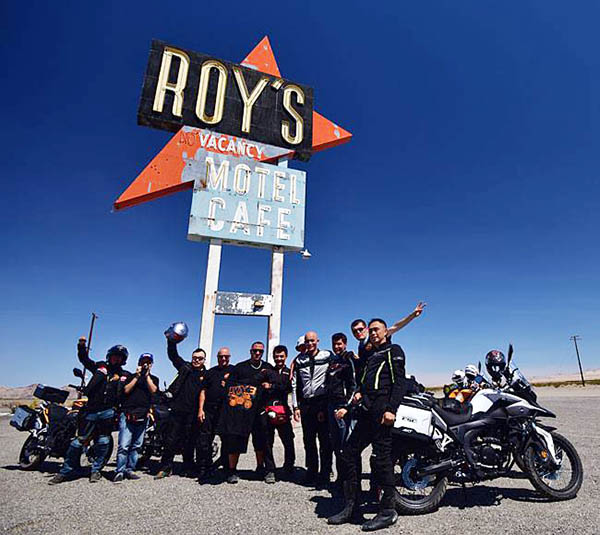
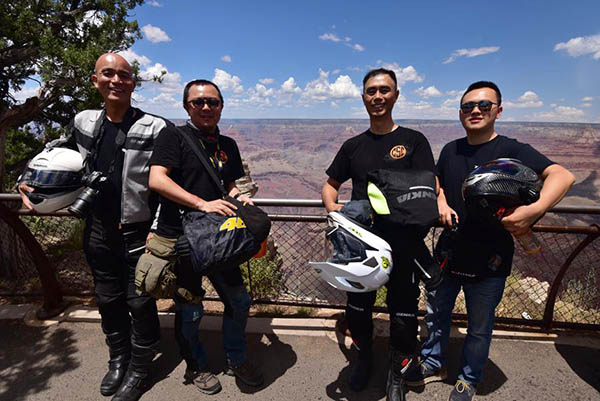
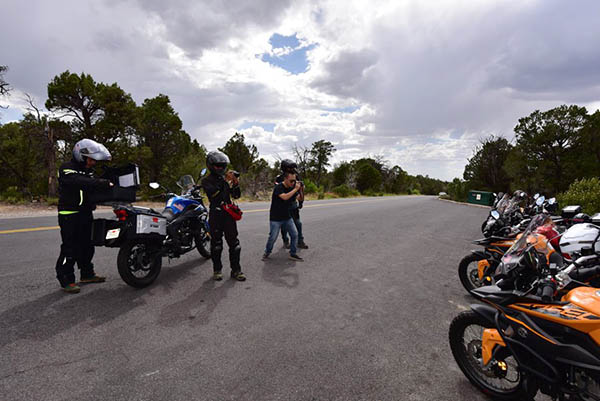
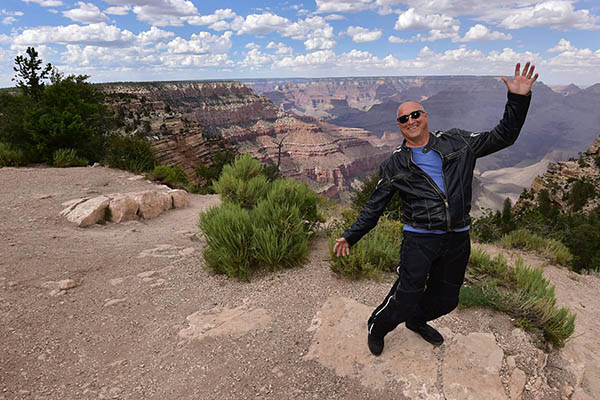
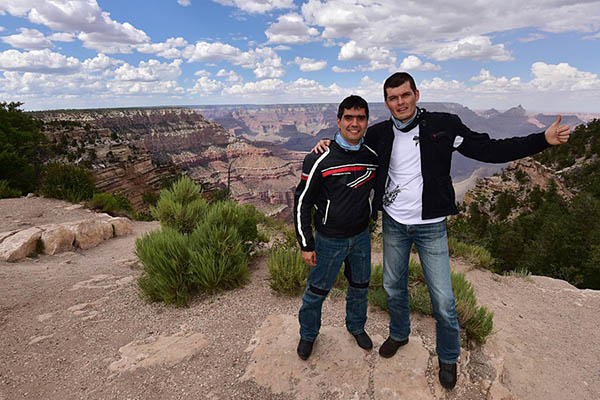
That was my reaction when the photos you see below popped up on my Facebook feed, telling me it had been four years since I posted them. Yep, it was in July of 2015 that yours truly, Joe Gresh, and riders from China and Colombia descended on CSC Motorcycles to christen the RX3 with a ride through the great American West. So Cal to Sturgis, due west to Washington and Oregon, and then a run down the coast home, hitting every National Park and site worth seeing along the way. It was an amazing adventure, and truth be told, I was shocked that it has been four years already. That meant it was about four years ago that CSC brought the RX3 to America, it was four years ago that I first met Joe Gresh in person (a living legend, in my mind), and it was four years ago that we took a ride that made the entire motorcycle world sit up and take notice. A dozen guys, a dozen 250cc motorcycles fresh off the boat from China, 5000 miles, and not a single breakdown. Tell me again about Chinese motorcycles are no good? Nah, don’t waste your breath. I know better.
It was a hell of a ride, and good buddy John Welker did a hell of a job as our very own Ferdinand Magellan, defining the route, making all of the hotel reservations, keeping us entertained with great stories, and more. These are the same photos (I took them all) that popped up on Facebook. They represent only a small portion of the ride, but they give you an idea of what it was like. It was grand.
Somewhere along Highway 89 in Arizona. The guy in the foreground is our very own Baja John Welker. That’s Joe Gresh way at the other end of this row of motorcycles.Same location, with Hugo out front. Hugo is the Zongshen factory rep. He’s a great guy who kept us constantly entertained.Mr. Tso, posing for me in Zion National Park. This guy makes for a great photograph. He rode with us in China, too!We stayed in Panguitch, Utah, the night before we visited Bryce Canyon National Park. Dinner that evening was at the Cowboy’s Smoke House. I liked it so much I later returned with my wife just to have dinner there.Tony and his mascot inside Cowboy’s. Great times.Bryce Canyon National Park. Everyone was captivated by this place. It was awesome.Kyle, one of the Chinese riders, and Big John, our chase vehicle driver. Good guys both.Tony and Kyle, posing at Bryce.The crew when we returned to So Cal. From left to right, it’s Juan from Colombia, Joe Gresh, Tony from China, Mr. Tso from China, John Welker, Lester from China, Kong from China, Big John Gallardo, Hugo Liu, Gabriel from Colombia, and Kyle from China.The obligatory photo at Roy’s in Amboy, somewhere in the Mojave Desert. God Almighty it was hot that day.The guys at the Grand Canyon…Lester, Kong, Tso, and Hugo.In Capitol Reef National Park in Utah, at an impromptu photo stop.I grabbed this photo of Joe Gresh along the South Rim of the Grand Canyon. It looks like he’s Photoshopped into the picture, but he’s not.Same spot, different guys: Gabriel and Juan from Colombia. Juan later invited me to ride with him in Colombia, and I went. That, too, was an incredible ride.
So there you have it, or at least snippets of what was one of the greatest rides I’ve ever done. I’m hoping Facebook has more of these anniversary photos pop up for me, as the ride lasted 19 days and I know I posted more on that ride. Good times. Great riders. Superior camaraderie.
As always, there’s more good stuff coming your way. Stay tuned!
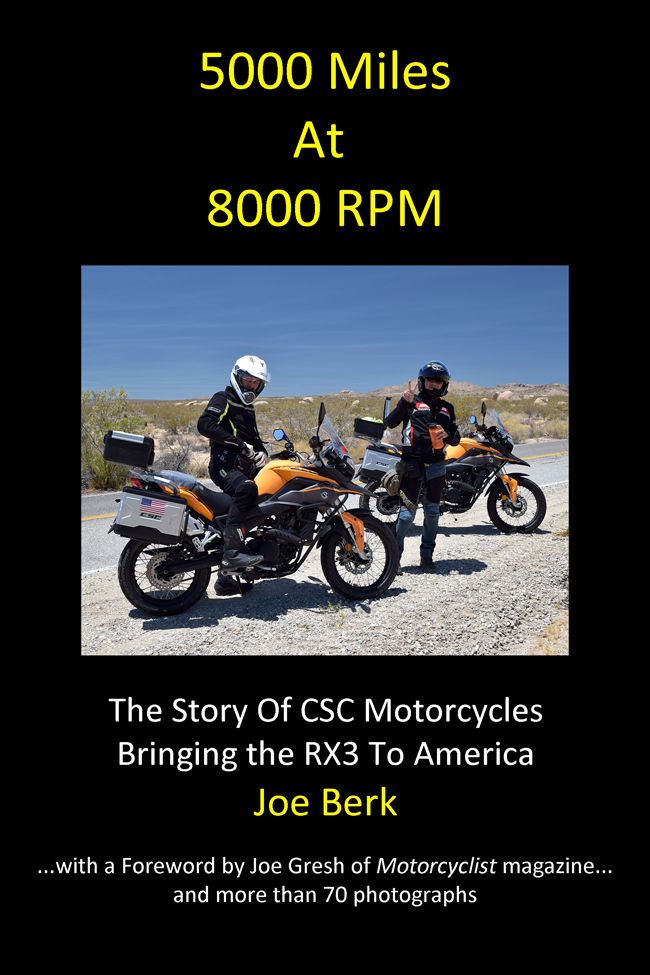
Hey, the whole story of that ride is here. You can get the whole nine yards by buying your own copy of 5000 Miles At 8000 RPM. There’s a lot more good information in there, too, like CSC’s no-dealer approach to market, how we dealt with the Internet trolls who tried to hurt the company, the first CSC Baja trip, the RX3’s strengths and weaknesses, and much, much more!
A Remington Model 700 BDL Varmint gun in .223. I spotted this at the Gunrunner in Duarte, and it followed me home.
There’s gun stores, and then there’s gun stores. I can’t pass a gun store without stopping in. The issue is that most gun shops today are soulless retail outlets with black plastic. Glocks, ARs, you get the idea. Guns with no soul and gun shop owners with even less. But there are exceptions. One that comes to mind is the Gunrunner in Duarte. It’s a favorite, partly because the team working there consists of older guys a lot like myself (crusty, maybe carrying a few pounds more than they should be, and a sense of humor). But it’s mostly because they get it. “It” being, of course, blue steel and walnut. And military surplus rifles. I can’t drive by Gunrunner’s without stopping in. You never know what they might have in stock, and even if I don’t buy anything, it’s always fun looking.
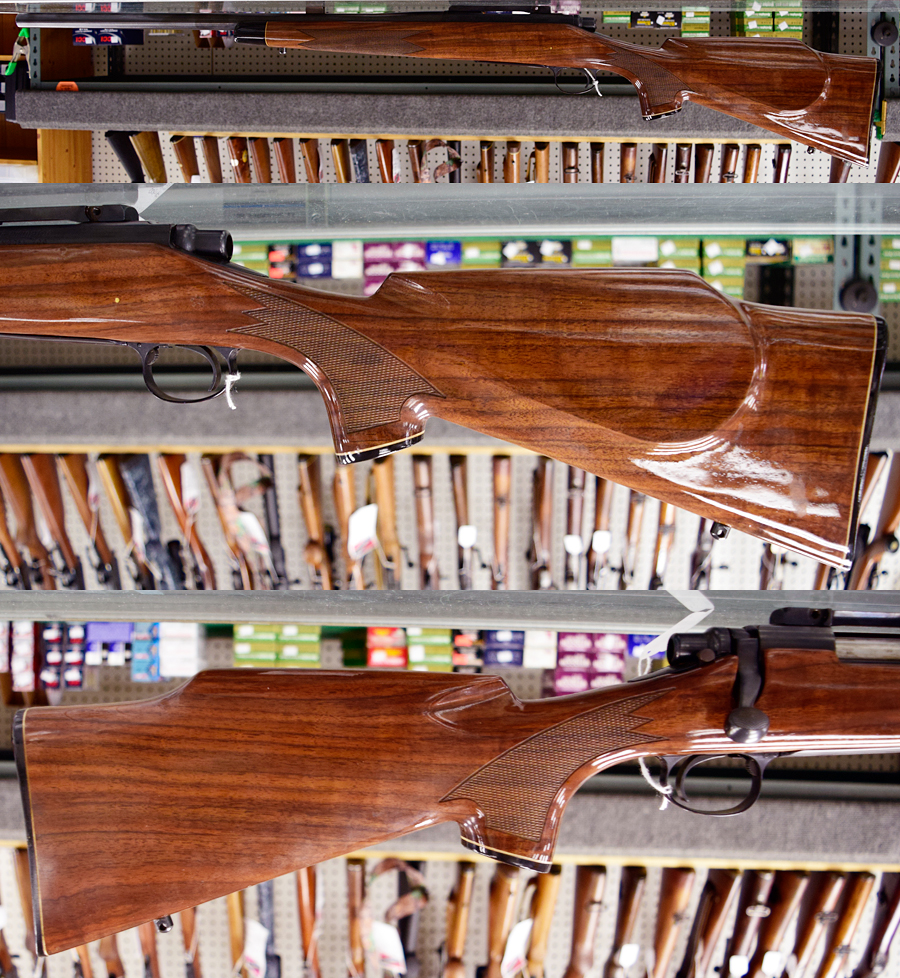
One day a few years ago on just such a stop, I noticed an older Remington Model 700. It was the varmint model and it had a price that was just too good to walk away from. And the photos don’t do it justice. It had a real contrasty bit of walnut with horizontal dark stripes that were unusually nice on a production gun. As the saying goes, I pulled the trigger. I bought the rifle for a scant $400, which I thought was a hell of a deal (I think new ones are about a thousand bucks now).
The Remington was pretty well gummed up with old oil (so much so the firing pin and trigger were stuck), and the standard M-700 BDL high gloss urethane finish was going south in a big way. I took the barreled action out of the stock and gave it a thorough cleaning. Then I spent hours on the stock with 0000 steel wool.
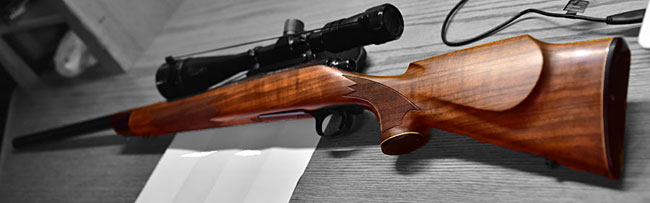
When I was finished, I was pleased with the results. The rifle looked way better than it did with the original high gloss finish (which never really appealed to me…it was too Hollywood for my tastes). The stock had a few nicks and scratches before; after the refinish, those completely disappeared. It became a thing of great beauty with a nice, subdued, European look. I grabbed a few shots, and then I played with them a bit in Photoshop to subdue the background and highlight the rifle. I like how the rifle and this photo in particular turned out…
The results of 0000 steel wool and a bit of work on my Model 700 Varmint rifle.
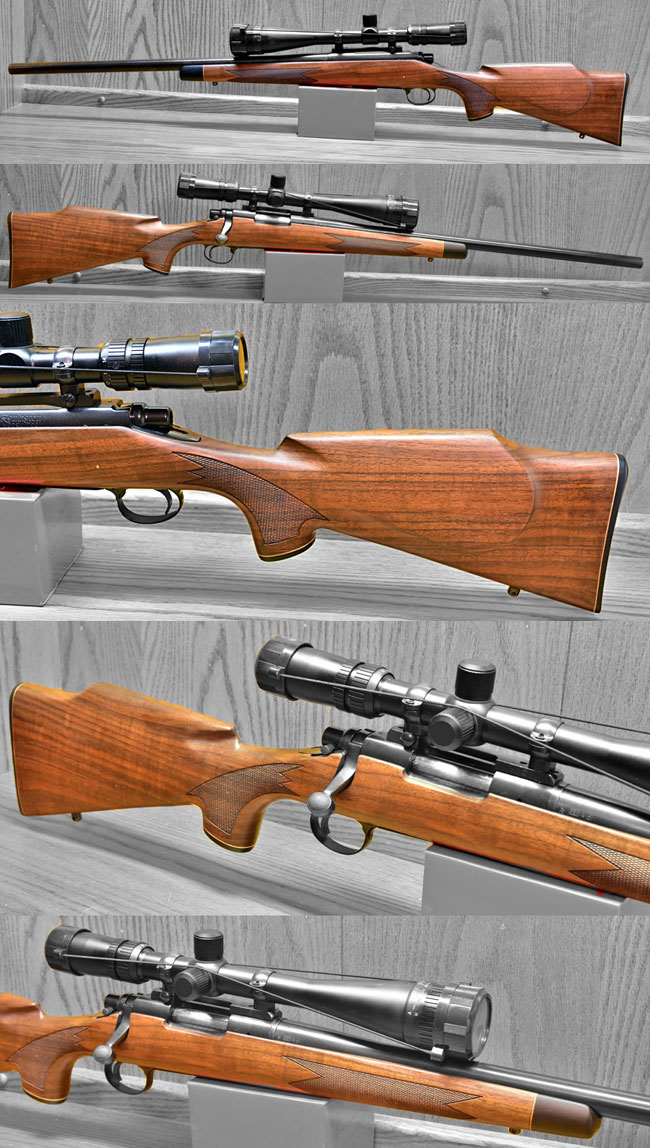
I mounted an inexpensive Tasco 6×24 scope on the Model 700. I wasn’t wild about the scope, as it didn’t seem to be able to focus the reticle and the target simultaneously (or maybe it was just my old eyes). A new Weaver or a Leupold might have been in order, but the results with this resurrected old warhorse were still outstanding. The rifle shot into an inch at 100 yards before I did any load development (which wasn’t too shabby) with what I regarded as junk .223 ammo.
More photos of the Model 700 after refinishing and with the new Tasco mounted.
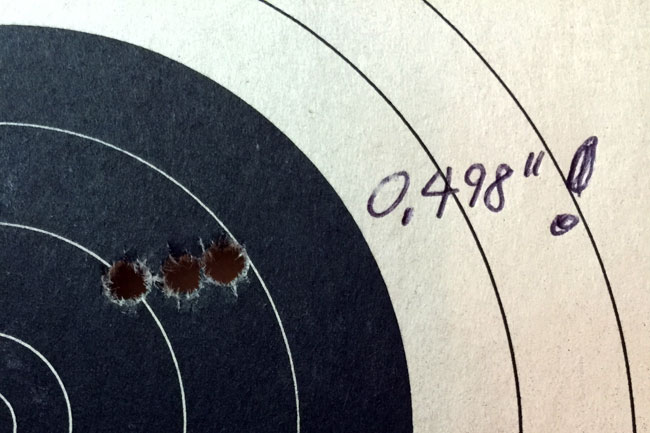
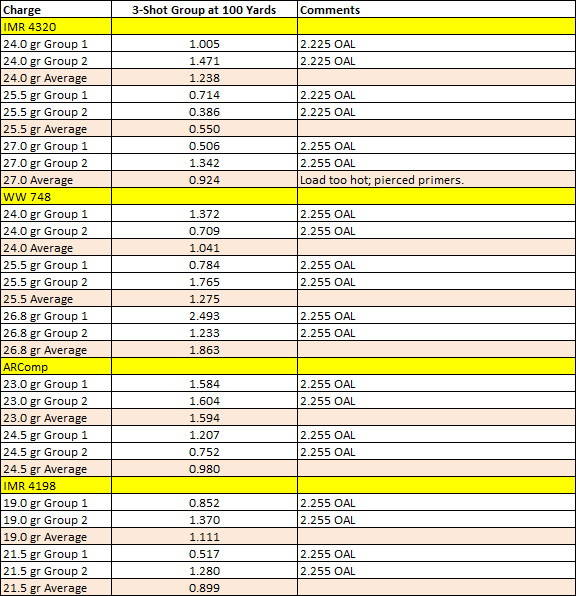
I went to work on developing a load to get the rifle to shoot into a half-inch, and I succeeded: I broke the half-minute-of-angle barrier with a 0.498-inch three-shot group almost immediately!
A half-minute of angle!
That was with IMR 4320 propellant, and it prompted me to try several different propellants and charge weights:
Load results for the Model 700 .223 Remington. All of the above loads used the Hornady VMax 55 grain bullet. You should always start at the low end of the charge range and work up; do not simply take my accuracy loads and try them in your rifle!
You might think that with the above results the rifle was a keeper. It was, but not for me. A couple of my shooting buddies wanted it, and I transferred it to a good friend for what I had into it.


 2×7 on another auction site. Weavers are good scopes and the ones from the 1970s were blued steel and made in America. It was just what the doctor ordered, and it looks right at home on my B78.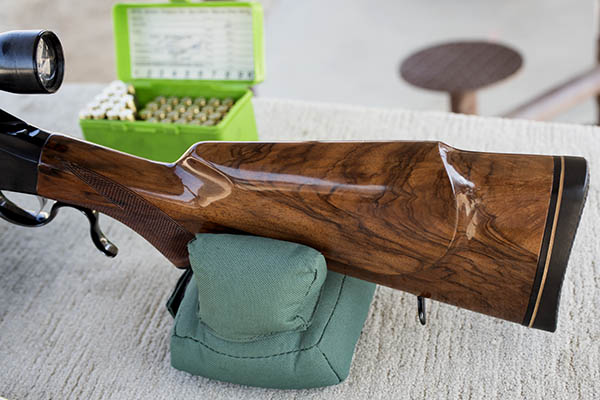
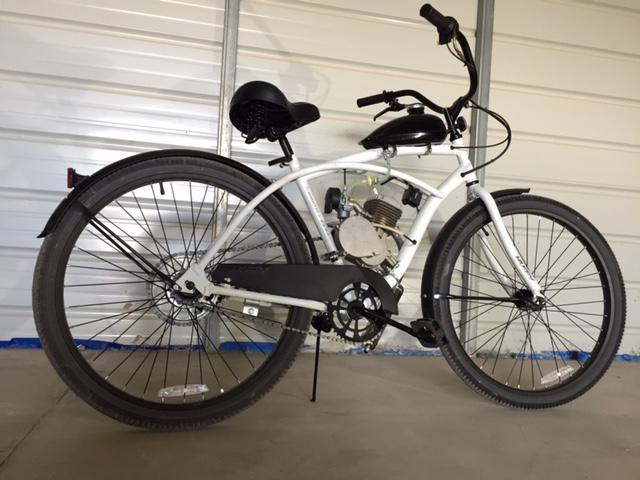 I managed to get all the cables routed and connected. The electrical wiring is concealed inside the large diameter front down tube along with the clutch and throttle. Mini Motor Madness was looking sharp but there were still a few more details to attend.
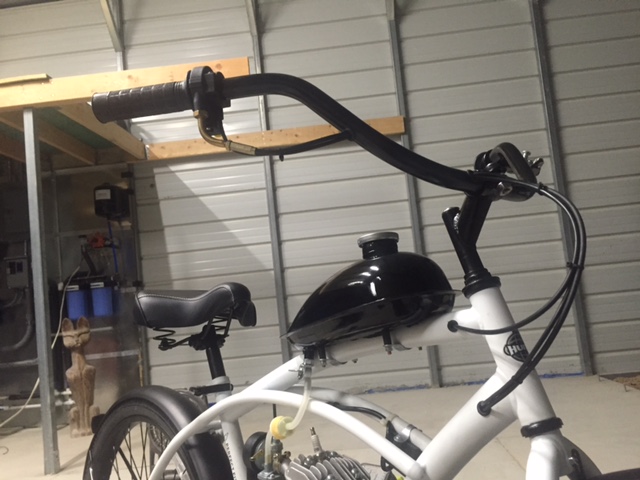 The cute little gas tank has studs spot-welded onto the underside of the tank. Thin brackets fit onto these studs and clamp the tank to the top frame tube. Except that the brackets are so thin they distort when tightened. The studs needed a few spacers to give the nuts something to tighten against.
 From there it was a simple matter to connect the supplied fuel line and filter. The fuel line feels like silicone, it’s very soft and flexible, I don’t think it will need clamps. The kit came with a rubber gasket for the fuel petcock but it looked like the gasket would squirt out the side when the petcock was tightened. I used Teflon tape instead. It hasn’t leaked so far. So many little pieces came with this kit. It really is complete.
 The Wal-Mart fender supports were made from ultra thin sheet metal. Just by looking at them I created a fracture. I cut some scrap L angle aluminum into braces and made a backing plate to spread the load a bit. Hopefully the fender won’t tangle in the wheel.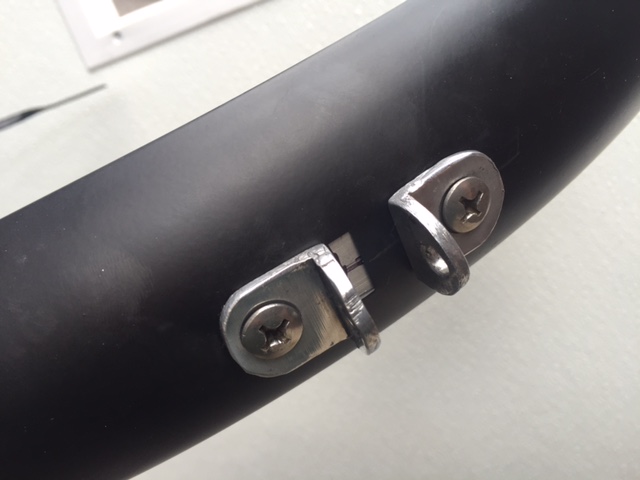
 Long time Mini Moto Madness readers will recall the chain alignment issue I was having in an earlier episode. I meant to get back to the problem but the bike was nearly complete. I had to hear it run, man. I turned on the gas, pedaled down Tinfiny’s steep, rutted driveway, popped the clutch and the little motor fired right up. For about a second.
 To ride this puppy I’d have to bite the bullet and take that damn rear sprocket off (again!) and fit spacers. Like I said earlier, this kit is complete. It had everything needed to shim the sprocket, although the shims were a little harder to access.
 After butchering the sprocket for shim stock I reinstalled the rear sprocket. Now on their 3rd round trip the elastic stop nuts were losing elasticity but I was all in, I had to ride the beast. The sprocket was a tad wobblier than I remember but my patented sprocket-tuning tool allowed me to true up the mess to a reasonable level.
 And it worked! The little beast fired up and settled into a retro idle, the smoke poured from the recommended 16:1 fuel mix ratio. I live in a steep, hilly area and the bike is geared too tall. I don’t know how fast it goes (that will have to wait for the full exhaustnotes.us road test) but it’s faster than any coaster brake bicycle should be going. The gearing would be ok in Florida but at 6000 feet elevation with 1st gear hills all around it’s Light Pedal Assist all the way.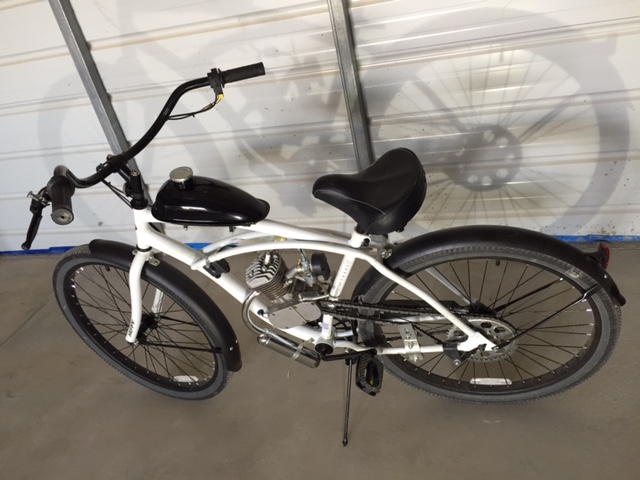
 Not only do I rarely finish projects, it takes forever for me not to finish them. I’m a slow worker. I get bogged down in details and miss the big picture. Details like the front engine mount on Mini Moto Madness. The front down tube on the Huffy is a large diameter pipe and the smaller, cast in semi-circle on the engine crankcase will not fit. The engine kit comes with a steel adapter plate and a U-bolt that fits the fat tube but the thing looks like hell.
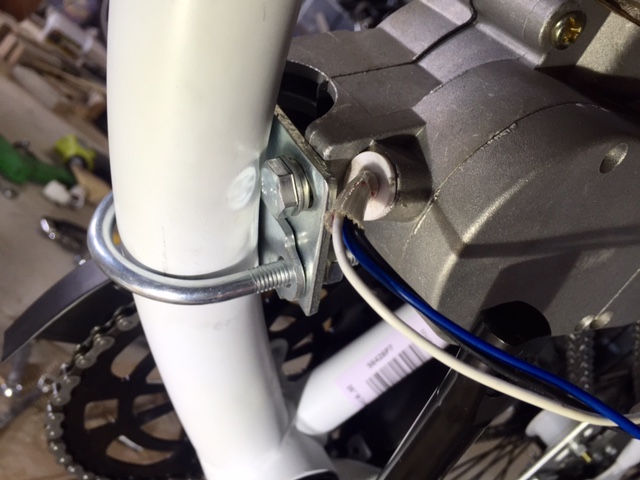 I got to thinking and planning, figuring on a chunk of aluminum to fit the two different pipe diameters, holes drilled, cuts made, longer bolts, it was getting out of hand, man. This time I was able to catch myself. What the hell am I doing? Every other mini motor I looked at used the stock mounting plates so I said, “Screw it.” and went with the popular choice. Right there is a two-day labor saving decision.
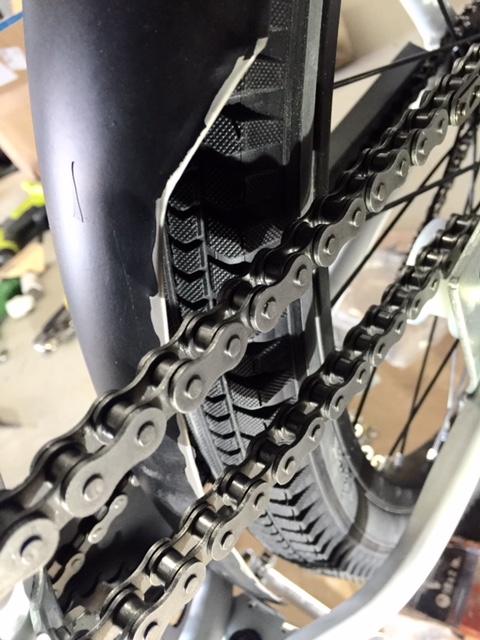 With the motor firmly in place I spent some time on the chain drive. The rear fender came in contact with the chain so I had to trim it and roll the sharp edge. It’ll need a paint job and stronger brackets but I’m going to wait until the mechanical is done before tackling cosmetics.
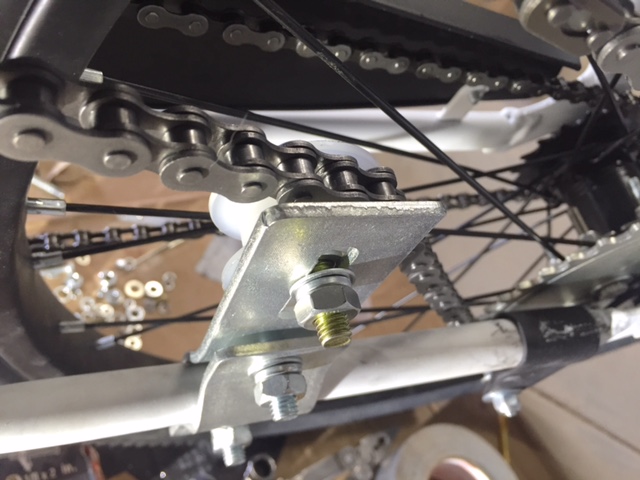 It’s almost impossible to get two chains to agree on length so the mini motor kit comes with an idle roller for tension adjustment. The idler also turns the chain angle upwards before the lower frame tubes get narrow, keeping the chain from rubbing. I don’t like the thing but I’m not sure what to do about it. My rear sprocket is slightly misaligned; the chain doesn’t jump off the sprocket but it sure favors the hub side. To center the chain the rear sprocket needs to go outboard 1/16” so that means making a spacer and reassembling the sprocket onto the wheel. I’m also considering adjusting the countershaft sprocket instead. I’ve decided to deal with this situation later.
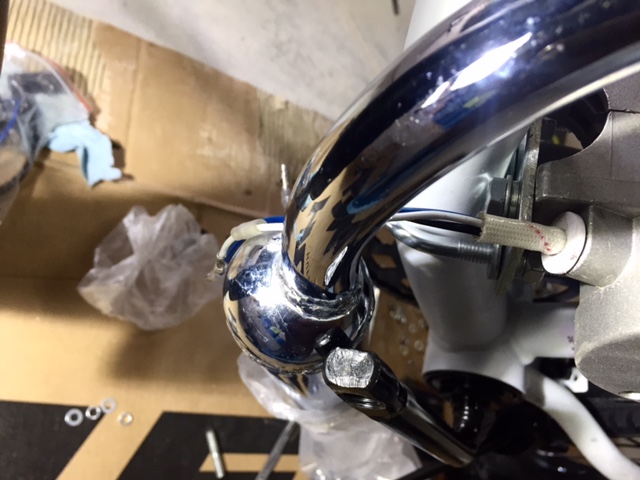 The pretty chrome exhaust pipe didn’t quite clear the Huffy’s crank arms. I didn’t want to mess up the chrome by cutting and welding the pipe so instead clamped the exhaust flange in the vise and twisted the pipe a few degrees. The pipe twisted beautifully with no wrinkles or kinks. The crank arms clear with room to spare. Sadly, the chrome plating did not go along with the program and delaminated. Pro Tip: Buy the kit with the black painted exhaust. It’s easier to modify for your particular bike.
 The ignition coil was a straightforward install. I’ve upped the difficulty rating by routing the wiring through the frame. Most of these bike builds look cluttered with wires and cables. I’ll run the controls inside the frame as much as possible.
 The rotor output wiring will also run internally. I’m sure this will end in tears but I saved a lot of time not fabricating a front engine mount so I’m using that time credit to tidy up the job.
 The other sloppy area on these builds is the handlebar. Unlike a motorcycle, there is no speedometers or bodywork to hide the throttle/clutch/kill wiring. I’ve drilled holes and snaked the stuff through the bars. It looks cleaner to me. Yes, I’ve weakened the handlebars. I’m willing to risk a crash from structural failure in support of aesthetics. We are all artists and it’s about time we started living like it.