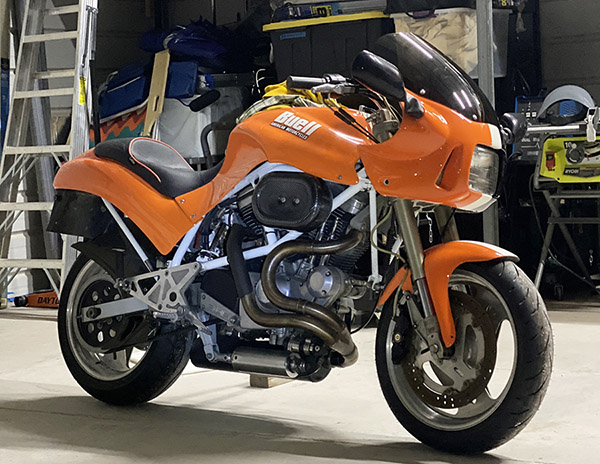
The 1995 Buell Thunderbolt is home safe and dry. It was good to meet up with Berk out in California. He really pulled out the stops: I had my own room, he bought me a bunch of food, took me on a tour of the San Gabriel mountains and helped pick up the Buell from Iconic Motorbikes. I really don’t deserve this much kindness. But I’m not turning it down.
The trip back to New Mexico was uneventful except for a steady rain that fell from Phoenix all the way to Las Cruces, New Mexico. It was nice to be snug and warm in the Toyota. I see why people drive cars.
The Buell in Bay 2 of the shed. CT recently cleaned this area so I’ll have room to work on the bike.
Driving in the rain gives you time to think and I thought about how much longer I’ll be strong enough to suffer the elements on a motorcycle. It was a grey, melancholy ride. The bright orange and black Buell cheered me up whenever I looked in the rear view mirror. I got back home at dark. It started to rain. I left the Buell in the truck.
The rain was drizzling the next day when we unloaded the Buell. It was a slick, wet plastic Toyota bed liner that the front tire slid out of and down the ramp. Luckily CT was there to back me up if the Buell started to tumble. We managed to park the bike in the shed, I dried off the Buell and started examining my prize.
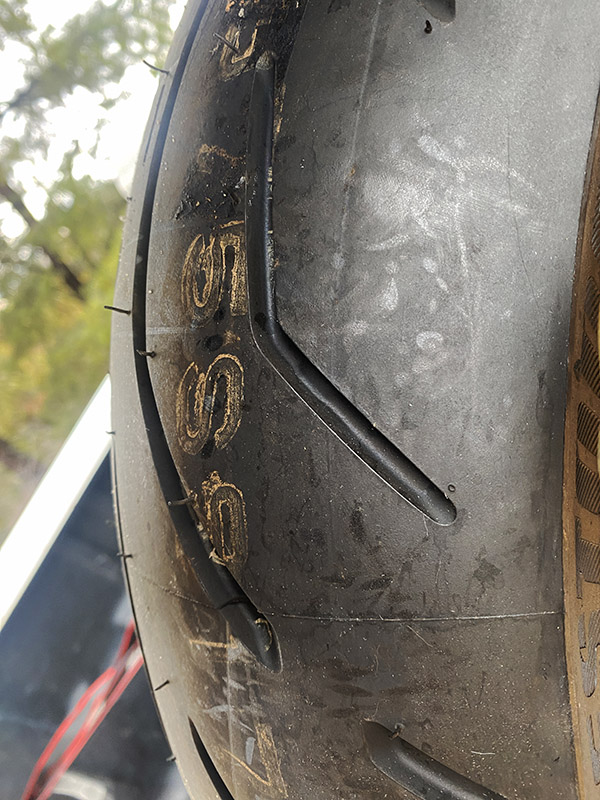
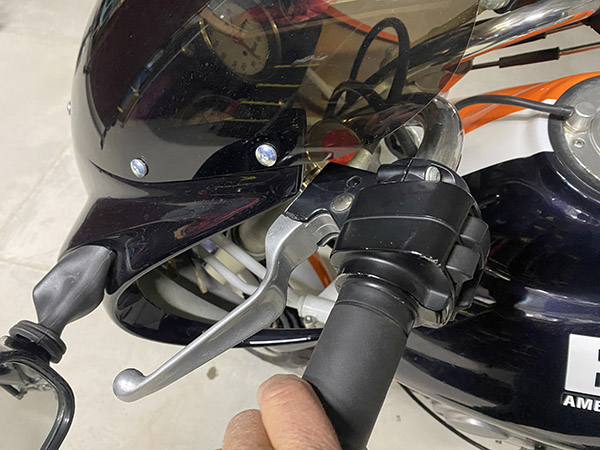
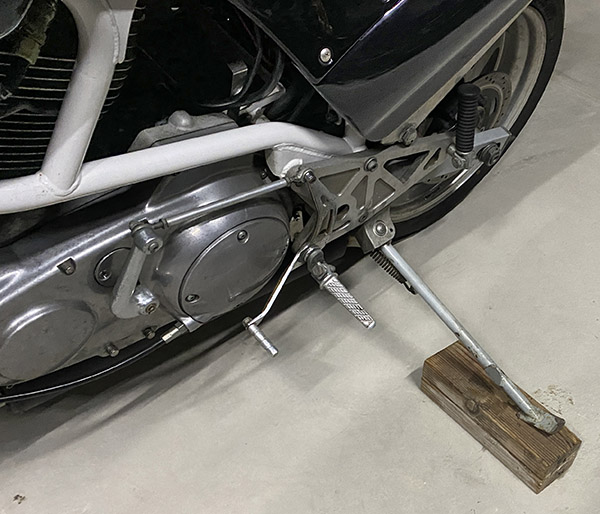
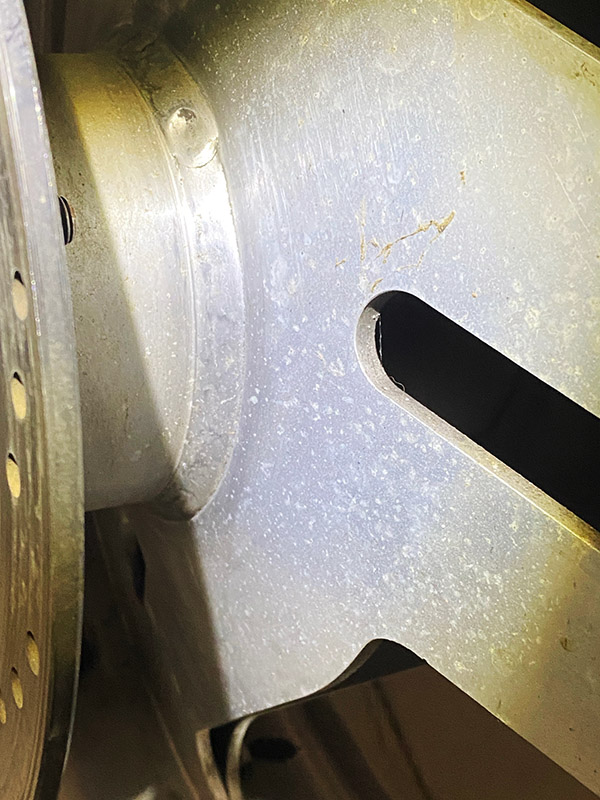
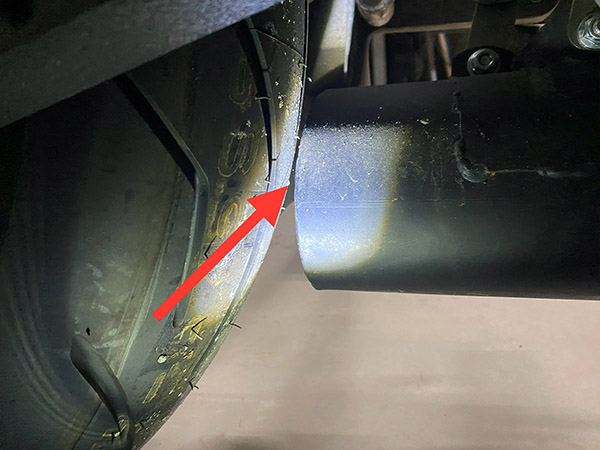
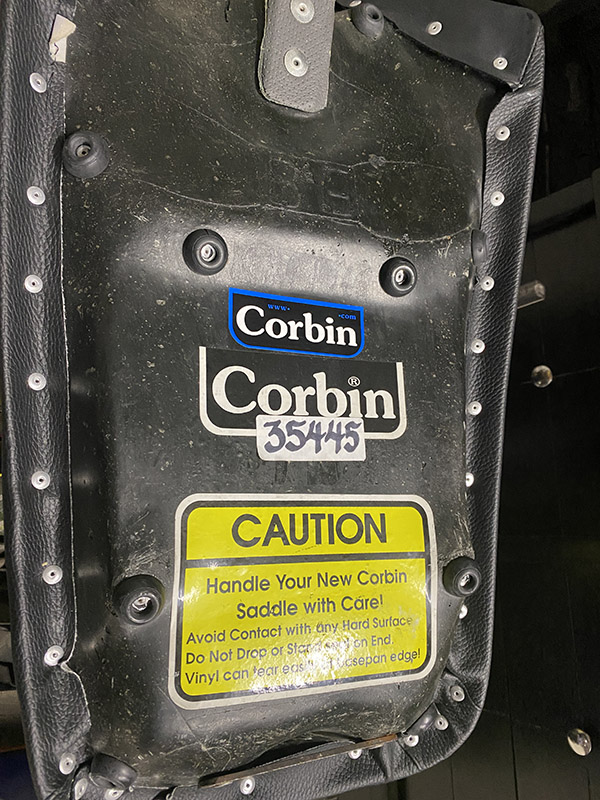
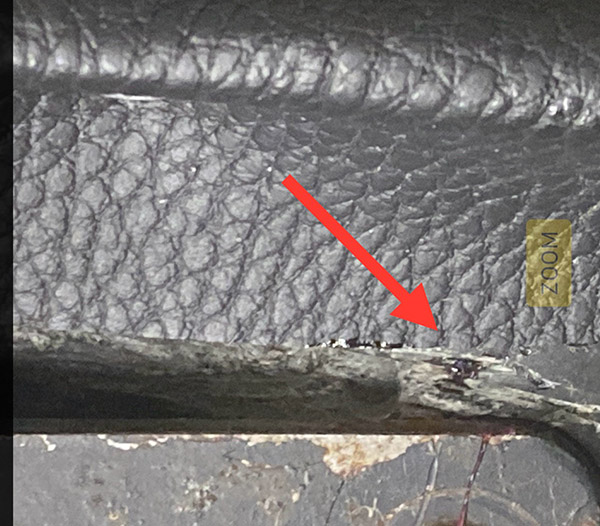
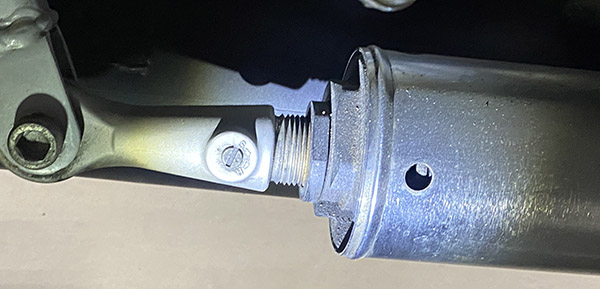
Both Bridgestone Battleaxe tires are unused and still have printing on the tread surface. The date code is from 2015 so 10 years old and never been warmed up. Before you tell me they are dangerous let me cut you off and say I’m running them. There are no cracks or check marks, they have been out of the sunlight, the rubber feels soft. I’m going to risk it.I’ll need to do a little adjusting as the handlebars hit the frame-mount faring. The faring has cut outs for low bars but these higher bars don’t align with the openings.The kickstand leans the bike way over. The stand is worn in the aluminum holder. I’ll need to shim this a bit or possibly put a slight bend in the stand to make the bike sit more upright.Performance Machine spun aluminum wheels are two halves joined at the hub and (I’m guessing) welded inside. A lick of polish should have them looking new.The under-slung muffler is uncomfortably close to the rear tire. Maybe the new drive belt will move the wheel back a bit. If not, I’ll have to make a bit of clearance.The Buell came with a Corbin seat. I don’t understand why this seat is so heavy. It’s like it’s made of lead. My brief time in the saddle seemed ok. Longer road tests to come.The Corbin seat fits the Buell well but the rear, locking latch doesn’t line up. The lever hits the seat too soon. It looks like someone tried to grind a bit of clearance but didn’t do enough. I’ll see what I can do, I’m just glad the seat didn’t blow off on the way home.The rear suspension is pretty stiff. I’m going to take out a bit of preload assuming this is where you adjust preload. With a Buell you can’t be too sure.
Now to start buying stuff for the Buell starting with a battery, seals for the stuck rear brake, fork seals and a fresh drive belt followed by a carb cleaning and a gas tank flush. Hopefully I’ll have a video of the bike running for Buell Fever Part 3.
Eight-cylinder motorcycles are rare. The first was the 1907 Curtiss V8, another early one was the 1950s Moto Guzzi V8 racing bike, there’s the the Chevy V8-powered motorcycles made by Boss Hoss, and the Morbidelli V8. Most recently, there’s the new Chinese Great Wall Souo S2000 GL (it has a 2000cc flat-eight engine).
The Curtiss V8 motorcycle was the first eight-cylinder motorcycle. It dates to 1907. If you want to see an original Curtiss V8, get yourself a ticket to the Smithsonian. If you want to see a reproduction of one of the Curtiss V8s, look no further than Jay Leno’s collection:
The Moto Guzzi V8 was built for the 1955-57 racing season; it was never a street motorcycle. I didn’t know too much about that bike (other than that a drawing of it adorned the cover of Melissa Pearson’s outstanding motorcycle book, The Perfect Vehicle : What It Is About Motorcycles). I found a YouTube video that tells us a bit about the Guzzi V8:
My first exposure to an 8-cylinder motorcycle was the Boss Hoss. I saw these bikes at one of the Laughlin River Runs back in the 1990s. The Boss Hoss company had two or three of these bikes on display in the parking lot outside one of the casinos. I sat on one at lifted it off the sidestand. That was enough for me. I’ll bet that bike weighed a thousand pounds. It was an absurd approach to motorcycling, and my 10 or 15 seconds of stationary seat time convinced I could easily live without one. Somewhere I have a photo my friend Dick Scott took of me on the thing, but I didn’t think enough of the bike to bother looking for it for inclusion in this blog. These bikes go for around $70K (maybe less if you can find one used). Boss Hoss offers these in both a small block Chevy version, and a big block Chevy model. Save your money, folks. But if you want to see more, here’s a video on these ridiculous machines:
The short-lived Morbidelli V8 motorcycle was offered in the mid-1990s. Even though I’d see some of the world’s most exotic sports bikes here in southern California (especially on the Angeles Crest Highway), I’ve never seen one of these bikes in person. To me, the name is of-putting enough, and it was billed as the world’s most expensive motorcycles. Thanks, but I’ll take a pass. I found a YouTube video on the Morbidelli. Check this out:
And finally, there’s the the Chinese Great Wall SOUO S2000 flat eight, a bike that takes the boxer engine concept to octopusian extremes. I’ve never seen one of these, either, but in keeping with my approach to his blog, here’s yet another video:
My take on all of the above? Too much of a good thing is just that: Too much. I’ll never own an 8-cylinder motorcycle, and that’s okay by me.
Missed our other ¿Quantos Pistones? stories? Here they are:
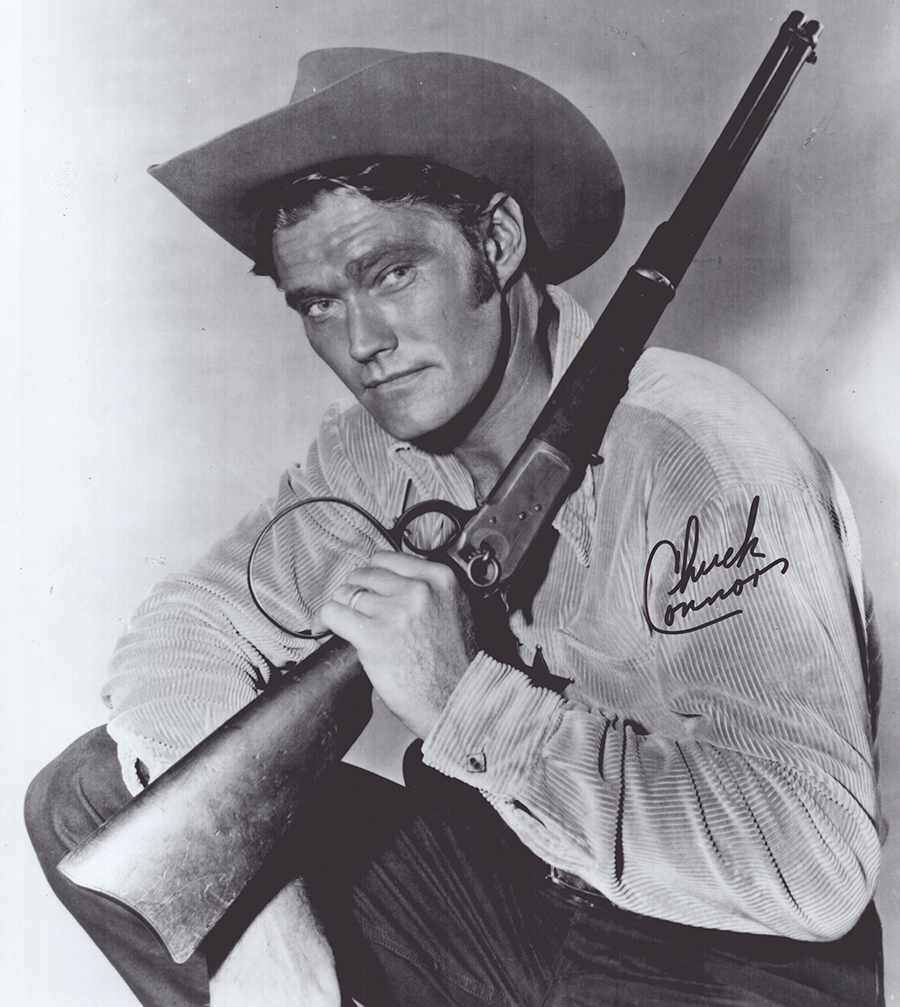
As a kid growing up in the ’50s, I watched a bunch of cowboy movies and TV series. One was The Rifleman, starring Chuck Connor. Unlike most of the TV shows in which the hero carried a Colt 1873 Single Action Army revolver (a “six shooter”), Connor’s character carried a Winchester 1892. The rifles he used recently went up for auction, and the price attained was stratospheric.
The Stringer is a recently released show on Netflix. It tells the story behind a photo most folks my age remember well: The 1972 Vietnam War photograph of a little girl, Phan Thị Kim Phúc, who was severely burned by a napalm bomb dropped by a South Vietnamese aircraft.
The story goes like this: Nguyễn Thành Nghệ is the photographer who actually took the photo. Nghệ was a stringer (a freelance photographer). When he sold the photo to Carl Robinson at the Associated Press, the guy in charge (Horst Faas, who died in 2012) decided to attribute it to Nick Ut, an AP staff photographer. Robinson felt uncomfortable about doing so, but did as he was told. Ut was present at the scene when the photo was taken and willingly accepted credit for the photo, although he had to know he had not taken it.
The photo went on to win the 1973 Pulitzer Prize for Spot News Photography, the World Press Photo award for Photo of the Year, and the George Polk News Photography award. It made Nick Ut’s career.
Carl Robinson went public with what he had been told to do 50 years later (which would be 2022). The Netflix show (The Stringer) presents compelling arguments that Nghệ , not Ut, was the actual photographer. The Associated Press rejects these claims and still attributes the photo to Ut; World Press Photo accepted Nghệ’s authorship and stripped Ut of its award.
Not included in the movie are the details of Phan Thị Kim Phúc’s life after the 1972 napalm bombing. She endured multiple surgeries and great pain in the years after. Ms. Phúc grew up in what become communist Vietnam and subsequently moved to Cuba, where she became a pharmacist and married. While living in Cuba, she was on a flight to Moscow when she left the plane during a stop in Newfoundland and requested political asylum in Canada (which was granted). Today, Ms. Phúc is a Canadian citizen. She leads several international foundations focused on helping children who are war victims.
The Stringer is one of the better shows I’ve seen recently. If you are a Netflix subscriber, it’s one I recommend you not miss.
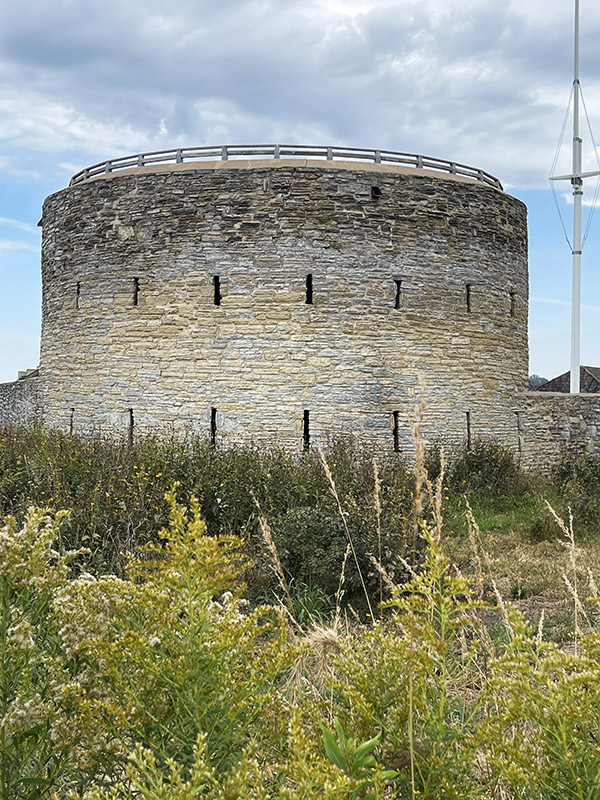
Minnesota’s Fort Snelling State Park is a subject more worthy of a multi-volume book than a single blog post. The challenge in a blog piece is to hit the high points, so bear with me as I attempt to do so. Sue and I recently visited the Minneapolis/St. Paul area, and Sue found several interesting spots to visit. One of them was Fort Snelling.
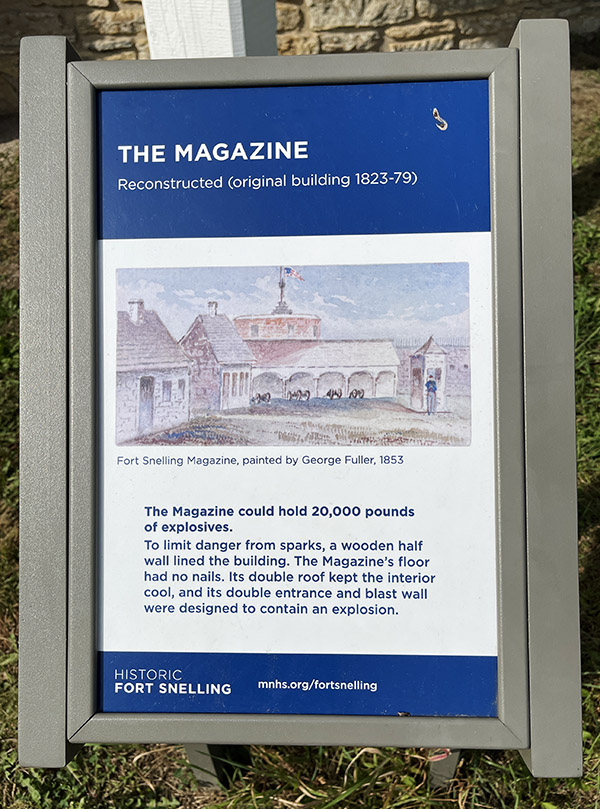
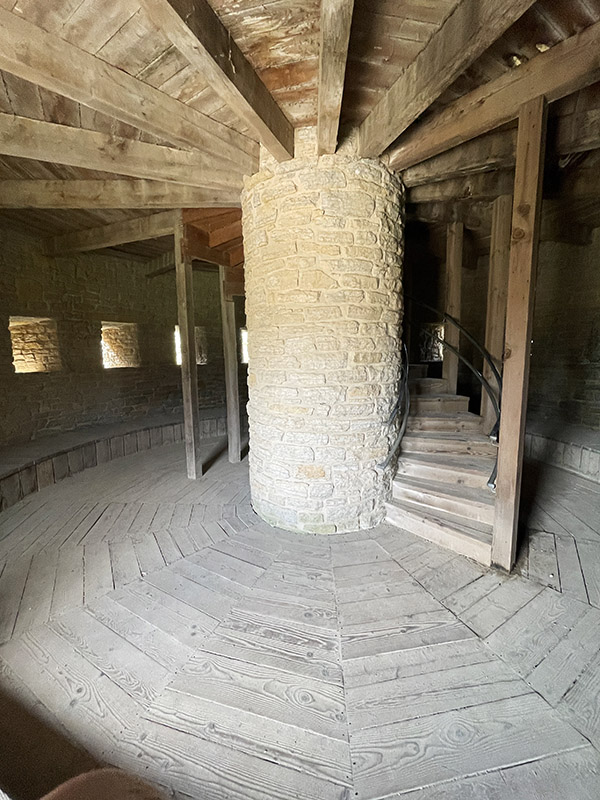
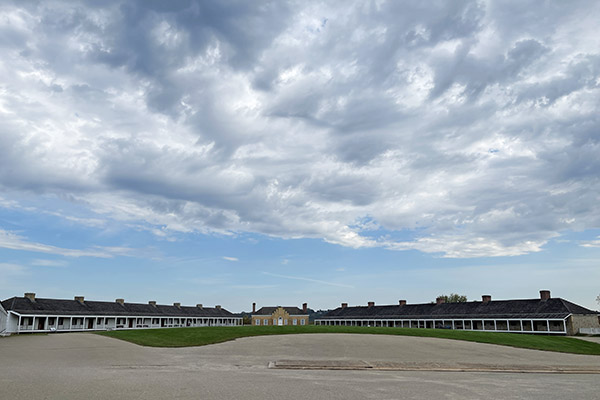
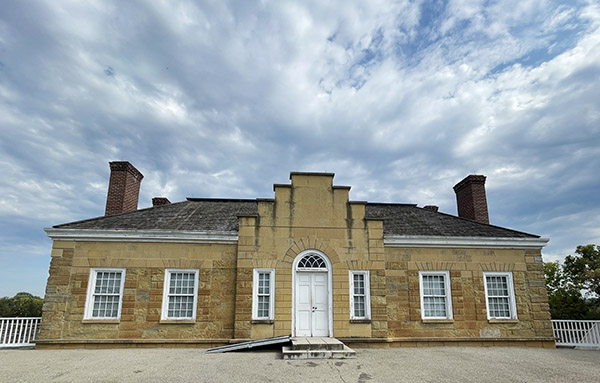
The Tower, also known as the Magazine, dominates Fort Snelling. It was used to store gunpowder. It also served as a prison.More information on the Magazine.Inside the magazine. You can take the stairs to the top.A view of Fort Snelling’s barracks and shop area. The house in the center was the commanding officer’s quarters.
Fort Snelling is located where the Minnesota and Mississippi Rivers meet. Here’s a bit of its background and just a few of the significant things that happened there:
Fort Snelling was founded in 1820
The Mdewakanton Dakota Native American people believe that this area is the center of the Earth.
In 1805, Lieutenant Zebulon Pike met with the Mdewakanton Dakota and signed a questionable treaty to purchase the area for the United States. Most historians believe that neither Pike (of Pike’s Peak fame) nor the Native American representatives were authorized to strike such a deal. Pike paid about $200,000 for the area, which consisted of about 155,320 acres, but left the amount blank in the treaty he brought back to Washington. The US Congress changed the amount to $2,000, but didn’t pay the Dakota people in cash. The Government instead provided goods it felt were worth about $2,000.
Lieutenant Colonel Henry Leavenworth built the initial outpost in 1819.
Colonel Josiah Snelling assumed command in 1820 and finished construction; he died in 1827 after being recalled to Washington.
Minnesota’s first post office opened at Fort Snelling in 1827, the same year that Colonel Zachary Taylor assumed command.
Slavery existed at Fort Snelling up until 1857.
Dred Scott (of the Dredd Scott Decision fame) and Harriet Robinson Scott were among slave population at Fort Snelling.
Fort Snelling acted as a concentration camp for the Dakota people before they were sent to Nebraska.
The fort was a primary recruiting station during the Civil War, the Spanish American War, World War I, and World War II.
In 1848, portions of the military reservation were set aside and would become St. Paul.
In 1856 Major Edward Canby became the fort. Canby would go on to become a general, and would hold the dubious distinction the only general killed in the Indian wars. Canby, a Minnesota town, bears his name.
The fort was the primary military base during the Dakota War of 1862.
In 1916, when General John J. Pershing was chasing Pancho Villa in Mexico, Minnesota’s National Guard was activated at Fort Snelling to provide border security.
In 1944, the Army’s Military Intelligence branch operated at Japanese language school at Fort Snelling, which was relocated to its current location in Monterey, California when Fort Snelling was decommissioned in 1946.
Restoration of the old Fort Snelling began in 1957.
Fort Snelling became a National Historic Landmark in 1960.
Fort Snelling State Park opened in 1962. It is Minnesota’s most visited state park.
Here are a few additional photos we grabbed as we wandered through the Fort Snelling grounds.
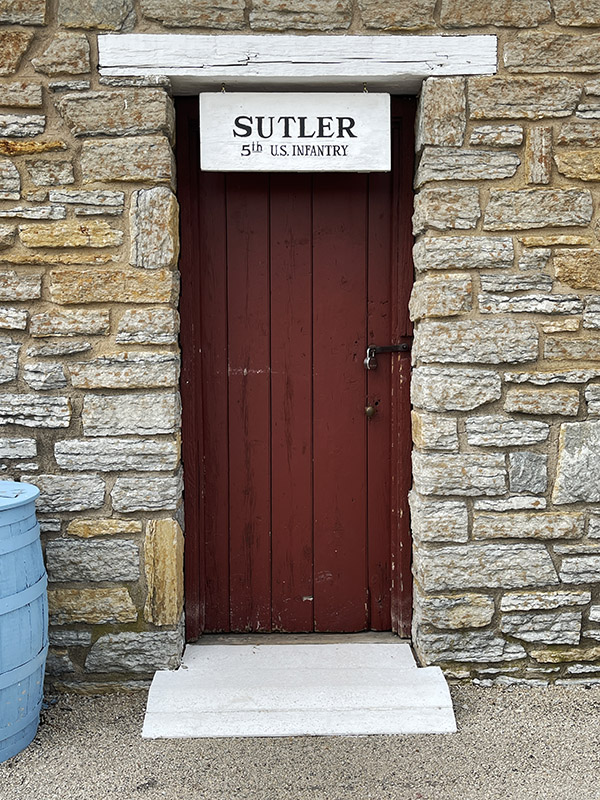
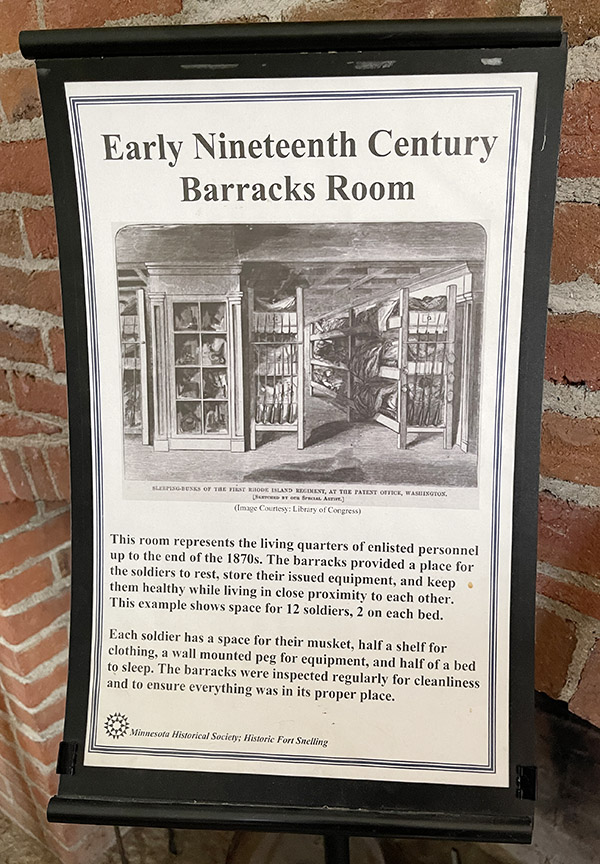
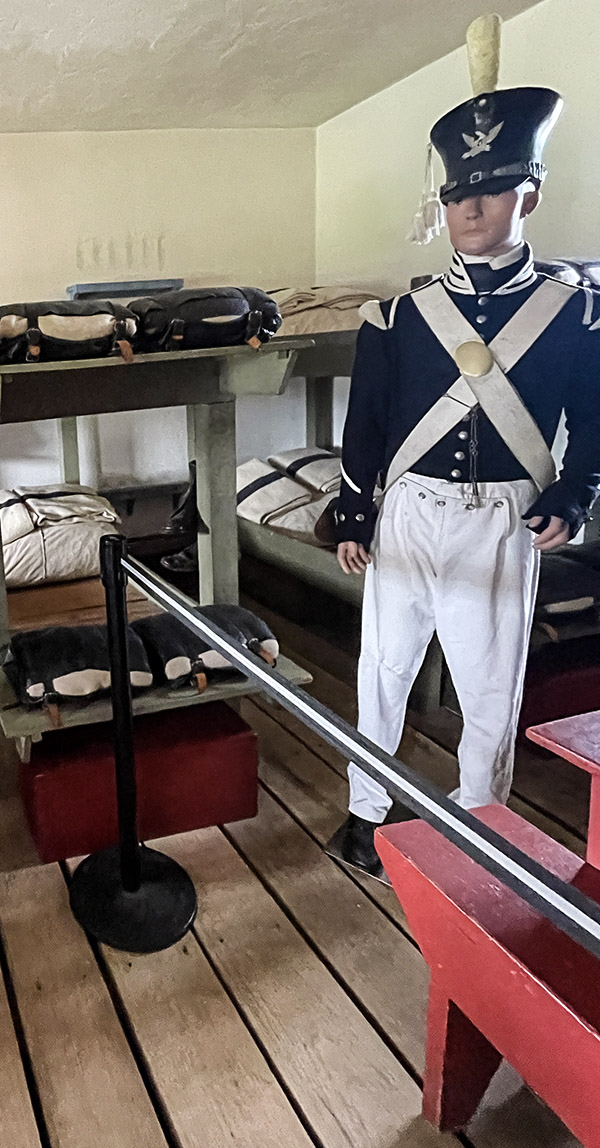
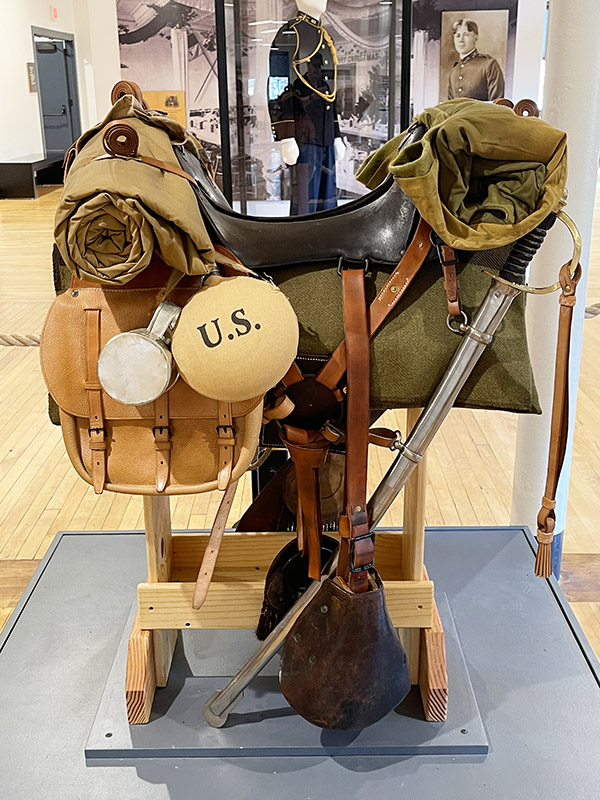
The Post’s general store (a sutler is a storekeeper who sold food, clothing, personal items, etc., to soldiers at a military camp or post; today it would be called the Post Exchange).Information about early barracks living.Inside an early barracks room.The Commandant’s quarters. You can go inside, too.Early Army gear on display in the Fort Snelling State Park Museum.
There’s an interesting Museum that houses a number of exhibits as you enter Fort Snelling State Park. Our visit was a good one. We opted for the guided tour and it was money well spent. Our tour guide was enthusiastic and made the tour interesting. If you ever pass through the Minneapolis/St. Paul area, Fort Snelling should be on your list of places to visit.
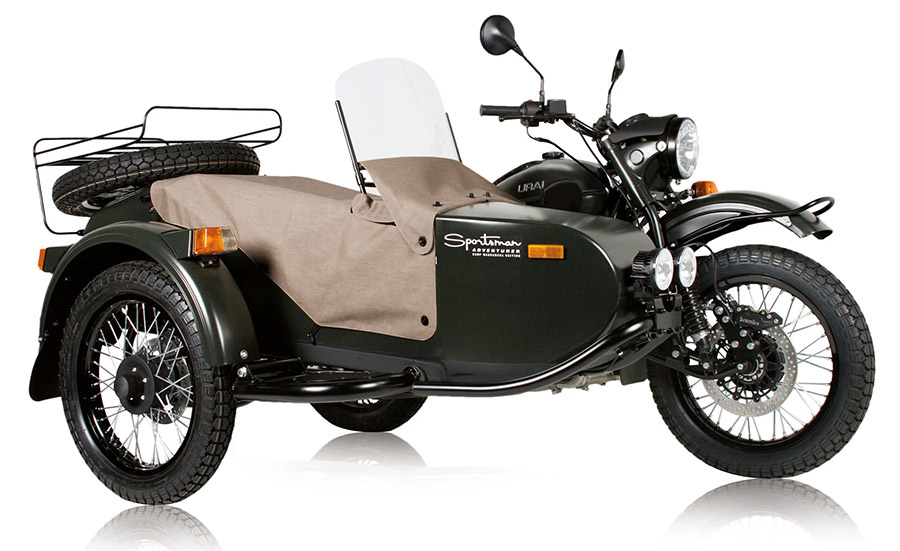
I don’t know much about Urals. I had a chapter devoted to the brand in the Police and Military Motorcycles book because their motorcycles kind of had a military flavor to them, I would see a Ural at the annual Griffith Park sidecar rally here in LA (it belonged to a guy who had swapped an 800cc BMW engine into it), and our good buddy Dan from Colorado had one (I knew Dan from the CSC rides into Baja). I guess the other thing I should mention is that we often sold CSC Mustang seats to Ural owners because the wait for a seat from Ural in Russia often took a year or more. On occasion when I’d hear the latest news about Putin’s military misadventure, I would sometimes wonder how that affected Ural Motorcycles. They were always a super-small niche marque; I reckoned that they probably weren’t selling anything since that stupid war began.
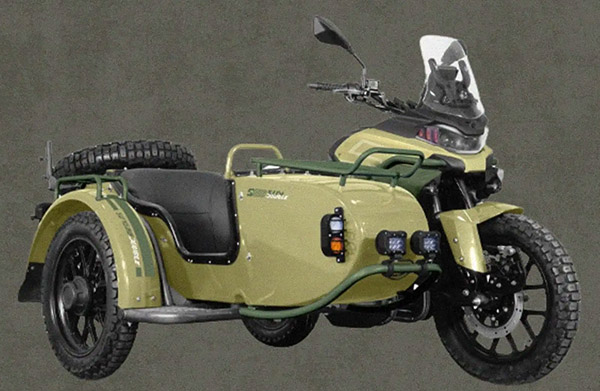
I guess I was right, as an email I recently received from Ural shows. Ural is taking a different tack: They’ve pretty much dropped the Russian-made WWII BMW clones (Ural moved to Kazakhstan, but to me, that’s still Russia), and now they’re hooking up with a Chinese manufacturer to make a smaller sidecar-equipped 500cc twin. They’re calling it the Ural Neo.
The 500cc Ural Neo. Projected list price is “under $15,000.”
Man, talk about stacking the marketing cards against you: A smaller displacement bike, a bike from a Russian (sort of) company, a bike made in China, and catering to the sidecar market (when was the last time you saw a bike in America with a sidecar?). I’m guessing they will be pricey, too, but hey, what do I know?
I have no idea how I made it onto a Ural email list, but here’s the letter from Ural:
Dear Friends,
If you know our history, you know this brand was never built in comfort. The challenges of the last five years and especially the move to Kazakhstan have made the legacy Urals impossible to produce sustainably. This led us to the decision to pause manufacturing of the new legacy models for export markets. It does not, however, mean that Ural is stopping. Instead, we are pulling (yet another) one-eighty in order to keep moving forward. Below is a letter from Ilya (a long read), that explains where we are, how we see the path forward, and the answers to some of your questions and concerns.
For new subscribers – welcome to the community! You caught us amid a big change. If your interest is solely in our legacy machines, please check inventory to find models that are still available at dealers in US, Canada and Australia. If you are interested in sidecars in general, feel free to subscribe to updates on Ural Neo.
For those of you who have followed the story for a while, our customers and supporters, we know this transition is not easy, and we don’t take your trust for granted. We want you to know that every decision we’re making right now is with your experience, your bikes, and your future support in mind.
Thank you for your patience and for sharing your stories, they keep us going every single day.
We wish you and your close ones a happy Thanksgiving and a happy upcoming holiday season!
Stay tuned for new developments.
The Team at Ural
A Letter From Ilya
“Dear Friends,
It’s been a while since our last update. Much of our time was spent on reorganizing the company and evaluating what is possible that would allow Ural to continue into the future. The complex challenges we faced required difficult decisions, sharp turns in direction, and more than a few leaps of faith.
Our recent post on our Facebook page – inviting riders to test-ride the new Ural Neo at one of our dealers – received a lot of attention. As with every mention of Neo, it brought out not only curiosity and support but also strong emotions, questions, and criticism.
We understand where those emotions come from. For most of you, Ural isn’t just a motorcycle – it’s a part of your personal story, the same way it’s a part of ours.
I still struggle to find the right words to describe what happened to Ural when the war began in 2022. The best way to describe it is this: it felt like our factory in Irbit had suddenly exploded. We had to make decision quickly. Some voices suggested stopping altogether, but this thought was dismissed almost immediately. Instead we moved final assembly to Kazakhstan.
This allowed us to continue building bikes. However, operating between two countries – one under sanctions and another with almost no infrastructure for a business like ours – proved to be extremely complicated. By late 2024, it was clear that this setup couldn’t last: we were losing money with every bike we built.
That’s when the idea of a lighter, street-oriented sidecar motorcycle in a different price segment began to take shape. Our original goal was to broaden our lineup and make better use of the infrastructure we still had. At the same time, we were searching for a longer-term solution for legacy bikes: exploring new suppliers, alternative assembly locations, and possible partnerships.
Then, in April 2025, the tariffs hit. Now not only was manufacturing inefficient – selling our motorcycles in our main market, the United States, had become nearly impossible.
Building in China and Staying Ural
When we started looking for ways to continue, we knew exactly what we didn’t want: to become a badge fixed on someone else’s product (and yes, we did have such offers). We wanted partners who understood sidecars and were willing to collaborate.
That search led us to Yingang, a family-owned motorcycle company with decades of experience making sidecar-equipped models for their local market. Their capabilities and willingness to work with us to refine the product made them the right fit.
Together, we began developing what would become the Ural Neo 500 – based on an existing platform, tested and refined with our input and oversight, built to our specifications and quality requirements.
What Ural Neo Is – And What It Isn’t
Ural Neo is not meant to replace our legendary 2WD sidecars. Legacy Urals gave generations of riders the kind of experience no other motorcycle could offer.
Neo is different. It’s modern, light and by far more approachable. It’s designed to bring new riders into the sidecar world, not to take anything away from those who already love it. If the 2WD models were still part of our lineup, Neo wouldn’t compete with them — it would complement them. Instead, it now continues Ural’s story in its own way.
Think of Neo as a bridge between Ural’s past and its future – a way to keep Ural’s name, spirit and know-how alive while we’re reinventing the company for the opportunities and challenges ahead.
Now let’s address some of the big questions.
Is production of classic Ural 2wd bikes stopped permanently?
We call it “put on pause”, which in plain English means we don’t know. What we can say with certainty is that we haven’t written it off entirely. The key for restoring the production, if it ever becomes possible, is to maintain documentation, equipment, tooling and, most importantly, our experienced engineers and skilled workers. We will be doing everything we can for as long as we can to support this infrastructure.
What’s going on at the factory in Irbit?
The Irbit factory is operational, although with a smaller team. Currently the factory is assembling a limited number of bikes for domestic market from existing stock of parts and components, and making spare parts for exports. The factory also performs contract assembly for a local vehicle manufacturer. The team in Irbit continues to work relentlessly to bring more business to the factory.
What’s going on with parts supply?
No sugarcoating here – the situation is tough. It’s hurting our reputation and the hard-earned trust of our dealers and customers. Parts are still coming to the country, but not in quantities or the regularity we need. Mainly it is caused by two factors: limited financing (especially when dealing with suppliers who require large minimum orders) and extremely complex logistics. We’re doing what we can to stabilize the supply chain, but realistically, it won’t improve overnight. The success of the Neo project will play a major role in helping us rebuild a reliable parts flow for all legacy bikes.
Why not move production to the U.S.?
We explored this and many other options, the numbers just don’t work. The replication of the manufacturing infrastructure would require multi-million-dollars investments. Even setting up an assembly in the U.S. is not feasible at this time, as logistical costs, wages and the costs of maintaining the facilities would drive retail prices out of reach for most riders.
Why in China?
China is the largest motorcycle manufacturing base in the world, with a vast ecosystem of specialized suppliers of parts and components. No other place in the world can manufacture sidecar bikes of comparable quality and as affordably priced.
The Neo 500 is built in China because it’s the right choice today, not because it’s the only choice we’ll ever make. As the project grows, we will continue to evaluate where and how future models should be built.
You shouldn’t put the Ural name on anything that isn’t original bike.
That’s exactly why this project is called Ural Neo. It’s a new chapter, and we fully acknowledge the difference. The alternative was losing Ural altogether. We’d rather see the name move forward than carved on a tombstone. We hope you would too.
The main appeal of Ural was its classic look. Without that vintage charm, who’s going to buy your new bike?
We know the Neo’s design and overall direction of the company don’t match what many of our long-time customers expected. But we don’t believe that appeal of the sidecar bikes begins and ends with nostalgia. A new generation of riders is discovering sidecars for different reasons – shared experience, practicality, and curiosity. Ural Neo is built for them – let’s give them a chance to decide if there’s something there.
How is Ural Neo financed? Why Ural is spending money on new project instead of supporting existing customers?
Ural Neo is structured, financed and operating independently from legacy business. A small group of long-term partners and investors – people who believe in the brand and in our team – provided the initial capital to develop, homologate and bring the new model to the market. We’re finalizing an additional funding round to ensure Ural Neo is set for successful launch.
When will we see Ural Neo at dealers?
The EPA/CARB certification unit is already in the country and we’re starting the certification tests in a couple of weeks. Additional demo units will arrive in the US late January – early February, and we’re planning demo-tour for February – April. The first production units are expected to start reaching dealer floors late May. We’ll share timelines and updates as we go.
***
We know the past few years have tested everyone’s patience and faith in Ural. But through all the challenges our goal hasn’t changed: to make sure Ural keeps going. Ural Neo doesn’t erase our history – it keeps our story, and yours, alive.”
— Ilya Khait
President, Ural Motorcycles
Will the above approach work for Ural? Hard to say. I think they’ll sail through the EPA/CARB certification process (China’s emissions requirements are tougher than ours). The cost and marketing challenges will the toughest hurdles, I think. Here are a few things they can do based on our success at CSC with the RX3:
Bring in enough spare parts to build the things. That was one of the biggest concerns RX3 buyers had, but it was non-issue. Steve brought in enough spares to cover any need. That quickly put the spare parts issues to bed.
Be enthusiasts, spend a lot of time on the bikes yourself, and blog the hell out of your rides and adventures. A lot of people followed the CSC blog, and that blog sold a lot of bikes.
Offer free online maintenance tutorials for your bikes. CSC did, and it became a strong selling point.
Sponsor a cool ride every year for your customers. We did that at CSC with the Baja rides, and people bought the RX3 bikes just to go on those rides. It was great, it built a real community, and it gained us a lot of coverage.
Keep the price low. People aren’t going to stand in line to pay a premium price to a Russian motorcycle company for a motorcycle made in China. I read that Ural is projecting a list price “under $15,000.” Good luck with that.
Probably the most significant factor and the best advice I can offer is to keep the price low. The second most significant one would be the company rides; they did a lot for us to prove our bikes’ reliability and to quickly build a community. Here’s one of my all-time favorite videos; it’s the one from our very first CSC Baja ride.
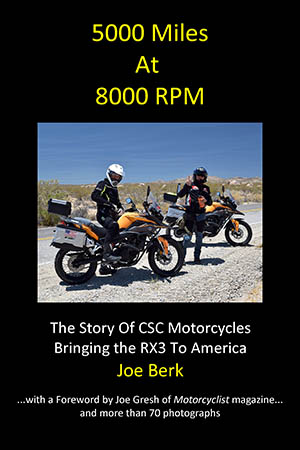
If you would like to read more about CSC’s marketing strategies in bringing the RX3 to America, and those sponsored motorcycle rides mentioned above, pick up a copy of 5000 Miles At 8000 RPM. Don’t wait for the movie.
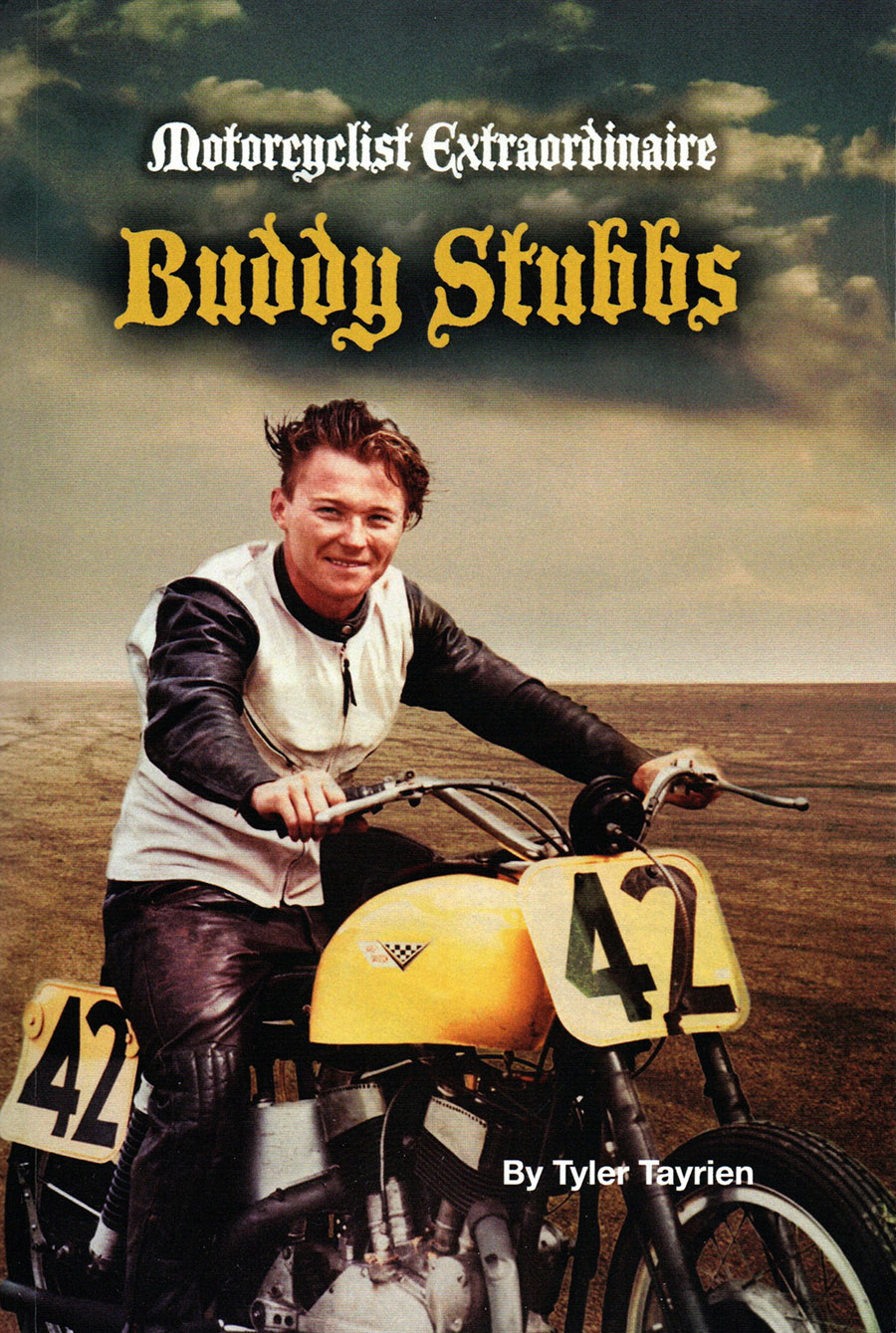
Not too long ago, I posted a blog about the Buddy Stubbs Motorcycle Museum in Phoenix, Arizona. Sue and I visited it for an upcoming Motorcycle Classics magazine Destinations piece. While I was there, I saw a book about Buddy Stubbs (Motorcyclist Extraordinaire: Buddy Stubbs), and I picked up a copy. I finished reading it last night and I thought I’d share my thoughts with you.
Written by Tyler Tayrien (who also wrote Arena, a book about Sam Arena’s motorcycle racing career), I’d give it a solid 8 out of 10 points. The subject matter is superb; the writing and editing are good but not great. I already wrote about Buddy Stubb’s history, his dealership, and a bit of his background in my recent blog about the Buddy Stubbs Museum, so I won’t go into that in too much detail here.
What’s great about Motorcyclist Extraordinaire: Buddy Stubbs is that the subject of this book (Mr. Stubbs) has had such an interesting life. It would be hard for a book covering this topic to be dull. What’s also great about the book is that Buddy Stubbs’ racing contemporaries are the guys I followed when I was a teenager and a young man: Riders like Dick Mann, Gary Nixon, Cal Rayborn, Roger Reiman, Bart Markel, Kenny Roberts, and others. These guys were the kings of flat track, motocross, and road racing back in the day, and reading about them from another rider’s perspective made the book even more interesting.
Motorcyclist Extraordinaire: Buddy Stubbs has a lot of photos, and maybe that’s one of its weak points, but I can’t blame the author for that. Most of the photos (maybe all of them) were from earlier printed photos shot with film, I’m guessing many were shot in black and white, and these were scanned for inclusion in the book. It’s hard to get a decent image using that approach, but when working with these kinds of archival prints, there’s really no other way to do it. The downside is that many of the photos are grainy and lack clarity. That’s not intended to be a criticism; it’s just an observation.
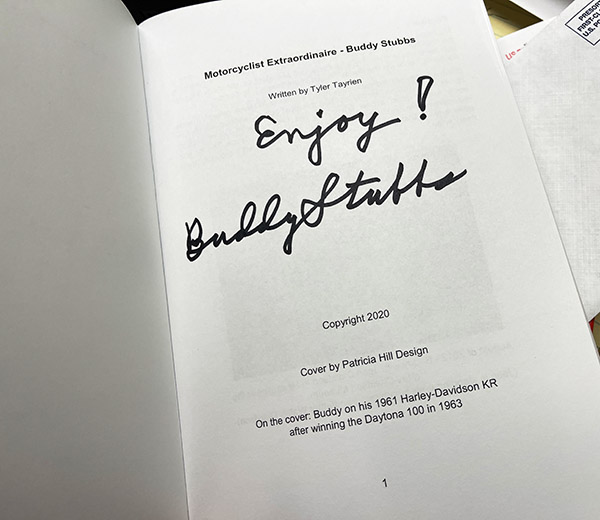
Motorcyclist Extraordinaire: Buddy Stubbs covers Buddy Stubbs’ life, his experiences in buying and building up the dealership, his marriages, his automobile and motorcycle racing, his cars, and the motorcycle museum. Mr. Stubbs is in his mid-80s today. I’m sorry I didn’t get to meet him while I was in the dealership, but I did get an autographed copy of his book. That’s cool.
My minor criticisms aside, I think that Motorcyclist Extraordinaire: Buddy Stubbs is an excellent read. My advice to you is to pick up a copy. I think you will enjoy it.
Sue and I recently flew to Minnesota as part of Sue’s quest to visit all 50 states. I’d been there a few years ago for a business trip when I worked in the bomb business. We were having problems with a booster for one of munitions, and I visited the factory in Edina to seek assistance in finding the root cause. The factory was underground in an old Nike Hercules missile command center. It was a bit scary, being around all those explosives and the intermittent hisses from the air moisturizers (if the humidity dropped below a certain level, electrostatic discharges could induce inadvertent ignitions, hence the moisturizers).
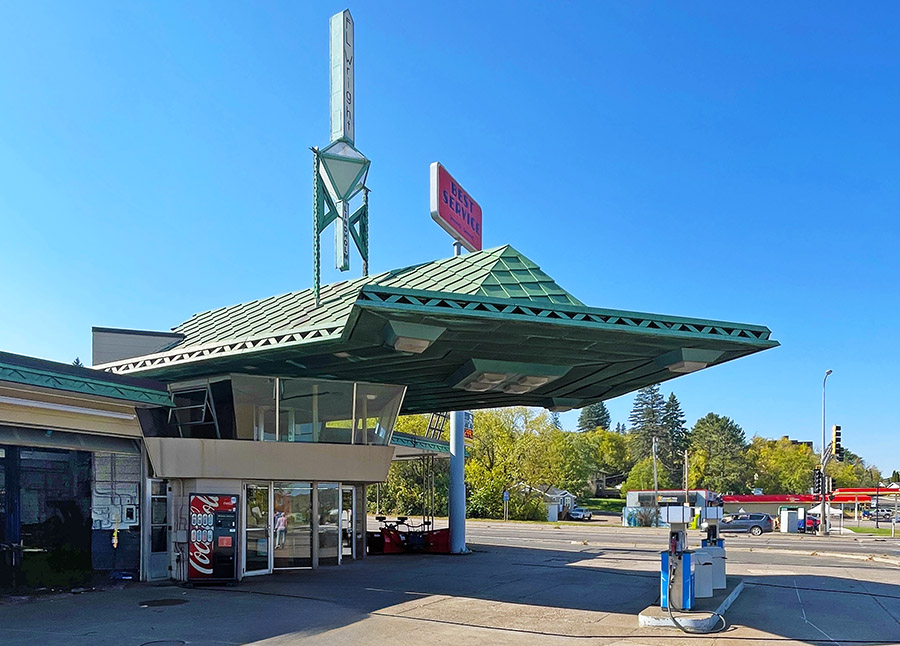
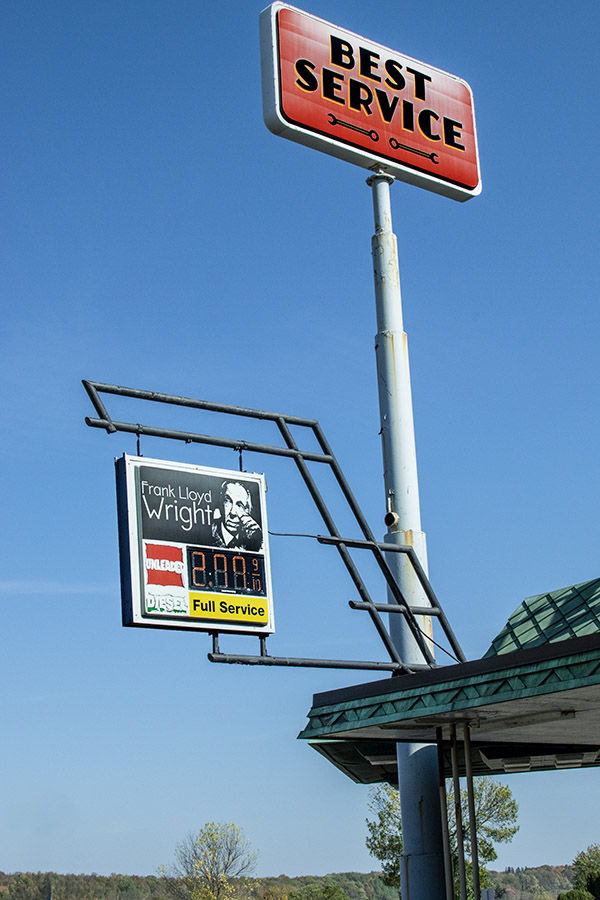
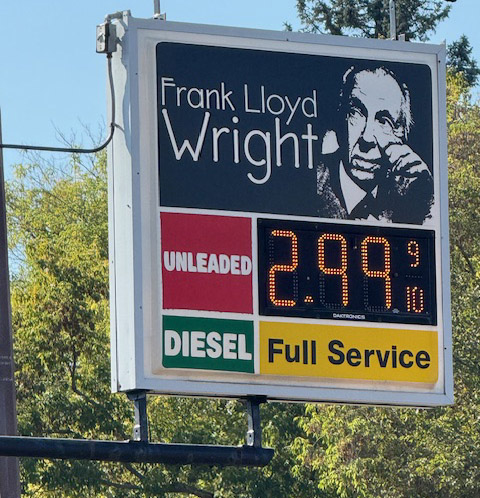
This trip would involve no such scary bomb factory visits. In fact, there were a lot of cool things we saw in Minnesota. One was a Frank Lloyd Wright gas station.
Without setting out to do so, we’ve become a bit of a Frank Lloyd Wright website. We featured his architecture a couple of times already, once with an article by yours truly about the Fallingwater home in western Pennsylvania, and more recently with Joe Gresh’s recent piece on Taliesen West, the Frank Lloyd Wright desert home in Arizona. Architectural Digest magazine is not looking over its shoulder at ExhaustNotes, but it’s interesting that Mr. Wright’s genius has found its way into a motorcycle and gun blog.
So, about that Frank Lloyd Wright gas station: Sue found it while researching cool things to see in Minnesota. It’s a little out of character for Mr. Wright, you know, designing a gas station. It’s located in the small town of Cloquet. It came about when a guy who worked in the oil biz (a guy with evidently lots of money), one R.W. Lindholm, had Wright design a home in 1952. Lindholm liked it. In fact, he liked it so much that when Wright approached him about designing a gas station, Lindholm agreed. Lindholm wanted to beautify gas station design; Wright wanted to create a gas station that could be used as a community center and gathering place.
If that sounds goofy to you (and it did to me when I first read about it), think again. When I was a teenager with a GTO (a decidedly dangerous combination), I and all of my gearhead buddies used to hang out at Herbie Eckert’s gas station. Herbie was a kid in my high school class who’s Dad owned an Empire gas station in New Jersey. I hung out there most of the time with my GTO, Ralph Voorhees was there with his GTO, Bobby O’Connell was there with his Hemi Road Runner, Vernie Frantz was there with his 409 Chevy, and, well, you get the idea. It sort of seemed natural back then in the late 1960s. Yeah, the concept works: A gas station as a community center. Especially if you’re a community of gearheads. I don’t think that’s quite what Frank Lloyd Wright or Mr. Lindholm had in mind, but hey, it worked for us.
Wright’s gas station design was built in 1958. It was the only gas station ever designed by Frank Lloyd Wright, and it’s still in use today. It’s listed on the National Register of Historic Places. When we visited, the gas station was open, but the place was pretty much empty other than one other car that had stopped for the same reason we did: To take pictures. Frank Lloyd Wright’s design was a success in that his $20,000 gas station (four times the cost of a typical gas station in 1958), came into being, but it never realized Wright’s vision in becoming a community center. Maybe it’s because there were too many people like me, Vernie, Bobby, and Ralph hanging around the place. We must have scared them all away.
The Dream is perched on the new Harbor Freight lift and slowly coming apart. I’ve been busy with other projects so don’t freak out if it seems like progress is slow. It’s not me. It’s the environment I work in.
This installment involves a bit of inventory control. I need a decent front rim but all the ones online look just as bad as the rim I have. The parts bike front rim is bad too. They are sturdy and run true but lots of surface rust makes them look bad. I can get new rims on eBay, sold in pairs for around $200 delivered, but I only need one rim. Anyone want to form a syndicate and go halvies on some 305 Dream rims?
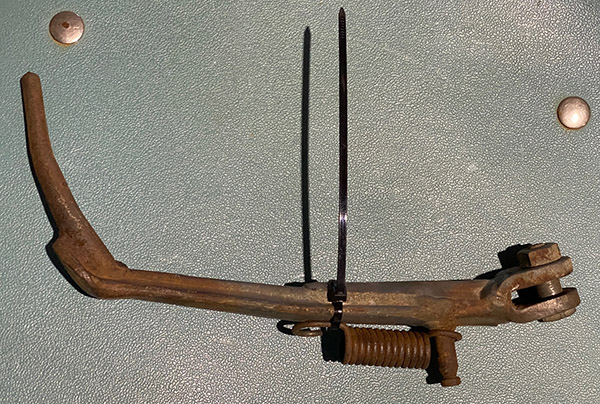
$20 kickstand. Sometimes I do it the easy way.
Both of the Dreams were missing their side stands and I debated making one from scratch. Just for kicks I went on eBay and some hero had a side stand for $20 so I bought it. It’s kind of like cheating but It would take me two days to make a stand.
Hopefully these seals will work, keeping the oil inside where it belongs.
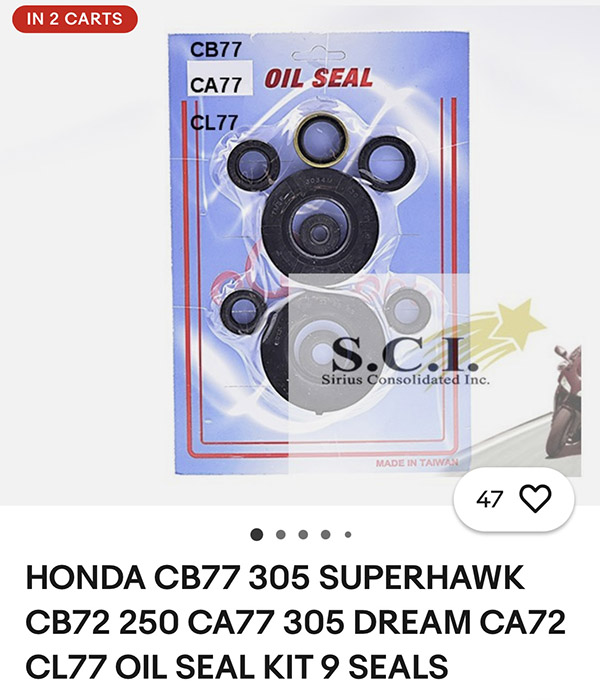
I’ve also ordered a set of engine seals. I’ll have the engine side covers off to free up the clutch plates and clean the centrifugal oil filter can. Also I need to remove the alternator to gain access to the starter clutch as it’s hit and miss. I figure it’s a good time to replace the seals. The only one leaking at the moment is the shift-shaft seal but you know how it goes with old rubber. Twenty miles down the road another seal will start leaking. Then another.
Deez Nuts were tight as hell. It took me two days to get them loose.
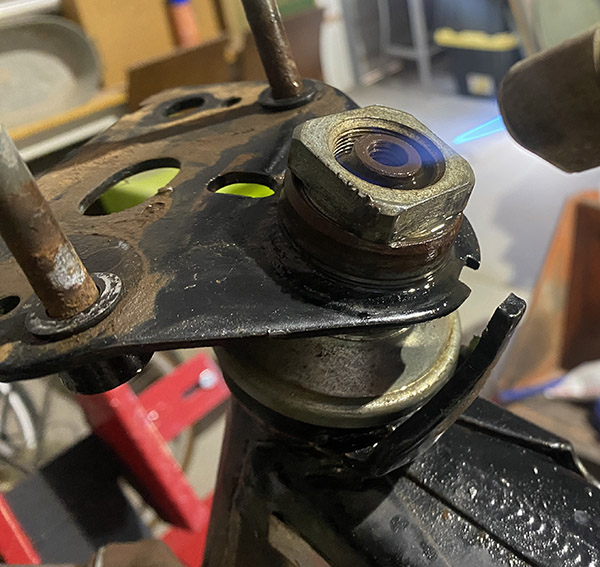
Getting the Dream’s steering stem apart was an Ossa. The top lock nut was knitted to the cone nut and the thing was tight as hell. Much hammering, heat and penetrating oil was used over the course of two days. The steering stem nuts finally unwed and spun off by hand. All the bearings and races look good with no divots or flat spots to cause erratic steering. There was even soft grease still inside! Impressive for a 63-year-old motorcycle.
The Dream on the maiden lift.
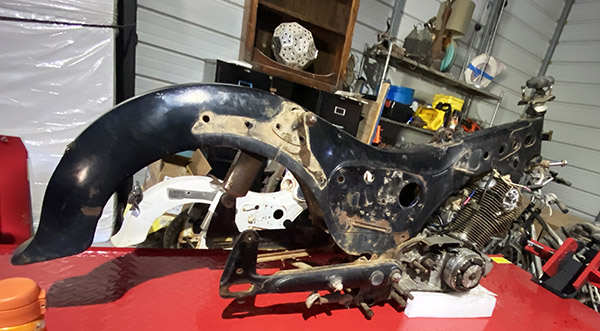
I’ve got the frame off the engine now. It’s a fairly lightweight sheet metal construction. Kind of like a monocoque Norton but with a separate fuel tank. Honda copied a lot of ideas from German and British sheet metal frame manufacturers.
The Dream frame is light. Easy to lift off the engine for an old man.
The frame has a few dings to fix and the Dream is made from pretty thick metal. The dents are hard to get behind to push out. I’ll try the painless/paintless dent remover but I don’t hold out much hope as the frame is twice as thick as gas tank metal. If that doesn’t work I’ll get a stud welder and pull the dents with a slide hammer.
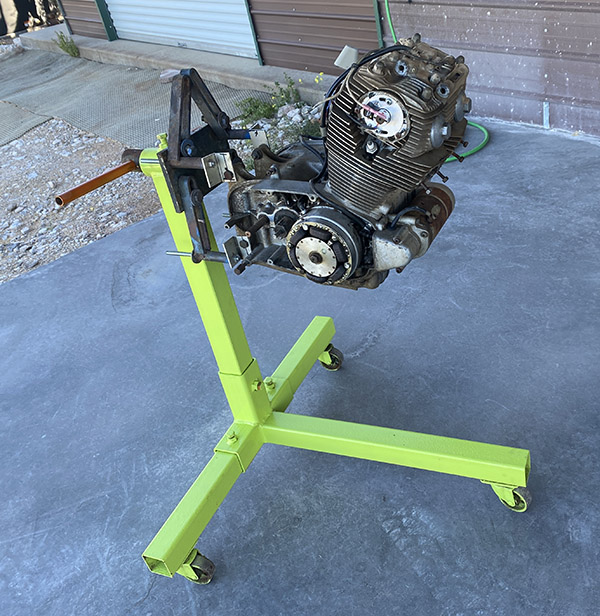
Kind of Kawasaki green for the new paint on the stand. Almost safety vest green. I had a can in stock.
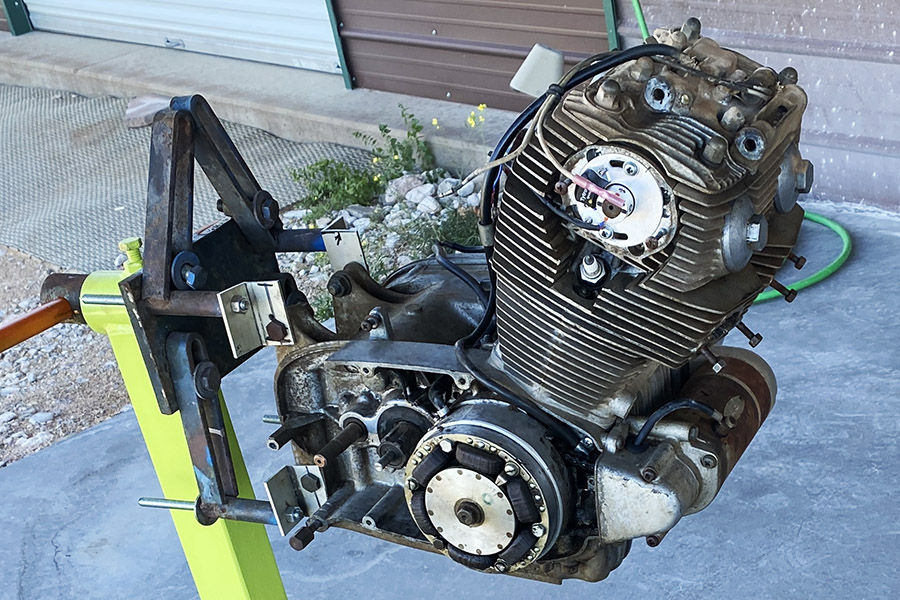
Since I have a new, shiny lift I decided to clean up the old, rusty engine stand to match. I’ve had this stand since the late 1970’s and it’s had everything from a 4-Cylinder Volvo marine engine, many Chevy small blocks and a big, heavy, Ford 427-inch OMC inboard strapped to the thing. The big Ford was pretty bouncy. With the cast iron, water-cooled exhaust manifolds the thing probably exceeded the stand’s weight rating by 300 pounds. I used a 2×4 in the front to help stabilize the engine.
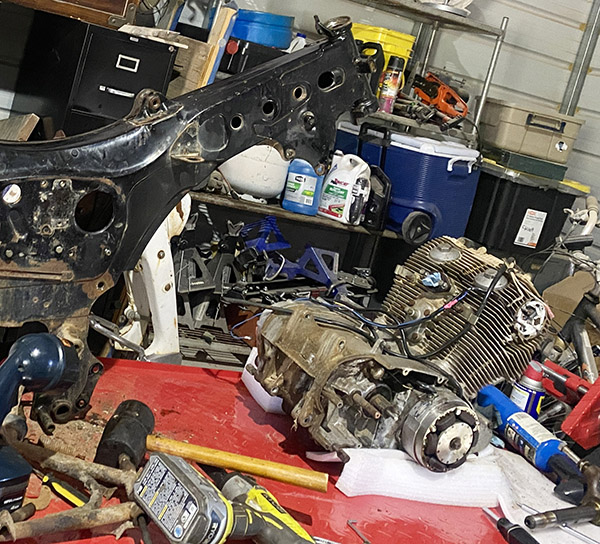
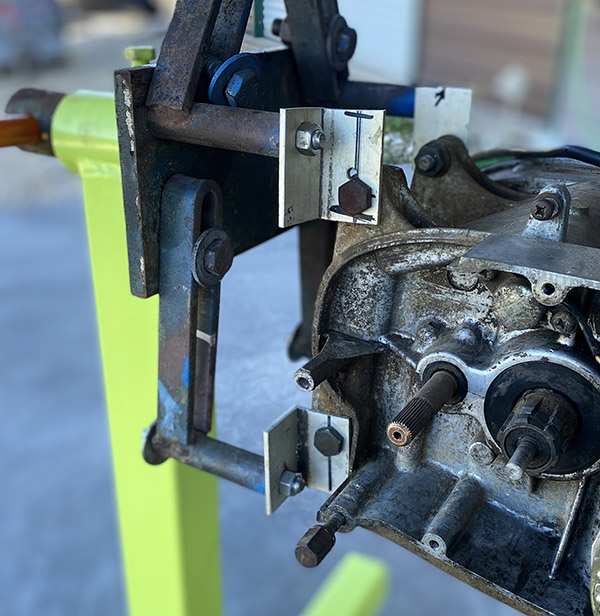
A few aluminum tabs and the Dream engine bolted right up. I’m going to do this method on the next MC engine I work on.
In all those years this will be the first motorcycle engine I’ve had on the stand. It makes everything easy with the mill at hip level. You can rotate the engine 360 degrees by spinning the T-handle. Which begs the question: why didn’t I think of this before?
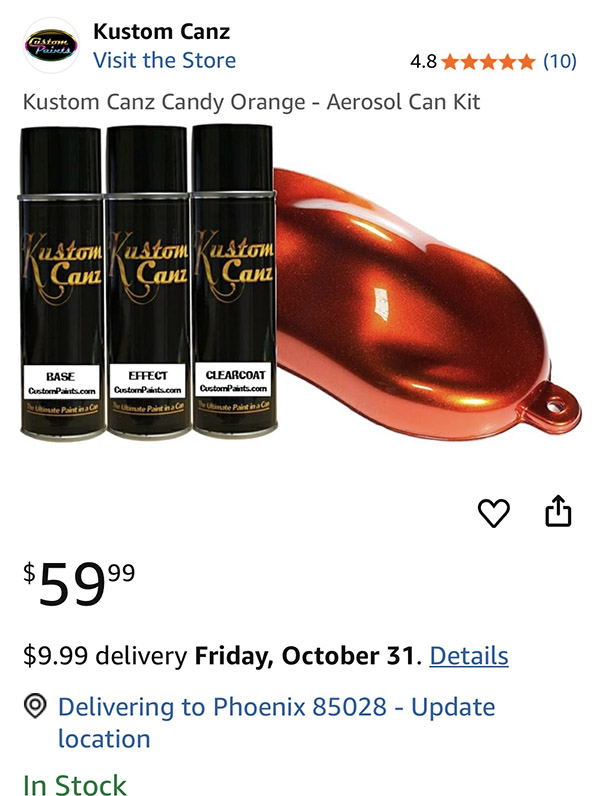
I’m thinking heavy metallic with candy-copper followed by 2K clear. What are the odds it won’t bubble?
I hear you: not much progress but I’m a bit lame right now and taking it easy for a week or so. What about a 3-part metallic orange for a color? Too much? Atomic Green? Black, red or white is boring.
The alarm rang early last week, and Sue and I were on the road at 5:00 a.m., pointed east on the 210 for the 5 1/2 hour trek to Phoenix and the Buddy Stubbs Motorcycle Museum. It was worth the drive out there.
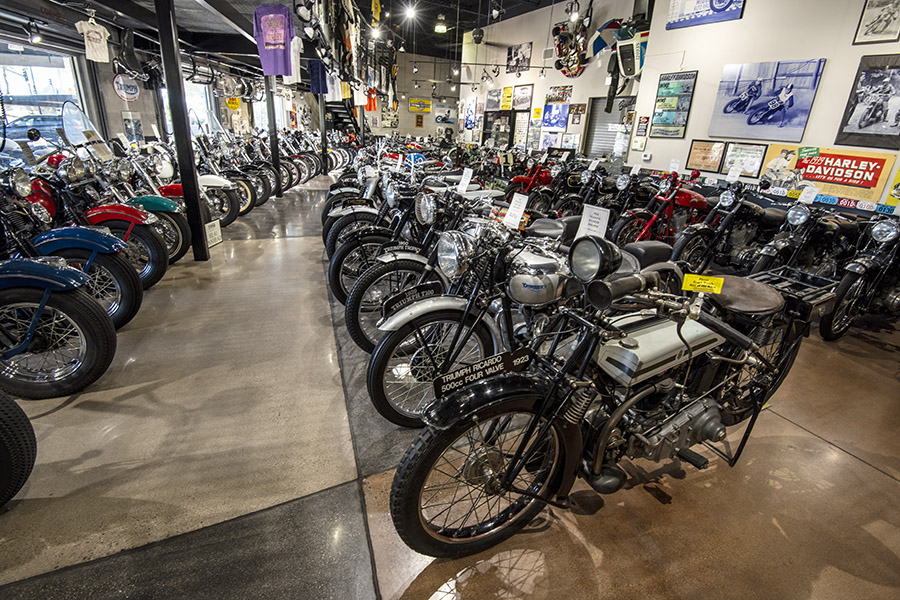
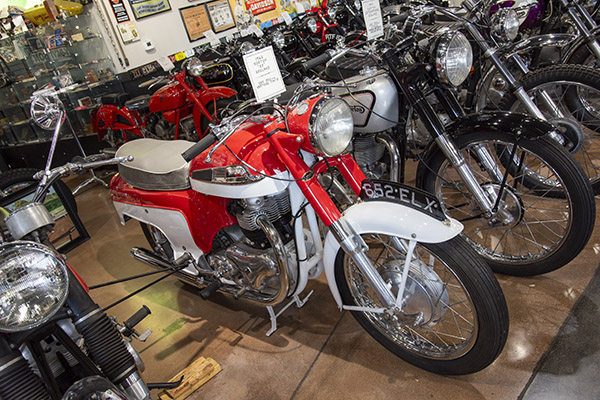
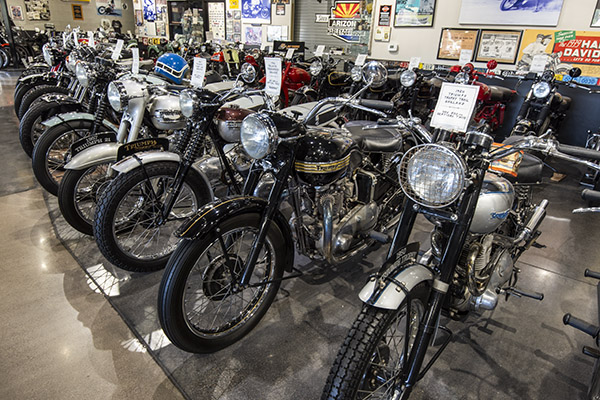
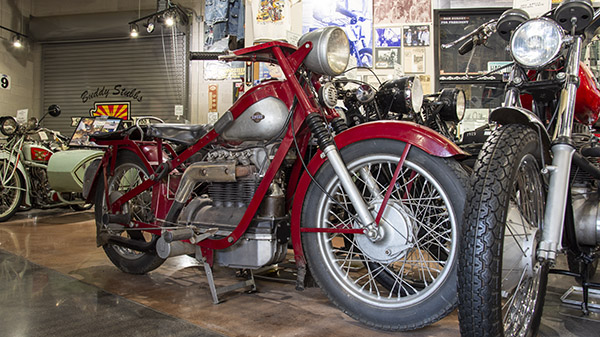
There are more than a few dealers who have a handful of bikes tucked into a corner of their showrooms they call a museum. Not so with the Buddy Stubbs Motorcycle Museum in Phoenix, Arizona. It’s the largest motorcycle museum in the American Southwest, and it’s one of the best motorcycle museums of the many I’ve visited over the last 30 or 40 years. I don’t say that lightly. This place is spectacular.
Many marques are well represented. This colors on this early ’60 Noron twin work for me.
Sue and I visited the Buddy Stubbs Museum recently for an upcoming issue of Motorcycle Classics magazine, and I sure was glad we did. The Museum has 137 bikes (with 124 on display). You might think they’d all be Harleys, but you’d be wrong. All the cool stuff is there, and it’s all vintage. Harleys, Triumphs, BSAs, Vincents, BMWs, Excelsiors, Indians, and a bunch more. It seems like every motorcycle in the Museum has a story.
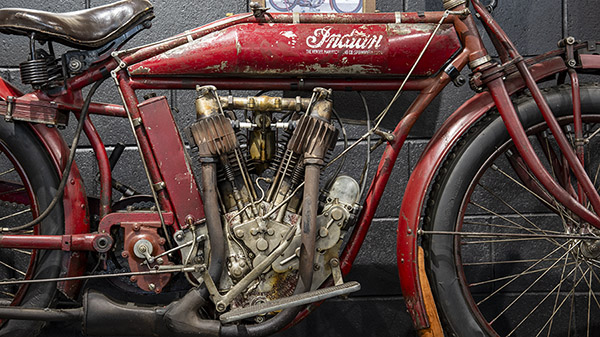
The 1913 Indian Buddy commuted on between dealership locations.
One of the stories is about the 1913 Indian in its original unrestored glory. You might recall that about 25 years ago Harley made their dealers build new and modern showrooms. Buddy Stubbs was one of those dealerships, and while the new location was under construction, Buddy rode between the old and new locations daily on that 1913 Indian. That’s cool.
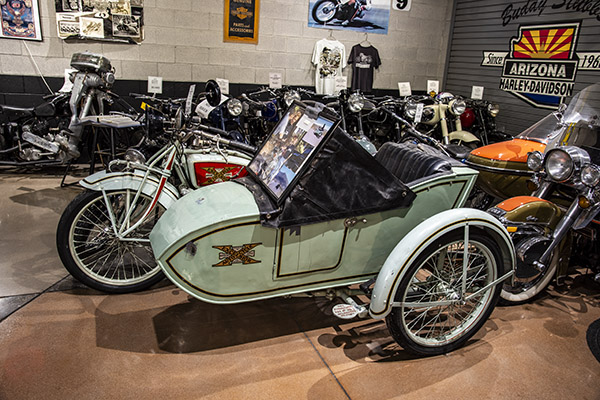
Buddy’s Cannonball Excelsior. All the spares rode in the sidecar and there was no chase vehicle.
Another bike with a story is the 1915 Excelsior, with sidecar, that Buddy rode in the 2010 cross country Cannonball Run. Okay, you might be thinking a lot of guys did that. Yeah, but…and the “yeah, but” in his case is that a 70-year old Buddy Stubbs made the ride with no chase vehicle. He carried all the parts he thought he might need in the sidecar. Wow.
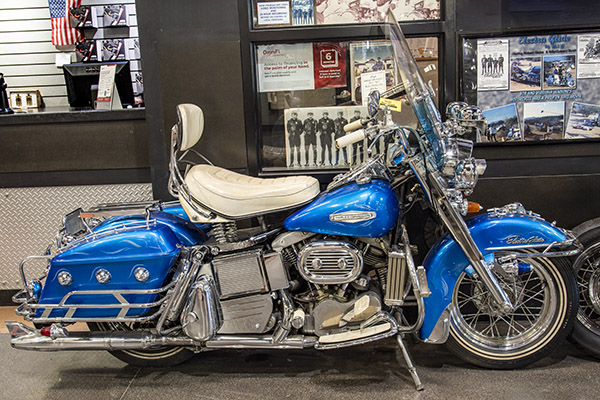
Yes, it’s the actual Electra-Glide in Blue. The real one that we all saw in the movie.
Remember the 1973 Electra-Glide in Blue movie? Buddy taught Robert Blake how to ride a motorcycle for that movie, and the motorcycle that Blake’s felonious motor officer buddy bought with stolen money (in the movie, not in real life) currently sits in the Buddy Stubbs showroom. Blake went on to a successful TV series (Baretta), and then he fell from grace when he murdered his wife (which he got away with in the criminal trial, although he was later found financially liable in a subsequent civil case). It’s tough to convict a movie star here in the Golden State.
The black T-Bird (second from right) was The Wild Ones backup bike.
Speaking of motorcycle movies, the grand-daddy of them all has to be Marlon Brando’s The Wild One. You will recall that Brando rode a Triumph Thunderbird in that movie. The producers kept a spare Triumph Thunderbird on set during the production. You know, just in case. That spare T-Bird is in the Buddy Stubbs Museum.
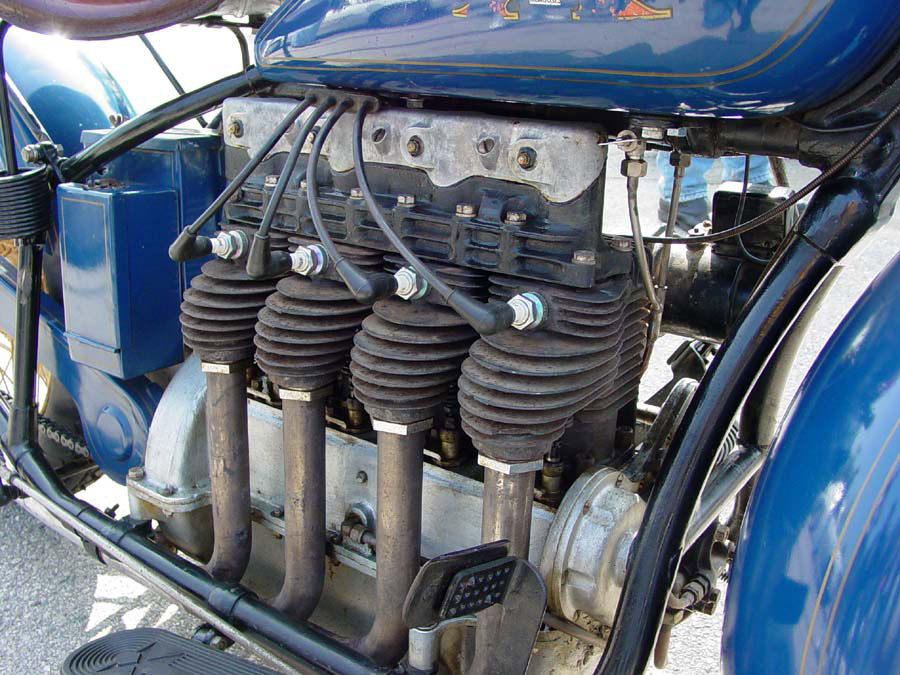
A four-cylinder Nimbus. It might have made it into our ¿Quantos Pistones? series had I seen it sooner.
There’s a whole section here on ExNotes focused on our dream bikes. Satisfyingly, several of those are in the Buddy Stubbs Museum, including lots of Triumph Bonnevilles, Harley Cafe Racers, and the Harley XR1000.
By any measure, Buddy Stubbs (who at age 85 is still with us) is an amazing man. You can even buy a book about Mr. Stubbs, which I did while visiting the dealership. I have a signed copy.
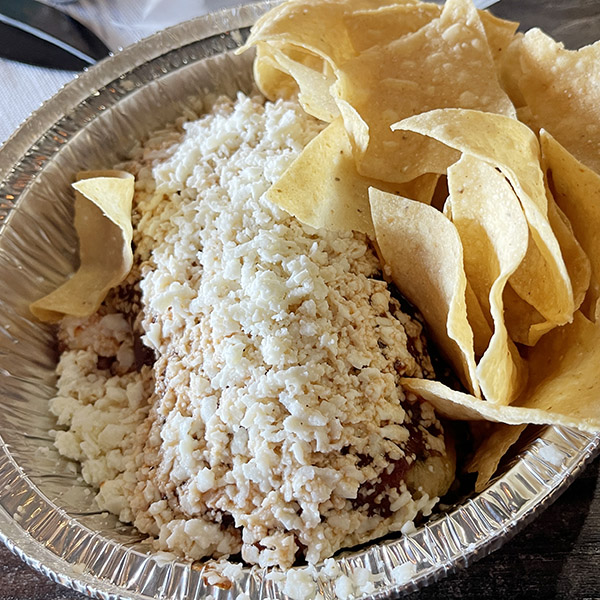
A chile relleno tamale. Muey bueno!
Hey, one more thing that I’d be remiss to not mention in this blog. Stop for lunch at the Tamale Factory, which is just 8/10ths of a mile up North Cave Creek Road from the dealership. I had the chile relleno tamale and Sue had the chicken version. Both were fantastic.