Buy A Bike In A Box!

By Joe Berk

Boy oh boy, it’s hard to believe a dozen years have slipped by.  The year was 2013, and one of CSC Motorcycles’ early marketing campaigns for the CSC 150 Scooter was the “bike in a box” program.  CSC sold its Mustang revival motorcycle as a kit, with assembly to be performed by the owner.  It was a brilliant marketing campaign and it worked well.  So well, in fact, that when CSC started importing the iconic RX3 250cc adventure touring motorcycle a couple of years later, an option available to consumers was to buy the bike in a pre-setup  format and perform the setup themselves.

In an effort to hold the line on tariffs and keep prices down, CSC is returning to its roots for the San Gabriel 250, one of its best-selling models.  Buyers can get the bike pre-setup, set it up themselves, and save a whopping $495.  It’s easy to put one of these motorcycles together, and to make it even easier, CSC provides a complete “how to” video.  It’s a great way to bond with your bike and to learn a bit about motorcycle mechanics in the process.  For more info, visit the CSC website at www.CSCMotorcycles.com.

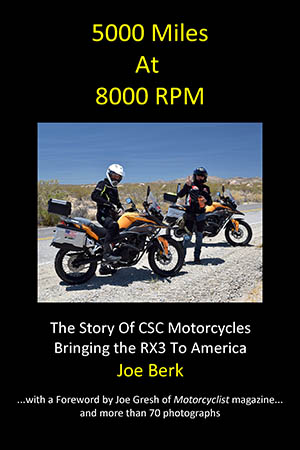
Would you like to learn more about CSC’s early days and the role yours truly and Joe Gresh played in helping to promote CSC Motorcycles?   It’s all there in 5000 Miles at 8000 RPM.


Join our Facebook ExNotes page!


Never miss an ExNotes blog:


Help us keep the lights on:


Don’t forget: Visit our advertisers!


The Crash – A Ride I Won’t Forget

By Bobbie Surber

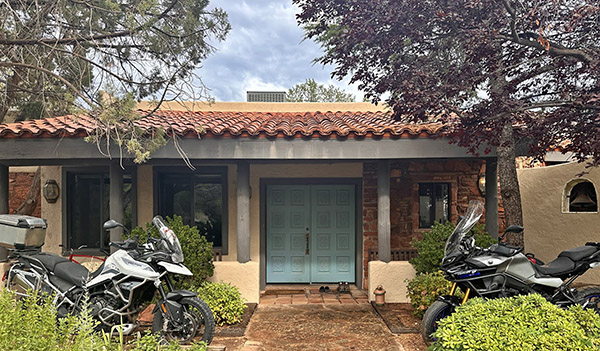
Ten weeks ago today, Tom and I set out on our bikes from Sedona, AZ, headed for a little mining town in Sonora, MX. The plan? Visit our good friends Tom and Lynn—expats who’ve built a beautiful life there with their hotel and a yearly rider meet-up that’s become a favorite stop for us.

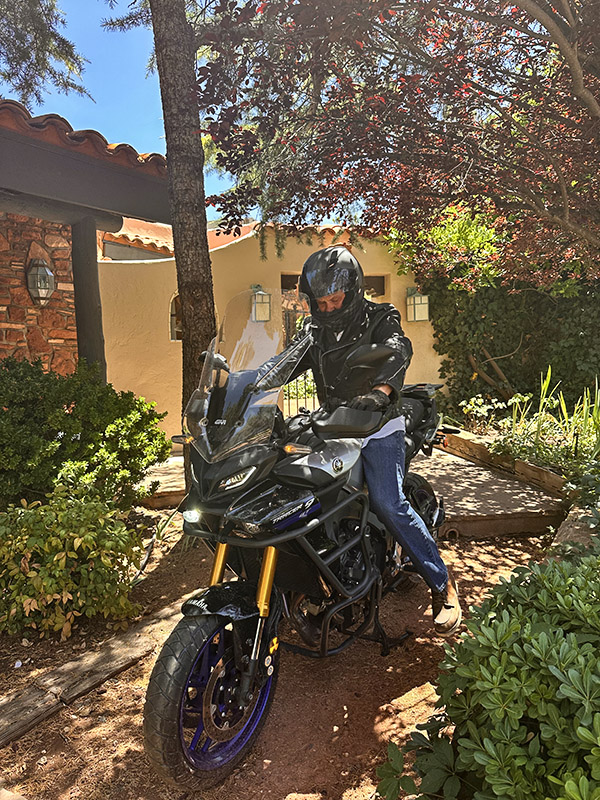
It started like any great ride: a cool Thursday morning, Sedona fading in the mirrors, Bisbee as our stop for the night, and an early morning border crossing on Friday. I was back on Tippi, my Triumph Tiger 900 GT Pro. Tom rode his Yamaha 900. Ahead of us? Three days with Tom and Lynn in their Sonoran paradise and, of course, some excellent Bacanora—a local smoky cousin of tequila.

The Perfect Morning

We left Tom’s house in that perfect early light, the red rocks glowing like they do only in the morning. Onto Highway 89A, then climbing Highway 260 toward the Mogollon Rim. First stop: Payson for fuel and a snack from the top box. It was one of those perfect riding mornings—cool air, empty roads, and that smooth hum where the bike feels like it knows what you’re thinking.

From there, we rolled onto Bush Highway, then Route 188, Lake Roosevelt flashing blue beside the desert. It’s one of those stretches that makes you forget you even have a destination. Too soon, Globe showed up—time for another quick fuel stop and stretch.

Tom looked tired when he swung off his bike. I noticed, but let it slide. That was mistake number one.

When It Went Wrong

Highway 77 is a narrow, twisty canyon road. Tom led, I followed. He was riding too close to a double-trailer semi, hugging the shoulder. I wanted to yell “Move over!” but we weren’t running headsets that day—mistake number two.

The wind blast hit him hard. He veered toward the ditch—four, maybe five feet deep—plowed through two plastic road signs, and fought like hell to keep it upright. For a moment, I thought he’d pull it off. Then the bike hit a rock the size of a pineapple and went down.

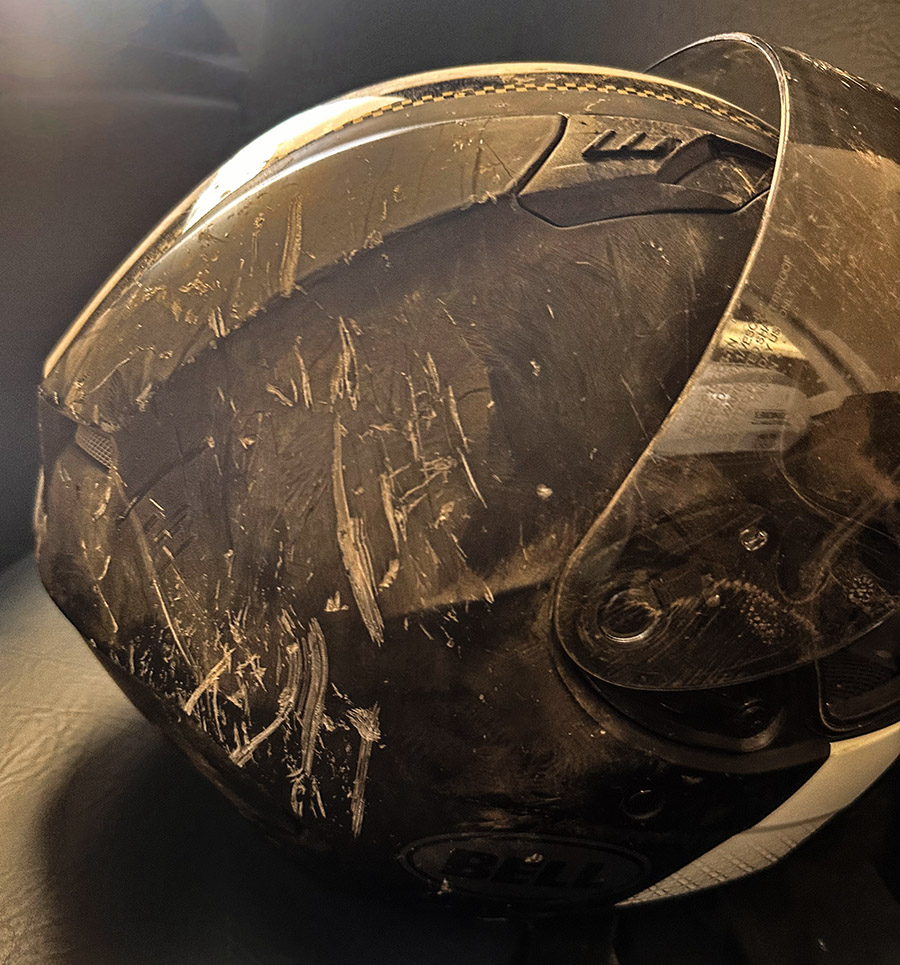
I rode past to find a safe place to stop, heart pounding so hard I could barely swing a leg over to dismount. For a second, I almost let Tippi fall so I could get to Tom faster. Somehow, I steadied myself, pulled off my helmet, and sprinted uphill.

Best sound I’ve ever heard? Tom yelling. Painful yelling, sure, but yelling. He was conscious, breathing, and already doing a self-check—old ER doctor habits die hard.

Angels on the Road

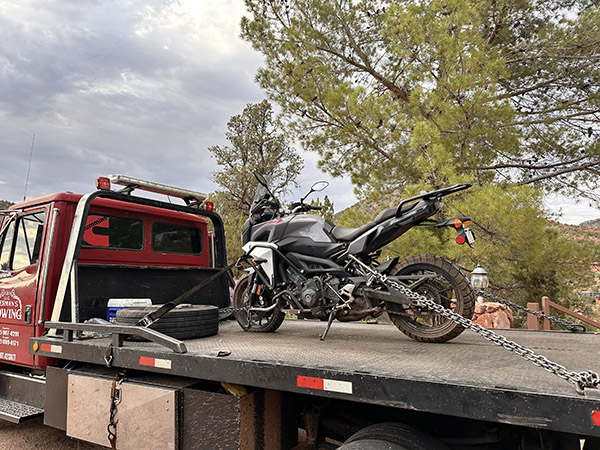
Cars kept flying by until one truck pulled over. Out stepped Chris—a firefighter, of all things. He took control like it was second nature: called for help, righted Tom’s bike, and helped him climb out of the ditch. Minutes later, paramedics loaded him into the ambulance headed for Cobre Valley Medical Center. Chris even gave me a ride to the hospital and didn’t leave until he knew we were okay.

Scans confirmed it: a broken scapula and two fractured ribs. Painful, yes, but survivable.

That night, I sat in the hotel room, had a good cry then listening to Tom breathe, whispering thanks to the road gods and to Tom’s split-second decision that might have saved his life.

Healing & Moving On

The following weeks were slow. Broken bones heal according to their schedule. Tom never complained, just kept moving, day by day.

By week six, the doctors were shaking their heads—he’d healed faster than expected. And, in classic Tom fashion, he now owns another Yamaha 900, fully loaded with more extras than I even knew existed. That crash slowed him down, but it sure didn’t stop him.

I’m still riding Tippi, and we’re already planning a fall ride back to Sonora. That Bacanora run? Just delayed, not canceled.

Lessons From the Road

      • If you’re tired, stop. Always.
      • Eat, drink, rest. These rides aren’t the place to “push through.”
      • Use comms. Sometimes one quick word can be the difference between safe and scary.

Join our Facebook ExNotes page!


Never miss an ExNotes blog:


Help us keep the lights on:


Don’t forget: Visit our advertisers!


Two Kool Kamp Kings

By Joe Berk

Sue and I were in Reno last month to visit the National Automobile Museum.  Like most places, Reno isn’t what it used to be.  The downtown area is a bit sketchy and I didn’t feel comfortable at all walking around.  That said, we had a good time at the Auto Museum and a good time in Reno.  As is my habit, I checked online to see if there were any interesting gunstores in town, and the online info for one in particular caught my eye: Willey Brothers Firearms.  Unlike the others, Willey’s ad emphasized the kind of guns I’m interested in (blue steel and walnut, not the black plastic tactical junk one mostly sees in gun stores these days).  Willey Brothers lived up to its ad:  The firearms were interesting, including the used guns.

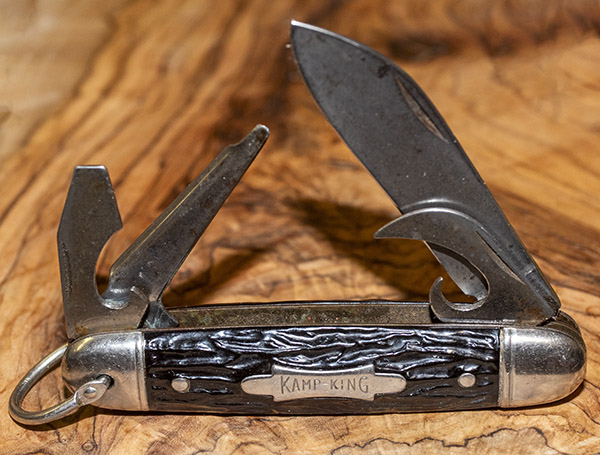
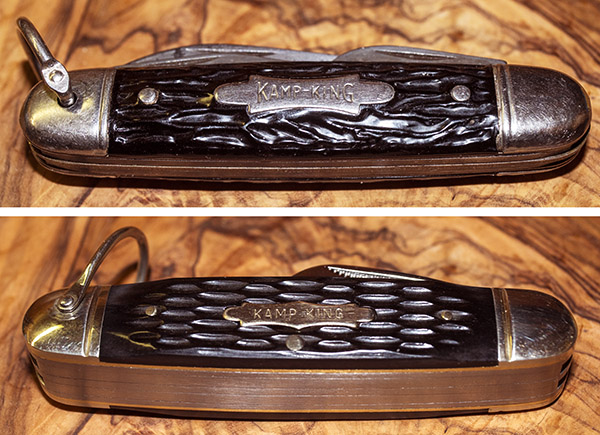
The old Imperial Kamp King knife I bought at a gun store in Reno, Nevada. It has a combination bottle opener/scredriver, an awl for punching holes and undoing knots, a can opener, and a main blade. This one is about 50 years old, and it is in great shape.

Nothing in the gun offerings was interesting enough, though, to make me want to go to the bother of shipping it to the Peoples Republik of Kalifornia, but I noticed the store had a few used pocketknives for sale.  One in particular caught my eye:  An old Imperial Kamp King that was in nice shape.  I was interested in it because it has the same four-bladed configuration as my old Cub Scout knife.   At $25, it looked like a good deal, so I paid the asking price and Sue and I were on our way.  When I got home, I cleaned it up with a bit of Kroil penetrating oil and 0000 steel wool. I think it was made in the 1950s or 1960s (that’s a guess on my part, although if I studied the video included below, I’d probably be able to narrow it down more).

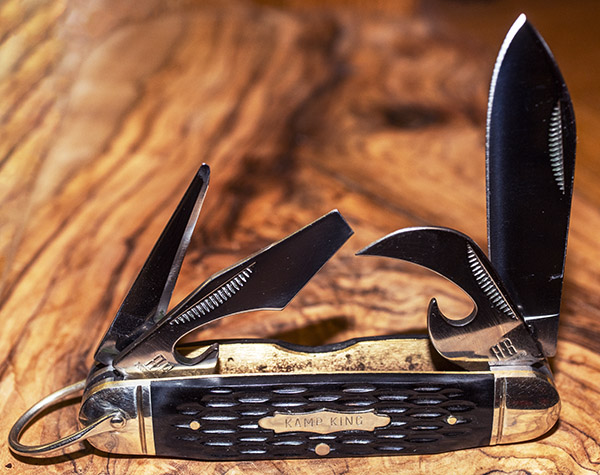
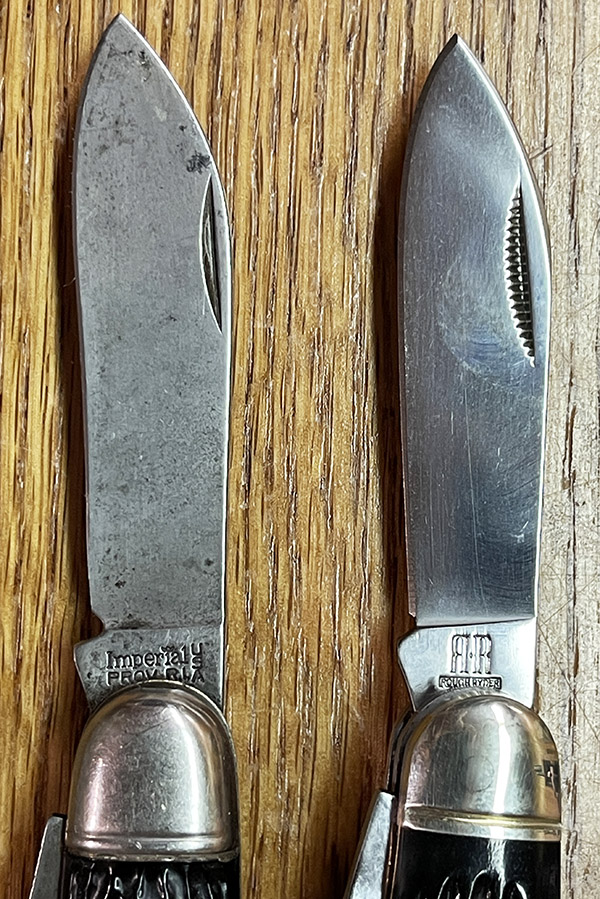
The new Rough Rider Kamp King, with the same blades as the original. This is a very high-quality knife, and I can tell you that the main blade is razor sharp (don’t ask me how I found out).

That got me thinking.  There’s a company called Rough Rider (not the condom company) that makes a current version of the Kamp King.  I recalled seeing that knife when scrolling through the offerings from Chicago Knife Works (which is actually located in Marion, Virginia).  The CKW Kamp King was only $16.94, and the more I thought about it, the more I knew I had to have it (admittedly, the thought process did not take long).  Move to cart, buy now, and in went my credit card number.

Chicago Knife Works has great prices and terrible shipping.   It takes 10 to 12 days from the time I’ve placed orders with these guys until whatever I order actually ships.  I don’t mean until it gets here; I mean until it actually leaves the CKW facility.  I don’t know if that’s because CKW is just pokey, or if they don’t keep much in stock and they order their knives from China when I place an order.  I suspect it’s the former, as every time it’s taken an inordinate amount of time to ship and I send them an email to complain (I did that every time I’ve ordered anything from them).  Then I’ll get an automated response from Chicago Knife Works telling me they’re sorry (which I already knew) and they have so many orders they just can’t get to them all in a reasonable amount of time.  And every time when I wrote to complain about taking to long to ship, well, CKW ships my order the very next day.  I should get smart and complain about the shipping delay as soon as I place an order, I guess.

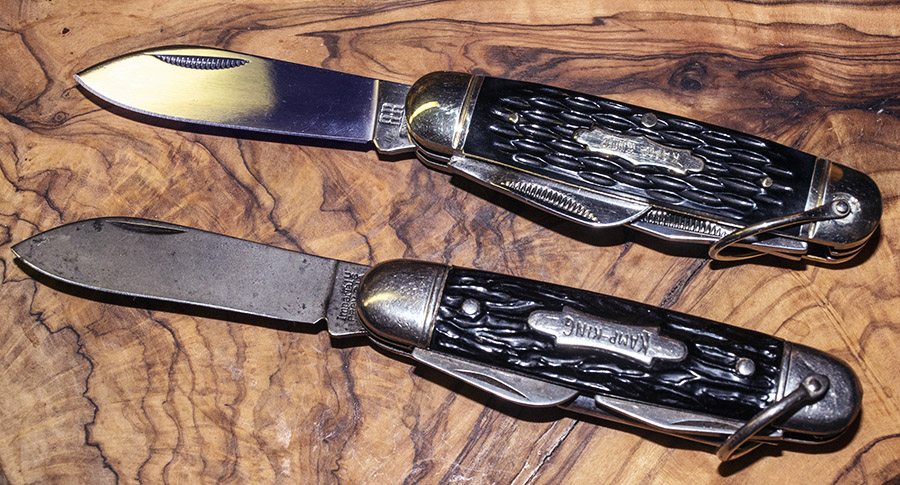
My new Rough Rider Kamp King arrived a few days ago and I’m impressed.  It is a really nice knife that dimensionally is pretty true to the older ones that were manufactured in America.  The quality on the new Chinese Kamp King is really good.  The fit and finish are superb, and it just doesn’t look or feel like a cheap knife.

The old Kamp King (top), and the newer one (bottom). The dimensions are the same. For $16.94, the new one is a great buy.

The other reason I ordered the new Kamp King is that I wanted to compare it to a Marbles Scout King I had purchased from Chicago Knife Works about six months ago.  I thought it might be the same knife as the Marbles, but it is not.  The Marbles knife is a bigger, heftier version of the Kamp King.  I suspect they are both manufactured by the same knife company in China, but I don’t know this.  The appearance of the two new knives (even though the dimensions and the scales are different) is so similar that I’d bet both come out of the same factory somewhere in the Peoples’ Republic (and I’m talking about China now, not Kalifornia).

The original Kamp King was manufactured by Imperial in Providence, Rhode Island. The new one is produced somewhere in China; most likely in Yangjiang City, China’s knife-making capital.

I Googled the topic and although I couldn’t find the specific Chinese company that makes these knives, I learned that China’s primary knife-manufacturing region is Yangjiang City in Guangdong Province.  It’s been China’s knife-making center for more than 1,400 years and is home to several knife companies.  I’d sure like to visit that area someday.  I’ve been to Providence, Rhode Island (where the original Kamp Kings were manufactured).  A visit to Yangjiang City would be interesting. I’d probably come home with a suitcase full of interesting and inexpensive knives.


Join our Facebook ExNotes page!


Never miss an ExNotes blog:


Help us keep the lights on:


Don’t forget: Visit our advertisers!


Pa-Pae Meditation Retreat

By Mike Huber

After scuba diving and a relaxing month living in Ao Nang, Thailand, I was becoming too comfortable and thought it was time to move north to experience Chiang Mai and its temples and sights near the Laos border.  I didn’t have much of an itinerary, but I had met a pretty cool French guy who highly recommended a Buddhist meditation retreat called Pa-Pae.  It was about an hour’s bus ride north of Chiang Mai.  Having never experienced meditation before, this seemed like a great opportunity.

I was surprised at how well organized the retreat was. It was adjacent to a small village with its own store and a local restaurants, but otherwise this retreat was in its own world separated from everything else. This was the perfect location to practice meditation. Wanting to experience this retreat even deeper I chose to perform a fast (water only) and not speak throughout the four days (the silence was the world’s loss for the four days).

Once settled into my little cabin on the mountainside and changing into the white pants and shirts they provided, it was time to relax until the evening meditation class.  The class would cover the basics of meditation in an attempt for me to clear my mind (never an easy task) and try to find some peace within myself.  Meditation isn’t easy for me.  It took a lot of work to focus on a mantra or an object within my mind and remove all the static from the outside world.

With there being three meditation classes daily and without speaking, I was able to silence my mind, if only for a few moments each class.  In between the meditation classes there were monks who would share their illuminating life stories and also provide answers to the many questions we first timers had.  With not being able to speak, the question-and-answer sessions were my only source of social activity.

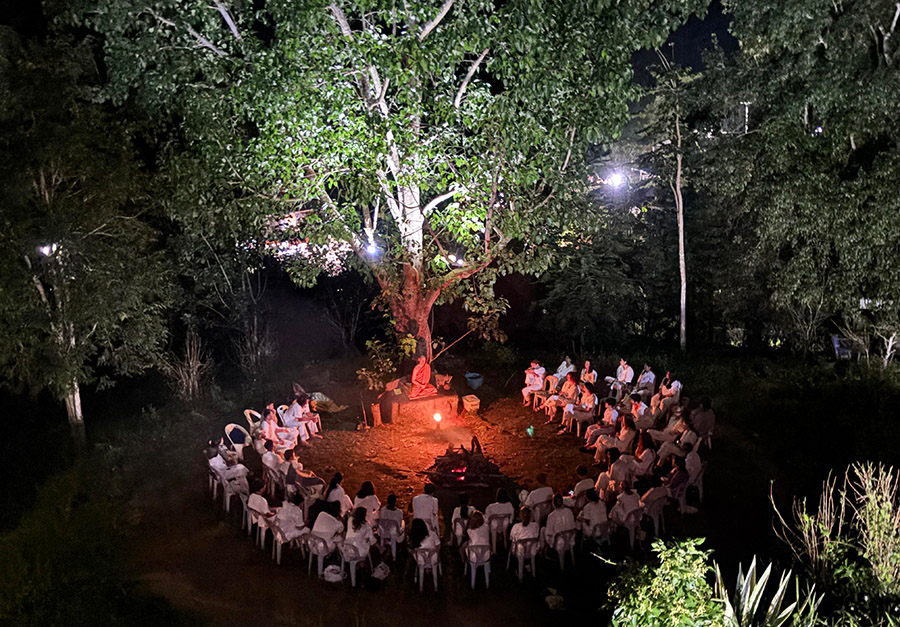
Our final meditation ceremony was held around a fire pit.  This is where I almost broke my silence as the wood for the fire was quite wet (we were in a rainforest, after all) and I had an extremely difficult time pantomiming “get some gasoline to get this fire going!”  I did finally manage, though, and the fire was lit. When that evening’s meditation ended, we lit paper lanterns to release into the sky.  My lantern in the photo is the one stuck in the tree. Slip away!

Upon leaving I felt refreshed, rested, and almost ready for the next part of my adventure. I successfully completed the classes, my fast, and even my 92-hour silence. Later that evening I celebrated by stuffing my face with some Pad Thai and talking with my mouth full.  My next retreat should be one that involves learning proper manners.


Join our Facebook ExNotes page!


Never miss an ExNotes blog:


Help us keep the lights on:


Don’t forget: Visit our advertisers!


A Tale of Two Bowie Knives

By Joe Berk

Well, maybe it’s three.  A little while ago I wrote about a custom Bowie knife good buddy Paul crafted for me.  That knife was a surprise gift, I like it a lot, and it fit in nicely with the rest of my collection.

A surprise gift from good buddy Paul: A custom Bowie knife.

Paul then sent a photo of a curly maple Bowie he made for himself, and I liked it so much I offered to buy it.  Not so fast, Paul said.  He’s keeping that one, but he offered to make another one just like it for me.  One thing led to another, and I decided to go ahead with the curly maple Bowie.  And then I decided to get yet another Bowie, this time with a white Micarta handle.  Paul told me about a block of Micarta he’s had for 40 years, and he thought it would do nicely.  Over the years, the Micarta had taken on a beautiful yellow hue similar to real ivory.

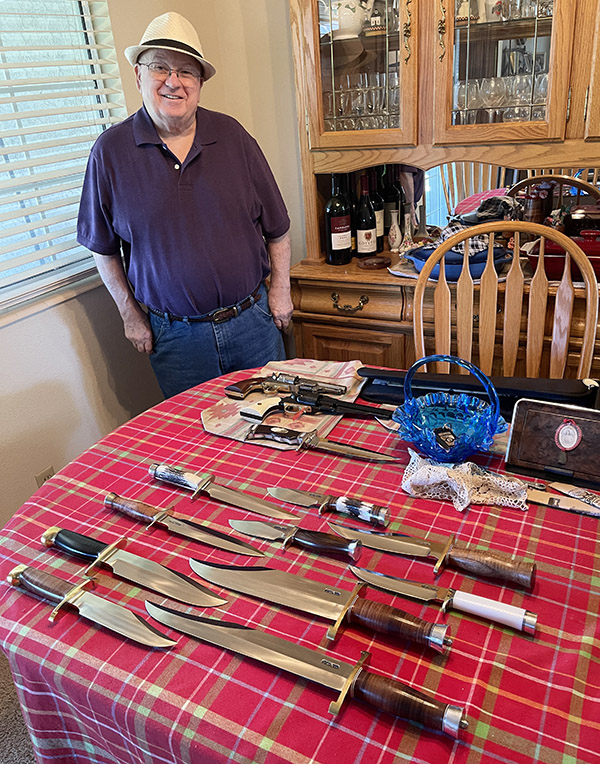
Lifelong good buddy Paul with some of his Randalls and a few other toys. I’ve known Paul longer than any other person on the planet.

Paul is an experienced and serious knifemaker, and he is also a collector.  He has the nicest collection of Randall knives I’ve ever seen, as well as a bunch of other high-end knives.

Now, on this business of Bowie knives:  In the previous Bowie blog (to which I provided a link above), I wrote briefly about the history of Jim Bowie and the knife that bears his name.  And speaking about bears, some of you might be thinking about Davy Crockett, a Bowie knife, and the myth surrounding his encounter with a bear.  Congressman Crockett’s ursine encounter is but a story; it’s not historical fact.  It likely came about as the result of the song, “The Ballad of Davy Crockett.” As our President might say: It’s fake news. There’s no proof it actually occurred. But it’s fun to think about.

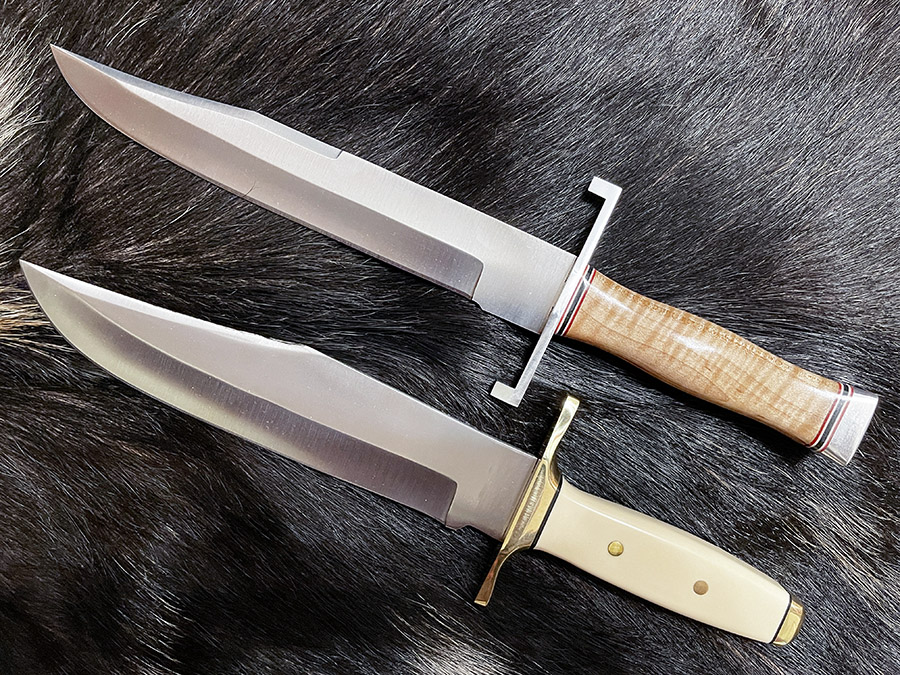
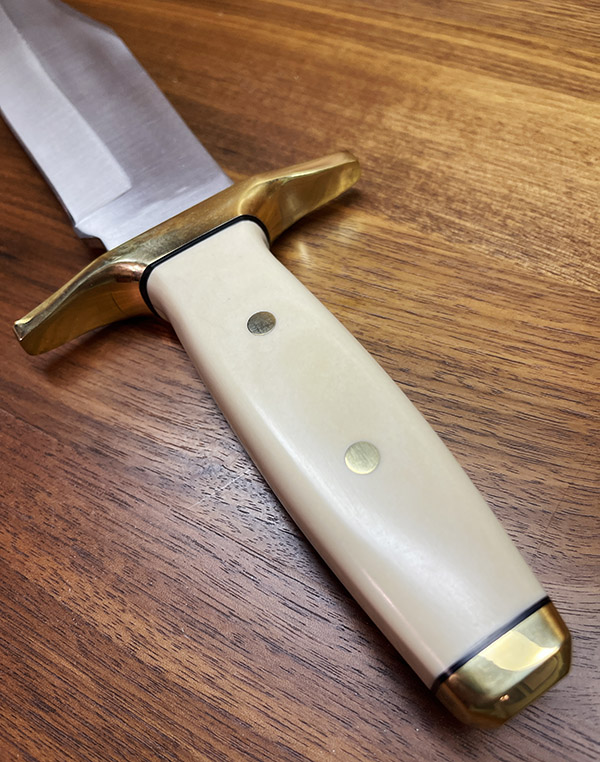
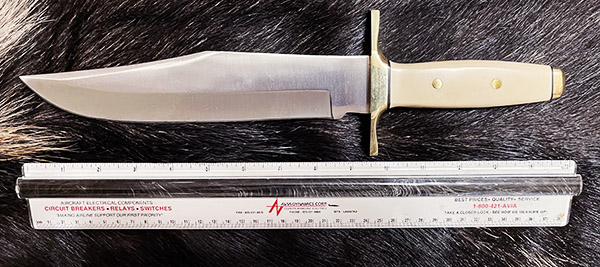
My two recent custom Bowie acquisitions are both massive knives.  The Micarta-handled bowie has a blade length of 9 3/4 inches and an overall length of 14 7/8 inches.  It’s a huge knife with a gorgeous brass guard.  It is simply stunning.

The Micarta Bowie. The handle, the brass guard and pommel, the blade, the brass pins, and the Micarta handle make for a beautiful custom knife.
A close up shot of the craftsmanship on the custom Bowie handle. It is an exquisite knife.
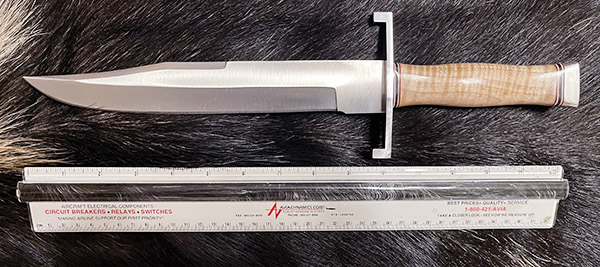
Big boys, big toys: Both of these knives are huge. The Micarta-handled knife has a good feel to it.  The ruler you see above is 15 inches long.

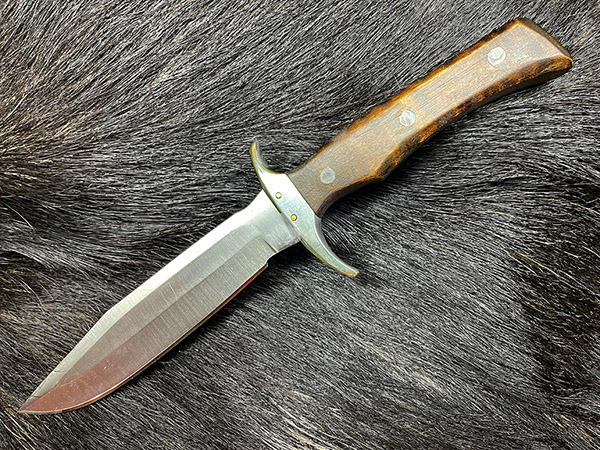
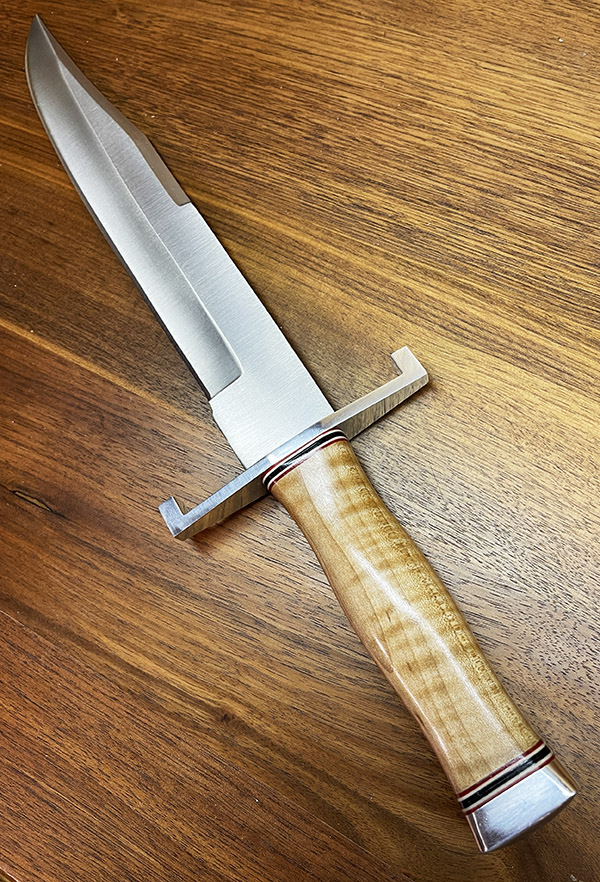
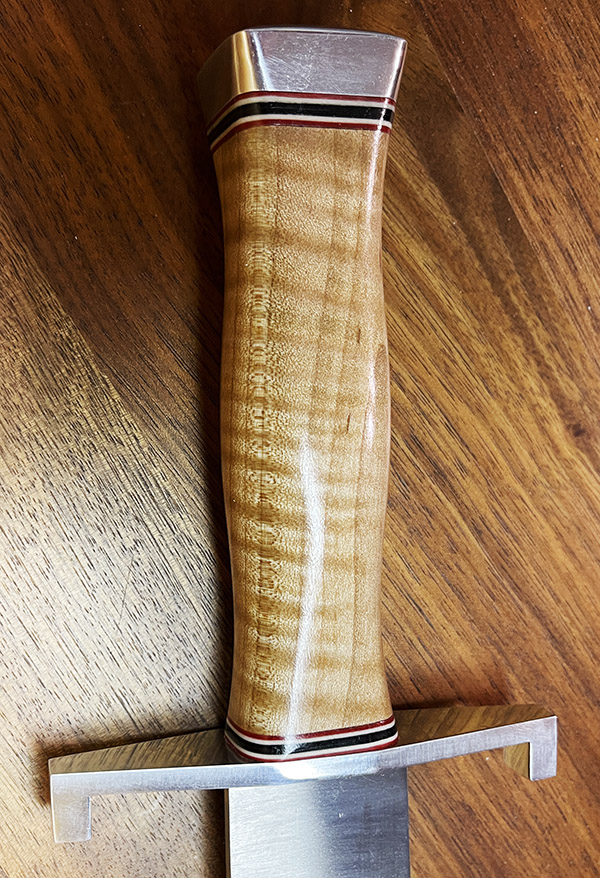
The curly maple custom Bowie knife is the one that got all this going.  When I saw the one Paul had crafted for himself, I had to have one.  I absolutely didn’t need it, but I wanted it.  I wanted one just like Paul’s, and he came through. It’s a beautiful knife.

Paul does beautiful custom work. You should see his black powder rifles; they are equally impressive. This knife just looks right.
The workmanship on both knives is superb. The guard and the pommel are beautiful bits of aluminum hand filed and finished by Paul. There are a lot of hours in these knives, and it shows.
Curly maple, custom everything: This is a beautiful Bowie knife.  The background for this photo and others in this blog is an Ossabaw hog skin.  I shot it on a hunt with Paul in Arizona about 10 years ago with a curly-maple-stocked Model 70.

The curly maple knife is even bigger than the Micarta knife (the blade length is 10 inches and the handle is 5 1/4 inches, for an overall length of 15 1/4 inches).  Although it’s bigger, the maple knife is noticeably lighter than the Micarta Bowie due to its more slender blade, the aluminum guard and pommel, and the curly maple handle.  Both are big, big knives.  Huge, actually.

Paul asked for my inputs during the design of both knives, and he kept me posted with photos as the knives came together.  It was fun, and I now own the two beautiful Bowies you see in this blog (three, if you count the first one).  They are stunning knives, they are built exactly as I wanted them, and they are a magnificent addition to my small collection.

You know, we have bears here in southern California. Lots of them, apparently.  One was in the backyard of a home just a half-mile from ours few days ago.  Bears, be forewarned.  Thanks to Paul, I’m ready.


Join our Facebook ExNotes page!


Never miss an ExNotes blog:


Help us keep the lights on:


Don’t forget: Visit our advertisers!


A Laminated Mosin

By Joe Berk

One of the best gun deals ever were the surplus Mosin-Nagant rifles that were everywhere until Obama was in office; now, you hardly see them anywhere, and when you do, they go for big bucks.  You used to be able to buy a Mosin for $79 at Big 5.  I started playing around with them about 15 years ago.  Today, when you see one, it’s not unusual for the store to have them marked at $500 (or more).

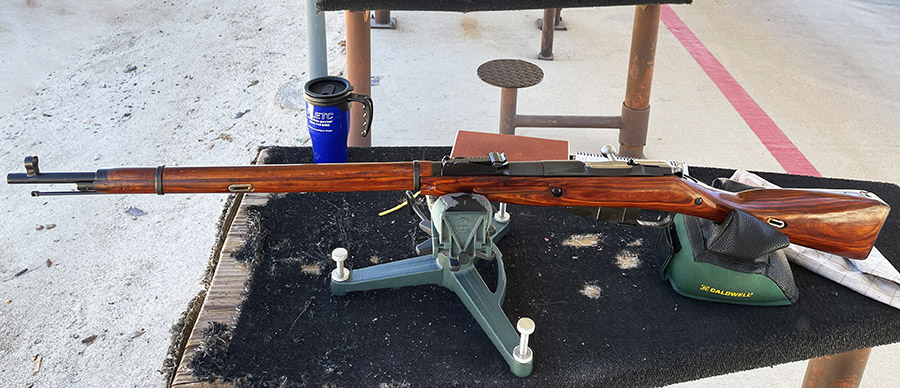
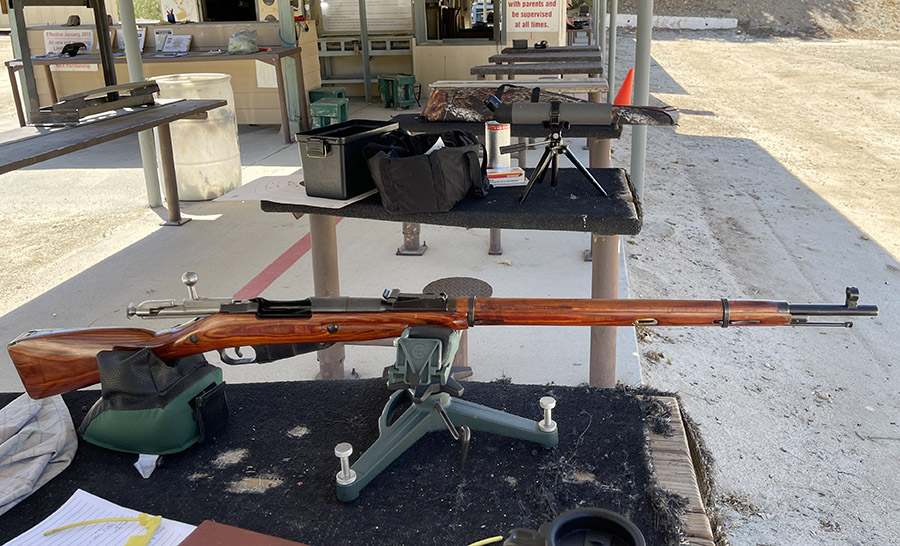
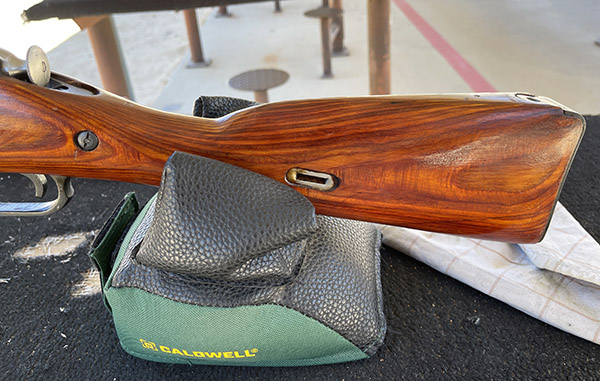
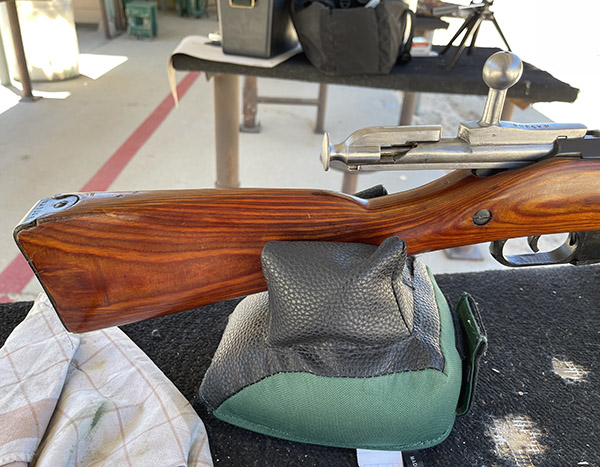
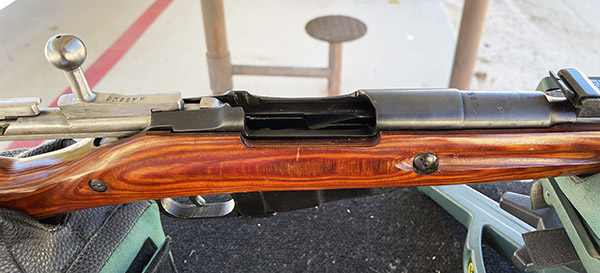
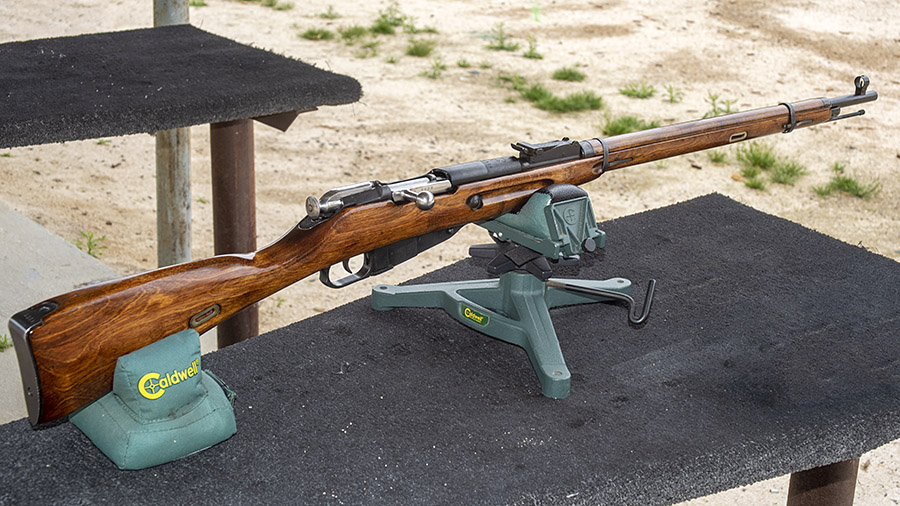
One of mine is a laminated stock Mosin 91/30, which is not seen too often.  I bought it about 10 years ago from Gunrunner’s in Duarte for $239 and stuck it in the safe.  Until today, I had not fired it.  It’s a Tula (there were two makers; Tula was one) with a round receiver.  It was made originally in 1939.  After the war, the Soviets refurbed most of them and a very few were fitted with laminated stocks.  I’ve never seen another one on the range.  It’s a pretty rifle, and I like the look of it.  Laminated wood stocks are usually much more stable than a standard stock, so I think that’s helping this rifle’s accuracy.

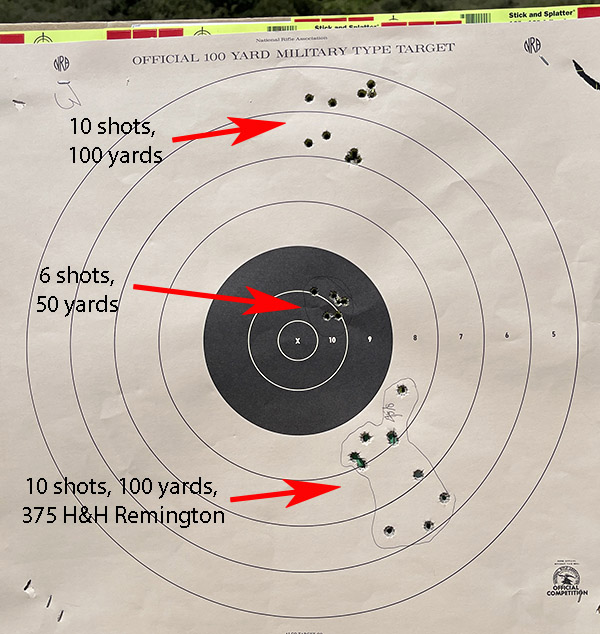
My laminated Mosin has the usual nicks and dings.  The serial numbers all match (stock, magazine, bolt, receiver, and bayonet).  The trigger is heavy, gritty, and just God-awful.  For the groups you see here, I used my new favorite Mosin load (42.0 grains of IMR 3031 and the PRVI PPU 150-grain jacketed softpoint boattail bullet).

The rifle, I think, shoots well (even with its terrible trigger, and it was pretty windy out there the day I shot the groups you see above).  Because I am a cheap SOB, I reused a target from a previous range session with my .375 H&H, so you can ignore the group to low right of the bullseye.  With my laminated-stock Mosin, I first shot 6 rounds at 50 yards to see where the rifle was printing (my aim point was at 6:00 on the bullseye).  Then I moved the target out to 100 yards and fired another 10 rounds using the same aimpoint.  The 50-yard group measures 1 1/8 inch; the 100-yard group measures 2 13/16 inch.  That’s not too bad for the first time out, and not too bad for an old guy using iron sights.

My rear sight is already all the way down.  I am going to look for a front sight with a taller post (if you know who might offer these, please let me know). The rifle probably has a 500-meter battlesight zero (or whatever the Russians used), and it was probably set up with the bayonet installed (which makes the rifle shoot to the right without the bayonet).   I can adjust the windage by drifting the front sight; I can’t lower the elevation without getting a taller front post.

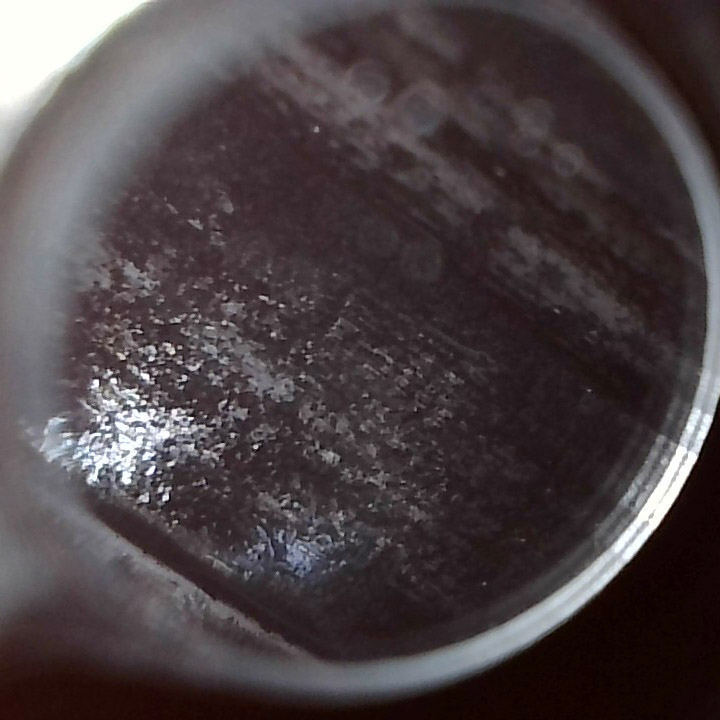
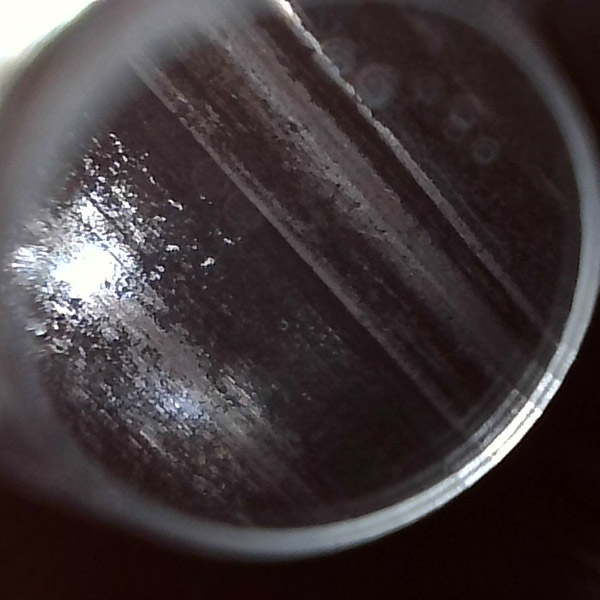
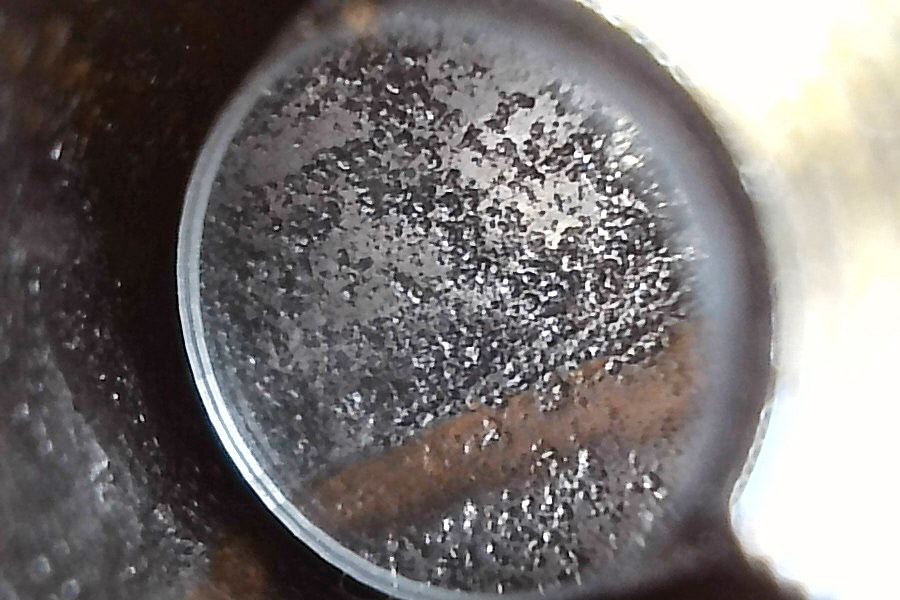
You might be wondering what the bore looks like on this rifle.  I can show you:

There are some takeaways from the above photos:

      • The bore is better in some spots than in others.
      • When these rifles saw action in World War II (as this one probably did), the ammo used had corrosive primers.  The effects of that are visible.
      • Even Mosin-Nagant rifles with funky bores can shoot well.
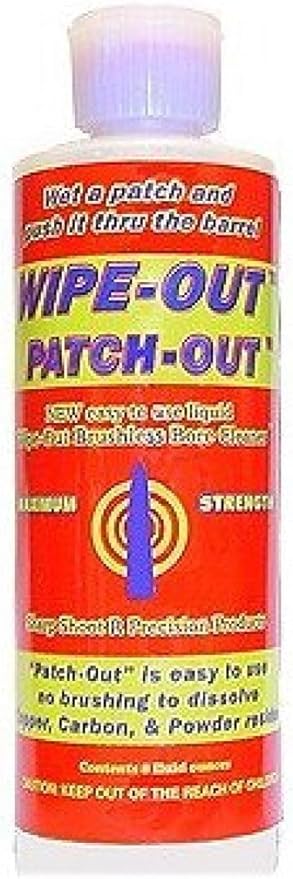
      • The bore cleaning copper fouling solvent I use, Patch-Out, does a good job.  It works a lot better than Hoppes No. 9.  You don’t see any copper in the photos above.

Incidentally, if you’ve never seen the movie Enemy at the Gates, it’s one of the best movies ever (in my opinion).  The Mosin-Nagant rifle plays a starring role.  The opening scenes are really well done.  Take a look:

I’ve written a lot about the Mosin-Nagant 91/30 rifle.  I love these old rifles. Here are my earlier posts:

Three Mosin-Nagant Loads
Mosins, Sewer Pipes, and Lunar Landscapes
A Tale of Two Mosins
More Mosin Loads
Cast Bullet Mosin Loads
Mosins, and Enemy at the Gates
NJ State Police Museum
A Tale of Two Old Warhorses
Home on the Range
Stupid Hot 7.62x54R Ammo
Lee Ermey’s Guns Go To Auction
Revisiting World War II
Sniper!
Motorcycles and Milsurps

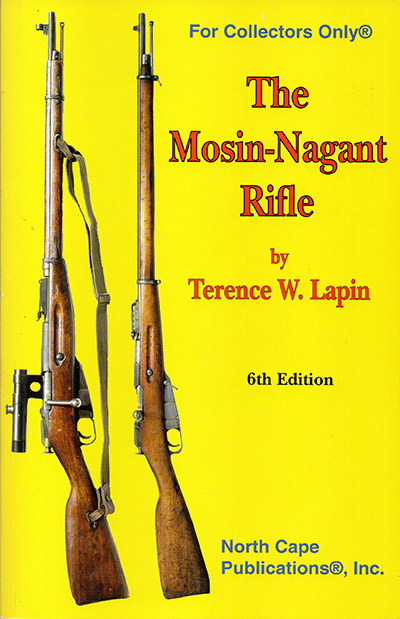
If you would like to learn more about the Mosin-Nagant rifle, the Lapin book is the definitive source:

The Mosin-Nagant Rifle is an easy and fascinating read.   I enjoyed it and I think you will, too.


Join our Facebook ExNotes page!


Never miss an ExNotes blog:


Help us keep the lights on:


Don’t forget: Visit our advertisers!


ExNotes Review: MidwayUSA Soft Rifle Case

By Joe Berk

I don’t usually buy things with features I don’t need, but I made an exception for MidwayUSA’s soft rifle case.  I needed a couple of soft rifle cases because some of mine had worn out (the zippers were tearing on a couple, the inner lining was snagging on the front sight on another, the handle broke on one, etc,).  Usually, I spend about $10 or $12 on a rifle case because the only thing I really use them for is bringing a rifle to or from the range.  In the past, I’ve purchased them when visiting Bass Pro or Turner’s.

I buy a lot of reloading components from MidwayUSA, so that’s where I went for the cases.  MidwayUSA usually ships either the day I order anything, and they have that $100 free shipping threshold.  At $26.24, their Heavy Duty Scoped Rifle Case was more than I wanted to spend, but hey, I would only need to order four of the things to get my free shipping.  I am a sucker for that free shipping deal.

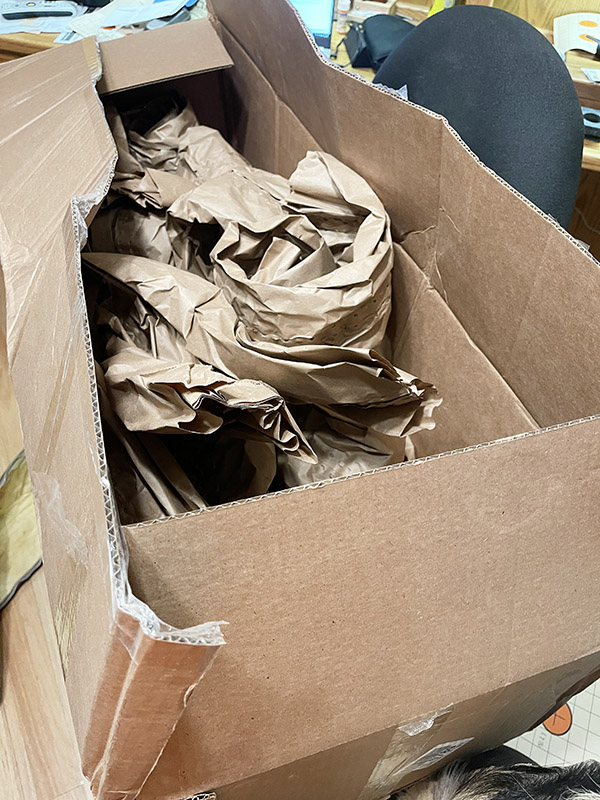
The cases arrived quickly, and MidwayUSA packaged them well.  They arrived in a single large box with plenty of padding.  You could have shipped a body in the box (it was that big). Each case was in a separate plastic bag.  It’s funny when you think about it:  Carefully packing a case in a box to protect it from damage when the purpose of the case is to protect things from damage.

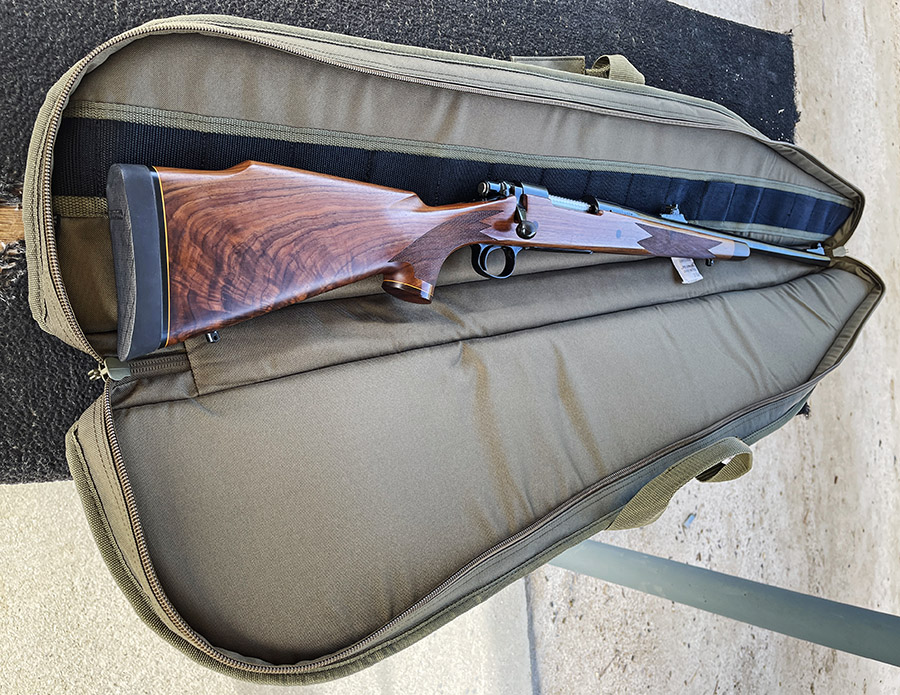
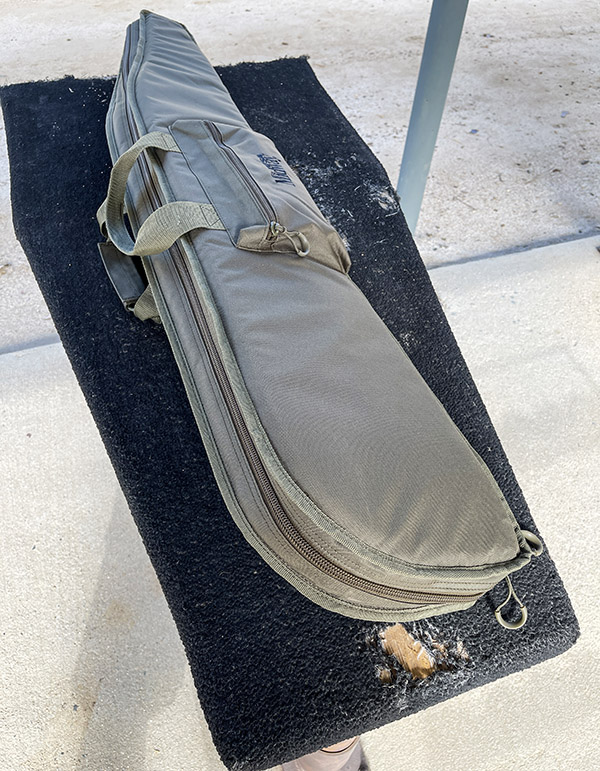
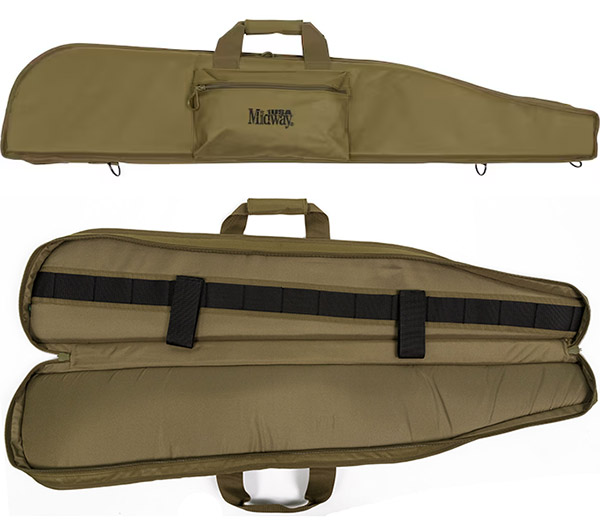
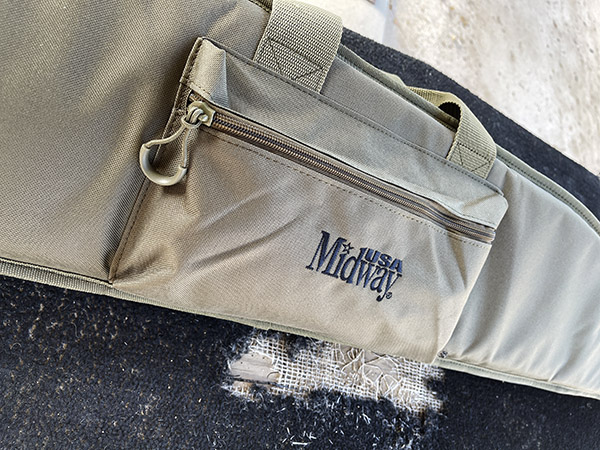
The rifle case itself is impressive.  It’s wider than usual and it has heavier padding on the sides.  The zippers are higher quality than what I usually see on rifle cases.  Inside, there are a couple of Velcro straps to secure a rifle (that’s a feature I don’t need, but it’s a nice touch).  The case has a carrying strap so you can carry it from the shoulder (yet another feature I don’t need, but some folks might).  There’s an exterior zippered pocket, presumably for carrying ammo.   I used it for the Velcro retainers and the shoulder strap, so I guess it came in handy.

I was worried about the case being big enough to accept get some of my longer barreled rifles, but there’s plenty of room.  I have a couple of long action bolt rifles with 26-inch barrels, and the MidwayUSA case swallowed those with ease.  You can see that in the photo at the top of this blog.

The cases can be had in olive green, desert, or black.   I bought the olive green version in a nod to my alma mater (the US Army).

Overall, I give the case 10.0 points (out of a total possible 10 points).  I knocked it down a half a point because it had things I didn’t need, but then I gave it a half point back for MidwayUSA’s free (and speedy) shipping.  If you are in the market for a rifle case, this is a good one.


Pro Tip:  Never store a firearm in a soft case (or a holster) for an extended period of time.  The case or the holster will hold moisture and lead to rusting.  Take the weapon out regularly and wipe it down with an oiled rag.


Join our Facebook ExNotes page!


Never miss an ExNotes blog:


Help us keep the lights on:


Don’t forget: Visit our advertisers!


Wrapping Up Patagonia: Part 5

By Bobbie Surber

From horseback trails at Estancia Nibepo Aike to the jagged peaks of Fitz Roy, the crash of Perito Moreno, and penguin-packed beaches at Ushuaia, our Patagonia journey mixed grit, awe, and laughter into something unforgettable.

Where the Wilderness Ends and Ice Begins

Our last morning at the Estancia unfolded slowly, heavy with goodbye. This wild land, tamed into a ranch, had left its mark on me, I knew I’d be back. With a swirl of nostalgia and excitement, we boarded a boat bound for Perito Moreno, the glacier I’d dreamed about for years, stretching broad and blue beneath the Patagonian sky.

The lake whispered under sunlight slicing through the clouds while the cold bit like a sudden awakening. We lucked into front-row seats, perfect for nature’s ice show. Then, out of the mist, the glacier appeared, nineteen miles long, three miles wide, towering like a twenty-story giant barging into the lake as if it owned the place.

Then it happened: a slab of ice, bigger than my first apartment building, sheared off the wall of ice, flipped, and exploded into the water. The boat rocked, someone yelped, and for a moment we just stood there, slack-jawed, like kids watching their first fireworks.

On land, we wandered the boardwalks like rookie tourists, phones mostly forgotten, because how do you capture something like that? Perito Moreno groaned and cracked like an old house in a storm, moving seven feet a day as if it had somewhere to be. Patagonia does that to you, it shrinks your ego and hands you awe instead.

That night, we rode a shuttle back to El Calafate, ate whatever was put in front of us, and collapsed like marathoners at the finish line, ready for the rental car desk come morning.

El Chaltén: At the Foot of Fitz Roy

The road north was classic Patagonia: big sky, endless pavement, guanacos grazing like they invented grass. Then Fitz Roy broke through the clouds, jagged and impossible, like someone Photoshopped a mountain into the sky. Driving into El Chaltén felt like stepping inside a painted postcard, wild winds, raw mountain air, and beauty so sharp it steals your breath.

El Chaltén is barely a town, more like a trailhead with a postal code. Dirt roads, gear shops smelling of ambition and old socks, and cafés held together by determination. Our guesthouse perched up a steep stairway, its walls creaking with the wind like it had opinions. Pilar, our host, greeted us like long-lost cousins and tossed in trail tips along with the town’s scrappy story of origin.

At night, the walls creaked so loudly I was sure they were gossiping about the weather. Pilar swore it was just the wind; I’m still not convinced.

One Perfect Day: Laguna de los Tres

Finally, a good-weather day. No howling winds, no rain, no clouds, just the rare Patagonia morning that feels like a cosmic mistake. We hit the trail early, coffee still buzzing, weaving through meadows and little forests while parrots heckled us from the trees.

The last mile was brutal, steep, rocky, and exposed enough to make me question my life choices. My knee staged a mutiny, Tom’s back grumbled, but when we crested the ridge and saw Fitz Roy blazing in full glory, mirrored in the turquoise lake, every complaint evaporated.

The wind tried to knock us sideways, but we dug in. We laughed like idiots, hair whipping everywhere, snapping far too many photos that still couldn’t capture the scale. We stayed longer than sense allowed, because who walks away from a dream?

The descent cost us dearly. By town, I was hobbling like a newborn giraffe, and Tom looked like he’d been in a fistfight with a grizzly. That first beer? Pure nectar of the gods.

The next day, we didn’t even pretend to hike. We committed fully to rest, ice packs, naps, and Fitz Roy playing coy outside our window. That night, we stumbled upon a tiny café serving guanaco stew. I tried not to picture those long lashes blinking at me from across the table. Failed miserably. Ever seen a guanaco? Long neck, spindly legs, and eyes so big they look permanently surprised, like they just realized they’re on the menu.

Ushuaia

The end of the world felt like the beginning of everything.

From El Calafate, we flew south to Ushuaia, the literal end of the world. The plane dipped over a harbor ringed by jagged peaks, like we’d been rerouted to Earth’s last page.

Our Airbnb perched high above town with floor-to-ceiling windows overlooking the Beagle Channel. At night, we bundled up in blankets, poured red wine, and watched ships drift by like sleepy ghosts.

Where the Mountains Meet the Sea

We hiked Tierra del Fuego National Park, where the Andes finally give up and slide into the ocean. Trails curled through forests and along lazy rivers, ending at Ruta 3, the southernmost highway in Argentina. Standing there felt like closing a book you didn’t want to end, except this one left you with sore calves and windburn.

Penguins, Naturally

Penguins were mandatory, my first chance to see them in the wild. I tried to play it cool, my second failure, bouncing to the start of the tour like a kid handed their first ice cream sundae.

We boarded a boat that bucked like a mechanical bull with abandonment issues. Spray stung our faces as I mentally rewrote my will, just in case.

On Isla Martillo, Magellanic and Gentoo penguins ruled the beach like feathered royalty. Hundreds waddled in tight little lines as if late for a crucial penguin meeting, while others strutted around their burrows, squawking like they owned the place, which, to be fair, they did. A few belly-flopped into the icy surf with the grace of bowling pins, then shot through the water like sleek black-and-white torpedoes. The bold ones toddled straight up to us, tilting their heads with that signature “You’re lost, aren’t you?” look. It was ridiculous, hilarious, and unexpectedly moving, proof you can thrive anywhere if you just commit to it.

Flying Home

Looking out over the Beagle Channel, it hit me: we’d started way up north in Santiago and now stood at the end of the world, the tip of South America.

The trip wore us out and inspired us in ways words can barely touch. Patagonia’s raw landscapes crashed over us like waves, the aching climbs, the relentless rain, the wind that stole our breath, and moments so beautiful they squeezed my chest tight. It forced open parts of myself I’d kept locked away.

Tom was my rock, steady when I stumbled, stubborn when I doubted, always there with a hug, a glass of wine, and that quiet grin that said, “We’ll get through this together.”

From Santiago’s sweetness to Torres del Paine’s jagged towers, across Perito Moreno’s moving ice, up Fitz Roy’s wind-thrashed trails, and finally Ushuaia’s edge-of-the-world quiet, Patagonia gave us more than landscapes. It gave us stillness we didn’t know we needed, laughter we didn’t see coming, and trust built one bruised knee and newborn giraffe step at a time.

We flew home tired, grateful, and just a little different, carrying Patagonia in our bones and ready for whatever wild road comes next.


Join our Facebook ExNotes page!


Never miss an ExNotes blog:


Help us keep the lights on:


Don’t forget: Visit our advertisers!


IMR 3031 Mosin Loads

By Joe Berk

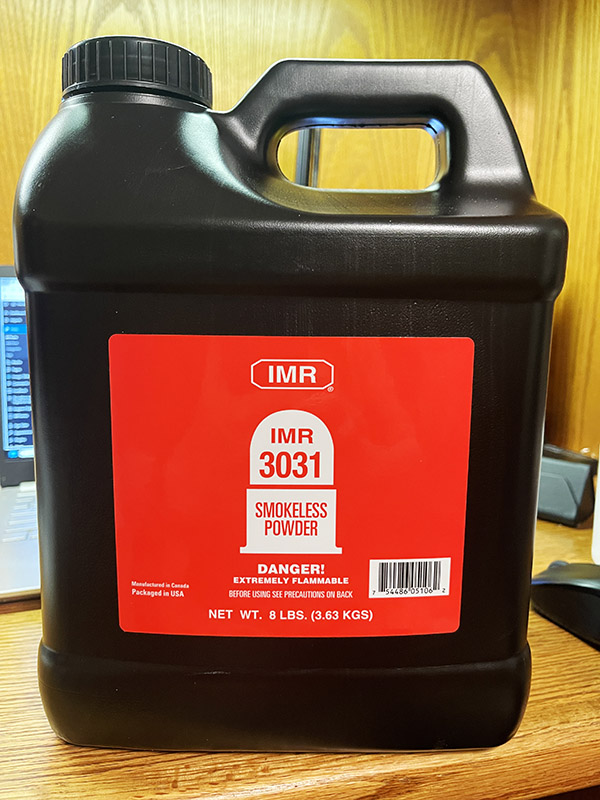
I recently bought an 8-lb container of IMR 3031 on the theory that the time to buy something is when you see it, and I’ve been researching loads for various cartridges using that powder.

IMR 3031, and lots of it.

IMR 3031 doesn’t appear too often in modern reloading manuals, which struck me as odd because when I first started playing with things that go bang it seemed like 3031 was an almost universal propellant, good for whatever ails you.  So I dug out some reloading manuals from the 1970s, and as I expected, 3031 showed up for a bunch of different cartridges.  One of them is 7.62x54R, and I wanted to see if I could develop a decent load for my Mosin-Nagant.  I should point out at this point that there’s nothing special about my 1940 Tula Mosin (other than the fact that it’s one of my favorite rifles).  In fact, the barrel looks more like a sewer pipe than a precision shooting instrument.

My Mosin-Nagant’s bore. It ain’t pretty.

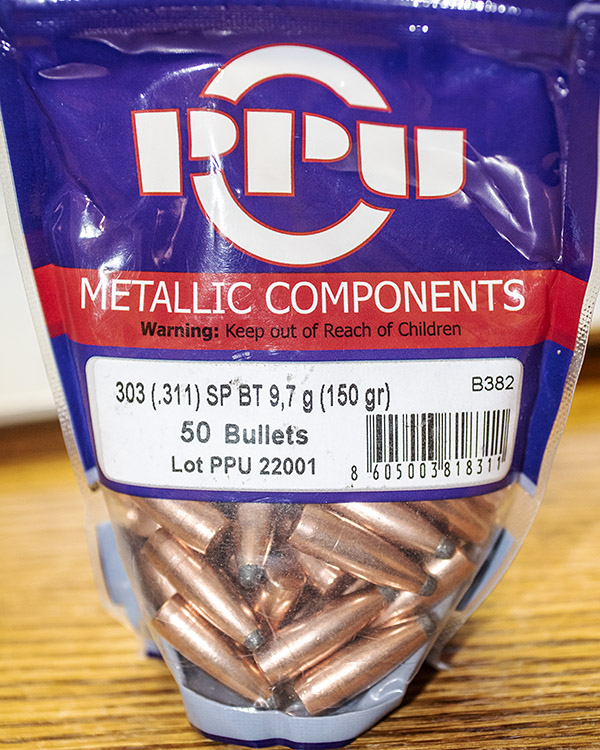
I loaded the ammo for this test series with the PPU Partizan 150-grain,  0.311-inch diameter, jacketed softpoint boattail bullet.  These are relatively inexpensive bullets (they go for around $.30 each from Graf’s, which I guess is cheap by today’s standards).  These bullets pop up for sale occasionally, and a while back I bought 500 of them.

PPU bullets. They are relatively inexpensive. Sometimes they go on sale.
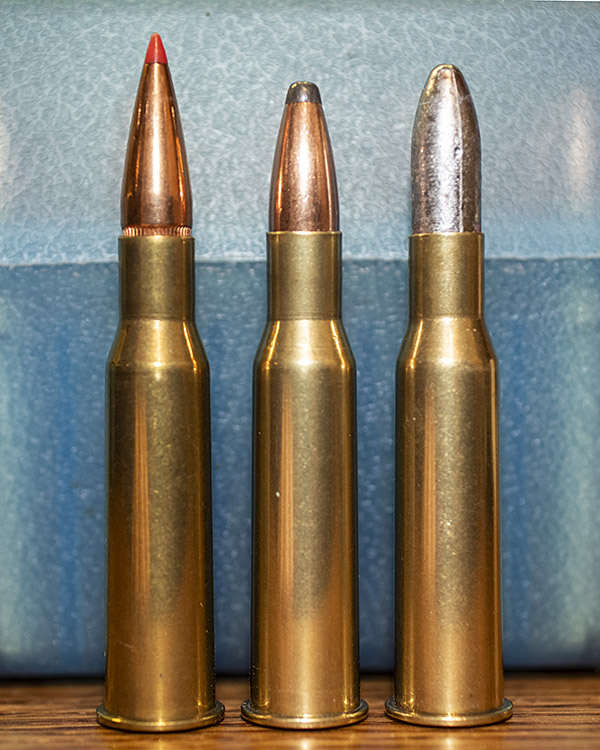
Three different 7.62x54R reloads. From left to right, it’s the Hornady V-Max bullet, the PPU jacketed softpoint bullet, and a cast lead bullet. I shot only the PPU bullets for this blog.

My testing consisted of five different IMR 3031 loads to see how they performed at 100 yards.  The drill was to fire 10 rounds each at charges of 39.0, 40.0, 41.0, 42.0, and 43.0 grains.   I used PRVI Partizan brass and Winchester primers, and I seated the bullets for an overall cartridge length of 2.790 inches with no crimp.  Here’s what I found:

The chrono and accuracry results. 42.0 grains of IMR 3031 seems to be the sweet spot.
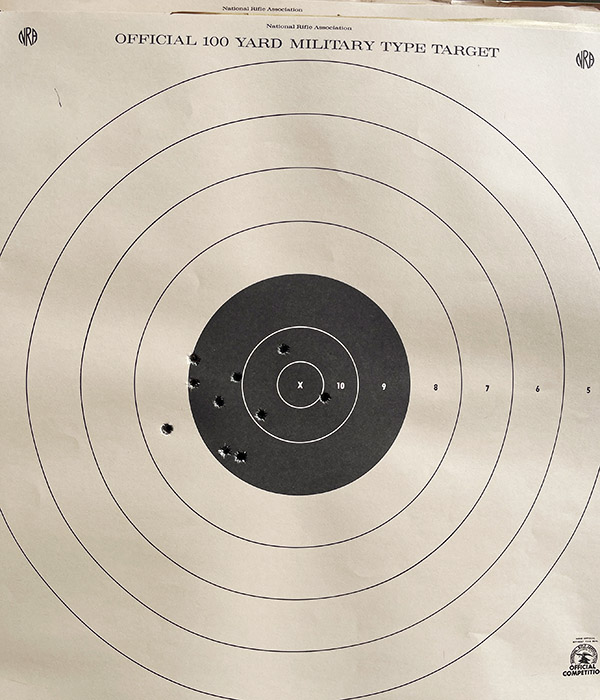
A 100-yard target group with the 42.0 grain IMR 3031 load.

The sweet spot appears to be right about 41.0 to 42.0 grains of IMR 3031 (the target above is with 42.0 grains).   The standard deviation is smaller for the 42.0-grain load with the same group size, so that’s what I’m going with.  Recoil was moderate with all loads; none of the loads showed any pressure signs.  None of the above were compressed charges. The 43.0-grain load had a smaller standard deviation, but the group opened up and shifted to the left, so I’m going to call the 42.0-grain load good.  It’s as good as the groups I was getting with IMR 4320, which had previously been my Mosin accuracy load.

Before any of you out there in the blogosphere get your shorts in a knot about using older reloading manuals, I realize the manual companies (and others who parrot them) advise against doing so.  The theory is that the propellant formulations have changed and what the old manuals show as a safe load may not necessarily be so today.  I get it.  That’s why I start testing at the bottom of the range and work up, looking for pressure signs along the way.  The current and the 2007 Hornady manuals do not list IMR 3031 for the 7.62x54R.  The 1973 Hornady manual (the first one I ever bought when I was just getting started in this game) shows a max of 44.4 grains with a 150-grain bullet, which is why I stopped my initial testing at 43.0 grains.  None of the loads I tested showed any pressure signs and recoil was moderate with all loads.  I think the new manuals feature new powders because the powder companies pay for the manuals to include their newest stuff.  I don’t think they do it because the powders are necessarily better.  Maybe I’m wrong.  I’m a cynical old fart.

I should point out that my findings are not rigorous for two reasons:

    • I’m not that good a shot, and
    • My eyes are not what they used to be.  It’s getting increasingly more difficult to get the front sight in sharp focus (ah, to be 72 again…).  I do the best I can.

But I’m still out there having fun, and that’s what important.


I’ve written a lot about the Mosin-Nagant 91/30 rifle.  Here are my earlier posts:

Three Mosin-Nagant Loads
Mosins, Sewer Pipes, and Lunar Landscapes
A Tale of Two Mosins
More Mosin Loads
Cast Bullet Mosin Loads
Mosins, and Enemy at the Gates
NJ State Police Museum
A Tale of Two Old Warhorses
Home on the Range
Stupid Hot 7.62x54R Ammo
Lee Ermey’s Guns Go To Auction
Revisiting World War II
Sniper!
Motorcycles and Milsurps

If you would like to learn more about the Mosin-Nagant rifle, the Lapin book is the definitive source:

The Mosin-Nagant Rifle is an easy and fascinating read.


Join our Facebook ExNotes page!


Never miss an ExNotes blog:


Help us keep the lights on:


Don’t forget: Visit our advertisers!


Revisiting the 375 H&H Safari Rifle

By Joe Berk

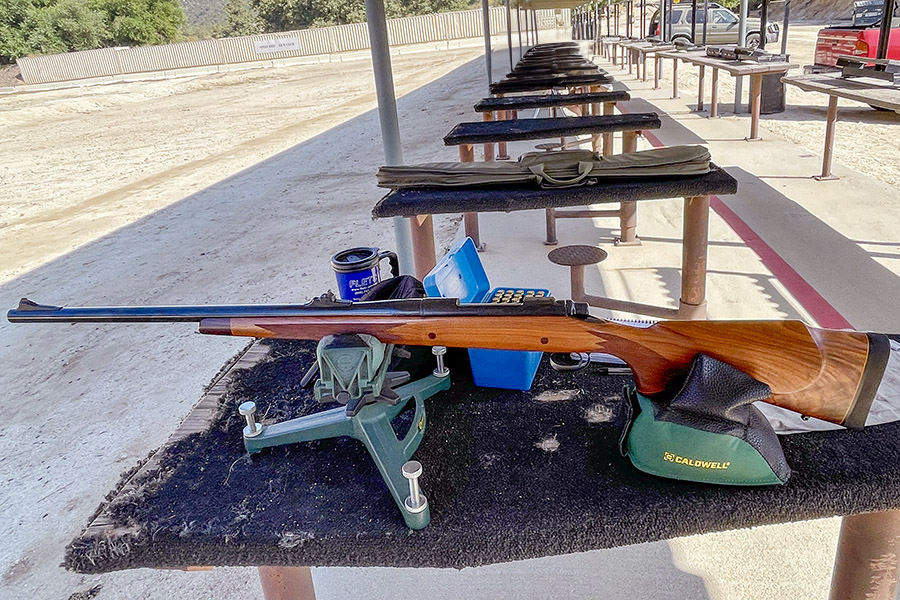
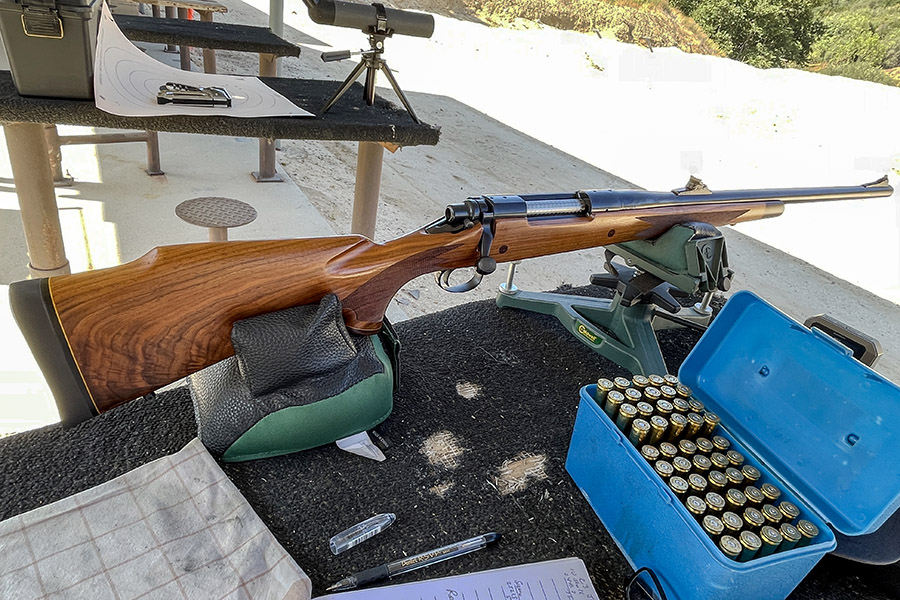
I’m not as good as I used to be.  That point was brought home during a recent session with my Remington .375 H&H Safari Grade rifle.  I can tell by reviewing a few blogs I did earlier on this rifle.  The groups were better. Way better.  I just don’t have the visual acuity I used to. I’ve written about this rifle before, and I’ll give you the links for those earlier blogs at the end of this one.

The walnut is what drew me to this rifle. That, and the fact that it is a .375 H&H.
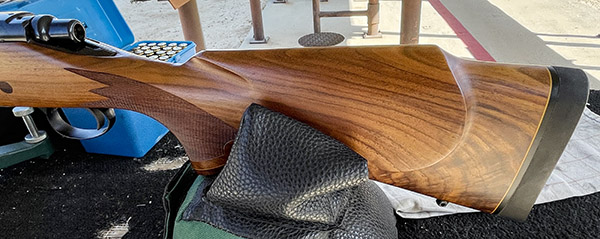
The lumber is straight grained through the length of the stock, and then it explodes in a feather pattern near the butt. This is good stuff.
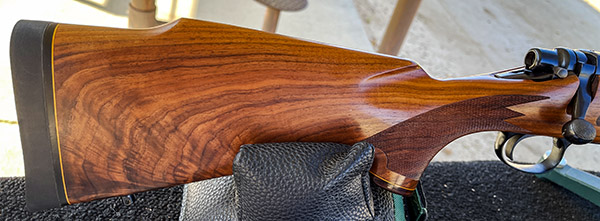
The view from the starboard side, where the contrasty grain is even better. Life is too short for plain walnut. You can quote me on that.

I’ve owned the Safari rifle for five decades now.  I’ve never been on a safari with it, and at this point in my life, I probably never will be.  But I can still dream.  Capstick, Corbett, Bell, and other professional hunters wrote about their adventures going after things that could gore, stomp, or bite you to death.   I like reading those stories.  Like I said, I can still dream.

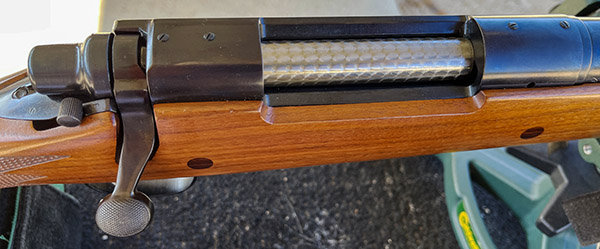
Back in the 1970s, the Safari Grade Model 700 Remington rifles were only offered in two chamberings: .458 Magnum and .375 H&H. Check out the jeweled bolt.
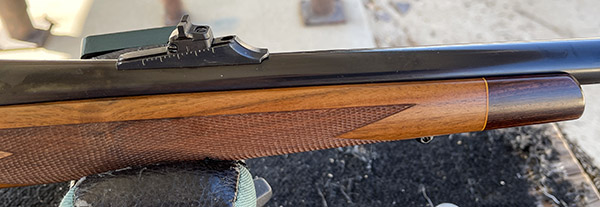
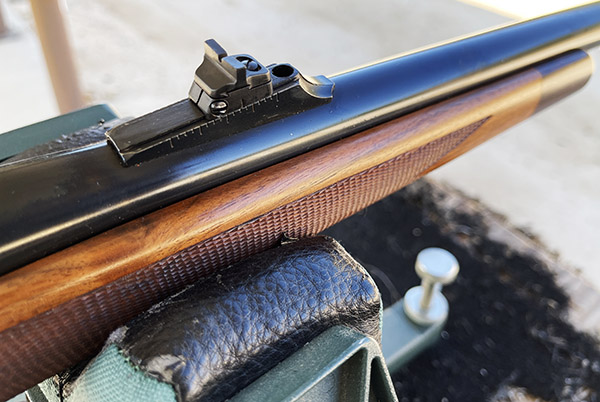
The Safari Grade rifles had a rosewood fore end tip and matching pistol grip accents, with light maple spaces. Classy stuff. Check out the rear sight.
Another view of the rear sight.  The Safari Grade rifles had cut checkering, too (no pressed-in or fuzzy laser cut checkering on these rifles).
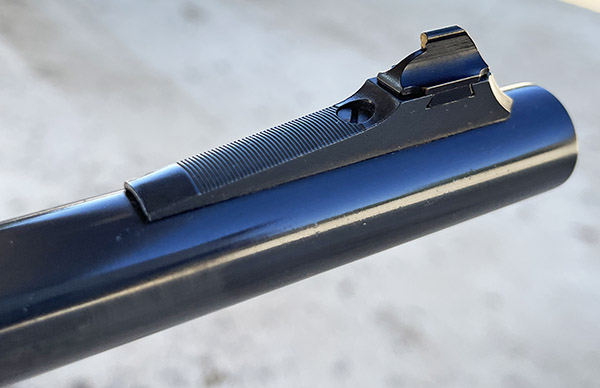
The front sight on my Model 700. That little bead is a lot harder to see these days than it was 40 or 50 years ago.

I first became interested in big bore rifles when a group of guys I hung around with in El Paso 50 years ago cooked up a cast bullet bench rest competition.  They all bought big bore rifles, with the understanding that minor casting imperfections wouldn’t affect the bigger .458 or .375 cast bullets very much.  I never lost interest in that concept, although the bullets I’ll write about here are of the jacketed variety.

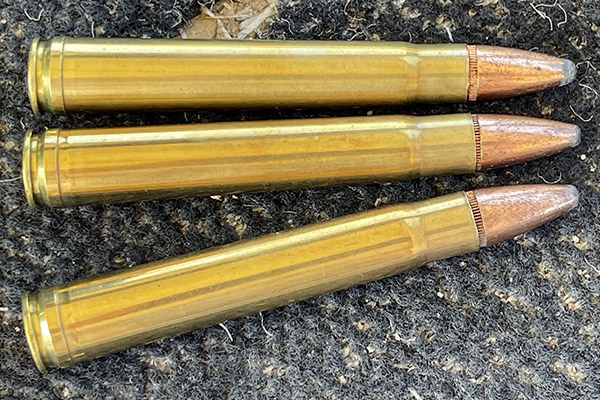
.375 H&H reloads with 270-grain Hornady jacketed softpoint bullets. The bullets are factory seconds.

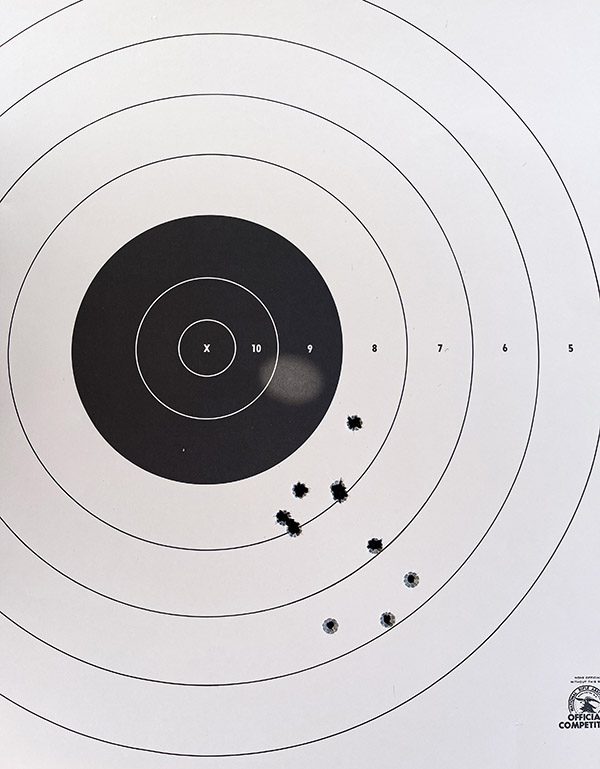
The weather at the West End Gun Club was perfect:  No wind, moderate temperatures, and the horseflies weren’t out.  I set up my gear, put my targets out during a line break, and chatted with my geezer buddies for a bit (being retired is fun).  Then I pulled the big Remington from its case, placed it in the rifle rest, set up my Garmin chronograph, chambered a round, and searched diligently for the front sight as I settled in behind the rifle.  As the front sight danced in and out of focus, I did my best to hold it at the base of the bullseye (barely visible 100 yards away), and gently put pressure on the trigger.  I did the same nine more times, each time remembering the marksmanship fundamentals I learned in the Army.

My first target of the day. Low and to the right. The group was just okay. I’ve done better.

I shot at 100 yards from the bench, and as has been the case in prior outings, the rifle printed a little low and a little to the right (I had to use my spotting scope to see it; there’s no way those little .375 holes would be visible to the naked eye).  I thought I would adjust the rear sight to compensate for this, but I had my contact lenses in on this outing and I couldn’t see the screws that lock the rear sight in position well enough to take a chance on loosening them and moving the sight.  I’ll do that when I get home.  I had my contacts in because I thought I might be able to see the front sight a bit better.  Hope springs eternal, but it wasn’t in the cards for me.  I shoot open sights pretty much the same whether I’m wearing my glasses or my contacts.

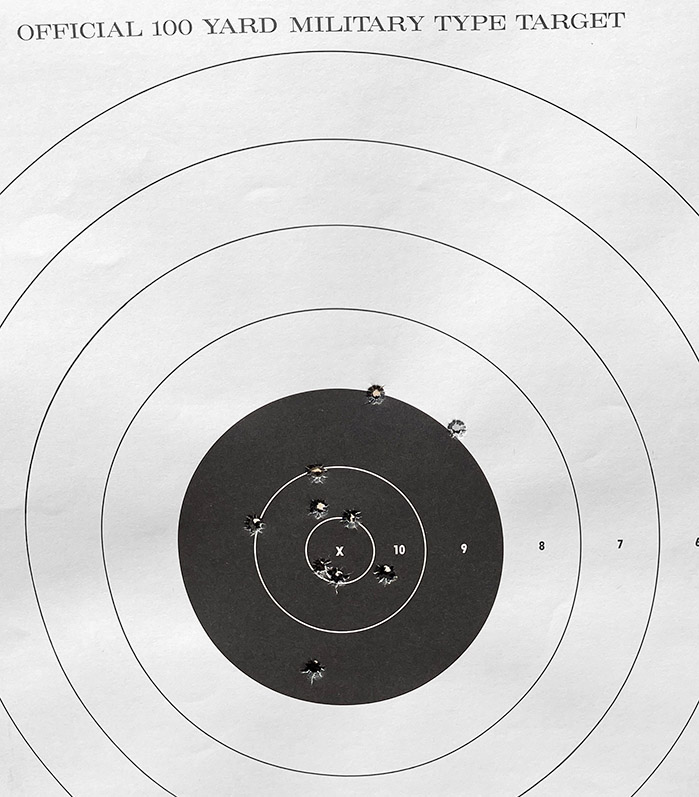
On the next target, I threw in a little Kentucky windage, doing my best to hold the front sight at 9:00 on the black bullseye.  It worked.  The next 10 shots were mostly in the bullseye, but I had to struggle even more to see the front sight with it partially over the black bullseye.  Normally I would hold at 6:00, where the front sight is still tough to see but the contrast against the white background surrounding the bullseye is better.  Trying to hold it at 9:00, with the front sight’s little bead half in and half out of the bullseye, was like trying to have a discussion with a left winger.  But when I looked through the spotting scope, I could see that I did okay.

A 9:00 o’clock hold and a little luck resulted in this group. I do love shooting my .375 H&H.

My load is mild compared to where you can go with this cartridge.  I shoot a reduced load using Hornady 270-grain jacketed softpoint factory second bullets, 33.0 grains of SR 4759 propellant, Remington brass, a CCI 200 primer, an overall cartridge length of 3.570 inches, and no crimp.  Recoil is mild for a .375 H&H.

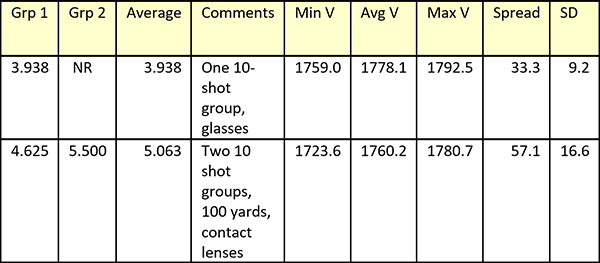
The group size and chrono results, along with those from a single group fired a week or so earlier, are provided below.

It looks like I did a little better wearing glasses than I did with my contact lenses.  I think I see better with my contacts, but I guess the results don’t lie.  It was a little bit cooler on this second outing than it was on the day I shot previously, and that shows up in the velocity results.

One of my buddies chided me about the Remington needing a scope.  I would do better with a scope, but I like the challenge of hitting a distant target with iron sights.

You might be wondering about the factory second bullets.  They are usually available from MidwayUSA.  I don’t know what makes them factory seconds.  It might be the cannelure location on the bullet shank, it might be slight tarnishing, or it might be something else.  The factory second bullets are about half the price of the standard (presumably higher quality) Hornady bullets.  For my purposes, these are good enough.  Maybe I’d get smaller groups with first quality bullets.  Maybe not.  Someday maybe I’ll test to see if there’s an accuracy difference.

As promised, here’s a set of links for my earlier .375 H&H blogs:

The 375 H&H at 100 Yards
375 H&H Loads
The Remington 375 H&H Safari Grade Rifle

You might recall that we also wrote a few blogs on a cartridge that improves upon the .375 H&H (and that would be the .375 Ruger).  Those blogs are here:

A Custom 375 Ruger
A Day at the Range

And to wrap up this blog, while I was on the Midway site I came across a Youtube video about the .375 H&H by my good buddy Larry Potterfield.  I enjoyed it and I thought you might, too.


Join our Facebook ExNotes page!


Never miss an ExNotes blog:


Help us keep the lights on:


Don’t forget: Visit our advertisers!