After completing the W Trek in Torres del Paine, we crossed the border from Chile into Argentina, taking a bus from Puerto Natales to the windswept outpost of El Calafate. The transition felt like stepping into another rhythm of life. We checked into a modest Airbnb along the town’s main street, no lake views, no frills, just a place to drop our packs and breathe.
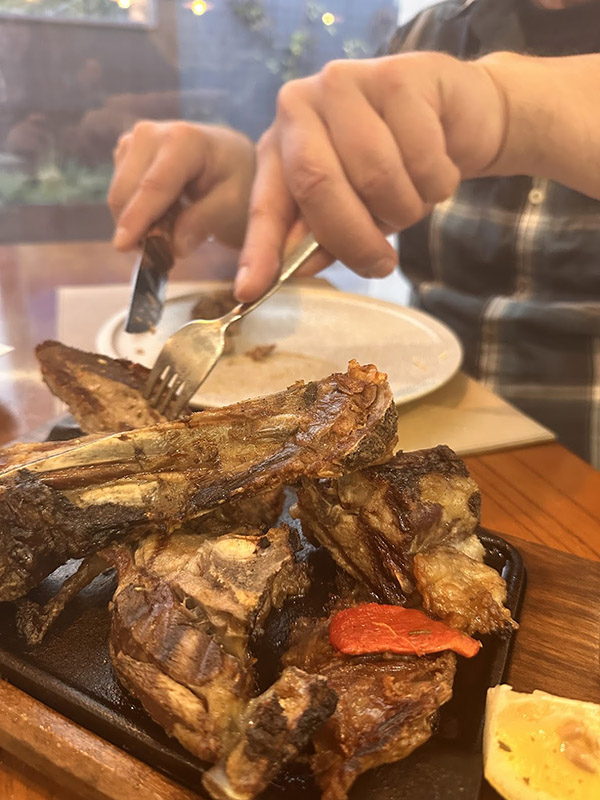
El Calafate charmed us with its unhurried pace and pastel-hued light. Dusty streets and artisan shops hinted at the town’s glacier tourism, while the smoky aroma of grilled meat drifted invitingly from nearby restaurants. That first evening, we savored a perfectly cooked lamb dinner paired with a velvety upscale Malbec, a delicious homecoming after days of relentless trekking.
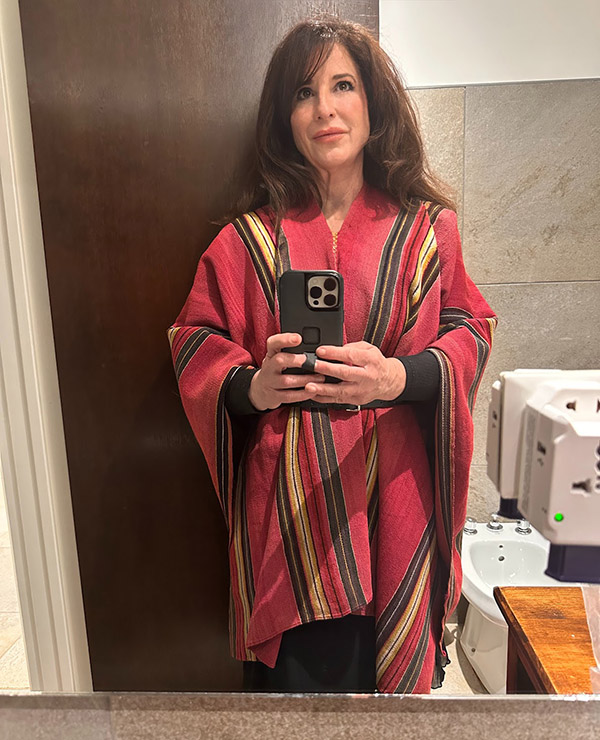
Before dinner, Tom surprised me with a thoughtful gift: a stunning, authentic wool wrap, in rich shades of red and earthy browns. It wasn’t just the wrap’s beauty, it was the meaning behind it. His quiet gesture felt like a warm embrace, a tangible memory woven into fabric. Wrapping it around my shoulders, I felt deeply seen and cared for.
We exhaled here, not just from the physical effort of the W Trek, but from the mental tension that comes with planning, moving, and always pushing.
Here, things slowed.
As the glow of El Calafate faded behind us, our journey turned inward again, toward Estancia Nibepo Aike, a place that etched itself into memory, nestled within Los Glaciares National Park. Our guide Ana greeted us in town. “This land tests you,” she said firmly, “but it also gives back in ways you never expect.” She told us of a Croatian immigrant who founded the estancia at the turn of the 20th century, braving this wind-swept wilderness to build a life from scratch.
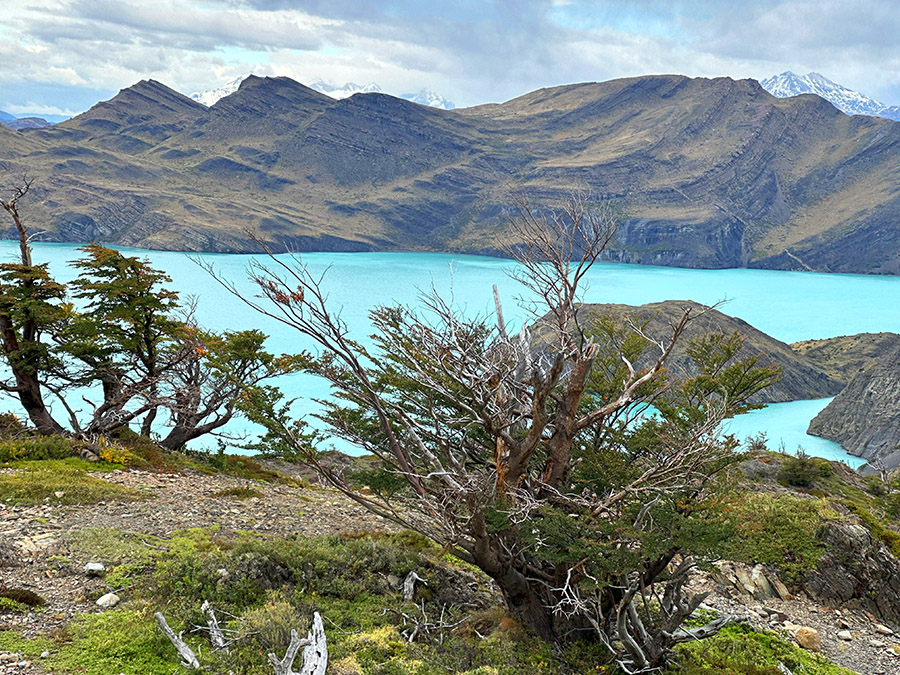
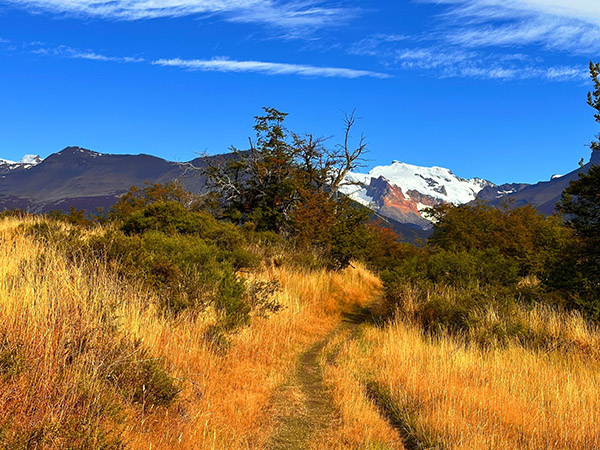
We traveled by truck across the open steppe, the road fading into the endless horizon beneath the vast Patagonian sky. Our arrival felt like stepping into a dream, a cluster of rustic buildings perched near Lago Roca, glacier peaks faintly visible in the distance. I barely reached the bench overlooking the lake before my tears welled up. The stillness, the timelessness, the sheer space to simply be, it all felt profound. As Tom checked us in, a man settled beside me, tapping my leg gently in comfort. “Welcome,” he said softly. Only later did I learn he was the owner, a direct descendant of the original settler, carrying the legacy of conviction and grit.
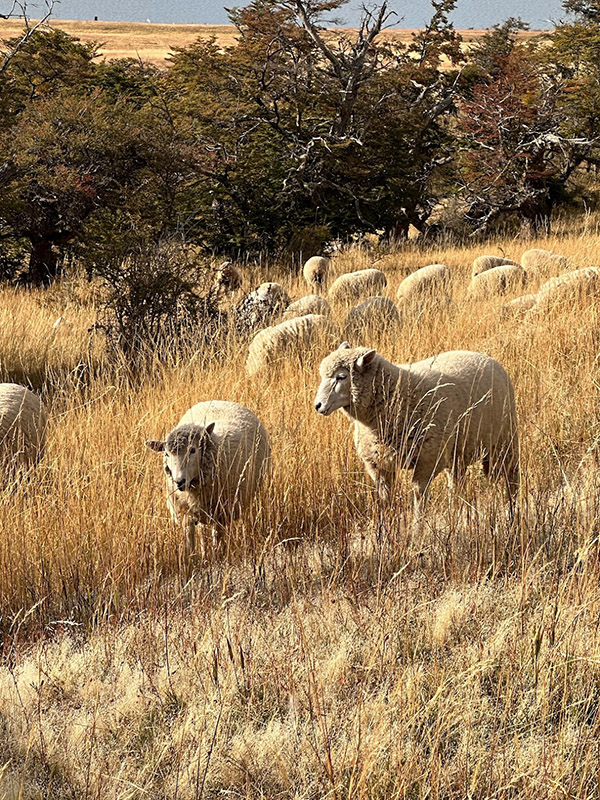
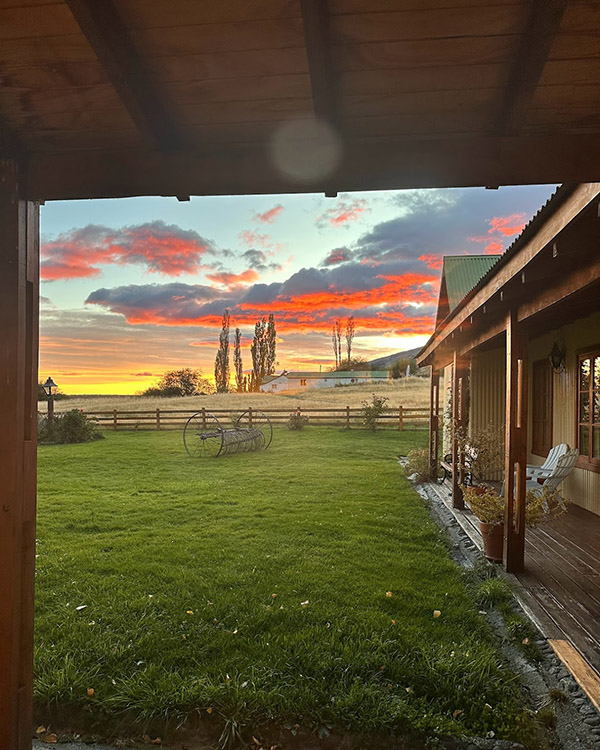
We stayed for three nights, and each day unfolded in a gentle rhythm. The estancia offered the basics in the best way: no cell service, no TV, no distractions. Wi-Fi was available in the main lodge, but it wasn’t why we came. The meals were hearty and local, Argentine lamb raised and butchered on-site and cooked the gaucho way, over an open flame. We gathered family-style with other guests, sharing bottles of wine and stories, the lake and sheep grazing in the fields providing a calming backdrop.
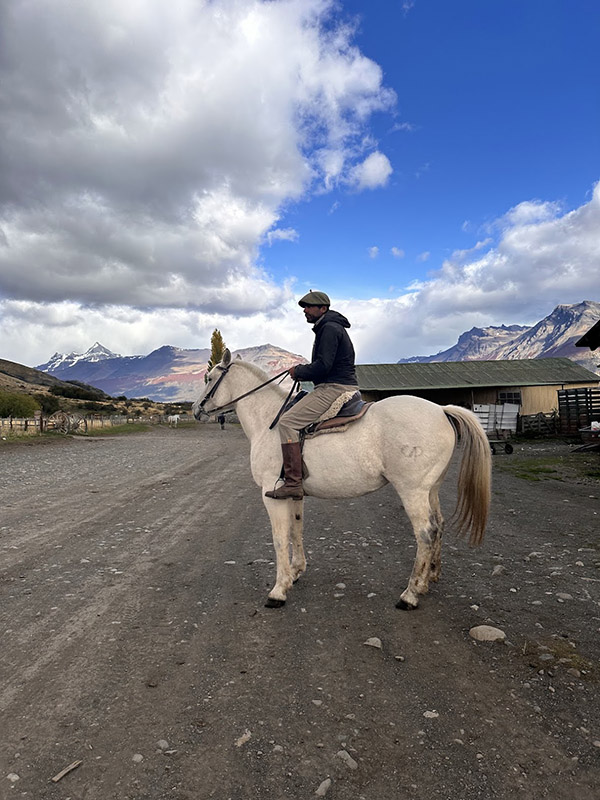
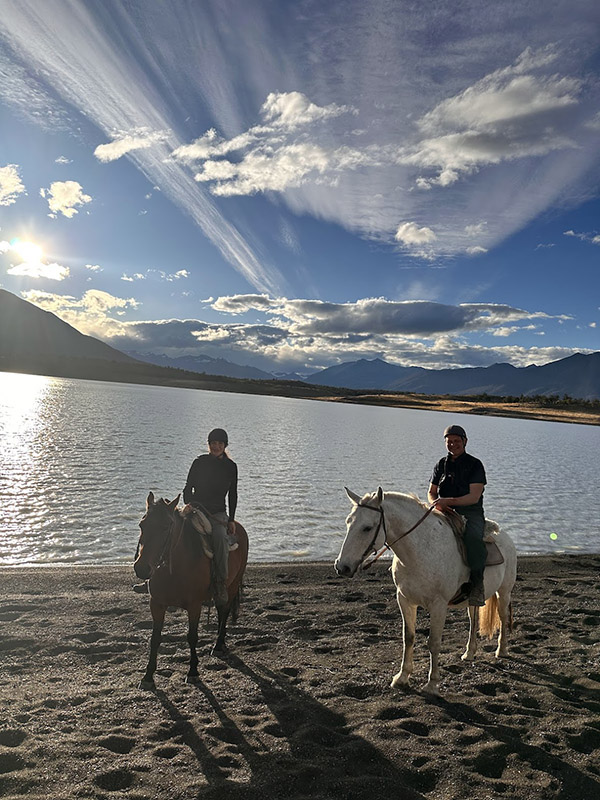
Days were filled with optional activities: horseback rides through rolling hills and along the lake, hikes into the surrounding terrain, mountain biking on dusty trails, ranch tours, and the unforgettable spectacle of gauchos expertly rounding up sheep with their loyal dogs.
One afternoon, the gauchos rode out across the field in a blur of motion, horse and rider moving as one, dogs darting through the flock like threads in a living tapestry. It wasn’t just skill; it was poetry carved into tradition.
The Land and Its Stories
The landscape here demanded attention, rolling hills that spilled into wide plains, then abruptly lifted to jagged peaks topped with glaciers. Lago Roca shimmered silver under shifting light. Caracaras circled above as sheep, cattle, and horses grazed peacefully below. This purity stripped away all distractions.
I hadn’t ridden in years, but the saddle welcomed me back like old muscle memory. For two days, we explored on horseback, winding down to the lake, climbing along ridges, and crossing open fields with distant glaciers etched on the horizon. At one ridge, the vista swallowed us whole, glacier, lake, and sky meeting in a vast silence that stilled even the wind. In every hoofbeat, I reconnected to something ancient in myself, a love for silence, unhurried motion, and true presence.
Reflection
The W Trek tested our stamina, courage, and determination. This place demanded nothing, and in that quiet, gave everything. Tom and I found ourselves sitting side by side in peaceful silence, the unspoken connection between us stronger than words. We shared the stillness like we had shared the trail, letting something new grow, deeper trust or simply a profound appreciation for our life together.
Farewell to the Estancia
Leaving was harder than I expected. The people, the animals, the rhythm of life, they had become part of our rhythm, subtly and completely. On our final morning, I stood by the fence as the sunrise spilled soft pinks and golds across the hills. The wind tugged at my jacket, and from somewhere out on the steppe, the steady rhythm of hooves echoed in the distance. A gaucho passed by, ready for his day, his wide-brimmed hat tipped slightly as he offered a knowing smile, not rushed, not performative, just part of the land.
We boarded the bus to the boat dock, the first leg of our next journey, a glacier excursion that would begin Part 5. As the estancia slipped from view, my thoughts were still, my spirit grounded and full.
Yes, it really was like that. Somewhere along the Silk Road (the actual Silk Road) in China. I parked my RX3 when I saw the double rainbow, thinking someday I might use the shot in a blog about this adventure.
Almost 40 years ago, I saw my first Indiana Jones movie and it affected me profoundly. I started traveling the world stumbling upon lost empires. Things that have been swallowed by time, as they say. My motorcycle ride through Colombia had some of that. The Baja adventures have a bit of it, too. But none of the rides had more of an Indiana Jones flavor than did the ride across China. That ride was three years ago this month, and I still think about it every day. There were several things we saw in China that would have been right at home in an Indiana Jones movie. One was Liqian. I can best tell you about it with an excerpt from Riding China, the story of the ride with Joe Gresh across the Ancient Kingdom.
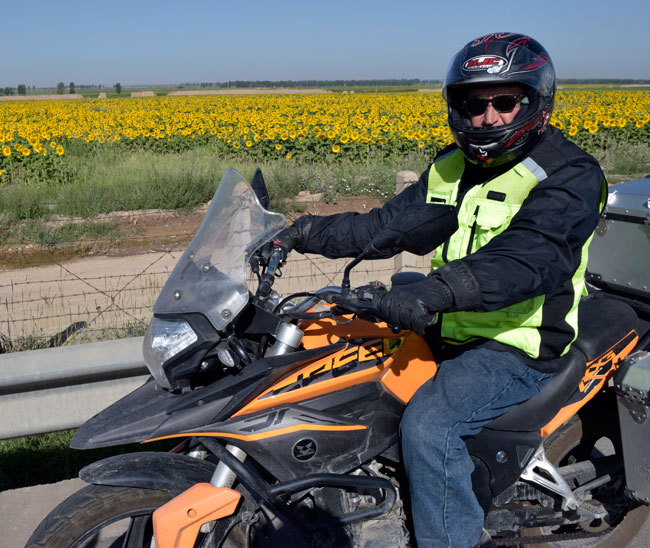
Gobi Gresh, aka Arjiu, stopping to smell the sunflowers in China.
The ride in the morning was just like yesterday. We rode the Silk Road at high speed, making great time in magnificent weather. I knew we were going to Wuwei (you could have a lot of fun with that name; it’s pronounced “woo wee”), but that was really all I knew about that day as we started out that morning. Boy, would this day ever be an interesting one!
It was to be a very full day, and Wuwei would be another one of those cities of several million people that seem to pop up in China every 50 to 100 miles. It was a huge city I had never heard of. China is an amazing place, and I was going to learn today it is more amazing than I could have imagined, and for a reason I would have never guessed. I’ve mentioned Indiana Jones movies a lot in this book. Today, we came upon something that could easily be…well, read on. This is going to be good.
After riding for a couple of hours, we left the freeway and entered a city called Yongchang. It seemed to be pretty much a regular Chinese city until we stopped. I needed to find a bathroom and Wong helped me. Wong is a big, imposing guy. He’s a corrections officer supervisor in Xi’an. He has a friendly look, but he can turn that off in a New York minute and become an extremely imposing figure. I saw him do that once on this trip, and I’ll tell you about that episode when we get to it.
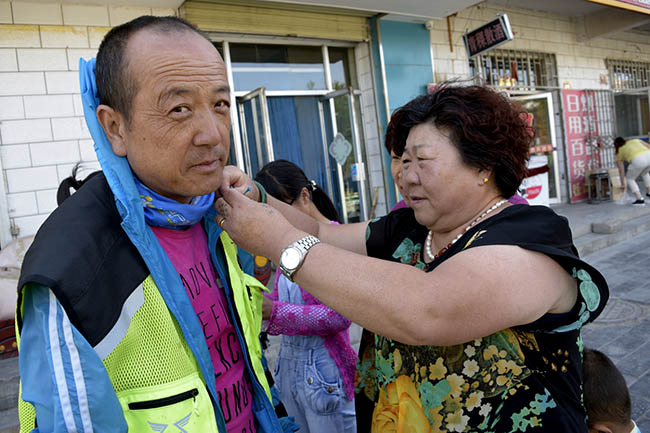
Corrections Officer Supervisor Wong. He looks like a mischievous guy. This guy’s command presence was amazing. I saw him stop a car just by looking at it. Here, he’s enjoying the attention in Yongchang.
Anyway, I followed Wong through a couple of alleys and businesses until we came to an empty restaurant (it was mid-morning, and it had no customers). Wong spoke to the lady there, she nodded her head and smiled at me, and pointed to the bathroom. When I rejoined the guys back on the street, several women at a tailor shop (we had coincidentally stopped in front of a tailor shop) were fussing over Wong. He needed a button sewn on his jacket and it was obvious they were flirting with him. Wong seemed to be enjoying it. Like I said, Wong is a big guy, and I guess you could say he’s good looking. I think the women who were sewing his button on were thinking the same thing.
Beautiful young Chinese ladies. Mostly Chinese, anyway. The one on the left is entering my phone number in her contacts list.
Three teenage girls approached us and wanted to know about our bikes. Like many young Chinese, they spoke English (in China, you learn English as a second language in grade school; it is a strong advantage in Chinese society if you can speak English well). They wanted to practice with us. It was the routine stuff (“how are you?” “hello,” and things like that) until one of the teenaged girls looked directly at me and asked, “Can I have your phone number?” Gresh and I both had a good laugh over that. I actually gave her my phone number and she carefully entered it into her phone (and no, she hasn’t called me yet).
I was enjoying all of this immensely, taking photos of the girls, the seamstresses flirting with Wong, and the rest of China all around me. There was something different about one of those teenage girls. I couldn’t quite recognize what it was, but to me she definitely looked, well, different.
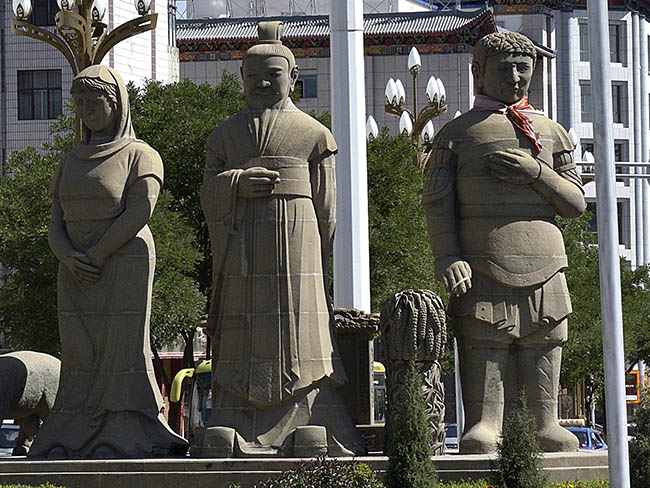
Yongchang statues. They don’t look as Chinese as you might think they should. There’s a reason for that.
It was at about that time that Sean approached me and said, “Dajiu, do you see those three statues over there?” He pointed to three tall statues that faced us, perhaps 300 yards away. I nodded yes. “If you look at their faces, you will see that they have Roman features.” Truth be told, I couldn’t really see it in the statues because they were too far away, but I grabbed a photo and later, on my computer, I could see something different. But before I looked at the photo, it all clicked for me. That’s what had my attention with that girl. We were literally in the middle of China and she didn’t look as Chinese as her two friends. She looked different.
All right, my friends, I need to go tangential here for a minute or two and share this story with you. Hang on, because this is real Indiana Jones stuff. No, scratch that. I’ve never seen an Indiana Jones movie with a story line this good (and I’ve seen all of them).
More than 2,000 years ago, before the birth of Christ, the two most powerful empires on the planet were the Roman Empire and the Han Dynasty. These two superpowers of their time enjoyed a brisk trade relationship along the Silk Road. Yep, the very same trail we had been riding for the last few days. Between them (in what became Iran and its surrounding regions) lay a smaller empire called Parthia. For reasons only the Romans understood, Rome thought it would be a good idea to attack Parthia. They sent several Roman Legions to war (and to put this in perspective, a Roman Legion consisted of about 5,000 men). To everyone’s surprise (including, I would imagine, the Romans), the Parthians kicked Rome’s butt.
Wow, imagine that. Rome, defeated on the field of battle by the much smaller Parthian Empire. To put it mildly, things did not quite go the way the Romans thought they would.
Help us bring more content to you: Please click on the popup ads!
All of this severely disrupted trade between the Han Dynasty and the Romans, and nobody liked that. “Why the hell did you do that?” the Han Dynasty asked Rome. “We had a good thing going and you screwed it up.” At least that’s what I’m guessing the conversation went like. You get the idea.
Cooler minds prevailed and the Romans realized, yeah, that was a dumb move. The Romans told the Parthians, hey, it’s over, let’s be friends again. The war ended, the Chinese were happy, the Romans were happy, the Parthians were happy, and trade resumed. All’s well that ends well.
Well, sort of. There was still that matter of those pesky Roman legions that had invaded Parthia. They didn’t come back from that war, and for two thousand years, no one knew what happened to them. The Romans probably assumed their Legionnaires had all been slaughtered. No one knew until an Australian dude and a Chinese guy, both University archeologist types (starting to sound a little like Indiana Jones yet?) put a theory together in 1957. Hmmm, maybe those Romans had not been killed after all.
The Parthians, being bright enough to defeat the Romans, were not about to let the Legionnaires go home and perhaps attack them again in some future war. They didn’t want to kill the Romans, either. I guess they were kinder, gentler Parthians. Here’s where those two Aussie and Chinese archeologists enter the picture. They hypothesized that the Parthians told the errant Legionnaires, “Look, we don’t want to kill all you guys, but there’s no way we’re going to let you go back to Rome. And there’s no room for you here, either. Your only option is to keep heading east. Go to China. Maybe you crazy warmongering Italians will find nice Chinese girls and settle down.” With that, and as one might imagine, a hearty arrivederci, the Romans continued their eastward march straight into the middle of China.
And folks, the prevailing wisdom today is that is exactly what happened (although the prevailing wisdom evidently hasn’t prevailed very far, as I had never heard the story until that morning in Yongchang). In fact, prior to this theory surfacing, folks wondered why the Chinese referred to the area around Yongchang as Liqian. That’s not a Chinese word, and it’s unlike the name of any other Chinese town. The folks who know about these things tell me it is an unusual word in the Chinese language.
Liqian is pronounced “Lee Chee On.”
Get it yet?
Lee Chee On? Liqian?
Doesn’t it sound like “legion?” As in Roman legion?
A Chinese man in Liqian. This guy could be the Marlboro Man for a Chinese cigarette company!
I found all of this fascinating. I saw more than a few people around the Liqian area that had a distinct western appearance, and they all consented to my taking their photos when I asked. They recognize just how special their story is. The Chinese government is taking note of this area, too. They are developing a large theme park just outside of Yongchang with a Roman motif. We visited that theme park, and while we were there, Sergeant Zuo gave a book to me (printed in both English and Chinese) about the place. It is one of the two books I brought back from China, and that book is now one of my most prized possessions.
Imagine that: Roman legions, resettled in the middle of China, in a town called Liqian. And I rode there. On an RX3.
Watch for our next Indiana Jones episode in China. It’s about the lost Buddhist grottos at Mo Gao in the Gobi Desert. There’s more good stuff coming your way. Stay tuned!
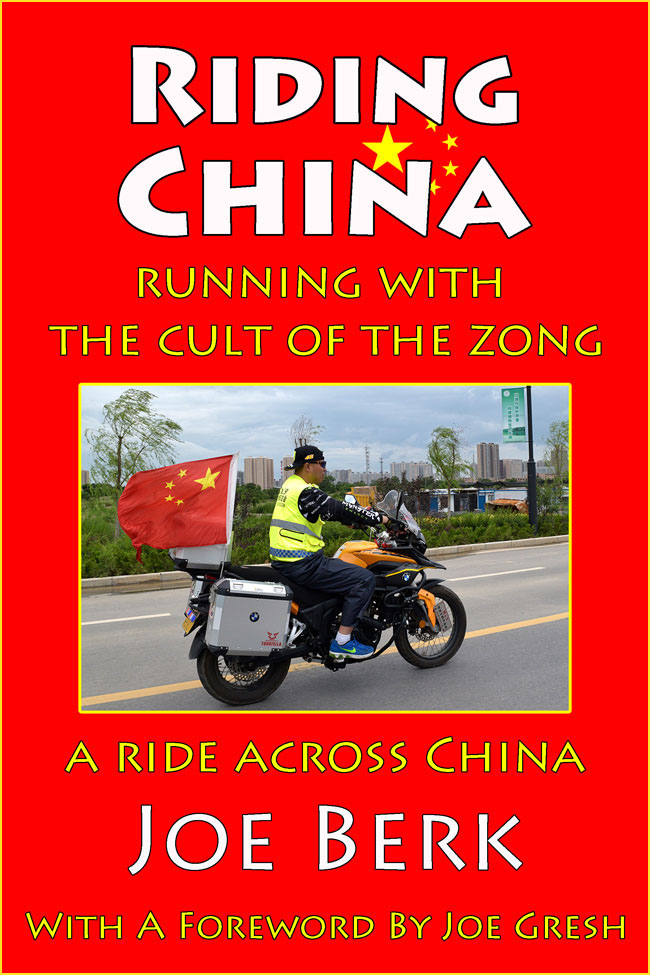
Want to read more about the ride across China? Pick up a copy of Riding China!
With the inability to reach Lukla Airport due to weather my guide and I were feeling defeated as we bounced along the bumpy road back to Katmandu. We each had a couple of beers along the ride to kill the boredom and try to determine what next steps would be. Upon arrival in Nepal I had the foresight to purchase a 90-day visa to be proactive should things go sideways, as they seem to always do.
Upon returning to Katmandu my tour operator Kiran met me at the hotel with a new itinerary. One that would lift my spirits for sure. There was another trek I was contemplating, The Annapurna Circuit. It was a 17-day trek which was more remote than the Everest one. This would now replace the Everest Base Camp Trek. Kiran then added that upon completing the Annapurna Circuit I would helicopter from Katmandu to Lukla as rotary winged aircraft had much less restrictions in terms of visibility. All in all this would fill up a month and a half and allow me to hopefully complete both objectives (Annapurna and Everest Base Camp).
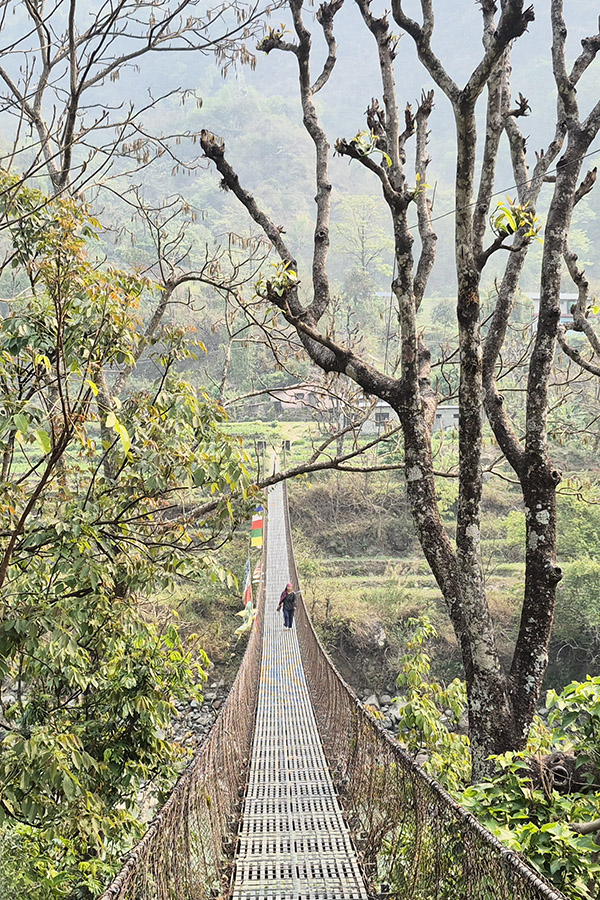
The next day Guyen, my guide and I were on our way on another local bus that would take us to Tribeni Tol, which was the starting point of the trek at a low 738 meters in elevation. The first few days would remain at those low elevation but long days, up to 27k. There were a lot of fires in Nepal and the region we were trekking had the worse air quality on Earth (even worse than New Delhi, India).
Not being much of a hiker and even less of a trekker it didn’t take long before I realized being uncomfortable was part of this hobby. Something was almost always hurting. My previous occupation of falling out of airplanes had me feeling constant pain in my back and constant knee issues. Being used to having pain here or there (or everywhere) I travel with a plethora of medicines. Pretty much a full kit and as needed I reload in countries where most of these drugs are over the counter.
It didn’t take but half a day and my knees were beyond shot. My hiking poles became crutches. It was time to dig into my medicine kit and see if I had anything that could help. A challenge with my med kit is the pills are from literally all over the world so whenever I need something I have to hope there is a cell signal for me to cross reference it and translate it. After tearing the kit apart I found something that I thought may help. It was a powerful anti-inflammatory I picked up in Romania. As I opened the pills they looked a bit odd. They were longer and sorta waxy. Back to the internet I went. As it turns out it’s a suppository. At this point I was in a ton of pain and contemplating turning back as I didn’t want to get into trouble further u the trek due to this injury.
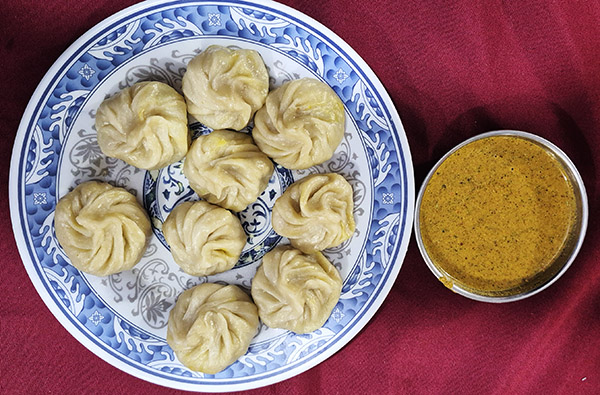
I gave the pills a shot, and with my dinner of chicken momos completed it was time to go to sleep to see if these Romanian anti-inflammatory pills would be able to salvage my trek.
We had a deep sleep that night, the kind you only find after many days on the trail, your body surrendering to exhaustion. As morning broke the wind picked up with a force that relentlessly battered our tent. The wind reminded me of sleeping aboard my sister’s sailboat with the waves crashing against the bow. I eased out of the tent, stretched, and honestly took stock of my injured knee, questioning if I had one more day in me. There was a boat in the harbor waiting to take the first group of hikers back to Puerto Natales. Should I call it quits and board, ending my time on the trail?
As I contemplated my choices, another small miracle took place, a sweet young girl who worked at the Refugio offered to carry my pack for the day. Hallelujah with minimal effort a solution had found me.
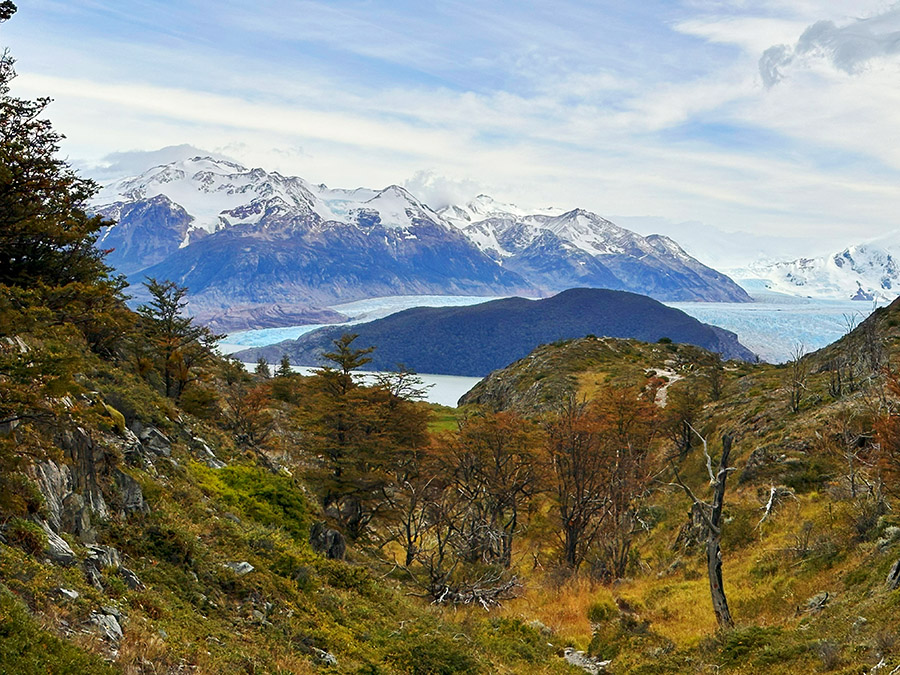
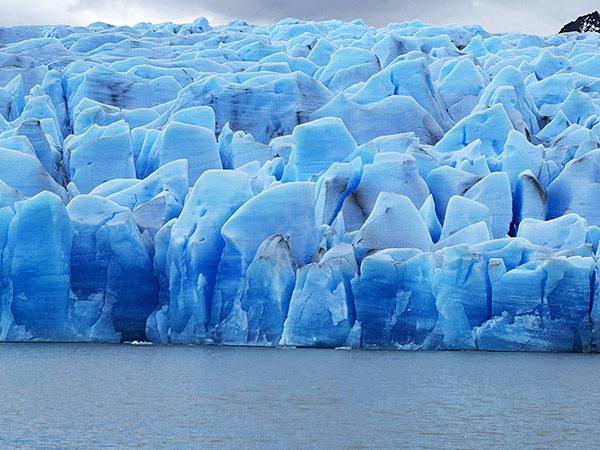
After breakfast and a quick repack, we hit the trail for the day climbing away from the bay up to the wind-swept ridgelines. The protruding rocky ledges crumpling their way to Lago Grey demanding your full attention, yet our reward was looking over the lake seeing our first icebergs bobbing along the shore. The intensity and range of colors and hues of blue, in the ice challenge you to bring their magnificence to life. giving up and surrendering to the simple joy of looking over the lake with Tom beside me.
I managed the last final scramble down the path that was more waterfall than actual trail. Just as my knee was screaming for relief, ready to abandon me for good, we hit a gentle portion through a forest protected from the Patagonian winds and leading us to our night’s destination.
Refugio Grey
We arrived at the Refugio with sore legs and near dying for a cold beer. A staff member who greeted us like long lost pilgrims, pointed us in the direction of the bar. Our packs abandoned, we hastily secured our first icy beverage and toasted each other for the completion of our grand adventure along the W trail.
The night’s lodging was a simple tent set up in a field with thick mats to protect us from the cold. Before a hearty meal and our first long hot shower of the trail we settled into chairs to watch the fading light capture the distant peaks of ice. That final sunset rewarded us with soft shades of pinks and pale purple gently fading as the sun dipped below the horizon.
We left camp after a hasty breakfast making our way down to the water’s edge. Just a few hardy trekkers leaning into the wind, patiently waiting for the catamaran that would take us to the glacier’s face. As we pulled from the shore, we witnessed icebergs, some small like delicate flowers, and others large abstract sculptures reaching for the sky. It was an ice field floating museum of art, each bend of the lake showing you her rare gifts.
I still struggle to describe a mass so large, ice reaching back through the ages. Colors that frustrate my ability to describe with a glow seem to start deep within the center, with more shades of blue that an artist can capture on canvas. You could feel the impact on everyone on the boat as a hushed silence momentarily captured us as we stood in awe.
Our time had ended in Torres del Paine as we departed the catamaran at Hotel Grey. We found our way to our driver and as we surrendered to the ease of the back seat I looked over my shoulder trying to will every moment into my memory.
Reflection
Patagonia is protected by two countries that have dedicated themselves as stewards of this unique wilderness. I feel incredibly lucky, honored to have spent this time walking her paths. I cried with equal parts pain and wonder at the beauty of the trail, the towers on our second day, with their peaks drifting in and out of the clouds, The grandeur of the French Valley and that unforgettable sound of a distant avalanche like the sound of roaring thunder. The beauty of Grey Glacier, with the gentle reminder of how short our time on earth is when looking at a body of ancient ice formed by the power of nature. We experienced it all on this journey of mountains, forest, peaks and towers together, my love and appreciation for Tom growing with each hard-earned mile.
Our Patagonia adventure is far from over. Here’s what I’ll write about next.
In Part 4, I’ll share our time in El Calafate and the unforgettable stay at Estancia Nibepo Aike, a place where history, hospitality, and the Patagonian steppe come alive in a way that feels both timeless and deeply grounding.
Part 5 will describe our trek to Fitz Roy, the iconic granite spires that have lived in my dreams for years, a landscape both fierce and breathtaking.
Part 6 will take us to Ushuaia, the end of the world, where the wild meets the sea and every moment feels charged with the magic of Patagonia’s farthest reaches.
I hope you will continue to follow along as this journey unfolds.
There are more than a few .45 70 stories here on the ExNotes blog. This is another one. I like the .45 70, and I make no excuses for that. I’ll share a few links on our other .45 70 stories at the end of this blog.
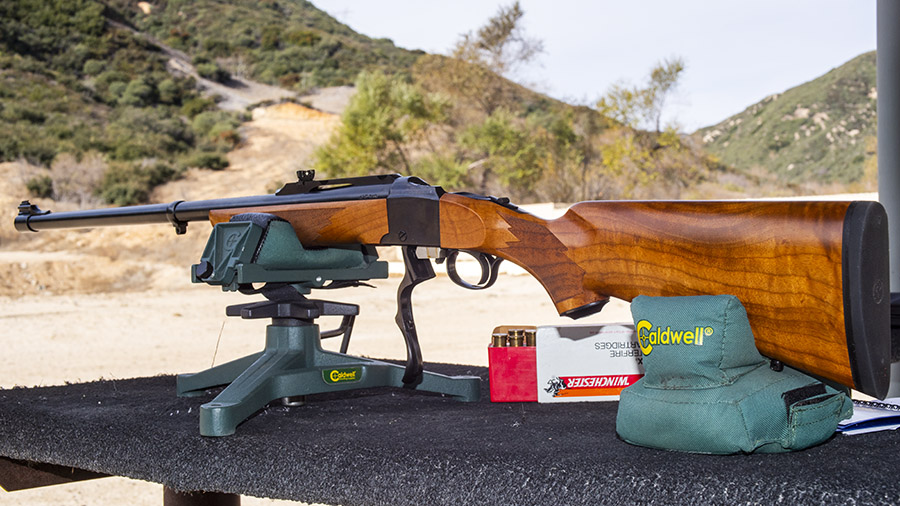
A few years ago Ruger offered a special No. 1 Single Shot rifle in .45 70 with a 26-inch barrel and a Circassian walnut stock. Most had very plain wood. Then I found an almost new one in Duarte for cheap. Ruger rifles usually have long throats, but this run of No. 1 rifles had short ones, and conventional 405 grain bullets wouldn’t chamber if the bullet was crimped in the crimping groove (or so the whining on the Internet went). I’m guessing the original owner either bought or reloaded ammo for my rifle (the one you see above) and it wouldn’t chamber, so he put the rifle up for sale.
Then another stroke of good luck: A guy at the range had some Winchester 300-grain .45 70 ammo, and it chambered in the No. 1.
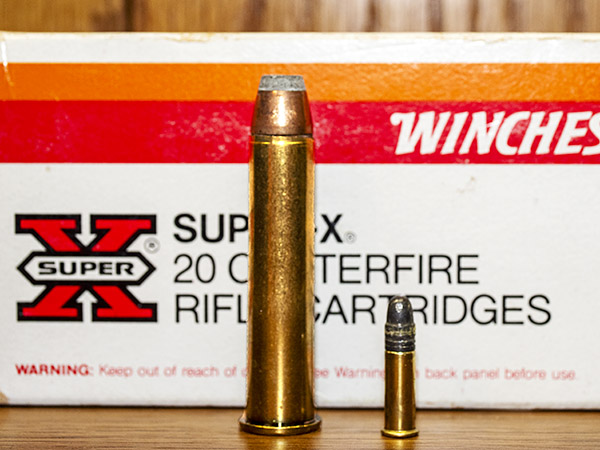
A Winchester .45 70 cartridge with a .22 Long Rifle cartridge.
That Winchester ammo was noteworthy for two reasons: It chambered, and it was relatively accurate at 100 yards. I wrote about that before (you’ll see the link below).
The story gets more interesting. Hornady makes a jacketed 300-grain hollow point bullet, and I picked up a bunch of those years ago. When I loaded them, they wouldn’t chamber in the Circassian .45 70. Then I noticed a Hornady illustration of their current 300-grain bullet design, and the bullet profile had changed. It looked like it might work based on the illustration, so I bought a box of the Hornady bullets and they worked. I could crimp in the cannelure and they chambered in my Circassian Ruger.
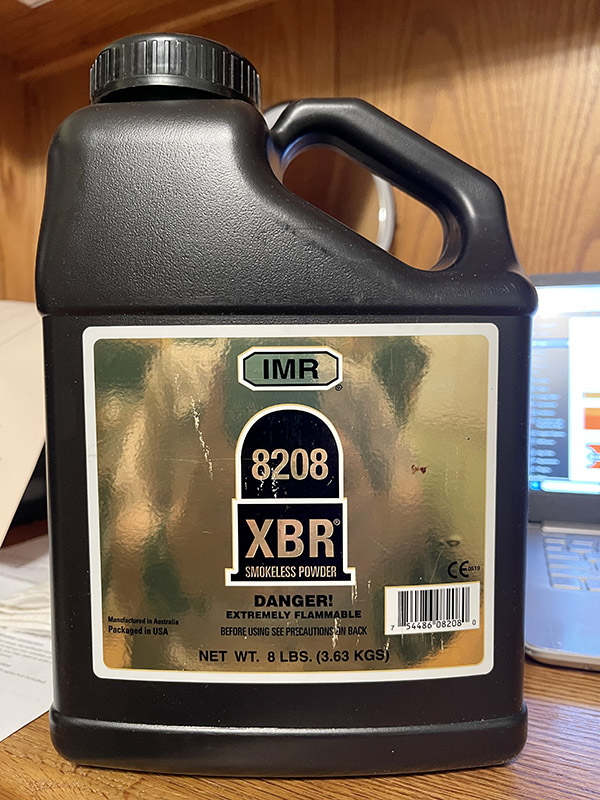
XBR 8208 Propellant. This is good stuff.
Like I said above, I knew from an earlier range session that the Winchester ammo was relatively accurate in my Circassian No. 1, so my objective was to duplicate that load. I found online that Winchester listed their ammo’s velocity at 1880 feet per second. I didn’t know what propellant Winchester used, but I had a bottle of XBR 8208 and it was proving to be very accurate in other cartridges (more on that later). Interpolating from the Hodgdon’s XBR 8208 load data, it looked like what I needed was 54.0 grains, and that’s how I loaded.
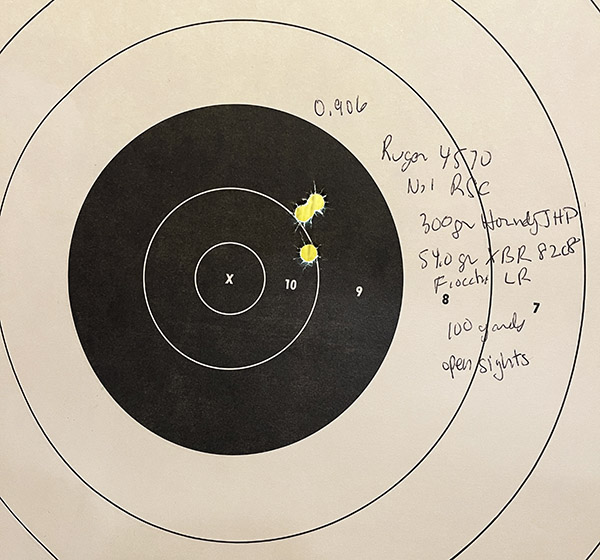
It was an overcast Wednesday morning out at the West End Gun Club when I tried the load at 100 yards. I fired three rounds and took a peek through my spotting scope. I couldn’t spot the hits in the scope, so either they all went in the black (which would be good), or I missed the target completely (which would be bad). Good buddies Duane and Walt were on the range that day, and when we walked out to check our targets, it was time for a collective “Whoa!” I was more than pleased with the results. Hell, a 0.906-inch group would be good with a scoped rifle. For a guy like me and open sights at 100 yards, it was spectacular. I’m really pleased with the load, the rifle, and myself. I’m even more pleased I had a couple of witnesses out there to see it!
Phenomenal results (at least for me) at 100 yards with open sights.
Those other cartridges I mentioned that work well with XBR 8208? In my .22 250 rifles, this propellant works very, very well with Hornady’s 52-grain match bullet. In the .243 No. 1, it pairs very well with Nosler’s 55-grain bullet, Hornady’s 58-grain V-Max bullet, and Speer’s 75-grain jacketed hollow point bullet. In 6.5 Creedmoor Browning X-Bolt rifle, XBR 8208 is the cat’s meow with the 123-grain Nosler jacketed hollow point boattail bullet and the 140-grain Hornady jacketed hollow point boattail bullet. With that last load, you could shoot flies at 100 yards if you could find them in the scope.
Did you ever love a thing that stopped deserving your love, but you keep on loving it? That’s how I feel about my Rock Island Compact 1911. Man, I want to love this pistol, but it’s fighting me. The latest development? The reverse recoil plug on my Compact 1911 failed again.
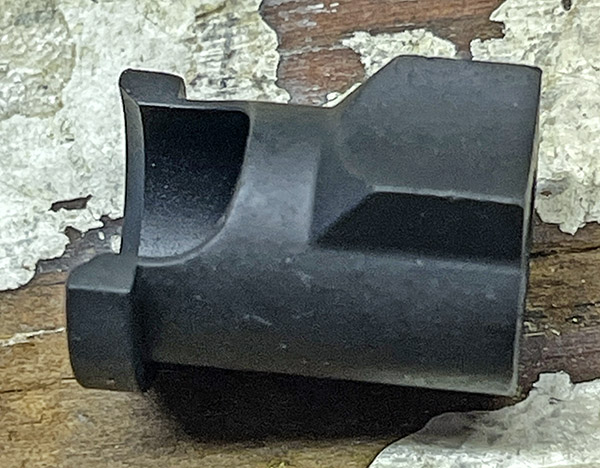
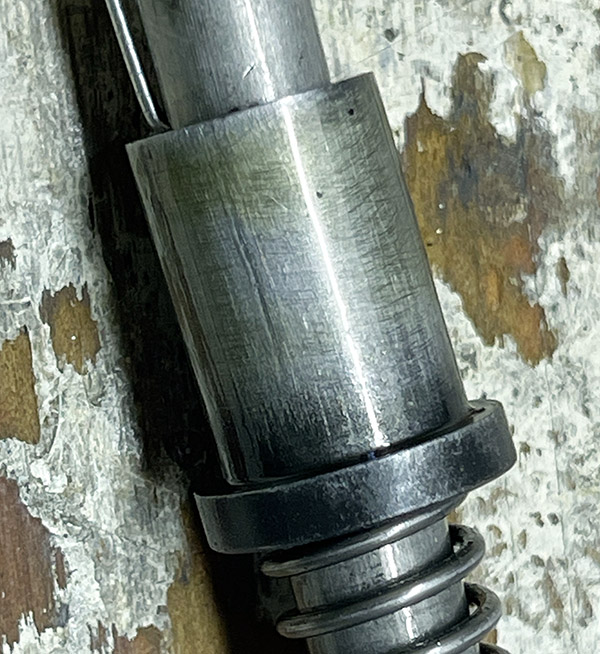
The offending culprit: The Rock Island Compact 1911 Reverse Recoil Plug. This is the new part. The old failed one is in the photo at the top of this blog.
You may recall that this part failed once before in my Rock Compact. I wrote about that as well as a host of other Rock Island Compact 1911 issues in a previous blog.
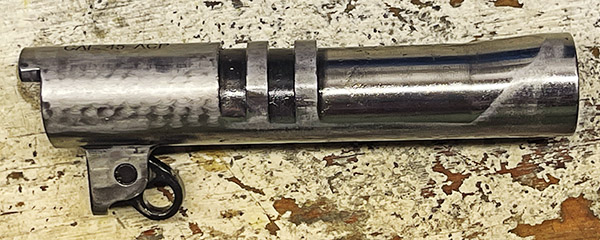
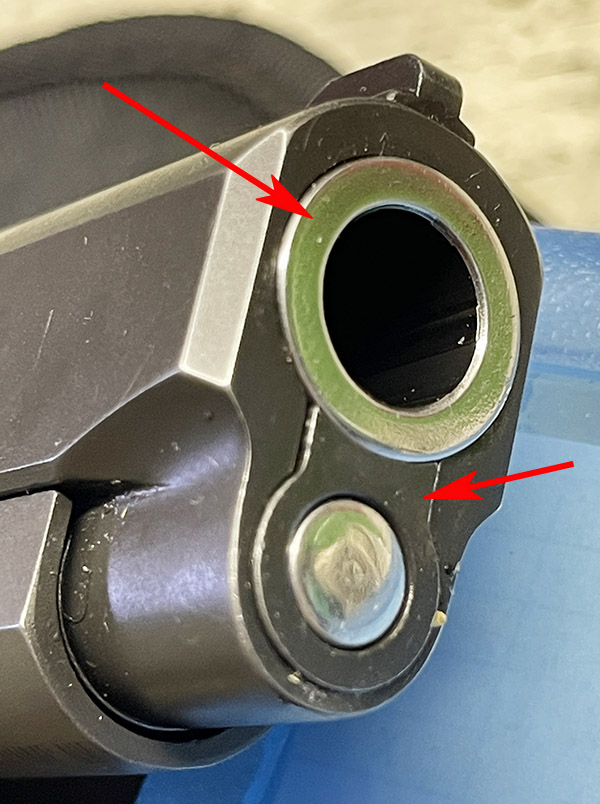
The Compact 1911’s barrel. Note the increased diameter at the muzzle end, which eliminates the need for a separate barrel busing. My chamber’s exterior has custom jeweling by TJ’s Custom Gunworks.The business end of my Compact 1911. The arrow on the left points to the barrel, the arrow on the right points to the reverse recoil plug.
In a conventional, full-sized 1911, the guide rod spring fits into a barrel-like plug that captures the end of the spring, and that plug engages the handgun’s barrel bushing. There’s not enough room for that arrangement in a compact 1911, so the various companies producing compact 1911s incorporate different designs to address this. Rock Island’s Compact 1911 has no barrel bushing (the barrel itself has a larger diameter and it acts as the bushing). And there’s no conventional recoil spring plug, either. Instead, the Rock Island Compact uses what they call a reverse plug. The Rock Island part is made of steel, as it should be (I initially suspected it was made of aluminum, but my magnet doesn’t work on aluminum). Even though it’s made of steel, it just doesn’t hold up.
What happened this time is the gun became extremely stiff (I could barely rack the slide), the trigger pull became increasingly heavy, and the gun doubled on me (it fired two shots with a single trigger pull). When that happened, it was time to call it a day and tear the gun down.
The arrow points to the reverse plug installed in the slide, with the guide rod/recoil spring/reverse plug assembly installed in the slide.
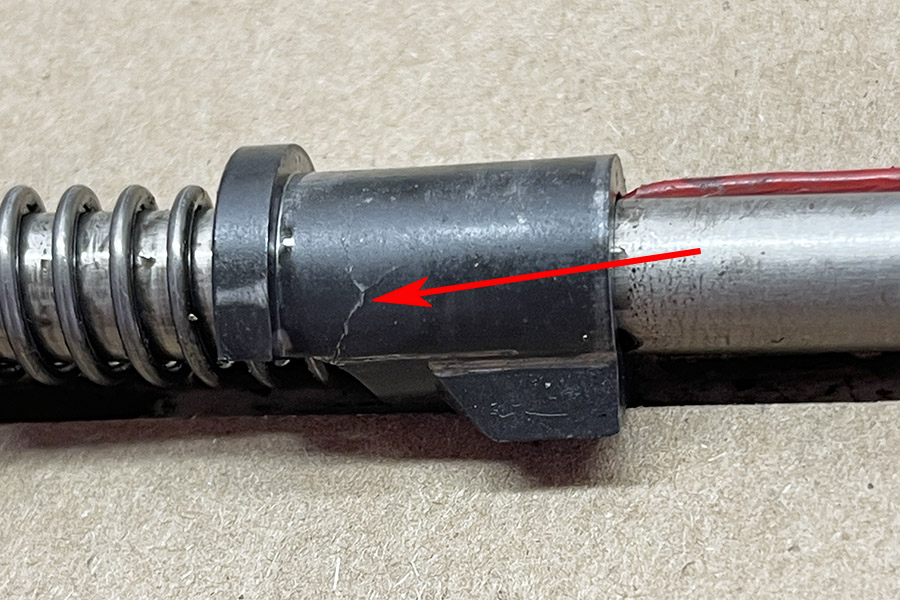
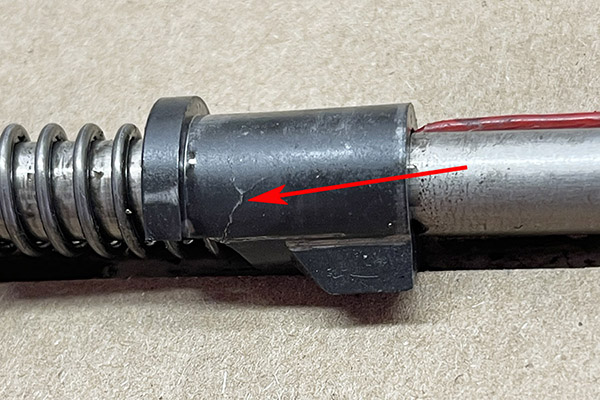
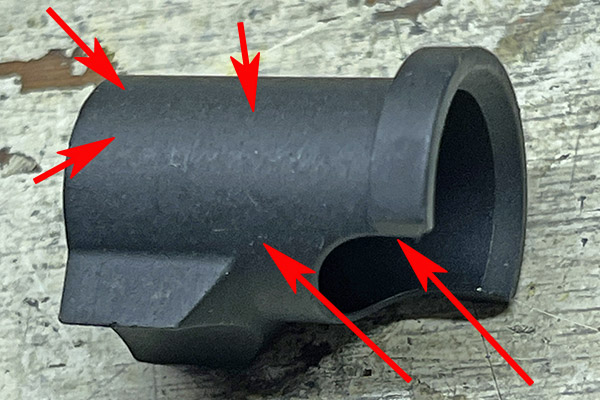
The interior of the 1911 was funky. It had been working well so I just kept shooting it, but now it was time for a good cleaning. When I disassembled the 1911 and pulled guide rod, spring, and reverse plug from the slide, I noticed two hairline cracks on either side (that’s the photo you see at the top of this blog and below). Wow. I hadn’t fired more than a thousand rounds since I had replaced the recoil plug when it previously failed.
Cracks on the previous reverse plug. This has happened twice. I think this part is poorly designed. It doesn’t last very long.
I called Armscor/Advanced Tactical/Rock Island three times (these guys have more names than a character in a Russian novel) and left messages. I filled out their website’s customer service form. That was a couple of months ago and I’ve still not had a response. The Rock Island 1911s are supposed to have a lifetime warranty.
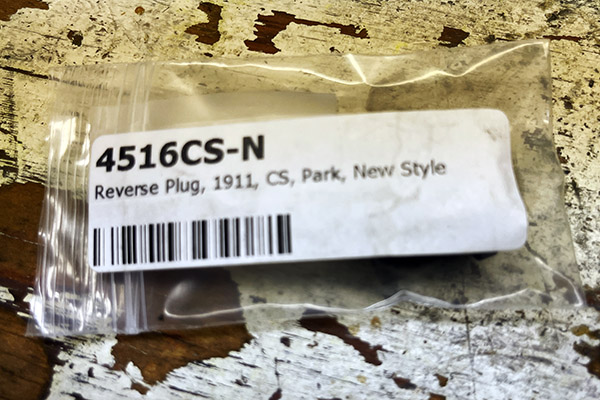
A new reverse plug from Rock Island. I bought three this time. They didn’t honor their lifetime warranty.
After not receiving a response, and based on the reverse plug’s flimsy design, I ordered three new ones. I suppose I could have continued to sit around and feel sorry for myself, but I wanted to shoot my 1911, and I’m not going to take these guys to small claims court for $30 and change. The reason I ordered three parts is that I don’t know how long the Rock Island parts aren’t going to last (I suspect it won’t be long), so I wanted to have spares on hand the next time this occurs. To Armscor/Advanced Tactical/Rock Island’s credit, the parts shipped the same day, so I knew they have people monitoring their website. They just didn’t respond to my complaint about the part. Maybe it’s because of my previous blogs on their Compact 1911.
Edit: Several weeks later, I received an email from Advanced Tactical. Here’s the text of their email:
From: Advanced Tactical Sales Sent: Friday, July 25, 2025 7:03 AM To: Joseph Berk Subject: Re: Compact 1911 Recoil Spring Plug Persistent Failures
Good morning Joseph,
Thank you for your patience and understanding. Our call center is currently experiencing a major transition, leading to a high volume of customer requests for information, replacement parts, repairs, and other inquiries. We are working hard to address these issues promptly and professionally, even though we are short-staffed.
Please provide the serial number of the gun, it is required for our records.
Thank you!
Pedro
I responded to my new buddy Pedro to let him know that I threw in the towel waiting for them, and I had already purchased three replacement parts (three, because I knew they wouldn’t last). I suggested that they reimburse me for the three parts. I have yet to get a response.
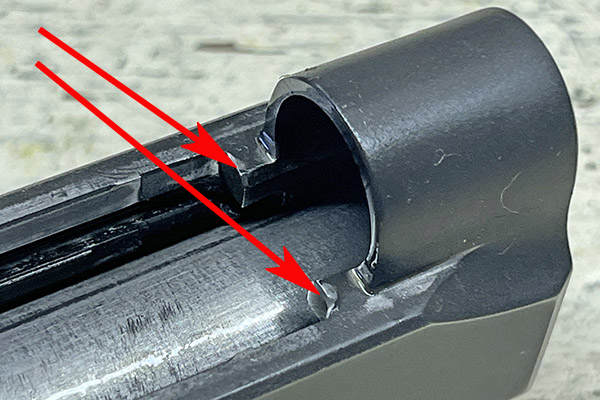
Tabs on the Compact 1911 slide that interact with the reverse plug. These should not be modified. The reverse plug needs to be relieved and slightly ramped to slide into these tabs.
Rock Island states on their website that the reverse plug needs to be fitted by a competent gunsmith. For good buddy TJ (of TJ’s Custom Gunworks) doing so would be a slam dunk, but we were having riots in Los Angeles again and I didn’t want to drive through town. (There are gunsmiths closer to me, but I know from hard-won experience that none of them meet that “competent” qualifying adjective). So I did what Joe Gresh would do: I did the work myself.
Areas on the reverse plug that need to be relieved to fit the part to the slide. I refer here to the larger diameter interrupted ring (on the right in the photo above) as the plug’s rib.
Fitting the reverse recoil plug involved sanding its body until it would enter the slide’s bore. There are a couple of tabs on the slide, and the reverse plug’s rib needs to be relieved to clear these. I think not relieving the rib would accelerate the reverse plug’s failure (the plug would slam into the slide’s tabs with each shot). if that occurs, the reverse plug would be torqued in a downward direction. Looking at the failed plug and its fractures, I believe this is what occurred on both of my reverse plugs’ failures.
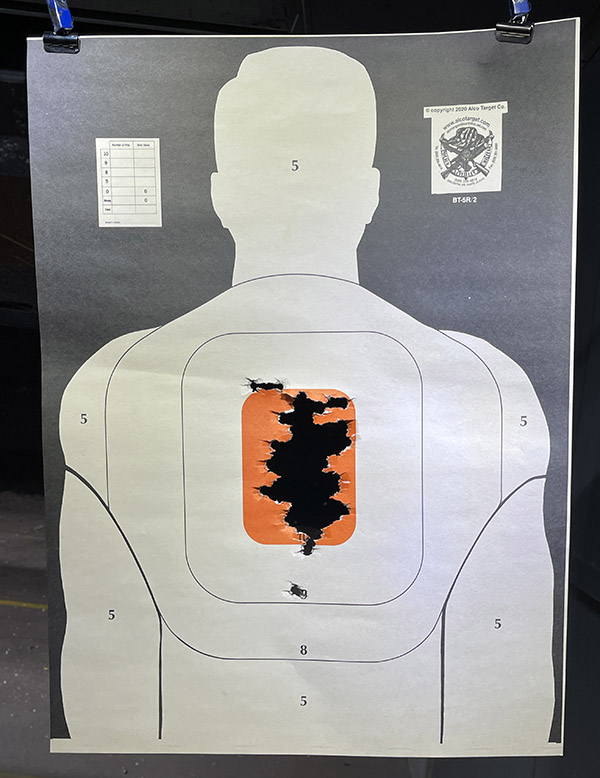
After working on the reverse plug for about an hour (such that it slid easily into its cavity in the slide and the plug’s rib cleared the slide tabs), I reassembled the 1911 and took it to an indoor range near where I live. It functioned flawlessly, except for one shot that dropped a little below the orange bullseye. I think maybe a gnat landed on my front sight for that one.
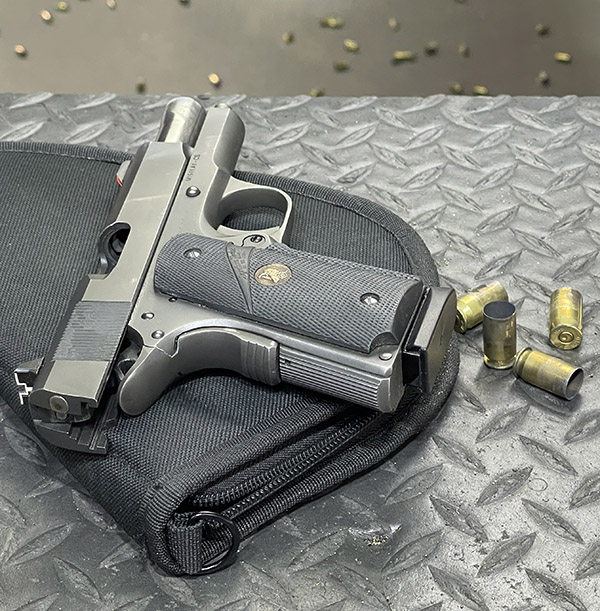
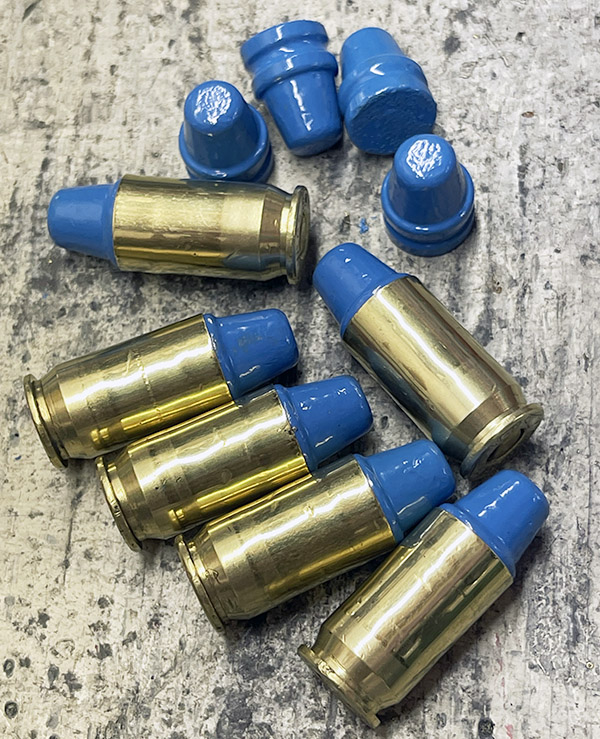
The Compact 1911 on the range. It’s well worn. I like the idea; the execution is weak.A hundred rounds later. Dead is dead, and this guy is as dead as Julius Caesar.My Compact 1911 Load. It works well.
My load for the Compact 1911 is the 185-grain powder-coated Gardner semi-wadcutter bullet seated to an overall length of 1.250 inches, 5.0 grains of Bullseye powder, and the Winchester large pistol primer. For this particular box of ammo, I used Winchester brass that had previously experienced multiple reloadings (you almost can’t wear .45 ACP brass out). This same load also works well in my full size 1911.
The post-firing reverse plug after 100 rounds.. I’ll be inspecting it regularly.
When I returned home, I examined the new reverse recoil plug and it had no cracks. I’m keeping my fingers crossed. I’ll inspect the reverse recoil plug every time I disassemble the Rock Compact for cleaning. I know what to look for now, and I know how to fix it.
Last year, Susie and I took a trip to Georgia, Wisconsin, and Michigan. It was fun. We met with my former battery commander (with whom I served in Korea), we went to the Harley Museum in Milwaukee, we visited Green Bay and their fabulous Auto Museum, we stopped in at the Green Bay Rail Museum, we rode up to the Pictured Rocks National Lakeshore, we toured the Miller Brewery, and we hit a few other places (I’ll provide links for all these at the end of this blog). We do trips like this to have fun and as ExNotes and Motorcycle Classics content safaris. It’s fun. I like to travel, I like to write, and I like taking pictures. Yep, life is good, and what we do sure beats working for a living.
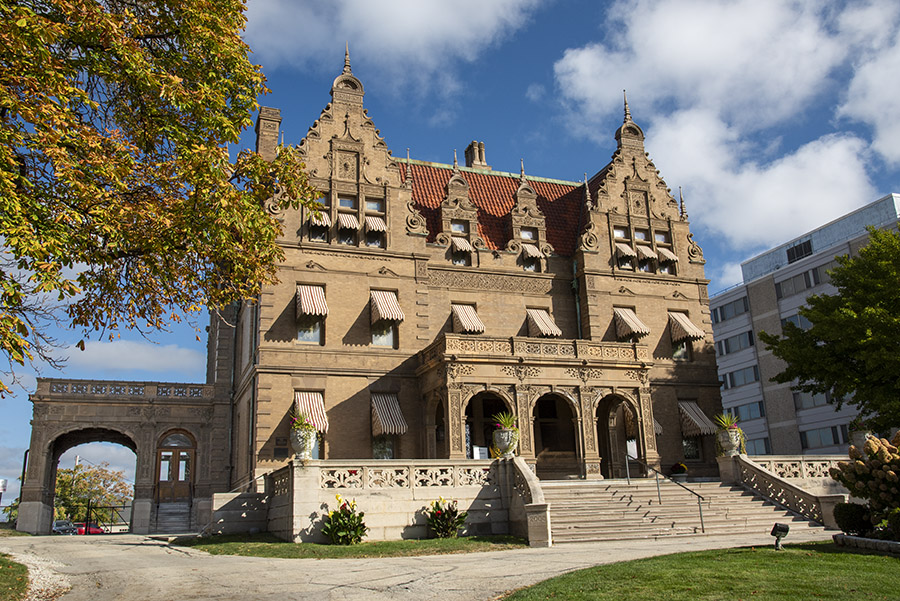
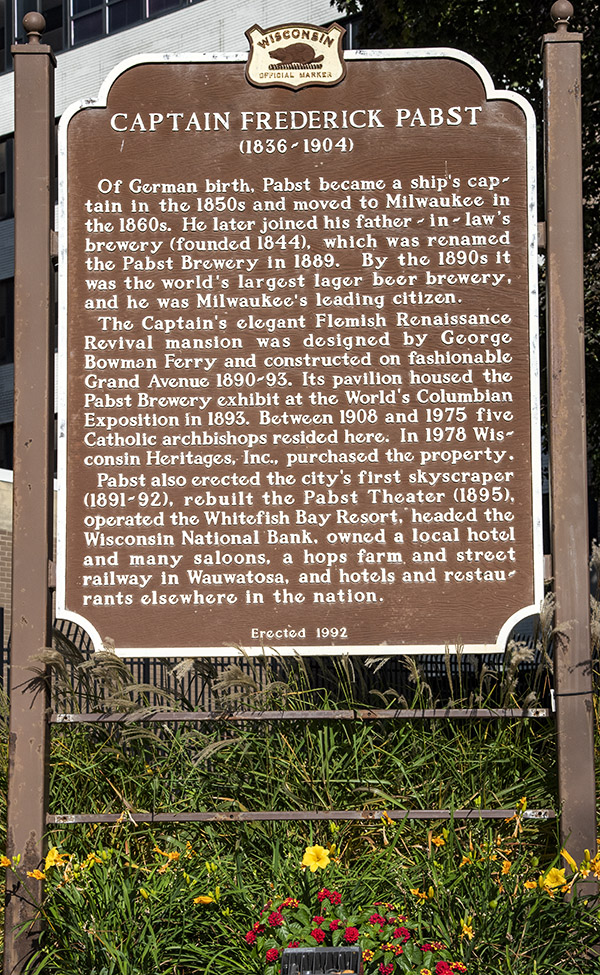
Susie is super good at finding places (usually ones I’d never heard of) wherever we wander, and one of them was the Pabst Mansion in Milwaukee. This is an interesting story. You probably know from the Miller Brewery blog we wrote last year that Milwaukee is America’s beer capital. One of the early beer companies in America was Pabst. The story goes like this: Frederick Pabst came to this country from Germany as a 12-year-old boy (with his family) in 1848. He started his working life as a cabin boy on the ships plying Lake Michigan and eventually worked his way up to captain. He married Maria Best in 1857, which brought him into the beer business. Maria’s father owned Best and Company, which at the time was the largest beer company in the country. The Captain (as Frederick Pabst was known by that time) joined the beer biz in 1864, and through hard work (and an obviously smart choice in the matrimonial department) he soon became the top dog. The Captain changed the company’s name to the Pabst Brewing Company in 1874.
The Captain commissioned construction of the Pabst Mansion in 1890. It took a couple of years to build, but I think the wait was worth it. This place is as grand as anything I’ve seen anywhere in the world. Apparently, I’m not the only who felt that way; in 1908 the Catholic church’s Archdiocese of Milwaukee purchased the place. Over the next seven decades, five Archbishops and more than a few priests and nuns lived there, too. By 1975, the Archdiocese wanted out, and sold the property to Wisconsin Heritage, and outfit that offers tours and sells tickets. That’s a good thing; the Pabst Mansion (prior to the sale) was going to be demolished and turned into a parking lot. Just prior to the sale to Wisconsin Heritage, the Pabst Mansion was added to the National Register of Historic Places.
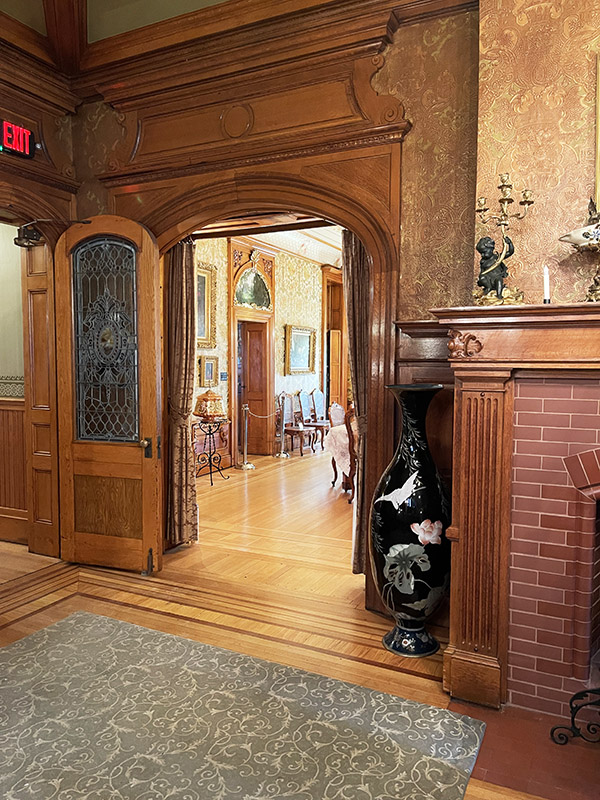
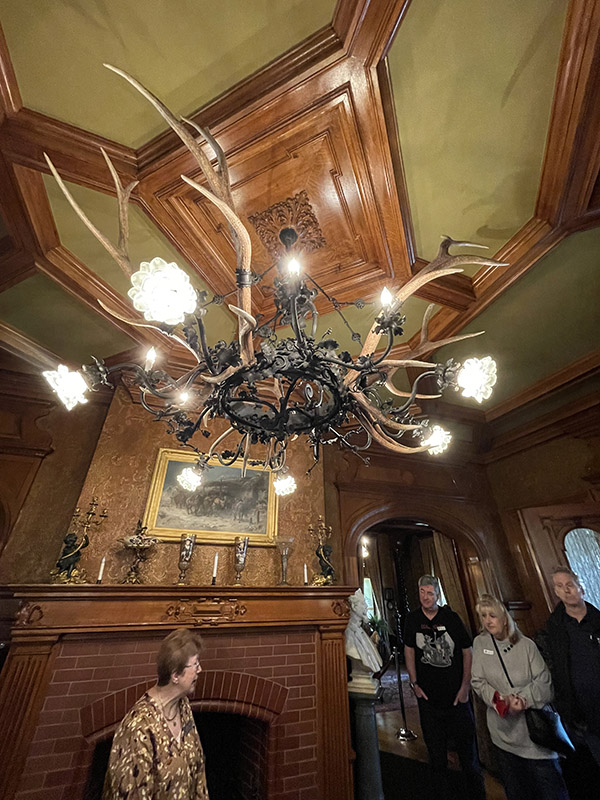
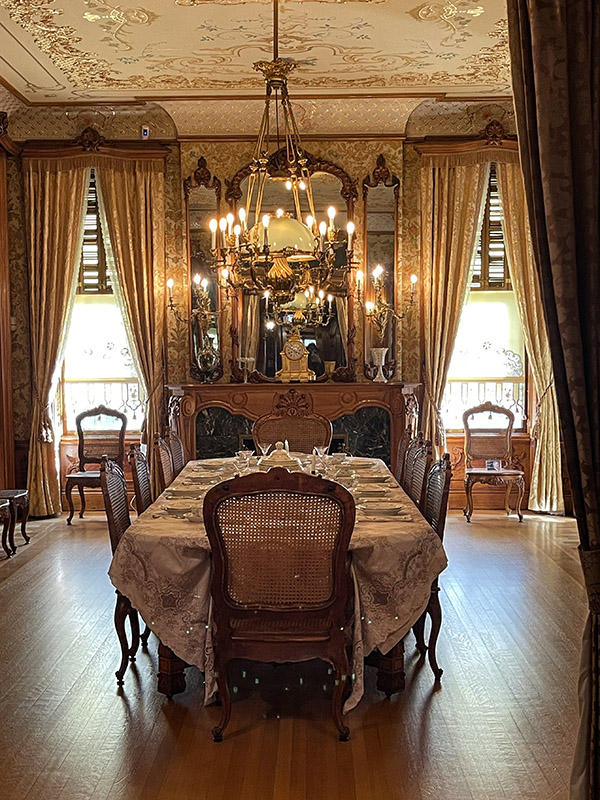
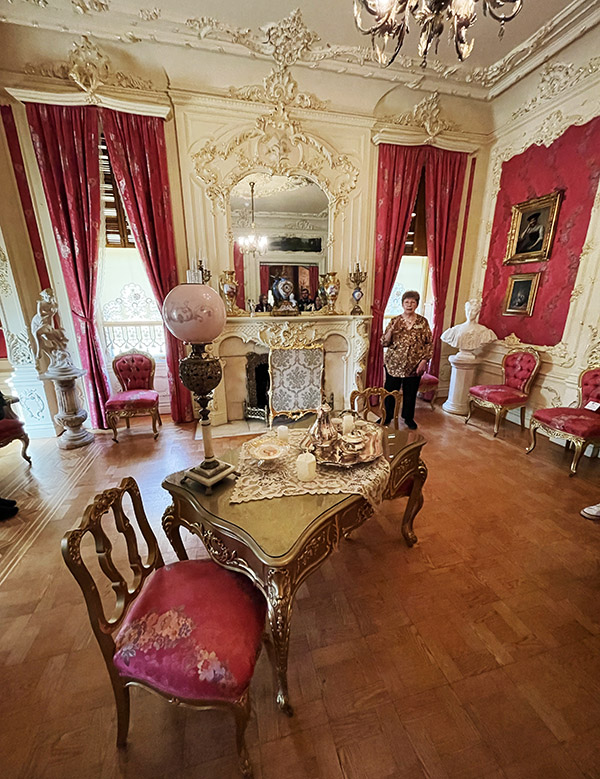
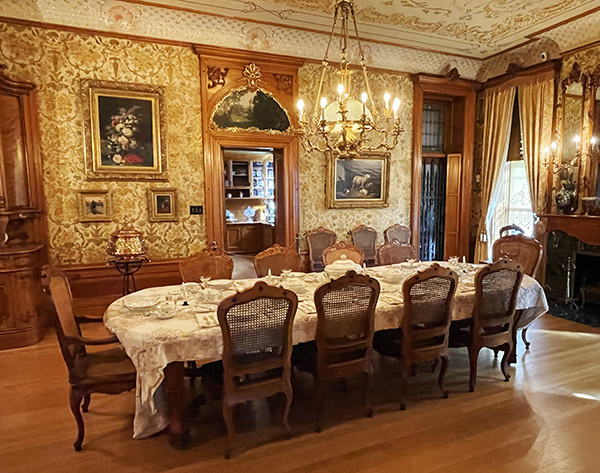
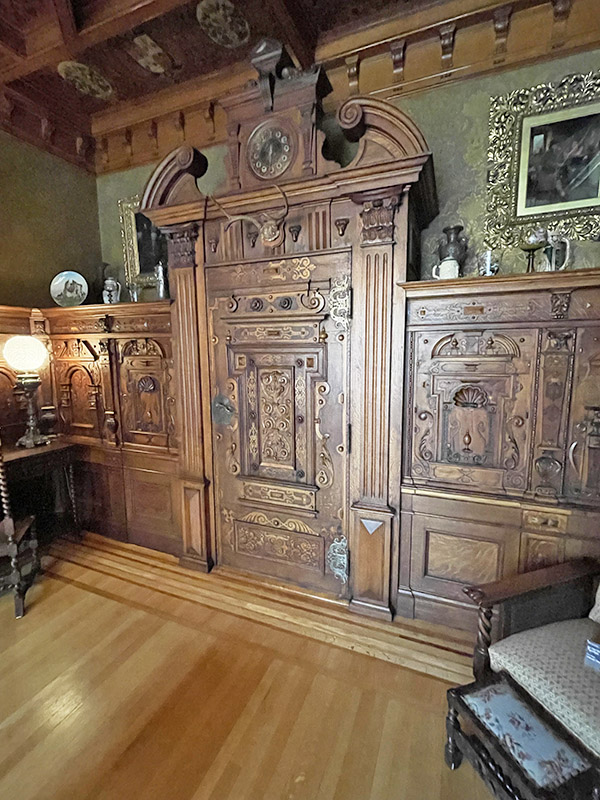
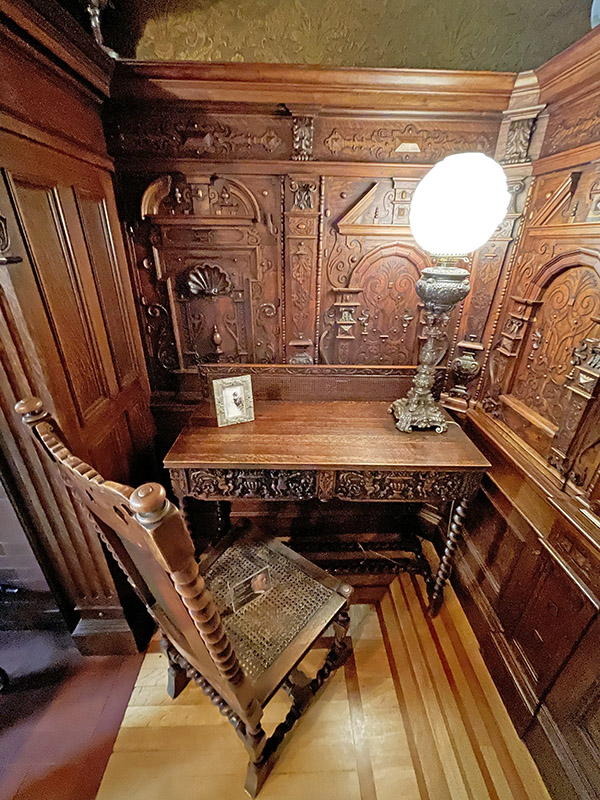
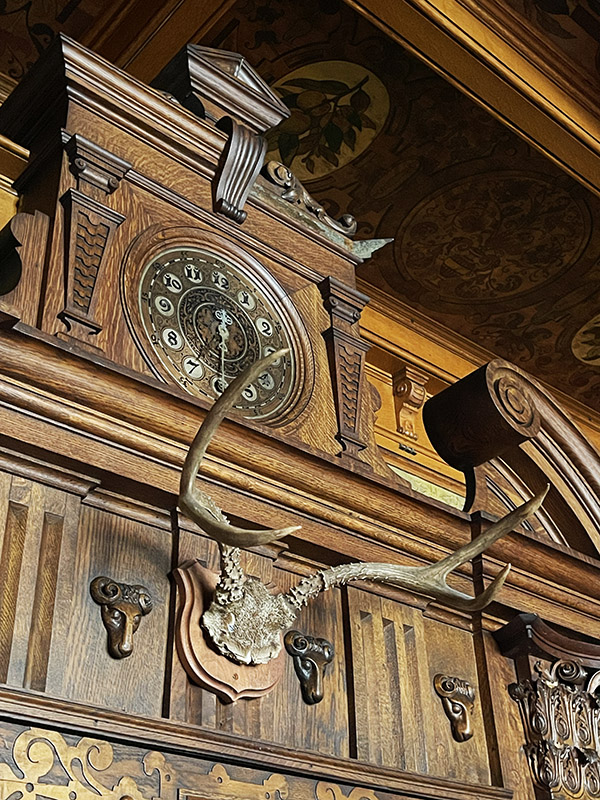
Once inside the mansion, we were blown away by its ornateness, the beautiful wood paneling, and the sheer luxuriousness of it. As we went through the different rooms, I wondered what it must have been like for the Captain, and then all those archbishops, priests, and nuns to live here. It must have been grand.
Living there must have been grand. We had a fun time at the Pabst Mansion. If you ever find yourself in Milwaukee, the Pabst Mansion is worth a stop.
The other blogs and magazine articles I mentioned that resulted from our visits to Georgia, Wisconsin, and Michigan? Here they are:
The morning light over Puerto Natales was soft and silver, with a misty rain that whispered rather than shouted. Tom and I shouldered our packs, my heart fluttering with a mix of nerves and anticipation as we stepped into the unknown. We boarded the early bus from Puerto Natales, joining a mix of wide-eyed trekkers and seasoned hikers, all bound for Torres del Paine National Park. The drive itself felt like a quiet ritual — the final stretch of comfort before the wild began. As we moved deeper into Patagonia, the land shifted again: golden steppes gave way to alpine slopes, windswept plateaus, and glimpses of distant glaciers. At the park entrance, we checked in with our reservations and caught the connecting shuttle to the Central/Torres sector, arriving at Refugio Chileno, our gateway to the trek’s first challenge.
We hiked for several hours along the Río Ascencio, winding through lenga forests – native beech trees with leaves that whispered in the wind — crossing footbridges, and climbing switchbacks softened by moss and whipped by gusts. The relentless Patagonian wind pushed against our packs, howling around bends – a constant reminder that nothing in Patagonia is guaranteed.
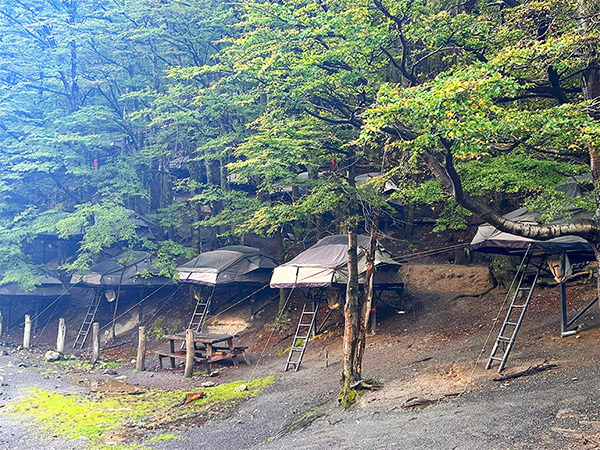
By late afternoon, we reached Refugio Chileno, perched at the edge of a forested valley. For the next two nights, this would be our home: a reserved tent platform with meals provided by the Refugio. The food here was the best of the entire trek, and the staff radiated warmth and kindness. Though the quarters were small and cramped — especially with day hikers seeking shelter — the atmosphere remained joyful and welcoming.
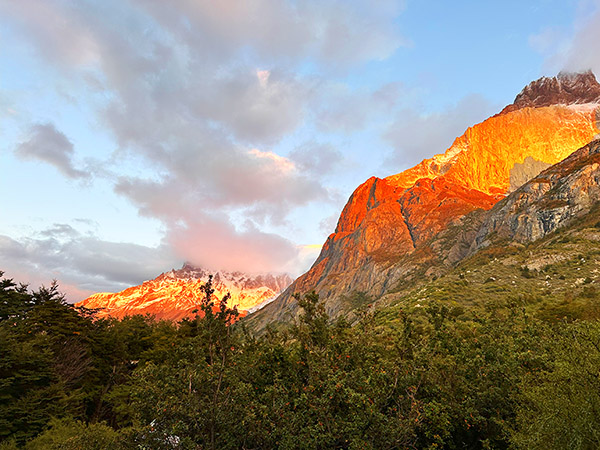
The setting was raw and beautiful — the kind of place where you arrive dusty, tired, and utterly alive. We laid out our gear, adjusted our layers, and walked down to the river to watch the sunset light up the granite towers in hues of copper and rose. Our bellies full of fresh salmon, brought in by horseback, and some much-needed vino Tinto, we climbed the stairs to our tent platform surrendering to the exhaustion of the day.
Day 2: Mirador del Torre – The Towers
Despite the wind and rain keeping frustrated hikers at bay through the morning, we kept a close eye on the forecast. Around 1 p.m., the clouds began to lift – just enough to give us hope that the iconic granite spires we had come to see might finally reveal themselves.
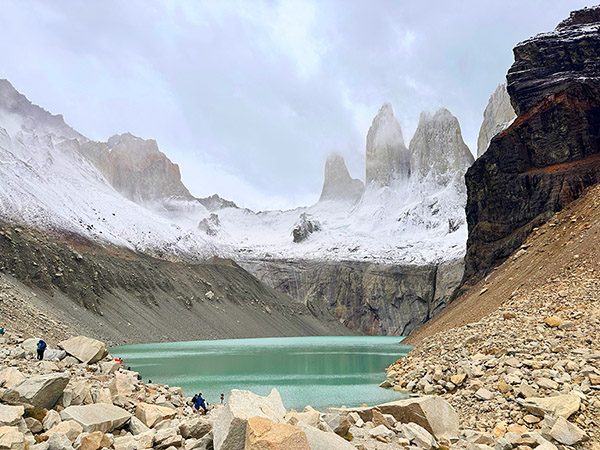
The climb was tough: wind whipping, rain falling, slippery, rocky switchbacks slowing our pace. But the moment we reached Mirador Torres, the clouds cleared fully, unveiling the full glory of the towers rising sharply against the sky. Seeing the towers for the first time stopped me in my tracks. I had dreamed of this moment, one of the most iconic sights in Patagonia, and now I had arrived. After the long, grueling climb, standing at the base of those towering granite spires was nothing short of humbling. They rose with such raw power and timelessness, carved by ice and wind over millennia, that I felt both incredibly small and deeply connected to something far greater than myself. That glimpse, brief and breathtaking, was worth every bone-weary step.
Day 3: Humbling Miles Along Lake Nordenskjöld
We woke up in our tent excited to see what day three would bring. It wasn’t until I climbed down the stairs of the tent that I came to terms with smoked legs and aching knees. Oh lord, I felt old! We had heard this would be the “easy” day, relatively flat, a chance to recover. That turned out to be not exactly accurate! The trail stretched endlessly in rocky, uneven waves, one steep climb after another, each followed by a jarring descent. The ups and downs felt cruel, especially on sore joints and tender muscles. The wind rarely left us. It pushed against our packs, howled around bends, and made balance tricky over exposed rock sections.
We traced the shoreline of Lake Nordenskjöld for most of the day, its slate-blue water glinting beneath a thick ceiling of clouds that later broke open to brilliant blue. The views were stunning, even through the fog of physical discomfort: sprawling valleys, snow-dusted peaks, and the icy blue lake curving endlessly at our side. It was wild and cinematic — just enough magic to keep us moving. A family from the East Coast crossed paths with us several times throughout the day. Each time, we shared a moment of mutual misery, cheering each other on with dark humor and tired smiles.
By the final stretch, the fatigue wore thin on both of us. Tom, usually my steady, optimistic hiking partner, hit a wall. Frustrated, he picked up his pace and took off ahead, muttering curses at the unknown trail gods. Too tired to keep up and trying my best to hide my giggles at Tom’s colorful curses. I soldiered slowly up and down the trail ever longing for the day to end and preferably ending with a pisco sour or glass of wine.
And then it happened: A section of trail gave out underfoot – loose rock, bad timing, tired legs. I tumbled hard, unable to catch myself. When I landed, I knew instantly my left knee was in trouble. The pain was sharp and deep. Sitting in the dirt, stunned, breathing through the sting. Alone, I took slow, careful steps, stopping often. My knee buckled repeatedly. Doubt crept in as to whether I would even make it to camp. The trail seemed to stretch forever.
Then, finally, just as the trail descended toward Refugio Los Cuernos, I saw Tom waiting, his earlier frustration replaced by quiet concern. He took my pack without a word and helped me down the final stretch. I was still upright, still walking, but just barely. The relief of seeing him was immense. We reached the Refugio together, subdued, exhausted, and deeply relieved.
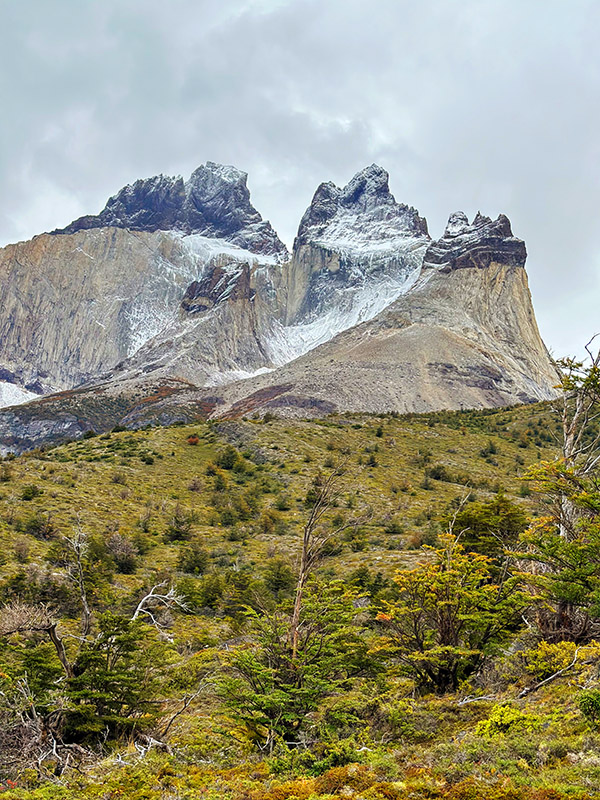
Refugio Los Cuernos sits tucked beneath the jagged black horns of the Cuernos del Paine, towering, wind-carved peaks that look like something from a dream. The setting is spectacular: to one side, the deep turquoise waters of Lake Nordenskjöld; to the other, the dramatic silhouettes of the horned mountains looming above like ancient guardians.
The Refugio itself is small and charming, wooden cabins scattered along a rocky slope, connected by boardwalks. Our tent platform was nestled into a gentle rise just a short distance from the bar and dining hall. The communal area buzzed with tired hikers sharing meals, comparing stories, and soaking up the fading golden light.
That night, we ate with our boots still on, grateful for the hot food, a precious ice pack provided by the staff, and a warm place to sit. The staff, kind, and patient despite their long day, served up hearty portions and laughter with our meals. As the wind howled outside and the peaks turned dusky purple, we sipped wine and leaned into the warmth of it all. We were sore and injured in new places, but also held, somehow, by the land and by each other.
Day 4: The French Valley
The morning started slowly as Tom checked on my knee, confirming that I tore my meniscus already compromised years earlier. We talked through how best to continue the trail. The staff at Los Cuernos kindly offered, for a fee, to transport my backpack to the next Refugio. I gratefully accepted. Shedding 20-plus pounds gave me the best shot at finishing the day ahead.
I set out earlier than Tom, knowing he would catch up quickly. I often joke he is part man and part mountain goat, thanks to years of summiting peaks across North America and, more recently, 26 nights of hiking in Nepal. My pace would be slower, and we both knew it.
I arrived at Refugio Francés mid-morning and took a welcome break. With sweeping views and a patch of sun warming me, I indulged in a second breakfast while waiting for Tom to catch up.
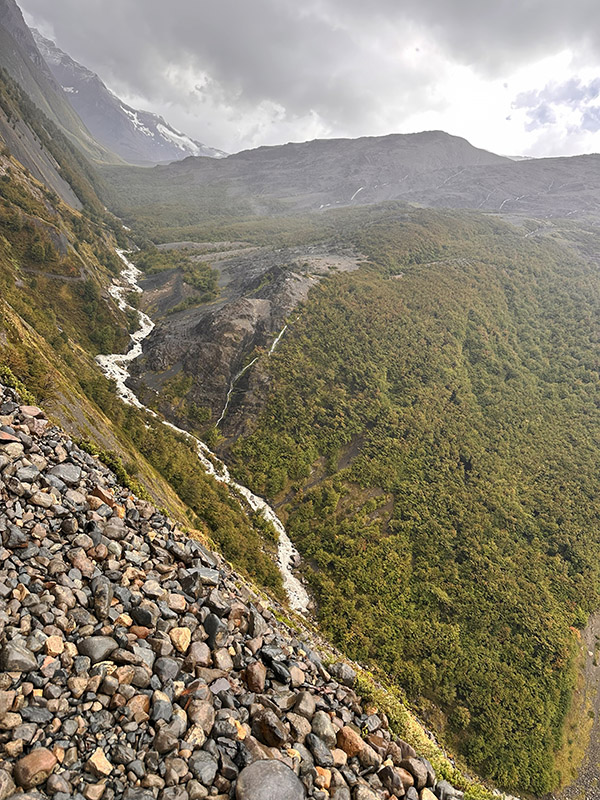
Before reaching Campamento Italiano that afternoon, we paused on a narrow ledge, the forest thick around us, wind whispering through the trees. Below us, the French Valley unfolded like a hidden cathedral: raw, vast, and breathtaking. I dropped my trekking poles and leaned back against Tom, my heart pounding as I looked up. For a moment, I simply forgot to breathe, overwhelmed by the sheer scale and silence. Jagged granite peaks rose like spires; their faces streaked with snow. Glaciers spilled down cliffs like frozen waterfalls, suspended in time. Somewhere high above, an avalanche cracked like distant thunder, echoing through the stillness.
It was not just the view. It was everything it meant, that we had made it here, injured, and uncertain, every step hard-earned. I stood there, breath finally returning, feeling both insignificant and fiercely alive. We rested for a while, watching clouds drift low over the valley walls, the wind tugging gently at our jackets. Many hikers dropped their bags and headed up the trail to Mirador Británico, a high lookout deep within the valley. That had been our original plan too.
But my knee had its own truth to tell. We knew that if I pushed too far, I might not be able to walk the next day. So, with a bittersweet kind of grace, we turned west toward Refugio Paine Grande, skipping the deeper valley climb.
The trail to Paine Grande offered long, sweeping views of Lago Skottsberg, the wind carving whitecaps on its slate-blue surface. We followed the ridgeline, battered by gusts but buoyed by the promise of shelter, and a hot meal at the end.
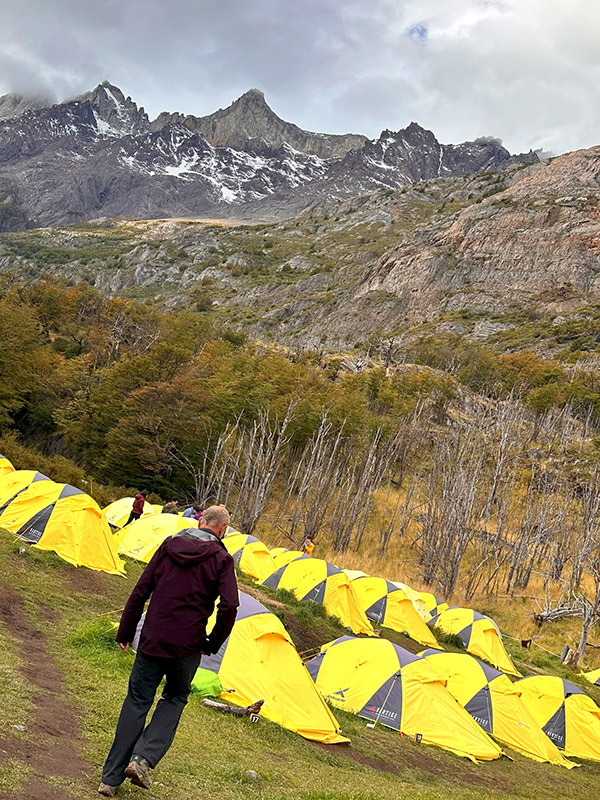
When we arrived, Paine Grande felt massive. Easily the largest Refugio we had seen, it sprawled at the base of the mountains, surrounded by a wide field dotted with rows of identical lemon-yellow tents, each fluttering in the wind like wildflowers stitched into the grass. The bright, bold color was almost joyful, defiant against the gray sky and rugged peaks surrounding it.
Inside, the Refugio was warm and bustling. Hikers shuffled in camp slippers and fleece layers, swapping stories and queuing in the cafeteria-style restaurant, trays in hand, hungry in that special way only trail days create. We claimed our assigned table, plates piled with pasta and warm bread, our bodies already loosening in the glow of arrival.
After dinner, like every night on the W, we headed to the Refugio bar. It had quickly become our ritual: wine, cold Patagonian beer, or a celebratory pisco sour, frothy, citrus-bright, the perfect end to the day. That night, sipping wine with my knee gingerly stretched beneath the table, something in me settled. I was in a place that felt unreal, wild, remote, and somehow tender, with a man whose gaze held warmth and love. This shared journey deepened our understanding of each other and quietly strengthened our bond. Gratitude settled beside me, humbled by the magic of the moment.
This was an interesting blog to write (and it was interesting on many levels). As you know, I’m writing a series of blogs on motorcycles I’ve owned with the machines organized by cylinder count. The idea is to consider all of them from my ownership perspective, rack up a bunch of (hopefully) fun-to-read blogs, and then wrap up with my opinion on which engine configuration is the best. I’ve already done the first one on the singles I’ve owned.
A word on the photos: I was surprised I had photographs of every bike I’ve ever owned. In recent decades, after I had become a half-assed amateur photographer, the photo quality is generally good. In earlier years, I was not a very good photographer, nor was my equipment very good. Some of the photos are in black and white, and most of the earlier ones were taken with a dinky little Minolta C-110 camera. Hey, you go to war with the army you have.
Between that first ¿Quantos Pistones? post and this one, something self-updated on my computer and my laptop went from simply taking my orders to predicting what words I’m going to type next and then filling them in, which I found to be wildly annoying. I thought it was in the WordPress software, but it wasn’t. It was in my Edge browser. Google helped me; I found the offending “feature” in the Edge settings and switched it off. I think these software weenies are changing things just to give themselves something to do. I wish they would stop. The folks who keep doing this sort of thing are going to have a hard time explaining themselves when they’re standing in front of the pearly gates. I’ll be there, too, as a witness for the prosecution.
Rant over; let’s get back to the main attraction.
As was the case in the blog on singles, I am again discovering this: Just when I think I’ve listed all of the twins I’ve owned, I remember another one. That sure has been the case here. I suppose I had better hit the Publish button before I remember another one.
Alrighty then: With the above as a backdrop, here we go.
1965 Honda CB 160
Okay, I’m cheating a little. This wasn’t my bike at all. It was my Dad’s. But I rode it in the fields behind our house quite a bit and I sort of considered it to be mine, and that’s why it’s on this list.
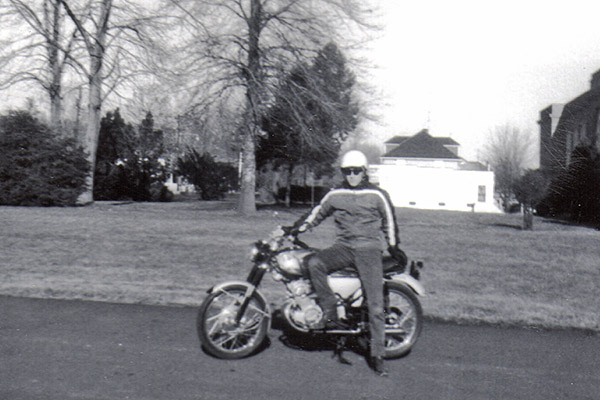
The 1964 Honda CB 160, That’s me on the bike in New Jersey, during the winter months, when I was 14 years old.
The little 160 was nice. It was the first motorcycle I ever rode and I had a lot of fun on it. Honda was making big inroads in the United States in the mid-1960s and they changed nearly everything in the motorcycle world. It was a fun time for a 14-year-old kid.
The CB 160 only stayed with us for a couple of months. Dad had been bitten by the bug. He wanted something bigger.
1965 Honda Super Hawk
As was the case with the CB 160, the Super Hawk was Dad’s motorcycle. But the same modifier applied: I used to ride it in the fields behind our house in New Jersey, so I’m including it here.
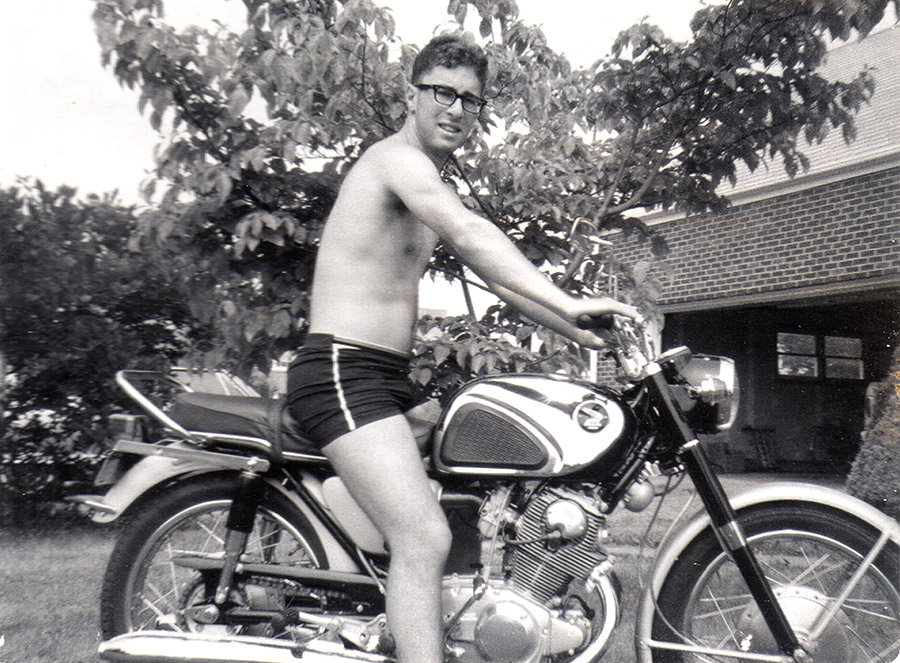
Fast forward a bit, and it’s me again during the summer months on a 1965 Honda Super Hawk. We had a swimming pool, so I spent my summers in a bathing suit.
The Super Hawk, with its 305 cubic centimeters, seemed infinitely more powerful than the CB 160 (especially riding it in the fields behind our house). Dad had the bug, though. The Super Hawk would only last for a couple of months, too.
1966 Triumph Bonneville
Ah, this was a motorcycle. A Triumph Bonneville. I couldn’t believe it. It had been my dream machine for at least a couple of years, and now there was one in the garage. And you know what? Dad let me ride it in those same fields behind our house. I can’t imagine what he was thinking or why he let me do that. I never dropped it, though. God Almighty, it was powerful. And the sound….it was awesome.
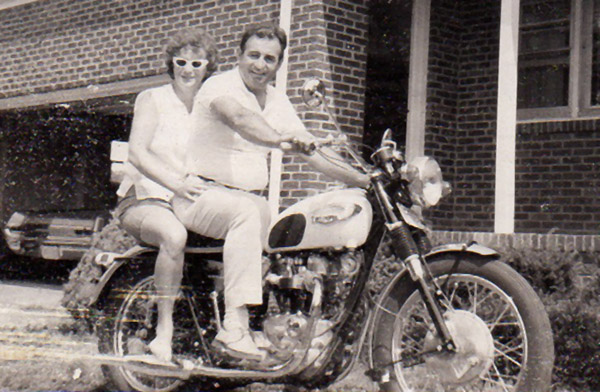
Mom and Dad on the 1966 Triumph Bonneville. You can see their other Bonneville (a 1965 Pontiac) in the garage. You could say we liked Bonnevilles. No one in my family has ever been to the Bonneville Salt Flats. I probably should go there one of these days.
The Bonneville was an amazing motorcycle. Dad and I had a lot of good rides on it. I wish we had kept it. On that sound comment above: Nothing, and I mean nothing, has a a more soul-satisfying exhaust note than a Triumph.
1978 Triumph Bonneville
I was living in Fort Worth, Texas, I was single, and I was an engineer at General Dynamics on the F-16 program. When I passed by the Triumph dealer I realized I hadn’t ridden a Triumph Bonneville since I was 16 years old, so I thought I’d stop by. An hour later I signed on the dotted line, and I owned a Bonneville again.
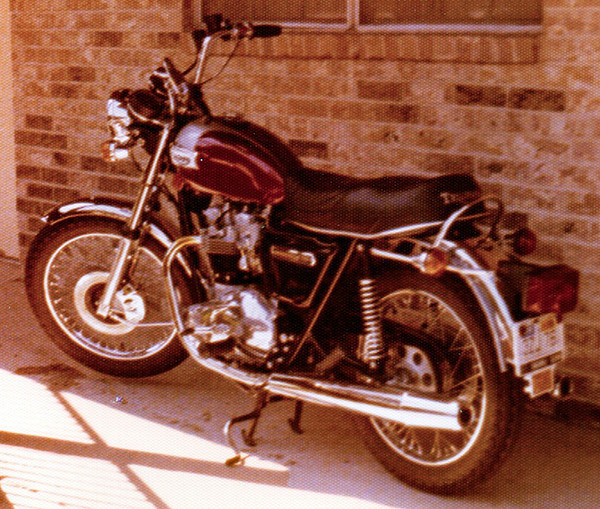
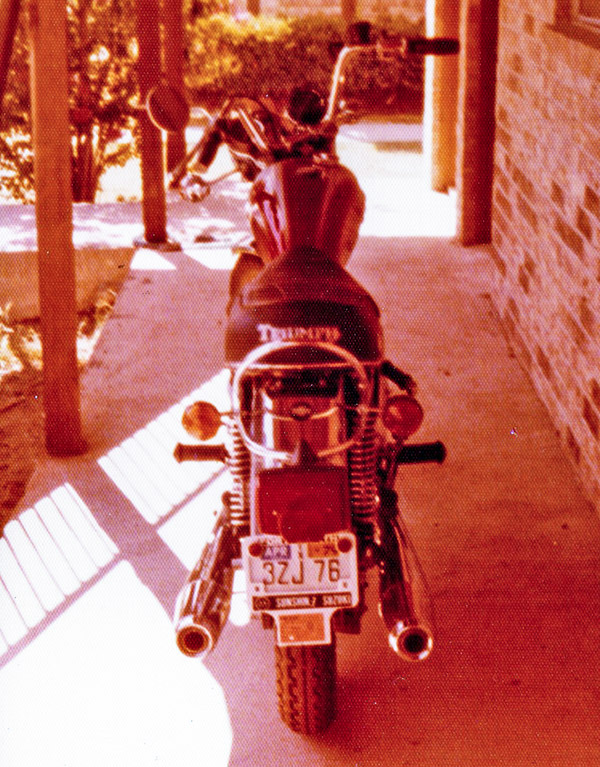
My 1978 Triumph Bonneville, parked outside my apartment in Fort Worth, Texas. The colors have mostly drained from these two photos. The bike was a deep candy apple red.Another shot of my 1978 Triumph Bonneville.
It was a great motorcycle. There was an older guy who owned a Yamaha TT 500 at General Dynamics (his name was Sam), and we road all the farm roads in the areas around Fort Worth. We both had hay fever and Texas had terrible pollen, but the riding was great. My Bonneville would top out at exactly 109mph (the earlier T120 and then T140 designations notwithstanding), and that was enough. The bike was kick start only (which made it an anachronism in 1978), but I was okay with that, too. For awhile, anyway.
I sold the Bonneville. I’m can’t remember why; I did a lot of dumb things when I was young. Shortly after I sold the Bonneville, I realized I needed a motorcycle again. You know, to be a complete person. That led to my next acquisition. But to this day, I wish I had kept the Bonneville.
1979 Harley Electra-Glide Classic
I used to spend a lot of time at the Fort Worth Harley dealer drooling over their new bikes. The late ’70s were, in my opinion, the height of the Willie G styling years at Harley. It was also the absolute bottom for them from a quality perspectives, as I would soon find out when I finally bit the bullet and bought the bike I thought was the most beautiful motorcycle I’d ever seen: The 1979 Electra-Glide Classic.
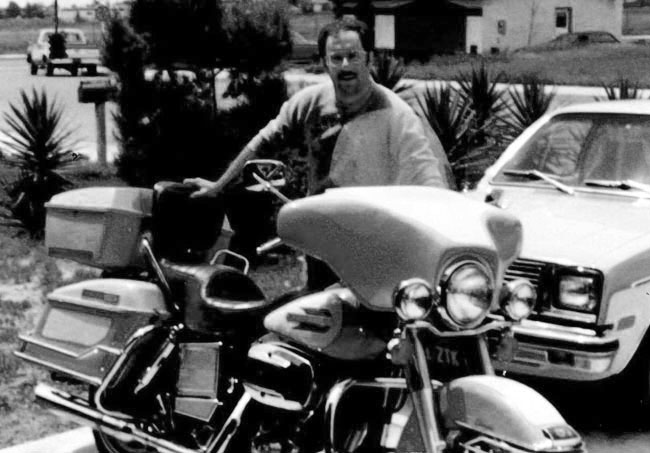
Yours truly, with a full head of hair and a 1979 Electra-Glide Classic. I called it my optical illusion. It looked like a motorcycle.
The Electra-Glide was beautiful, but to call it a piece of crap would be insult to turds the world over. The bike couldn’t go a hundred miles without something breaking on it. It needed three top end jobs in the 12,000 miles I owned it (the first two were on the warranty, the last one was on me). I’d finally had it with that bike and what some folks like to call “The Motor Company.” Hell, the motor was the worst thing on that bike. And the brakes. And the clutch. And the starter. And the handling. And the….well, you get the idea. It was one of the last years Harley was owned by AMF, and when a Harley mechanic told me what that stood for, I finally got it. I smiled inwardly when I sold the bike, thinking to myself, “Adios, MF.”
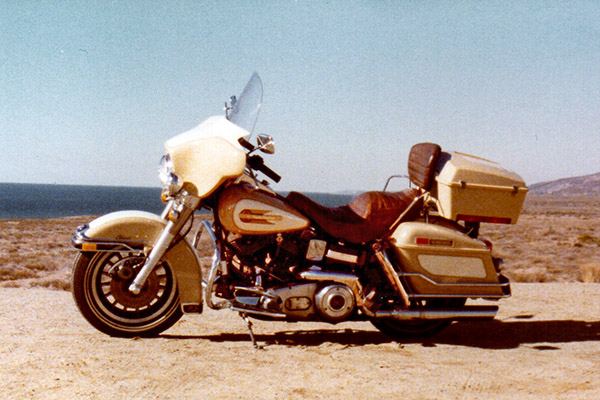
On the way down to San Diego, with the Pacific Ocean in the background. I explored a lot of southern California on the Harley. It was the most unreliable motor vehicle of any type I ever owned.
After that awkward ownership experience, I swore I’d never buy another Harley. I didn’t keep that promise, though.
Even considering all the above, I wish I still had that ’79 Electra-Glide. It would be worth a small fortune today. It sure was a pretty motorcycle.
1976 Triumph TR6
Somewhere in the succession of events described above, I moved from Fort Worth to southern California. General Dynamics transferred me to the Pomona facility. I loved southern California and I hated GD/Pomona. Actually, that’s not entirely accurate. The company was okay, but my boss was a dickhead. So I did what I normally do in that situation: I quit and went to work for another defense contractor. While there, I worked with yet another defense company, and one of the guys there had a 1976 Triumph TR6 he offered to sell to me for $500. It was running, it was registered, and minutes later it was mine.
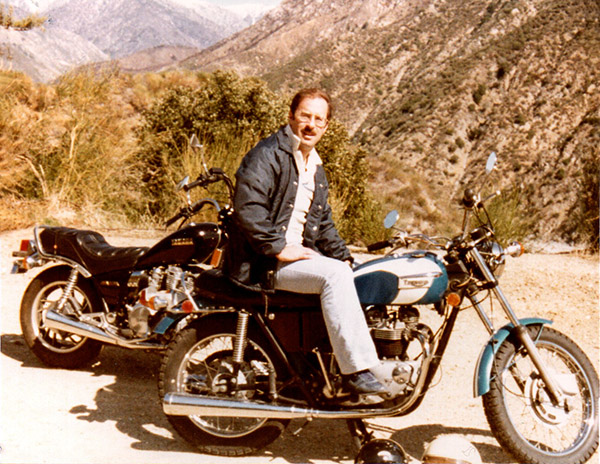
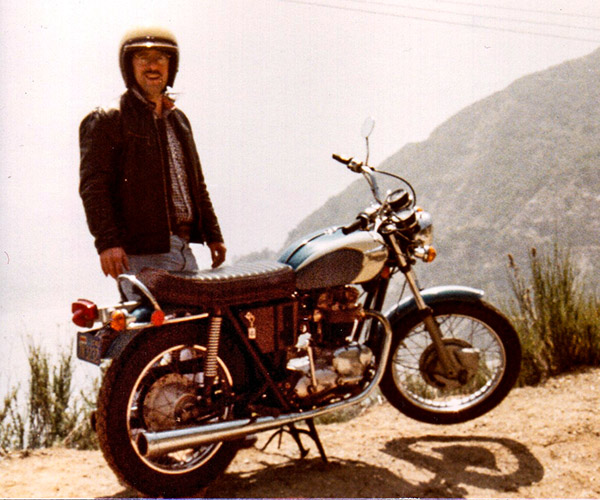
On Glendora Ridge Road on the 1972 Triumph Tiger. It was a great motorcycle.
The TR6 was a wonderful motorcycle. If there was a performance difference between it and a Bonneville, I didn’t have the asspitude to feel it. The single-carb TR6 actually felt stronger at low rpm than the Bonneville did. I loved that bike, too.
Another Glendora Ridge Road portrait. The Tiger had character, and I mean that in a good way.
The paint on the TR6 had oxidized pretty badly (the former owner kept it outside). I had this idea I would restore it (see above regarding my propensity to do dumb things when I was younger). I did a pretty good job turning the great-running TR6 into a basket case (again, see the preceding comments regarding my youthful decisions). The paint job I paid for on the fuel tank was a disaster, and then I lost interest in resurrecting the bike. I sold the basket of bits and pieces for what I had paid for the bike. I wish I still had that one.
1972 Triumph Daytona
The first motorcycle I ever went gaga over was a 1964 Triumph Tiger that a kid named Walt Skok rode to high school. In those days, the Tiger was a 500cc twin that looked a lot like a Bonneville. God, that thing was beautiful.
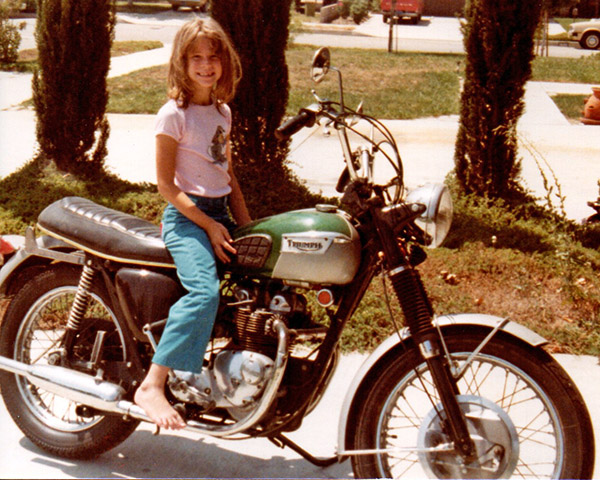
One of the neighbor kids on my 1972 Triumph Daytona, also known as the Baby Bonneville. This was another great motorcycle.
Triumph kept that 500cc twin in their line for years, ultimately adding a second carb and rechristening the bike as the Daytona. When the 650 line went to the oil-frame-configuration in the early 1970s, the Daytona (also known as the Baby Bonneville) did not; it kept the classic Triumph separate oil tank and peashooter mufflers.
I can’t remember who I bought the Daytona from (I bought it used), but I sure remember its looks. It was a deep candy metallic green with silver accents. It was bone stock and it was a wonderful ride. The handing was almost thought-directed…I could just think what I wanted the motorcycle to do and it would do it. One day, for no particular reason, I took it to the top of one of our streets that ran up into the mountains, turned it around, turned off the ignition, and started coasting downhill. I wanted to see how fast it would go with zero power (see my previous decision-making comments); the answer was exactly 70mph.
I never registered the Daytona over the three years I owned it; I just rode the snot out of it. I never got stopped or and I never had a citation for the expired plates. I can’t remember why I sold it, or who I sold it to. The Daytona was a wonderful motorcycle. I wish I still had it.
1992 Harley Heritage Softail
I didn’t keep my promise to never buy another Harley. A fried let me ride his ’89 Electra-Glide. It was a big, fat porker (the bike, not my friend), but Harley was getting a lot of press about their improved quality. I saw a blue Heritage Softail on the road one day, and I decided I need one. It was that simple.
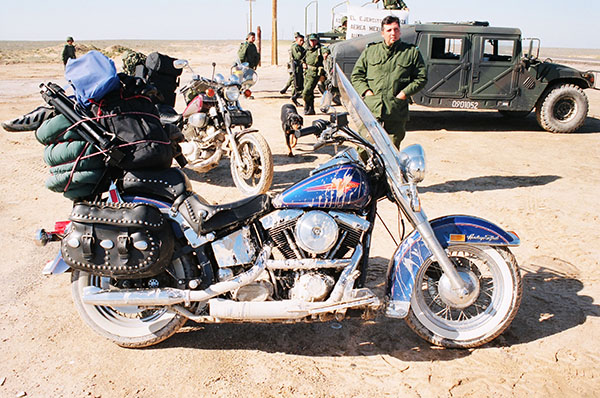
I covered a lot of territory on my 1992 Harley Softail. This shot was in the mud flats near Guerrero Negro in Baja, a trip I made with good buddy Baja John.
I put a lot of miles on my ’92 Softail, and while it lasted, it was a great motorcycle. Good buddy Baja John and I rode our bikes to Cabo, we took the ferry across the Sea of Cortez, and we rode down to Guadalajara and then back up through mainland Mexico to Nogales (you can read about that adventure here).
The Harley died on me down in Mexico on another trip, and although I had regained a tiny bit of trust in Milwaukee, the dealers were still (in my opinion) basically incompetent. When my ’92 went belly up, the dealer wouldn’t touch it because it was more than 10 years old (I can’t make this stuff up, folks), so I took it to an unencumbered independent repair shop and had it rebuilt as a real motorcycle (you can read that story here).
What kind of killed the Harley dream was me forgetting to pick up milk one day when coming home from a ride on the Harley. My wife asked about the milk. I realized I had forgot it, so I went back out to run to the store. For whatever reason, I took my KLR, and it was as if I had been set free. The KLR was just so much better, I put an ad in the local Cycle Trader the next day and sold the Harley the day after that.
While I am on this subject of Harley twins, I will tell you that I always wanted a Sportster. One day the Harley dealer had to keep my bike overnight and he lent a Sportster to me. That changed my mind in a hurry. It was gutless. I know some of my readers ride Sportsters and others ride Big Twins. Mea culpa in advance. If you’d like to tell me how great your bikes are and how I have my head up my fourth point of contact, please leave a comment, or send in a draft blog (info@exhaustnotes.us) with pics and I’ll publish your rebuttal.
1982 Yamaha XS 650
This was a lucky find, or rather, it sort of found me. I was teaching a failure analysis class at McDonnell Douglas about thirty years ago, and the first evening when I connected my laptop to the projector, a photo of the Triumph Daytona (the one described above) briefly appeared in front of the class.
“Hey, I have one of those,” one of the older engineers in the class said. I asked if he was a Triumph fanboy (as I was). He told me that he didn’t have a Triumph; he had the Yamaha that was based on it. He offered to sell it to me in front of the entire class. I hadn’t even introduced myself yet.
“Let’s talk after class,” I said.
I turns out this guy had purchased the XS 650 new, rode it very little, and it had sat in his garage for several years. I bought it for $900. I think it was a 1982 model, but I can’t say that for sure. Being a Triumph rider, I always thought it would be cool to own one of the Japanese 650 twins. You know…better reliability, no oil leaks, smoother running engines, better fit and finish, and all that.
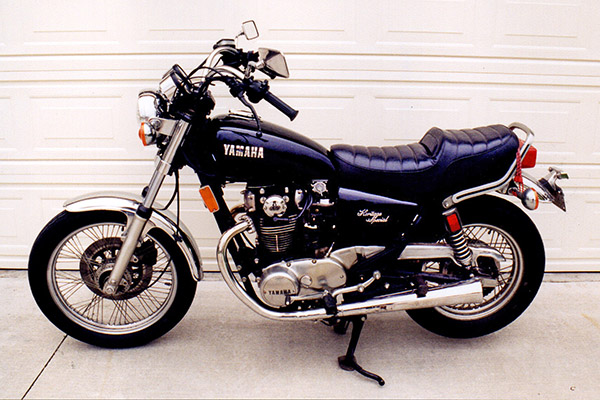
I found had a good shot (at least I think it is good) of my 1982 Yamaha XS 650 Heritage Special. To this day, I don’t know how Yamaha managed to make the bars so uncomfortable.
I didn’t keep the XS 650 long enough to assess its reliability. I did keep it and ride it long enough to find out that it had absolutely no personality, it didn’t have the bottom end torque that a Triumph did, it sounded more like George Jetson’s car than a real motorcycle (let’s see how many of you know who he was), its Phillips head screws reacted to a screw driver the same way butter reacted to a hot butterknife, and the “cruiser style” handlebars were the most uncomfortable I’d ever experienced. As you can guess, the XS 650 didn’t hang around long. I traded it in to lower the cash outlay on my TL1000S Suzuki.
1997 Suzuki TL1000S
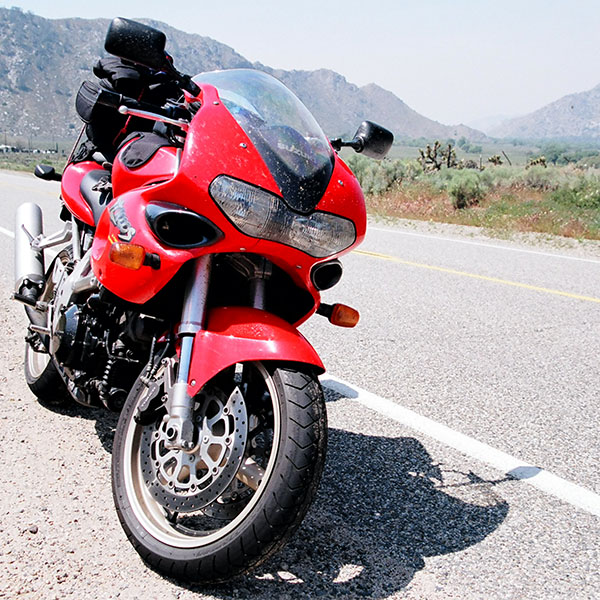
Ducati was setting the world on fire with its L-twin performance bikes, and predictably, it was only a matter of time before the Japanese attempted to do the same. Two L-Twin Japanese motorcycles emerged in 1997: Suzuki’s TL1000S and Honda’s Super Hawk (not to be confused with their Super Hawk of the mid-1960s, as shown above in this Twins story). I opted for the Suzuki variant in red. I just liked the looks of it; I felt it was a prettier motorcycle than the Honda.
The Roadmaster. This thing ate miles and speed limits voraciously. I toured a lot of Baja on it. This photo was taken somewhere in northern Baja.
The Suzuki was the fastest and hardest accelerating motorcycle I ever owned. It would lift the front wheel when shifting from second to third at over 100 mph. I dropped it twice getting in over my head, but I never really damaged the bike or myself. I used the TL as a touring bike, and I covered large parts of Baja with it. It was a fabulous machine and I wish I still had it.
2020 Royal Enfield INT
My most recent twin is the Royal Enfield 650 INT. Enfield called it the Interceptor initially (which is a much better name), but they quickly changed it to the INT (my guess is because Honda threatened to sue them, as they already had a model called the Interceptor).
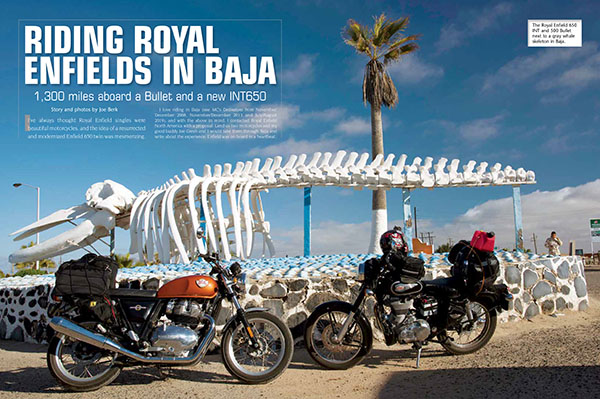
The Motorcycle Classics magazine centerfield showing the two Enfields Gresh and I used for touring Baja. It was a fun trip.
Gresh and I conned Enfield North America into loaning us two bikes (a 500cc Bullet and the new twin INT) for a comparo ride in Baja. We had a great trip, trading bikes off each day and blogging extensively about our impressions. I liked the INT so much I bought one shortly after we returned. It’s a great bike at a great price and it has all the performance I’ll ever need, both as a street bike and as a touring bike.
So there you go. I’ve owned a lot of twins. To me, a well-engineered twin makes a great street bike.
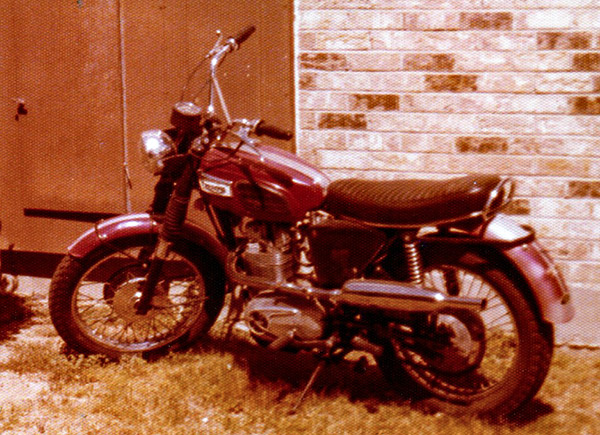
You know what? In searching for photos of my old twins, I found another single I’d forgotten all about. It was my Triumph Cub.
I never put the Cub on the street. I just rode it a bit in the fields behind my apartment building and then sold it. It was crude compared to other bikes of the era, but it was nice. It would be worth way more today than what I paid for it or what I got when I sold it.
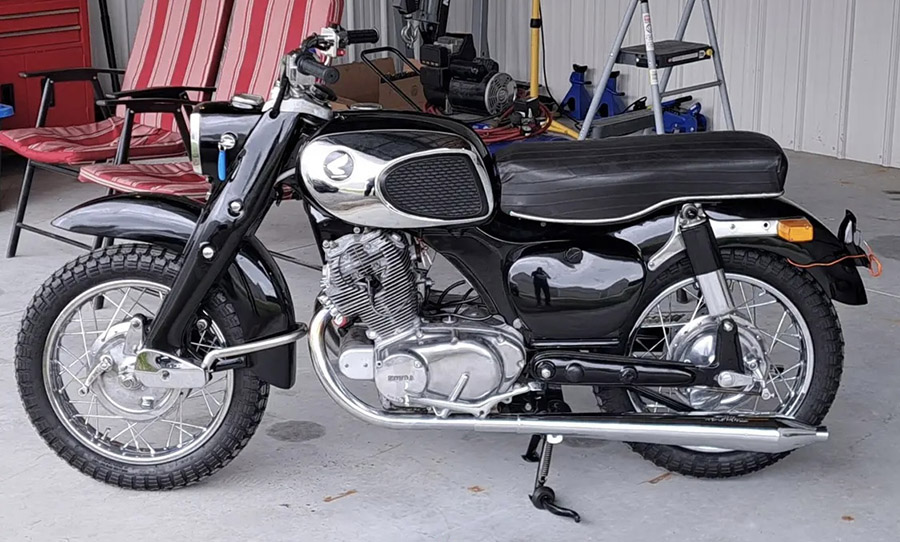
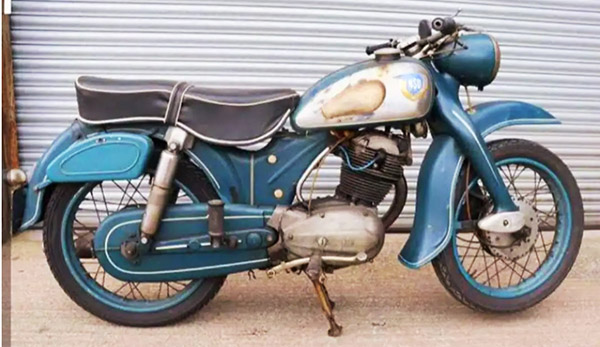
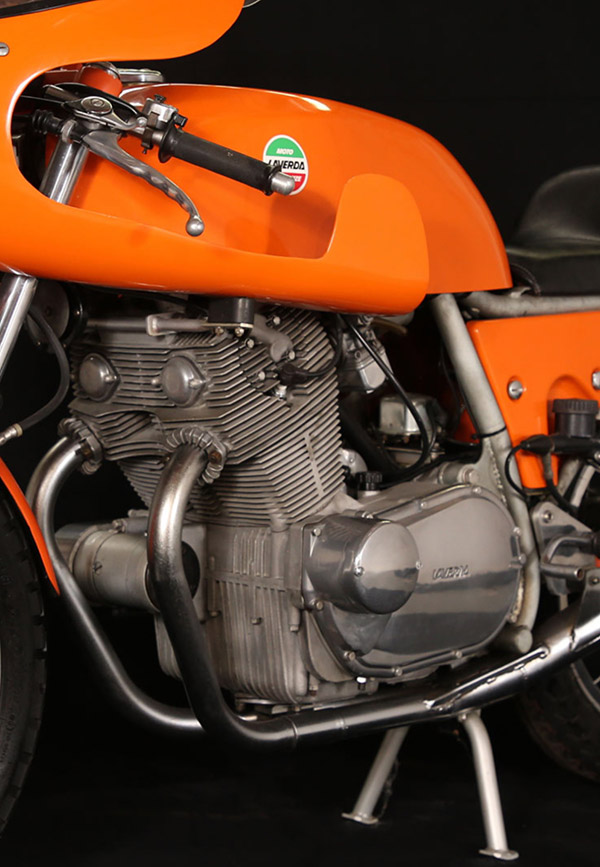
Originality is rare in the mechanical world. Designers build on other’s work. The clean sheet stays clean and so the Honda Dream was heavily influenced by German motorcycles of the 50’s. Just like Honda’s 305 inspired Laverda’s 750 of the mid-1960’s.
The Dream borrowed a lot of ideas from the German NSU.And then Laverda borrowed a lot of ideas from Honda’s 305 engine.
Of course, none of that has to do with the job at hand: getting the 1962 Dream running as cheaply as possible.
The running part was easy: you can’t kill these old Hondas. I cleaned the carb, squirted some oil in the cylinders and onto the valve train, rigged a battery and a hot wire to the ignition, stabbed the starter wire onto the positive-battery and the Honda fired right up.
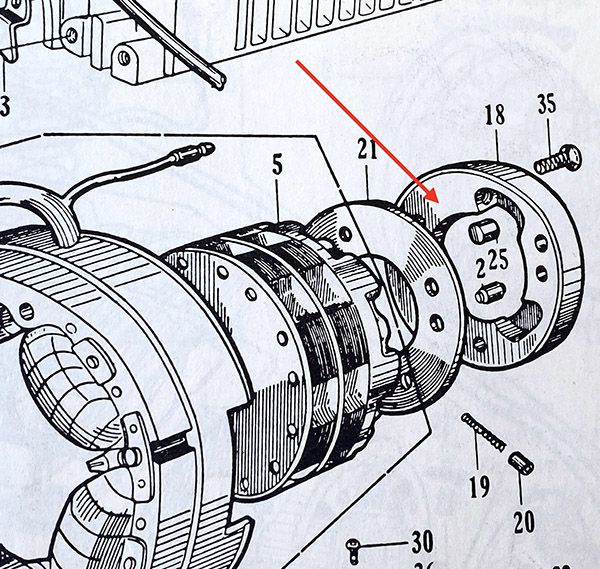
The sprag clutch (red arrow) will need some work. It skips and grabs intermittently.
Not right-right up as the electric starter’s sprag clutch is a hit and miss affair. (I’ll work on that later) once the engine turned over it ran.
Of course, clouds of smoke poured out of the tail pipes, as all that oil I squirted in the cylinder was burning off. Then the left cylinder stopped firing. I discovered the Tytronic ignition puts out a strong spark when I electrocuted myself pulling the left-side spark plug lead to confirm it wasn’t hitting.
Next I swapped leads to check the secondary of the ignition coil and the problem stayed on the left side. Since there’s only one carb, that left the spark plug. I swapped plugs and the problem moved to the right side.
The Dream came with three boxes of parts, and inside those boxes were at least eight new spark plugs. All were the wrong ones (the reach was too long). I kept digging and found a used plug with the correct reach but a different part number. Regardless, I screwed the thing in and the Honda ran on both cylinders.
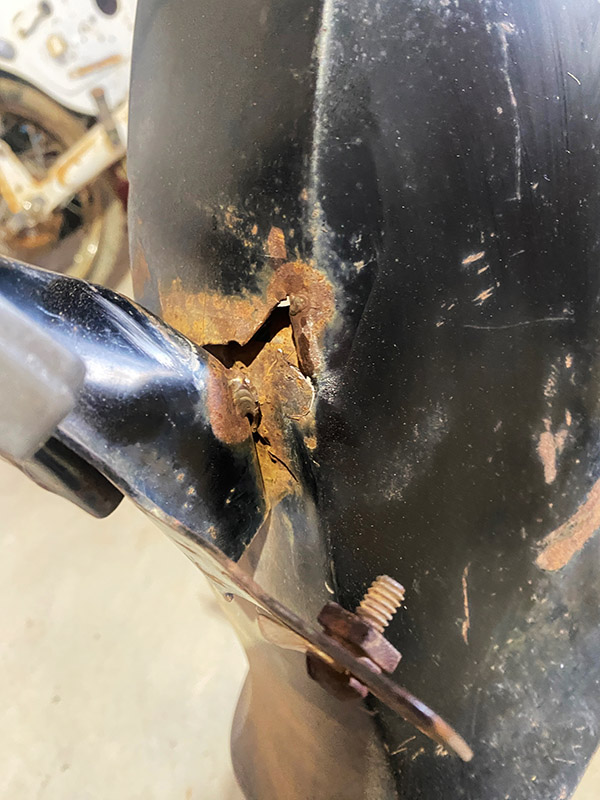
The rear fender is kind of a mess.
I shifted the gearbox through its four speeds. The countershaft rotation speed increased with each up shift. I didn’t hear any untoward noises except for the taillight. At some point the taillight cracked the rear fender. Someone, probably an engineer, welded the light to a back plate and then to the fender. Which should have been fine. It wasn’t. The welds broke and the taillight rattled like a loose roofing panel.
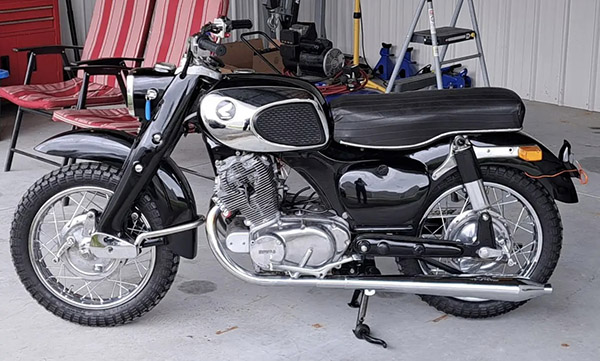
I like the way the Dream looks with the fenders shaved. (Photo from internet, I don’t know who took it.)
A hacksaw remedied the taillight situation. I ran the Honda until it quit smoking. The bike kept running better the longer it ran. I have something to work with, baby. Now I can move on to the running gear.
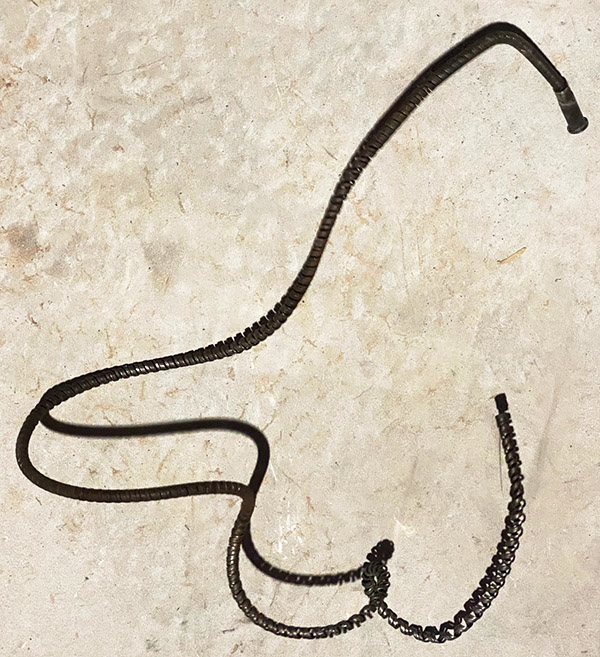
The old speedo cable took a beating.
Unfortunately, my budget-build took a setback with the speedometer cable. The cable stuck in the housing and twisted the end off near the wheel side. Fiscally, I was going to fix it. The dried grey plastic around the housing flaked off easily. I managed to get the cable out and since the speedo cable was a bit long I figured to shorten it by a 1/2-inch and re-crimp the drive tang and end piece. For the plastic cover I was going to use black, heat shrink tubing.
All was going well. I decided to wire wheel the rust on the cable housing. Long-time wire-wheelers will be able to predict what came next. I must have momentarily relaxed my grip on the housing. The wheel grabbed the housing and wound it around the grinder shaft. The loose end flailed like a weed whacker string. I was lucky to escape un-whacked. The worst part is I kind of knew it was going to happen but I kept going anyway.
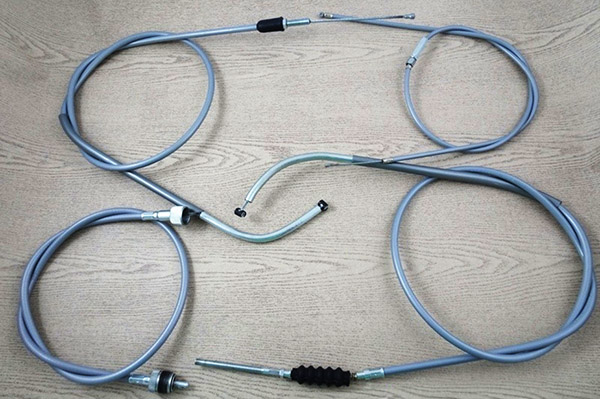
Four cables for $100! Such a deal!
A new speedometer cable was around $50 on eBay. Or, I can get a complete set of speedometer, clutch, throttle and front brake cables for $100. My budget swelled with excitement. At least I won’t have to watch those other three cables wind around the wire wheel.
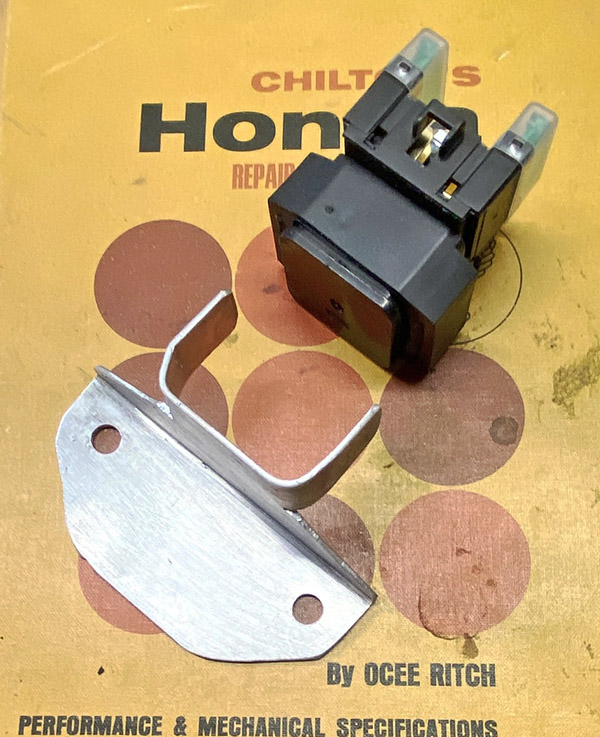
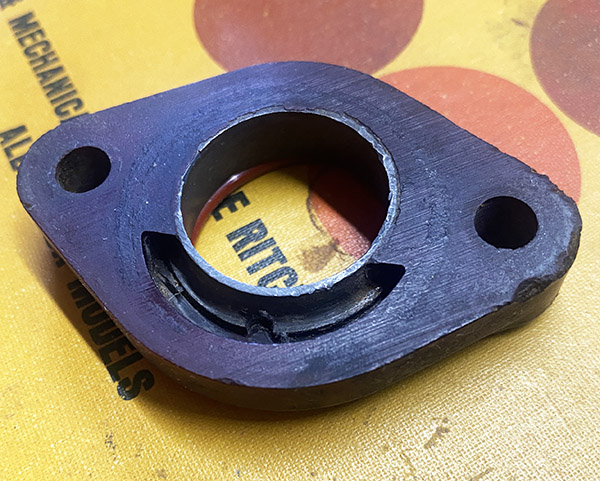
I’m using a generic starter relay. These are cheap and available. I’ll need to make a bracket to mount the thing to my bike.Interesting duct work on the 305’s phenolic carb spacer
Then came a bridge rectifier, a starter solenoid, a chain, some o-rings, and new spark plugs. When the stuff shows up I’ll have more work to do.
Still on the list is tires and tubes, a seat cover, cleaning out the gas tank liner crap, and all the wiring. The plan now is to get the bike operational and ride it around a bit to see if it’s worth messing with further.
For Where You in ’62 Parts 1 and 2, as well as earlier Joe Gresh Resurrections, click here.




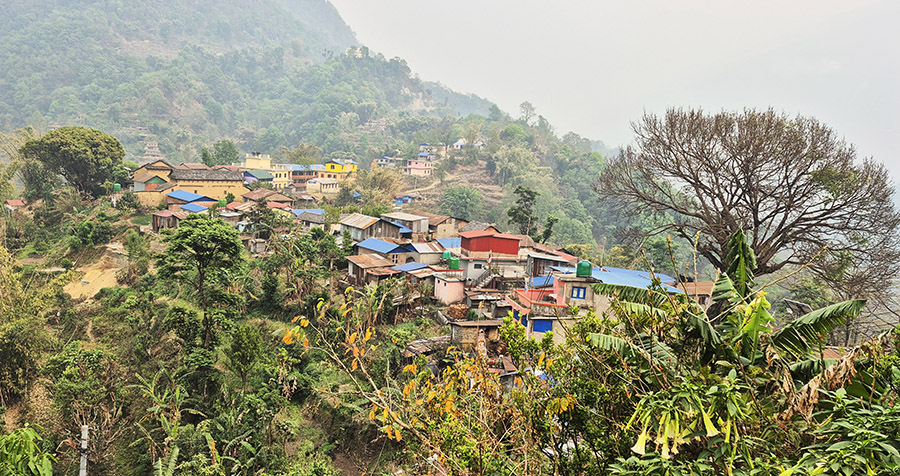
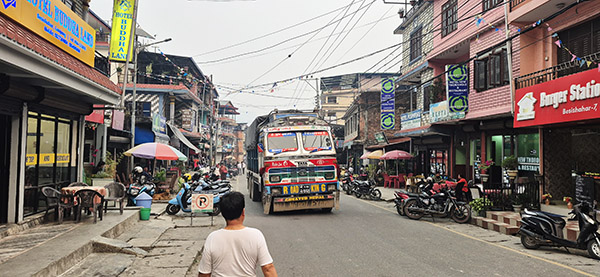 Upon returning to Katmandu my tour operator Kiran met me at the hotel with a new itinerary. One that would lift my spirits for sure. There was another trek I was contemplating, The Annapurna Circuit. It was a 17-day trek which was more remote than the Everest one. This would now replace the Everest Base Camp Trek. Kiran then added that upon completing the Annapurna Circuit I would helicopter from Katmandu to Lukla as rotary winged aircraft had much less restrictions in terms of visibility. All in all this would fill up a month and a half and allow me to hopefully complete both objectives (Annapurna and Everest Base Camp).