The year was 1974. I had just finished grad school and I was at Fort Bliss, Texas, for the Basic Course and the Chaparral/Vulcan Course, which is to say I was there for another five months of school before heading overseas. There was no such thing as Gunbroker.com yet…in fact, there wasn’t a dotcom anything yet…this was all well before the Internet. But we had The Shotgun News, a print publication that served much the same purpose. I studied that newspaper like a Democrat looking for something new to tax.
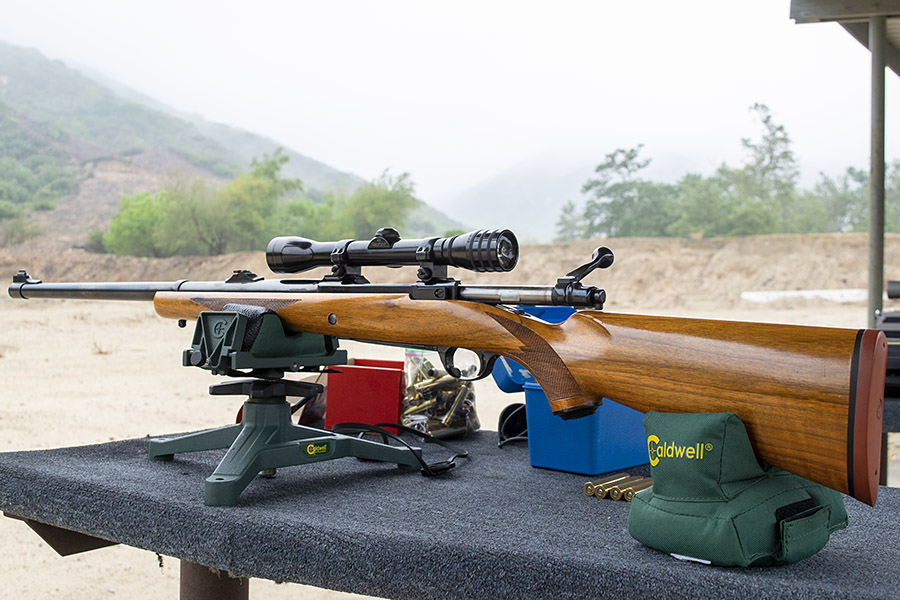
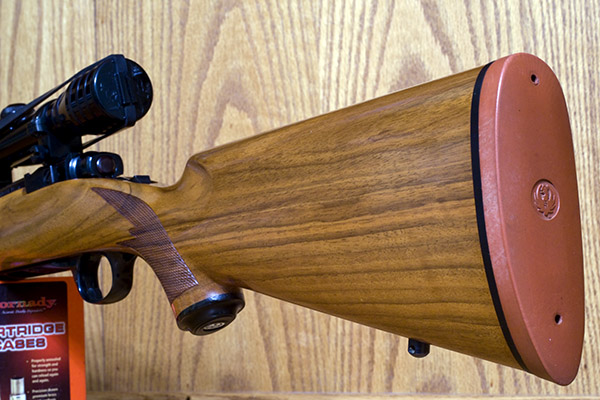
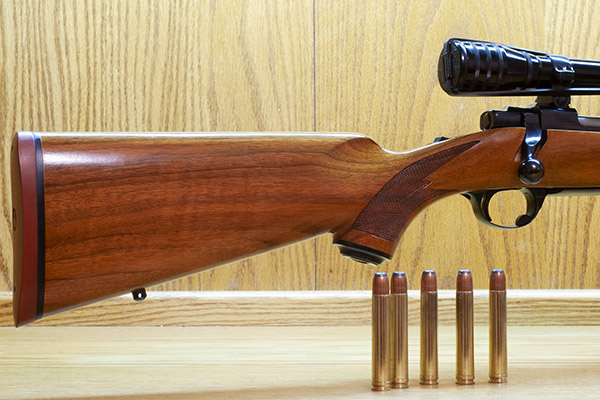
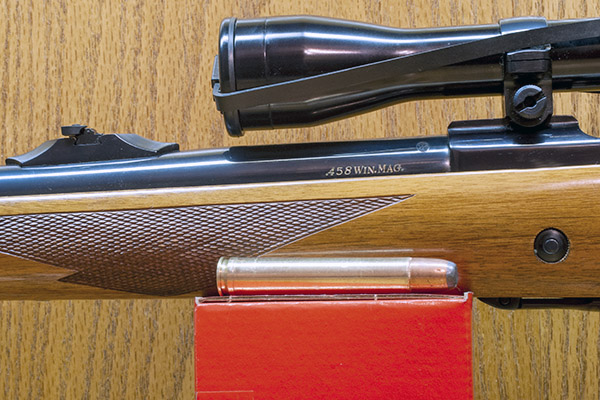
Ruger did a very limited run of their Model 77 in .458 Winchester Magnum back in the early 1970s, and within that limited run, they did a few with Circassian walnut. I might be wrong, but I think this was the first limited production anything Ruger did with Circassian walnut. I read the ad and I immediately knew I had to have one.
Man, I was hooked. I needed a .458 Mag elephant gun. My Army gun was a 20mm Vulcan, and by comparison, the .458 didn’t seem so big. The rifle was $340 from J&G Rifles in Prescott, Arizona (an outfit that I think still exists), and in those days it was as easy as picking up the phone, sending a check, and having them ship the rifle to a local dealer. The amount seems laughably low today, but $340 was a big nut back in 1974. I borrowed the money from my sister and the rifle was on its way to Barney’s Guns out in the west Texas town of El Paso. God bless Marty Robbins and all that is west Texas. I loved it out there.
Not knowing too much about hunting elephants, I bought three boxes of .458 factory ammo with predictable results: Today, nearly 50 years later, I still have most of that factory ammo in its original yellow Winchester boxes. You see, there weren’t too many elephants in El Paso, and that ammo redefined recoil for me. Just a few rounds of the 500-grain, 2100 feet per second factory fodder convinced me there had to be a better way, and there was. I’ve loaded literally thousands of rounds in .458 Win Mag over the last 50 years, virtually all of it at .45-70 levels. It’s actually a nice shooting rifle when you drop it from “elephant” to “buffalo” on the energy meter. And that’s still plenty potent. People used to kill buffalo with 400-grain pills at 1200 feet per second (they killed nearly all of them, actually).
I picked up a Redfield straight 4-power scope that is still putting the crosshairs where I want the bullets go (I think it was something like $30 at one of the K-Marts in El Paso). Not surprisingly, the Circassian .458 is very accurate with both jacketed and cast bullets. It can easily put five rounds into an inch at 100 yards.
Every once in a while I’ll go on a tear experimenting with new loads, and I suppose when I exhaust my supply of 405-grain Remington jacketed softpoint bullets and SR 4759 propellant I’ll get serious about that, but for now I have a good stash of the Remington bullets and SR 4759. I’ll probably still be working my way through that stash when I ride off into the sunset. And when I enter the Happy Hunting Grounds, I’ll rub elbows with Karamojo Bell, Frederick Courtney Selous, Peter Capstick, and others who chased elephants in Africa and we can compare notes.
My buddies and I hunted jack rabbits out in the desert east of El Paso near Fabens, and I had a lot of fun with the .458. Yeah, it was massive overkill. But some of those jacks were big, man. Not that I needed a .458 Winchester Magnum elephant gun. But who buys these things because they need them?
When you’re a reloader you get a bunch of odds and ends components and you go on a jag to load them all just to get the stuff off the bench. Oddball bullet dribs and drabs, brass you don’t want to bother cleaning, trimming, or sorting, that sort of thing. I had a bunch of the above laying around crying out to become .223 ammo, I hadn’t been to the range with my Mini 14, and it was time to shoot up the leftovers.
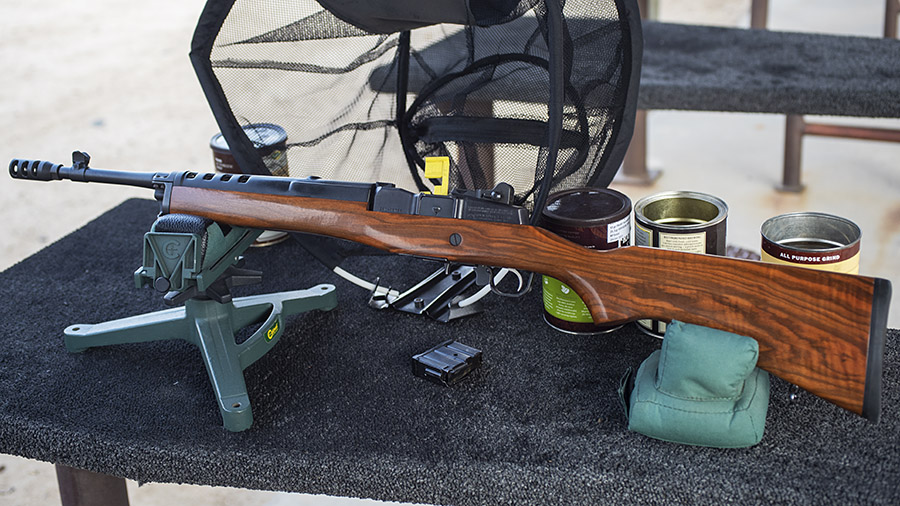
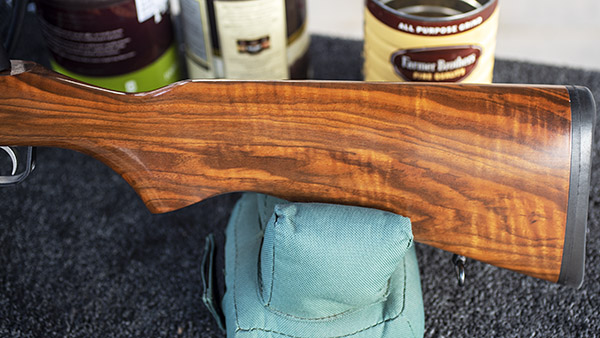
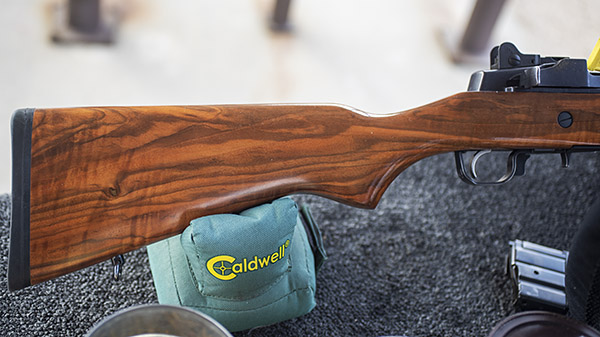
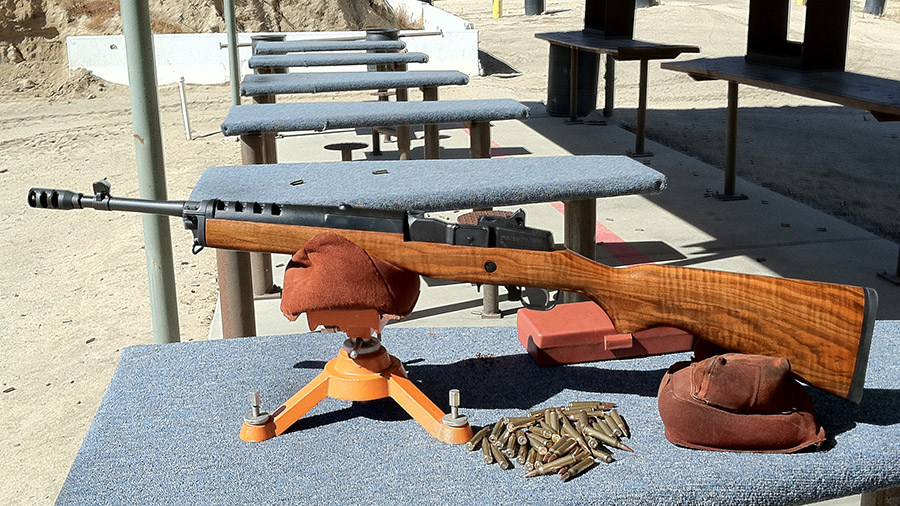
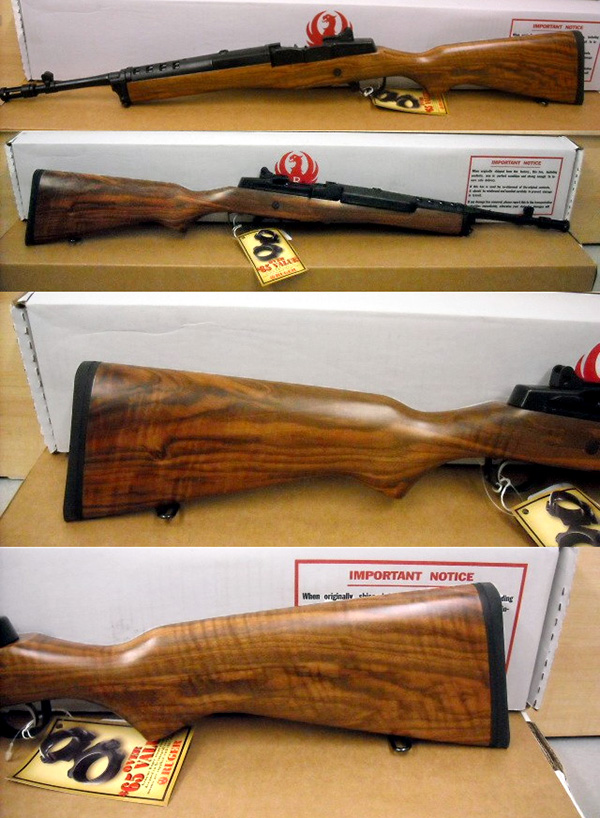
First, a bit about the rifle. It’s what Davidson’s called the Mini 14 Tactical, and it was a limited run they had Ruger make with Circassian walnut stocks. I looked at a bunch of them on Gunbroker before I spotted the one you see here and I pounced (most had very plain walnut).
An unusual Mini 14 with a Circassian stock. I get a lot of compliments on this rifle. It’s not for sale.
This is a rifle that gets compliments every time I bring it to the range. I’ve written about my Mini 14 before here on the ExNotes blog and I know what it takes to make this puppy group. This wasn’t going to be one of those days; like I said, I was just using up remnants from reloading sessions for other rifles.
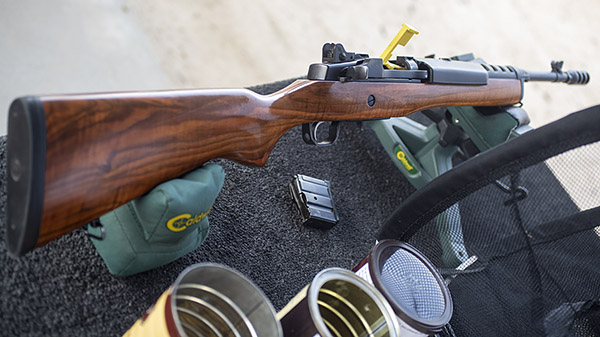
The left side of the Mini 14’s Circassian walnut stock.The right side. This sure is a nice-looking Mini 14.
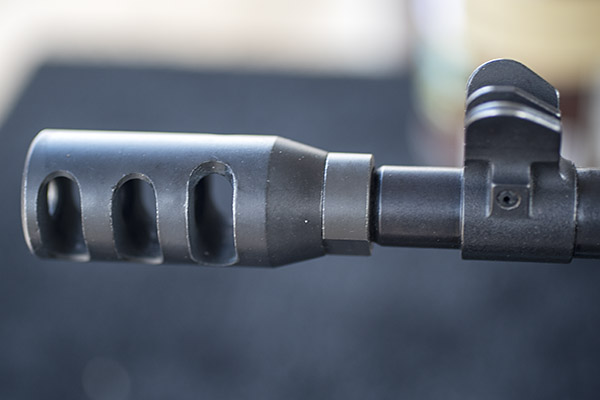
The Davidson’s Mini 14s came with 30-round mags and a flush suppressor, both of which are apparently favored by folks who rob gas stations and convenience stores (our legislators have their heads so far up their fourth points of contact they haven’t seen daylight in decades). I replaced the flash suppressor with a muzzle brake to make the rifle much less intimidating.
You might laugh at a muzzle brake on a Mini 14. It works, though. Fire a Mini 14 with a muzzle brake and then fire one without and you’ll feel the difference.
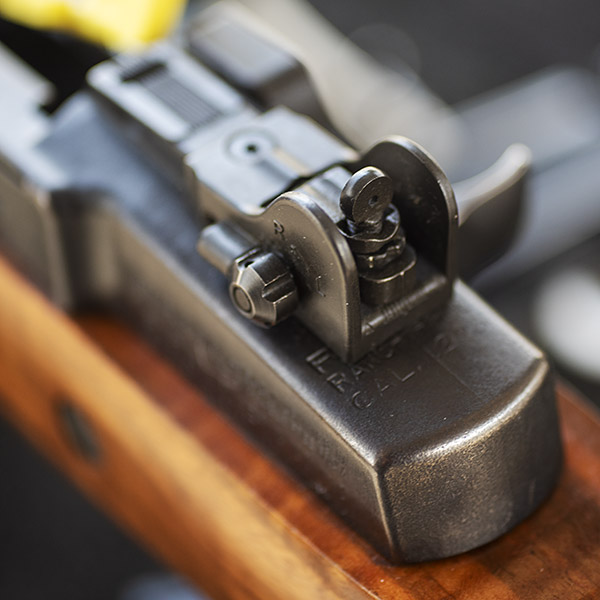
I also installed the Tech Sights Mini 14 rear aperture sight, which I like a lot better than the standard Mini 14 rear sight.
The Tech Sights rear aperture sight. If you have a Mini 14 and you don’t have one of these, you’re missing the boat.
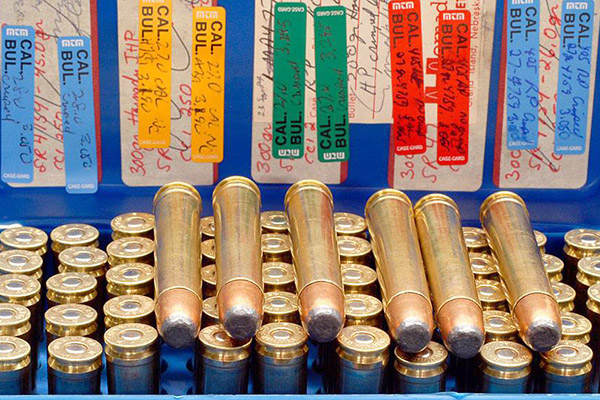
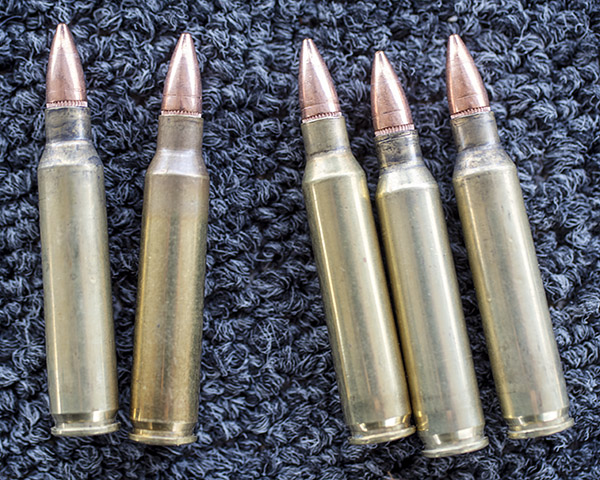
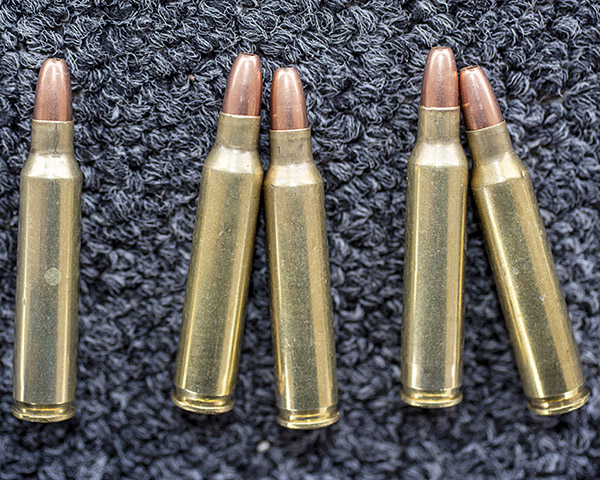
I loaded three configurations of ammo. The first was a new load I had developed using XBR 8208 propellant. For reasons I can’t remember, I had a bunch of Hornady 55-grain full metal jacket bullets I had pulled from another load. If you look closely at the photo below, you’ll see the circumferential ring where the collet puller grabbed the bullets. My thought was that pulled bullets would degrade accuracy, which is why they were tucked away and ignored for a long time. The load was 25.3 grains of XBR 8208, mixed brass previously fired in the Mini 14 (neck sized only for this load), and Winchester small rifle primers. I seated the bullets about midway in the cannelure, but I didn’t crimp. For this load, I didn’t tumble or trim the brass, either.
55-grain bullets loaded in .223 Remington brass for the Mini 14. Note the circumferential bullet puller collet marks just above the cannelure.
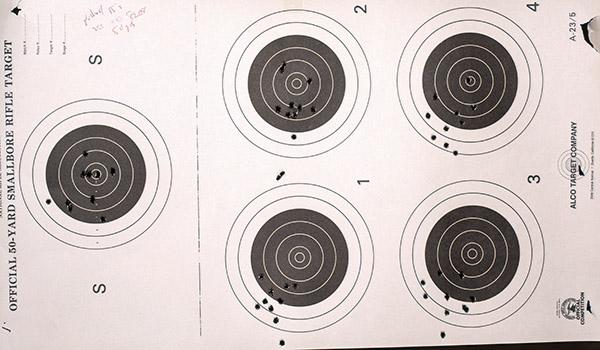
Surprisingly, the above load shot relatively well. If the marks on the bullets affected accuracy I couldn’t see it. I shot a few 10-shot groups at 50 yards just to get into the swing of things, and then I fired a 10-shot group at 100 yards (which I’ll get to at the end of this blog). The 10-shot group at 100 yards wasn’t too shabby. The rifle shot low left (my aim point was at 6:00), but I hadn’t adjusted the sights for this load.
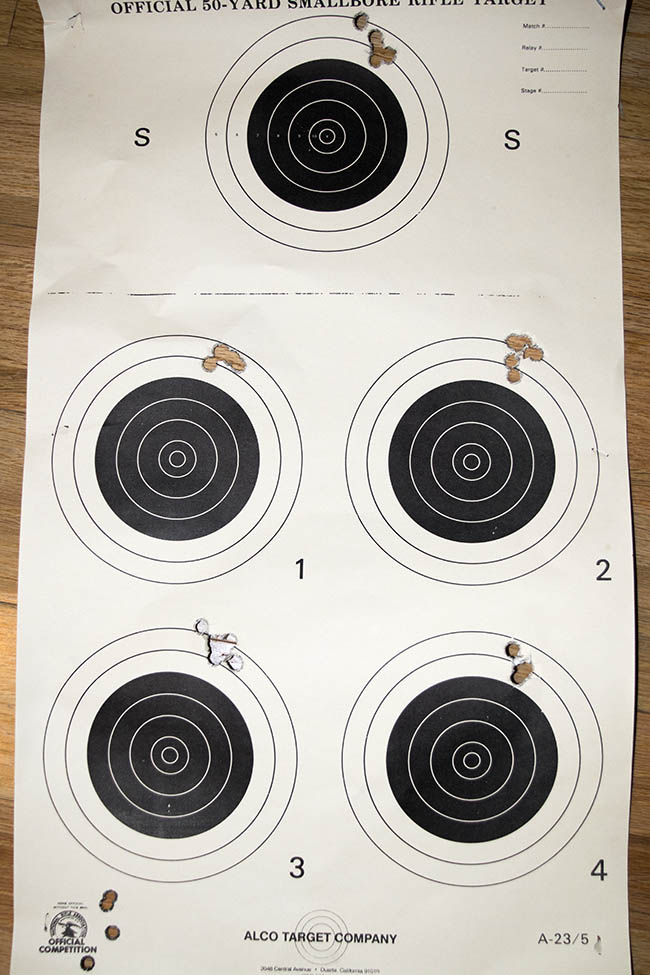
50-yard groups with the above load. The flyers are do to operator error. The groups showed promise at 50 yards, and I knew I would test them at 100 yards.
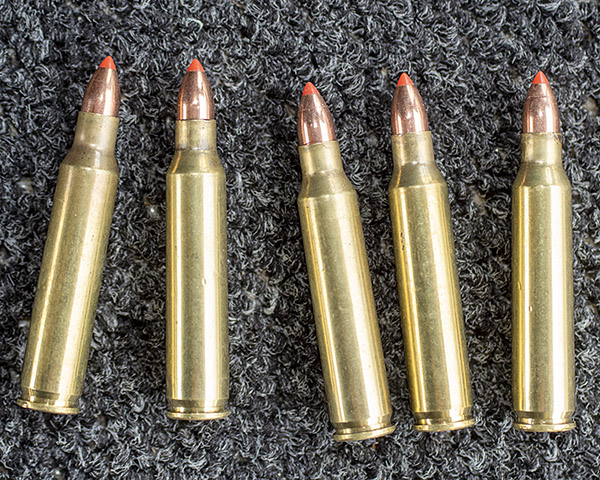
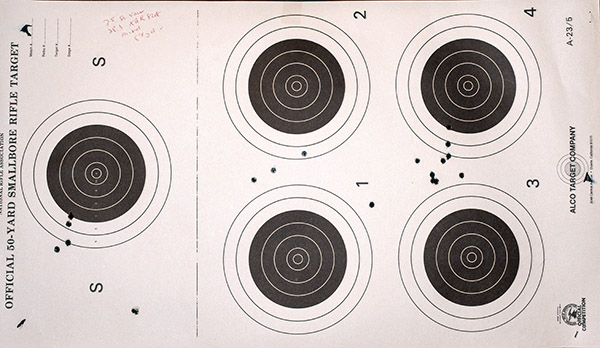
For the next load, I had a few 35-grain Hornady V-Max bullets I normally use for my .22 Hornet. This is a bullet I guessed would not do well in the much-higher-velocity .223 Remington cartridge, and I was right. Some of them grouped okay at 50 yards, but they were right on the edge of instability. A few tumbled and went wide. I didn’t bother firing these at 100 yards; if they were flaky at 50 yards, they would be positively flaky at 100.
.223 Remington cartrdiges loaded with 35-grain Hornady VMax Hornet bullets. The ammo looks good, but it was not a good load for the Mini 14.The 35-grain VMax loads at 50 yards. The bullets were right on the stability threshold.
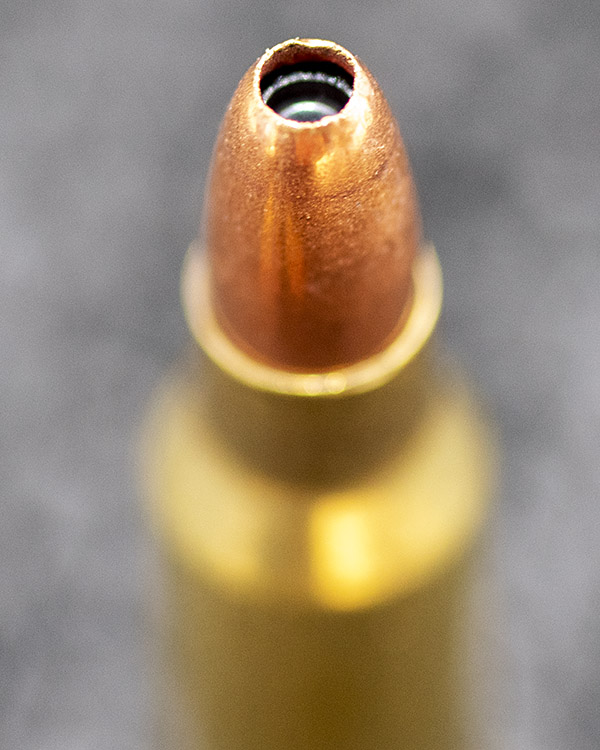
The last group was one I put together using another set of leftover Hornet bullets, the 46-grain Winchester jacketed hollow point bullet. They shot poorly when I tested them in my Ruger No. 3 Hornet, and they were really terrible in the .223 Mini 14. I suspect they were breaking up in flight. Several went wide or through the target sideways.
46-grain Winchester hollowpoint jacketed bullets loaded in .223 brass. This didn’t work out at all.A huge hollowpoint. It might work well on prairie dogs in the .22 Hornet, but these bullets weren’t stable and didn’t group well in the .223 Remington cartridge.
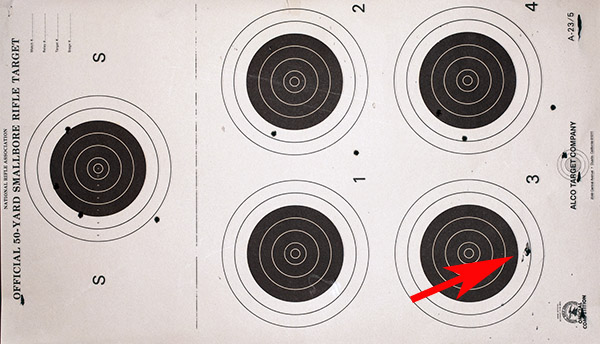
The 46-grain Winchester groups were huge at 50 yards and I could see on the target that they were unstable. At least one tumbled. Some never even made it to the target.
The above load’s poor performance was predictable, but I’m one of those guys who has to pee on the electric fence. You know, just to make sure. The arrow points to a spot where a bullet went through the target sideways.
After testing the above bullets at 50 yards, I knew that the Hornet bullets were a no go. Actually, I kind of knew that before I tested the load. But I had the bullets and I thought I would give it a try.
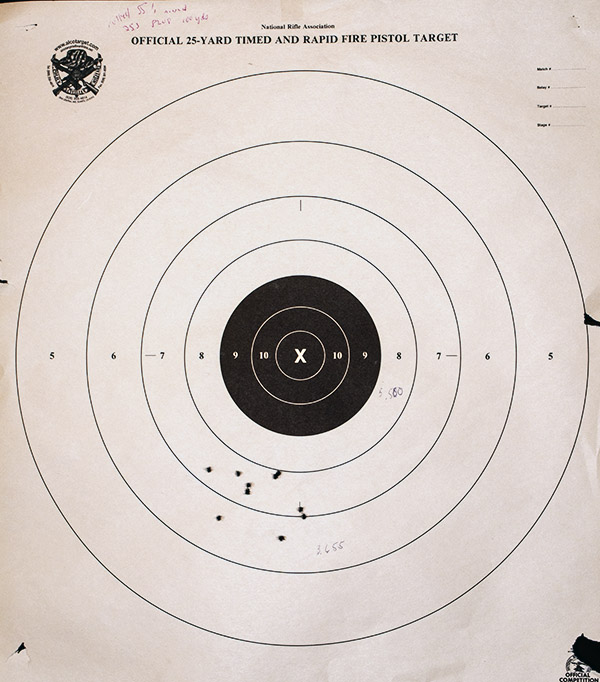
I wanted to see how the pulled 55-grain Hornady bullets would do at 100 yards, so I moved a target out to 100 yards they did relatively. The group centroid shifted from my usual Mini 14 load, but it was fairly tight for iron sights with junk/untrimmed mixed brass.
55-grain full metal jacket boattail pulled Hornady bullets, 25.3 grains of XBR 8208 propellant, Winchester small rifle primers, and mixed brass provided a 3.65-inch 10-shot group at 100 yards. The black bullseye is 5.50 inches in diameter. I was pleased with these results.
Well, you live and you learn. I cleaned off the reloading bench, I had a little fun, and I now know from personal experience that 35-grain and 46-grain Hornet bullets won’t do very well in the .223. Sometimes it’s good to learn what doesn’t work as well as what does.
More guns and reloading content? Like fancy walnut? Hey, it’s all right here!
You can’t beat free…sign up here and never miss an ExNotes blog.
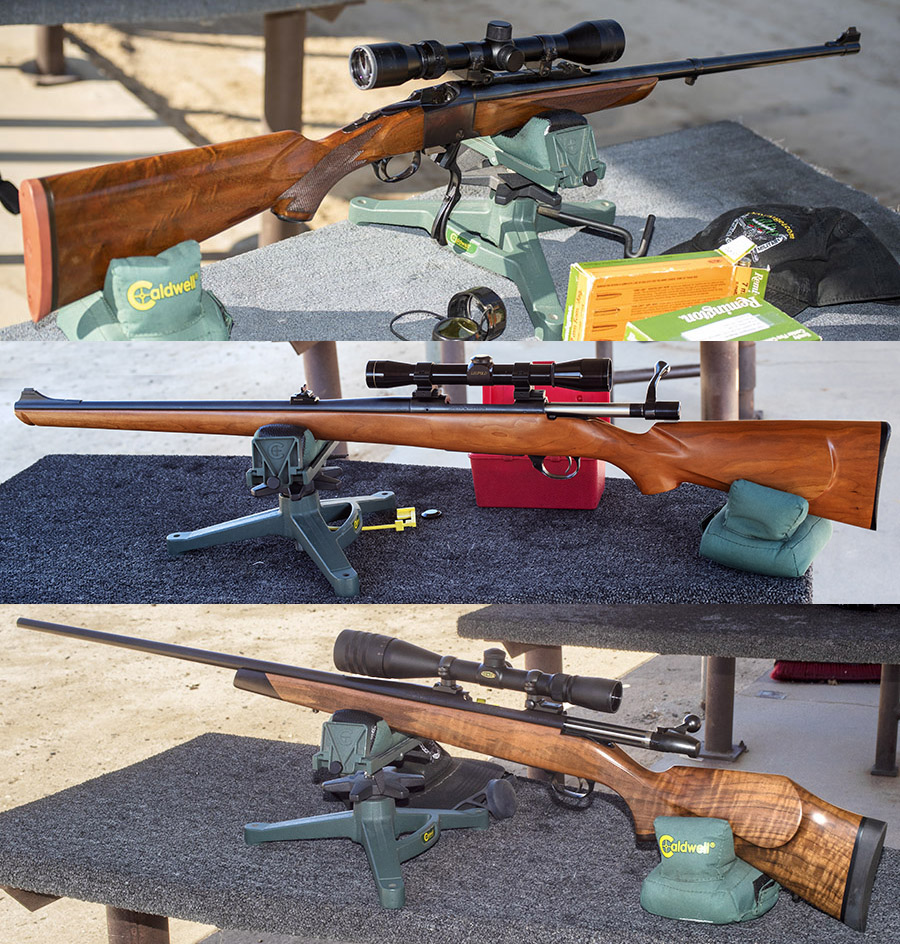
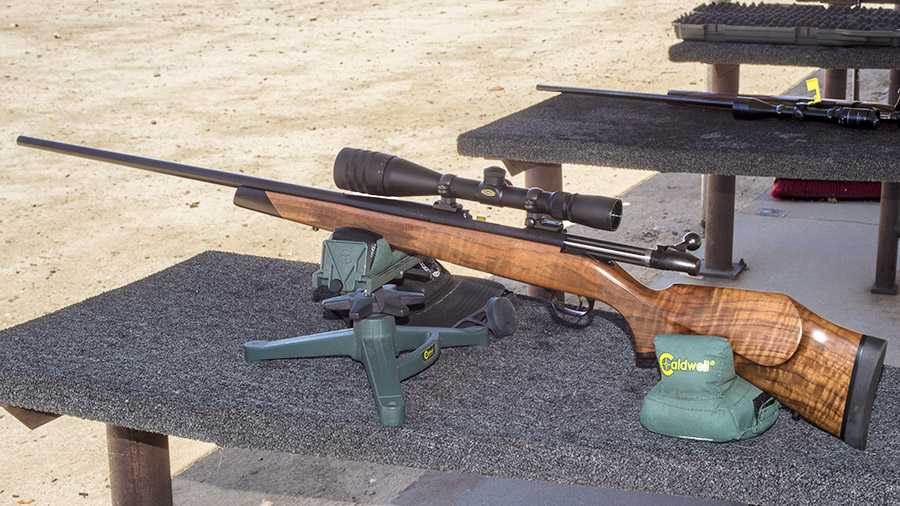
I always liked that “kinder, gentler” line from George Bush. We don’t do politics here at ExNotes (we’d lose half our readers no matter which way we leaned), but every once in a while I’ll borrow a phrase if it fits. So, you’re looking at the big photo above showing a 300 Weatherby Magnum, a 7mm Remington Magnum Ruger No. 1, and a custom Howa 30 06, and you’re probably wondering: What is kinder and gentler about shooting those T-Rex cannons?
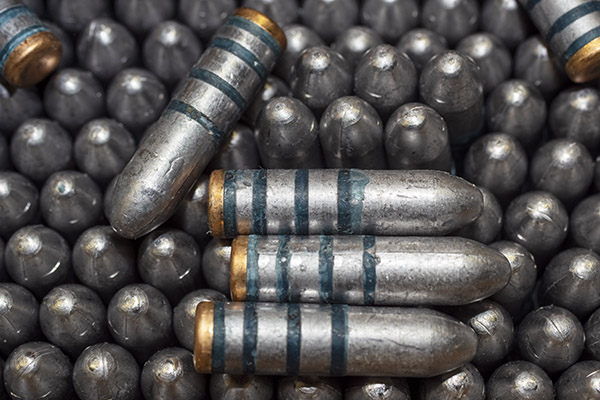
Cast bullets, that’s what. I started shooting cast bullets back in the 1970s in El Paso and I’ve been hooked on them ever since. I don’t cast my own these days (it’s easier to buy them), but I still enjoy the benefits. Lower cost, exclusivity (far fewer folks shoot cast bullet rifle loads), long brass life, easier cleaning, and the big one: Lower recoil.
That last one, reduced recoil, figures prominently in my mind. I’ve been beating myself up lately shooting full bore .300 Weatherby cartridges and it’s been tough. I have a box of 180-grain cast .308 bullets and I have a bottle of Trail Boss propellant and that got me to thinking: Would cast bullets work in the .300 Weatherby?
Help us keep the lights on…click on those popup ads!
I checked the Lyman manuals and there are cast loads listed for .300 Weatherby. I checked the Trail Boss site and it lists .300 Weatherby cast loads, too. Hmmm. I wondered how good it could be. After all, you could fit the Hollywood Bowl inside a .300 Weatherby cartridge case. There’s a lot of space in there, and not occupying it usually hurts accuracy. With jacketed bullets, the .300 Weatherby usually delivers its best accuracy at max or near-max loads. Would all that volume and the much lighter charges associated with cast bullets make an accurate load?
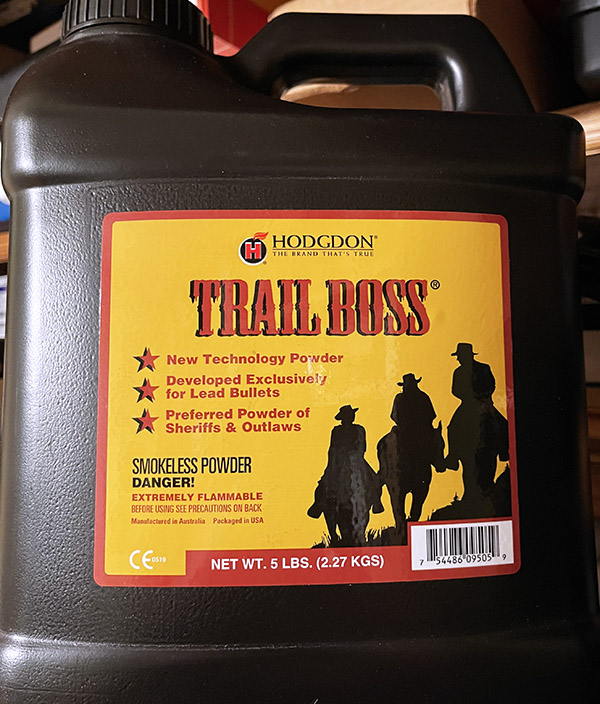
Trail Boss propellant. It’s shaped like flattened Cheerios and it’s a light, fluffy powder. It’s good stuff.
There’s one powder designed for cast bullet shooting that hits the cartridge case volume issue head on, and that’s Trail Boss. The Trail Boss people tell you to fill the case to the base of the bullet and that’s your max load, and if you take 70% of that, you’ll have your minimum load. My Weatherby brass took 31.3 grains of Trail Boss, but that was in a fired, unresized case, so I figured 30.0 grains would make for a good max load. 70% of that is 21.0 grains. Then I checked the Hodgdon site (they’re the folks who make Trail Boss) and it showed a range of 19.0 to 27.5 grains. That’s close enough for government work…my lower end load would be 21.5 grains, and then I’d try a warmer load with 24.5 grains. You know, to get a feel for what the Weatherby Mark V preferred. So I loaded a few rounds early one morning and I was ready to test the Mark V with cast bullets.
The .308 180-grain cast bullets I used in both the .30 06 and the .300 Weatherby. They were sized to .309..300 Weatherby ammo loaded with the above 180-grain cast bullets.
I already had a bunch of 7mm Remington Magnum reloads with Gardner’s 145-grain cast bullets. I had three boxes: One with 18.0 grains of Trail Boss, one with 20.0 grains, and a third with 21.4 grains. My prior reloading adventures with the 7mm Remington Magnum in my Ruger No. 1 indicated that it liked Trail Boss, but I didn’t know what the right dose would be.
Gardner’s 145-grain 7mm cast bullets.7mm Remington Mag ammo with cast bullets seated to different depths, with and without crimping.
I also had a box of .30 06 ammo loaded with cast bullets. I loaded these with SR 4759 powder, a stellar cast bullet propellant. I grabbed that box and my custom Howa.
I stocked this rifle with a Bishop cherry stock about 35 years ago. It’s one of my favorite rifles. There’s a blog on it here.I wanted to try my hand at a Mannlicher style, full length stock. I carved it to match the Alex Henry fore end tip on a Ruger No. 1. It’s a unique rifle that always gets noticed on the range.Howa sold barreled actions to Smith and Wesson when Smith wanted to play in the rifle business maybe 40 years ago. They no longer are..30 06 ammo loaded with 180-grain cast bullets and SR 4759 propellant.A comparison: .30 06, 7mm Remington Magnum, and .300 Weatherby ammunition, all loaded with cast bullets. It’s cool-looking ammo.
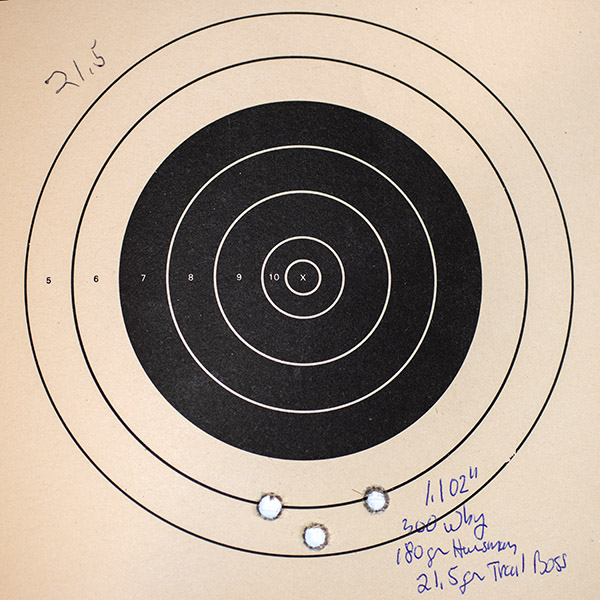
So how did the cast bullet rifle session go? Surprisingly well. I shot the Weatherby first, as it was the rifle that had prompted the cast bullet theme. The recoil level was low, almost like shooting a .38 Special. That was a welcome relief from the factory-level loads I had been shooting. The .300 Weatherby Mark V printed its best 50-yard group at 1.102 inches (a three-shot group), and that was with 21.5 grains of Trail Boss.
Shooting cast bullets in the .300 Weatherby was a pleasant experience. I could do this all day.
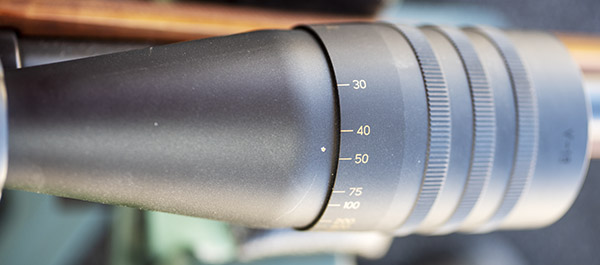
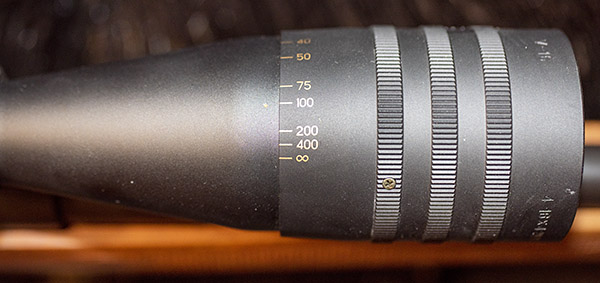
Because I was shooting at 50 yards, I needed to readjust the parallax on the Mark V’s 4-16 Weaver scope. When I did this at 100 yards, the parallax adjustment was right where Weaver had marked it for 100 yards. At 50 yards, the Weaver marking on the scope’s objective was a bit off, but that’s okay. I could move my eye around behind the scope and the crosshair movement had been appropriately minimized.
At 50 yards, the parallax adjustment was at about the 46-yard mark. I took this photo so I could return to this spot on subsequent 50-yard shooting sessions.
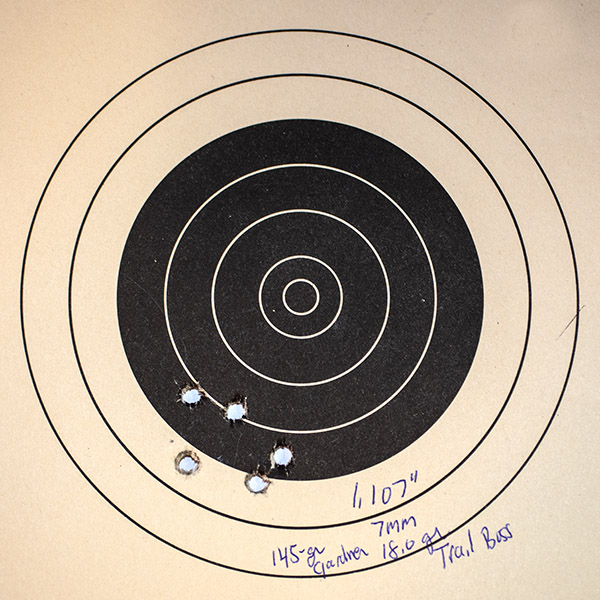
The Ruger No. 1 in 7mm Remington Magnum printed a 1.107-inch five-shot group at 50 yards with 18.0 grains of Trail Boss.
The Ruger No. 1 shot well with Trail Boss and cast bullets. I have more loaded with a slightly lighter load (not because of recoil, but because it appears the gun will do better with a lighter load).
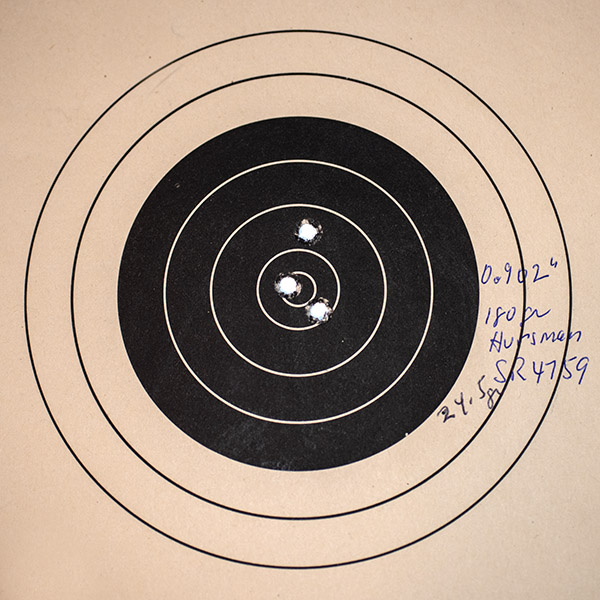
And my .30 06 Howa did the best of the three, with a 0.902-inch three-shot group at 50 yards. I loaded that ammo with 24.5 grains of SR 4759. I’ve always had good accuracy with SR 4759 when shooting cast bullets.
The .30 06 group. These were with SR 4759 powder; I’ll next test with Trail Boss.
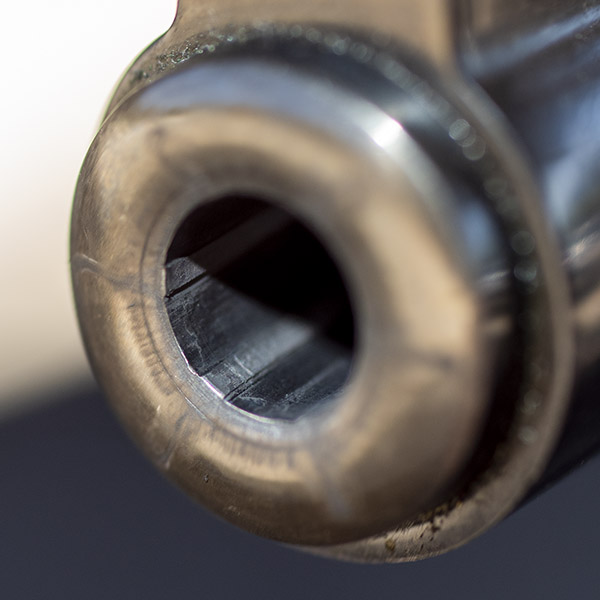
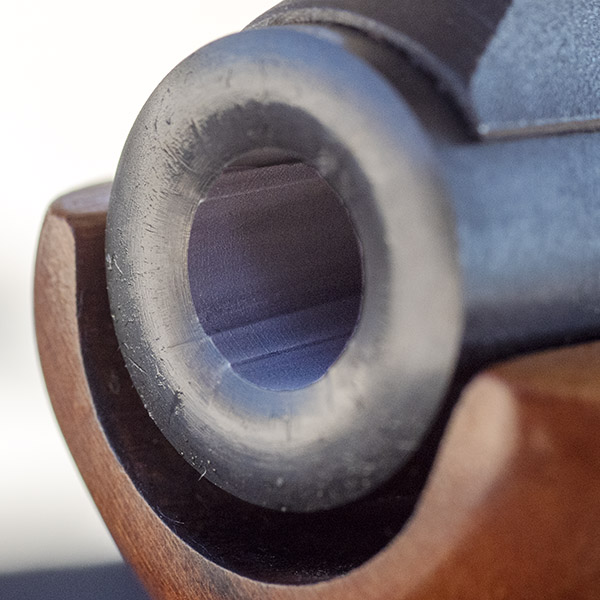
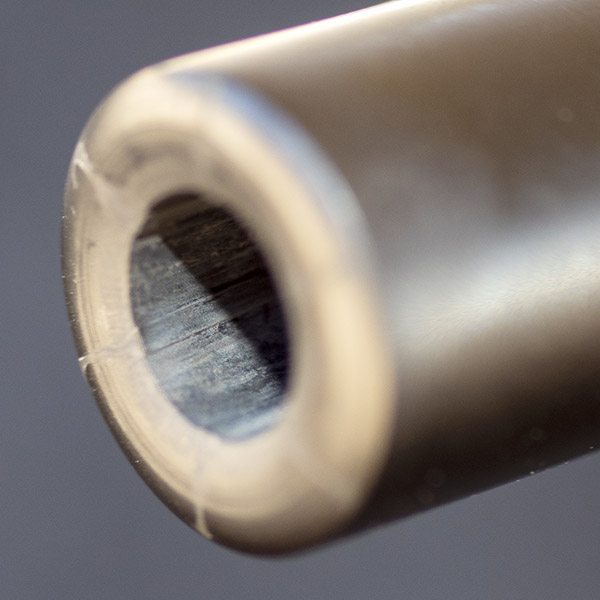
None of the cast bullet loads leaded the barrels, and that’s a good thing. Take a look (all of these photos were after shooting, but before cleaning):
The 7mm Ruger No. 1 bore after firing cast bullet loads. The bore was surprisingly clean with almost no leading.The Howa’s bore after firing a box of cast bullets. This bore was immaculate. It appears the machining on it was better than the Weatherby and the Ruger rifles.The Weatherby Mark V’s bore after firing cast bullets. There’s a very tiny bit of leading, but nothing significant. It cleaned up easily.
Cleaning a rifle after shooting cast bullets is much easier than cleaning after shooting jacketed bullets. I run a patch soaked with Hoppes through the bore and let it set for maybe 15 minutes to soften any lead remnants and combustion residue. After that I run a bronze bore brush through the barrel three or four times, and then I push two or three patches through the bore. That’s all it takes to get an immaculate bore. It’s much easier than removing copper fouling after firing jacketed bullets.
On the next set of cast bullet loads, I think the direction is clear. The .300 Weatherby shot better with 21.5 grains of Trail Boss than it did with 24.5; the Hodgdon online data shows the charge going as low as 19.0 grains. My next .300 Weatherby load will be with 20.0 grains of Trail Boss. The 7mm Remington Mag shot better with 18.0 grains of Trail Boss than it did with 20.0 and 21.4 grains; I think I’ll try 17.0 grains in a few to see if accuracy improves. I haven’t tried any 30 06 loads with Trail Boss yet (the loads I shot for this blog were loaded with SR 4759), so I’ll do some .30 06 Trail Boss loads for the next outing.
I was just about out of Trail Boss powder after loading more cast bullet ammo for the next session with the above three rifles, and with component availability today being what it is, that concerned me. I got lucky, though. I found a source with a 5-pound bottle of Trail Boss at a decent price and I jumped on it. I’m set for a while.
Trail Boss propellant. Good stuff and a good find.Ready for the next range session: 7mm Remington Magnum, .300 Weatherby, and .30 06 ammo, all loaded with cast bullets and Trail Boss propellant.
I’ll move the targets to 100 yards the next time I’m out. Good buddy Paul set me up with a box of Montana Bullet Company’s 200-grain .308 cast bullets, and I’ll load a few of them to see how they do in the .30 06 and the .300 Weatherby. Montana Bullet Company’s cast bullets have done superbly well in my .35 Whelen and .416 Rigby rifles; I’m eager to see how these do in the .30 06 and .300 Weatherby.
Montana Bullet Company cast 200-grain rifle bullets. These are great bullets.
That’s it for now. I intend to be on the range sometime this week to continue the cast bullet testing, and when I do, you’ll read about it here.
I’m in the money with the Mark V .300 Weatherby now, but it took some doing to get there and the journey isn’t over yet. My recent reloads with this rifle were all over the place at 100 yards. I suspected it was more me than the rifle (or the loads) and I was probably right about that. This rifle has serious recoil, way more than I am used to. I was developing a flinch in anticipation of getting whacked by the Mark V.
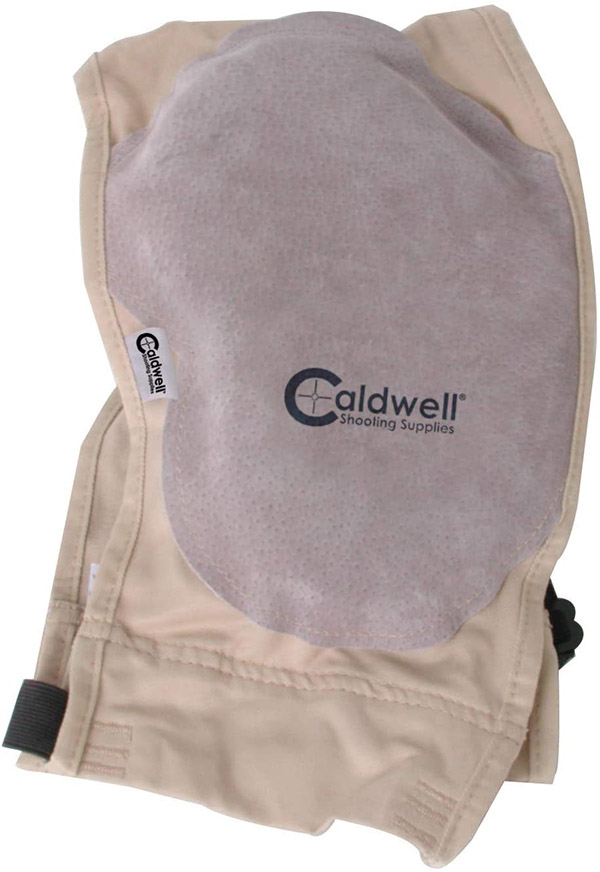
I have a friend who shoots the .300 Weatherby a lot, and he’s about the same size as me. I thought about him a bit, mentally picturing him on the range, and then I realized: He uses a shoulder pad. It was a click or two on Amazon until I found the Caldwell recoil shield.
I had the Caldwell recoil shield the next day, and I had to play with it a bit to find how to wear the thing. I bought the thickest version, figuring that if some is good, more would be better.
I next researched the Internet to find ways to improve my bench rest technique and I immediately found two improvement opportunities: Parallax, and how I positioned the rear rest.
With regard to parallax, it’s a real thing and a real issue. Most scopes don’t have any adjustment for parallax, but the 4×16 scope I have on the Mark V does. To adjust for parallax, you set the rifle in the rest and put the cross hairs on the target. Then, without touching the rifle, you move your head around and see if the reticle moves around on the target. On a scope with parallax adjustment, what I read is that you ignore the markings on the parallax adjustment and move your head around, adjusting the parallax adjustor until the parallax is minimized. I couldn’t completely eliminate the parallax on my 100 yard target, but I was able to greatly reduce it. After making the adjustment I looked at the scope objective (the parallax adjustment feature), and what do you know, it was right on the 100-yard mark. I guess those Weaver boys knew what they were doing.
I had a rifle with me that has a non-parallax-adjustable scope and checked it for parallax at 100 yards, and wow, when I moved my head around the reticle was moving around a good 3 inches on the target (left to right, and up and down). To control parallax with a non-parallax-adustable scope, the trick is to get your eye in exactly the same spot every time. In fact, that’s good technique with any scope.
The next thing for me was to get the rear rifle rest directly under where my face rested on the stock. You can see the front and rear rest in the large photo at the top of this blog (I use Caldwell equipment). The idea behind getting the rear rest directly under where your cheek contacts the stock is that the downward force from your cheek is transmitted directly through the stock into the rear rest without flexing the stock. It may not seem possible (or even detectable), but if your face is ahead of the rear rest or behind it, you will impart a torque into the rifle and it can be enough to shift the point of impact at 100 yards.
On to my loads: I reloaded the next set of .300 Weatherby cartridges, going with 73.0 grains of IMR 7828, the CCI 250 magnum primer, 200-grain Sierra MatchKing bullets, and every trick I knew of to improve accuracy. This is a relatively light load. I neck sized three different sets of brass (fireformed .300 Remington cases made from .300 H&H brass, Remington .300 Weatherby brass, and Weatherby brand .300 Weatherby brass). I have a Lee .300 Weatherby collet die that squeezes the neck down to size, and I used brass I had previously fired in the Mark V rifle. I also seated the bullets out much further (the reloading manuals all show the cartridge overall length to be 3.560 inches, but I seated the Sierras out for an overall length of 3.718 inches). The Weatherby Mark V rifles have a lot of freebore. The cartridges still fit in the magazine and the bullets did not contact the rifling, so I was good to go.
It was a quick trip to the West End Gun Club and I had the range to myself. I got everything set up, pulled on the Caldwell shoulder pad, and went to work. The Caldwell shoulder pad was awkward at first (as you might imagine), but it was wonderful. The .300 Weatherby Magnum is still a beast, but the Caldwell pad did its job. It greatly alleviated my fear of getting clobbered every time I squeezed the trigger and my groups tightened up immediately.
So my groups were way better, but I had a new problem. Many of the cases were sticking in the chamber after firing. The bolt would rotate freely, but the cases didn’t want to come out. When I pulled harder on the bolt, the extractor popped over the rim and the case stayed in the chamber. I had to tap the cases out with a cleaning rod. Other than the cases sticking, there were zero indications of excess pressure. No flattened primers or anything. The Remington cases were sticking almost 100% of the time (both the fireformed .300 H&H cases and the .300 Weatherby Remington cases). The Weatherby brass did not stick in the chamber, although a couple felt like they wanted to.
On to the good news: My best group was a .608-inch 3-shot group at 100 yards, which ain’t half bad on a fire-breathing monster like the .300 Weatherby. Before you trolls tell me I should shoot 5-shot groups, I will share with you that in my experience it’s pretty difficult to get animals to sit still for five shots. If your dead set on being critical, let’s get your butt out here. I want to watch you shoot 5-shot groups with your .300 Weatherby.
The next morning, after cleaning the rifle, I rechambered a couple of the fired Remington cases, and then when I withdrew the bolt the cases stuck in the chamber again. And again, I had to tap them out with a rod. The Weatherby brass did not, but it was tight. I measured each of the cases that stuck, and they all met the SAAMI .300 Weatherby specification. My conclusions are:
I don’t have an excess pressure situation. I loaded at the bottom of the propellant range, the bolt rotated freely, there were no pressure signs on the case base, and the primers were not flattened.
Neck sizing on my .300 Weatherby Mark V is not a good way to go (notice I said mine; your mileage may vary). I full length resized one of the cases that stuck (a Remington case) and it chambered and extracted easily. Weatherby brass is better (but it is hard to get).
I need to full length resize when reloading for this rifle.
The Weatherby Mk V extractor is weak. For a dangerous game rifle, that’s not a good thing. Maybe the extractor spring is weak.
I think the real issue was the neck sizing approach. I’m out of IMR 7828 propellant (powder goes fast with the 300 Weatherby) and no one seems to have any in stock, so I’ll try either H1000 or IMR 4831 next. Like we always say, stay tuned.
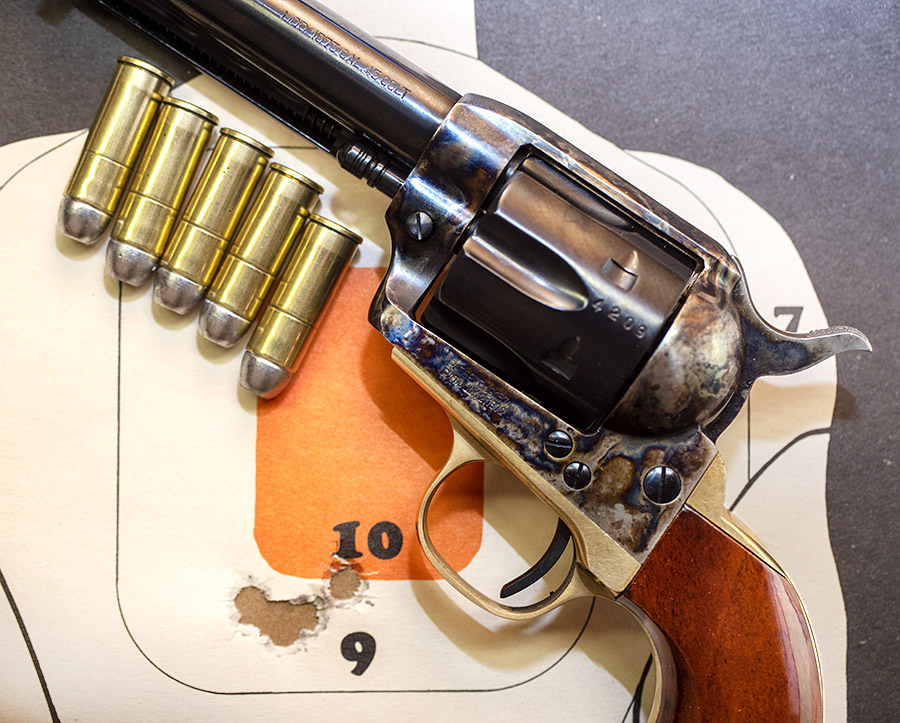
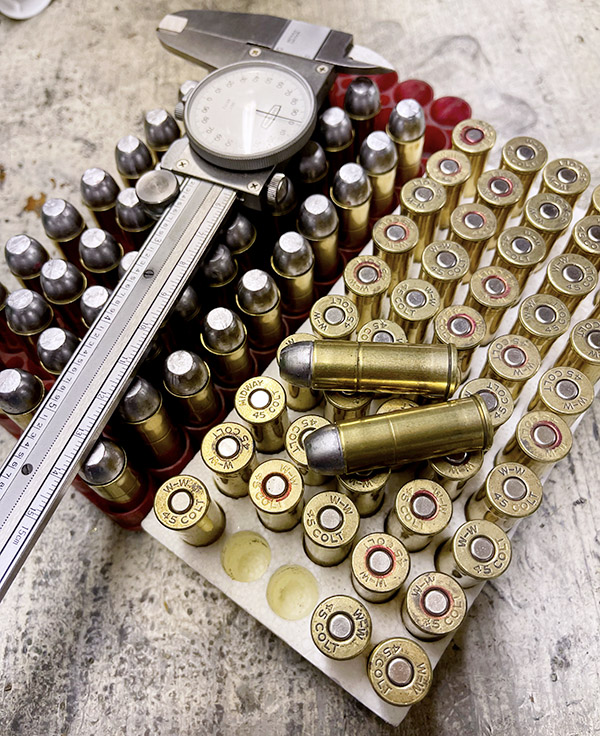
That would be my tuned Taylor Uberti in .45 Colt, the Italian Stallion Single Action Army revolver that has graced these pages in a few earlier blogs. It was a good day…a couple of my good buddies stopped by with brass they didn’t want (including the ultra-tough-to-get-these-days .45 Colt), and I was hard at it on the reloading bench shortly thereafter. My go to fun load in .45 Colt is 6.4 grains of Trail Boss, a 200-grain cast bullet (in this case the truncated roundnose thrown by the Lee mold, although just about any 200-grain semi-wadcutter works equally as well), and a crimp for an overall cartridge length of 1.595 inches. It was 5 shots at 50 feet, and I was putting them pretty much into one ragged hole just about exactly at my point of aim. You just gotta love a good Single Action Army revolver…I sure do!
Keep us in components…please click on the popup ads!
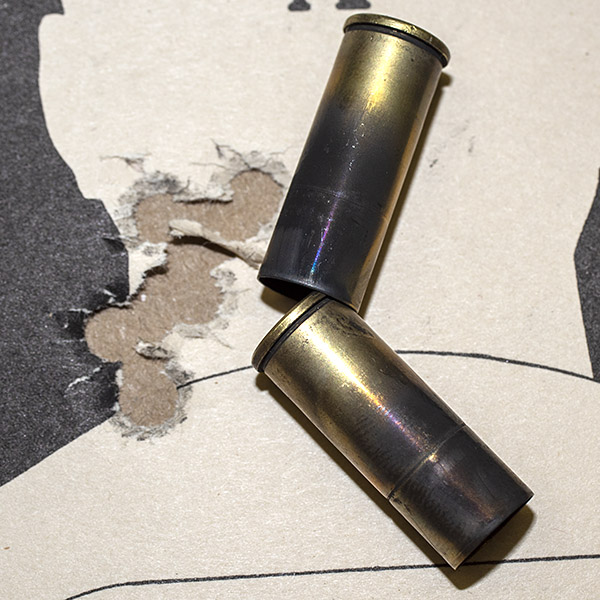
About the only thing I don’t like about Trail Boss powder is that it doesn’t obturate well, although you wouldn’t know it from the accuracy this load delivers. Trail Boss soils the cases and they take longer to come clean in the tumbler, but it’s a small price to pay for this kind of accuracy.
The nice thing about the Trail Boss load mentioned here is that it shoots just about to point of aim for me at 50 feet. Another nice thing is there’s almost no recoil…this load in a Single Action Army is a real powder puff. Yeah, I could go hotter, but what would be the point?
I love the Ruger Mini 14 and I’ve written several blogs on it (I’ll give you a link at the end of this blog). The Mini 14 is not the most accurate rifle I’ve ever shot, but there’s something about it that just makes it fun. I think if Ruger had introduced the Mini 14 a few years earlier it might have been the next US service rifle instead of Mattel’s M-16. That statement might get a few trolls’ shorts in a knot, but hey, they’re young. They’ll get over it.
Photos from the original GunBroker.com ad for my Mini 14. It was a limited production item with a Circassian walnut stock. Very few had wood this highly figured.
I took my Mini to the West End Gun Club a couple of weeks ago to see what impact (if any) a new Lee factory crimp die had on accuracy. Usually when I reload rifle cartridges with jacketed bullets I don’t crimp. Part of this is because it’s a bit difficult to get a consistent crimp if the brass is not trimmed to exactly the same length, and part of it is I often find I don’t need to trim my brass to get good accuracy. That’s not to say case neck tension isn’t critical (it is; lube a couple of bullets before seating them and see how far out of the group they print). But it you don’t crimp, you rely on friction between the case neck and the bullet to control the case’s grip, and friction is a tough thing to control. Crimping should make the grip on the bullet more consistent (or so the theory goes). Crimping is also thought to provide more complete combustion, reducing pressure variability and the inaccuracies associated with it.
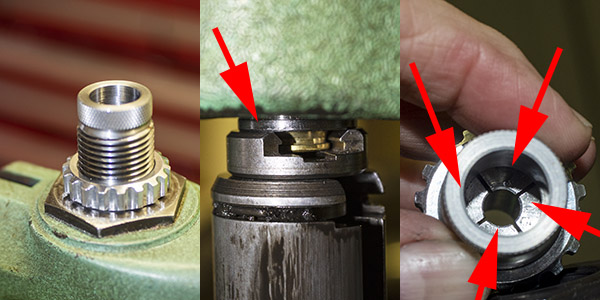
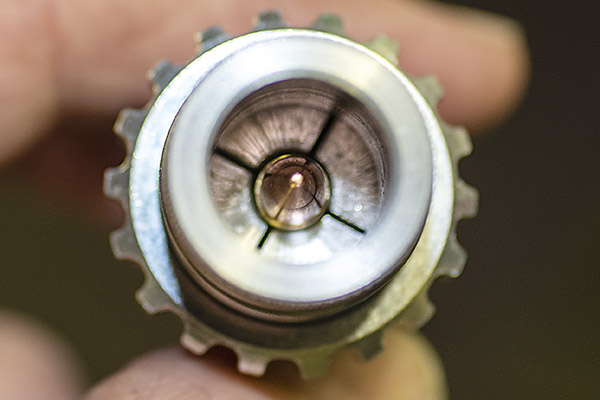
Conventional reloading dies rely on a reduced diameter in the bullet seating die, which rolls the case mouth into the bullet to achieve a crimp (such a crimp is called a roll crimp). Lee’s factory crimp die uses a different approach. It has four collets (each forms a quadrant) that work at 90 degrees to the case to crimp the brass. The collets are activated by the die’s base during the reloading press upstroke.
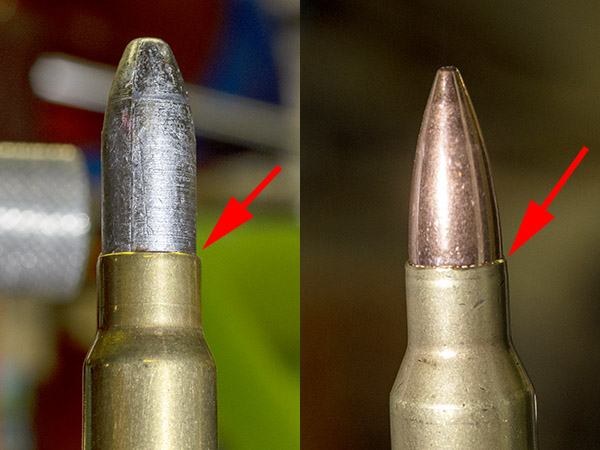
A .223 Lee factory crimp die. This is the last step in the reloading process. The die is screwed into the press after the bullet has been seated to the desired depth (left photo); the amount the die is screwed into the press controls the interface between the shell holder and the die (center photo). When the ram is fully raised, the die has collets that compress the brass horizontally around the case mouth (right photo), thereby crimping the bullet in place in the same manner as factory ammunition.The view from above. The collets squeeze the brass around the bullet to crimp it in the case.A 7.65x53mm Belgian Mauser round with a cast bullet roll crimped in place (left), and a .223 Remington/5.56mm NATO cartridge crimped with the Lee factory crimp die. The difference is subtle, but you can see it if you look closely.
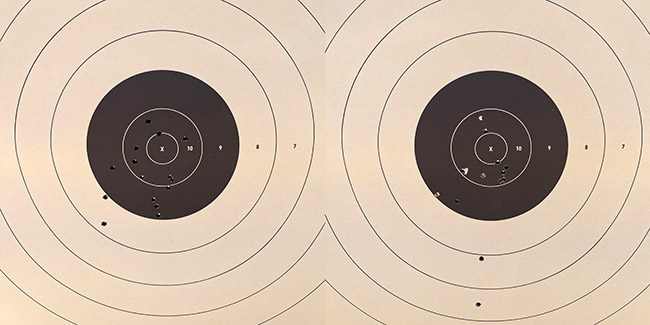
I loaded 15 rounds crimped in the Lee factory crimp die, and I used another 15 rounds without the crimp. I shot two targets at 100 yards from a rest using iron sights, with 15 rounds for each target. The target on the left is with no crimp, the one on the right is with the Lee factory crimp die (and I used a heavy crimp). The brass was fireformed in this rifle and neck sized only to get a good fit in the Mini 14’s 5.56 NATO chamber, which (as you know) is slightly larger than the .223 Remington cartridge. In prior load development work, I found that neck sized only brass is much more accurate in the Mini 14.
15 uncrimped .223 rounds at 100 yards (left target) and 15 rounds crimped with the Lee factory crimp die (right target).
The first five shots using uncrimped reloads all went into the left target’s 10-ring, so I thought I was doing pretty well. Then I switched to the Lee factory crimp die ammo on the right target. The first shot felt weird, and it did not fully extract. I think it was the one that went way low. The next four all went into the 10 ring. On the next five rounds (again, using the Lee die ammo on the right target), the first one did the same thing (it failed to extract and it went low). I fired one more magazine of Lee crimped ammo and all five worked okay.
Somewhere in those first two magazines of the Lee crimped ammo, I had two light primer strikes that did not fire. I extracted and chambered them again and they fired on the second attempt. I didn’t know why those two rounds had light primer strikes. Maybe the round had not fully chambered? Maybe because the Lee factory crimp die distorted the case mouth or something and it didn’t fully chamber? Or maybe something was interfering with the firing pin’s travel? I didn’t know and I wouldn’t find out until I disassembled rifle.
Then I fired 10 more uncrimped rounds at the target on the left and I had one failure to eject. My Mini 14 sometimes acts funny like that with the neck sized brass. It’s not a duty gun, so I thought I could live with an occasional failure to eject. But I don’t like it.
So back to those misfires. In the past, I’ve had to clean debris from around the firing pin, and it looked to me like it might be time to do that again. That could account for the two light firing pin strikes I had.
One other thing…I had painted the front sight with red nail polish, and that actually made the front sight’s top edge harder to see. I want to go back to the plain blued front sight.
I also want to adjust the Lee factory crimp for less of a crimp. These first rounds used a max crimp. I didn’t trim the brass for this test because it was only fired once, but I don’t know how even (in length) it was. I used bulk Remington loaded ammo to get the brass (having fired it previously in the Mini 14) because a couple of years ago that stuff actually cost less than unprimed brass. But inexpensive bulk ammo is not precision made and I suspect the case length had some variation (my suspicions were later confirmed, as you’ll read below).
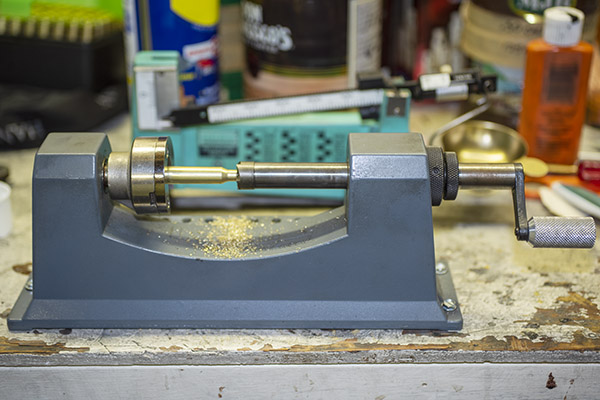
A Lyman case trimmer I’ve been using for nearly 50 years. The Lee factory crimp die does not require case trimming, but the cases had enough length variability that I decided to trim them anyway. Cases that are too long can interfere with the bolt fully closing and raise chamber pressures.
When I reloaded the rounds fired in this test, I checked a few case lengths after neck sizing. The “trim to” length (per the Hornady manual) is supposed to be 1.750 inches, with a max case length of 1.760 inches. These cases (after two firings and neck sizing) were all over the map. They ranged from 1.752 to 1.780. That alone could account for some of the anomalies described above. I ran them all through the trimmer and reloaded a hundred for the next range visit. I backed off a bit on the Lee factory crimp die, too, as my good buddy Robby suggested.
I gave the Mini 14 a good cleaning and I was surprised at how filthy it was. This is not a rifle that I clean religiously…I’ll shoot it on several outings before cleaning (heresy, I know, but hey…it is what it is). I wanted to grab a few photos of what a funky Mini 14 can look like, but my hands were so dirty and greasy I didn’t want to handle my Nikon camera. After the most recent range visit, I Hoppes No 9’ed the Mini 14 bore for a couple days to get all the copper out (you know, until the patches came out with no green).
There were bits of what appeared to be very thin sheet brass in the bolt around the firing pin as well as a whole bunch of greasy carbon residue in the bolt. That could account for the couple of misfires. Removing the firing pin is not an easy job (it takes a special tool I don’t have or want); the drill here was to shpritz the hell out of the bolt with carb cleaner and work the firing pin back and forth to push the nasty stuff out. The thin brass bits might have been primer cup material. Or they might have been chips from the extraction operation that found their way into the bolt and were peened flat. There’s no way of telling, as some of that ejected brass ends up in the next county (a trait Mini 14s are famous for). By the way, when you’re working with that carb cleaner, you need to do it outdoors where there’s plenty of fresh air. It’s highly flammable and if I use that stuff indoors, I get lightheaded and nauseated pretty quickly.
There was a lot of carbon gunk in the stock channel clear back into the action. There was also a lot of carbon in and on the guide rod, as well as around the extractor. This could account for the occasional failures to eject. I blew it all out with WD 40 (in the stock) and carb cleaner (for the metal pieces). There was so much carbon residue in the stock’s barrel channel that I thought I might have a leak around the gas port, but I didn’t see any carbon residue around the gas port and I’ve got the Allen bolts around that part tightened as tight as I dare go. I tried the smaller diameter aftermarket gas ports last year, but every one of them gave me unreliable function, so I went back to the stock port.
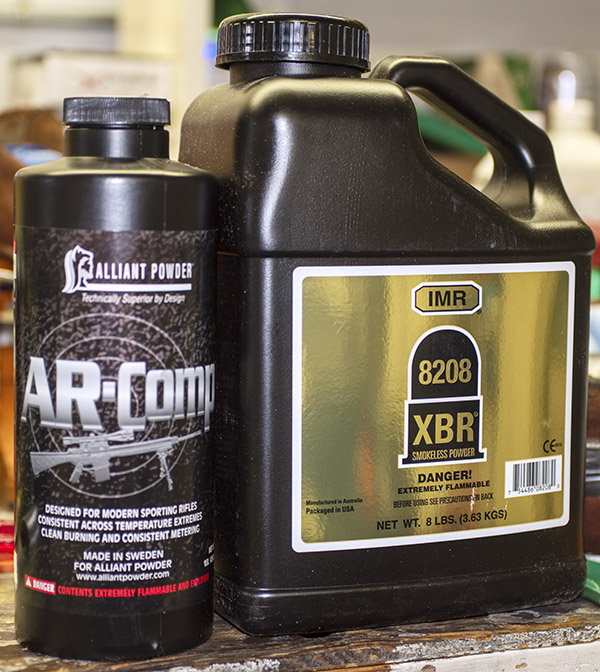
I’ve got a little more than a pound of ARComp, and that has been my “go to” Mini 14 powder for several years. When things started to get tight last year, my reloading outlet had an 8-pound bottle of XBR 8208 (it was the last bottle of anything he had). I had never heard of that powder before but I figured it would work in something, and in poking around on the Internet I found that 8208 gets the nod as a great powder for the .223 cartridge. The hundred rounds I just loaded are with ARComp, but I think I will do another 100 or so with different 8208 charges to see how they do. I’ve still got several hundred 62-grain Hornady full metal jacket bullets and I have another 500 55-grain bullets that just arrived from Midway. And I have small rifle primers and a potful of .223 brass. Unlike a lot of folks, I’m in good shape for .223 for a while (and no, I don’t want to sell or trade any components).
What’s the bottom line to all this? Did the Lee factory crimp die improve accuracy? The short answer is: I don’t know yet. I think it does, but I had too many other things going on with the rifle and the brass to be sure. If you ignore the first two rounds that went low, I think the accuracy edge goes to the Lee crimped ammo. Bear in mind that I was shooting with iron sights at 100 yards, so the differences may be more due to me than anything else. There were only four rounds outside the 10 ring with the Lee ammo; the uncrimped ammo had six rounds outside the 10-ring. But again, it’s iron sights at 100 yards, so who knows?
I’m going to share this post on Facebook, and you can bet some yahoo will tell me that he shoots 1/2-inch groups at 200 yards with open sights on his Mini 14 all day long. Hey, it’s the Internet. You have to ignore those buttheads. As far as the Lee factory crimp die’s accuracy edge goes, I think it’s real. I’ll find out for sure (maybe) the next time I go to the range. Everything in the Mini is clean, lightly oiled, and ready for action. We’ll see what happens on the next outing, and you’ll read about here on the ExNotes blog.
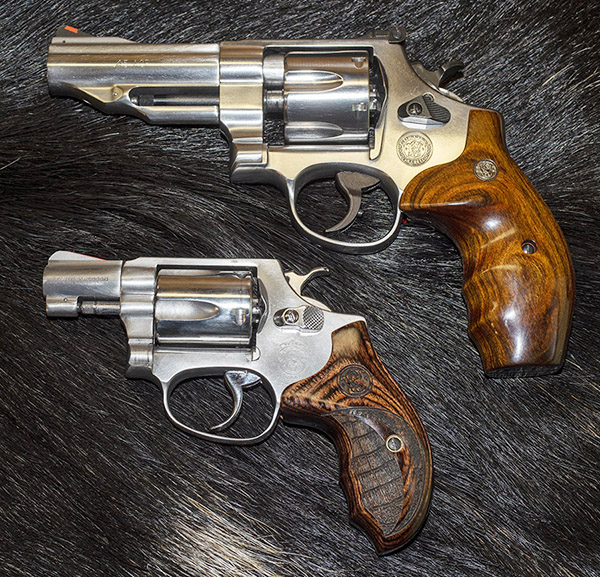
When I first posted about the Model 60 load development plan and the Altamont grips I bought from good buddy Paul, the cover photo showed my recently-acquired Model 60 snubbie and a Smith and Wesson Performance Center Model 625 I’ve owned for years.
The Model 625 and the Model 60.
I like that photo because the two stainless steel Smiths look great on the wild boar skin. That skin is from a pig hunt Paul and I did in Arizona a few years ago.
The earlier blog was about finding an accuracy load for the Model 60, but a few people wrote to ask if I had a favorite load for the Model 625. I do: My usual accuracy load for the 625 is a cast 200-grain cast semiwadcutter bullet (sized to .452 inches) over 4.2 grains of Bullseye.
When I went to the range to run a few rounds through the 625 I picked a box of ammo I had reloaded in 2014. It was different than my usual accuracy load. I used the same bullet (a 200-grain cast semi-wadcutter), but instead of Bullseye I had loaded these over 6.0 grains of Unique. And instead of .45 ACP brass in star clips, I used AutoRim brass. This is the load I fired that 6-shot group you see in the cover photo above for this blog, and it’s a honey. The group, that is…not the photo (it’s hard to get true colors when using an iPhone in the shade). I shot at 50 feet while standing…there’s no rest for the Model 625 or the weary.
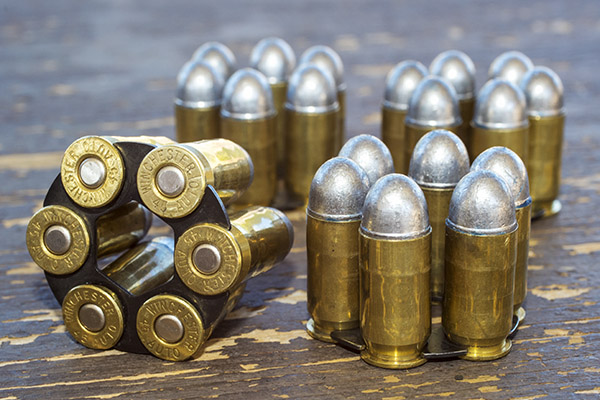
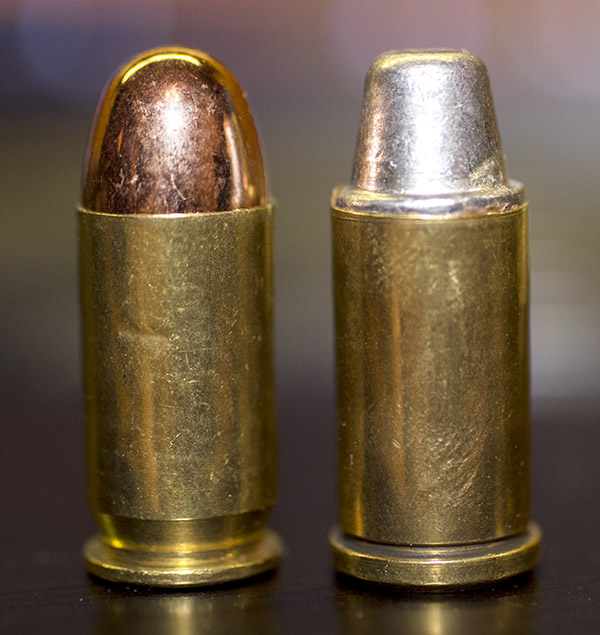
.45 ACP cartridges in star clips for the Model 625. These are loaded with 230-grain cast roundnose Missouri bullets.The .45 ACP cartridge (left) and the .45 AutoRim cartridge (right). The AutoRim cartridge is designed for use in the Model 625 without star clips. The ACP cartridge has a 230-grain roundnose Xtreme bullet; the AutoRim cartridge has Missouri’s 200-grain semi-wadcutter.
The AutoRim brass is in the tumbler as I write this and when I reload it I’m going to go with the same load: The 200-grain cast semi-wadcutter over 6.0 grains of Unique. It seems to be working for me.
Help keep us afloat: Please click on the popup ads!
Never miss an ExNotes blog: Sign up here for free!
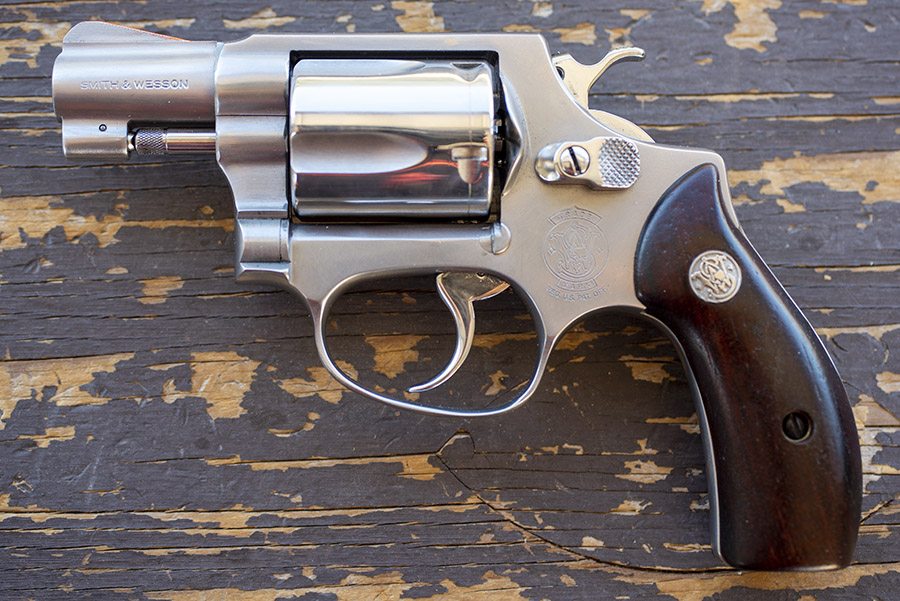
This blog outlines the development plan I’m using for my new-to-me Model 60 Smith and Wesson revolver. You might recall that I bought this revolver not too long ago and I had my good buddy and master pistolsmith TJ (of TJ’s Custom Gunworks) go through the gun, get everything perfect, do the trigger, and add a bit of tasteful polishing.
My custom Smith and Wesson Model 60. Note the polished ejector rod, cylinder, trigger, cylinder release, and hammer, and the smooth rosewood grips.
TJ did a hell of a job, I recently qualified with the Model 60 for my concealed carry permit, and now I want to find the most accurate load for this handgun. To me this means two things: The smallest group size and where the revolver hits with respect to the point of aim. I’m not concerned with velocity. All the velocity in the world doesn’t mean a thing if you can’t hit your target.
When I develop a load, I generally do a bit of research on the Internet to see what others have found to be an accurate load, I see what components I have on hand (bullets and powders), and I consult my reloading manuals. I never take loads off Internet forums as gospel unless I confirm their safety in my load manuals or they come directly from the manufacturer’s websites (there is just so much inaccurate information on the Internet), and I never load at the manual’s max without working up to that level. My approach is to load a few rounds at the minimum level and a few a bit below the max level with each bullet and powder combination to get a quick feel for further load development. Or, I might find a combination in the initial tests that is so good I don’t need to do any further testing.
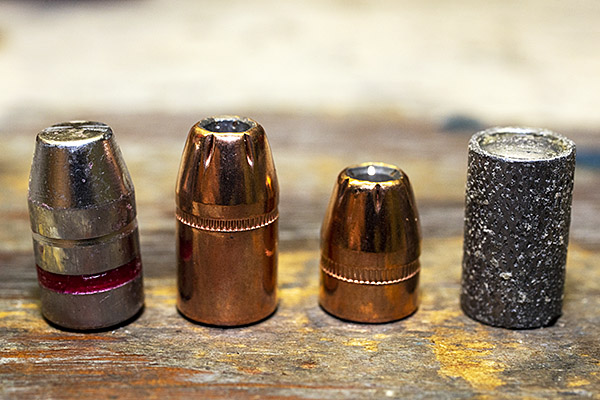
From left to right: 158-grain cast flatpoint, Hornady 158-grain jacketed hollow point, Hornady 110-grain jacketed hollow point, and Hornady 148-grain swaged wadcutter.
These days, I’m governed by what I have on hand, as the component suppliers are out of nearly everything. For me and this test series, that means four bullets:
A 158-grain cast flatpoint bullet from a local caster
Hornady’s 158-grain jacketed hollowpoint
Hornady’s 110-grain jacketed hollowpoint
Hornady’s 148-grain swaged wadcutter
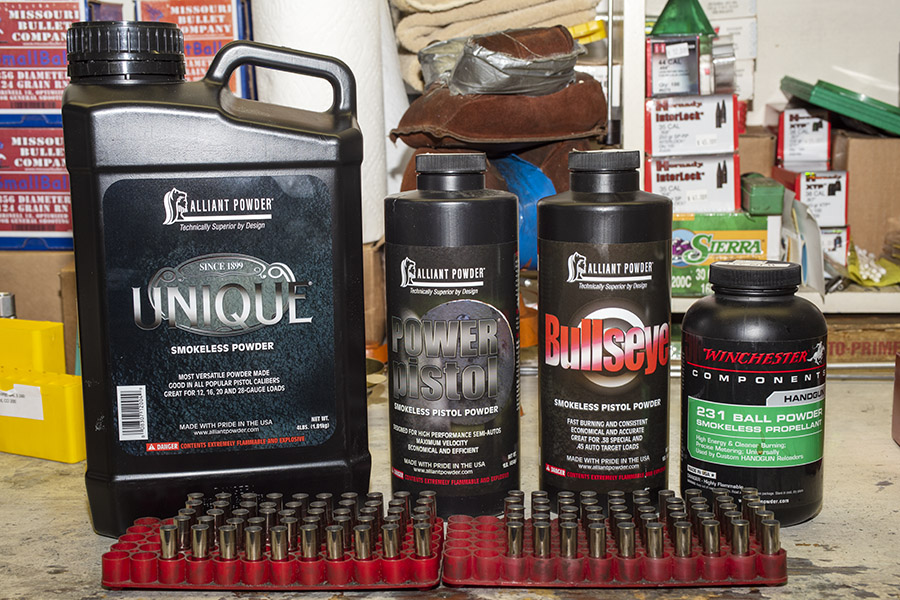
All are shown in the photo above. My powders include Winchester 231, Unique, Bullseye, and Power Pistol (as seen in the featured photo at the top of this blog).
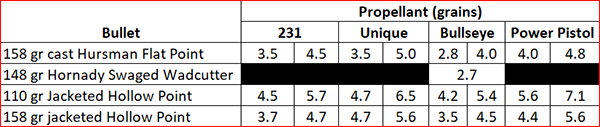
Here’s what the test plan looks like:
I’m going to test at 50 feet and fire two groups of three shots each for each combination. That will keep the total number of rounds fired to a manageable 150 rounds. It’s a quick look at what works and what doesn’t.
You might notice that I’m only going to test one load with the 148-grain wadcutter bullet. That’s because it’s been the known accuracy load for years, and it’s also because it’s what I have my Star progressive reloading press set up to make. Stated differently, I’m not going to change this load because it’s my standard wadcutter load, and the Model 60 will either do okay with it or it won’t. I already know this load shoots significantly to the right of my point of aim in the Model 60, but I’m including it here because I have the ammo and it’s easy to include in this test series.
That’s the plan. I’m reloading the ammo as you read this, and I’ll have it tested most likely next week. Watch the ExNotes blog for results in the near future.
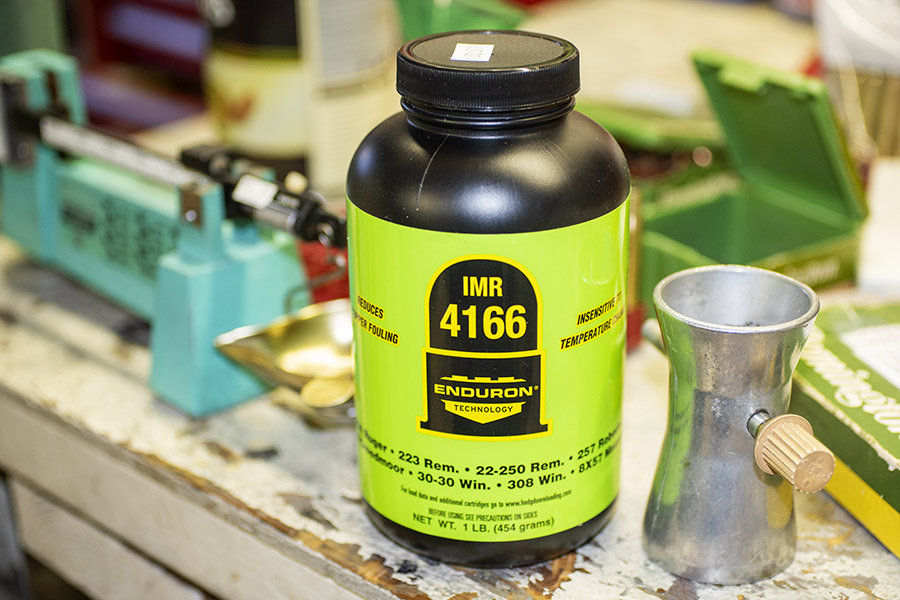
Necessity is the mother of invention, or something like that. When I heard that IMR 4320 was discontinued (on top of the ammo and components shortage), I was not a happy camper. IMR 4320 was my go to powder for several cartridges, and now what I have left is all there is (and it’s almost gone). But it really doesn’t matter, because we can’t hardly find propellants of any flavor. That notwithstanding, I made the trek to my local components supplier a couple of weeks ago, and he had only three propellants left: IMR 4166, 8208, and BLC2. I’ve never used any of these, although I had heard of Ballsy 2. The 4166 seemed interesting…it matched my motorcycle jacket, but none of my reloading manuals had any data for it (it’s that new). I bought all three.
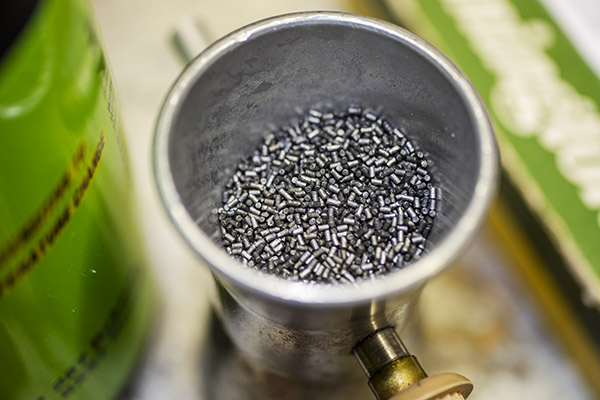
I went online and found data published by the manufacturer, so I worked with that for my 30 06. IMR 4166 is an extruded stick powder. It will flow through a dispenser, but the dispenser throw variability was about 0.2 grain, and that’s enough when loading for rifle accuracy that I’ll weigh every charge with my scale and trickle it in with my RCBS powder trickler.N Would 0.2 grains make an accuracy difference? I don’t know (and someday I’ll test to find out). I suspect not, but weighing every charge only takes a few seconds more, and it seems like the right thing to do.
IMR 4166 is a stick powder that looks like any other stick powder. It’s in a powder trickler in this photo. Yeah, I weigh the powder for every cartridge.
On the IMR website, it said that Enduron IMR 4166 is one of a new class of propellant that offers four adventages:
Copper fouling reduction. These powders contain an additive that drastically reduces copper fouling in the gun barrel. Copper fouling should be minimal, allowing shooters to spend more time shooting and less time cleaning a rifle to retain accuracy. Hmm, that might be interesting. We’ll see how it does, I thought to myself as I read this.
Temperature change stability. The Enduron line is insensitive to temperature changes. Whether a rifle is sighted in during the heat of summer, hunted in a November snowstorm or hunting multiple locations with drastic temperature swings, point of impact with ammunition loaded with Enduron technology will be very consistent. In the old days, I might have dismissed this as a solution looking for a problem, but I’ve experienced what can happen in a temperature sensitive powder. I had a max load for my 7mm Weatherby that was fairly accurate that I took out to the range one day when it was 107 degreees. I fired one shot and had great difficulty getting the bolt open. It’s a real issue if you develop a load at one temperature and then shoot it at an elevated temperature. If IMR 4166 is free from that characteristic, that’s a good thing.
Optimal load density. Enduron powders provide optimal load density, assisting in maintaining low standard deviations in velocity and pressure, a key feature for top accuracy. Eh, we’ll see how it does on paper. I have some loads that are low density (i.e., they occupy well under 100% of the case volume) and they shoot superbly well. I’m interested in how the load groups. The target doesn’t give extra credit if an inaccurate load has a low standard deviation.
Environmentally friendly. Enduron technology is environmentally friendly, crafted using raw materials that are not harmful to the environment. Okay, Al Gore. Gotcha. Now go back to inventing the Internet.
My test bed for the new powder would be a Model 700 Euro in 30 06, a 27-year-old rifle I bought new about 10 years ago. I had just refinished it with TruOil and glass bedded the action (a story a future blog, to be sure), and I hung a cheapie straight 4X Bushnell scope just to get a feel for how everything might perform.
The Model 700 Euro had a tung oil finish. The rifle was only offered in 1993 and 1994. The tung finish didn’t do it for me, so I did my usual TruOil finish. That’s an old Bushnell 4X economy scope up top.
My load was to be a 180-grain Remington Core-Lokt jacketed soft point bullet and 47 grains of the IMR 4166, all lit off by a CCI 200 primer. If you’re interested, I was using Remington brass, too. The cartridges were not crimped.
Loaded 30 06 ammo with the Remington 180-grain jacketed soft point bullet.
Wow, those 180-grain bullets pack a punch. Recoil was fierce, and I probably felt it more because the Model 700 doesn’t have a recoil pad.
Okay, that’s enough about my heroics. Let’s take a quick look at how the propellant performed. With regard to the reduction in copper fouling claim, I’d have to say that’s an accurate claim. After 20 rounds (the very first through this rifle), I ran a single patch with Hoppes No. 9 though the bore, followed by a clean patch, just to remove the powder fouling. There was a very modest amount of copper fouling, way less than I would have seen with any other propellant. Ordinarily, at this point in the cleaning process (i.e., removing the soot) I would normally see a bright copper accent on top of each land. With 4166, there was only a minimal amount of copper present (as you can see below). After a second patch with Hoppes No. 9, the copper was gone. I guess this copper fouling eliminator business is the real deal.
This is a brand new rifle even though it’s nearly 30 years old. Check out the machinings inside the bore. Remington, for shame!
With regard to accuracy, 4166 has potential. I shot five targets that afternoon, and this was the best. It’s a 0.590-inch group at 100 yards, and that ain’t too shabby.
Sometimes you just get lucky. Other times you rely on careful load development, glass bedding, and a steady trigger squeeze.
The bottom line for me is that IMR 4166 is a viable powder. Now, like everyone else, I need to find more. That’s going to be a challenge. But at least I know that my IMR 4320 has a decent replacement.
The Colt Python is an iconic handgun that stands out as the pinnacle of the gunmaker’s art. They were originally offered by Colt as their premier .357 Magnum revolver in a run that spanned decades and offered several variants: Blue steel, nickel-plated steel, brushed stainless steel, bright stainless steel, and barrel lengths of 2 1/2, 4, 6, and 8 inches. For a brief period, they even offered one chambered in .38 Special only. That all ended a few years ago when the revolver market subsided and black plastic, semi-auto 9mm gangbanger guns held sideways took over the silver screen (there’s absolutely no accounting for some folks’ taste, I guess). Then, in a surprise move, Colt introduced a re-engineered Python last year, in stainless steel only, with either a 4 1/4-inch or 6-inch barrel. I had to have one, and about a month ago, I scratched that itch.
The new Python carries a hefty $1499 price tag and they are just about impossible to find. And when you do see one, it is always substantially above MSRP. I don’t see the prices coming down on these guns, either. The original Pythons sell for $3K or more (mostly more), and with guns in high demand now and for the forseeable future, I think you’ll always always be able to get your money out of a Python if you ever wanted to sell it. I don’t see the prices going anywhere but up, and like I said, it is near-impossible to find a new Colt Python. But I know people in high places, I got a hell of a deal on my Python, and I am enjoying it enormously. Just looking at it is fun.
I went to my gun club a few days ago to shoot the new Python for the first time, and in a word, it was spectacular. I’ll get to that in a second.
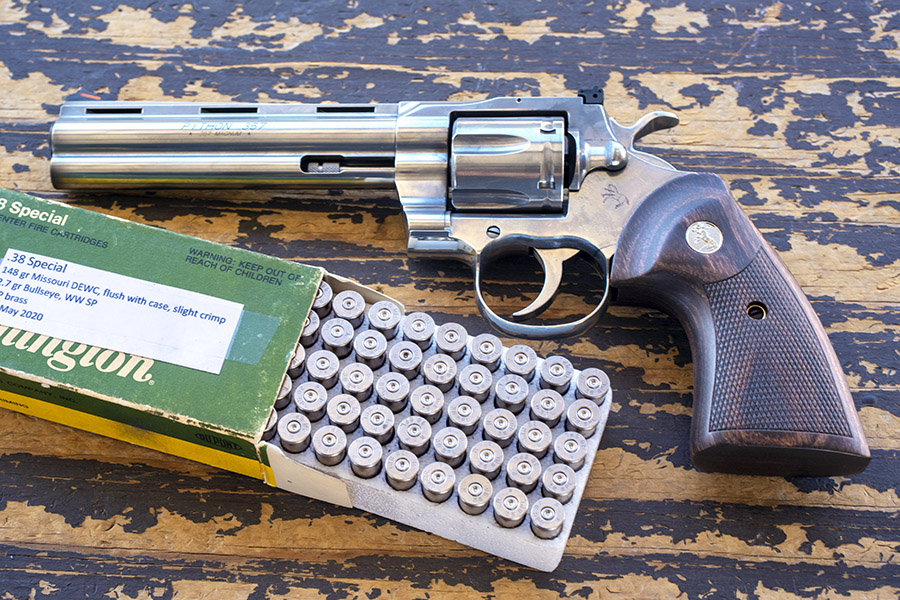
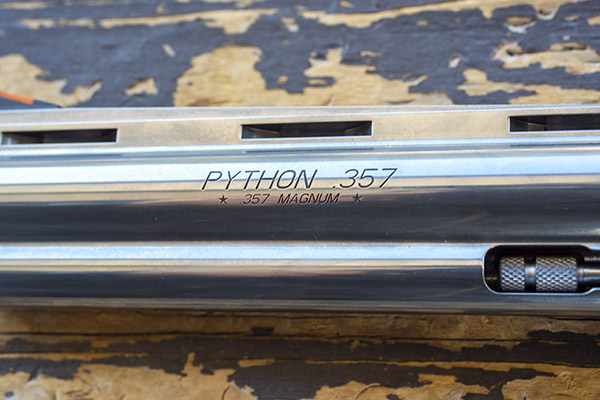
My Python has a 6-inch ventilated rib barrel. The revolver is polished stainless steel and it looks great. The roll marks on the new Python are very similar to the original Pythons. Very classy, in my opinion.
One of the reasons Colt stopped making the original Pythons a few years ago is they were too expensive to manufacture, as they required too much hand fitting of the revolver’s internal components. Colt’s re-engineering effort made all but one internal part capable of being CNC-machined to final dimensions, and in the modern Python hand-fitting is required for only one component. What that did was dramatically improve the double action trigger pull, and somewhat degrade the single action trigger pull. The double action trigger is short and sweet, and the hammer travel is only about half what it used to be. The single action trigger pull is, well, different. Read on, my friends.
Help us keep the content coming: Please click on the popup ads!
Single action, by design on the new Python, has a some take-up and you can actually see the hammer move a little further to the rear when you squeeze the trigger shooting single action. Think of it as a single action trigger that adds a little bit of double action to the dance before it releases the hammer.
I thought there was something wrong with the revolver, but my contact at Colt told me the new Pythons were designed that way to meet the California and Massachusetts drop test requirements. It is definitely not a “breaking glass” single action trigger; it’s closer to pulling the trigger on a Glock (that’s not intended to be a compliment). Double action, though, is absolutely outstanding. It’s a shorter pull than any other double action revolver I’ve ever fired and I like it. I suppose some people might think it’s a good thing that the gun meets the drop test requirements of left-leaning governments. Me? I’d go with Door No. 1 and refrain from dropping my loaded $1499 revolver.
Anyway, the single-action trigger threw me for a loop, but I adjusted to it quickly during a dry firing session. I don’t notice it anymore, and as you’ll see below, it sure hasn’t hurt accuracy.
Fit and finish on the new Python are top notch. You can see that in the photos on this blog, which I shot during and after an extended range session. I probably should have taken pictures before I fired the new Python (when the gun was factory immaculate), but hey, it is what it is.
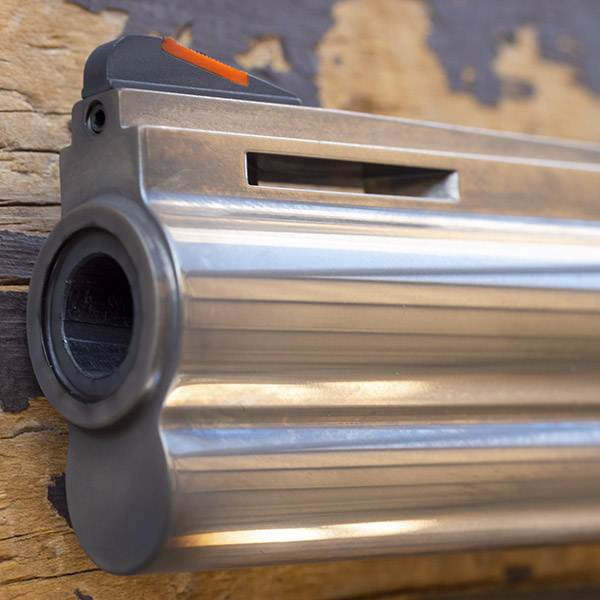
The new Python has a red ramp front sight, which I like. There is no white outline rear sight (it’s plain black). The combination works well, as the targets you see here show. The Python also has a recessed crown, unlike the original one, which was flush. The recessed crown better protects the bore.
My first shots were 50 rounds I put through the gun using my standard .38 Special target load (2.7 grains of Bullseye and a 148 gr wadcutter, loaded on my Star reloader), all fired single action. I shot from the 50-foot line and it was windy as hell. I had to stop a few times to walk downrange and add more staples to the target because it was starting to come loose, and the target stand was swaying toward and away from me as the wind rocked it. I was shooting, literally, at a moving target.
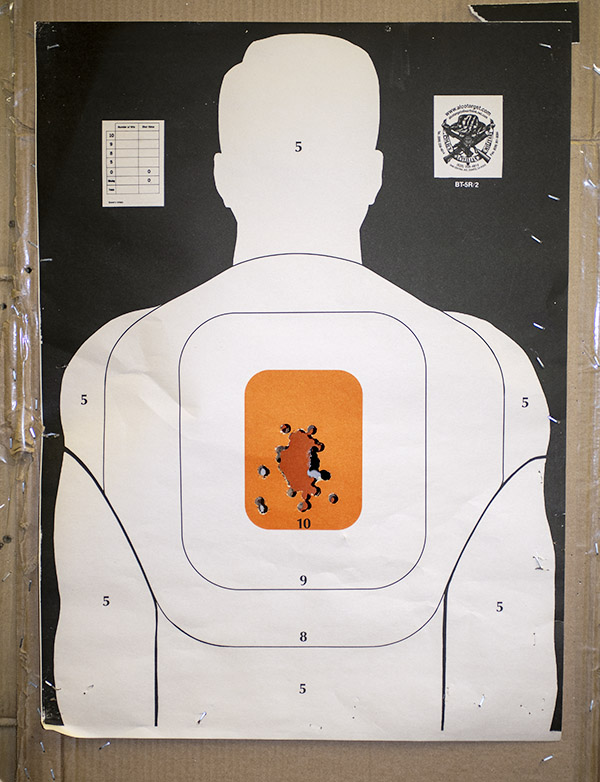
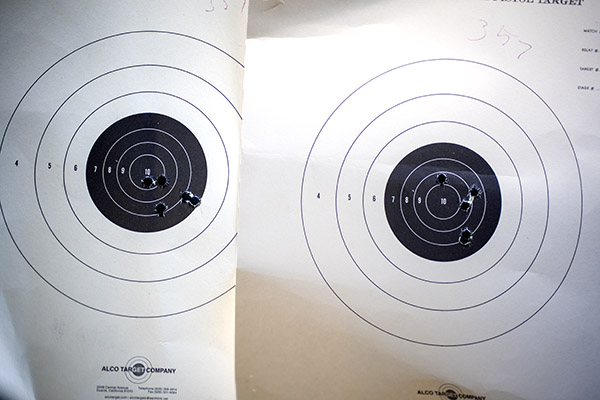
A complete box of .38 Special wadcutter ammo…50 rounds fired at 50 feet firing single action. All those extra staples were needed to keep the wind from tearing the target off the stand.
I was surprised (and pleased) at how stunningly accurate the new Python is. I hadn’t touched the sights, and it was punching holes right where I wanted right out of the box. It put an entire box of ammo into the bullseye with a standard 6:00 hold and the sights left as they came from the factory. That’s a first for me, and I’ve been doing this a long time. The bottom line: The new Python is accurate.
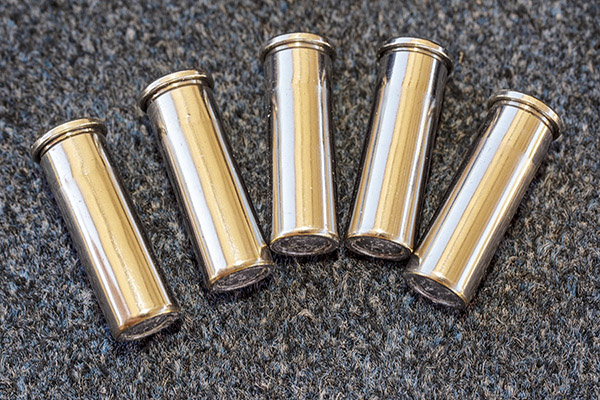
.38 Special ammo loaded with 148-grain wadcutter bullets. The bullet’s “wadcutter” nose profile cuts a clean hole in the target. I used mixed brass shooting the new Python for the first time.
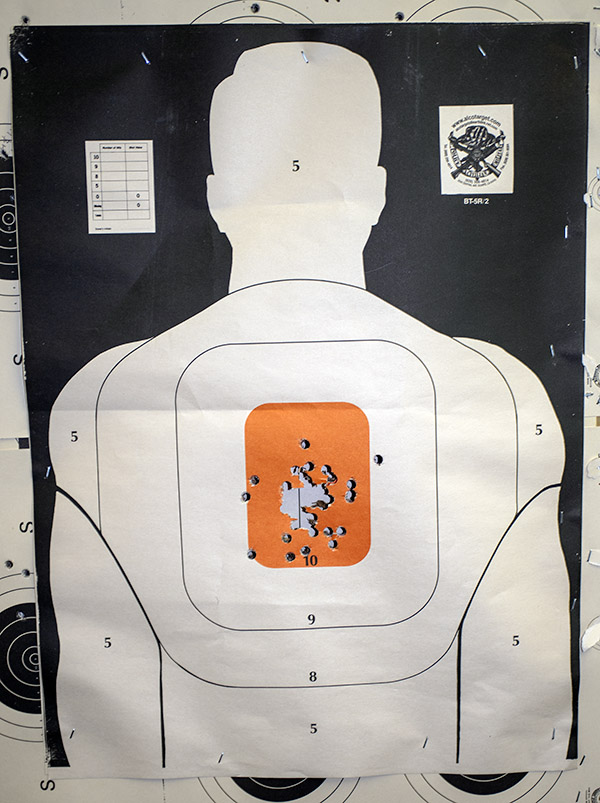
Then I shot another box of 50 cartridges (using the same .38 Special target load I used for the target above), but this time shooting double action. Let me make the point again: These two boxes were the first time I ever fired the new Python. Here’s my second 50 rounds on the target, fired double action.
Another 50 rounds at 50 feet, this time shooting double action. Not too shabby, if I do say so myself. The new Python’s double action trigger is superb.
Eh, one shot went out of the bullseye (it’s that one in the 9-ring, just outside the 10-ring, on the right). Like I said, it was windy out there. But still, for me, this was phenomenal double action shooting. It’s the best I’ve ever done shooting double action, actually.
Then I thought I’d try two 5-shot groups on the 50 foot standard pistol target with .357 ammo (all targets shown here were shot at 50 feet). As you know, a .357 Magnum handgun can shoot either .357 Mag ammo or .38 Special ammo. I brought along some of my standard 357 Magnum reloads (15.7 grains of Winchester 296 powder and a 158 grain Hornady jacketed hollow point bullet). This is a load I’ve been using since my Army days and it does well in any .357 Magnum revolver I’ve ever owned. It came from the pamphlet Winchester published in the 1970s for their powders. It performed superbly well in the new Python.
.357 Magnum shots at 50-foot targets. Point of aim was 6:00 for all shots. Bring it on…fire and brimstone…the new Python handles full power .357 Magnum loads well.
It’s easy to forget how powerful the .357 Magnum cartridge is unless you fire it back-to-back with the .38 Special. The .38 Special is a very manageable cartridge with moderate recoil, especially in a big, heavy, 6-inch handgun like the new Python. When I shot the .357 Magnum loads, I was instantly reminded that the .357 is a real barn burner. Think big recoil and lots of muzzle flash and blast. It was cool, and the big Python handled full power magnum loads well.
As I already mentioned, it was very windy and gusty on the range (two tractor trailers were on their side on I-15 when I drove out to the club). I was the only guy out there (I’m probably the first guy to visit our range with the new Python, too). On a calm day, I’m sure I could do better than the targets you see above.
I finished up another box of .38 Specials shooting 158 gr cast flatpoint Hursman bullets (also loaded with 2.7 gr of Bullseye), shooting at one of those green star target things you throw on the ground (my daughter bought it for me a few years ago and I think the thing is going to last forever). I walked it out to 50 yards with repeated hits, and I’ll bet I didn’t miss but two or three times out of 40 or so rounds.
There were no malfunctions of any kind in the approximately 150 rounds I fired through the new Python. No light strikes, no misfires, and no jams. And like I’ve been saying, accuracy was stellar. It’s almost like the new Python is laser guided.
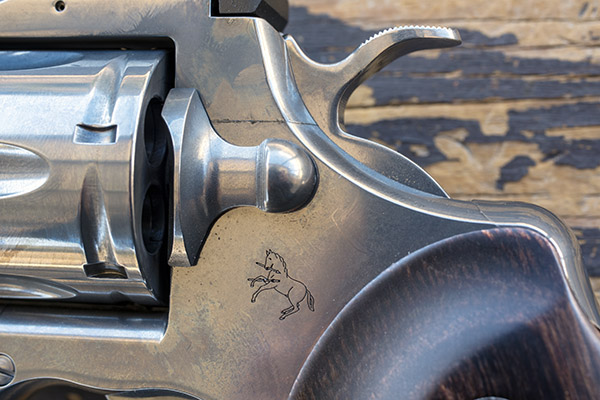
A prancing pony…the rampant Colt logo that has adorned Colt firearms for more than a century and a half. Long may it live!
You know, there’s an old saying: You get what you pay for. To that, I would add the qualifier: Sometimes. In the case of the new Colt Python, this is one of those times. I love the new Python. It’s an iconic firearm and if you are thinking about getting one, my advice is this: Do so. You won’t be disappointed.


 and have them delivered to your door!